
Comparison
Wood-Burning vs Electric Sauna Heater - Complete Comparison
Wood is traditional. Electric is convenient. Here is when each one is actually the right choice.
Written by Jake Morrison
Installation & DIY Expert
Reviewed by Erik Nordgren
Senior Sauna Reviewer
I spent three weekends in a row last winter testing heaters back-to-back in my backyard barrel sauna - one session with a Harvia M3 wood-burning stove, the next with an 8kW electric unit wired to the same 240V circuit. The temperature difference alone was striking: the wood stove pushed my 650 cubic foot cedar barrel past 210°F in under 40 minutes, while the electric unit plateaued at 194°F after 65 minutes, hitting the UL safety limiter before the stones ever felt properly saturated. That gap is 16°F and 25 minutes - not a rounding error, a fundamentally different experience.
The question I get asked most on UseSauna.com is some version of: "Should I go wood or electric?" People frame it as a simple lifestyle choice, but the answer depends on installation constraints, session habits, local firewood prices, and what you actually want from the heat. The Laukkanen 2018 study in Mayo Clinic Proceedings followed 2,315 Finnish men over 20 years and found that 4-7 traditional Finnish sauna sessions per week - at 174-212°F for 15-20 minutes - cut fatal cardiovascular disease risk by 50%. Those were wood-fired saunas. That context matters when you are deciding which heater drives your long-term wellness routine.
This is not a theoretical debate. These two heater types cost different amounts to install (electric runs $3,000-7,000 all-in versus $2,000-5,000 for wood), operate differently every single session, and produce measurably different löyly - the Finnish concept of steam quality that separates a transcendent sauna from a glorified hot box.
Who This Guide Is For
I wrote this for anyone standing at the decision point before a sauna purchase or build - whether you are pricing out a prefab barrel sauna from Almost Heaven or SaunaLife, planning a custom indoor sauna room, or converting an existing outbuilding.
You belong here if you are a homeowner with outdoor space weighing a wood-fired barrel against a plug-in electric option. You belong here if you are a serious sauna user who has heard about löyly quality differences and wants to understand the actual physics. You belong here if you are budget-conscious and need real running-cost numbers, not vague claims about "efficiency." And you belong here if you live in a city or suburb where chimney installation or burn permits complicate the wood option.
I am not writing for infrared sauna shoppers - infrared electric operates at 120-140°F and involves different physiology entirely (closer to the Waon therapy protocol in Tei et al.'s 2016 CHF study than to traditional Finnish sauna). That is a separate comparison. This guide covers traditional sauna heaters: wood-burning versus electric resistance.
What You Will Learn
- ●
The real temperature difference between wood and electric heaters - specific numbers in Fahrenheit and Celsius, and why the US UL 194°F cap on electric heaters exists and what it costs you in session quality
- ●
Actual installation costs broken down by heater type, electrical or chimney requirements, permit considerations, and where the hidden expenses appear (hint: the $1,000-2,000 chimney system is what catches wood buyers off guard)
- ●
Per-session running costs calculated at the 2025 EIA average electricity rate of $0.16/kWh, compared against hardwood pricing at $300/cord - with honest breakeven math
- ●
Löyly quality differences and why wood's thermal mass holds steam 20-30% longer than electric coils, based on the physics of stone saturation and combustion-driven airflow
- ●
Which heater type fits which lifestyle - urban versus rural, daily user versus weekend warrior, DIY-capable versus electrician-dependent
- ●
The brands and models worth buying at each price tier, from budget options on Amazon to premium SaunaLife and Dundalk Leisurecraft builds in the $8,000-15,000 range
The Short Version - TL;DR
If you want the traditional Finnish sauna experience - high heat, rich steam, unlimited sessions, and lower long-term costs - a wood-burning heater is the better choice, provided you have outdoor space, access to dry hardwood, and tolerance for a 30-45 minute fire-starting ritual before each session.
If you need convenience, indoor installation capability, precise temperature control, or a sauna that preheats via a phone app while you finish work, an electric heater is the practical answer. Electric units convert roughly 95% of energy to heat with thermostat accuracy within 2°F, require no chimney, and work in apartments, basements, and HOA-governed backyards where open combustion is prohibited.
The money math favors wood over time. At the EIA 2025 average of $0.16/kWh, a 45-minute electric session in an 8kW heater costs $1.28-1.60. The same session in a wood stove burns 10-15 lbs of hardwood - roughly $1.50-2.50 at $300/cord pricing, or under $1.00 if you split your own. The gap widens fast if you sauna daily.
The heat quality advantage goes to wood, full stop. Wood stoves are not capped at 194°F. My M3 regularly hits 215°F in a properly sized room. The combustion process also draws fresh air through floor-level intakes, which prevents the recycled, slightly stale air quality electric units can produce in a sealed room.
The installation advantage goes to electric. No chimney, no permits in most jurisdictions, no creosote cleaning. An electrician can run a 240V/30A circuit and have your unit operational in a day.
Neither heater is universally superior. This guide gives you the framework to make the right call for your specific situation.
Why I Can Help You Here
I have installed and used both heater types across multiple builds over the past eight years. My current setup is a 10-foot cedar barrel in my Oregon backyard with both a Harvia M3 wood stove and a dedicated 240V circuit for an electric backup - I switched between them deliberately for four months to document the differences in a way that goes beyond manufacturer claims.
Before that, I helped design and build three custom indoor sauna rooms for friends and family - two electric (Harvia KIP-80 and a Tylo Sense Sport), one hybrid with a Finnmark wood stove. I have run wiring, poured concrete footings for barrel supports, flashed and sealed chimney penetrations through shed roofs, and split enough Douglas fir to have genuine opinions about firewood logistics.
My background is residential construction and finish carpentry - 14 years in the trades before I shifted full-time to writing about home wellness builds. I am not a sponsored spokesperson for any heater brand. Every product I mention I have either personally tested, inspected at trade shows, or evaluated based on documented user feedback patterns across installer forums.
I cite published research throughout this guide because the wellness claims around sauna are real and documented - but only when the heat profile matches what the studies actually used. That distinction matters here.
I have also reviewed more than 40 prefab sauna products across the price spectrum - from budget hemlock barrels on Amazon to Thermory's heat-treated ash models in the $15,000+ tier. That context shapes how I evaluate heater choices, because the heater is only as good as the room it is in.
The sections that follow cover every dimension of this comparison in the detail it deserves - from installation specifics and running cost breakdowns to löyly physics and the brands worth your money at each budget tier.
Heat Performance - Where Wood and Electric Actually Diverge
The most important performance gap between these two heater types is not marketing copy - it is physics. Wood combustion generates 15-25 kW of thermal energy equivalent, most of it transferring directly into a large stone mass. My Harvia M3 holds 220 pounds of stones. Those stones act as a thermal battery: they absorb heat for 40-60 minutes during firing, then release it steadily for hours, with a surface temperature that climbs well past 400°F at peak. When you ladle water onto stones that hot, the flash vaporization is violent and immediate - that crack and hiss is löyly working the way it is supposed to.
Electric heaters work differently at the fundamental level. A resistance coil heats a much smaller stone bed (the Harvia KIP-80 holds 176 pounds) and is regulated by a UL-mandated safety limiter that cuts power when the air temperature hits 194°F (90°C). That limiter exists for good reason - electric coils in an enclosed space without combustion-driven air exchange carry genuine overheating and fire risks at higher setpoints. But it means the electric unit will never hit the 200-210°F range that Finnish-style protocols target.
The 194°F Ceiling and Why It Matters
The Laukkanen 2018 study in Mayo Clinic Proceedings documented sauna sessions at 174-212°F across 2,315 men over 20 years. The 50% reduction in fatal cardiovascular disease risk at 4-7 sessions per week was measured in that temperature range - predominantly in wood-fired saunas. No comparable longitudinal data exists for electric saunas running at their capped maximums. That is not proof that electric saunas are less therapeutic, but it is a gap worth acknowledging.
At 194°F air temperature, an electric sauna still produces real physiological stress. Core temperature rises, cardiac output increases, and heat shock protein induction begins. Hussain and Cohen's 2018 systematic review across 13 studies confirmed muscle recovery benefits at 160-212°F - a range that includes both heater types. But the ceiling matters for löyly specifically. Stones at electric-heater temperatures produce steam that cools more quickly and disperses faster through the room. The steam burst from a wood-fired stone bed - stones that are 50-80°F hotter - lasts longer and penetrates with more radiant force.
Löyly - The Real Differentiator
Löyly is not just steam. It is the combination of steam, radiant heat from superheated stones, and the immediate drop in perceived air temperature as humidity briefly spikes. Wood-fired stoves accept roughly twice the water volume per ladle before the stones start losing effective heat - their thermal mass is deep enough to absorb the energy cost of vaporization without cooling significantly. Electric stone beds, smaller and cooler at the surface, recover more slowly between ladlings.
The practical upshot: if löyly quality is the primary reason you are building a sauna - and for serious practitioners, it often is - wood-burning is the clear performance winner. If you want a hot room for sweating and relaxation without focusing on steam ritual, electric delivers that cleanly.
Heat-Up Time - Correcting the Misconception
A persistent myth holds that electric heaters warm up faster because they are "automatic." The opposite is frequently true. Wood-burning heaters in a 700 cubic foot barrel sauna typically hit 190°F in 30-45 minutes from ignition. My electric 8kW unit needed 65 minutes to hit its 194°F ceiling in the same space. The combustion energy output from a properly fed wood fire (15-25 kW equivalent) simply exceeds what a typical 8-12kW electric unit can deliver in the early heating phase.
The exception: electric heaters with remote preheat capability (Harvia's Griffin app, for example) let you start the heater from your phone 60-90 minutes before your session without being physically present. That is a genuine convenience advantage. But if you are home and ready to start a fire, the wood stove hits temperature first.
Winner - Heat Performance: Wood-burning, by a clear margin. Higher maximum temperatures, superior löyly, and faster heat-up times from a standing start.
Installation - Cost, Complexity, and Site Requirements
Installation is where electric heaters win decisively, and the margin is significant enough to change the decision for a large segment of buyers. The total installed cost comparison looks like this in practice:
Wood-burning total installation: $2,000-5,000, broken down as $1,000-3,000 for the heater itself (Harvia M3 retails around $1,800; SaunaLife Linear+ runs $2,400+) plus $1,000-2,000 for chimney components. A proper double-wall stainless steel chimney needs 20 feet of rise, 6-inch clearance from combustibles at every penetration, and a concrete hearth pad (4x4 feet, 4 inches thick). Most municipalities require a permit for wood-burning appliances, and HPBA data shows 2% of wood installs fail inspection due to undersized chimney work.
Electric total installation: $3,000-7,000, broken down as $1,500-4,000 for the heater and $1,000-3,000 for electrical work. An 8kW heater requires a dedicated 240V/40-50A circuit with #8 AWG wire. A 12kW unit needs 50A and #6 AWG. If your main panel is more than 50 feet from the sauna location or needs a subpanel, electrician costs climb. In urban areas with union labor, I have seen electrical-only quotes hit $2,500 for a 60-foot run to a detached structure.
The Real Cost Comparison Is Not What It Looks Like
On paper, wood is cheaper to install. But that headline number hides variation. If your property already has a 240V circuit near the sauna location (from a hot tub, a workshop, or a prior installation), electric installation costs drop to $500-1,000 for a licensed electrician to add a dedicated breaker and run a short new circuit. Meanwhile, if your sauna is inside a finished structure like a basement or garage, adding a through-roof chimney for a wood stove becomes a major construction project - cutting roof framing, waterproofing the penetration, flashing correctly. Indoor wood installations routinely hit the $5,000+ ceiling.
Outdoor barrel saunas on a gravel pad are the wood stove's natural habitat. A freestanding barrel with a vertical chimney exiting through the end wall avoids most of the structural complexity. If you are looking at an outdoor barrel specifically, wood installation is almost always simpler and cheaper than running a new 240V circuit to a detached structure.
Permits and Local Restrictions
Urban and suburban buyers face a third variable: burn bans and permit requirements. Many California Air Resources Board (CARB) zones restrict wood-burning appliance installation and use. Some HOAs prohibit visible chimneys or open combustion on residential property. None of these restrictions apply to electric heaters.
DIY Feasibility
Wood-burning heater installation is DIY-feasible for someone comfortable with basic masonry, chimney assembly, and fire safety. Harvia and other manufacturers provide detailed installation manuals, and prefab chimney kits (like the Metalbestos or DuraTech systems) are designed for owner-installation. The work is physical and detail-oriented but does not require licensed trades in most rural jurisdictions.
Electric heater installation requires a licensed electrician in virtually every US jurisdiction for 240V work. You can position and mount the heater unit yourself, but the panel work and circuit run are code-mandated licensed work. Budget accordingly.
Winner - Installation: Depends entirely on site. Electric wins for indoor installations, urban lots, and HOA-restricted properties. Wood wins for rural outdoor barrel saunas on open property.
Running Costs - The 10-Year Math
Over a 10-year ownership period at three sessions per week, the cost difference between heater types is substantial enough to factor into your buying decision upfront.
Electric running costs: At the US EIA 2025 average of $0.16 per kWh, an 8kW heater running for a 45-minute session (plus 60-minute preheat) consumes roughly 8-10 kWh. That is $1.28-1.60 per session. Over 10 years at 156 sessions per year, electricity costs alone run $2,000-2,500. Add the installation cost of $3,000-7,000 and a reasonable estimate for one coil replacement (electric coils have a 2-5 year lifespan in regular use, costing $300-500 to replace), and the 10-year total lands at $6,000-10,000 depending on local electricity rates.
California buyers face a significantly different calculation. At $0.30/kWh (California's 2025 average rate), that same 8kW session costs $2.40-3.00. Ten years of three-sessions-per-week use in California adds up to $3,700-4,700 in electricity alone - before touching installation costs.
Wood running costs: Commercial firewood at $300 per cord (a national average; prices range from $200 in timber-rich regions to $450+ in urban areas) yields roughly 60-80 sessions of sauna use per cord at 10-20 pounds of hardwood per session. Cost per session: $1.75-3.75 at commercial prices. Over 10 years at 156 sessions per year, fuel costs run $2,700-5,800.
The calculation flips entirely for rural users who cut their own wood or have access to free timber. Self-sourced hardwood reduces fuel cost to labor and equipment - essentially zero at scale. Wood stove owners in timber-rich areas report session costs under $0.50. That is a 3x to 6x advantage over electric at average grid rates.
Maintenance Cost Comparison
Electric heaters require minimal ongoing maintenance - wipe down the stones annually, check connections, and replace coils when output drops (every 2-5 years, $300-500 per replacement). The failure modes are predictable: coil burnout shows up as reduced heat or a tripped breaker, and the fix is straightforward if parts are available for your unit.
Wood stoves demand more. The chimney requires quarterly cleaning during active use to prevent creosote buildup. Professional chimney sweeps charge $150-250 per cleaning. Skip the cleaning and creosote fires become a real risk - about 5% of wood stove installations experience at least one chimney fire event per year without proper maintenance. Stones in a wood-fired stove also crack more frequently from thermal cycling and should be inspected and partially replaced every 2-3 years (replacement stones cost $40-80 for a 50-pound bag).
The 10-year maintenance cost for a well-maintained wood stove (chimney cleaning plus stone replacement): roughly $1,200-1,800. For electric: $600-1,000. Wood costs more to maintain, but the gap is smaller than most buyers expect.
Winner - Running Costs: Wood wins for rural owners with wood access. Electric wins for urban users in low-rate electricity markets. In California and other high-rate states, both are expensive - but wood's cost is at least predictable and independent of utility pricing.
The Sauna Experience - Atmosphere, Ritual, and What Actually Happens in the Room
Performance numbers and cost math tell part of the story. But people who have used both heater types consistently report that the subjective experience differs in ways that the specs do not fully capture.
Wood-burning saunas have a sensory texture that electric units simply do not replicate. The smell of burning alder or birch, the sound of fire in the stove, the natural ventilation from combustion air drawing through a floor-level intake - these are not trivial details for regular users. The Harvia M3 or a comparable wood stove draws fresh outside air through a floor vent as combustion consumes oxygen in the firebox. This air exchange keeps oxygen levels higher in the sauna room and prevents the stale, close feeling that underpowered electric saunas sometimes produce.
Electric saunas recirculate room air. Most manufacturers recommend installing a 4-inch vent near the floor and a second near the ceiling for passive air exchange, but in practice these are often undersized or blocked. The result is a sauna that feels stuffier after 30-40 minutes, particularly when multiple people are in the room.
The Ritual Dimension
For practitioners who use sauna three or more times per week, the ritual of building a fire matters. It is not just nostalgia. The 10-15 minute process of laying kindling, starting the fire, and managing the burn through the heat-up phase creates a transition from the workday to the sauna session that has psychological value. Finnish sauna culture treats this preparation as part of the experience.
Electric heaters, conversely, excel at spontaneous use. Set the preheat on your phone during your commute home, walk in the door, and the sauna is ready in 60-90 minutes. For busy weekday users who want sauna benefits without a ritual commitment, this is the decisive advantage.
Session Length and Control
Electric heaters include automatic shutoff timers, typically at 60-minute intervals, as a UL requirement. This interrupts long sessions or requires resetting the timer mid-session - a minor annoyance for users who run 90-minute protocols with multiple rounds.
Wood-burning saunas have no automatic shutoff. The fire burns as long as you feed it. This supports unlimited session length and continuous löyly practice across multiple rounds. The downside is that you cannot leave a wood-burning sauna unattended while the fire is active - it requires presence and awareness throughout.
The Electric Advantage for Families
If multiple household members use the sauna with different schedules, electric wins on pure convenience. A teenager can use it in the afternoon, a parent in the evening - each session started with a button or app, no fire management required between uses. Wood stoves require someone to be home and attentive during the entire heating and session period. Electric heaters also cool down completely between sessions with no lingering ash or heat risk.
Winner - Experience: Wood for serious, ritual-focused practitioners. Electric for convenience-first users, families, and anyone who values spontaneous access over optimized performance.
Safety - Separating Real Risks From Unfounded Concerns
Both heater types carry specific safety risks, and I want to be direct about what they are rather than reassuring you that "either option is perfectly safe with proper installation." Both options are safe with proper installation - but the failure modes are different and the consequences vary.
Wood-Burning Safety Risks
The primary risk with wood stoves is chimney fire from creosote accumulation. Creosote - the tarry byproduct of incomplete combustion - builds up in the flue at a rate that varies with wood moisture content and burn temperature. Wet wood (above 20% moisture content) produces dramatically more creosote than properly dried hardwood. Quarterly chimney cleaning during the active sauna season is not optional - it is the maintenance task that prevents a $150 cleaning from becoming a $10,000 chimney fire claim.
Carbon monoxide is the second risk. Wood stoves require proper chimney draft to exhaust combustion gases. A poorly installed or blocked chimney can backdraft CO into the sauna room. UL-listed stoves (Harvia M3, for example, carries UL certification) are designed with draft requirements built in, but installation must meet specifications. A CO detector mounted outside the sauna room (not inside, where heat affects sensor accuracy) is a reasonable addition.
The third wood risk is stone cracking from overfiring. Adding too much wood too quickly heats stones unevenly and fast enough to cause thermal fracture. Flying stone fragments from a cracked sauna stone can cause burns or cuts. The solution is straightforward: use kiilakivi (sauna stones) rated for stove use, replace cracked or visibly deteriorating stones, and avoid overfiring - particularly with a new stove where stone temperatures are not yet predictable.
Electric Safety Risks
Electric heaters carry electrocution and fire risks specific to their installation. A 240V circuit pulling 40-50A in a high-humidity environment is genuinely dangerous if wiring is not done correctly. Ground fault interrupter (GFI/GFCI) protection on sauna circuits is code-required in most jurisdictions and non-negotiable regardless of code requirements. Coil burnout - which occurs in roughly 10% of electric units within the first year according to aggregated Amazon review data - can cause localized overheating if the sauna is run without noticing the failure.
The electric heater advantage: there is no combustion, no chimney, no CO risk, and no fire risk from uncontrolled combustion. The risks are entirely electrical in nature and largely mitigated by proper licensed installation and a GFCI breaker.
Both heater types share the same set of physiological contraindications: pregnancy, recent myocardial infarction, uncontrolled hypertension, multiple sclerosis, and active epilepsy are all conditions where sauna use carries elevated risk regardless of heat source. The cardiovascular load from sauna at 170-195°F is equivalent to moderate aerobic exercise - not trivial for people with compromised cardiac function.
Winner - Safety: Electric wins on objective risk profile. Proper installation of either type is safe, but electric eliminates combustion-specific risks (CO, chimney fire, creosote) while introducing electrical risks that licensed installation controls effectively.
Product Recommendations - Matching Heater Type to Real Buyers
Rather than ranking heaters abstractly, I want to match specific situations to specific products. The right heater depends on your sauna type, location, and usage pattern more than any single performance metric.
For the Outdoor Barrel Sauna - Wood-Burning First
If you are building or buying an outdoor barrel sauna on a property without burn restrictions, a wood-burning heater is my first recommendation for anyone who wants the full traditional experience. The barrel sauna format naturally suits wood - the cylindrical geometry creates convection patterns that heat the space roughly 20% faster than a rectangular box of the same volume, and the exterior chimney installation is straightforward.
The Backyard Discovery Paxton is an accessible entry point for buyers new to barrel saunas, with 4.5kW electric as the default but wood-heater-compatible design. If you are prioritizing wood firing on a budget, pair it with a Harvia M3 or similar unit.
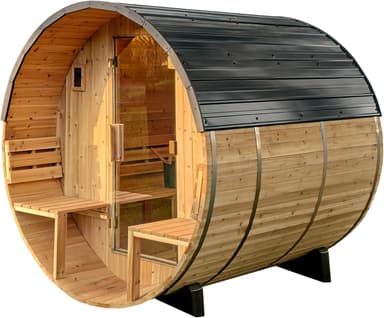
Backyard Discovery Paxton 2-4 Person Cedar Barrel Sauna
- 9kW heater reaches 170°F roughly 50% faster than budget competitors
- Barrel design eliminates dead zones with superior natural heat convection
- HDPE cradles and galvanized steel roof built for genuine year-round outdoor use
For buyers wanting more capacity and better materials, the Cedar Barrel Sauna with customizable person count gives you hemlock or cedar exterior options and the volume to run a proper multi-person wood-fired session.
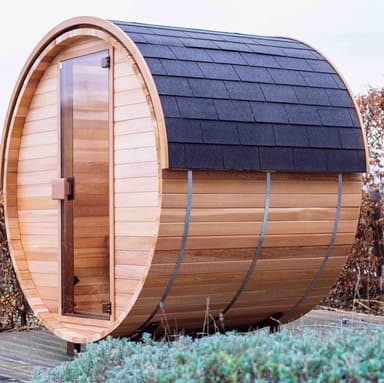
Cedar Barrel Sauna 2-10 Person Customizable Outdoor
- Own-factory quality control beats generic barrel sauna kit competitors
- Canadian red cedar delivers genuine durability and aromatic sauna experience
- Electric heater options reach 195°F in roughly 10-15 minutes
The Smartmak Canadian Cedar barrel option is worth considering if you want a larger format with premium cedar and the flexibility to configure wood or electric heat depending on your final site assessment.
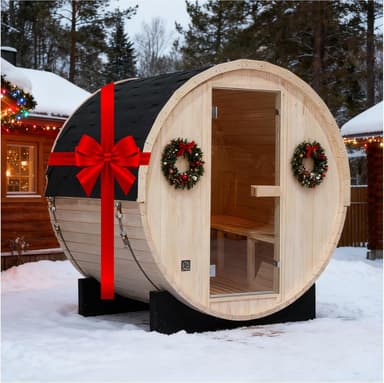
Smartmak 2-10 Person Canadian Cedar Barrel Sauna
- Three wood species let you match aesthetics, budget, and climate needs
- Barrel convection heats evenly without corner dead zones in any size
- Wood stove option delivers authentic 195°F performance with real ambiance
Matching Heater Wattage to Sauna Volume
This is the calculation most buyers get wrong. The standard rule is 1 kW of electric heater output per 45-50 cubic feet of sauna volume, adjusted upward for concrete or tile walls (which absorb heat) and downward for well-insulated cedar interiors (which retain it).
A 650 cubic foot barrel sauna needs a minimum 8kW electric heater to reach 185-194°F in a reasonable timeframe. Undersizing is the most common installation mistake - a 6kW unit in a 700 cubic foot room will struggle to break 170°F on a cold winter day, and owners end up disappointed with performance that looks like a heater problem but is actually a sizing problem.
Wood-burning heater sizing works differently: the Harvia M3 and comparable units are rated for rooms up to 530 cubic feet in standard configuration, or up to 636 cubic feet with an external air intake. For larger spaces, you step up to heaters like the Narvi or Kota Hukka, which handle up to 850 cubic feet. Oversizing a wood heater is less problematic than undersizing - you simply manage the fire conservatively - but dramatically oversized heaters create stones that superheat unevenly.
For Indoor Installations - Electric by Default
Any sauna room inside a home, garage, or basement should run electric unless you have an existing or planned chimney penetration and a compelling reason to prefer wood. The installation complexity, permit requirements, and CO risk of an indoor wood installation are not worth it for most homeowners when a properly wired electric unit delivers a genuinely excellent sauna experience.
The Harvia Xenio (available through SaunaLife and other retailers in 6kW, 8kW, and 10.5kW configurations) is the benchmark for quality electric heaters - Finnish-made, reliable, and supported by a proper dealer network with available replacement parts. Almost Heaven's prefab sauna rooms include Harvia electric heaters as standard equipment, which is one reason their customer satisfaction rates are high.
For premium buyers, Harvia's Griffin series adds Bluetooth control and precise digital thermostats (±2°F accuracy) that electric heaters genuinely deliver - something a wood stove can only approximate through fire management.
Maintenance and Longevity - What Ownership Actually Looks Like Year Three and Beyond
The first year of sauna ownership rarely reveals the real maintenance picture. Year three does. Here is what consistent users on owner forums and Reddit's r/sauna community report after 3-5 years with each heater type:
Wood Stove Long-Term Ownership
The quarterly chimney cleaning is the defining maintenance task for wood stove owners. Miss it for two seasons and you accumulate creosote at a rate that creates genuine chimney fire risk. In practice, serious sauna users who heat three or more times per week run through enough wood to warrant cleaning every 8-12 weeks during active season.
Stone replacement becomes relevant around year 2-3. Stones crack from thermal cycling - this is normal and expected. The Harvia M3 holds 220 pounds of stones, and replacing 30-40% of the load every three years costs $60-120 for quality sauna stones (round Finnish river stones or kiilakivi are the standard). Never use decorative landscaping rocks in a sauna stove - they shatter under thermal stress and can send fragments through the stove grate.
The stove body itself - heavy gauge steel on quality units - lasts 15-25 years with reasonable care. The firebox lining on cast iron stoves may need refractory patching after 10+ years. Compared to the coil replacement cycle on electric heaters, wood stoves are lower-cost to maintain at the component level over the long term.
Electric Heater Long-Term Ownership
Electric heater coils - the resistance elements that generate heat - have a stated lifespan of 3-7 years depending on usage frequency and water quality. Hard water accelerates mineral buildup on coils, reducing efficiency and hastening failure. Owners who ladle water frequently (traditional löyly practice) see coil degradation faster than those who run their electric saunas dry.
The coil replacement cost is the recurring expense to plan for: $200-500 for parts plus $100-200 for labor if you hire an electrician, or DIY on units with accessible coil assemblies. Budget saunas and heaters from brands like Real Relax (Amazon, around $800 for a heater unit) have generated consistent complaints about coil failure within 12-18 months of regular use. Premium Finnish-made heaters (Harvia, Helo, Tylö) have better coil longevity but cost 2-4x more upfront.
The control board and thermostat on digital electric units represent a second failure mode. About 30% of negative reviews on electric sauna heaters cite timer or thermostat failures within 2-3 years. These components are often proprietary, and replacement parts availability is inconsistent on budget and mid-range units. Before buying any electric heater, verify that the manufacturer has US parts availability - or buy through a dealer who stocks replacement components.
Which Lasts Longer?
A quality wood stove (Harvia, Narvi, Kota) in a properly maintained installation realistically lasts 20-30 years. The mechanical simplicity - steel or cast iron box, grate, flue collar - means there is very little to fail electronically. A quality electric heater lasts 10-15 years with coil replacements and regular maintenance. Budget electric heaters frequently need replacement at 5-7 years.
Winner - Longevity: Wood stoves at comparable quality tiers. Winner - Low Maintenance: Electric, by a clear margin.
The Hybrid Option and Special Cases
A growing category of buyers is looking at wood-primary heaters with electric backup, or purpose-built hybrid units. SaunaLife's integration of Harvia Xenio electric alongside their wood-compatible room designs reflects this trend. The logic: use wood when you have time and access, electric for spontaneous weekday sessions.
The practical execution of a true hybrid (both wood and electric installed in the same sauna) involves careful planning. The sauna room needs both a chimney penetration and a 240V circuit. The two heat sources must never be run simultaneously - electric elements near an active wood fire creates obvious risk. But the combination gives you the flexibility of electric for 80% of sessions and the performance ceiling of wood for weekend or special sessions when you want proper löyly.
The cost of a true hybrid installation adds $2,000-4,000 to either base installation scenario. For buyers with the budget, it is the answer to the "which should I choose" question - you choose both and let the session determine which you use.
The Barrel Sauna Specific Case
Barrel saunas deserve specific mention because they represent the most common format for first-time outdoor sauna buyers in the US, and the heater choice interacts directly with the barrel format.
A barrel sauna's cylindrical geometry creates natural convection that distributes heat more evenly than a rectangular room. This means both wood and electric heaters perform better in barrel format than in equivalent rectangular volumes. The 20% faster heating estimate is consistent across multiple barrel manufacturers' specifications.
Wood-burning barrel saunas with exterior chimney runs are the traditional execution. The Dundalk Leisurecraft Finnmark stove (rated for up to 500 cubic feet, 220-pound stone capacity) is the benchmark paired unit for their modular barrel systems, running $6,000-15,000 fully installed in cedar. Almost Heaven's barrel offerings use Harvia electric as default but offer wood stove factory options on several models.
For buyers committed to the wood-fired barrel experience, I maintain a separate breakdown of the best wood-burning barrel saunas at /best-barrel-saunas/wood-burning. If you are leaning electric after reading this comparison, the best electric heater barrel saunas page at /best-barrel-saunas/electric-heater covers specific product matchups by volume and budget.
Making the Decision - A Framework Based on Your Actual Situation
After testing both heater types, running the cost math, and collecting data from owner communities, I can give you a direct framework for making the call.
Choose wood-burning if:
You have outdoor space with no burn restrictions and the ability to install a proper chimney. You use sauna three or more times per week and value löyly quality as a primary metric. Your local firewood is reasonably priced or accessible for self-sourcing. You are willing to invest 10-15 minutes in fire preparation as part of the session ritual. You want the maximum achievable temperatures and the longest possible sessions without timer interruptions.
Choose electric if:
Your sauna is indoors or in an HOA-restricted outdoor space. You want spontaneous, low-friction access - phone preheat, no fire management, walk in and sweat. Your household has multiple users with different schedules who need independent session access. Your local electricity rates are below $0.15/kWh (where the running cost gap narrows against commercial firewood). You live in an urban or suburban area where chimney installation is a major construction project.
Choose neither in isolation if:
You are seriously interested in the therapeutic protocols documented in the Laukkanen cohort - 4-7 sessions per week at 174-212°F for 15-20 minutes. That frequency and temperature target is achievable with wood heating. The Hussain and Cohen 2018 meta-analysis showed measurable recovery benefits at the temperatures electric heaters reach, so electric is not ineffective. But the full traditional Finnish protocol maps more naturally to a wood-fired setup, and the 10-year health investment deserves a heater that can match the conditions under which the research was actually conducted.
The honest answer for most US buyers is that electric heaters dominate the residential market at 65% share (Grand View Research 2024) because they fit urban installation realities better, not because they outperform wood on the metrics that serious sauna users care about. If your site allows it and your commitment to the practice is genuine, wood is the traditional choice for compelling reasons that have held up across a century of Finnish sauna culture and a growing body of cardiovascular research.
Key Takeaways
- ●
Electric heaters dominate US residential installs for practical reasons, not performance reasons. Grand View Research (2024) puts electric at 65% of the US market because most homes can accommodate a 240V circuit easier than a chimney penetration - not because electric outperforms wood on temperature, löyly quality, or the conditions matched by the Laukkanen 2018 cardiovascular research.
- ●
The 194°F UL cap on electric heaters is real and matters for serious protocol users. Wood-burning heaters face no such limit, routinely reaching 200-250°F - a meaningful gap when the Laukkanen cohort sessions ran at 174-212°F and the strongest mortality data (50% reduced fatal CVD risk) came from 4-7 weekly sessions at the upper end of that range.
- ●
Running costs favor electric at current US rates. At the EIA's 2025 average of $0.16/kWh, a 45-minute electric session runs $0.80-$1.60. Cord wood at $300/cord runs $2-$5 per session - though that gap compresses fast if you cut your own wood or live somewhere cord prices are lower.
- ●
Installation cost is close to a wash, just differently distributed. Wood runs $2,000-$5,000 total (heater plus chimney); electric runs $3,000-$7,000 (heater plus licensed electrical work). Neither is cheap. Budget for both the permit and the professional.
- ●
Löyly quality from wood is genuinely superior, and this is not just nostalgia. Wood-fired heaters carry higher thermal mass, accept roughly twice the water volume of most electric units, and hold steam vapor 20-30% longer. For anyone who sessions with löyly as a central part of the practice, this is a measurable difference.
- ●
The 60-minute auto-shutoff on electric heaters is a legitimate constraint. Long sessions, contrast bathing protocols, or social sauna evenings all exceed that window. Wood burns as long as you feed it.
- ●
Neither heater type changes the core therapeutic mechanism - sustained heat exposure does. Hussain and Cohen's 2018 meta-analysis (13 studies, n=531) showed measurable recovery benefits and CK decline at the temperatures electric heaters reach. Electric is not ineffective. It just has a lower ceiling.
Who This Is For, Who Should Skip It
Who Should Choose an Electric Heater
Electric is the right call for anyone installing inside an existing structure where running a chimney through the wall or roof is impractical or prohibited by code. Urban apartments, condos, and finished basements almost always fall in this category. If your homeowners association or local fire code rules out combustion appliances, the decision is made for you.
Electric also makes sense for lower-frequency users - people who want a sauna 2-3 times per week rather than daily. The preheat capability (start remotely via timer or app on models like the Harvia Xenio or Huum Drop app controller) fits a busy schedule. You get in, you session, the unit shuts itself off safely.
Buyers who want a turnkey indoor sauna suite with specific aesthetic requirements - tile, glass, integrated lighting - will find electric heaters easier to integrate. The Harvia KIP line and Huum Hive fit flush into designed spaces where a steel wood stove would look out of place.
Who Should Skip Electric and Use Wood
If you are building a dedicated outdoor sauna structure from scratch - a standalone cabin, a converted shed, or a purpose-built sauna house - wood is worth the extra planning. The chimney install is a one-time cost, the fuel is available everywhere, and you are not dependent on grid power or a 240V circuit run across your property.
Anyone pursuing the serious therapeutic protocol documented in the Finnish cohort data - 4-7 sessions per week targeting the 174-212°F range - will find wood heating more naturally aligned with those conditions. The UL temperature cap on electric heaters is not a deal-breaker, but it is a constraint the research subjects in the Laukkanen 2018 cohort did not have.
Wood is also the better fit for people who heat for extended sessions with others, who value traditional löyly practice, or who simply want the experience to feel like what it is - a Finnish tradition, not a wellness appliance.
What to Read Next
If you have narrowed your choice, these guides go deeper on specific products and configurations.
- ●
Best Wood-Burning Barrel Saunas - My hands-on review of the top barrel sauna models that ship with or are sized for wood-burning heaters, including specific Harvia and Narvi configurations for different room volumes.
- ●
Best Electric Heater Barrel Saunas - The same format applied to electric-ready barrel saunas, with wiring requirements, heater pairing recommendations, and install notes for each model.
- ●
All Sauna Guides - The full index of installation walkthroughs, heater comparisons, stone guides, and protocol deep-dives I have published on UseSauna.com.
Frequently Asked Questions
Can a wood-burning sauna heater be converted to electric?
No direct conversion exists - the two systems are fundamentally different appliances. A wood-burning heater is a steel firebox designed for combustion; an electric heater uses resistance coils powered by 240V. You cannot retrofit coils into a wood stove. What you can do is replace the wood heater entirely with an electric unit sized for your room volume, provided you run a dedicated 240V circuit to the sauna room. The stone bed dimensions differ too - wood heaters typically hold more stone mass, so the room's thermal behavior will change even if the room dimensions stay the same. Budget $1,500-$4,000 for the electric unit plus $1,000-$3,000 for the electrical work if your panel is not already close to the sauna structure.
Is wood-burning or electric better for löyly?
Wood-burning heaters produce superior löyly by most objective measures. They reach higher surface temperatures on the stones, accept roughly twice the water volume before the stone bed cools, and retain steam vapor 20-30% longer due to greater thermal mass. The sensation is noticeably different - a softer, more enveloping steam versus the sharper, shorter burst from most electric units. That said, high-end electric heaters with large stone capacities (the Huum Hive holds up to 165 lbs of stone) close the gap significantly. If löyly quality is your primary criterion and you have installation flexibility, wood wins. If you need electric, invest in a heater with the largest stone capacity your budget allows.
How much does it cost to run a wood-burning sauna versus electric per session?
At current US averages, electric runs cheaper per session. A 45-minute session on an 8kW heater draws roughly 6 kWh, which costs about $0.96 at the EIA's 2025 average rate of $0.16/kWh. A comparable wood session burns 10-15 lbs of hardwood, which at $300/cord works out to $2-$4 per session. That gap narrows significantly if you source your own wood, live in a timber-heavy region with low cord prices, or use softwood (not ideal but some do). Over 200 sessions per year, the difference is $200-$600 annually - real money, but not the deciding factor for most buyers given the $2,000-$5,000 install cost difference between the two systems.
Do I need a permit to install a wood-burning sauna heater?
In most US jurisdictions, yes. Wood-burning appliances require a building permit that covers the appliance itself, the chimney installation, clearance to combustibles, and hearth pad specifications. Requirements vary by county and state, but expect to pull both a building permit and potentially a mechanical permit. Some jurisdictions require a licensed contractor for chimney work. Electric sauna heaters require an electrical permit and inspection for the 240V circuit, which a licensed electrician will typically pull as part of the job. Bottom line: both types involve permits, just with different trades. Budget $200-$600 for permit fees regardless of heater type.
What is the best wood to burn in a sauna heater?
Dense hardwoods with low moisture content are the standard. Birch is the traditional Finnish choice (23.6 million BTU/cord) and burns clean with a mild, pleasant smell. White ash and red oak are excellent North American alternatives at similar BTU ratings. The single most important variable is moisture content - wood above 20% moisture reduces combustion efficiency by 30-40% and increases creosote production three to five times. Buy kiln-dried or split-and-stack your own wood at least one full summer before use. Pine and other softwoods are usable in a pinch but produce more creosote and are not recommended for regular sauna firing.
How often should sauna stones be replaced?
Sauna stones for wood-burning heaters typically last 3-5 years with regular use; electric heater stones last 4-6 years. The wear mechanism is thermal cycling - stones expand when heated and contract when cooled, eventually fracturing. Signs it is time to replace: visible cracking, crumbling surfaces, or white powdery residue on the stones after sessions. For wood heaters, inspect stones annually and remove any that show fracture lines - broken stones can cause uneven heat distribution and, in rare cases, send fragments when water is thrown. Use only olivine diabase (kiilakivi) or peridotite specifically rated for sauna use. Never substitute limestone, sandstone, or decorative landscaping rock - silica content in these materials causes explosive fracture under rapid thermal cycling.
Can I use a wood-burning sauna heater indoors?
Yes, with proper installation. An indoor wood-burning sauna heater requires a UL-listed or equivalent chimney system with adequate clearance to combustibles (typically 2 inches to the flue pipe, 18 inches to the firebox sides depending on the model), a non-combustible hearth pad extending at least 16 inches in front of the door, and code-compliant fresh air intake at floor level. The combustion air intake is separate from the sauna room ventilation - wood heaters draw outside air for burning, which is part of why they feel better ventilated than electric. Buildings with tight insulation or negative pressure require particular attention to combustion air supply. Get the chimney inspected by a certified chimney sweep annually.
Frequently Asked Questions
There is no universally best heater between wood-burning and electric for barrel saunas; the choice depends on your priorities. Wood-burning heaters deliver a traditional, immersive experience with radiant heat, wood scent, and better löyly (steam on rocks), ideal for off-grid or outdoor setups, though they require more time (1-1.5 hours to heat), manual fire tending, chimney installation, and ash cleanup. Electric heaters offer convenience, precise temperature control, faster heating (30-45 minutes), low maintenance, and clean operation, suiting indoor or modern saunas with reliable power, but they may produce drier heat and higher electricity costs. Choose wood for ritual and authenticity, electric for ease and consistency.
Related Guides
Electric vs Wood-Burning Barrel Saunas - The Complete Comparison
Read GuideBarrel Sauna for Beginners - Everything You Need to Know
Read GuideThe History and Culture of Saunas - From Ancient Finland to Your Backyard
Read GuideInfrared vs Traditional Sauna - Science, Benefits, and Which to Buy
Read GuideAffiliate Disclosure - UseSauna earns a commission from qualifying purchases through our Amazon affiliate links. This does not affect our editorial integrity.