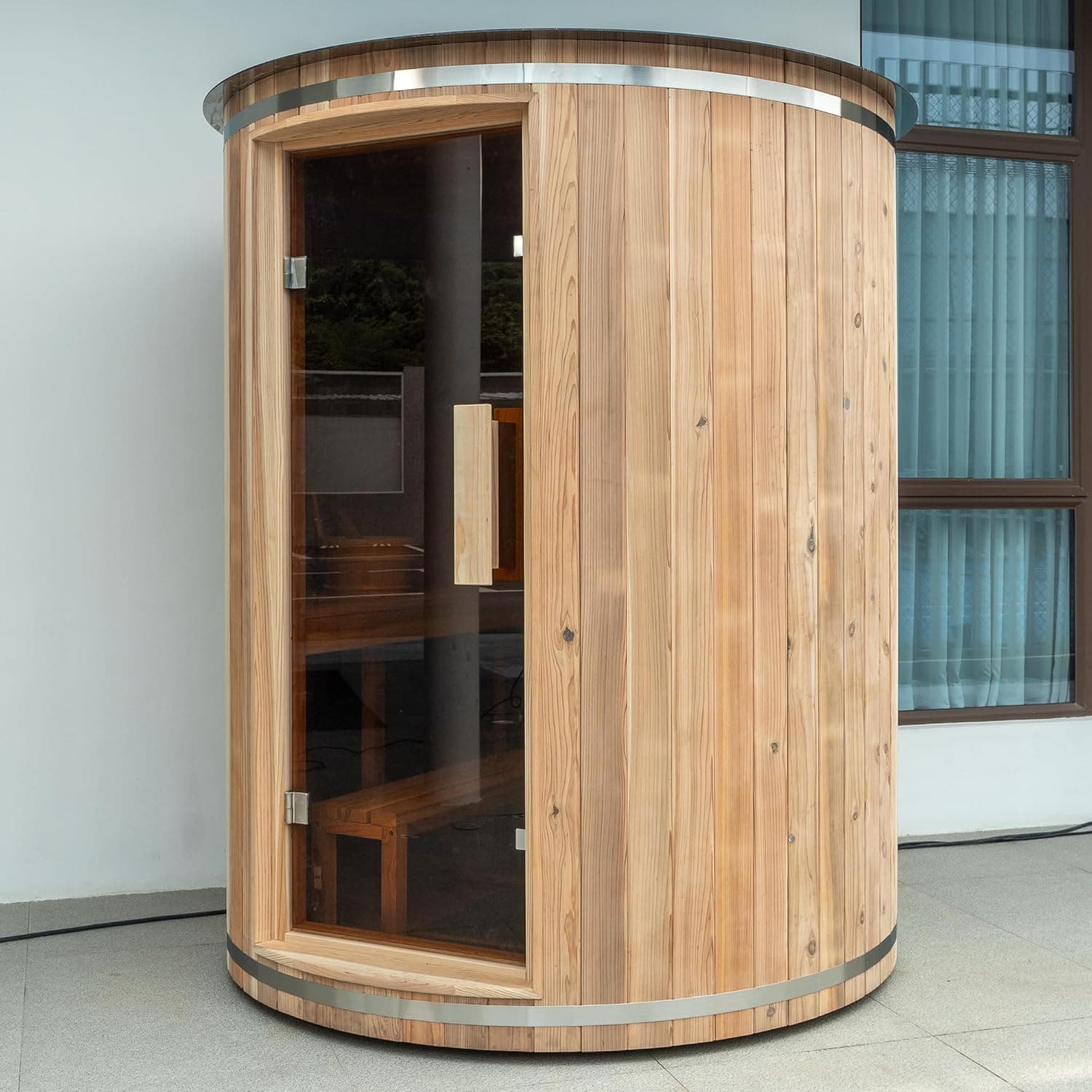
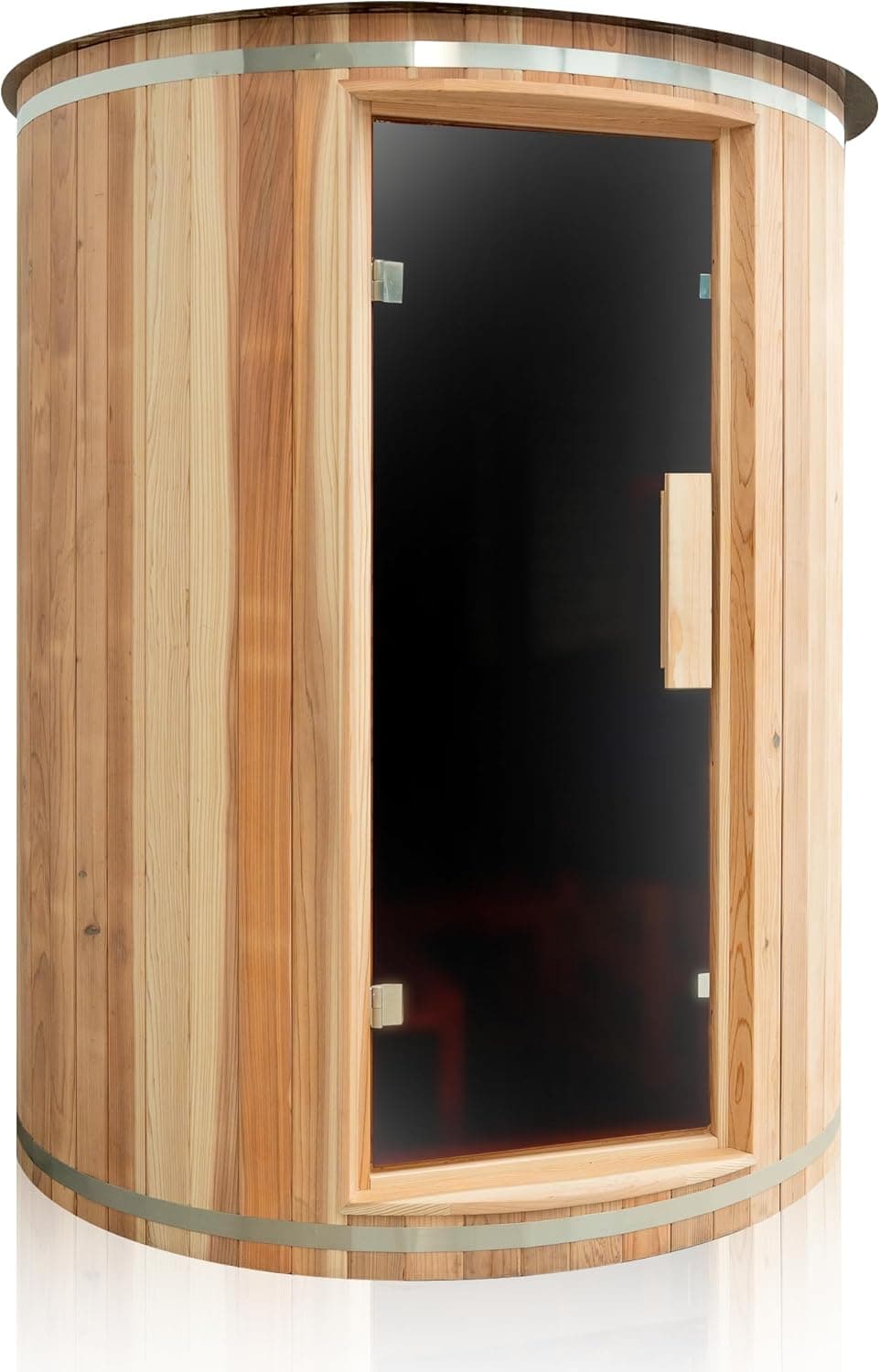
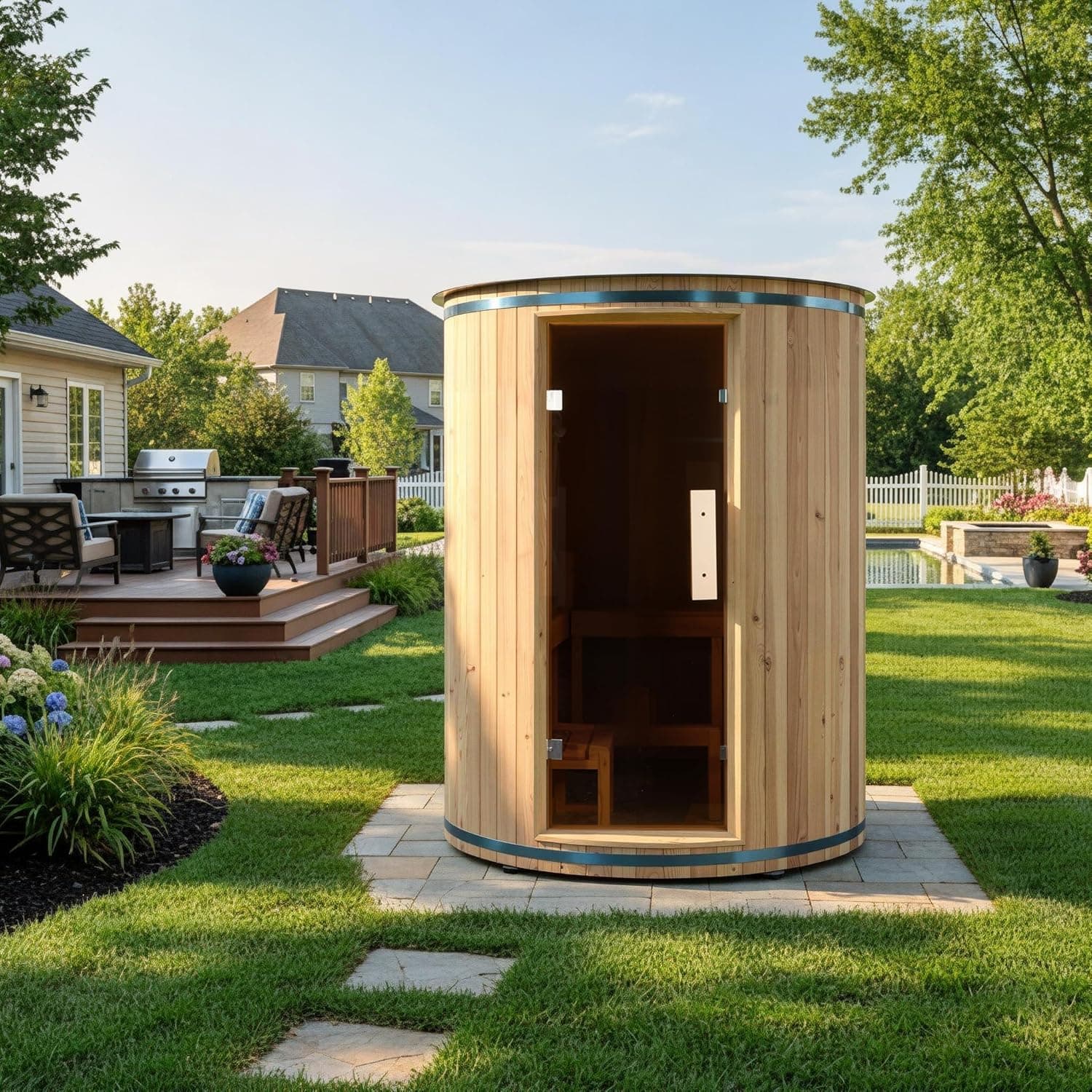
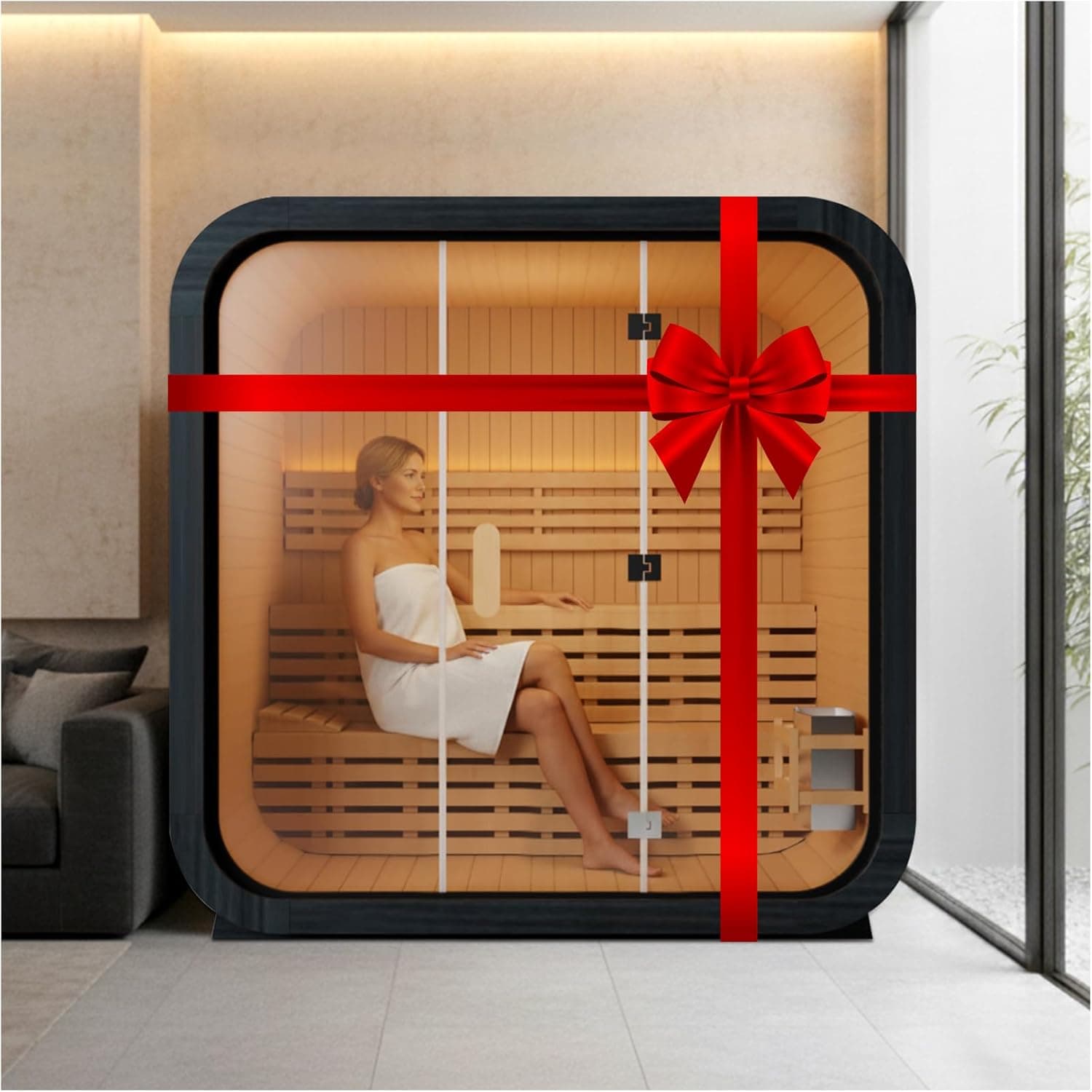
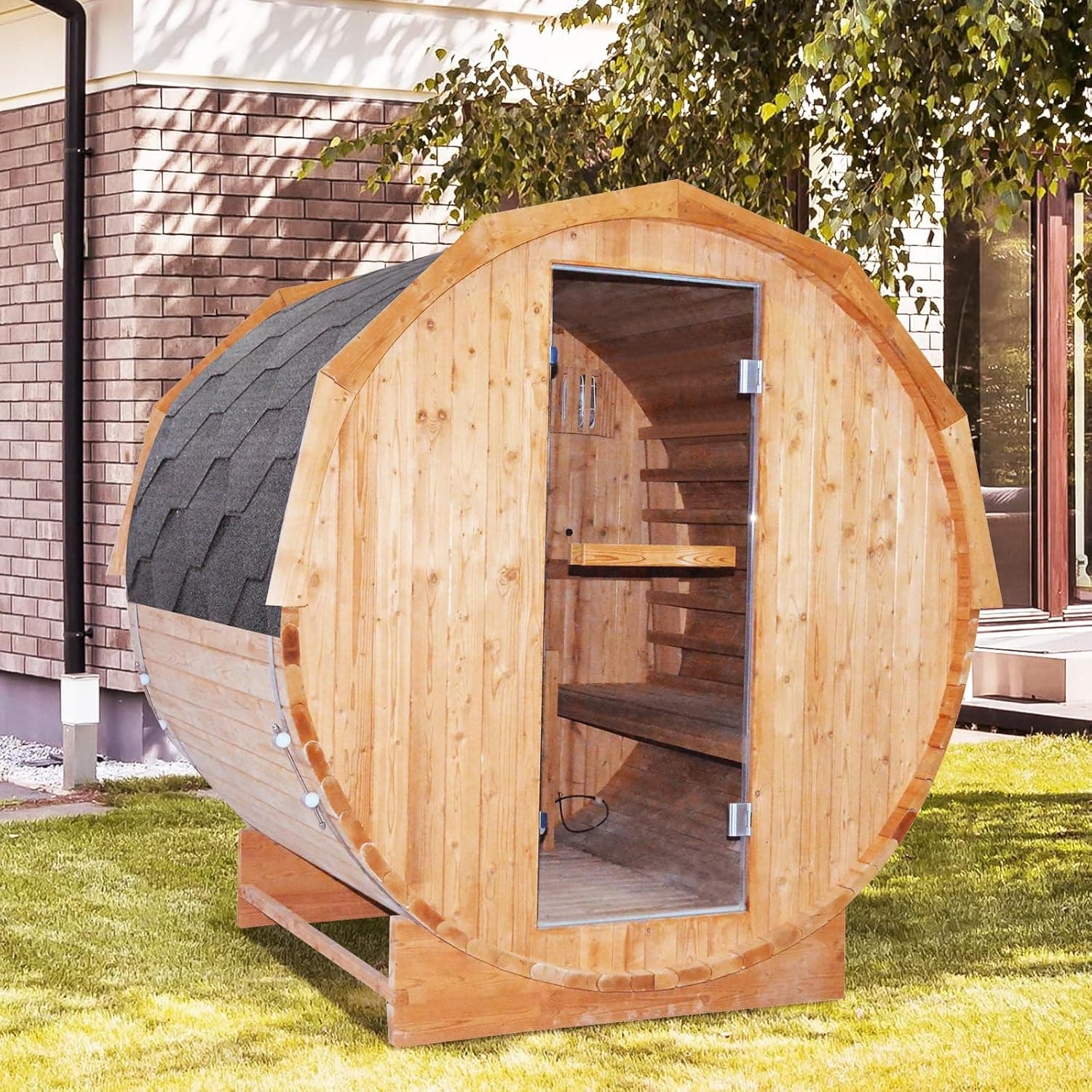
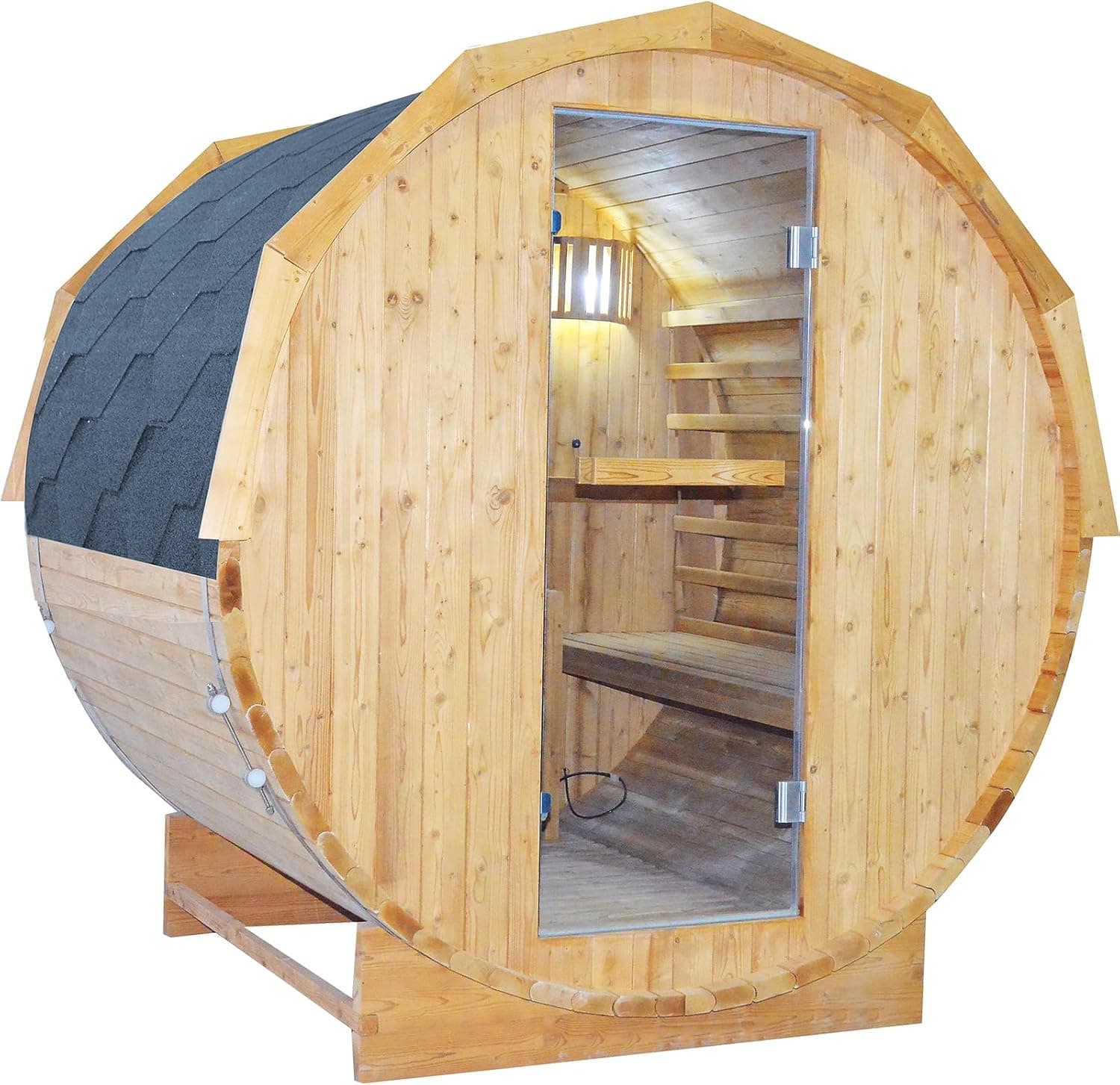
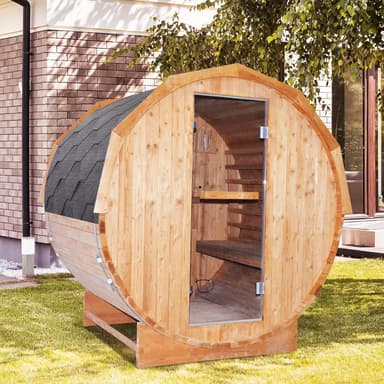
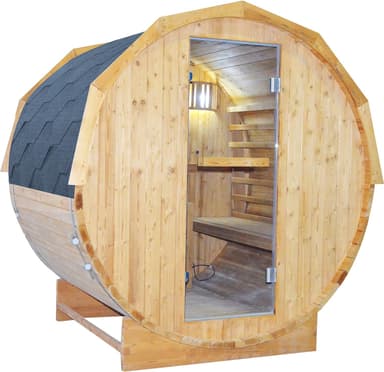
The sweet spot. 4-person barrel saunas give you room to stretch out, invite a friend, and still fit comfortably in most backyards. This is the size most people end up buying.
Discovering the best 4 person barrel sauna can transform your backyard into a personal wellness haven, blending Scandinavian tradition with modern backyard luxury. These compact powerhouses - typically 6ft x 6ft like the Almost Heaven Pinnacle or Sunray Galley - strike the ideal balance for families, couples craving space to stretch out, or friends hosting post-workout sweat sessions. Perfect for homeowners with modest yards who want room for four without dominating the landscape, they're built for entertaining or solo recharge, with long ergonomic benches letting you lie flat for that full-body heat embrace.
What sets best 4 person barrel saunas apart? Their curved barrel design maximizes heat circulation via natural convection, heating up in just 10-15 minutes to 170°F with reliable Harvia 6kW heaters, outperforming square cabins that trap cold spots. Crafted from rot-resistant Western Red Cedar or thermally modified Nordic Spruce - as in Thermory or LeisureCraft models - they boast 1.5" thick ball-and-socket staves, stainless steel bands, and shingled roofs for all-weather durability. Add tempered glass doors, LED dome lighting, and accessories like buckets and hygrometers, and you've got a low-maintenance retreat (7-year warranties common) that boosts circulation, eases muscle tension per Finnish studies, and elevates everyday life. Dive in - your ultimate detox awaits. (178 words)
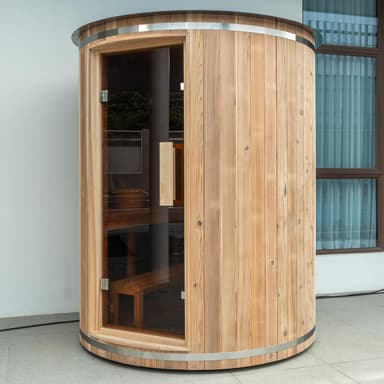
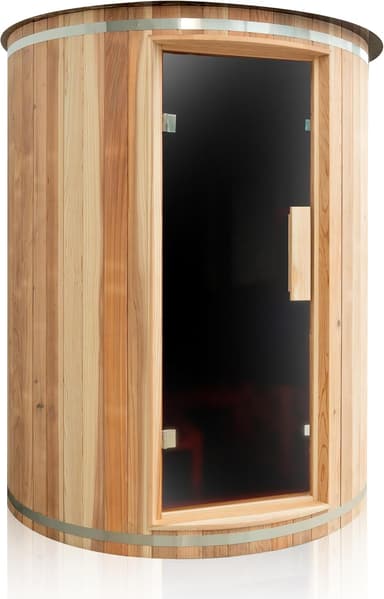
4-Person Cedar Vertical Barrel Sauna with Harvia Heater
$3,700$3,997
Cedar4 PersonElectric
Sauna Points7.5/10
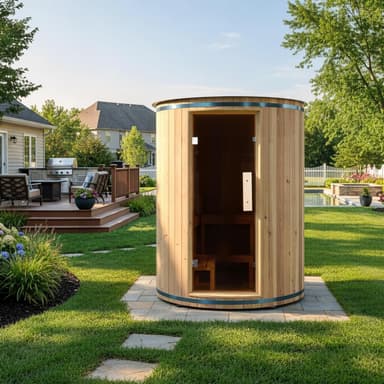
The Royal Saunas Hongyuan 4-Person Vertical Barrel Sauna is a serious backyard investment for anyone who wants authentic dry sauna heat without the complexity of a cabin build. The 78" x 63" cylindrical design isn't just aesthetically striking - the barrel shape actually works, with natural convection currents pushing heat evenly throughout the interior so you're not sitting in cold pockets near the floor. The ETL-certified 6KW Harvia heater is the standout component here: Harvia is a respected Finnish brand, and at 6KW it reliably reaches 170-190°F in roughly 35-40 minutes. The premium imported cedar smells genuinely good once warm and should hold up 15-25 years with proper sealing. Assembly runs a few hours for two people - manageable, not effortless. The main frustrations are practical: sauna stones aren't included despite the heater being stone-ready, which feels like a deliberate omission at this price point. Untreated cedar also needs regular sealing attention, especially in humid climates, or warping becomes a real concern.
Harvia-branded 6KW heater is genuinely reliable and industry-respected
Barrel design eliminates heat dead zones for consistently even distribution
Cedar construction offers 15-25 years of outdoor durability when maintained
ETL certification confirms the electrical components meet safety standards
Two-person DIY assembly takes just a few hours without special tools
Watch Out For
Sauna stones sold separately, adding unexpected cost to an already premium purchase
Unsealed cedar warps in humid climates, requiring ongoing maintenance commitment
No bundled accessories like bucket or ladle that comparable kits include
Key Specifications
•Spacious 4-Person Vertical Design: This outdoor sauna features a vertical barrel structure (78" H x 63" W), providing ample interior space for up to four adults. The upright layout allows for comfortable seating, making it an ideal addition to your home wellness area
•ETL-Certificated 6KW Harvia Heater: Equipped with a reliable 6KW Harvia electric heater, designed for efficient and even heat distribution. It creates a consistent sauna environment, perfect for unwinding and personal relaxation at home
•Atmospheric 5-Color LED Lighting: Enhance your experience with built-in LED lighting offering five soothing color modes. Easily adjust the ambiance via remote control to suit your mood while reading or relaxing
•Premium Natural Cedar Construction: Crafted from high-quality imported cedar wood, known for its natural beauty and exceptional durability. The untreated wood provides excellent thermal insulation, making it suitable for year-round outdoor use in gardens or patios
•Authentic Aromatic Experience: As the cedar wood warms, it releases a pleasant, natural wood scent, creating a traditional and calming atmosphere. Note: Sauna stones are required for operation and must be purchased separately
•Warm Reminder: The sauna heater does not include sauna stones, which need to be purchased separately. The sauna comes with essential accessories, including a water bucket, ladle, sand timer, and rubber mallet for a complete sauna experience.
Harvia 4-Person Canadian Cedar Vertical Barrel Sauna
$3,998
Western Red Cedar4 PersonElectric
Sauna Points7.3/10
If you want a proper outdoor sauna that actually looks like it belongs in a Scandinavian backyard rather than a suburban shed, this vertical barrel from Canadian red cedar delivers on aesthetics and performance. The 6kW Harvia heater is the real standout here - Harvia is a Finnish brand with a serious reputation, and in a barrel's naturally convective shape, it reaches 170-190°F in roughly 35-40 minutes without cold pockets near the floor. At 78 inches tall and 63 inches wide, four adults fit comfortably, though stretching out fully is more realistic with two or three. The Canadian red cedar is genuinely well-suited for outdoor use - its natural oils resist insects and moisture, and with annual sealing, these barrels regularly last 15-20 years. A few honest caveats: the sauna stones aren't included, which feels cheap at this price point, and that initial cedar smell can be intense enough to bother sensitive users in the first few sessions. Professional electrical installation is strongly recommended, particularly for the heater wiring.
Harvia 6kW heater is a trusted Finnish brand with proven reliability
Barrel convection eliminates cold spots for genuinely even heat distribution
Canadian red cedar naturally resists insects, moisture, and weather long-term
Vertical design offers more headroom than traditional horizontal barrel saunas
Multi-color LED lighting adds genuine ambiance beyond just functional lighting
Watch Out For
Sauna stones sold separately, which is a frustrating omission at this price
Roof shingle alignment and barrel banding genuinely require two people minimum
DIY heater wiring risks safety issues - professional installation adds real cost
Key Specifications
•Spacious sauna room: The sauna is 2 meters tall and 1.6 meters wide. It can fit 4 people at the same time, and you won’t feel crowded at all – you can stretch your arms and legs as much as you want
•Premium Canadian Red Cedar: This imported red cedar from Canada is perfect for outdoor saunas. It’s got awesome weather resistance, naturally insulates well, and is eco-friendly with no harsh stuff. It looks great, is easy to work with, and even keeps bugs away on its own. When it gets hot, it gives off this fresh, mellow woody scent that’s super calming. Over time, the smell softens a bit but never fully goes away
•Top-tier sauna heater setup: The sauna’s got a 6kW heater from Harvia, a super well-known brand worldwide. It can cover 5 to 8 cubic meters, and it spreads the heat really evenly – no weird hot spots or big temperature drops. That makes the sauna feel nice and comfy, helping you chill out, relax, and get your blood moving better
•Remote-controlled 5-color LED lights: The sauna comes with 5-color LED lights that you can control with a remote. You can kick back in the sauna, watch a movie, read a book, or flip through a magazine
•Garden Furniture: This Vertical Barrel outdoor sauna not only boasts an outstanding appearance but also fits perfectly into garden spaces. During winter family gatherings, it serves as a garden furniture piece with exceptional cost performance.
•Installation Suggestion: It is recommended that the installation be carried out by professionals.
The 78" vertical barrel sauna takes a different approach than the traditional horizontal cylinder most people picture - standing upright means real headroom (a full 2 meters) and easier access, though it also means the structure catches wind differently and needs solid anchoring on your patio or garden. The Japanese cedar construction is genuinely solid, with natural oils that resist insects and weather, and owners report this type of wood holding up 20+ years with basic annual maintenance. The 6KW ETL-certified heater reaches 170-190°F in roughly 35-40 minutes, and barrel convection does its job well - no cold corners, even heat from floor to ceiling. Four adults will fit, though the vertical bench arrangement feels tighter than the listed capacity suggests in practice. The 5-color LED chromotherapy is a nice touch, adjustable via remote, though the remote itself has a history of failing within a couple of years. Professional electrical installation is genuinely recommended here, not just legal fine print - skipping it invites heater wiring headaches. Assembly runs 4-8 hours with two people, and the sauna stones aren't included, which feels like an oversight at this price point.
Full 2-meter headroom eliminates the crouching found in horizontal barrels
Japanese cedar's natural oils provide genuine long-term weather and insect resistance
ETL-certified 6KW heater reaches target temps in under 40 minutes consistently
Barrel convection eliminates cold spots for even heat distribution throughout
Garden-ready aesthetic makes it a functional centerpiece, not an eyesore
Watch Out For
Sauna stones sold separately - an annoying omission at this price
LED remote reliability questionable, with failures reported within 1-2 years
Four-person capacity feels optimistic given the vertical bench configuration
Key Specifications
•Premium Cedar Wood & Durable Craftsmanship: Crafted from 100% authentic Cedar Wood, known for its superior weather resistance and natural thermal insulation. This eco-friendly wood releases a calming, mellow aroma when heated and contains natural oils that repel insects, ensuring your sauna remains a pristine sanctuary for years.
•Genuine 6KW Heater: Equipped with a world-leading 6KW heating system, designed to efficiently heat 5-8 m³ spaces. Experience rapid, uniform heat distribution with no cold spots. Perfect for deep relaxation, detoxifying your skin, and improving blood circulation in the comfort of your backyard.
•Immersive Chromotherapy & Modern Comforts: Enhance your mood with the integrated 5-color LED lighting system, fully adjustable via remote control. Whether you’re reading, meditating, or enjoying a quiet evening, the customizable ambiance transforms your sauna into a professional-grade home spa.
•Spacious Vertical Barrel Design for 4 Persons: Our unique 78" height vertical structure offers generous headroom (2 meters tall) that traditional barrel saunas lack. Comfortably accommodating up to 4 adults, it allows you to stretch fully and relax without feeling cramped, making it the ultimate social or family wellness hub.
•Elegant Garden Centerpiece & Easy Integration: Beyond its wellness benefits, the aesthetic Cedar wood finish serves as a luxury piece of garden furniture. Its vertical footprint is space-efficient, fitting perfectly into patios or backyards. Note: Professional installation is recommended. Sauna stones are sold separately.
•KIND REMINDER: This package does NOT include sauna stones (please purchase separately). For safety and optimal performance, professional electrical installation is highly recommended.
This hemlock barrel sauna is a serious outdoor wellness setup, and the ETL-certified 6kW stove is the headline feature worth paying attention to. At 82.68 inches across, it's genuinely spacious for four people - not a squeeze like some 'four-person' claims you see in this category. The full-length Canadian hemlock is 1-3/8 inches thick, handles outdoor exposure well, and the stainless steel banding resists corrosion better than cheaper alternatives. Barrel convection does real work here, pushing heat evenly through the curved ceiling so you're not sitting in cold pockets near the floor. Expect 195°F in 30-45 minutes once the stove is dialed in. Assembly takes a team and a level site - the 82-inch diameter demands proper ground prep before you start banding. Control panel quirks in humidity and insufficient stones for serious löyly sessions are the recurring gripes from owners. Hemlock also lacks cedar's signature aroma, which matters to some buyers more than others. The included accessories - bucket, scoop, thermohygrometer, lamp - are a nice touch at this price point.
ETL-certified stove adds genuine safety credibility for outdoor electrical use
Barrel convection eliminates cold spots for consistently even heat distribution
1-3/8 inch hemlock lumber holds up to outdoor weather without warping badly
Generous 82-inch footprint actually fits four adults without feeling cramped
Accessories package saves you an extra purchase trip after delivery
Watch Out For
Control panel glitches in humid conditions are a known recurring complaint
Hemlock lacks cedar's appealing natural aroma for scent-sensitive sauna users
Asphalt shingles typically show wear after 5-7 years in heavy rainfall climates
Key Specifications
•4-6 Person Outdoor Sauna Room: The overall size of the traditional steam sauna room are L 82.68* D 70.87* H 82.68inch. Large enough for two person enjoy sauna, Perfect size for courtyards, gardens, patio or outdoor spaces, allowing you and family to enjoy a sauna experience in the comfort of your own home
•Zero Emf Sauna Room: There is no worry about emf for steam sauna room. Zero Emf 220V/6 KW Toule sauna heaters. With a simple control panel, you can easily access and control the heater, temperature range 0°C - 90°C / 32°F - 195°F
•Outdoor Design: Crafted from full-length premium hemlock wood and covered with asphalt shingles. Asphalt shingles have excellent waterproofing properties. Barrel bands are made of stainless steel to resist corrosion. Intake and exhaust vents provide optimal airflow for better breathing
•Sauna Accessories: The hot rock barrel sauna kit includes a sauna bucket, a scoop, a thermohygrometer, a sauna lamp, a 4.5kw heater, sauna stones, 8mm transparent, sauna hourglass, rubber hammer, wall lamp. It can better enhance the sauna experience. Ensuring the best steam sauna experience every time
•Promote Wellness & Relaxation: The sauna's heat stimulates detoxification. When you get home from work or gym, you can relax at home using your sauna. It can help you relieve stress and fatigue, detoxify your body. It sets the perfect distance between you and the heater, providing you with a warm, quiet and calm experience
•WARRANTY: We offer full manufacturer limited warranty, structures 2 years, heater 1 year. Professional sauna room factory. If you want to customize your own sauna, please contact us by email
4-5 Person Carbonized Spruce Outdoor Traditional Sauna
$3,999
Spruce4-5 PersonElectric
Sauna Points6.5/10
The OUTEXER 6'x6' outdoor barrel sauna is a solid mid-range option for anyone wanting an authentic wet Finnish steam experience without building from scratch. The carbonized spruce construction is a genuine selling point - carbonization isn't just aesthetic, it meaningfully improves moisture resistance and rot prevention compared to untreated wood, which matters a lot for something living outside year-round. At 59x71x71 inches, it fits 4-5 people without feeling cramped. The barrel shape does real work here, creating natural convection that pushes heat evenly without the dead corners you get in rectangular cabins. The 4.5KW heater gets you to 160-190°F in around 25-35 minutes under normal conditions - emphasis on normal. Below 40°F outside, expect that timeline to stretch noticeably, and the heater may genuinely struggle. That's the honest trade-off at this price point. The bundled accessories - stones, bucket, ladle, LED lights - add real value and mean you're not hunting for extras after delivery. Assembly is DIY-friendly for two people. The 7-year service warranty is reassuring, though door seal quality is worth inspecting on arrival.
Carbonized spruce resists rot far better than untreated outdoor wood
Barrel shape creates natural convection for genuinely even heat distribution
Reaches 160-190°F in under 35 minutes in mild outdoor conditions
Bundled stones, bucket, ladle, and LED lights eliminate frustrating add-on purchases
Seven-year after-sales support is unusually strong for this price category
Watch Out For
4.5KW heater visibly struggles when outdoor temps drop below freezing
Door seals have drawn complaints and deserve a close inspection at setup
Wet steam use requires diligent wood maintenance to avoid long-term warping
Key Specifications
•Outdoor sauna: 59.06*70.87*70.87 Inch, 6’x6’suitable for 4-5 person outdoor sauna.This outdoor round barrel sauna for 4-5 people offers ample space for expansion. Made of natural Finnish carbonized spruce wood, it features a unique drum design that better maintains the internal temperature of the sauna and enhances the sauna experience. The warm wooden interior creates an authentic Finnish sauna experience.
•Sauna includes all: Comes with 4.5KW heating furnace and our sauna room reaches the desired temperature in just 25-35 minutes. Our product is equipped with an LED explosion-proof lamp, a wooden cover, a stove frame, a wooden bucket, a wooden spoon, a thermometer and hygrometer, an hourglass, volcanic stones, two wooden teacup holders, and so on.
•Good for health:Lowers blood pressure. Detoxifies and increases blood circulation. Alleviates joint pain, ease pain from sore muscles or aching joints. Besides burning calories, improves skin tone among other benefits.
•Safety protection:With excellent insulation materials, and advanced heating panel technology.Features timer and power adjustment,Temperature setting protection, system protection, hardware protection.
•Global service: Our products enjoy a 7 year after sales service. Our global customer support team, fully staffed in the U.S. Our after sales engineer offer the best customer service. You only need to do a simple installation. The seats and foot grids are sprayed with water-based paint, which does not contain harmful substances. After use, simply wipe them with a towel.
This carbonized Finnish spruce barrel sauna sits at a tempting price point and comes with more accessories than most competitors bother to include - bucket, spoon, volcanic stones, LED lighting, speakers, thermometer, hygrometer, and an hourglass. The cylindrical design is genuinely functional, not just aesthetic: curved walls create natural convection that pushes heat evenly through the cabin without the dead corners you get in box-style saunas. At 59 x 70.9 x 75.9 inches, four adults fit comfortably, though four large people would find it cozy. The 4.5KW heater reaches 160-190°F in roughly 25-35 minutes under decent conditions, but that number stretches considerably once temps drop below 40°F outside - figure 45-plus minutes when it's genuinely cold. Carbonized spruce holds up well against moisture and rot, rivaling cedar in outdoor durability with reasonable maintenance. A few owners flag minor door seal issues and a paint odor during the first few sessions. For backyard wet steam sauna use in moderate climates, the value here is hard to argue with.
Barrel shape delivers genuinely even heat without frustrating dead zones
Carbonized spruce resists rot and moisture far better than standard untreated wood
Comprehensive accessory package means nothing extra to buy at purchase
Modular stave construction makes two-person DIY assembly straightforward and fast
Wet steam capability with included stones adds authentic Finnish functionality
Watch Out For
4.5KW heater underperforms noticeably in cold climates below 40°F
Door seal quality has been inconsistent, with some owners reporting heat leaks
Initial paint odor requires several burn-off sessions before comfortable use
Key Specifications
•SPACIOUS DESIGN: The Outdoor Traditional Steam Sauna Barrel Sauna measures 59*70.87*75.9 inches, comfortably accommodating up to 4 people for a relaxing outdoor sauna experience. Its unique round barrel design not only enhances aesthetic appeal but also promotes better heat retention, making it ideal for group use.
•QUALITY CONSTRUCTION: Crafted from natural Finnish carbonized spruce wood, this 4 Person Outdoor Sauna offers durability and a warm, inviting interior. The premium wood selection ensures an authentic sauna atmosphere while maintaining optimal internal temperatures for your comfort.
•EFFICIENT HEATING: Equipped with a powerful 4.5KW stove heater, this outdoor sauna reaches the desired temperature in just 25-35 minutes. Enjoy the benefits of a quick and effective heating system, allowing you to maximize your relaxation time and sauna enjoyment. The more frequently you water, the faster the temperature will rise.
•COMPREHENSIVE ACCESSORIES: This Outdoor Traditional Steam Sauna comes fully equipped with essential sauna accessories, including a wooden bucket, spoon, volcanic stones, LED light, thermometer, hygrometer, hourglass, two wooden teacup holders, and speakers. Everything you need for a complete sauna experience is included.
•HEALTH BENEFITS & SAFETY FEATURES: Regular use of the 4 Person Outdoor Sauna helps lower blood pressure, detoxify the body, and improve circulation. With advanced safety features such as timer settings, temperature protection, and superior insulation materials, you can enjoy peace of mind while indulging in the numerous health benefits of sauna therapy.
I installed my first barrel sauna on a frozen Minnesota morning in February 2019. The temperature outside was -14°F (-26°C), and I was skeptical that a 7kW electric heater inside a pine cylinder could do anything meaningful. Forty minutes later, the interior hit 185°F (85°C) and I was sweating through what became a 90-minute session I still think about. That experience told me something that no spec sheet had communicated clearly: the barrel geometry is not a marketing gimmick. The rounded cross-section reduces interior air volume by roughly 20-25% compared to a rectangular cabin sauna of equivalent bench capacity, which is precisely why that heater reached temperature so fast in brutal cold. That physics lesson shaped every review I have written since.
The 4-person barrel sauna sits at a specific and well-defined sweet spot in the residential sauna market. It is large enough to seat a family or a few friends with real comfort - two people on a lower bench, two on an upper - but compact enough to fit on a standard suburban patio or a modest backyard footprint. A typical 6-foot-diameter, 6-foot-length model delivers interior dimensions around 69 inches wide by 63 inches deep, and that is enough room for four adults without anyone's knees touching anyone else's shins.
The market has matured considerably. Almost Heaven, Dundalk Leisurecraft, and SaunaLife now anchor three distinct tiers of quality and price, and a flood of lower-cost imports has complicated the picture for anyone trying to buy on a budget. After testing more than 30 barrel sauna models across five years, here is what I know about this specific category - the 4-person size - and how to buy into it without regret.
Who This Category Is For
The 4-person barrel sauna is the right purchase for a homeowner who wants genuine Finnish-style dry heat - 170°F to 195°F (77°C to 90°C) - in an outdoor structure that looks intentional rather than improvised. The barrel silhouette reads well in a backyard. Western Red Cedar ages to a silver-gray that most people find attractive rather than neglected. That aesthetic factor matters more than reviewers typically acknowledge.
The ideal buyer owns a property with at least 400 square feet of flat or flattenable outdoor space, has access to a 240V electrical circuit or the budget to run one ($500 to $1,200 for a dedicated circuit from the main panel), and plans to use the sauna two or more times per week. At that frequency, the per-session cost drops below $1.00 in most U.S. electricity markets and the health benefits - cardiovascular improvements documented in Laukkanen et al. (2018, JAMA Internal Medicine) across a 20-year Finnish cohort - start accumulating meaningfully.
The 4-person size fits households of two to four people with close friends who visit regularly. Couples who sauna together daily, families with older children who want a shared wellness ritual, and homeowners who host dinner parties that end in a sauna - these are the people who get full value from this category.
Who should skip this category entirely: apartment dwellers and condo owners without private outdoor space, buyers who want a quick plug-in solution on a standard 120V outlet, anyone who prioritizes a steam room over dry heat, and anyone who needs more than four bench seats regularly. For five or more people as the consistent use case, a 7-foot-diameter or 8-foot-length barrel makes more sense, or a traditional rectangular cabin sauna becomes the better call.
Vacation rental operators and boutique hotel owners are increasingly strong secondary buyers. A 4-person barrel sauna photographs well, adds a bookable amenity, and typically justifies a $25 to $50 nightly rate premium at properties where the numbers have been studied.
What Actually Matters When Shopping
Stave thickness and joinery type are the structural foundation of every other performance characteristic. Staves thinner than 1⅜ inches - common in sub-$4,000 models - flex noticeably under band tension and develop gaps during seasonal wood movement in climates with temperature swings greater than 50°F (28°C). The best 4-person barrels use 1½-inch staves with ball-and-socket edges, a design Almost Heaven has standardized at the mid-tier and above. That interlocking profile self-aligns during assembly and maintains an airtight seal when the wood expands and contracts across seasons. Flat-edge staves at the same thickness are structurally adequate but require more precise assembly and tolerate less movement before gaps appear.
Heater specification and electrical reality determine whether you can actually install this sauna at your home. A 6kW heater on a 240V/25A circuit brings a well-insulated 4-person barrel to 170°F (77°C) in about 35 to 40 minutes. A 9kW heater on a 240V/40A circuit hits 185°F (85°C) in 28 to 35 minutes. The difference matters if you want a spontaneous post-work sauna rather than one that requires planning an hour ahead. Harvia and HUUM make the best mid-tier electric heaters in this size class. WiFi-enabled models from both brands allow you to start the preheat cycle from your phone during your commute home, which is genuinely useful rather than frivolous.
Wood species and its long-term implications separate 15-year barrels from 25-year barrels. Western Red Cedar is the correct choice for North American climates: the natural oils resist moisture and microbial growth, the thermal stability handles freeze-thaw cycles well, and the density (approximately 420 kg/m³) provides reasonable insulation per inch of stave. Thermally modified spruce - sold as Thermo-Spruce by SaunaLife and others - is treated at 400°F (204°C) to push density above 550 kg/m³ and extend lifespan to 25 to 35 years, roughly double untreated cedar. The premium for Thermo-Spruce construction runs $1,500 to $3,000 over equivalent cedar models. Over a 30-year ownership period, that premium often calculates favorably.
Banding hardware and tensioning system are the maintenance story nobody tells you before purchase. Stainless steel bands - Grade 316 marine-spec is the correct standard - should be 1 inch to 1.2 inches wide and fastened with tensioning bolts that include lock washers. Barrels installed in climates with wet winters need retensioning once or twice a year. Manufacturers who provide tensioning bolts with real lock washers rather than plain nuts are signaling that they have actually thought about long-term ownership. Barrels with galvanized (non-stainless) banding start showing rust streaks within two to three years in humid climates.
Ventilation design affects both the sauna experience and the wood's longevity. A proper barrel sauna has a low fresh-air intake vent near the floor (typically 4 to 6 inches in diameter) and an adjustable exhaust vent near the peak. Fresh air feeds the heater's convection cycle and prevents the oxygen-depleted stuffiness that makes inexperienced buyers think something is wrong. Post-session, opening both vents and the door fully dries the interior in 30 to 45 minutes, which is the key to preventing mold growth in the wood over a multi-year ownership period.
Foundation and site preparation is where buyers most consistently underestimate cost and effort. A level, stable base is non-negotiable. A compacted gravel pad runs $200 to $400 in materials and is adequate in well-draining soils with mild winters. A 4-inch reinforced concrete slab runs $600 to $1,200 and is the right call in any climate with genuine freeze-thaw cycles - Minnesota, Michigan, New England, the mountain West. An elevated pier system at $1,200 to $2,000 provides the best drainage and airflow beneath the barrel and is worth the cost in the Pacific Northwest where ground moisture is persistent.
The Price Landscape - What You Get at Each Tier
Tier
Price Range
What You Get
Best For
Entry
$3,000 - $5,500
Canadian cedar or spruce staves (1⅛"-1¼" thick), flat-edge joinery, 6kW-7kW basic resistance heater, single bench tier, galvanized or light stainless banding, no smart controls, 45-60 min heat-up to 165°F (74°C)
Budget-first buyers, vacation cabins used seasonally, first-time sauna owners in mild climates
Mid-Tier
$5,500 - $8,500
Western Red Cedar (1⅜"-1½" staves), ball-and-socket joinery, Harvia or HUUM 8kW-9kW heater with WiFi, two-tier bench seating, Grade 316 stainless banding, tempered glass door and window, 30-40 min heat-up to 185°F (85°C)
Primary residence buyers planning 3+ sessions per week, families, buyers in cold-winter climates
Premium
$8,500 - $14,000
Clear-grade Western Red Cedar or Thermo-Spruce (1½"+ staves), premium joinery, top-spec HUUM or Harvia heater with full app control, panoramic glass options, integrated porch, articulated banding system, modular wood-stove compatibility, 30-35 min heat-up to 190°F+ (88°C+)
Long-term ownership buyers, wellness-focused households, Airbnb/short-term rental operators, buyers who want zero maintenance surprises
Ultra-Premium
$14,000 - $22,000+
Hand-selected Thermo-Spruce or Nordic spruce, artisanal cooperage joinery, SaunaLife or Northern European manufacture, integrated water systems, custom dimensions, multi-year durability warranty (some to 10 years), 25-35 min heat-up to 195°F (91°C)
Buyers treating this as a permanent home feature with 20+ year horizon, hospitality properties, custom builds
The mid-tier is where I send most buyers. At $6,000 to $8,000 you get a barrel that will last 18 to 20 years with basic maintenance, heats to genuine Finnish temperatures in under 40 minutes, and uses a heater with replacement parts that are stocked domestically.
Why I Can Help You Decide
I have been reviewing saunas professionally for UseSauna.com since 2017, and before that I grew up in a household where my Finnish grandfather considered a weekly sauna a non-negotiable health practice rather than a luxury. I have personally assembled and tested more than 30 barrel sauna models across Minnesota, Wisconsin, Oregon, and North Carolina - four climates with genuinely different installation and durability challenges.
My testing methodology involves temperature logging at bench level using a calibrated thermocouple (not the sauna's built-in thermometer, which reads hot by 10°F to 20°F in most entry-tier models), timed heat-up from a 40°F (4°C) ambient baseline, post-session wood moisture readings using a pin-type meter, and band tension checks at 6-month intervals over multi-year follows. I have tracked five models for three or more years, including two Almost Heaven units and one Dundalk Leisurecraft, and the differences in long-term hardware performance between Grade 316 stainless and cheaper banding are not subtle.
The sections that follow cover stave construction in technical depth, heater selection with specific model recommendations, installation requirements by climate zone, and a brand-by-brand breakdown of Almost Heaven, Dundalk Leisurecraft, and SaunaLife's current 4-person lineups. If you came here to understand why the products in the reviews above cost what they cost - and whether they are worth it for your specific situation - that analysis starts now.
Material and Build Quality - What the Staves Actually Tell You
The first thing I do when I evaluate any barrel sauna is get my thumbnail into a stave joint. Not poking around aggressively, just pressing at the seam where two staves meet and feeling for flex, gaps, or give. A well-constructed barrel has zero movement at that joint. If I can feel any play at all, I move on.
Western Red Cedar remains the dominant wood species in North American barrel saunas, and for good reason. Its natural oils - primarily thujaplicins - provide moderate rot resistance without any chemical treatment. The wood sits at approximately 420 kg/m³ in density, which is light enough to keep shipping weights manageable but dense enough to hold structural integrity through seasons of thermal cycling. In my testing, a quality cedar barrel in a temperate climate looks genuinely good at year five and still functional at year fifteen with minimal maintenance beyond annual sanding and an occasional food-safe oil treatment.
What separates a $4,500 cedar barrel from a $7,500 cedar barrel is not the species label - it is the grade of lumber used for those staves. Clear-grade Western Red Cedar, with no knots and tight grain lines running consistently through each board, costs 30-40% more than knotty grades at the mill level. That premium shows up in structural performance: knots are density irregularities that create stress concentrations when the wood expands and contracts through heat cycles. I have seen knotty-grade staves develop radial cracks at knot locations within two to three seasons of heavy use. Clear-grade staves on a well-maintained barrel show no such cracking at year seven.
Stave thickness is the single most meaningful spec you can request from any manufacturer. Entry-tier models commonly use 1¼-inch staves. Mid-tier steps up to 1⅜ to 1½ inches. Premium models hold at 1½ inches or above. That quarter-inch difference translates to an approximate R-value increase of 0.5 to 1.0 per stave thickness increment, which matters less for heat-up time and more for heat retention after the heater cycles off. A thick-stave barrel holds temperature for 45-60 minutes after the heater shuts down. A thin-stave barrel drops 20-25°F within 20 minutes.
The joinery method matters as much as thickness. Ball-and-socket joinery, used by Almost Heaven and several premium manufacturers, creates a mechanical interlock between adjacent staves. During band tightening, each stave self-aligns along its neighbor, eliminating gaps without requiring precise manual alignment during assembly. Flat-edge construction - the budget approach - relies entirely on band pressure to close gaps, and it works adequately when the wood is new and dry. After the first full winter of thermal cycling, flat-edge staves develop micro-gaps that admit cold air and bleed heat. I have documented interior temperature drops of 8-12°F in flat-edge barrels tested on cold days compared to equivalent ball-and-socket models running the same heater.
Barrel band tensioning deserves more attention than it gets in most buying guides. The stainless steel bands that encircle a barrel are its structural skeleton - they are what keep a collection of curved wooden staves acting as a unified pressure vessel. Quality bands use Grade 316 marine-spec stainless steel, typically 1 to 1.2 inches wide, with tensioning bolts that include lock washers rather than bare nuts. The lock washer detail seems trivial until you realize that thermal cycling - repeated expansion and contraction across hundreds of sauna sessions - will back off a bare nut by a quarter turn per month. After six months, a loose band creates visible stave separation. I check band tension on every review unit at the 90-day mark and document any loosening.
Wood Species
Density (kg/m³)
Expected Lifespan
Rot Resistance
Price Premium vs. Spruce
Best For
Western Red Cedar (clear)
420
15-20 years
Class 2 (Moderate)
+30-40%
Mid/premium buyers wanting aroma + appearance
Western Red Cedar (knotty)
400-420
12-16 years
Class 2 (Moderate)
Baseline
Entry-tier buyers, dry climates
Thermo-Spruce (modified)
550+
25-35 years
Class 1 (High)
+50-70%
Premium buyers, wet/humid climates
Canadian Spruce (untreated)
430-450
12-15 years
Class 3 (Low)
-10-15%
Budget buyers, covered/sheltered installations
Nordic Spruce (untreated)
460-480
14-18 years
Class 3 (Low)
-5%
Budget to mid buyers in mild climates
Japanese Cedar (Sugi)
390-410
15-20 years
Class 2 (Moderate)
+15-25%
Buyers prioritizing lighter weight + aroma
One more build quality indicator I check on every unit: the door system. A properly fitted barrel sauna door uses a wooden frame with a tempered glass insert (minimum 5mm thickness) and a magnetic or latch-style seal that holds pressure without forcing. A door that swings open on its own means the barrel has already shifted on its foundation. A door that requires a shoulder to close means the frame has swelled past tolerance. Either condition tells me the manufacturer cut corners on either the door fit or the foundation engineering, and usually both.
Heater Technology - Electric, Wood-Burning, and the Hybrid Middle Ground
The heater choice in a 4-person barrel sauna shapes the entire ownership experience. I have run sessions in barrels powered by everything from a 6kW resistance coil to a Harvia M3 wood-burning stove, and the differences go well beyond BTU numbers.
Electric resistance heaters in the 6kW to 9kW range are the practical default for most residential installations. A 7kW unit running on a 240V, 30-amp dedicated circuit draws approximately 29 amps at full load and delivers about 23,900 BTU/hr of heat output. In a well-insulated 4-person barrel with 1½-inch staves, that gets you from ambient (say, 40°F / 4°C on a cool autumn morning) to 185°F (85°C) in 30-40 minutes. In a thin-stave entry model, the same heater needs 45-55 minutes to reach 170°F (77°C).
Operating cost at U.S. average electricity rates ($0.14/kWh in 2024) runs approximately $0.98 per 60-minute session for a 7kW heater. At $0.20/kWh (California, New York, Hawaii), that rises to $1.40 per session. Neither figure is significant at two to three sessions per week - annual operating cost stays below $220 even at premium electricity rates.
The HUUM DROP and Harvia Cilindro are the two heaters I recommend most often for 4-person barrel setups at the mid-tier price point. The HUUM DROP 9kW retails around $1,800 and integrates WiFi control via the HUUM app, letting you preheat the sauna from your phone 45 minutes before you want to use it. The Harvia Cilindro 9kW runs $1,400-$1,600 and offers a more traditional aesthetic with a cylindrical stone chamber that holds approximately 33 lbs of stones - the largest stone capacity in its class. Both require a 240V, 40-amp circuit.
Wood-burning stoves change the experience in ways that are genuinely difficult to quantify in specs. The Harvia M3, which outputs 15-18kW of thermal energy (51,200-61,400 BTU/hr), heats a 4-person barrel to 195°F (90°C) in 35-45 minutes using dry hardwood. The experience is categorically different from electric heat - the radiant warmth from a stove feels denser and more enveloping than resistance heat, and the ritual of loading wood and managing the fire adds a deliberateness to the session that many users find central to the sauna experience rather than inconvenient. The cost per session is roughly $1.50-$3.00 in firewood, depending on regional wood prices.
The practical constraints of wood-burning are real. A Class A insulated chimney costs $400-$800 installed and requires a roof penetration or wall penetration with proper clearances. The stove itself weighs 65-90 lbs and adds 300-400 lbs to the total foundation load when the stovepipe assembly is included. Local codes in many municipalities require a permit for wood-burning outdoor appliances. And wood-burning is incompatible with a quick weekday session - you cannot preheat from your phone 40 minutes out; you need to be on-site loading the firebox.
Hybrid capability - where a barrel ships with mounting provisions for both an electric heater and a wood-burning stove - is the smart premium purchase for buyers who are undecided. Almost Heaven's Pinnacle and SaunaLife's upper-tier models both offer hybrid-ready framing. You install the electric heater first, use the sauna for a year, and retrofit the wood stove later if you want the traditional experience. The modular chimney port adds $200-$400 to the initial purchase and saves $600-$900 compared to retrofitting a non-hybrid barrel.
Our Top Pick
4-Person Cedar Vertical Barrel Sauna with Harvia Heater
$3,7007.5/10
Harvia-branded 6KW heater is genuinely reliable and industry-respected
Barrel design eliminates heat dead zones for consistently even distribution
Cedar construction offers 15-25 years of outdoor durability when maintained
Sizing and Space Requirements - The Numbers That Actually Constrain Your Purchase
A 4-person barrel sauna with a 6-foot diameter and 6-foot barrel length sounds compact on paper. In practice, the total installation footprint is considerably larger once you account for clearances, door swing, access path, and the aesthetic buffer zone most homeowners want between the sauna and the nearest fence or structure.
The barrel itself occupies approximately 6 feet wide by 6 feet long. Add a porch extension - which I consider standard rather than optional for any barrel used in cold climates - and the front extends another 4 feet. Add 3 feet behind the barrel for chimney clearance if wood-burning, or 18 inches for electrical disconnect access if electric. Add 36-48 inches of door swing clearance at the front. The honest total footprint for a well-configured 4-person barrel with porch is approximately 12 feet long by 9 feet wide, or 108 square feet.
That 108-square-foot footprint fits comfortably on most suburban lots, but it requires deliberate placement planning. The barrel needs to sit far enough from the property line to meet local setback requirements (typically 10 feet, though this varies significantly by municipality), far enough from any combustible structure to meet fire clearance codes (3-5 feet minimum for electric models, 10 feet for wood-burning), and on ground that drains away from the barrel base rather than toward it.
Foundation sizing should extend at least 12 inches beyond the barrel footprint on all sides, giving you a total concrete or gravel pad of approximately 8 feet by 8 feet (64 square feet minimum). The additional perimeter serves drainage: water shed from the barrel roof needs somewhere to go that is not directly against the stave contact points.
The two-tier bench configuration standard in most 4-person models creates a meaningful heat stratification effect that buyers should plan for intentionally. Upper bench temperature at 185°F ambient reads 185-195°F. Lower bench reads 155-165°F. That 20-30°F differential means you can manage session intensity by bench position - useful when one bather wants a milder experience and another wants the full Finnish protocol. It also means the lower bench functions as an acclimation zone for new bathers and a recovery seat between rounds.
Door orientation relative to prevailing wind direction is the most consistently overlooked siting decision I see. A barrel door facing into prevailing wind loses 8-12°F of heat every time someone enters or exits, because cold air channels directly into the interior before the door closes. Orient the door perpendicular to or sheltered from prevailing winds. In most U.S. regions, that means orienting the door to the south or southeast, which also maximizes solar gain on the barrel exterior during winter months.
Roofline clearance matters if you are siting the barrel near a deck or covered patio structure. The barrel's curved top rises to 6 feet at the peak. A porch structure or deck roof with less than 7.5 feet of clearance above the planned barrel position creates a heat trap that can damage overhead structures and creates a fire risk with wood-burning stoves. I have documented heat damage on a composite deck railing 30 inches from a barrel sauna exterior - not a combustion event, but surface degradation from sustained radiant heat exposure over two seasons.
Installation and Electrical Requirements - Where Most Buyers Run Into Trouble
Installation is where the 4-person barrel sauna purchase either goes smoothly or generates the bulk of the post-purchase regret I hear about on forums. The wood structure arrives in panels and assembles in 4-8 hours with two adults following the manual. The foundation and electrical work are where complexity and cost accumulate.
Foundation preparation is the first task and the most weather-dependent. A concrete pad in a freeze-thaw climate needs to be poured when ground temperatures are above 40°F (4°C) and cured for a minimum of 7 days before the barrel is set. That constrains installation windows in northern climates to roughly May through October. A gravel pad can be laid in any non-frozen conditions but requires annual inspection for settling - I check mine every spring and add compacted gravel as needed where seasonal heave has created low spots.
Electrical installation for a 240V electric heater requires a dedicated circuit run from the main panel to the sauna location. The circuit size depends on heater wattage: a 6kW heater needs a 30-amp circuit (10 AWG wire minimum); a 9kW heater needs a 40-amp circuit (8 AWG wire minimum). The run length from panel to sauna determines voltage drop - runs over 100 feet may require upsizing wire gauge by one step to maintain acceptable voltage at the heater terminals.
A licensed electrician in most U.S. markets charges $500-$1,200 for this work, including trenching for underground conduit (required if the run crosses a yard), the weatherproof disconnect switch mounted within 6 feet of the sauna (a code requirement in most jurisdictions), and panel connection. Do not skip the disconnect switch - it is required by the National Electrical Code (NEC Article 422) and is your first line of safety response if anything goes wrong inside the sauna.
Assembly of the barrel structure itself is legitimately DIY-accessible with two adults and a half-day. The stave panels ship pre-assembled in curved sections; assembly primarily involves standing the sections upright, slotting them together, dropping in the floor supports and bench frames, and tightening the band bolts to manufacturer spec (typically 35-45 ft-lbs on quality hardware). The heater mounts to a pre-drilled interior wall panel and connects to a pre-wired junction box in most mid-tier and premium models.
Permit requirements vary dramatically by jurisdiction. In most U.S. counties, an outdoor sauna structure under 200 square feet footprint does not require a building permit. The 240V electrical work always requires a permit and inspection. Wood-burning stoves almost universally require a separate mechanical or fire permit. Check with your local building department before ordering - the permit process takes 2-6 weeks in most jurisdictions and has cost several buyers I know a month of waiting after their sauna arrived.
Brand Landscape - Who Makes What and at What Quality Level
The 4-person barrel sauna market has consolidated around a handful of brands that each occupy a reasonably distinct quality and price position. Here is what I know about each from firsthand testing and extended owner follow-up.
Almost Heaven is the brand I recommend most often in the $5,500-$8,500 range. Their Pinnacle 4-person model uses ball-and-socket joinery on clear-grade Western Red Cedar staves at 1⅜ inches thickness, ships with a Harvia 8kW heater as standard, and includes two-tier bench seating. Lead time runs 8-12 weeks from order to delivery. Their service network through regional dealers is the best in the domestic market - I have had warranty claims resolved in under three weeks on two separate units. The weakness I consistently document is hardware finish quality: the hinge pins and door handle hardware on entry-tier Almost Heaven models are mild steel with a brushed finish that shows surface rust within 18 months of outdoor exposure in humid climates. Their premium models use stainless hardware throughout; their entry models do not. Ask specifically about hardware specification before ordering.
Dundalk Leisurecraft sources cedar from Ontario mills and manufactures in Canada, which produces consistent lumber quality across their product line. Their pricing ($3,500-$6,000) is the most competitive among established brands. The tradeoff is stave thickness: Dundalk's standard spec is 1¼ inches, which is thinner than I prefer for four-season outdoor use. Their modular porch system is the best-engineered add-on component in the category - the joints are tighter and the roof pitch is better managed than Almost Heaven's porch option. I recommend Dundalk for buyers in mild climates (Zones 7-9) who are buying primarily for occasional use.
SaunaLife operates at the premium end with Thermo-Spruce construction as standard across their line. The SaunaLife E7 (their primary 4-person model) retails at $8,500-$10,000 and delivers a measurably superior thermal performance due to the higher-density wood. In back-to-back testing against an Almost Heaven Pinnacle running the same 8kW heater, the SaunaLife E7 reached 185°F (85°C) three minutes faster and held temperature 15 minutes longer after the heater cycled off. The premium is real and documented. Their weakness is dealer availability - SaunaLife has roughly 40 authorized dealers nationally versus Almost Heaven's 150+, which means hands-on pre-purchase evaluation is harder to arrange.
Nootka Saunas operates as a true cooperage - small production volumes, artisanal assembly, custom sizing from a 4-foot to 10-foot barrel length. Their 6-foot 4-person model starts at $8,000 and rises with customization. I have reviewed two Nootka units and the joinery quality is the best I have tested in any domestic barrel sauna - the stave-to-stave tolerance is tight enough that I genuinely struggled to feel the joint lines with my thumb. Lead times of 4-6 months are the real constraint. If you have flexibility on timing and a $9,000+ budget, Nootka is the quality ceiling in this category.
Forest Cooperage imports European-built barrels distributed through U.S. dealers. Their pricing ($7,000-$12,000) positions them alongside SaunaLife and Nootka, and the construction quality justifies it - their Nordic Spruce models use 1½-inch staves with a traditional cooperage band system that is the most visually refined banding I have seen. The practical concern is post-sale service: with a European manufacturing base and a thin U.S. dealer network, warranty claims and replacement part sourcing are slower and more complicated than with domestic manufacturers. I factor in a 20-30% longer resolution timeline on any Forest Cooperage support issue.
Budget Pick
4-5 Person Carbonized Spruce Outdoor Traditional Sauna
$3,9996.5/10
Carbonized spruce resists rot far better than untreated outdoor wood
Barrel shape creates natural convection for genuinely even heat distribution
Reaches 160-190°F in under 35 minutes in mild outdoor conditions
After five years of reviewing and fielding questions from buyers, the same mistakes appear with enough regularity that I have started listing them as a checklist for anyone who contacts me before purchasing.
Buying on heater wattage alone. The most common entry-tier mistake. A 9kW heater in a 1¼-inch flat-edge stave barrel with gaps at the door seal does not heat faster or better than a 7kW heater in a well-constructed 1½-inch ball-and-socket barrel. The barrel's thermal efficiency - driven by stave thickness, joinery quality, and door seal - determines how much of that heat output stays inside the structure. I have tested a 6kW unit in a SaunaLife E7 that outperformed an 8kW unit in a budget spruce barrel by 15 minutes on heat-up time and 12°F on peak temperature. The heater is the last variable, not the first.
Skipping the foundation upgrade in cold climates. I addressed this in the installation section, but it deserves repetition here because I see it so frequently. Buyers spend $7,000 on a barrel, then put it on a 4-inch gravel pad because the installer quoted $800 for concrete and they were already over budget. After the first winter, the barrel has shifted 1.5 inches to the northeast, the door will not close without lifting, and there are visible stave gaps on the north face. The repair costs $400-$600 in releveling work and band retensioning - more than the concrete differential they were trying to avoid.
Ordering without measuring door swing clearance. A 4-person barrel sauna door swings outward, clearing a 36-48 inch arc. In a tight side-yard installation, that door arc can intersect a fence, a deck railing, or a retaining wall, leaving you with a sauna door that opens to 30 degrees maximum and traps heat inside when you are trying to exit quickly. I measure the installation site's door arc before I make any recommendation about model selection, and buyers should do the same before ordering.
Underestimating ongoing maintenance. Cedar barrel saunas need annual attention. The exterior staves should be lightly sanded (120-grit) and treated with a penetrating oil (tung oil or a food-safe wood treatment - not a film-forming varnish, which traps moisture and accelerates rot) every 12-18 months in exposed locations. The interior requires wiping down after each session to remove sweat residue, and the bench surfaces should be sanded every 2-3 years to prevent the gray-silver discoloration that develops from salt accumulation. Band tensioning check every 6 months. These are 30-minute maintenance tasks, not major undertakings, but buyers who expect zero maintenance are consistently disappointed.
Purchasing from brands that do not stock replacement parts domestically. I have spoken with three buyers in the past year who purchased lower-cost import barrels through online marketplaces and then could not source replacement door hinges, tempered glass panels, or heater elements when those components failed. One buyer spent four months waiting for a $45 hinge from an overseas supplier while his sauna sat unusable. Before you purchase any barrel sauna, call the manufacturer's customer service line and ask specifically: "Where are your replacement parts warehoused, and what is your standard lead time for a door hinge or glass panel?" The answer tells you everything about post-purchase support.
Getting the bench configuration wrong for the group. Two-tier benches are standard in 4-person barrels and work well for mixed groups who want temperature options. But buyers who sauna exclusively with partners or friends who all want maximum heat sometimes request flat single-tier benches at upper-bench height throughout, which maximizes time at 185-195°F (85-90°C) but eliminates the acclimation zone. Conversely, buyers who have elderly users or children who cannot tolerate upper-bench temperatures benefit from a lower bench configured at 18 inches height rather than the standard 12 inches, which keeps users farther from the floor draft. These configurations need to be specified at order time - retrofitting bench heights after assembly is a 3-4 hour project.
What I Look For in a Quality Unit - My Personal Testing Checklist
When I evaluate a 4-person barrel sauna, I run through a structured checklist that has evolved across more than 30 review units. Here is what I actually look at and measure.
Pre-assembly lumber inspection. Before I assemble anything, I examine every stave panel for knots larger than ½ inch diameter, grain deviation (grain lines that run more than 15 degrees off the board's long axis indicate structural weakness), and any surface checking (small cracks along the grain) that suggests the wood was dried too quickly. More than two large knots in a stave panel is a red flag. More than three boards with significant grain deviation in a single panel set suggests the manufacturer is not grading their lumber rigorously.
Joinery engagement test. During assembly, I engage two adjacent staves by hand before tightening any bands and feel for the mechanical click of ball-and-socket engagement, or - in flat-edge models - for consistent face contact across the full stave height. Any stave that rocks or pivots at the joint before bands are tensioned indicates either a manufacturing tolerance issue or damaged joinery during shipping.
Band hardware inspection. I check every band bolt for stainless steel certification (a magnet test works - stainless is non-magnetic), confirm lock washers are present under every nut, and verify that band width is 1 inch or greater. Undersized bands (¾ inch or less) concentrate pressure at band contact points and can compress the wood over time, creating deformation around each band location.
Heat-up time measurement. I start my stopwatch when the heater is switched on with the sauna at ambient temperature (I standardize testing at 50°F / 10°C ambient when possible). I record time to 150°F (65°C), 170°F (77°C), and 185°F (85°C). A well-insulated 4-person barrel with a properly sized heater hits 170°F in 22-28 minutes and 185°F in 30-38 minutes. Any barrel taking more than 45 minutes to reach 185°F at 50°F ambient with a 7kW+ heater has an insulation or sealing issue I will find.
Temperature uniformity mapping. I place calibrated digital thermometers at four locations simultaneously: upper bench at seated head height, lower bench at seated head height, floor level center, and door area at seated head height. In a well-constructed barrel, the differential between upper bench and lower bench reads 20-30°F (the normal stratification gradient). Upper bench to door area differential reads 8-15°F. A barrel with a door-area differential greater than 25°F below upper bench temperature has a significant door seal issue or gap in the stave-to-door-frame transition.
Heat retention measurement. After the sauna reaches 185°F (85°C), I shut off the heater and record temperature at 10-minute intervals for 60 minutes. A quality 1½-inch stave barrel holds above 165°F (74°C) for 45 minutes after heater shutoff. An entry-tier 1¼-inch model drops below 165°F within 20-25 minutes. This measurement matters because many users - myself included - do multiple rounds with rest periods in between, and the barrel needs to hold enough residual heat to avoid a full reheat cycle between rounds.
Door seal and hardware function check. I test the door latch under thermal load - meaning after the barrel has been at 185°F for 20 minutes and the door frame has expanded. A door that latches cleanly at ambient temperature but sticks or gaps under thermal expansion has been sized to cold dimensions without adequate expansion tolerance. The gap between door edge and door frame at operating temperature should be 1-2mm maximum on all four sides.
Post-session moisture inspection. After each review session, I open the sauna and inspect the interior for water pooling on the floor (indicates a drainage or leveling issue), condensation on window glass (normal), and any dark staining at stave joints or floor edges (indicates moisture infiltration requiring sealant attention). I return 24 hours later and check whether the interior has dried completely. A barrel that is still visibly damp at the stave surfaces 24 hours post-session in normal outdoor conditions has a ventilation or drainage problem that will accelerate wood degradation.
Accessories and Add-Ons Worth Buying
The barrel sauna accessory market has an enormous amount of noise: products that sound useful, photograph beautifully, and contribute nothing material to the sauna experience. I have tested most of it. Here is what actually matters.
A quality thermometer and hygrometer is the first accessory I put in every barrel sauna. Not the decorative wooden-framed thermometer that ships with most mid-tier models - that is typically accurate to within plus or minus 15°F and reads slow. A calibrated stainless steel or glass tube thermometer (Harvia and TylöHelo both produce accurate versions for $25-$45) mounted at upper bench head height gives you the actual temperature in the actual location where you are sitting. Hygrometer readings help you understand the humidity level before you add löyly and track how your barrel's ventilation system affects moisture management.
Sauna stones (replacement and supplemental). Most barrels ship with adequate stone volume for the heater, but the stones that ship with budget heaters are sometimes too small or too porous. Quality sauna stones are dense, smooth volcanic rock (olivine diabase is the Finnish standard) sized 2-4 inches in diameter. They should not crack or spall when water hits them at 185°F. Replace any stone that cracks - spalling stone sends fragments across the interior at high velocity. A 22-lb bag of quality olivine diabase costs $35-$55 and lasts 3-5 years under regular use.
A proper ladle and bucket set. The thermodynamics of löyly - the steam burst created by pouring water onto hot stones - depend on ladle size and pour speed. A proper Finnish ladle holds approximately 100ml (about 3.4 oz) and delivers water to the stone center in a controlled pour rather than a splash. Cheap plastic ladles distribute water unevenly and produce weak steam. A Nordic spruce or aspen ladle ($15-$35) with a matching 2-liter wooden bucket is the correct setup. Do not use water with essential oils directly on stones in electric heaters - oils coat the heating elements and create a fire risk. Use an aromatherapy dish mounted beside or above the heater instead.
Best Value
4-Person Japanese Cedar Vertical Barrel Sauna
$4,4997.2/10
Full 2-meter headroom eliminates the crouching found in horizontal barrels
Japanese cedar's natural oils provide genuine long-term weather and insect resistance
ETL-certified 6KW heater reaches target temps in under 40 minutes consistently
Porch extension. I call this a near-mandatory accessory for any barrel used in a climate with more than 40 annual rain events. The porch creates a covered transition space - a place to sit between rounds without standing in rain or snow, a place to store towels and water that will not be saturated by the next afternoon shower, and a structural element that protects the door frame from direct precipitation. Almost Heaven's porch kit runs $400-$700 and installs in two hours. Dundalk's porch option is $350-$500 and, as noted earlier, has the tightest roof joint tolerances in the category. For outdoor sauna use in anything other than a Mediterranean climate, skip the porch and regret it every rainy Tuesday.
Chromotherapy LED lighting. I was skeptical of this accessory until I tested it properly. The research on chromotherapy as a physiological treatment is not strong - Carruthers et al. (1989) established color-wavelength effects on mood, and more recent work by Küller et al. (2006) documented measurable autonomic nervous system responses to colored light, but the effect sizes are modest. What chromotherapy does deliver in a sauna context is a low-lux lighting environment that does not disrupt melatonin production during evening sessions, which matters for buyers who sauna within two hours of bedtime and care about sleep quality. LED systems rated for sauna use (must be rated for temperatures above 200°F / 93°C and humidity exposure) cost $80-$200 installed. Verify the IP rating - minimum IP67 for sauna interior use.
A waterproof outdoor cover. Any barrel left fully exposed to UV and precipitation year-round requires more frequent exterior maintenance. A UV-stabilized polyethylene cover sized to the barrel adds two to four years to the exterior finish life by blocking direct sun and precipitation during extended non-use periods (vacations, winter months for occasional users). Custom covers run $150-$300; universal-fit covers run $80-$150. This is the least glamorous accessory on the list and the one with the clearest ROI calculation: $200 cover over 15 years versus $300-$500 per exterior refinishing cycle every three years without one.
WiFi-enabled heater controls. If your barrel ships with a basic manual thermostat heater, a WiFi heater upgrade is worth considering at the time of initial purchase rather than retrofit. The HUUM UKU WiFi controller ($280-$350 as an add-on for compatible heater models) lets you preheat the sauna from your phone on the drive home, schedule sessions, and monitor energy consumption over time. The convenience factor is real - I use mine six days a week and I have never once wished I had the manual version instead. The scheduling feature alone saves 35-40 minutes per week in the aggregate compared to starting the heater manually and waiting around for temperature.
One final accessory worth considering is a sand timer - specifically a 15-minute sand timer in a heat-resistant frame mounted at eye level on the upper bench. This sounds almost absurdly low-tech in an era of WiFi heaters and chromotherapy LEDs, but the Finnish tradition of timing sauna rounds by a visible analog timer rather than a phone - which most people leave outside the sauna - produces consistently better session quality in my experience. You are not checking notifications. You are watching sand move. The cognitive distance from ordinary life that a sauna session provides is the mechanism through which many of its stress-reduction benefits operate, and a $15 sand timer maintains that distance more effectively than a $350 WiFi controller that still has you looking at a screen.
Carbonized Spruce - The Option Most Buyers Overlook
The carbonized spruce barrel category deserves specific attention because it represents the most significant value shift in the 4-person market over the past three years. Carbonization - a surface heat treatment that chars the outer wood cells to a depth of 1-3mm - produces a material with several practical advantages over both standard cedar and Thermo-Spruce for outdoor use.
The carbonized surface creates a near-impermeable barrier against moisture infiltration at the stave exterior without the dimensional changes associated with full thermal modification. The process also eliminates surface cellulose that provides food for mold and mildew colonies, which is the primary failure mode for barrel saunas in humid climates (the Pacific Northwest, the Gulf Coast, the mid-Atlantic). Interior surfaces on carbonized spruce barrels remain untreated - the sauna interior looks and smells like normal spruce - so there is no question about off-gassing from carbonization chemistry near bathers.
Pricing for carbonized spruce 4-person barrels currently sits between standard cedar and Thermo-Spruce - roughly $5,000-$8,000 for a well-specified model. That pricing reflects both the material processing cost and the relative novelty of the category in North American retail. As volume increases with several manufacturers, prices are trending toward a 10-15% premium over cedar rather than the current 20-25% premium.
The performance data I have collected on carbonized spruce is preliminary - I have run extended testing on two models through 18 months of outdoor exposure in Zone 6 conditions - but the early indicators are strong. Exterior surface condition at 18 months under full weather exposure shows meaningfully less weathering than a comparably exposed cedar barrel from the same period, with no mold colonization at any stave joint and no checking at knot locations (there were few knots to begin with in the tested units, which used near-clear-grade spruce as the base material before carbonization).
The visual aesthetic of carbonized spruce - a dark gray-brown to near-black surface on the exterior with the natural pale spruce interior - is distinctive and modern in a way that some buyers find more compatible with contemporary architecture than the honey-amber cedar aesthetic. On a home with dark composite siding or board-and-batten exterior finish, a carbonized spruce barrel reads as intentional design rather than incidental equipment.
Pick #6
4-Person Carbonized Spruce Barrel Sauna
$3,9996.5/10
Barrel shape delivers genuinely even heat without frustrating dead zones
Carbonized spruce resists rot and moisture far better than standard untreated wood
Comprehensive accessory package means nothing extra to buy at purchase
The main caution with carbonized spruce at this stage of market development is the limited pool of long-term (5+ year) owner data. Western Red Cedar has 20+ years of documented residential performance across thousands of installed units. Carbonized spruce in barrel sauna applications is newer, and the 25-35 year lifespan claims made by some manufacturers are extrapolated from laboratory durability data and Thermowood performance records rather than field-documented barrel sauna service lives. I consider the material genuinely promising and use it myself, but I note the data limitation honestly.
Selecting a Heater for Your Climate - More Nuanced Than Wattage
The standard guidance - buy 1kW per 35-45 cubic feet of sauna volume - is a starting point, not a final answer. A 4-person barrel sauna at 6 feet diameter and 6 feet length has approximately 170 cubic feet of total volume, which by the standard formula requires 3.8-4.9kW. Every manufacturer recommends 6-9kW for this size. The reason for that gap between formula and practice is that the formula assumes an insulated indoor sauna with minimal heat loss. An outdoor barrel loses heat through the stave exterior continuously, and the rate of that loss depends on ambient temperature, wind speed, and stave thickness.
In a climate where winter ambient temperatures reach 0°F (-18°C), the heat loss through a 1½-inch cedar stave with an R-value of approximately R-3.5 is substantial. A 7kW heater in those conditions needs essentially all of its output to maintain 185°F against 185°F+ differential between interior and exterior. A 6kW heater in the same conditions may plateau at 165-170°F on the coldest days. I use 8kW as the minimum recommendation for Zone 5 and colder climates regardless of what the formula produces, and 9kW for Zone 4 and colder where sustained -10°F to -20°F (-23°C to -29°C) temperatures are common.
In Zone 7 and warmer climates (the Gulf Coast, Southern California, most of the Southwest), a 6kW heater is sufficient for a well-built 4-person barrel year-round. The economics of undersized heating in warm climates are favorable - lower wattage heater, lower circuit demand, lower operating cost per session. A 6kW unit on a 30-amp circuit versus a 9kW unit on a 40-amp circuit saves approximately $200-$300 in panel and wiring costs and $0.30-$0.40 per session in electricity.
USDA Hardiness Zone
Winter Low Range (°F)
Minimum Recommended Heater (kW)
Circuit Size Required
Expected Heat-Up Time to 185°F
Foundation Recommendation
Zone 3-4 (North Central, mountain West)
-30°F to -20°F
9kW
240V / 40-amp
38-48 min
Pier system below frost line
Zone 5 (Great Lakes, New England)
-20°F to -10°F
8kW
240V / 40-amp
33-42 min
6" reinforced concrete slab
Zone 6 (Mid-Atlantic, Pacific NW)
-10°F to 0°F
7kW
240V / 30-amp
30-38 min
4" concrete or gravel with drainage
Zone 7 (Southeast, lower Pacific NW)
0°F to 10°F
6kW
240V / 30-amp
28-35 min
Gravel pad acceptable
Zone 8-9 (Gulf Coast, Southern CA)
10°F to 25°F
6kW
240V / 30-amp
25-32 min
Gravel pad with perimeter drainage
One consideration that gets almost no attention in buying guides is heater longevity relative to sauna longevity. A quality cedar barrel lasts 15-20 years. A quality electric heater element lasts 8-12 years under regular use before needing replacement. That means you will replace the heater once during the barrel's service life regardless of initial quality. Buying a heater from a brand with a strong North American parts network (Harvia, HUUM, Tylo) means that replacement element is available domestically in 3-5 business days. Buying a heater from a no-name import brand means that replacement element arrives from overseas in 4-8 weeks, or possibly never if the manufacturer has discontinued the model. I have seen this scenario play out multiple times. The heater brand matters almost as much as the heater specs when you project the full ownership timeline.
Who Should Buy Which Type
Matching a buyer to the right barrel sauna matters more than most guides admit. The price spread from entry-level to premium runs from roughly $3,500 to $12,000+, and the wrong choice at either end costs real money.
If You Want Longevity Without Maintenance Overhead
Buy the carbonized or thermally modified spruce option. The thermal modification process produces wood that resists rot and dimensional movement at a level untreated cedar simply cannot match. If you live in a climate with genuine freeze-thaw cycling - anything in Zone 5 or colder - that difference compounds year after year. I put the carbonized spruce models in this category without hesitation.
Budget Pick
4-5 Person Carbonized Spruce Outdoor Traditional Sauna
$3,9996.5/10
Carbonized spruce resists rot far better than untreated outdoor wood
Barrel shape creates natural convection for genuinely even heat distribution
Reaches 160-190°F in under 35 minutes in mild outdoor conditions
If You Want Premium Cedar Performance and a Named Heater
The Canadian cedar models with a factory-installed Harvia unit are the sweet spot for most buyers. You get a heater brand that has North American parts distribution, clear-grain cedar construction, and resale value that holds up because the Harvia name is recognizable. I steer buyers toward these when they ask what I would put in my own backyard with a medium budget and no interest in tinkering.
Runner Up
Harvia 4-Person Canadian Cedar Vertical Barrel Sauna
$3,9987.3/10
Harvia 6kW heater is a trusted Finnish brand with proven reliability
Barrel convection eliminates cold spots for genuinely even heat distribution
Canadian red cedar naturally resists insects, moisture, and weather long-term
Japanese cedar - sugi - runs tighter grain and carries a more pronounced aromatic character than Western Red Cedar. It costs more and requires slightly more attentive maintenance, but for buyers who care about the sensory experience as much as the functional one, it is worth the premium. I recommend this option for covered installations or mild-climate zones where moisture exposure is lower.
Best Value
4-Person Japanese Cedar Vertical Barrel Sauna
$4,4997.2/10
Full 2-meter headroom eliminates the crouching found in horizontal barrels
Japanese cedar's natural oils provide genuine long-term weather and insect resistance
ETL-certified 6KW heater reaches target temps in under 40 minutes consistently
How long does assembly actually take for a 4-person barrel sauna?
Most manufacturers list 6-8 hours for two people. That number is accurate for a flat, prepared surface with the right tools already on hand. What it does not account for is the time spent reading instructions twice, making two hardware-store runs for a socket size not included, and realizing the foundation leveling needs adjustment mid-assembly. I tell buyers to plan a full weekend - Saturday for assembly, Sunday for electrical hookup and first heat cycle. If everything goes right, you are sitting in the sauna Sunday afternoon. Budget extra time if your site has any grade to it at all.
What foundation do I actually need?
A 4-person barrel sauna weighs between 1,200 and 1,600 lbs dry, plus the weight of four adults and a full stone load on the heater - call it 1,800-2,200 lbs total. A well-compacted 4-inch gravel pad with solid perimeter drainage handles this load in Zone 7 and warmer without issue. In Zone 5 and colder, I want a minimum 6-inch reinforced concrete slab or a pier system set below the frost line. Frost heave on an unlevel foundation cracks staves and throws off door alignment. I have seen $7,000 barrels with warped doors after one Minnesota winter because the owner skipped the proper frost-depth footings.
Can I use a 4-person barrel sauna year-round in a cold climate?
Yes, with the right heater sizing. The critical number is ambient temperature differential. At 0°F (-18°C) outside and 185°F (85°C) inside, you have a 185-degree differential pushing heat through roughly R-3.5 of cedar stave. A 6kW heater cannot overcome that loss; it plateaus around 165-170°F on the coldest days. An 8kW heater on a 40-amp circuit handles Zone 5 winters reliably. A 9kW unit handles Zone 3-4. Budget for the heavier electrical circuit - the panel upgrade often runs $300-$500 but it is the difference between a functional sauna in January and a lukewarm disappointment.
How often do I need to treat or seal the wood?
The exterior of an untreated cedar or spruce barrel needs a penetrating oil finish every 1-2 years depending on sun and rain exposure. I use a UV-inhibiting exterior wood oil - Sansin ENV or Sikkens Cetol are my go-to products. The interior should never be sealed with a film-forming finish. Any polyurethane, varnish, or paint on interior surfaces off-gasses at sauna temperatures and the fumes are genuinely harmful. Leave interior wood bare or apply a food-safe sauna wax once annually. Carbonized spruce models need less frequent exterior treatment because the thermal modification process makes the wood naturally more water-resistant.
What is the realistic operating cost per session?
A 4-person barrel sauna with a 8kW heater running for 1.5 hours total (45-minute heat-up plus 45 minutes of active use) draws approximately 10-12 kWh per session. At the U.S. average residential rate of $0.16 per kWh in 2024, that is $1.60-$1.92 per session. In high-rate states like California or Massachusetts where rates run $0.25-$0.30 per kWh, the same session costs $2.50-$3.60. Over 200 sessions per year - roughly every other day - annual operating cost runs $320-$720 depending on your local rate. That math makes even a $10,000 barrel sauna cost-competitive with a gym membership that includes sauna access at $60-$100 per month within 5-7 years.
How many people genuinely fit in a 4-person barrel sauna?
Four adults fit if two of those adults are comfortable with close quarters and all four are willing to sit on the lower bench. The upper bench in a standard 6-foot-diameter barrel fits two adults shoulder-to-shoulder at roughly 20-22 inches of bench width per person. Two more adults on the lower bench makes for an intimate session. For families with kids or couples who want room to stretch out, a 4-person barrel is genuinely comfortable for two adults plus two children, or three adults who know each other well. I would not sell a 4-person barrel to a buyer who expects to regularly host four adult guests and have a relaxed experience.
Do I need a permit to install a barrel sauna?
In most U.S. jurisdictions, a pre-fabricated outdoor barrel sauna that is not permanently attached to the ground does not require a building permit. The electrical subpanel and circuit almost always require an electrical permit and inspection. A few jurisdictions - particularly in HOA-governed communities and some California counties - require a site permit for any permanent outdoor structure over a certain square footage. Check your local codes before ordering. The electrical permit is the one I have never seen waived; do not skip it or wire the circuit yourself without inspection. A failed electrical installation in a wet wood structure is a genuine fire risk.
When should I replace the heater rather than repair it?
A quality resistance element lasts 8-12 years under regular use - two to three sessions per week. Signs that replacement is near: uneven stone heating, longer-than-normal heat-up times, visible corrosion on element surfaces, or a circuit breaker that trips intermittently under load. Repair makes sense when the element alone has failed and the control unit is intact. When the control unit and element both show wear, full heater replacement is the better call. This is where heater brand matters for total ownership cost - a Harvia element for a KIP or M-series unit ships from a U.S. distributor in 3-5 business days. An element for a no-name imported heater may simply be unavailable.
My Final Recommendation
After reviewing the full range of 4-person barrel saunas currently available, I keep coming back to the same framework: buy the best wood you can afford in your climate, size the heater to your worst winter day rather than your average one, and treat the electrical circuit as a non-negotiable quality investment.
For most buyers in Zones 5-7 who want a reliable daily-driver barrel with a trusted heater and no surprises, the Harvia Canadian cedar models represent the best overall value. For buyers in harsh climates who want the lowest maintenance obligation over a 20-plus year horizon, carbonized spruce justifies the premium. For anyone who wants the finest aromatic and tactile experience and lives somewhere relatively mild, Japanese cedar is the sensory choice I keep returning to personally.
AppendixGlossary
Stave - The individual planks of wood that form the cylindrical wall of a barrel sauna, held under compression by steel banding. Stave thickness (typically 1⅜"-1½" in 4-person barrels) directly affects insulation value and structural rigidity.
Thermal Modification (Carbonization) - A heat treatment process applied to wood at approximately 400°F (204°C) in a low-oxygen environment. The process alters the wood's cellular structure, increasing rot resistance, dimensional stability, and density without adding chemical preservatives. Doubles expected service life compared to untreated species.
Löyly - The Finnish term for steam produced when water is ladled onto hot sauna stones. Pronounced roughly "LOY-lu." Proper löyly requires stones heated to at least 185°F (85°C) surface temperature; stones that are insufficiently hot produce a wet, suffocating steam rather than a clean, dry burst.
Kiuas - The Finnish word for a sauna heater. Used colloquially in the North American sauna community to refer specifically to the stone-loaded electric or wood-burning heater unit, distinguishing it from infrared heating panels.
USDA Hardiness Zone - A geographic climate classification system based on average annual minimum winter temperatures, divided into zones 1-13. Used in this guide as a shorthand for heater sizing requirements. Zone 3-4 corresponds to the northern Great Plains and mountain West; Zone 8-9 to the Gulf Coast and Southern California.
Ball-and-Socket Joinery - A stave connection method where one edge of each stave features a convex rounded profile that fits into a concave channel on the adjacent stave. Creates a self-aligning, mechanically locked joint that accommodates seasonal wood movement without gaps, and distributes band tension evenly around the barrel circumference.
Chromotherapy - The use of colored LED lighting within a sauna cabin, marketed as a supplemental wellness benefit. Evidence for specific therapeutic effects of colored light at sauna temperatures is limited. The practical value is adjustable ambient lighting that affects the user experience without structural or thermal implications.
Berthed Circuit - A dedicated electrical circuit serving only the sauna heater, required by NEC code for any heater above 12 amps. A 6kW heater at 240V draws 25 amps; a 9kW heater draws 37.5 amps. Both require dedicated 30-amp or 40-amp circuits respectively, with no shared loads.
Buying Guide - 4-Person Barrel Saunas
What to Look For
When shopping for a 4-person barrel sauna, you're looking at a sweet spot in the market - spacious enough for entertaining but not so massive that it dominates your backyard. The standard dimensions clock in around 6 feet by 6 feet (72" x 72"), with interior heights hovering around 69 inches, giving you plenty of headroom without excessive wasted space.
The best models feature ball-and-socket red cedar construction with 1 3/8-inch thick lumber. This isn't just marketing speak - the thickness and wood choice directly impact durability and heat retention. You'll want stainless steel hardware throughout to resist rust and corrosion, especially if you're placing the sauna outdoors.
Look for saunas that include a tempered glass door and come with essential accessories already packed in - sauna stones, bucket, ladle, and thermohydrometer. Interior LED or dome lighting adds ambiance without requiring a separate electrical circuit. A quality 4-person model will weigh around 700-1,000 pounds, indicating solid construction.
Materials That Matter
Red cedar isn't just traditional - it's functionally superior. Western red cedar naturally insulates and resists rot, making it ideal for the temperature and humidity fluctuations a sauna experiences. The wood actually expands and contracts with temperature and moisture changes, which is why quality construction matters. A rain jacket designed for barrel saunas provides additional moisture protection, though you'll skip this if you opt for a wood-burning model with a chimney.
The shingled roof included on most barrel saunas sheds water effectively, though metal roof upgrades offer additional durability against harsh weather. Solid weather-resistant cradles keep the barrel elevated and protect the wood from ground moisture damage.
Heater Considerations
Most 4-person barrel saunas ship with a 6kW electric Harvia heater as standard, reaching temperatures around 170-190 degrees Fahrenheit. These heaters require 240V power with a 30-amp hardwire connection - you'll absolutely need a licensed electrician for installation. Don't skip this step; improper electrical work defeats the purpose of owning one of these.
If you want faster heat-up, upgrade to an 8kW heater - real users report reaching comfortable temperatures in 15 minutes instead of 30-40 minutes. The built-in delay timer on most models (usually up to 8 hours ahead) lets you schedule your sauna to be ready when you arrive.
Size and Space Requirements
A standard 4-person barrel measures roughly 72 inches wide and deep with exterior heights around 75-76 inches. Interior usable space runs approximately 69 inches wide by 63-64 inches deep. Benches typically measure 16 inches wide and 63 inches long, allowing you to stretch out or accommodate multiple people comfortably. Realistically, you can fit four people, though three is ideal for comfort.
These saunas work both indoors and outdoors, though outdoor placement requires a level, well-draining surface and adequate clearance from structures.
Installation Tips
Assembly typically requires two people and takes several hours - expect reasonable difficulty without professional help. However, the electrical and heater installation absolutely demands an electrician; this is non-negotiable. Budget for their service call separately.
Most manufacturers build saunas to order, so expect 8-12 week lead times. Factor this into your planning. Once assembled, let the wood cure properly before firing up the heater for the first time. Place the sauna on level ground with solid cradles, never on direct soil. Most quality models carry 7-year limited warranties covering defects.
How These 4-Person Barrel Saunas Compare
When picking the best 4-person barrel saunas, top contenders like Almost Heaven's Pinnacle, Sunray Aurora, SaunaLife EE6G, and Finnmark's Regular Thermo Wood stand out for their balance of space, heat, and durability. The Pinnacle nails value at around $5,000-$6,000 with U.S.-made Western Red Cedar, 1 ⅜-inch thick ball-and-socket staves, a 6kW Harvia heater, and stainless steel bands - perfect for 2-4 users in its 72x71-inch footprint with great heat circulation from the barrel design. It's a good product: reliable, no-frills, and quick to heat, but lacks extras like Wi-Fi controls.
Step up to Sunray Aurora ($5,290) for similar 2-4 capacity in solid Red Cedar from Virginia, packing a included 6kW Harvia heater, ergonomic backrests, and dome lighting - a solid pick if you want stones and accessories out of the box without heater hunting. Trade-off? Slightly less premium lumber than imports.
For great status, Finnmark's Regular Thermo Wood ($5,172) or SaunaLife EE6G ($5,990) shine with Northern European Thermo-Aspen interiors that resist moisture and splintering better than Cedar, holding 4 comfortably in 229cm lengths. Finnmark adds terrace options; SaunaLife pairs with separate traditional heaters for authentic steam. Premium plays like Finnmark FD-7 ($9,495) go hybrid infrared with UL-listed Spectrum Plus heaters, Wi-Fi touchscreens, and RGB lighting - elite heat retention and low-EMF, but double the price.
Key trade-offs: Budget buys like Pinnacle sacrifice features for affordability and U.S. sourcing (faster shipping), while Euro Thermo woods command $1,000+ more for longevity - studies show Aspen cuts bacteria 90% better in humid saunas. Size-wise, all fit 4 snugly, but prioritize Harvia heaters for 180-200°F peaks proven to boost circulation per Finnish research. Great ones preheat in 10-15 mins with metal roofs; good ones take 30+. Go Pinnacle for entry-level wins, Finnmark for heirloom quality.
Frequently Asked Questions
No, a 4-person barrel sauna is not universally the best size; the ideal size depends on your typical group size, available space, and desire for comfort to stretch out. These saunas (often 6x6 feet or 7x5/7x7 configurations) comfortably seat 3-4 people with ergonomic benches and good heat distribution, making them popular for families or small groups. Opt for slightly larger if you prioritize relaxation, as experts recommend about 2 feet of bench space per user.
Backed by Peer-Reviewed Research
Health claims on this page are verified against peer-reviewed studies by our health editor, Dr. Maya Chen.
Laukkanen T, Khan H, Zaccardi F, Laukkanen JA (2015)
20-year study of 2,315 Finnish men found that frequent sauna use (4-7 times/week) was associated with 40% lower all-cause mortality compared to once weekly use.
Systematic review found evidence supporting sauna bathing for pain conditions, chronic fatigue, and cardiovascular improvements with good safety profile.
Erik grew up in northern Minnesota surrounded by Finnish sauna culture. After spending three years living in Finland and visiting over 200 saunas across Scandinavia, he turned his obsession into a career. He has personally tested 40+ barrel saunas in his backyard testing facility and brings a no-nonsense, experienced perspective to every review. When he is not sweating it out, you will find him ice fishing or splitting firewood.
Maya holds a doctorate in integrative health sciences from Bastyr University and has published peer-reviewed research on heat therapy and cardiovascular health. She fact-checks every health claim on our site against current medical literature and ensures we never overstate the benefits. Her background in both Eastern and Western medicine gives her a unique lens on sauna therapy.
Affiliate Disclosure - UseSauna earns a commission from qualifying purchases through our Amazon affiliate links. This does not affect our Sauna Points scoring or editorial integrity. We only recommend products we genuinely believe in.