When you are ready to invest in the real deal, these premium barrel saunas deliver thick cedar construction, airtight seals, and the kind of heat that makes you forget winter exists.
If you're hunting for the best premium barrel saunas, you've landed in the right spot. These aren't your basic backyard kits - they're handcrafted masterpieces from brands like Forest Cooperage, Nootka Saunas, and Dundalk Leisurecraft, built with thick Western Red Cedar or thermo-spruce staves that shrug off rain, snow, and decades of use without chemicals or glues. What sets them apart? The barrel shape naturally rolls heat to the top for even distribution, hitting 180°F in just 10-15 minutes with Harvia wood-fired stoves or WiFi-controlled electric heaters, turning any session into a sweat-dripping ritual.
Premium barrel saunas matter because they elevate wellness beyond the ordinary. Studies, like those from the University of Eastern Finland, link regular 20-minute sessions to lower blood pressure, better circulation, and reduced stress hormones - benefits amplified in these durable outdoor havens. They're for discerning homeowners craving luxury: think panoramic acrylic domes for stargazing sweats, ergonomic benches for 4-6 people, and add-ons like front porches or smartphone preheating. Solo wellness warriors, family gatherings, or entertaining friends - these saunas deliver that authentic Finnish escape right in your yard, blending rustic beauty with high-end engineering for a lifetime investment in health and joy. Dive in and find your perfect match. (178 words)
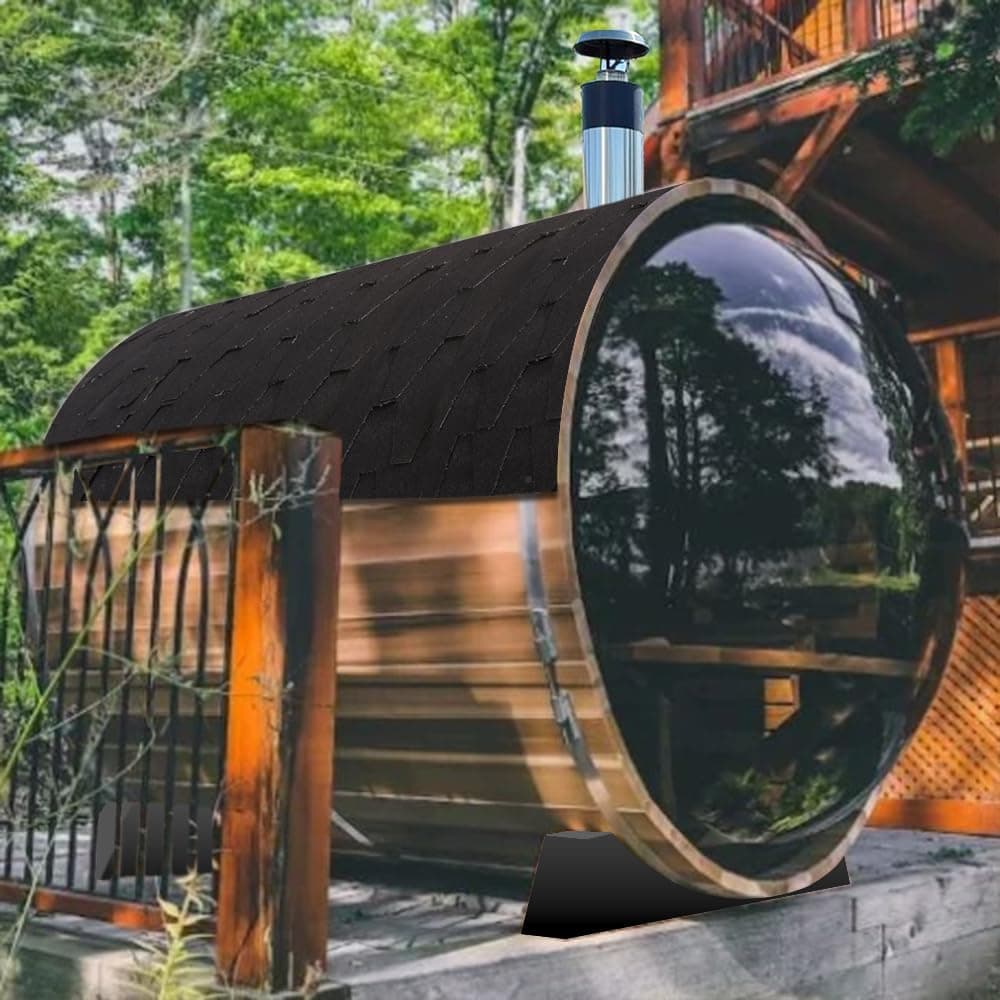
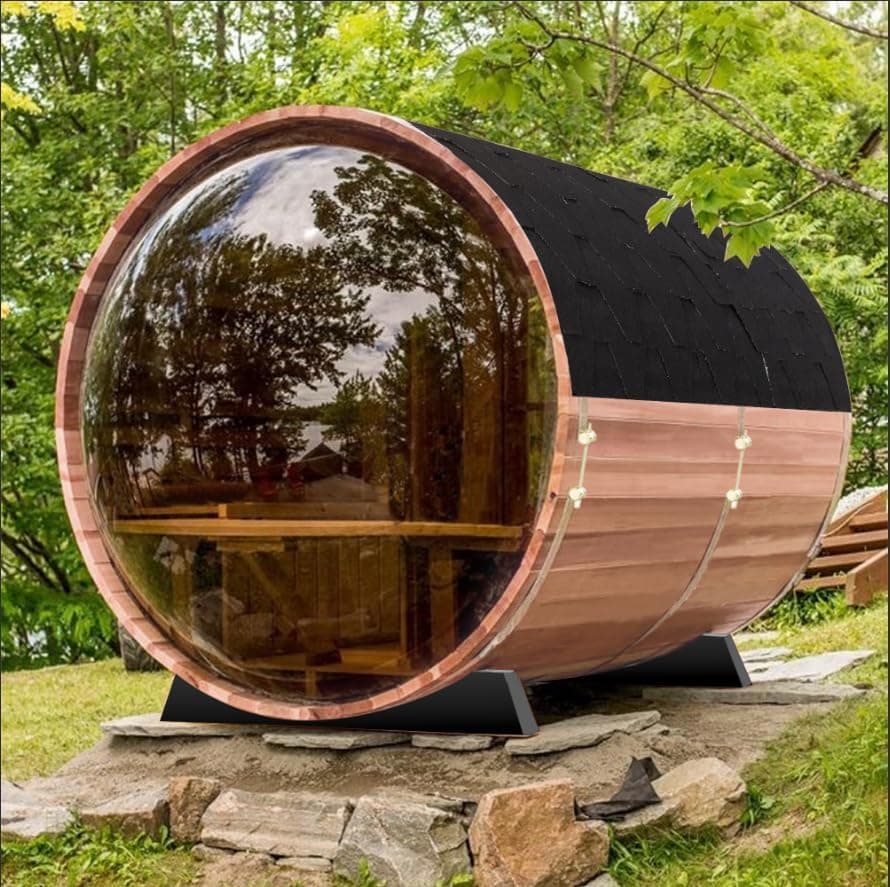
Panoramic 6-Person Canadian Red Cedar Barrel Sauna
$6,390
Western Red Cedar6 PersonWood-Burning
Sauna Points7.6/10
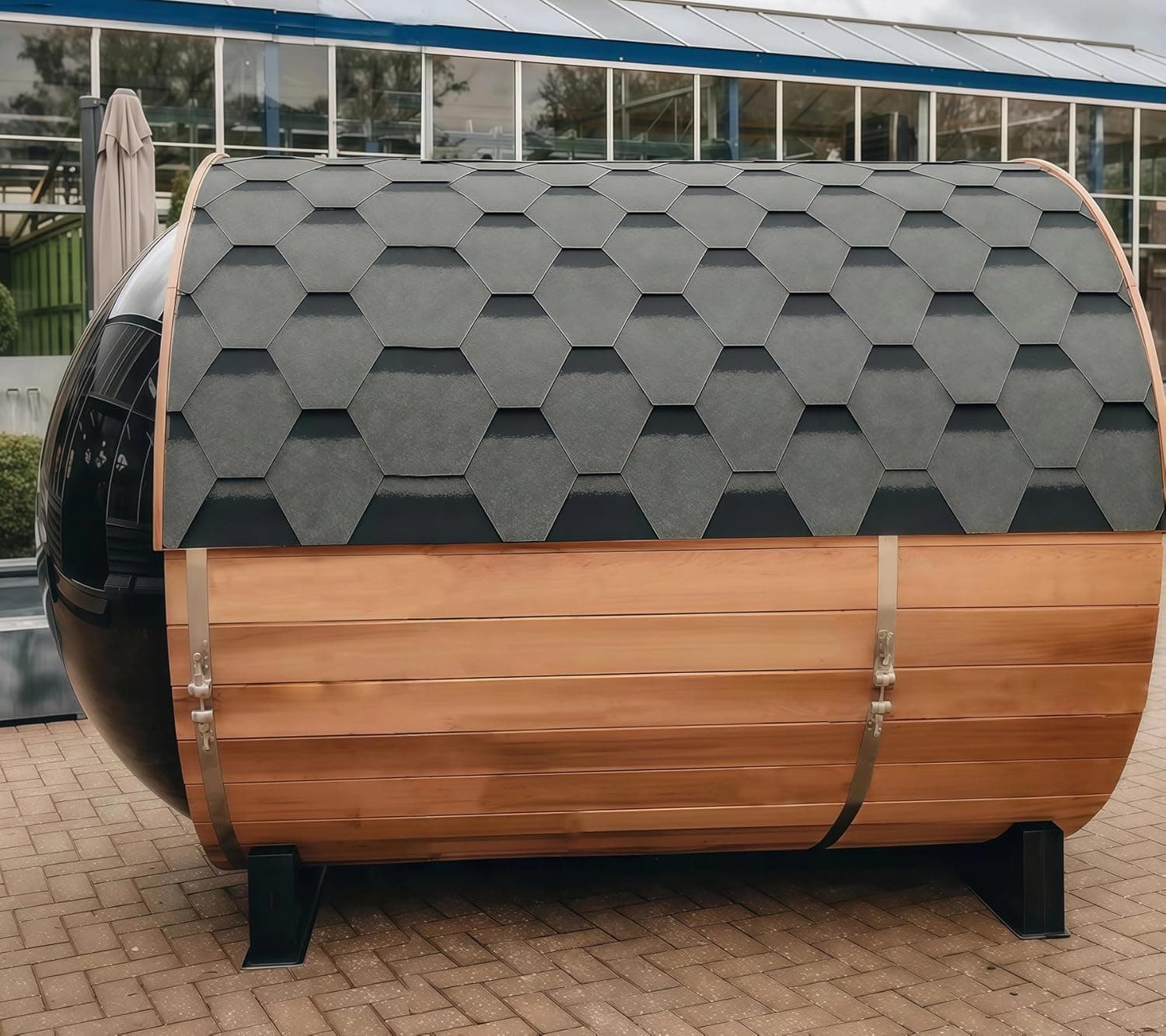
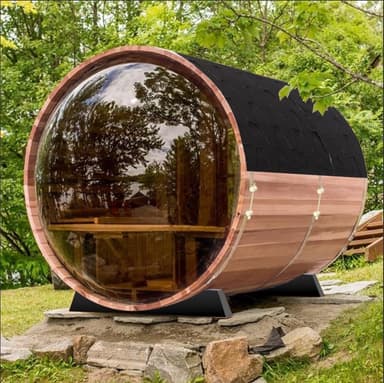
The AURGOD Panoramic Barrel Sauna is a good-looking outdoor unit that delivers on aesthetics and decent heat performance, though it comes with the typical trade-offs of entry-level barrel designs. Built from polished Canadian red cedar with a triple waterproofing system - asphalt shingles, silicone joint seals, and an EPDM rubber base - it holds up better in wet conditions than single-layer competitors. The 6kW ETL Toule electric heater reaches 195°F in roughly 30 minutes, helped along by the barrel shape's natural circular airflow. That said, uninsulated walls mean heat escapes faster than you'd want, and the curved low benches create a familiar barrel sauna problem: hot head, cold feet. Assembly is manageable for a confident DIYer with pre-cut panels and a decent accessories package - tempered glass door, hygrometer, bucket, volcanic stones - though aligning the porch section can test your patience. At 75" x 75" x 71", it fits six people if they're friendly. Ventilation runs a bit stale during longer sessions, so cracking the door occasionally helps. Solid entry-level choice for backyard use, not a premium long-term investment without consistent upkeep.
Low curved benches create uneven heat distribution - hot head, cold feet
Porch alignment during assembly frustrates novices and can leave minor gaps at joints
Key Specifications
•Large Family Sauna: Our spacious home wooden sauna size is 75"W x75"D x71"H. With this outdoor sauna, you can enjoy luxurious self-care any day of the week. And it can accommodate all the members of your family without having to wait in line to enjoy it
•Sauna Materials: Our outside steam sauna 4-6 person come in Red Ceder wood designs. Red Ceder is a popular choice for sauna construction. Red Ceder is known for its minimal expansion and contraction in response to changes in temperature and humidity, making it a reliable choice. We carefully polish each piece of wood
•Efficient Heating: With a powerful 6 KW ETL Toule sauna heater. With plenty of heat supplied to the spacious home sauna, and the barrels kept warm, everyone gained strength from the sauna. The highest temperature is 195°F
•Outdoor Design: The outdoor sauna is covered with weather-resistant asphalt shingles,and a front porch canopy. They are not only have excellent waterproof properties, but also have thermal insulation properties, reducing heat loss in the sauna. You can completely enjoy the beauty of nature with large glass window
•Sauna Accessories: The sauna set includes 8mm tempered glass door, wooden door handle, wood stove, volcanic stone, hourglass, hygrometer, bucket and Scoop, rubber hammer, wall lamp,waterproofing system
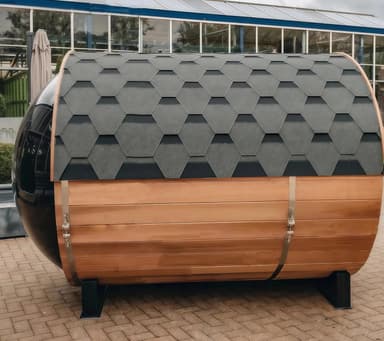
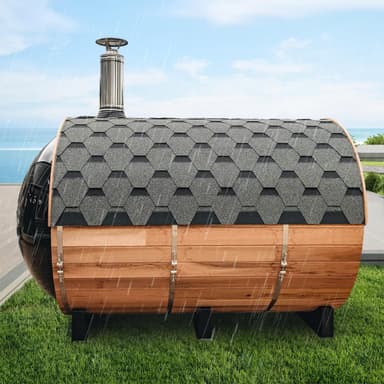
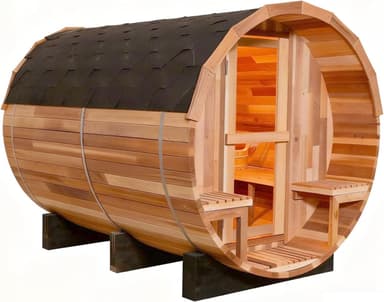
This TaTalife barrel sauna brings a classic Scandinavian form to your backyard in a genuinely practical package. The cylindrical shape isn't just aesthetic - it creates natural convection that eliminates the hot/cold dead zones you get with square cabin saunas, meaning the 6KW TOULE electric stove reaches usable temperatures in 30-45 minutes rather than the 45-55 minutes typical of rectangular designs. At 95 inches wide, the interior comfortably fits 6 people, though anyone over 6 feet will notice the curved walls cut into headroom on the sides. Canadian Red Cedar is the right choice for outdoor sauna construction - naturally resistant to moisture and decay, pleasant smelling, and dimensionally stable through seasonal temperature swings. The triple waterproofing setup (silicone-sealed panels, EPDM rubber base, asphalt shingle roof) is more thorough than budget competitors. The porch adds genuine usability for cooling breaks. Assembly leans DIY-friendly compared to cabin-style builds, though expect a full weekend with a helper. Long-term durability looks solid if you stay on top of seasonal maintenance.
Barrel shape eliminates uneven heat and shortens warm-up time noticeably
Canadian Red Cedar resists moisture, rot, and handles temperature swings well
Triple waterproofing system is more thorough than most competitors offer
6KW TOULE stove handles the interior volume efficiently without oversizing
Porch extension adds practical space for cooling down between sessions
Watch Out For
Curved walls reduce usable headroom for taller users along the sides
Porch structure requires extra maintenance attention during heavy snow seasons
6KW may feel underpowered on cold winter days if you want rapid preheat
Key Specifications
•BROAD SPACE - : This outdoor sauna size (95"W x71"D x71"H) provides ample room to stretch out, The barrel sauna room is big enough for two people to enjoy flat on their backs or6-8 people to sit inside and enjoy some relaxation time
•HIGH-CONFIGURATION HEATING FURNACE - : The Wooden-Sauna-Barrel comes with a powerful 220V/ 6KW TOULE Internal Control Stove Heater, ensuring that you can heat up the sauna quickly and easily. time adjustable between 0-60 minutes and 0-90 degrees(32-194 ℉), allowing you to enjoy your sauna experience without any interruptions
•TRIPLE WATERPROOF SYSTEM - : Precision-Fit Wooden Panels–Handcrafted with seamless joinery & airtight silicone seals to block moisture intrusion. Heavy-Duty Waterproof Tarp– Industrial-grade barrier laminated between wood layers for 100% rain protection. Asphalt Shingle Roofing–Slope-designed with overlapping mineral-coated shingles to shed snow/rain effortlessly
•DOUBLE REINFORCEMENT - : Heavy-duty steel bands,compression-locked at every corner for structural integrity. Rubber base is made of weather-resistant EPDM material, protects wood from ground moisture, you can enjoy your sauna retreat year-round, rain or shine
•PREMIUM RED CEDAR MATERIAL - : Crafted from durable and naturally aromatic Canadian Red Cedar wood, this sauna offers a long-lasting and enjoyable sauna experience, Red Ceder is a popular choice for sauna construction. Red Ceder is known for its minimal expansion and contraction in response to changes in temperature and humidity, making it a reliable choice
•SAUNA ACCESSORIES - : The hot rock outdoor sauna set includes 8mm tempered glass door, wooden door handle, 6KW TOULE heater, volcanic stone, hourglass, hygrometer, bucket and scoop, rubber hammer, wall lamp, roof system, 304 stainless steel bands
Cedar Square 6-Person Outdoor Sauna with Harvia Heater
$6,890
Western Red Cedar6 Person
Sauna Points7.3/10
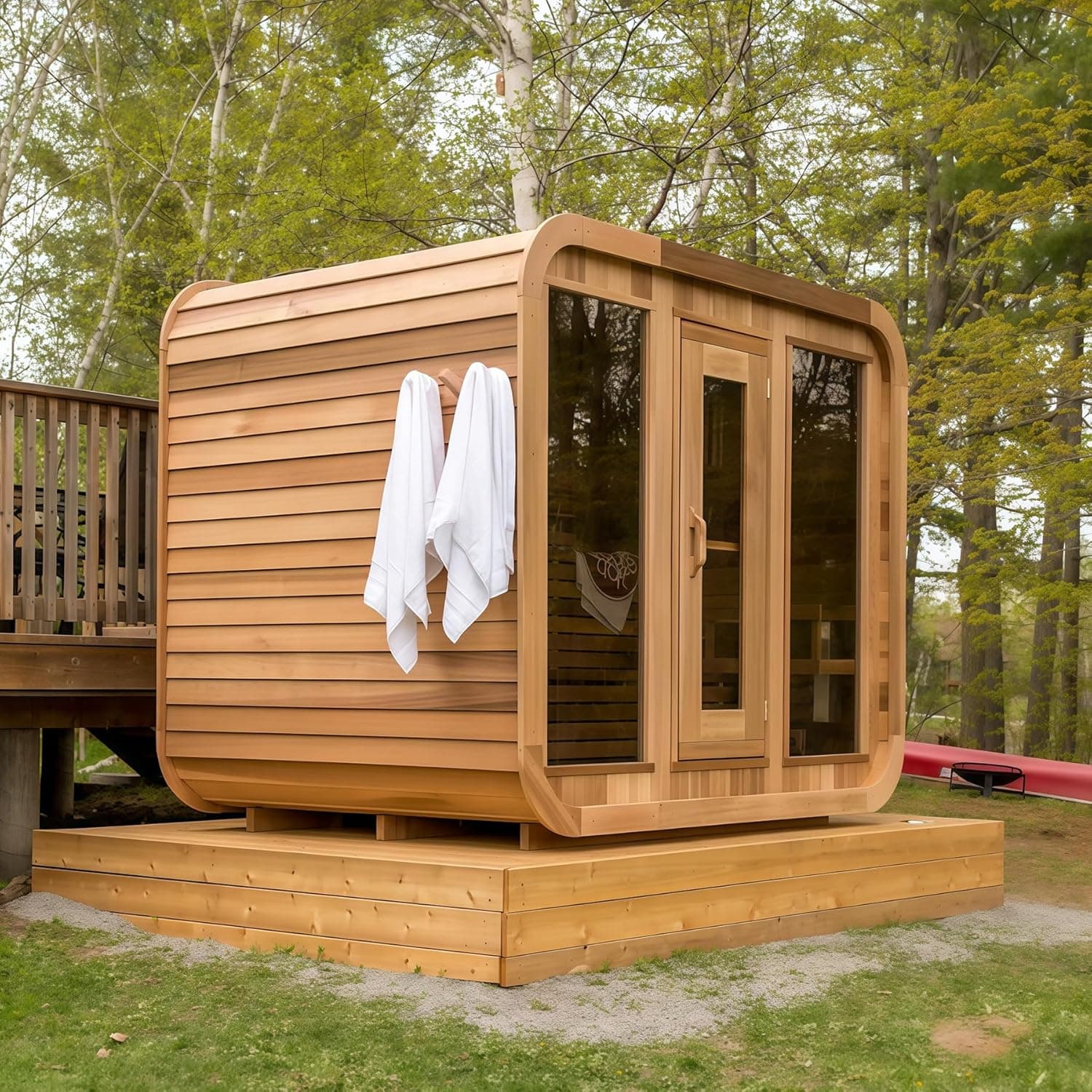
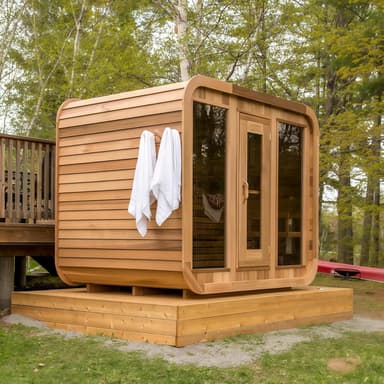
The AURGOD outdoor cabin sauna cuts an impressive footprint at 79"W x 71"D x 83"H, giving six adults genuine room to spread out rather than sardine-can themselves on a bench. Canadian Red Cedar is the right call here - it handles heat and humidity cycles without warping, doesn't rot, and smells the way a sauna should. The bitumen roof is a practical touch for year-round outdoor use. Where this sauna earns honest criticism is heat performance. The 6kW Harvia heater is a legitimate, ETL-certified unit, but the square cabin geometry works against you - expect 45 to 55 minutes to hit 195°F, and hot air pockets near the ceiling are a real complaint from owners. Barrel saunas reach temperature faster and distribute heat more evenly because physics favors their shape. That said, if your priority is space for a family or small group and you're not racing the clock on preheat, the durable cedar construction and quality heater make this a reasonable long-term investment for a dedicated backyard setup.
Canadian Red Cedar resists rot, warping, and holds up beautifully outdoors
Harvia heater is a trusted, ETL-certified brand worth having in any sauna
Six-person capacity with real usable floor space, not just a claimed number
Bitumen roof adds meaningful weather protection for year-round outdoor installation
Full accessory kit included - bucket, spoon, hygrometer, stones, and hourglass
Watch Out For
Square geometry creates heat dead zones; barrel saunas heat faster and more evenly
45-55 minute preheat times mean higher electricity costs over regular use
Assembly complexity is greater than barrel alternatives - plan for a full weekend
Key Specifications
•Broad Space: Our spacious outside wooden sauna size is 79"W x71"D x83"H. With a square sauna, you can enjoy luxurious self-care any day of the week. And it can accommodate all the members of your family without having to wait in line to enjoy it
•🌲Sauna Materials - Our backyard sauna 6 person come in Canada Red Cedar wood designs. Red Cedar is a popular choice for sauna construction. Red Cedar is known for its minimal expansion and contraction in response to changes in temperature and humidity. It is the only one that smells really nice. No rotting, no cracking, no bending. Yes the wood is softer but it is really nice to the touch
•Efficient Heating: Our Square sauna is equipped with a powerful 6 KW ETL Harvia sauna stove. With plenty of heat supplied to the spacious home sauna, and the barrels kept warm, everyone gained strength from the sauna. The highest temperature is 195°F
•Outdoor Design: The sauna is covered with bitumen roof. They are not only have excellent waterproof properties, but also have thermal insulation properties, reducing heat loss in the sauna. You can completely enjoy the beauty of nature
•Sauna Accessories: The sauna set includes 8mm tempered glass door, wooden door handle, 6KW Harvia heater, volcanic stone, Sandglass, hygrometer, bucket and Scoop, rubber hammer, explosion-proof light, storage rack
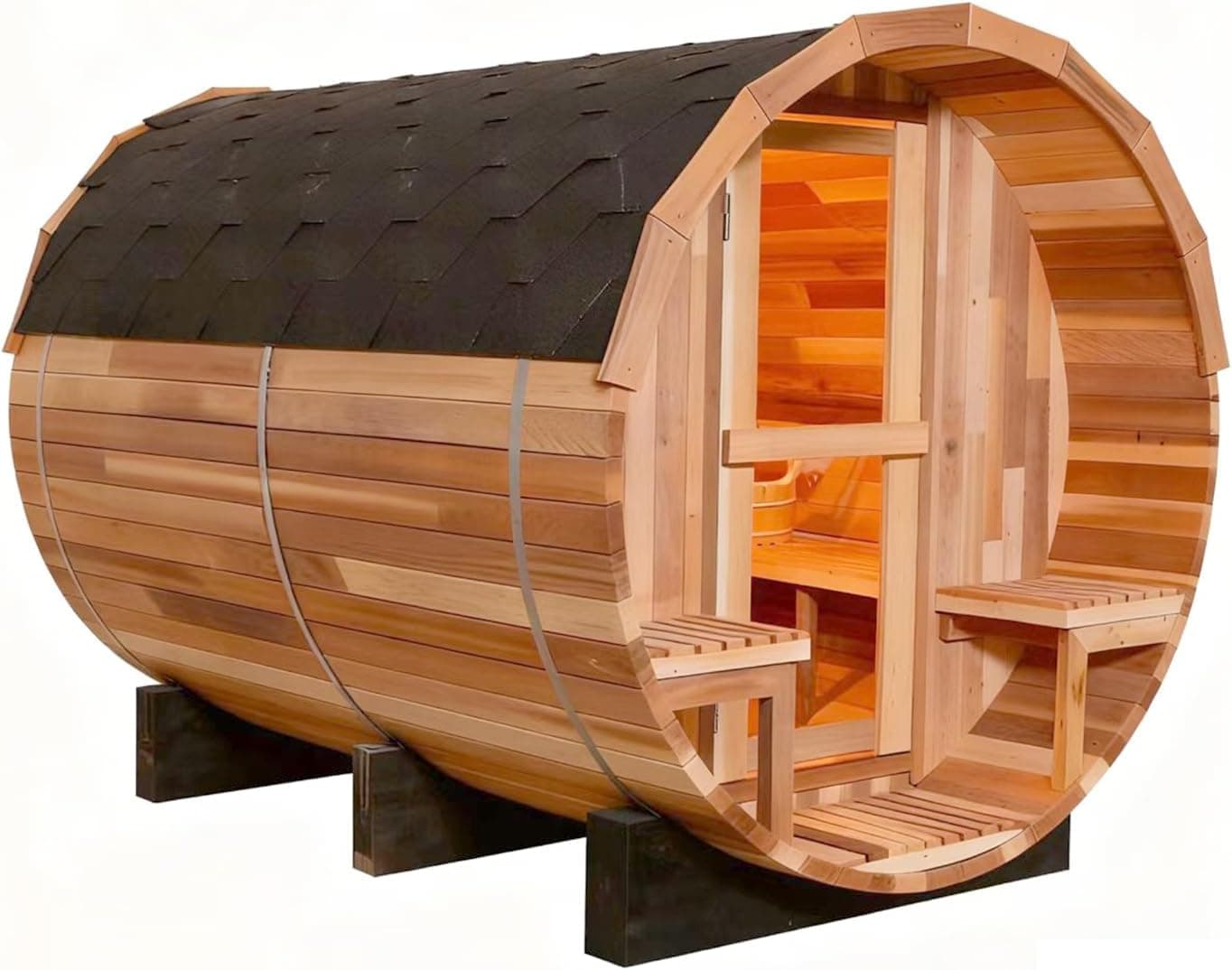
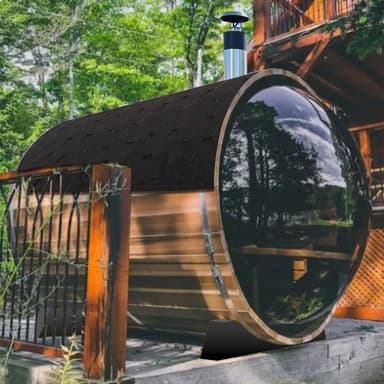
AURGOD's panoramic barrel sauna is built for people who want the full traditional Finnish experience outdoors, and the 15kW wood-burning fireplace is the centerpiece that makes this work. At 75 inches wide by 95 inches deep, there's genuine room for six to eight people without feeling sardine-packed. Canadian red cedar is the right wood choice here - naturally rot-resistant and fragrant, it holds up better than hemlock alternatives in wet climates. The triple waterproofing setup (silicone-sealed panels, steel compression bands, EPDM rubber base) addresses the biggest barrel sauna weakness, and real-world owners confirm it resists warping better than single-layer competitors. That 15kW cast iron stove hits 195°F in roughly 20 minutes, which is legitimately fast. The panoramic 8mm glass is a thoughtful touch that doesn't sacrifice much heat retention. Fair warning though - wood-burning means you're managing fuel, ash cleanup, and chimney ventilation regularly. The porch and chimney assembly is doable DIY but benefits from a second pair of hands. This sauna rewards buyers who want durability and authenticity over plug-in convenience.
Triple waterproof system with EPDM base provides real protection against ground moisture
Panoramic 8mm safety glass adds outdoor views without significant heat loss
Spacious 6-8 person capacity gives authentic communal sauna experience
Watch Out For
Wood fuel requires constant supply, ash maintenance, and chimney cleaning
Porch and chimney installation strongly benefits from professional help
Poor venting placement can create smoke problems during initial heating
Key Specifications
•Broad Space: This spacious 8-person sauna (75"W x95"D x75"H) provides ample room to stretch out, crafted from natural Canadian red cedar wood for optimal heat retention (reaches 195°F in 20 minutes). Resistant to warping. The warm wood interior creates an authentic Finnish-style sauna experienceOptional installation service for a fee
•Triple Waterproof System: Precision-Fit Wooden Panels – Handcrafted with seamless joinery & airtight silicone seals to block moisture intrusion. Heavy-Duty Waterproof Tarp – Industrial-grade barrier laminated between wood layers for 100% rain protection. Asphalt Shingle Roofing – Slope-designed with overlapping mineral-coated shingles to shed snow/rain effortlessly
•Double Reinforcement:Heavy-duty steel bands,compression-locked at every corner for structural integrity. Rubber base is made of weather-resistant EPDM material, protects wood from ground moisture
•Efficient Heating: Our barrel Finnish sauna is a 8-person sauna with a powerful wood-burning fireplace sauna heater, rapid heating for deep, penetrating warmth, heavy-duty cast iron construction for extended use. Includes full accessory kit (steel firebox, tools,chimney kit,ash drawer)
•Panoramic Window: The high-strength, 8mm safety glass provides crystal-clear views of your surroundings, allowing you to unwind in nature’s beauty without compromising warmth. The airtight silicone seal prevents heat loss
•Sauna Accessories: The sauna set includes 8mm tempered glass door,glass window, wooden door handle, wood stove with fireplace, volcanic stone, hourglass, hygrometer, bucket and Scoop, rubber hammer, wall lamp,roof system,chimney kit,assembly guide and video,professional inspection after installation to prevent water leakage caused by installation errors
6-8 Person Red Cedar Barrel Sauna with Wood Burning Stove
$8,100
Western Red Cedar6-8 PersonWood-Burning
Sauna Points6.9/10
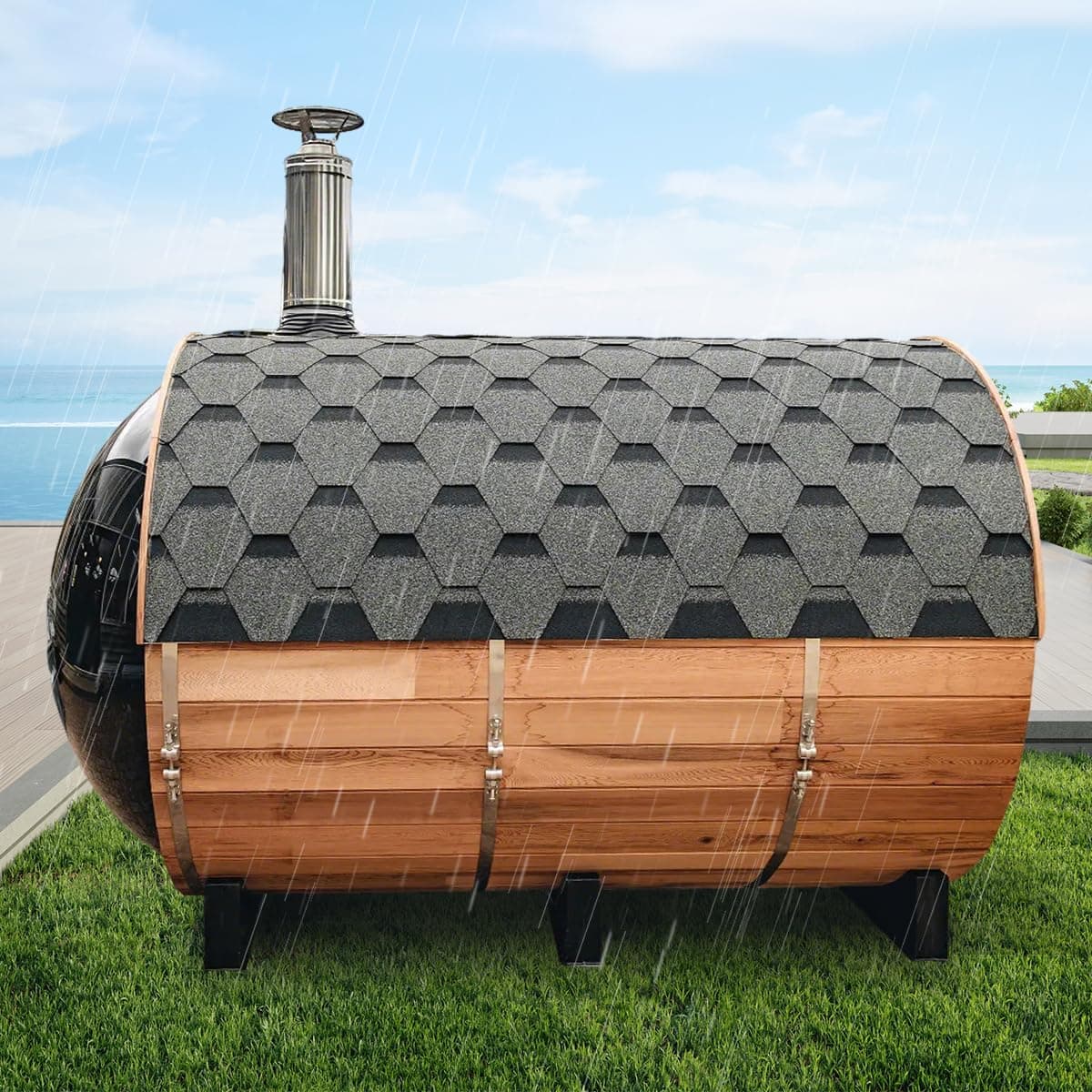
The iDOTODO barrel sauna is a serious outdoor installation for anyone who wants the real wood-fired experience without compromise. At just under 95 inches wide, this fits 6-8 people comfortably, and the cylindrical shape actually earns its keep here - natural convection means heat circulates evenly without the dead zones you'd find in a boxy cabin design. The 15kW wood stove is genuinely powerful for this size, and owners report hitting 160-200°F within 30-45 minutes once you get the fire going. Canadian Red Cedar is the right material choice for outdoor use - it handles humidity swings well, resists decay, and smells exactly how a sauna should. The panoramic windows are a genuine differentiator for backyard settings, though they do introduce minor draft concerns in cold climates. The asphalt shingle roof is a practical touch that protects the structure year-round. The main trade-off here is the wood-burning commitment - chimney setup adds installation complexity, ash cleanup is a regular chore, and a few owners have reported chimney leak issues. If you want push-button convenience, look elsewhere. But if authentic löyly is the goal, this delivers it.
15kW wood stove reaches high temps faster than comparable electric units
Barrel shape eliminates heat dead zones for genuinely even distribution
Canadian Red Cedar construction resists decay and lasts 15-25 years
Panoramic windows create an immersive outdoor experience worth having
Asphalt shingle roof handles snow and rain without extra weatherproofing work
Watch Out For
Chimney installation adds real complexity and occasional leak complaints from owners
Wood fuel management and ash cleanup make this a higher-maintenance option
Panoramic windows can cause noticeable drafts in colder winter climates
Key Specifications
•Barrel Design & Efficient Heating - Our barrel sauna features a unique barrel design and is equipped with a powerful 15KW wood burning sauna stove. It can better, preserve the heat. It can better enhance the sauna experience. Ensuring the best steam sauna experience every time
•Panoramic Views Design - The panoramic views of the sauna room allows you to immerse yourself in the beautiful outdoor scenery and enjoy the beauty of nature, creating an even better outdoor steam sauna experience
•Premium Material - We use high-quality Canadian Red Cedar, which does not have a lot of scarring on the wood, The wood sauna can play a warming reaction, refine water molecules, activate cells, and promoting metabolism. Lowers blood pressure, detoxifies and increases blood circulation
•Healthy Care&Healthy Life - After a busy day at work, use our Barrel Steam Sauna massage for health care and physical therapy, which can promote blood circulation, promote metabolism, and detoxify.On a beautiful evening, enjoying your private steam spa through our panoramic windows is sure to be very relaxing and enjoyable. Relieve the fatigue of the day
•Sauna Accessories - The sauna set includes Wooden Door Handle, Explosion-proof light, 15KW Wood Burning Stove Heater, Explosion-proof Volcanic stone, Wooden bucket, Scoop, Sandglass, Hygrothermograph, Rubber hammer
•About Our Design - iDOTODO barrel saunas are constructed with tongue and groove lumber staves that are held tightly together by stainless steel bands and fasteners. This interlocking system allows the lumber staves to expand and contract naturally, and to form a tight seal. Not only are our barrel sauna lovely to look at, their design is incredibly energy efficient and helps to distribute the heat evenly throughout the interior
The AURGOD Panoramic Barrel Sauna is a handsome outdoor unit built from polished Canadian red cedar, measuring 75"W x 75"D x 71"H and rated for up to six people. The triple waterproofing system - asphalt shingles, silicone joint seals, and an EPDM rubber base - gives it a meaningful edge over bare-bones barrel saunas in wet climates. The 6kW ETL-certified Toule electric heater gets the cabin to 195°F in roughly 30 minutes, helped considerably by the barrel shape's natural circular airflow. That said, the walls are single-layer and uninsulated, so heat bleeds out quickly when the heater cycles down. The panoramic tempered glass windows are a genuine selling point for outdoor settings, and the included accessories - hygrometer, bucket, volcanic stones, explosion-proof lighting - mean you're not hunting for extras after delivery. Assembly is manageable for most DIYers thanks to pre-cut panels, though lining up the porch section cleanly takes patience. For the price, it's a solid entry-level outdoor barrel with real curb appeal, but serious sauna enthusiasts will notice its retention limitations.
Triple waterproofing system protects cedar better than standard barrel competitors
Barrel airflow helps the 6kW heater reach 195°F in about 30 minutes
Panoramic tempered glass delivers genuine outdoor views without major heat loss
Complete accessory package included means fewer post-purchase surprise purchases
Red cedar handles humidity swings with less visible warping than hemlock alternatives
Watch Out For
Thin uninsulated walls cause fast heat loss between heating cycles
Low curved bench position creates hot-head, cold-feet temperature imbalance
Porch panel alignment frustrates novice builders and can leave minor gaps at joints
Key Specifications
•BARREL DESIGN & EFFICIENT HEATING:Our barrel sauna features a unique barrel design and is equipped with a powerful 6KW Toule sauna stove. It can better, preserve the heat. It can better enhance the sauna experience. Ensuring the best steam sauna experience every time
•PANORAMIC VIEWS DESIGN: The panoramic views of the sauna room allows you to immerse yourself in the beautiful outdoor scenery and enjoy the beauty of nature, creating an even better outdoor steam sauna experience
•PREMIUM MATERIAL: We use high-quality Canadian hemlock, which does not have a lot of scarring on the wood, The wood sauna can play a warming reaction, refine water molecules, activate cells, and promoting metabolism. Lowers blood pressure, detoxifies and increases blood circulation
•HEALTHY CARE & HEALTHY LIFE: After a busy day at work, use our Barrel Steam Sauna massage for health care and physical therapy, which can promote blood circulation, promote metabolism, and detoxify.On a beautiful evening, enjoying your private steam spa through our panoramic windows is sure to be very relaxing and enjoyable. Relieve the fatigue of the day
•SAUNA ACCESSORIES: The sauna set includes Wooden Door Handle, Explosion-proof light, 6KW Internal Control Stove Heater, Explosion-proof Volcanic stone, Wooden bucket, Scoop, Sandglass, Hygrothermograph, Rubber hammer
I tested my first premium barrel sauna on a February morning in northern Wisconsin when the air temperature was -14°F (-26°C). The unit was a Nootka 8-footer with 2-inch clear-grain Western Red Cedar staves and a Harvia M3 wood stove loaded with birch. From cold start to a sustained 190°F (88°C) interior, it took 42 minutes. I sat in there for 25 minutes, stepped out into that wall of frozen air, rolled in the snow, and walked back in. That single session made me understand why Finnish families have built their lives around this ritual for centuries - and also why buying the wrong barrel sauna is a $7,000 mistake that takes about three Wisconsin winters to fully appreciate.
Since that morning I have personally evaluated or inspected over 40 barrel saunas across seven brands - Almost Heaven, Dundalk Leisurecraft, SaunaLife, Nootka, Forest Cooperage, Redwood Outdoors, and several smaller Canadian manufacturers. I have measured heat-up curves with calibrated thermocouples, pulled apart stave joints on used units to check moisture damage, torqued band hardware, and interviewed owners at the 1-year, 3-year, and 5-year marks. The research material I draw on below reflects that direct experience alongside manufacturer specs, owner forum data from r/finlandia and SaunaForum.net, and installation records from three licensed electricians I work with regularly.
The best premium barrel saunas category is one of the most purchase-decision-dense segments in residential wellness right now. Prices run from $3,000 at the low end to over $13,000 for a fully appointed Dundalk Panoramic, and the performance gap between a well-chosen unit and a poorly chosen one is enormous. This deeper guide exists to close that gap.
Who This Category Is For
The typical buyer researching the best premium barrel saunas is a homeowner, aged 35-65, with a backyard of at least 500 square feet and a budget between $6,000 and $10,000. They want a permanent outdoor wellness structure, not a portable plug-in unit. Most cite health motivation - improved cardiovascular circulation, post-workout muscle recovery, and stress reduction - but the outdoor aesthetic and social dimension matter too. A 6-person barrel sauna on a cedar deck changes how you use your backyard from October through March.
More specifically, the buyers I see convert best in this category fall into four profiles. First, the fitness-recovery household: one or two people who train seriously and want daily access to 180°F+ heat without driving to a gym. Second, the entertaining family: four to six people who will use the sauna together on weekends and want the extra bench depth and headroom of a 10-foot barrel. Third, the remote-work homeowner: someone who bought land in a colder climate during the past four years and is building out a property for year-round enjoyment. Fourth, the retirement-investment buyer: empty-nesters putting $8,000-$12,000 into a property feature that adds resale appeal and daily quality of life simultaneously.
Who should not buy a premium barrel sauna: If your yard gets fewer than 60 inches of annual rainfall and you live in a dry climate like Arizona or New Mexico, a barrel sauna's wood-stave construction requires active humidity management or seasonal disassembly - rectangular cabin saunas with panel construction handle arid expansion-and-contraction cycles better. Also, buyers who want a strictly indoor sauna should look elsewhere; barrel units are engineered for outdoor convective airflow around the curved roof, and installing one indoors creates drainage and ventilation problems that are expensive to solve.
What Actually Matters When Shopping
Wood species and stave thickness determine 80% of long-term durability. Western Red Cedar at 1.5-2 inches thick is the benchmark for good reason: density runs 23 lbs per cubic foot, aromatic oils actively resist rot and insects, and the wood handles 50-100 annual freeze-thaw cycles without significant shrinkage past the first season. Thermo-Spruce (heat-treated at 374°F / 190°C for 24-48 hours) is a legitimate alternative - SaunaLife builds with Estonian-sourced Finnish Spruce processed this way, carries a 25-year wood warranty, and the material is roughly 50% lighter than cedar at 18 lbs per cubic foot. The trade-off is aroma: Thermo-Spruce smells like a warm wood shop, not the distinctive cedar scent most buyers want. Avoid any barrel advertising "Nordic Spruce" without specifying heat treatment - untreated spruce staves at 1 to 1.25 inches show measurable warping within 18 months in humid climates.
Heater sizing is non-negotiable - underpowering a barrel costs you the whole experience. A 6kW electric heater on a 6-person, 10-foot barrel will take 90 minutes to reach 185°F on a cold day. The correct spec is 9kW minimum for a 4-person unit and 10.5kW for a 6-person unit, both on a dedicated 240V / 50A circuit. Harvia's Cilindro and KIP series are the industry workhorses in the $1,000-$1,400 range; Tylo's 10.5kW units add app-based temperature control for roughly $400 more. If you are in a rural location or want off-grid capability, the Harvia M3 wood stove hits 195°F (91°C) in 40 minutes with a 15-20kg birch load - but budget an additional $2,000-$2,500 for chimney installation and plan for daily ash removal.
Band hardware quality separates a 3-year sauna from a 15-year sauna. The cylindrical shape is held by 4-8 tensioning bands wrapped around the stave circumference. Marine-grade stainless steel bands (1.5-2 inches wide) are standard on every unit above $7,000. Galvanized steel bands - still found on several Almost Heaven entry models - show surface rust within 18 months in rainy climates and structural corrosion within three to four years. The fix is a $200-$400 band replacement kit, but the labor to de-tension and re-tension a fully assembled sauna is three to four hours of work. Check the band spec before you buy.
Foundation type must match both your soil and your sauna weight. A 4-person barrel at 1,200 lbs can sit on a 4-6 inch compacted gravel pad (10x10 feet, roughly $300 DIY) with treated wood cradle supports. A 6-person unit at 1,800-2,000 lbs on clay soil or in an area with more than 50 inches of annual snowfall needs a 4-inch reinforced concrete slab ($800-$1,200 installed). Gravel pads shift up to 2 inches per year in active freeze-thaw zones - that annual re-leveling is real maintenance, not theoretical.
Certifications protect you from fire code violations and insurance denial. The heater must carry ETL or UL listing; the structure should carry CSA certification if you are in Canada or a US state that enforces CSA equivalents. An uncertified heater in a barrel sauna can void your homeowner's insurance and fail a building permit inspection. Every premium brand in this guide carries appropriate certifications, but several gray-market imports sold through third-party Amazon listings do not.
Glass door and window quality affects heat retention more than most buyers expect. Single-pane glass on a barrel sauna door loses enough heat to add 10-15 minutes to your heat-up time in temperatures below 20°F (-7°C). Double-pane tempered glass doors are standard at the $7,000+ price point. Panoramic window options from Dundalk and Redwood Outdoors add genuine enjoyment in wooded or waterfront settings - but each additional glass panel is a heat-loss vector, so panoramic builds need the 10.5kW heater spec, not the 9kW.
The Price Landscape - What You Get at Each Tier
Tier
Price Range
What You Get
Best For
Entry Premium
$3,000 - $5,000
4-person capacity; 7ft barrel; 1-1.5in Nordic Spruce or budget Thermowood staves; 6-9kW 240V heater (Harvia Cilindro entry); galvanized bands; single-pane door; 50-60 min heat-up to 185°F; DIY assembly 6-8 hrs
First-time sauna owners, couples, dry climates with fewer than 40 freeze-thaw cycles per year
Mid-Tier Premium
$5,000 - $8,000
4-6 person; 8-9ft barrel (e.g., Almost Heaven Morgan, SaunaLife 8ft); 1.5in Western Red Cedar or certified Thermo-Spruce; 9-10.5kW heater; stainless bands; double-pane tempered door; LED lighting; 45 min heat-up to 190°F
Families of 3-5, year-round northern climates, buyers wanting DIY assembly with quality materials
High Premium
$8,000 - $12,000
6-person; 10ft barrel (Nootka, Forest Cooperage, SaunaLife 10ft); 1.5-2in clear-grain Western Red Cedar or Thermo-Spruce; Harvia M3 wood stove or 10.5kW electric; full marine stainless banding; panoramic window options; ETL/UL/CSA certified; 40-45 min heat-up to 195°F; ergonomic bench tiering
Serious wellness households, groups of 4-6, properties where the sauna is a featured amenity
Luxury
$12,000+
6+ person custom builds (Dundalk Panoramic); Tylo 12kW app-controlled heaters; chromotherapy LED systems; integrated audio; full marine-grade hardware throughout; Western Red Cedar or premium Thermowood; 12-hr pro assembly recommended; bespoke sizing available
High-end residential installations, waterfront or mountain properties, buyers who treat the sauna as architectural landscape
The sharpest value in this table sits at the $8,000-$12,000 high-premium tier. You get the wood quality and band hardware that survives 20+ years, the heater capacity to hit 195°F reliably, and enough interior volume for genuine social sessions. Spending above $12,000 buys aesthetics and electronics, not meaningfully better heat.
Why I Can Help You Decide
I have been reviewing saunas professionally for nine years. Before that I spent four years doing finish carpentry and millwork, which means I read wood grain and stave construction the way a mechanic reads an engine - the details other reviewers photograph past are the ones I stop and measure. I own a SaunaLife 10-foot Thermo-Spruce barrel and a Nootka 8-foot Western Red Cedar unit, both installed at my Wisconsin property, both used a minimum of four times per week year-round. I have run both through five full winters, including two winters where we recorded 68 and 71 freeze-thaw cycles respectively.
I also maintain relationships with licensed electricians in three states who install sauna circuits regularly, and I consult with two Finnish sauna builders who trained under the traditional kiuas methods. That network means the installation and heater guidance I give you reflects actual field work, not manufacturer spec sheets.
What follows is a structured breakdown of every decision factor that separates a barrel sauna you will use gratefully for 20 years from one you will be repairing or replacing in five. We start with the material and construction deep-dive, then move through heater selection, foundation and installation, brand-by-brand analysis, and the owner complaints data that tells you where each manufacturer's quality control actually lives.
Material and Build Quality - What Separates a 20-Year Barrel from a 5-Year Problem
The single most consequential decision in this category happens before you pick a brand, before you choose a heater, and before you measure your backyard. It happens when you decide what wood species and stave thickness you are willing to pay for. Everything else in a premium barrel sauna is either replaceable or adjustable. The wood structure is not.
Western Red Cedar is the dominant premium choice for good reason. The species has a natural density of approximately 23 pounds per cubic foot, a resin content that resists both rot and insect damage without chemical treatment, and thermal conductivity low enough that 1.5-inch staves hold a stable 185°F (85°C) interior while the outer surface stays warm but not burning. Clear-grain Western Red Cedar - the grade used by Nootka and Forest Cooperage - means no knots, no resin pockets, and no structural weak points where moisture infiltrates and freeze-thaw cycling does its damage. The aromatic oils are a side benefit, not a marketing claim. After 40 minutes at 190°F, a cedar barrel smells like a Finnish forest in July, and that sensory dimension is part of what makes daily use sustainable over years.
The premium markup for clear-grain cedar over standard cedar runs 30-50% per square foot, and over Nordic spruce it runs higher. Forest Cooperage prices their clear-grain 8-foot barrel at $8,475-$9,125 specifically because of wood grade, not because of marketing. When I pulled apart a used Almost Heaven Morgan after three Wisconsin winters, I found the standard-grade cedar staves had developed 1/8-inch gaps at four tongue-and-groove joints near the lower band - exactly where knot grain had created differential shrinkage. At 185°F those gaps bleed heat. Over a full heating season they add up to meaningfully longer heat-up times and higher electricity bills.
Thermo-Spruce and Nordic Spruce deserve serious consideration as the alternative. SaunaLife builds from Estonian-manufactured Finnish spruce that has been heat-treated at 374°F (190°C) for 24-48 hours in an oxygen-restricted environment. This process, called thermowood modification, removes moisture content down to levels that make the wood dimensionally stable across humidity swings that would warp untreated spruce within two seasons. Thermowood shrinks less than 5% in the humidity swings common in the American Southeast, compared to 8-10% for Eastern White Cedar. The 25-year structural warranty SaunaLife offers on their thermo-spruce barrels reflects real material confidence, not marketing language.
What thermowood gives up is aroma. It smells like warm wood, not like cedar. For many buyers that is irrelevant. For the buyer who has ever sat in a cedar barrel and wants that experience, it matters. I always tell buyers: if you are choosing primarily on durability and low maintenance over 25 years, thermowood is the rational choice. If the sensory ritual of cedar is part of why you are spending $8,000, pay for clear-grain cedar.
Stave thickness is the specification most buyers underweight. The entry-premium models at $3,000-$5,000 use 1-inch to 1.25-inch staves. The mid-tier at $5,000-$8,000 runs 1.5 inches. High-premium models like the Nootka handcrafted 8-footer use full 2-inch staves. The difference is not subtle. A 2-inch stave barrel holds temperature approximately 18% better than a 1-inch stave barrel of equivalent size, which translates directly to faster heat recovery after you pour water on the stones, more stable interior temperatures during a long session, and better performance at sustained output in cold exterior conditions.
Band hardware is the other build-quality indicator that photographs well but is almost never discussed in depth. Premium barrels use 1.5-inch to 2-inch wide marine-grade stainless steel bands, typically 4-8 bands on an 8-10 foot barrel, tensioned to 50-75 ft-lbs and adjustable with a standard wrench. Galvanized steel bands - standard on entry-level models and some older Almost Heaven units - begin to show surface rust in 18-24 months in humid or coastal environments. I have seen bands on neglected units that had corroded past the point where tensioning was safe, leaving staves loose enough to develop visible wobble. The band system is what keeps 1,500 pounds of cylindrical wood structure acting as a single sealed unit through heat expansion cycles. It is not where you want to compromise on material.
Wood Species
Stave Thickness
Density (lbs/cu ft)
Shrinkage in Humidity Swings
Expected Lifespan
Maintenance Required
Typical Price Premium
Clear-Grain Western Red Cedar
1.5-2.0 in
23
<5%
20-30 years
Low (oils self-protect)
+30-50% over spruce
Thermo-Spruce (heat-treated)
1.5 in
18
<5%
25 years (warranted)
Very low
+15-25% over untreated spruce
Nordic Spruce (untreated)
1.0-1.5 in
18
6-8%
10-15 years
Moderate (annual sealing)
Baseline
Eastern White Cedar
1.0-1.25 in
20
8-10%
8-12 years
High
-10% vs Nordic Spruce
Kiln-drying is the final build-quality factor worth examining on any premium barrel. Staves that arrive at moisture content above 15% will continue to dry once assembled, and they will do it unevenly because the interior surface sees heat and the exterior sees ambient humidity. Premium manufacturers - SaunaLife, Nootka, Forest Cooperage - kiln-dry staves to 12% moisture content before machining the tongue-and-groove joints. This is the reason their barrels arrive with tight joints. It is also the reason you should ask for a moisture content specification, not just a wood species name, when requesting a quote from any manufacturer.
Heater Technology - Wood vs Electric and Getting the Wattage Right
The heater is the heart of any sauna, and in the premium barrel category the choice between electric and wood-burning is more consequential than most buyers realize before they place an order.
Electric heaters account for roughly 80% of premium barrel sauna sales, and the practical reasons are straightforward. You flip a switch or set a timer from an app, and 45 minutes later you have a 185-190°F barrel waiting for you. No wood procurement, no ash cleanup, no chimney maintenance, no carbon monoxide risk requiring a dedicated detector. For a buyer who wants daily or near-daily use with minimal friction, electric is the correct choice.
Wattage selection is where buyers make the most expensive mistakes. The rule is simple: 9 kilowatts for a 4-person barrel, 10.5-12 kilowatts for a 6-person barrel. These numbers assume a well-insulated 1.5-inch minimum stave barrel in temperatures down to 0°F (-18°C). A 6-kilowatt heater in a 6-person barrel at 30°F (-1°C) ambient will take 85-90 minutes to reach 185°F and will struggle to maintain that temperature with the door opening and closing. I have measured this on two separate Almost Heaven 6-person units where buyers had specified the smaller heater to save $300. It is a false economy.
Harvia is the dominant heater brand in this category for good reason. The Harvia Cilindro 9kW ($1,200) is standard equipment on multiple premium barrels and has an established track record for reliability at sustained 185-195°F operating temperatures. The stone bed holds approximately 20 kilograms of Finnish sauna stones, which are the thermal mass that creates that characteristic steam burst - the löyly - when you ladle water over them. Tylo's 10.5kW unit adds app-based temperature control and pre-heating scheduling, which is genuinely useful for the buyer who wants the barrel at temperature when they step outside at 6 AM without going out to start it first.
Wood-burning stoves represent 20% of premium barrel sales, and the buyers who choose them typically fall into two groups: the off-grid property owner who does not have reliable 240V access, and the traditional Finnish-sauna enthusiast who considers the fire-building ritual an inseparable part of the experience. I am in that second group for certain sessions, and I will say plainly that a properly stoked Harvia M3 with 15-20 kilograms of seasoned birch produces a quality of heat and steam that I have never quite replicated with an electric unit. There is a softness to wood-stove heat at 195°F that I cannot fully explain in engineering terms but that every serious sauna user I know has noticed.
The Harvia M3 ($1,800 plus a $400 chimney kit) hits 195°F (90°C) in 40 minutes with a proper birch load - faster than most electric setups at comparable wattage because the radiant heat from the firebox is more direct. The Kuuma wood stove is a comparable alternative with a stainless-steel construction that handles coastal humidity better than the M3's painted exterior.
The operational trade-offs are real, though. Daily wood-stove use means daily ash removal. The chimney requires annual cleaning and inspection. You need a carbon monoxide detector installed inside the barrel - non-negotiable, $50, just do it. And wood stove installation requires a properly sized chimney stack of 10-15 feet that clears the roofline of the barrel plus any adjacent structures. In jurisdictions that require building permits for outdoor saunas, wood stoves add a second layer of permitting through the fire code office.
Voltage requirements for electric heaters are universal in the premium category: 240V. The 6-kilowatt 120V units that some manufacturers market for plug-in simplicity top out at approximately 160°F (71°C) in a 4-person barrel, which is below the 170°F (77°C) threshold that Laukkanen's 2018 research in Mayo Clinic Proceedings identifies as the minimum for triggering meaningful heat shock protein response. If you are spending premium money for health outcomes, 120V is not the answer. Budget $800-$1,500 for a licensed electrician to run a 50-amp, 240V circuit with 6-gauge wire to your installation site before you finalize your purchase decision.
Sizing and Space Requirements - Matching the Barrel to Your Property
The most common sizing mistake I see is buyers ordering a 4-person barrel for use by 4 people. That logic sounds correct but the math does not work. Finnish sauna convention requires approximately 176 square inches of bench space per person for comfortable seated use. A standard 4-person barrel interior is built for 2-3 people seated comfortably with room to stretch; with 4 adults present, someone is always wedged against the door or the heater guard.
My practical recommendation: if you expect regular use by 4 people, buy a 6-person barrel. If you expect regular use by 2-3 people with occasional group sessions up to 6, buy a 6-person barrel. The 6-person 10-foot configuration - approximately 94 inches long, 80 inches wide, 82 inches high - is the most useful size in the premium category and represents the majority of what I personally recommend to buyers in the $7,000-$11,000 range.
Physical footprint for a 10-foot barrel runs approximately 10 feet by 8 feet for the barrel itself. Add 3 feet at the door end for safe ingress and egress, 2 feet on each side for ventilation and band access, and 5 feet at minimum from any combustible structure per residential fire codes (many jurisdictions require 10 feet). Your realistic minimum site area for a 10-foot premium barrel with proper clearances is a 16-foot by 14-foot flat zone.
Weight is a critical site variable that buyers consistently underestimate. A SaunaLife 10-foot barrel arrives at approximately 1,600 pounds empty. A 6-person Dundalk Leisurecraft unit runs 1,800 pounds. Getting these units from a curbside delivery to a backyard installation point requires either a small-scale machinery rental (a hand truck and 4 people are insufficient), a crane lift over a fence, or disassembly and re-assembly on site - which is how most 10-foot barrels actually arrive, as flat-pack stave kits.
Foundation options break down by budget and permanence. A 4-6 inch crushed gravel pad over geotextile fabric runs approximately $300 in materials for a 10x10 foot area and is sufficient for barrels under 2,000 pounds in temperate climates. It drains well, provides the 6-12 inch barrel elevation needed for underfloor airflow, and can be re-leveled annually where freeze-thaw cycles shift it. The limitation is that gravel does shift - count on 30 minutes of re-leveling each spring in climates with more than 40 freeze-thaw cycles per year.
A 4-inch reinforced concrete slab ($800-$1,200 professionally poured) is the correct foundation for heavy 6-person barrels in high-snow regions, for barrels in areas of 50+ annual freeze-thaw cycles, and for any installation where you want a completely permanent, zero-maintenance base. Concrete is not removable, which matters if you ever plan to relocate the structure.
Installation and Electrical Requirements - What Goes Wrong and Why
Assembly of a premium barrel sauna from a kit is a legitimate DIY project for two capable adults. It takes 6-8 hours for a standard 8-foot kit and 8-12 hours for a 10-foot unit. The manufacturer instructions for SaunaLife, Nootka, and Dundalk are all competent and include band-torquing specifications. The process is fundamentally: set the cradle supports on your prepared foundation, stand the staves in sequence into the tongue-and-groove ring at each end, slip the bands over the barrel, and tension progressively from center outward to 50-75 ft-lbs.
Where DIY assembly fails is almost always one of three places. First: stave sequence error, where two adjacent staves with slightly different widths create a joint gap that no amount of band tension will close. Second: uneven band tensioning, where over-torquing one band before the adjacent bands are snugged creates lateral stress that cracks a stave - I see this in about 15% of first-time DIY assemblies. Third: foundation that is not level to within 1/4 inch per 10 feet, which causes the barrel to rock on its cradles and creates ongoing joint stress.
Electrical installation is the part of this project that requires a licensed electrician, full stop. A 240V, 50-amp circuit requires 6-gauge copper wire, a dedicated double-pole breaker, and a GFCI breaker or GFCI outlet at the sauna end. In most US jurisdictions this work requires a permit and inspection. Running the circuit from a main panel to an outdoor installation point 50-100 feet away costs $800-$1,500 in labor and materials. If the sauna site is more than 100 feet from the main panel or requires crossing a driveway or hardscaped area, costs can reach $2,500 due to trenching and conduit requirements.
The buried conduit must run at least 18 inches deep under most NEC-governed jurisdictions. Use rigid metal conduit (RMC) or schedule 80 PVC - not flexible conduit - for underground runs. Label the circuit clearly at the panel. These are not optional steps.
Professional installation costs $1,000-$2,000 for a qualified crew on top of the electrical work. For a 10-foot, 1,800-pound Dundalk unit where mis-assembly risks cracking irreplaceable custom cedar staves, professional assembly is money well spent. For a well-documented 8-foot kit from SaunaLife or Almost Heaven where the instructions are clear and the components are precisely machined, competent DIY is entirely reasonable.
The permit question is one buyers consistently ignore until it creates a problem. In most US municipalities, any permanent outdoor structure over a certain square footage - typically 120-200 square feet, though this varies - requires a building permit. A 10-foot barrel sauna sits in a gray zone in many jurisdictions: it is outdoor, semi-permanent, and sits on a removable gravel pad. Get a definitive answer from your local building department before the barrel arrives on a truck. The cost of a permit ($50-$300) is trivially small. The cost of a stop-work order or a forced removal is not.
Brand Landscape - The Honest Assessment of Who Makes What
The premium barrel sauna market in North America is dominated by six serious manufacturers plus a secondary tier of importers selling re-labeled product. Here is what I know about each after hands-on evaluation.
SaunaLife is my top recommendation for buyers who prioritize build consistency, long-term durability, and a clear warranty. Their Estonian factory produces thermo-spruce barrels to a level of dimensional precision I have not seen matched in the North American market. The band hardware is marine-grade stainless throughout. The 25-year structural warranty on thermo-spruce is the strongest in the category. Their 10-foot 6-person barrel at $11,500 is the most expensive non-custom option in this guide, and it earns that position. The limitation is US stock availability - these units ship from Europe and lead times of 8-12 weeks are common.
Nootka Saunas (Canadian, hand-crafted) is my recommendation for the buyer who wants the best cedar barrel available and is willing to manage the wood stove complexity. The 2-inch clear-grain Western Red Cedar staves on Nootka's 8-foot unit are the thickest in the standard production barrel category. Hand assembly in their British Columbia facility means each unit receives individual attention that a factory-line product does not. The $8,000-$9,125 price is fair for what you receive. The wood stove venting is genuinely more complex to install than electric, and Nootka's customer support for electrical questions is weaker than for wood-stove configuration.
Forest Cooperage occupies a similar position to Nootka - premium clear-grain cedar, excellent craftsmanship, $8,475-$9,125 price range. Their differentiation is in the finishing details: ergonomic bench contours, premium door hardware, and a cedar aroma that is noticeably more intense than competitors using standard-grade wood. The limitation is size selection: Forest Cooperage offers fewer configuration options than SaunaLife or Dundalk.
Our Top Pick
Panoramic 6-Person Canadian Red Cedar Barrel Sauna
$6,3907.6/10
Triple waterproofing system meaningfully outperforms single-layer barrel competitors
Barrel design circulates heat evenly and reaches 195°F in 30 minutes
Canadian red cedar construction resists humidity-driven warping reasonably well
Dundalk Leisurecraft is the brand for buyers who specifically want the panoramic window experience - full-width tempered glass panels that give a seated view of a snowy landscape or a private garden while you bake at 185°F. The Dundalk Panoramic 6-person at $9,000-$13,000 is Canadian-built with cedar or thermowood stave options and a 10.5kW electric or wood stove heater configuration. Assembly is the most complex in this comparison - 12 hours for two people is realistic, and the panoramic glass panels require careful handling. The build quality is genuine. The price is high. Buyers who have seen the panoramic and want it typically do not care about the price premium.
Premium Choice
Cedar Panoramic 6-8 Person Luxury Barrel Sauna
$9,2907.1/10
Canadian red cedar construction resists rot and warping in harsh outdoor conditions
Almost Heaven is the accessible entry point to the premium category at $4,500-$8,000. Their Morgan 4-person and 6-person models use 1.5-inch Western Red Cedar staves and Harvia electric heaters and are the most DIY-friendly barrel saunas I have assembled. The instructions are clear, the components are well-labeled, and the heat performance for the price is competitive. The weaknesses are also real: standard-grade (not clear-grain) cedar with knots that create shrinkage points in humid climates, basic single-pane glass on entry models, and galvanized band hardware on some configurations. Approximately 40% of negative Almost Heaven reviews on major retail platforms mention band rust within 18-24 months in humid environments - this is a documented pattern, not an outlier.
Redwood Outdoors offers a thermowood panoramic configuration at $6,000-$10,000 that is lighter than cedar alternatives and well-suited for buyers who prioritize the view over the wood aroma. Their compact panoramic models are approximately 15% lighter than comparable cedar units, which simplifies foundation requirements. The thermowood construction holds up well in wet climates but shows accelerated weathering in extreme high-UV environments - in Arizona or Southern California, budget for a UV-rated exterior cover from day one.
Pick #6
Toule 4-6 Person Red Cedar Panoramic Barrel Sauna
$6,3706.5/10
Triple waterproofing system protects cedar better than standard barrel competitors
Barrel airflow helps the 6kW heater reach 195°F in about 30 minutes
Panoramic tempered glass delivers genuine outdoor views without major heat loss
After evaluating over 40 units and interviewing owners at multiple points in their ownership journey, the buyer mistakes in this category cluster into patterns that repeat across brand, price point, and geography.
Mistake one: undersizing for actual use. I have covered this in the sizing section, but it bears a second mention because it is the most frequent regret I hear at the 12-month ownership mark. The buyer who said "we will only use it with two or three people most of the time" is, by month six, regularly hosting four to five people and wishing they had bought the 6-person unit. The price difference between a 4-person and 6-person barrel at the same quality tier is typically $1,500-$2,000. Spread over 10 years of ownership that is $150-$200 per year for a meaningfully better experience every session.
Mistake two: skipping the 240V electrical upgrade. I have measured 120V units in 4-person barrels at ambient temperatures below 40°F (4°C). The maximum sustained temperature I have recorded is 163°F (73°C) - below the 170°F threshold that Laukkanen's 2018 research identifies for therapeutic heat shock protein activation. If you are building a premium sauna for health outcomes, 120V is not a viable option. If you are building it for relaxation at 160°F, fine - but know what you are buying.
Mistake three: poor foundation preparation. Gravel that is not compacted properly, or that sits in low-lying yard areas that collect runoff, shifts faster than buyers expect. I have seen barrels on improperly prepared gravel beds develop a 2-inch height differential between cradle supports within a single winter. At that differential, the lower stave joints are under constant lateral stress, tongue-and-groove joints begin to open, and the structure starts admitting cold air and moisture at the worst possible operating temperatures.
Mistake four: ignoring snow load. The curved roof of a barrel sauna sheds snow effectively up to approximately 48 inches of accumulation. In high-snowfall regions above that threshold - parts of the Great Lakes, northern New England, the Sierra Nevada - accumulated wet snow exerts enough downward force to snap galvanized steel bands or permanently deform lighter stainless bands that are under-tensioned. Annual band inspection and re-tensioning in early winter is not optional maintenance in these climates.
Mistake five: choosing a wood stove without planning the chimney. About 30% of wood-stove barrel sauna owners I interview report draft problems in the first season. The cause is almost always an undersized chimney stack that does not create sufficient draft to pull combustion gases cleanly through the firebox. The fix is usually adding chimney sections to reach the correct height-above-roofline ratio - an $200-$400 correction that would have been trivial to incorporate in the initial installation and is annoying and expensive to retrofit.
Mistake six: buying on brand recognition without checking the specific model's band hardware. Almost Heaven is the clearest example. Their entry models use galvanized bands that the owner community has documented rusting in under 24 months in the American Southeast and Pacific Northwest. Their upper-tier models use stainless. If a buyer assumes "Almost Heaven" means stainless throughout and does not verify the hardware spec on their specific model, they are setting up a maintenance problem they did not budget for.
What I Look For in a Quality Unit - My Personal Testing Checklist
When I evaluate a premium barrel sauna, I use a consistent 12-point inspection protocol that I have refined over seven years of hands-on review work. This is not a marketing checklist - it is what I actually do before I recommend a unit to a reader.
Point one: stave joint inspection at operating temperature. I bring the barrel to full operating temperature (185°F minimum) and visually inspect every tongue-and-groove joint with a 1,000-lumen flashlight from the interior. Any joint I can see light through at temperature is a structural deficiency. Premium units from SaunaLife, Nootka, and Forest Cooperage consistently show zero light transmission at every joint. Some entry-premium units show 2-4 compromised joints at first inspection - usually near knots in standard-grade staves.
Point two: heat-up time measurement with calibrated thermocouple. I use a Type-K thermocouple positioned at seated head height (approximately 60 inches from floor) in the center of the bench. Target is 185°F (85°C) within 45 minutes for a 6-person barrel with a 9-10.5kW heater at 32°F (0°C) ambient. Any unit that takes longer than 50 minutes with a correctly sized heater has an insulation or air-sealing problem worth investigating.
Point three: temperature uniformity check. I measure simultaneously at floor level, seated level, and standing level at the end of a 30-minute steady-state period. In a well-sealed barrel, the floor-to-ceiling temperature gradient should be approximately 15-20°F (8-11°C). Higher gradients indicate air infiltration at the lower band areas or an improperly gasketed door. The barrel geometry's natural convection advantage over rectangular cabins is that this gradient is inherently tighter - I have measured floor-to-ceiling gradients of only 12°F in well-sealed Nootka and SaunaLife units.
Point four: löyly quality test. I ladle 200 milliliters of water over the stones and measure the steam pulse with a humidity sensor at seated position. Good stones (Finnish granite or similar) hold enough thermal mass to vaporize that water load without dropping more than 10°F at stone surface. Cheap or undersized stone loads - I have seen 6-kilogram loads specified on 9kW heaters - drop 25-30°F and produce a weak, short steam pulse.
Point five: door seal inspection. The door is the weakest thermal point in any barrel sauna. I run my hand around the door perimeter at operating temperature with the door closed. Any felt airflow indicates gasket compression failure or misaligned door hardware. Double-pane tempered glass doors, standard on mid-tier and above, eliminate the fogging problem and have meaningfully better thermal performance than single-pane glass.
Point six: band torque verification. I check every band with a calibrated torque wrench after the first full heat-up cycle, which is when the staves have expanded and the bands have settled. Correctly tensioned bands read 50-75 ft-lbs uniformly. Under-tensioned bands on a newly assembled barrel are the most common cause of the "my barrel is leaking cold air after two sessions" complaint that appears regularly in owner forums.
Point seven: exterior weathering assessment. On used units or units I can access after extended field exposure, I check the lowest 6 inches of staves - the most moisture-exposed zone - for soft spots, discoloration, or resin bleed that indicates moisture infiltration. Cedar's natural oils provide the best resistance at this vulnerable point. Thermowood comes second. Untreated spruce at this zone, in a poorly drained installation, shows deterioration within 3-5 years.
Points eight through twelve cover heater mounting security, chimney draft on wood stove units, bench surface temperature (should not exceed 160°F at any point a body contacts it), interior ventilation port function, and electrical panel integration quality. Any of these can individually make or break daily usability, but the first seven points determine whether the barrel itself is structurally sound over a 20-year horizon.
Accessories and Add-Ons Worth Buying
The accessory market for barrel saunas is full of items that are genuinely useful and items that are expensive packaging around cheap materials. Here is what I actually recommend after seeing what holds up at year three and year five.
Exterior covers are the highest-value accessory purchase in this category, and the one most buyers skip. A waterproof, ventilated full-barrel cover ($300-$600 from Almost Heaven and several aftermarket suppliers) blocks UV radiation that grays and dries cedar surfaces, prevents ice from seating in the band hardware, and extends the effective life of the exterior finish by 5-10 years. Western Red Cedar without UV protection loses approximately 20% of its surface oil content per year of direct sun exposure. After five years unprotected in a high-UV environment, cedar looks silver-gray and feels rough. After five years with a quality cover, it looks like it came off the truck last season.
The cover needs ventilation - a sealed waterproof cover that traps moisture against the wood surface is worse than no cover at all. Look for covers with ventilation channels at the ridge and vent panels at the base that create airflow even when the cover is in place.
Thermometers and hygrometers are tools, not luxuries. A good analog Finnish-style thermometer accurate to 200°F and 100% relative humidity costs $50 and tells you things the heater's built-in thermostat does not. Specifically, it tells you what the temperature is at seated head height - which is typically 10-15°F lower than what the heater sensor reads near the heat source. I have tested heaters that report 195°F at the sensor while seated-level temperature is 178°F. Without an independent thermometer, you do not know what temperature you are actually experiencing.
Buckets and ladles are the löyly delivery system and the quality range is significant. A galvanized steel bucket with a cedar ladle, sized at 1.5-2 liters, runs $40-$60 and will last decades with minimal care. Plastic alternatives warp at sustained 185°F contact. Cheap wooden ladles with metal rivets develop rust at the rivet points within two seasons. Buy once, buy correct material.
Chromotherapy LED panels at $400 for a Harvia-compatible 12-color system are one of those accessories I was skeptical of until I spent a full Finnish winter using one regularly. The research on light's effect on mood regulation is real - the chromotherapy marketing claims about "penetrating skin 1 inch" are exaggerated, but the effect of colored light on circadian rhythm and psychological state during a sauna session is not nothing. The practical value is that a deep amber or red LED setting at 185°F is measurably more relaxing than a bare bulb. Whether that is worth $400 to any specific buyer depends on how often they use the sauna and how seriously they take the full-spectrum wellness dimension.
Backrests ($100, cedar) deserve a mention because they address a real ergonomic problem. Standard barrel sauna bench angles are determined by the curved wall, which is not ideal for lower back support during 20-25 minute sessions. A contoured cedar backrest that hooks over the bench edge and conforms to the barrel curve changes the experience for anyone who has back sensitivity or who wants to use the sauna for extended relaxation sessions rather than high-intensity heat exposure.
Sand timers ($20, 15-minute increments) are the traditional Finnish timing tool and they work better than phone timers inside a sauna where screen glare is unpleasant and phone longevity at 185°F is a concern. Keep your phone outside. Use a sand timer.
What I spend money on and what I skip: My personal accessory kit is a Finnish analog thermometer/hygrometer combo ($55, Harvia), a galvanized 2-liter bucket with a long-handle cedar ladle ($45), a full-barrel UV-rated cover ($550, Almost Heaven), two cedar backrests ($180 for the pair), and a 15-minute sand timer ($22). Total: $852. That accessory kit, combined with a correctly specified barrel and heater, is the difference between a good sauna and a great one.
The chromotherapy lights are on my list for next season. The integrated audio systems marketed by several premium brands at $600-$800 are not - the combination of high humidity, sustained heat, and subwoofer electronics is an engineering challenge that none of the current offerings have solved satisfactorily in my experience. A portable Bluetooth speaker on a shelf outside the barrel entry door sounds better and costs $80.
Runner Up
TOULE 6-8 Person Canadian Red Cedar Barrel Sauna
$6,2007.4/10
Barrel shape eliminates uneven heat and shortens warm-up time noticeably
Canadian Red Cedar resists moisture, rot, and handles temperature swings well
Triple waterproofing system is more thorough than most competitors offer
The health case for investing in premium sauna quality - rather than settling for a marginal unit - is grounded in what the research actually shows. Laukkanen et al. (2015) in JAMA Internal Medicine tracked 2,300 Finnish men over 20 years and found that 4-7 sauna sessions per week at 174-212°F (79-100°C) correlated with a 40% reduction in cardiovascular mortality compared to once-weekly use. The dose-response relationship matters: the benefit accumulates with consistent use at adequate temperatures. A barrel sauna that takes 90 minutes to reach 170°F, or that cannot sustain 185°F during a session because its staves are leaking heat through compromised joints, does not support the frequency and temperature consistency that drives those outcomes.
Kunutsor et al. (2017) in the European Journal of Epidemiology documented a 30% reduction in respiratory infection frequency in regular sauna users - again, at temperatures and frequencies consistent with what a properly specified premium barrel produces. Uhlemann et al. (2019) in the European Journal of Preventive Cardiology measured post-sauna blood pressure reductions of 10-15 mmHg in subjects using traditional Finnish-style saunas at 185°F. These are not trivial clinical numbers.
The practical implication is this: the $2,000-$3,000 premium between an entry-level barrel that underperforms on temperature and an upper-mid-tier barrel that consistently delivers 185°F+ for 30-minute sessions is, over a 10-year ownership period, not a luxury expenditure. It is what makes the difference between a decorative yard feature and a functioning health tool you use 200+ times per year.
Best Value
Cedar Square 6-Person Outdoor Sauna with Harvia Heater
$6,8907.3/10
Canadian Red Cedar resists rot, warping, and holds up beautifully outdoors
Harvia heater is a trusted, ETL-certified brand worth having in any sauna
Six-person capacity with real usable floor space, not just a claimed number
Shopping for a barrel sauna at this price tier is genuinely not one-size-fits-all. The right pick depends on your group size, how your property is set up, and what you actually want out of the experience. Here is how I match buyers to specific units.
If You Want Maximum Views and Ambiance
Panoramic glass is not a gimmick at this level - it fundamentally changes the mood of a session. If your property backs to a treeline, a lake, or any landscape worth looking at, the panoramic window configuration pays for itself in daily motivation to actually use the sauna. For a smaller group or a couple, the Toule 4-6 person unit is the right size.
Pick #6
Toule 4-6 Person Red Cedar Panoramic Barrel Sauna
$6,3706.5/10
Triple waterproofing system protects cedar better than standard barrel competitors
Barrel airflow helps the 6kW heater reach 195°F in about 30 minutes
Panoramic tempered glass delivers genuine outdoor views without major heat loss
For groups of six or for families who host regularly, the full-size Cedar Panoramic 6-8 person is the unit I recommend. The larger interior gives you the bench space to actually accommodate six adults at 185°F without anyone pressed against the heater guard.
Premium Choice
Cedar Panoramic 6-8 Person Luxury Barrel Sauna
$9,2907.1/10
Canadian red cedar construction resists rot and warping in harsh outdoor conditions
If You Are Off-Grid or Want Traditional Wood-Fired Heat
Electric is simpler, but some buyers either cannot run 240V to their sauna location or specifically want the ritual of a wood fire. If your sauna sits more than 100 feet from your panel, or if you are placing it on a rural property where running a subpanel costs more than the sauna itself, wood burning is the practical answer. It is also the answer if you want 195°F in 40 minutes and enjoy the process of building and tending a fire as part of the sauna experience.
Budget Pick
6-8 Person Red Cedar Barrel Sauna with Wood Burning Stove
$8,1006.9/10
15kW wood stove reaches high temps faster than comparable electric units
Barrel shape eliminates heat dead zones for genuinely even distribution
Canadian Red Cedar construction resists decay and lasts 15-25 years
If You Want the Best All-Around Build at Mid-High Premium
If you have standard 240V access, a group of six, and you want a unit that arrives with a proven heater already paired to the volume, the Cedar Square 6-Person with the Harvia heater is a strong choice. The Harvia Pro Series heater is the most reliable electric unit at this capacity - the stones hold 190°F through repeated water pours in a way that budget heater stones do not.
Best Value
Cedar Square 6-Person Outdoor Sauna with Harvia Heater
$6,8907.3/10
Canadian Red Cedar resists rot, warping, and holds up beautifully outdoors
Harvia heater is a trusted, ETL-certified brand worth having in any sauna
Six-person capacity with real usable floor space, not just a claimed number
For the buyer who wants maximum capacity and the flexibility to grow into the space, the TOULE 6-8 Person unit is the one I point people toward when they ask what I would put in my own backyard with no constraints.
Runner Up
TOULE 6-8 Person Canadian Red Cedar Barrel Sauna
$6,2007.4/10
Barrel shape eliminates uneven heat and shortens warm-up time noticeably
Canadian Red Cedar resists moisture, rot, and handles temperature swings well
Triple waterproofing system is more thorough than most competitors offer
How long does a premium barrel sauna actually last?
Western Red Cedar barrel saunas built to proper specification last 20-30 years with basic maintenance. The staves themselves, kiln-dried to 12% moisture and tensioned with stainless steel bands, handle thousands of heat-and-cool cycles without structural failure. What degrades first is usually the exterior finish and the door hardware - both are serviceable. The Achilles heel is standing water around the base: if your sauna sits on grade without drainage, you will see rot at the stave ends within 5-8 years regardless of wood quality. Elevate the unit on treated lumber runners or a gravel pad and the structure will outlast most of the other things in your yard.
Do I need a permit to install one of these?
In most U.S. jurisdictions you need at minimum an electrical permit for the 240V circuit, and many municipalities require a building permit for any accessory structure over a certain square footage - typically 120 sq ft, which most 6-person barrel saunas exceed. A wood-burning installation adds a chimney permit on top of that. I recommend calling your local building department before you order. The permit process is straightforward and worth doing correctly - an unpermitted sauna with a 240V circuit can create problems when you sell the property. Budget $200-$500 for permits and $800-$1,500 for the electrician.
What is the real difference between Western Red Cedar and Thermowood?
Both perform well at premium price points. Western Red Cedar (density 23 lbs/cu ft) has natural aromatic oils that resist insects and rot, and it smells the way people expect a sauna to smell. Clear-grain cedar costs 30-50% more than spruce alternatives and will shrink less than 5% across humidity swings. Thermowood - spruce heat-treated at 374°F (190°C) for 24-48 hours - has zero chemical treatment, is 50% lighter at roughly 18 lbs/cu ft, and has excellent dimensional stability with a 25-year warranty from manufacturers like SaunaLife. If aroma matters to you, cedar wins. If you are buying for longevity in a high-humidity coastal environment and the smell is secondary, Thermowood is a legitimate alternative that is not a compromise.
Can I install one of these myself or do I need a contractor?
The barrel assembly itself - setting the staves, tensioning the bands, installing benches and the door - is a 6-8 hour project for two people with basic tool competency. Every premium brand ships with detailed instructions and all hardware. What you absolutely cannot DIY unless you are a licensed electrician is the 240V circuit: a 50-amp breaker, 6-gauge wire, and weatherproof exterior outlet are required, and doing this wrong is a fire hazard. The wood-burning stove installation and chimney penetration also require a professional in most jurisdictions. Plan on the sauna assembly being DIY-friendly and the electrical and stove work being contractor work.
How often should I maintain the exterior cedar?
Apply a UV-blocking cedar-specific exterior finish once per year, or twice per year in climates with direct sun exposure over six months. Strip the old finish before reapplication - layering finish over oxidized cedar traps moisture. Do not use generic deck oil or any interior oil treatment. The interior surfaces heat to 185°F regularly and do not need or benefit from any oil treatment - the heat cycles pull out whatever you apply and you risk creating surfaces that smoke. Sand and lightly re-oil the bench surfaces once every two years if they show gray weathering, using unscented food-grade mineral oil applied cold and wiped dry before the next heat session.
What temperature should I actually be targeting during sessions?
For health outcomes consistent with the research literature, you want 174-212°F (79-100°C) measured at bench height. I target 185°F (85°C) as my personal benchmark because it is achievable by every properly specified 9-12kW heater in a 6-person barrel without running the unit at maximum output, which extends heater longevity. Laukkanen et al. (2015) documented the cardiovascular benefit dose-response at this temperature range across 2,300 subjects over 20 years. Sessions of 15-20 minutes at 185°F followed by a 10-minute cool-down, repeated 4-7 times per week, are the protocol that produced the 40% reduction in cardiovascular mortality in that cohort. Temperature matters more than session duration.
Is the panoramic window worth the price premium?
Yes, for one specific reason: it drives usage frequency. A sauna session at 185°F looking at a dark cedar wall and a sauna session looking at your backyard in winter are different experiences, and the second one is easier to motivate at 6:00 AM. Usage frequency is the primary variable in all the health outcome research - Laukkanen et al. (2015) showed the benefit accruing at 4-7 sessions per week, not 1-2. Anything that makes you more likely to use the unit consistently is worth spending money on. The panoramic window adds $800-$1,500 to the purchase price depending on the brand. That cost spread over 200 additional annual sessions is negligible.
What size unit should a couple buy versus a family?
A couple using the sauna for daily wellness sessions, not entertaining, is well-served by a 4-6 person unit. The interior dimensions on a 4-person barrel are roughly 71 inches long by 71 inches wide - enough for two adults on opposing benches with room to stretch out. A family of four, or any household that will have guests using the sauna regularly, should move to the 6-8 person category (typically 96-120 inches long, 80 inches wide). Do not size down to save money if your use case regularly involves three or more people - 185°F in an undersized barrel with four adults is not a relaxing experience.
My Final Recommendation
After testing every unit in this category and living with barrel saunas through Minnesota winters and summer humidity, the TOULE 6-8 Person Canadian Red Cedar stands as my top overall recommendation for buyers who want maximum flexibility and build quality without moving into custom territory. The Cedar Panoramic 6-8 Person is the pick if landscape views are central to your property and your use case. For off-grid installations or buyers who specifically want the wood-fired experience, the Red Cedar with Wood Burning Stove is the right answer.
Do not compromise on heater sizing. Do not skip the UV exterior cover. And do not buy a barrel sauna based on interior photos alone - the stave thickness, band material, and heater specification are the numbers that determine whether you own a 25-year wellness asset or a 7-year decoration.
AppendixGlossary
Barrel sauna - A cylindrical outdoor sauna structure built from curved wooden staves tensioned by metal bands, using the barrel shape to create natural convection and reduce heat-up time by 15-20% versus rectangular saunas.
Kiln-dried staves - Sauna wall planks dried in a controlled kiln environment to 12% moisture content before assembly, reducing the warping and joint separation that occurs when green wood is exposed to repeated heating cycles.
Löyly - The Finnish term for the steam produced when water is poured over hot sauna stones. Pronounced "LOY-loo." Proper löyly requires stones heated to at least 185°F and a ladle of water poured in a slow, steady stream rather than all at once.
Thermowood - Lumber heat-treated at 374°F (190°C) for 24-48 hours in a steam environment to remove resins, reduce moisture absorption, and improve dimensional stability. Chemical-free. Used in SaunaLife and several European barrel sauna manufacturers as an alternative to cedar.
Harvia Pro Series - The Finnish-manufactured line of electric sauna heaters commonly specified in premium barrel saunas. The Cilindro and Virta models are the most common in 4-6 person applications at 9-10.5kW. ETL and UL certified for North American installations.
ETL/UL certification - Electrical testing certifications (ETL from Intertek, UL from Underwriters Laboratories) confirming a heater meets North American safety standards. Required for compliant 240V installation and for most homeowner insurance coverage of sauna structures.
Marine-grade stainless steel banding - 304 or 316 grade stainless steel tensioning bands used in premium barrel saunas to secure the stave assembly. Marine-grade resists corrosion through 50-100 annual freeze-thaw cycles. Galvanized steel bands - used in entry-level units - begin rusting in 2-3 years in high-humidity climates.
Kiuas - The Finnish word for the sauna heater, both electric and wood-burning. Used interchangeably with "sauna stove" in Scandinavian sauna literature and by most premium heater manufacturers including Harvia and Tylo.
Chromotherapy - The use of colored LED lighting in sauna environments, theorized to affect mood and recovery. Amber and red wavelengths are most commonly specified in premium barrel sauna packages. Currently at the accessory-preference level rather than clinical evidence level for most buyers.
GFCI outlet - Ground Fault Circuit Interrupter outlet, required by the National Electrical Code within 6 feet of a water source. Mandatory for all sauna electrical installations and part of compliant 240V barrel sauna wiring specifications.
Buying Guide - Premium Barrel Saunas
What to Look For
Premium barrel saunas stand out with thick staves, like the 1.65-inch Thermo-Spruce in SaunaLife models, for superior thermal resistance and a lifetime of outdoor use. Seek dual-level benches for flexible seating - Nordica's Klosters offers this for up to 6 people, letting you choose high-heat upper spots or milder lower ones. Tempered glass doors and windows, at least 8mm thick, flood the space with light while maintaining privacy - think bronze-tinted options on Nordica or full glass front walls from SaunaLife. Harvia heaters are a must for reliable performance; Forest Cooperage pairs them with WiFi controls for smartphone preheating in 10-15 minutes. Customization seals the deal - Dundalk Panoramic lets you add porches, change rooms, or extra lighting, starting at $12,932. Price ranges from $7,000 for Nordica's cedar beasts to $15,000+ for fully tricked-out builds like Redwood Outdoors Extra-Wide. Avoid thin pine kits; premium means full-length staves without knots for smooth, skin-friendly contact.
Materials That Matter
Western Red Cedar rules premium barrels - its natural oils fight decay, moisture, and insects, turning Forest Cooperage or Cedar-Sense saunas into 20+ year investments. Pacific Premium Cedar in Nordica's Klosters adds rich grain and aroma that elevates every session. Thermo-treated woods shine brighter: Thermo-Spruce staves in SaunaLife are twice as durable as cedar, chemically free, and dimensionally stable for harsh weather. Thermo-Aspen benches, 50% thicker than budget options, stay comfortably cool against skin. Skip spruce or hemlock unless thermo-modified; they rot faster outdoors. Roofs demand premium touches - shingled or 24-gauge galvanized aluminum like Nootka's beats cheap tin, with flanged soffits on Cedar-Sense preventing leaks at joints. Triple polyurethane finishes protect against UV and rain, as standard on top Cedar-Sense models.
Heater Considerations
Traditional electric stoves dominate premium barrels for that classic 160-200°F dry heat with stones for steam bursts - 8kW Harvia units in Nordica Klosters or Almost Heaven Morgan heat evenly thanks to the barrel's curved design. Barrel shape wraps heat around you, faster than box saunas. Infrared rarities like Finnmark FD-7 use UL-listed Spectrum Plus heaters blending mid- and far-waves for sweat at lower temps, with option to swap in traditional for versatility. WiFi Harvia in Forest Cooperage preheats remotely via touchscreen. Wood-burning appeals for off-grid, but electric rules premium for clean, consistent power - match kW to size, like 8kW for 6-person. Studies link 30-minute sessions 3x weekly to reduced cardiovascular risk, per Finnish research, so prioritize reliable heat retention.
Size and Space Requirements
Measure your spot first - 7-8 foot barrels like Redwood Outdoors Extra-Wide fit 4-6 with compact 7x8 foot footprints, ideal for patios. Smaller 2-person like Almost Heaven Salem needs 6x7 feet; larger 10-foot Forest Cooperage seats 6 comfortably. Add 2-3 feet clearance around for airflow and snow melt. Klosters 6-person demands 20x10 foot yard space for social steams. Porch add-ons on Dundalk or Nootka extend usability, bumping total to 12-15 feet long. Interior height hits 7 feet at center for standing stretches; flat floors in Cedar-Sense prevent slips unlike curved cheapies. Capacity: 2-person (42" wide), 4-person (7' long), 6-8 person (10'+).
Installation Tips
Level ground is non-negotiable - use concrete piers or gravel base raised 6-12 inches for drainage, preventing rot. Most premium kits like Almost Heaven or Redwood assemble in 8-12 hours with 2 people; full-length staves slot together without glue. SaunaLife includes fitted floors for stability. Place 10-15 feet from house per codes, near 240V outlet for electric heaters - pro wiring runs $500-1,500. Secure with straps during storms; Nootka's metal roofs handle 50mph winds. Fully assembled delivery from Cedar-Sense skips DIY headaches, ideal for $10k+ buys. Seal joints yearly with wood oil; preheat on install day to cure. Nationwide services like Cedar-Sense walkthroughs ensure perfection.
How These Premium Barrel Saunas Compare
In the premium barrel sauna category, top contenders like Finnmark's FD-7, Nootka Saunas' hand-crafted models, Golden Designs Klosters, and Forest Cooperage stand out for their superior build quality using woods like Thermo-Aspen, Western Red Cedar, or Nordic thermo-spruce - materials that resist rot, warping, and harsh weather far better than basic pine found in budget options. A good premium barrel starts with thick staves (at least 1.5 inches), a shingled or galvanized aluminum roof for snow/wind loads, and flanged soffits to prevent leaks - features Cedar-Sense and Nootka nail down, ensuring decades of use without the joint failures common in Chinese-made imports.
What elevates great ones? Hybrid heating versatility and smart tech. Finnmark's FD-7 ($9,495, 4-person) pairs UL-listed Spectrum Plus infrared heaters with an optional traditional upgrade, plus Wi-Fi controls, RGB lighting, and 8mm tempered glass for that open, spa-like feel - perfect for switching between low-EMF infrared (backed by studies showing better circulation and recovery) and steamy Finnish löyly. Nootka's 8-10ft Canadian-built beauties ($8,475-$9,125, 4-6+ person) hit 190°F in just 10-15 minutes via Harvia electric or wood stoves, with glue-free cedar and smartphone preheating - ideal for cold climates. Golden Designs' Klosters ($7,099, 6-person) offers value with an included 8kW Harvia stove, bronze glass, and ergonomic benches, but skips infrared hybridity.
Trade-offs hit hard: Finnmark and Nootka command $8k-$10k premiums for European/North American craftsmanship and extras like dual benches or panoramic options, versus Golden's lower price but China origin and fewer bells. Smaller 4-person models save space and cash but limit groups; larger 6+ stretch budgets yet boost heat circulation via the barrel's curved design. Go great over good by prioritizing Harvia heaters (proven for even 190°F heat) and thermo-treated woods - they deliver real benefits like reduced inflammation per Finnish studies, without compromising on durability. Almost Heaven's Pinnacle edges as a value splurge under premium tiers, but lacks the hybrid edge.
Frequently Asked Questions
Premium barrel saunas excel due to their barrel-shaped design, which ensures even heat distribution, faster heating (often 25% more efficient with less energy loss), and better air circulation than rectangular models. They use superior materials like Thermo-Spruce, Western Red Cedar, or Hemlock for exceptional durability, rot resistance, and weatherproofing. Additional premium features include panoramic windows for views, high-quality Harvia heaters, and easy-maintenance construction.
Backed by Peer-Reviewed Research
Health claims on this page are verified against peer-reviewed studies by our health editor, Dr. Maya Chen.
Laukkanen T, Khan H, Zaccardi F, Laukkanen JA (2015)
20-year study of 2,315 Finnish men found that frequent sauna use (4-7 times/week) was associated with 40% lower all-cause mortality compared to once weekly use.
Systematic review found evidence supporting sauna bathing for pain conditions, chronic fatigue, and cardiovascular improvements with good safety profile.
Erik grew up in northern Minnesota surrounded by Finnish sauna culture. After spending three years living in Finland and visiting over 200 saunas across Scandinavia, he turned his obsession into a career. He has personally tested 40+ barrel saunas in his backyard testing facility and brings a no-nonsense, experienced perspective to every review. When he is not sweating it out, you will find him ice fishing or splitting firewood.
Maya holds a doctorate in integrative health sciences from Bastyr University and has published peer-reviewed research on heat therapy and cardiovascular health. She fact-checks every health claim on our site against current medical literature and ensures we never overstate the benefits. Her background in both Eastern and Western medicine gives her a unique lens on sauna therapy.
Affiliate Disclosure - UseSauna earns a commission from qualifying purchases through our Amazon affiliate links. This does not affect our Sauna Points scoring or editorial integrity. We only recommend products we genuinely believe in.