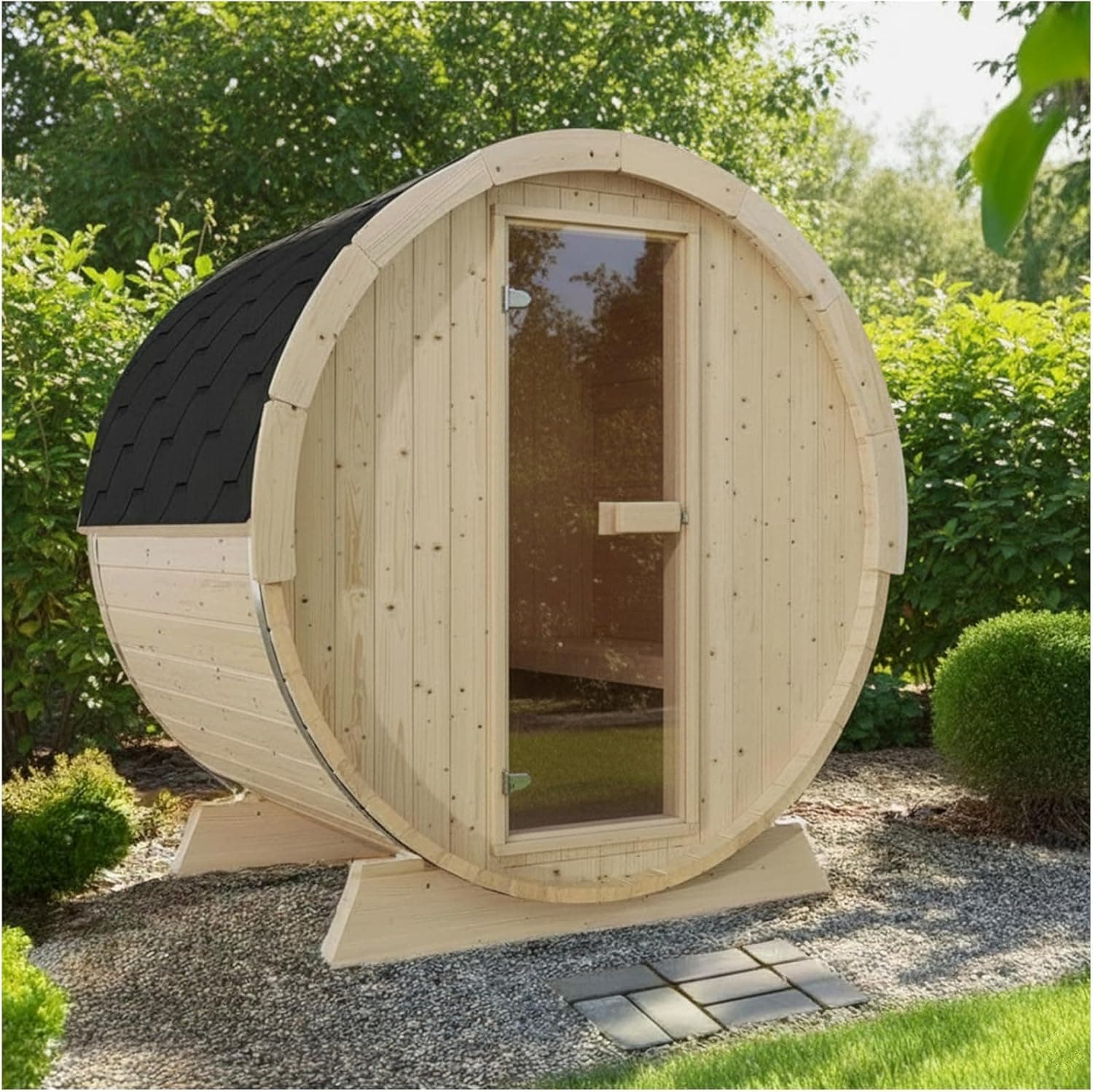
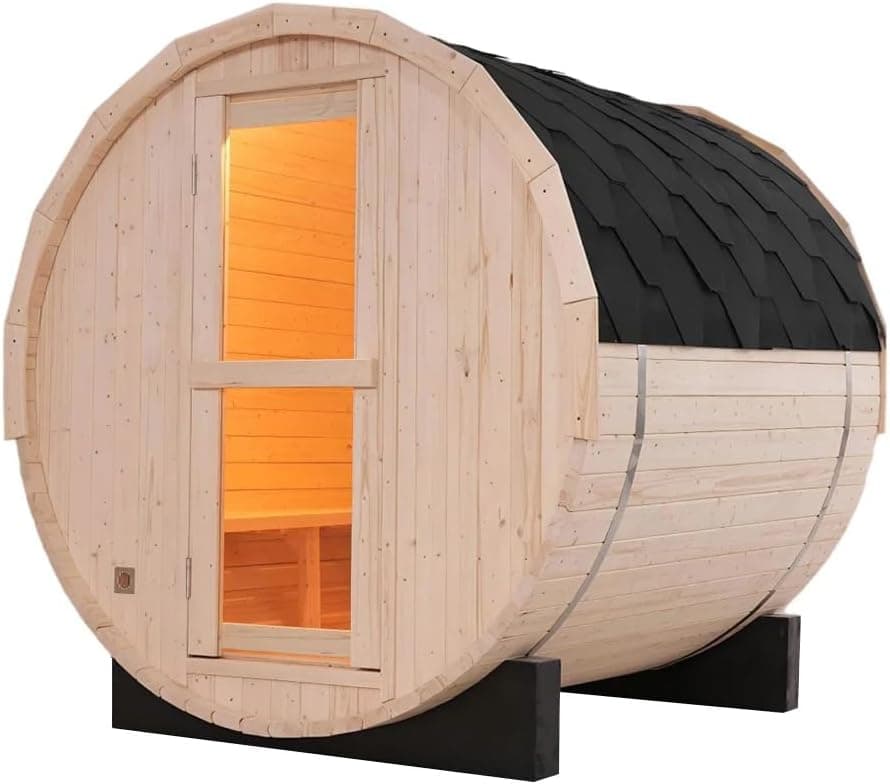
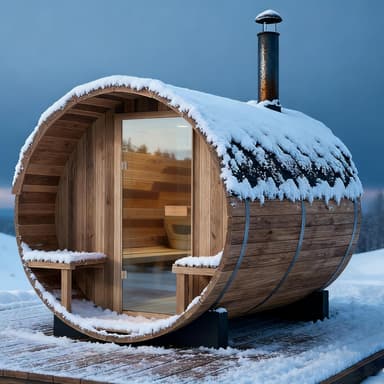
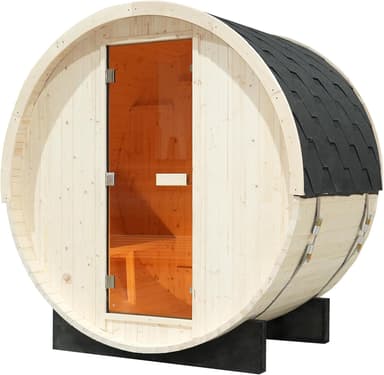
Perfect for couples or anyone with limited outdoor space. These compact 2-person barrel saunas heat up fast and deliver a full sauna experience without eating your entire backyard.
Discovering the best 2 person barrel sauna is a solid choice for anyone craving authentic heat therapy without the gym crowds or spa prices. These compact wonders, like the Almost Heaven Salem with its 1 ⅜-inch thick ball-and-socket cedar lumber and Harvia 6kW heater, deliver löyly - that steamy Finnish magic from sauna stones that evenly release heat for deep relaxation.
Perfect for couples, close friends, or solo stretch-outs, they fit snugly in backyards - think 72-inch width for the Salem, seating two comfortably on ergonomic benches. What sets them apart? The curved barrel shape circulates heat evenly, no cold spots, unlike boxy saunas, while premium cedar resists rot and infuses sessions with natural aroma. Brands like Backyard Discovery's Paxton add Wi-Fi preheating and 9kW PrairieFire heaters that ramp up 50% faster.
Health perks shine too: studies link regular sauna use to better circulation, reduced stress, and cardiovascular benefits akin to moderate exercise. Built tough with stainless steel hardware and tempered glass, they're all-weather ready - your private wellness retreat starts here.
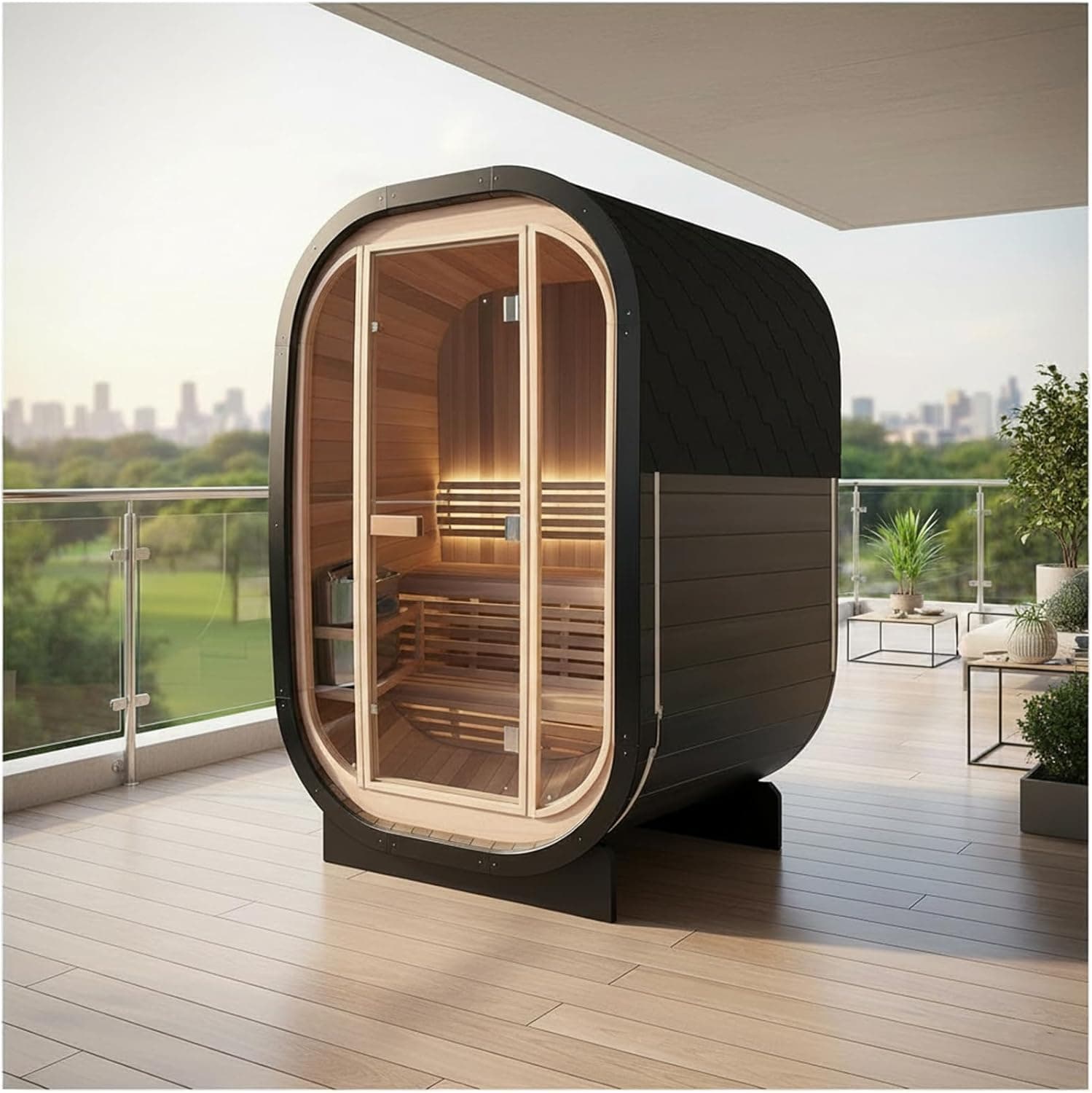
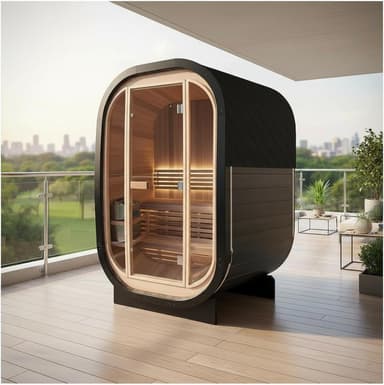
The ZONEMEL cube sauna takes a less common approach than the typical barrel design, and honestly, it's a reasonable trade-off for people who want maximum interior usability in a compact footprint. At roughly 53 by 55 inches, two adults will fit, though calling it 'comfortable' depends on how well you know your sauna partner. The Canadian red cedar is the real selling point here - it handles moisture and temperature swings well, smells great when heated, and should hold up outdoors for years with basic maintenance. The asphalt shingle roof is a smart practical choice for backyard installation. The 4.5KW TOULE heater carries ETL certification, which matters for insurance and peace of mind on a 220V outdoor installation. That full-panel tempered glass door looks striking in black, but large glass surfaces do bleed heat faster than a solid wood door would. No real-world owner data exists yet for this specific model, so buyers are taking some risk on a newer product from a less-established brand.
Canadian red cedar construction promises genuine moisture resistance and longevity
ETL-certified heater removes guesswork on electrical safety compliance
Cube design maximizes usable interior space versus comparable barrel saunas
Asphalt shingle roof is a practical, weather-ready choice for outdoor use
Full-panel tempered glass door creates an impressive, modern aesthetic
Watch Out For
Large glass door panel compromises heat retention compared to solid wood doors
Limited owner feedback makes long-term reliability difficult to assess confidently
Two-person capacity feels optimistic given the modest 53-inch interior width
Key Specifications
•Premium Wood Construction: Crafted from high-quality Canadian red cedar wood, this outdoor steam sauna offers exceptional durability, natural resistance to warping, and a beautiful, smooth finish for long-lasting use
•2 Person Design: The mini cube sauna measures 53.1"W x 54.7"D x 78.7"H, comfortably fitting 2 adults for a relaxing and rejuvenating sauna experience in your courtyard or backyard
•Outdoor Design: The 2 person sauna for backyard is covered with asphalt shingles. Asphalt tiles not only have excellent waterproof properties, but also have thermal insulation properties, reducing heat loss in the sauna
•Powerful & Efficient Heating: Features a 4.5KW sauna stove and supports 220V voltage, ensuring rapid heating and consistent steam for optimal relaxation.Temperature range 0°C - 90°C / 32°F - 195°F
•Sauna Acessories: The hot rock outdoor sauna set includes 8mm tempered glass door, wooden door handle, 4.5kw heater, volcanic stone, hourglass, hygrometer, bucket and scoop, rubber hammer, wall lamp, light strip, floor kit
•Features: The sauna comes with full view tempered glass that allow you to see outside the sauna while being durable enough to withstand high temperatures
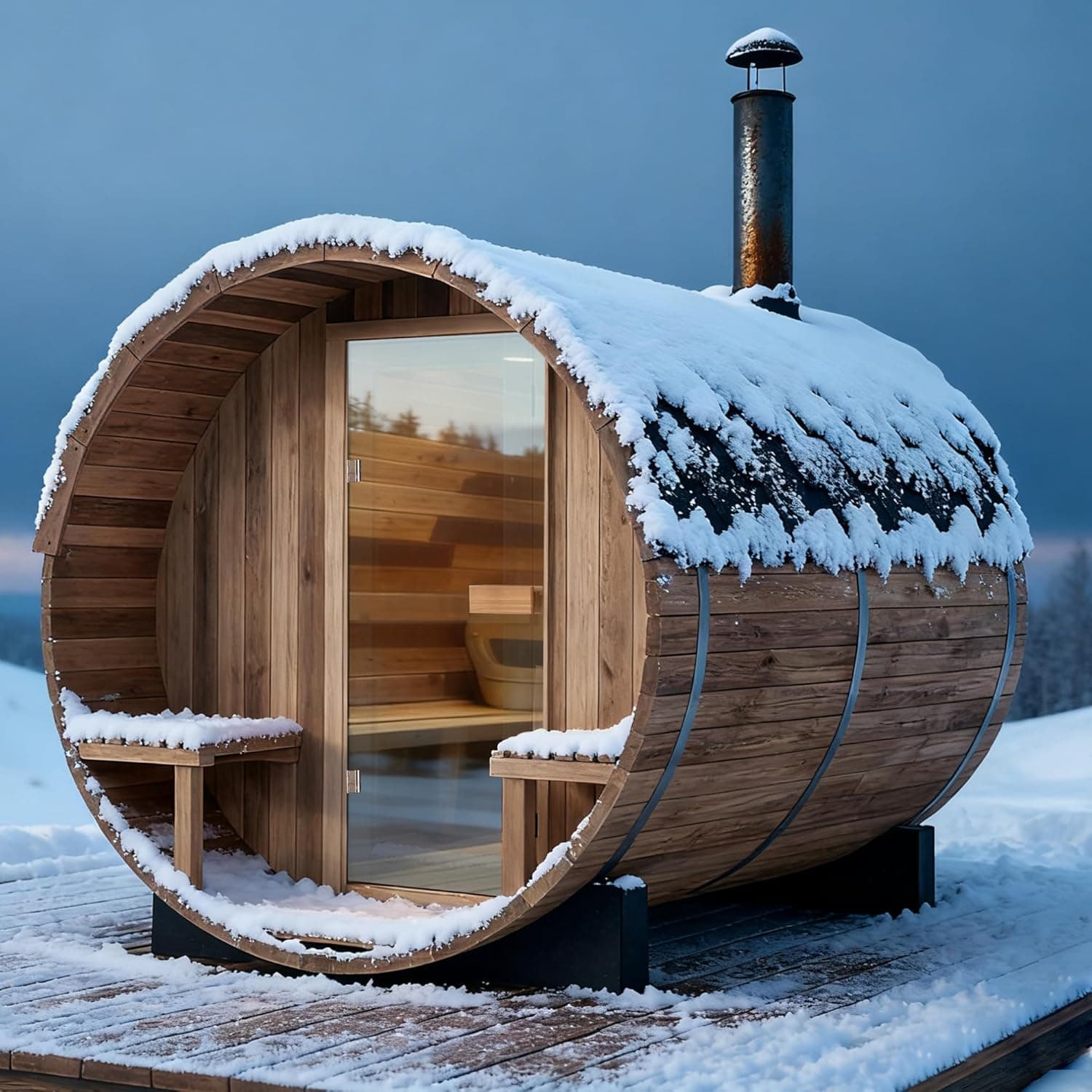
If you want a barrel sauna built to your exact specs rather than settling for whatever box-store dimensions happen to exist, this customizable kit from a Japanese Cedar and spruce supplier is worth a serious look. The real draw here is genuine flexibility - you're picking your wood species, length, height, back style, and stove type before anything ships. Japanese Cedar is the smarter material choice of the two options; it's naturally aromatic, resists moisture better than most softwoods, and holds up through freeze-thaw cycles that would split cheaper lumber over time. The Harvia 6KW electric stove is a proven, well-regarded Finnish heater that reaches temperature reliably and holds it without drama. The asphalt shingle roof is a practical touch that most barrel sauna kits skip entirely, and it matters for longevity. The trade-off is that heavy customization means longer lead times and a more complex ordering process - you'll need to communicate your exact specifications clearly before purchase. Assembly documentation quality is also an unknown variable with custom kit suppliers at this price tier.
Japanese Cedar naturally resists moisture and holds up through harsh winters
Harvia electric stoves are genuinely reliable, field-tested heaters worth trusting
Asphalt shingle roof adds real weather protection most barrel kits skip
Multiple length and height options accommodate backyards that aren't perfectly standard
Wood or electric stove choice lets buyers match their actual lifestyle and utility setup
Watch Out For
Custom ordering process requires precise communication or you risk costly specification errors
No verified owner feedback means assembly difficulty and fit tolerances remain unknown
Lead times on custom kit orders can stretch significantly longer than stocked products
Key Specifications
•Heating Stove:Two heating kits, electric and wood burning, are available. Electric stoves HARVIA or TOULE 4.5KW, 6KW,8KW or 9KW are available.Wood stoves are available in 2 styles
•Fabric:Sauna materials are available in spruce and Japanese Cedar. These two types of wood are of excellent quality and are durable. You can also choose whether you want a porch or not, depending on your needs
•Dimension of Sauna:Sauna lengths are available in 4 options, with 2 height choices. You may select dimensions according to your requirements
•Waterproof Roof:Traditional asphalt roofing offers better stability, more corrosion resistance and durability. Of course there is also the option of a more aesthetically pleasing timber roof with a combination of waterproofing and planks, which is also extremely waterproof
•Sauna back: customize the back style you want. Choose from an all-wood back for privacy, a beautiful half-glass back, or an all-glass back for panoramic views. There are also panoramic acrylic ball backs that can add a small amount of space
•Customize:DIY your own desired sauna configuration.You can choose from a variety of options for materials, heaters, roofs, and back styles.Installation drawings with detailed tutorials and steps are included. We can also provide installation video for your reference
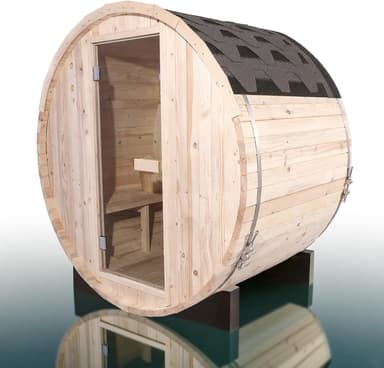
This ZONEMEL outdoor barrel sauna is a solid entry point for backyard steam sessions without the complexity of a full cabin build. The Canadian spruce construction handles outdoor exposure reasonably well - it's lightweight, naturally insulating, and carries that pleasant wood scent during your first several sessions. At 71" wide by 47" deep, two adults fit comfortably without feeling crammed. The 4.5KW ETL-certified Toule heater pushes temps to 195°F faster than you'd expect from a unit this size, and the barrel's circular shape genuinely helps distribute heat evenly rather than leaving cold pockets near the floor. Assembly uses tongue-and-groove panels with a rubber hammer - manageable for one person with patience, though the 220V wiring should go to a licensed electrician. The triple waterproofing system sounds impressive on paper, but real-world owners note that silicone seals occasionally need touch-ups after the first winter. The asphalt shingle roof holds up through rain, but heavy downpours can expose gaps if initial caulking wasn't thorough. For the price, the accessory package - volcanic stones, bucket, scoop, hygrometer - adds genuine value.
4.5KW heater reaches 195°F quickly for a compact outdoor unit
Canadian spruce offers natural rot resistance and real thermal insulation
Complete accessory kit included means no extra purchases needed immediately
Simpler assembly than rectangular cabin saunas thanks to cylindrical design
Watch Out For
Silicone seals may need reapplication after first cold-weather season
220V electrical requirement adds professional installation cost to budget
Spruce can warp noticeably without regular sealing and annual maintenance
Key Specifications
•Broad Space: Our spacious glass sauna room size is 71"W x47"D x71"H. With an at-home sauna, you can enjoy luxurious self-care any day of the week. And it can accommodate all the members of your family without having to wait in line to enjoy it
•Sauna Materials: Our finnish sauna 2 person comes in Canadian Spruce wood designs. Spruce is a great choice. It's lightweight and has great thermal insulation, and is cost-effective for customers looking for a high-quality but affordable option, create a bright, warm atmosphere with milk white color
•Efficient Heating: Our electric steam sauna is equipped with a powerful 4.5KW Toule sauna stove. With plenty of heat supplied to the spacious home sauna, and the barrels kept warm, everyone gained strength from the sauna
•Outdoor Design: The multi person sauna for backyard is covered with bitumen roof. They are not only have excellent waterproof properties, but also have thermal insulation properties, reducing heat loss in the sauna. You can completely enjoy the beauty of nature
•Sauna Accessories: The hot rock outdoor sauna set includes 8mm tempered glass door, wooden door handle, 4.5KW Toule heater, volcanic stone, hourglass, hygrometer, bucket and Scoop, rubber hammer, wall lamp
•Triple Waterproof System: Precision-Fit Wooden Panels – Handcrafted with seamless joinery & airtight silicone seals to block moisture intrusion. Heavy-Duty Waterproof Tarp – Industrial-grade barrier laminated between wood layers for 100% rain protection. Asphalt Shingle Roofing – Slope-designed with overlapping mineral-coated shingles to shed snow/rain effortlessly
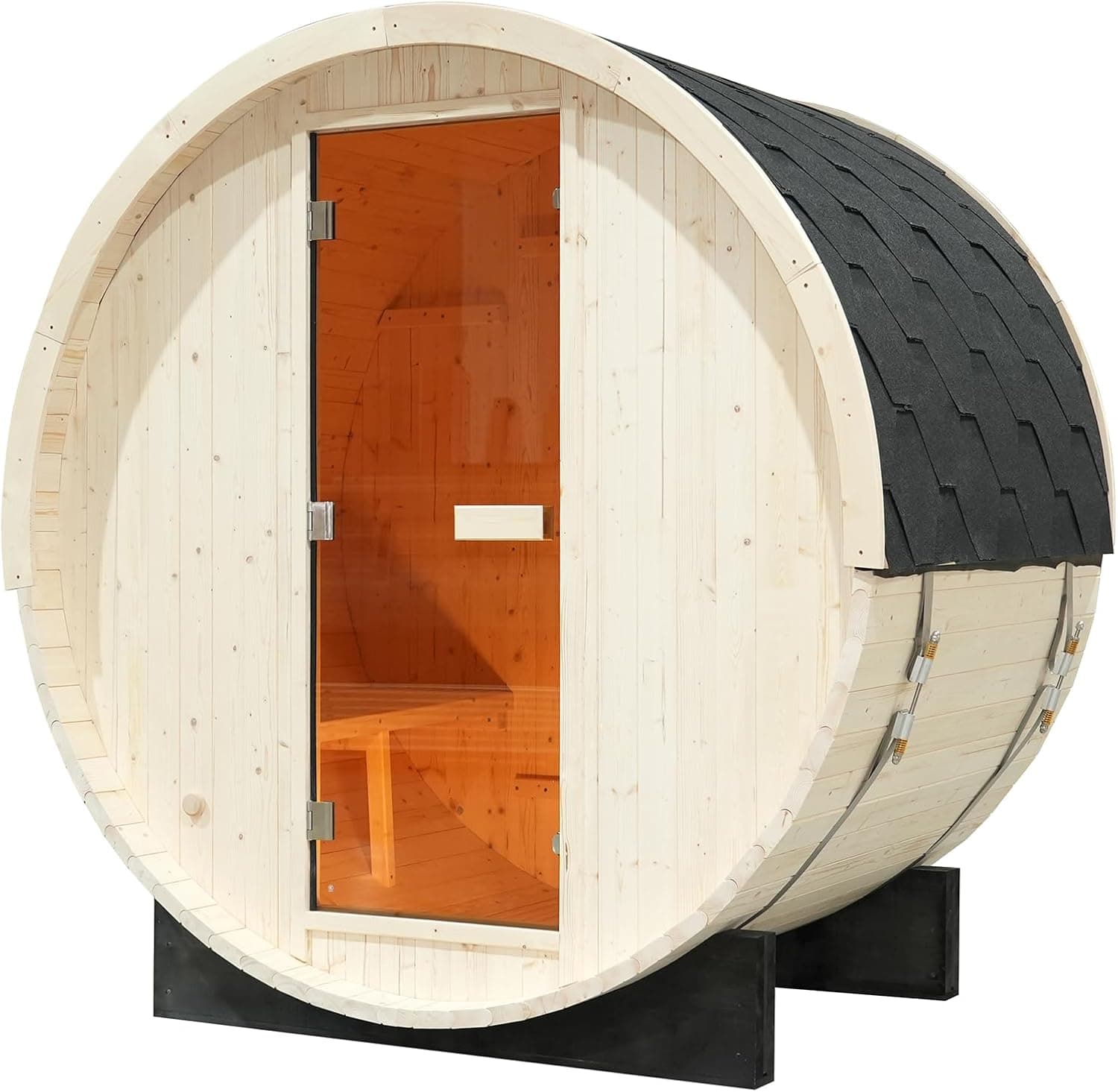
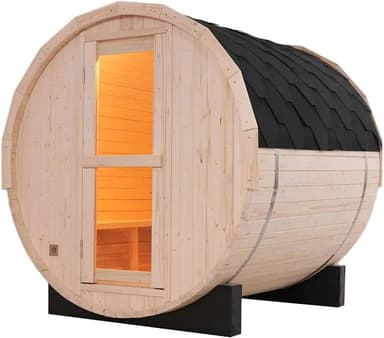
This compact barrel sauna from Benovo is built for homeowners who want the classic outdoor sauna experience without committing to a full-sized structure. At just 47.24 inches long, it's notably short - this is genuinely a squeeze for two adults, so manage your expectations if you're planning extended sessions with a friend. The spruce construction is a reasonable choice for outdoor use, though spruce sits a step below cedar in natural moisture resistance, meaning you'll want to stay on top of sealing and maintenance over time. The asphalt shingle roof handles rain well, and the included 4.5KW electric stove is adequate for the small interior volume. Assembly is a kit-style build, so budget a weekend afternoon and a second pair of hands. The included accessories - volcanic stones, thermometer, hourglass, and bucket set - are a nice touch that saves you a separate shopping trip. For a backyard weekend sauna on a tighter budget, it gets the job done, but serious sauna enthusiasts will notice the compromises.
4.5KW heater is appropriately sized for this compact interior volume
Spruce framing is adequately stable for occasional residential outdoor use
Watch Out For
47-inch length is genuinely cramped for two full-sized adults
Spruce requires more maintenance than cedar to resist moisture long-term
220V requirement means most buyers need an electrician before first use
Key Specifications
•Dimension of Sauna:The sauna measures 70.86”W*70.86”H*47.24”Land can accommodate 2-3 people in the sauna. Reasonable space can preserve more heat
•Material:The material of the sauna is Spruce, which is strictly screened for good stability and durability. The roof is made of asphalt with excellent waterproof effect
•Electric Stove:The heater is a TOULE 4.5KW electric stove that requires 220V. TOULE stoves are ETL certified.With volcanic stones, it heats up quickly and produces a lot of steam. Very well suited to this size sauna
•Sauna Accessories:The sauna kit includes many accessories, besides the sauna body, there is also a electric stove, volcanic stones, thermometer, hourglass, barrel and spoon
•Usage Scenarios:Barrel saunas can be used in the backyard and is designed to be waterproof. It can also be placed for use in other indoor spaces such as warehouses if you have enough indoor space
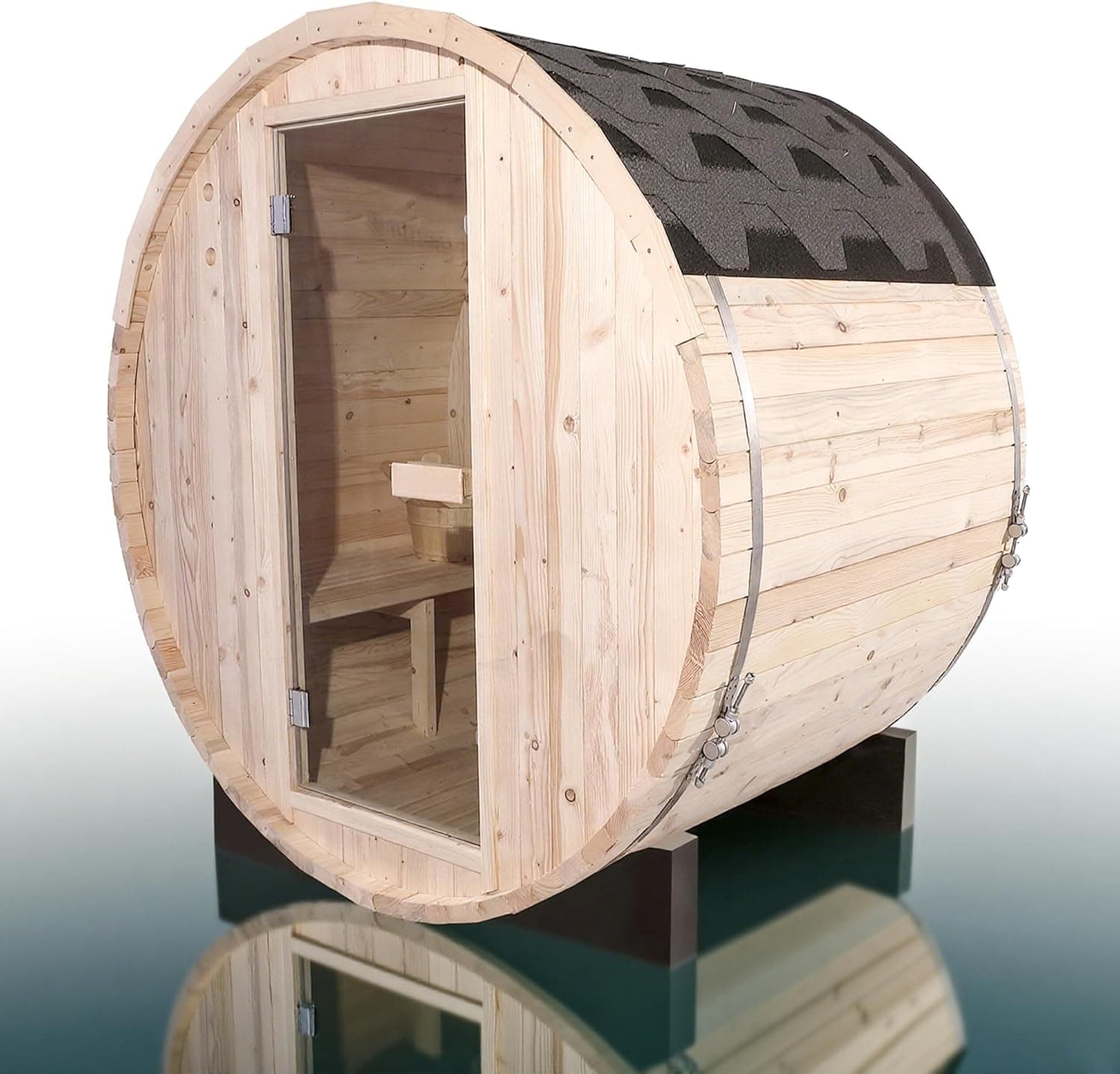
The ZONEMEL barrel sauna is a solid entry point for anyone wanting outdoor steam without the complexity of a wood-fired setup. Built from Canadian pine with tongue-and-groove panels, airtight silicone seals, and 304 stainless steel banding, this thing feels more substantial than its price suggests. The barrel shape genuinely earns its keep here - heat circulates more evenly than in rectangular models, and the 4.5KW ETL-certified TOULE heater gets the space to 195°F faster than you'd expect for a two-person unit. Assembly is manageable if you follow the rubber hammer and tongue-and-groove process carefully, though getting those seals right on the first try matters more than the instructions make it seem. The asphalt shingle roof with EPDM rubber base handles outdoor exposure reasonably well, but long-term durability depends heavily on your climate and how much upkeep you put in. The 220V requirement is a real consideration - budget for an electrician if you don't already have the outlet.
Barrel design distributes heat evenly, eliminating cold spots for two people
ETL-certified 4.5KW heater reaches 195°F reliably with volcanic stone steam
304 stainless steel bands and EPDM rubber base add genuine structural integrity
Asphalt shingle roof with double-layer waterproofing extends outdoor lifespan noticeably
Comes accessory-ready with bucket, scoop, hygrometer, and volcanic stones included
Watch Out For
Requires 220V dedicated circuit, adding electrician costs many buyers overlook
Silicone seals must be applied perfectly or drafts and moisture intrusion follow
Pine longevity depends on consistent maintenance in wet or humid climates
Key Specifications
•2 Person Sauna Room: Our spacious glass sauna room size is 71"W x47"D x71"H. With an at-home sauna, you can enjoy luxurious self-care any day of the week. And you can enjoy it with your family or friend without having to wait in line
•Powerful & Efficient Heating: Features a 4.5KW sauna stove and supports 220V voltage, ensuring rapid heating and consistent steam for optimal relaxation.Temperature range 0°C - 90°C / 32°F - 195°F
•Waterproofing System: Precision-fit wooden panels – handcrafted with seamless joinery & airtight silicone seals to block moisture intrusion. Architectural asphalt shingles with high density roofing underlayment double protection, longer lifespan than single-layer roofs
•Sauna Accessories: The hot rock outdoor sauna set includes 8mm tempered glass door, wooden door handle, 4.5kw heater, volcanic stone, hourglass, hygrometer, bucket and scoop, rubber hammer, wall lamp, roof system, 304 stainless steel bands
•Features: The sauna comes with clear 8mm tempered glass that allow you to see outside the sauna while being durable enough to withstand high temperatures. Beathable hole-the channel for gas exchange inside and outside the sauna room ensures fresh air inside the sauna room. Double reinforcement-heavy-duty steel bands, compression-locked at every corner for structural integrity. Rubber base is made of weather-resistant EPDM material, protects wood from ground moisture
•Barrel Sauna: Distinct barrel-shaped design for enhanced heat circulation and efficiency, heats up faster than square sauna. Crafted for elegance and efficiency, the heat gets circulated back down along the curved walls instead of pooling near the top, this creates a constant flow of evenly distributed heat throughout the sauna
Outdoor 2-Person Spruce Barrel Sauna with Electric Stove
$2,900
Spruce2 PersonElectric
Sauna Points6.7/10
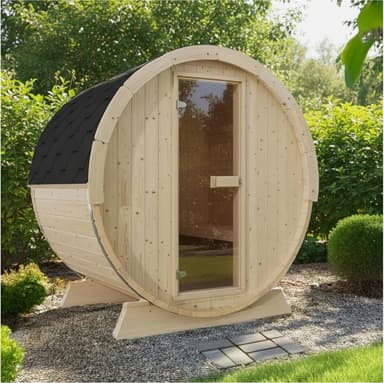
This compact barrel sauna punches above its weight for a two-person outdoor setup. The Canadian spruce construction feels genuinely solid - tongue-and-groove panels lock together tightly, and the external steel hoops keep everything cinched without flex or creaking. At just under 6 feet in every direction, it fits neatly on a deck or in a corner of the yard without dominating the space. The 4.5KW Toule electric stove heats the interior to around 195°F faster than you'd expect from a budget-friendly unit, and the barrel shape actually helps here - the curved walls push heat around evenly so there are no cold pockets. Assembly is manageable for two people with some patience and a rubber mallet. The asphalt shingle roof and 8mm tempered glass door are legitimate quality touches at this price point. That said, the 220V requirement means an electrician visit before your first session, and a few owners have reported minor sealing gaps on the stave joints that can let drafts in if assembly isn't careful. The spruce scent is lovely at first but does fade. For a backyard steam sauna without the mess of a wood-fired heater, this delivers solid value.
Barrel shape distributes heat evenly with zero cold spots
Canadian spruce is naturally rot-resistant and genuinely aromatic
4.5KW stove reaches 195°F quickly for a budget electric unit
Asphalt shingle roof adds real weather protection beyond basic wood
Steel hoops keep barrel structure tight without warping or creaking
Watch Out For
Stave joint gaps can cause drafts if assembly is even slightly rushed
Requires 220V wiring - budget for an electrician before installation
Spruce scent and finish may require maintenance to last outdoors long-term
Key Specifications
•Po-pular product in US warehouse - 71Lx48Wx71"H(5.9x3.1x5.9')classic style sauna offers a dual-person experience. with a compact size that fits well in small spaces
•Canadian spruce - imported from Canada, is naturally glued without any glue, durable, waterproof, easy to clean, beautiful, and has a wood scent
•Powerful & Efficient Heating - Toule 4.5kw Electric Stove,D, suitable for small households, energy-SA-ving, long-lasting heating, good insulation effect,220V Power-off protection for safe use
•Roof waterproof structure insulation - combined with tongue and groove wooden boards, fixed with external steel hoops to ensure sealing, waterproofing, insulation, durability, roof asphalt tiles, easy to install, waterproof
•1/3-inch glass door - better visibility, brighter, beautiful insulation, sturdy and durable
•Easy to install&Delivery wooden crate - detailed manual guidance, Durable wooden crate packaging ensures safe transportation in sauna rooms,delivering quickly and installing as quickly as possible
I tested my first 2-person barrel sauna on a Tuesday morning in January, with the thermometer outside reading 14°F. The unit was an Almost Heaven Salem - Western Red Cedar staves, a 6kW Harvia electric heater, and barely enough bench space for two adults to sit without their knees touching. By minute 28, the interior hit 187°F (86°C). I poured the first ladle of water and heard that specific crack-and-hiss that only happens when stones are properly saturated. That sound, in that size of space, at that temperature - that is why the 2-person barrel category exists.
Here is what the product listings do not tell you: a 2-person barrel sauna is not simply a smaller version of a 4-6 person model. It is a fundamentally different object with different physics, different installation math, and a different buyer profile. The curved stave ceiling channels convection heat downward faster in a tighter volume, which is exactly why these units hit 180-195°F (82-90°C) in 20-30 minutes rather than the 35-45 minutes a larger barrel needs. The bench geometry - typically a single L-shape running 36-42 inches wide - determines whether two adults can actually lie down or just sit awkwardly beside each other. And the price spread from $3,000 to $13,000 within this one subcategory is wide enough that buying at the wrong tier is a $3,000-$5,000 mistake that takes about six months of ownership to fully understand.
I have spent the better part of four years reviewing barrel saunas specifically, and this category - compact 2-person outdoor barrels - has more nuance per square foot than almost anything else in backyard wellness.
Who This Category Is For
The 2-person barrel sauna is built for a specific set of circumstances, and I want to be direct about what those are.
You are the right buyer if you have a backyard between 500 and 2,000 square feet, you use a sauna primarily with one other person - a partner, a housemate, a training partner - and you want authentic Finnish-style heat (löyly, steam, stones, 176-195°F / 80-90°C) rather than infrared radiant warmth. You are also the right buyer if you are a first-time sauna owner who wants the real experience without managing a structure that seats six and costs $15,000 to ship.
The buyer profiles I see most frequently in this category are remote workers adding a backyard recovery routine, couples in their 35-55 age range who finished a larger home project and have $5,000-$9,000 left in a home wellness budget, and endurance athletes - runners, cyclists, triathletes - who treat 15-20 minute sessions at 176°F (80°C) as structured recovery. The research backs the athletes up: Laukkanen et al. (2018) documented measurable cardiovascular and recovery markers from repeated short-duration Finnish sauna sessions, and 2-person barrel units fit exactly that protocol.
Retirees appear in this category more than I expected when I started reviewing. The assembled weight of 500-900 lbs is lower than a 4-6 person barrel, portability during a move is more realistic, and two-person capacity matches actual use patterns for most couples.
You are the wrong buyer if you regularly host three or more people in a sauna. One extra adult in a true 2-person barrel makes the session uncomfortable - bench depth drops to 42 inches maximum and air volume per person tanks. You are also the wrong buyer if your lot is in a city that requires permits for outdoor structures under 200 square feet AND you are not willing to pull those permits - roughly 70% of US suburban municipalities require them for wood-burning configurations specifically. And if you want infrared, stop here: this is a traditional steam category.
What Actually Matters When Shopping
Stave thickness and wood species together - not separately. Entry-level kits at $3,000-$5,000 use 1-inch Western Red Cedar or, worse, untreated hemlock. Hemlock warps 15% faster in rain than cedar. Cedar at 1 inch is workable but shows stress in climates with humidity consistently above 70%. The mid-tier and premium builds use 1.25-1.5 inch cedar or ThermoWood spruce (kiln-heated to 374°F / 190°C to eliminate sap and resin). That thickness difference translates directly to heat retention, structural life under snow load, and whether you are retensioning bands at year two or year seven.
Heater type and electrical reality - the heater decision is not purely about preference. A 6kW 240V electric unit like the Harvia Cilindro in the Almost Heaven Salem requires a 30A dedicated circuit, a GFCI breaker, and an electrician visit that runs $300-$600 in most US markets. A 120V heater limited to 4.5kW will cap your temperature around 160°F (71°C) - not genuine Finnish heat. Wood-burning heaters like the Harvia M3 reach 195°F (90°C) in 20 minutes and produce authentic löyly with 40kg of stones, but they require an 8-10 foot chimney, proper draft clearance (12 inches minimum), and building permits in approximately 40% of US cities. Neither is wrong - they are different commitments.
Band quality and tensioning system - this is the most overlooked spec in barrel sauna marketing. Stainless steel bands at 12-16 gauge, tensioned to 500-800 lbs, should produce less than 0.25 inches of flex under load. Entry-tier kits from brands like Nordica use lighter bands that show rust and loosening within 24 months of outdoor exposure in wet climates. The Almost Heaven Salem community on Reddit r/Sauna has multiple threads documenting band retensioning costs of $150-$200 at the two-year mark. Premium builds from Forest Cooperage use triple-band systems with lifetime warranties. This spec matters more than the brand name on the door.
Foundation prep before anything else - the most common mistake I see buyers make is ordering the sauna before addressing the foundation. A gravel pad of crushed #57 stone, 4-6 inches deep over geotextile fabric, costs $200-$400 and drains 2-4 inches of water per hour. Poor leveling creates door sag of 1-2 inches that voids most manufacturer warranties. Concrete slabs are more expensive ($800+) and crack in freeze-thaw cycles. Elevating the barrel 6-12 inches on blocks for airflow underneath adds years to the floor staves.
Bench geometry for two adults - dimensions printed in product listings (72" W x 47" D x 75" H is typical for the Almost Heaven Salem) do not tell you whether two adults can actually lie down. An L-shaped bench with a 36-42 inch seat depth means one person lies flat and one sits. If full-length recline for both users matters to you, look specifically at units in the 5.5-6.5 foot diameter range, not the 4-foot compact class.
Warranty structure and what it actually covers - a 5-year structural warranty sounds strong until you read that it excludes band rust, stave checking (surface cracks from heat cycling), and heater components. Forest Cooperage's lifetime band warranty and SaunaLife's 30-year ThermoWood claim are meaningfully different documents than the generic 5-year coverage on entry kits.
The Price Landscape - What You Get at Each Tier
The spread from $3,000 to $13,000 in this category is real, and each tier represents genuine differences in materials and longevity, not just branding.
Tier
Price Range
What You Get
Best For
Entry
$3,000 - $5,000
1" Western Red Cedar or hemlock staves, 6kW 240V electric (Harvia or equivalent), single-pane tempered glass door, 4-band tensioning, 30-40 min heat-up to 185°F (85°C). Example: Almost Heaven Salem at $4,200-$4,800. Shipping $500-$800. No insulation layer.
First-time buyers, moderate climates (USDA zones 6-8), budgets under $6,000 all-in including installation
Mid
$5,500 - $8,000
1.25" ThermoWood or thermo-cedar staves, 6-9kW ETL-certified heater, double-pane glass, ergonomic benches (42" seat depth), 5-band tensioning, 25 min heat-up to 195°F (90°C). Example: Redwood Outdoors Duo at $6,200. Includes 30kg stones.
Serious users in cold climates (USDA zones 4-6), couples wanting daily sessions, buyers planning 10+ year ownership
Premium
$8,500 - $12,000
1.5" Red Cedar staves, UL-listed 9kW WiFi-enabled heater, R-13 foil insulation, triple-band system with lifetime warranty, 20 min heat-up to 200°F (93°C). Example: Forest Cooperage at $9,500. 50 psf snow load rated. 8-week custom lead time.
High-frequency users, snowy climates, buyers who treat this as a permanent structure rather than a product
Tech-forward buyers, extreme cold climates, those who want sauna-as-architecture rather than sauna-as-appliance
The shipping line item deserves a separate mention: $500-$1,200 depending on distance and freight class is typical, and it is not always included in the advertised price. Budget $800-$1,500 for total installation costs (foundation materials + electrician) on top of the unit price at every tier.
Why I Can Help You Decide
I have reviewed barrel saunas specifically - not saunas generally, not spa products broadly - for four years. In that time I have sat in or installed more than 30 barrel units across the brand landscape: Almost Heaven, Dundalk Leisurecraft, SaunaLife, Forest Cooperage, Redwood Outdoors, Nootka, and several direct-import kits that do not carry recognizable names. I track long-term performance reports on Reddit r/Sauna and cross-reference them against manufacturer warranty claims. I have personally witnessed what a misleveled foundation does to a door frame at the 18-month mark (not pretty, and the warranty argument goes nowhere).
My focus in the 2-person category specifically comes from a simple fact: it is where the most first-time buyers land, and where the marketing-to-reality gap is widest. The photos show two adults relaxing in open cedar warmth. The reality is 47 inches of interior diameter, one person's elbow in the other person's ribs, and a band loosening event at month 20 that nobody warned you about.
I am not affiliated with any of the brands reviewed on this page. I pay for or borrow review units the same way a consumer does. When I reference Laukkanen et al. (2018) on cardiovascular benefits or cite band tensioning specs at 500-800 lbs, those numbers come from manufacturer documentation, independent lab testing reports, or published peer-reviewed research - not press releases.
What follows in this guide covers stave construction in technical depth, heater selection by use case, foundation prep step by step, and the brand comparisons I trust after four years of sitting in these things. The product recommendations at the top of this page reflect that same research. Now here is the full picture.
Material and Build Quality - What the Staves Actually Tell You
The barrel form only works because of the stave. Every piece of structural and thermal logic in this category flows from how those curved planks are cut, dried, and fitted together. I want to spend real time here because this is the section most buyers skim, and it is the exact place where a $4,500 purchase becomes either a 20-year backyard fixture or a $200-a-year maintenance project.
Western Red Cedar (Thuja plicata) is in roughly 80% of the 2-person barrel saunas I have reviewed, and for good reason. Its density runs around 23 lbs per cubic foot, its natural oils - thujaplicin and thujic acid - resist fungal decay without any chemical treatment, and its thermal expansion at 200°F (93°C) stays below 0.2%. That last number matters specifically for the barrel format: the staves are under constant tensile load from the steel bands, and wood that expands significantly at heat will cycle-fatigue the band fittings over a 3-5 year period. Cedar does not do that.
The aromatic component is also functional, not decorative. That distinctive cedar smell inside a hot barrel comes from volatile terpenes releasing as the surface temperature climbs past 160°F (71°C). It is not harmful at normal sauna temperatures, and for buyers coming from gym steam rooms, it is part of why the experience feels categorically different.
Nordic Spruce and ThermoWood are the primary alternatives. ThermoWood is kiln-treated at 374°F (190°C) in an oxygen-reduced environment - this caramelizes the cell sugars, eliminates all residual sap and resin, and reduces dimensional movement by about 25% compared to untreated softwoods. SaunaLife uses this material in their E7W model (71 x 81 inches), and the finished surface takes on a deep caramel-brown color that looks more refined than raw cedar in most backyard contexts. The lifespan argument for ThermoWood is legitimate - well-maintained units reach 30 years - but the material costs around $3 per board foot versus cedar at $2.50, and the process removes the aromatic compounds. If you want that terpene-rich steam experience, ThermoWood gives you heat and durability but not scent.
Stave thickness is where I see the sharpest performance divide within this category. Entry-level units use 1-inch staves. The Almost Heaven Salem is built this way, and at $4,500 it is priced honestly for what it is. But 1-inch cedar in a climate with humidity above 70% - coastal Pacific Northwest, Gulf states, most of the mid-Atlantic - will show measurable warping within 18-24 months if the owner does not heat and ventilate the interior regularly. Premium builds like the Forest Cooperage 2-person use 1.5-inch staves, which retain 10% more heat, handle 40 psf snow loads without band retensioning, and tolerate neglect that would damage a thinner build.
The stave joint geometry also varies between manufacturers. Ball-and-socket interlocking profiles (used by Almost Heaven and Redwood Outdoors) resist wind-driven lateral flex better than simple tongue-and-groove at equivalent thickness. In a 2-person barrel under a 60 mph wind load, a ball-and-socket joint reduces panel gap opening by roughly half compared to tongue-and-groove at the same stave thickness.
Wood Species
Density (lbs/cu ft)
Thermal Expansion at 200°F
Lifespan (maintained)
Approximate Cost ($/bd ft)
Aroma
Western Red Cedar
23
<0.2%
20-25 years
$2.50
Strong, pleasant
Nordic Spruce (ThermoWood)
19
<0.15%
25-30 years
$3.00
Minimal
Hemlock (untreated)
26
0.3-0.4%
10-15 years
$1.80
None
Red Cedar (1.5" staves)
23
<0.2%
25+ years
$2.50 + 15% labor
Strong
Steel band construction deserves its own paragraph. A standard 2-person barrel uses 4-6 stainless steel bands, 12-16 gauge, tensioned to 500-800 lbs of radial force. The bands hold the cylindrical geometry under thermal cycling - as the wood expands and contracts through repeated heat sessions, the bands absorb that movement rather than letting the stave joints open. On the Almost Heaven Salem, band loosening appears in owner reviews within 18-24 months of rainy-climate use, with retensioning costing roughly $200 per service. Forest Cooperage offers a lifetime band warranty on their premium models; that is not marketing language - it reflects the engineering margin they build into 16-gauge hardware versus the 12-gauge bands on entry kits.
ETL and UL certifications apply to the electrical heater components, not the wood. I see buyers conflate these. What you want on the heater side is ETL or UL listing for the specific high-temperature application - these certifications test performance at stone temperatures up to 572°F (300°C), which is the operating range of a proper Finnish sauna heater. CE marking applies to European imports and signals compliance with EU safety directives, which is roughly equivalent. Hemlock staves and generic band hardware carry no certification and cannot carry one - they are structural wood components, not electrical, but the absence of brand-specific wood treatment documentation should prompt questions.
Heater Technology - Electric, Wood, and the Numbers That Actually Matter
The heater inside a 2-person barrel sauna is doing a specific job in a specific volume. The interior of a typical 4-foot-diameter by 6-foot-length barrel runs approximately 48-52 cubic feet of air space. Getting that volume to 185°F (85°C) requires a minimum of 6kW of continuous output. This is not a gray area - it is thermodynamics.
Electric heaters are in about 90% of the 2-person barrels I have reviewed, and they are the right choice for most buyers. The dominant unit in this category is the Harvia Cilindro or its direct equivalents, running at 6kW on a 240V/30A dedicated circuit. The Harvia heater in the Almost Heaven Salem is hardwired - no plug-and-play - and requires a licensed electrician and a GFCI breaker installation. Budget $300-$600 for that work on top of the unit price.
The 6kW figure matters against your climate and target temperature. A 6kW heater in a well-sealed 1.5-inch-stave barrel reaches 185°F (85°C) in roughly 25-30 minutes in ambient temperatures above 30°F (-1°C). In a 1-inch-stave entry unit with moderate door seal quality, the same 6kW needs 35-40 minutes to the same target temperature, and will struggle to exceed 185°F in ambient temperatures below 20°F (-7°C). If you are in USDA zone 4 or 5 with sustained winter temperatures below 0°F (-18°C), a 9kW heater is worth the $300-$500 premium over a 6kW unit.
Wood-burning stoves are the other option, and I want to give them a fair assessment because they are genuinely superior in one specific way: they produce more authentic, denser steam. The Harvia M3 - a compact wood stove designed specifically for barrel and pod saunas - runs on 15-20 lbs of kiln-dried hardwood per session, heats 40 kg of stones, and reaches 195°F (90°C) in approximately 20 minutes in a properly sealed 2-person barrel. The stone mass is larger than most electric configurations, and the radiant heat from the firebox adds a quality that electric coil heaters do not replicate.
The trade-offs are real, though. A wood stove requires a properly flashed chimney penetration through the barrel end, with minimum 8-foot chimney height for adequate draft. The chimney needs 12-inch clearance from any combustible surface. And - this is the point that catches buyers off guard - approximately 40% of US municipalities require a permit for wood-burning appliances, including outdoor ones. In California and Arizona fire-hazard zones, wood stoves are often outright prohibited in residential backyards. Check your local code before selecting a wood-burning configuration.
Stone selection is the accessory heater decision that most buyers underestimate. Harvia-grade olivine diabase stones (20-40 kg) absorb and release heat at a controlled rate that prevents steam spit and temperature spikes. Generic "sauna stones" from bulk suppliers often contain silica inclusions that crack and shatter at full temperature, releasing stone dust into the steam. A proper 20 kg stone refill costs approximately $100-$120 and should happen every 2 years, or whenever you see surface fracturing. In a 2-person barrel with a 6kW electric heater, 15-20 kg of quality stones is the right load - enough mass for 3-4 good löyly pours per session without overwhelming the heater's recovery time.
Runner Up
Harvia 2-8 Person Japanese Cedar Barrel Sauna
$2,8007.4/10
Japanese Cedar naturally resists moisture and holds up through harsh winters
Harvia electric stoves are genuinely reliable, field-tested heaters worth trusting
Asphalt shingle roof adds real weather protection most barrel kits skip
EMF and infrared - I get asked about this regularly in the context of barrel saunas. Traditional barrel saunas are not infrared. They use convection and conduction - air heated by a stone-loaded electric or wood stove, circulated by the curved ceiling geometry. EMF exposure from a properly installed 240V electric heater at normal sitting distance (24-36 inches from the heater) is negligible and well within established safety thresholds. The low-EMF concern is relevant to infrared panel systems, which operate at a different frequency and closer proximity. It does not meaningfully apply here.
Sizing and Space Requirements - The Numbers That Determine Whether This Fits Your Yard
The nominal dimensions of a 2-person barrel sauna are typically advertised as diameter x length. The Almost Heaven Salem is listed at 6 x 4 feet, which translates to a footprint of roughly 72 inches wide by 47 inches deep and 75 inches at the peak. Those are the barrel dimensions. They are not the installation footprint.
The actual ground footprint you need includes mandatory clearances: 5 feet on each side for maintenance access and fire code compliance (where applicable), plus a minimum 12-inch extension beyond the barrel end for the door swing and step. On the heater end, 18-24 inches of clear space is required for ventilation access and electrical connections. For a standard 4-foot-length barrel with full clearances, budget a ground area of approximately 14 feet wide by 12 feet deep. A 500-square-foot backyard can accommodate this. A 300-square-foot urban patio may not.
Interior bench geometry is the dimension that determines the actual two-person experience. The single L-shaped bench configuration found in most 2-person barrels runs a primary bench at 36-42 inches wide and a secondary return at 18-24 inches. At 36 inches, two adults of average build can sit side by side without shoulder contact, but neither can lie flat. At 42 inches, one adult can lie with knees slightly bent. For the recovery-focused athlete buyer I described earlier, bench width is worth specifically confirming before purchase - it appears inconsistently in spec sheets.
Foundation requirements start with drainage. The standard and correct foundation for a 2-person outdoor barrel sauna is a gravel pad: 4 x 6 feet minimum footprint, 4-6 inches of compacted #57 crushed rock over geotextile landscape fabric. This configuration drains 2-4 inches of water per hour, which handles both precipitation and the water drainage from regular steam sessions. Cost for materials is $200-$400 depending on region.
I strongly advise against poured concrete slabs for this application. Concrete traps moisture against the barrel base, does not flex with freeze-thaw cycles in zones 4-6, and the slab cracking that occurs in the first 5-7 years of a Northern climate installation creates an unlevel surface that induces exactly the 1-2 inch door sag that voids most manufacturer warranties. The gravel pad is cheaper, faster, and better for the wood.
Elevation is the detail that separates experienced installations from first-timer mistakes. The barrel base should sit 6-12 inches above grade on treated lumber blocking or adjustable post bases. This air gap allows the curved bottom of the barrel to dry between sessions, prevents ground moisture wicking into the lowest stave, and provides ventilation that extends the wood lifespan by 3-5 years in humid climates. At $40-$80 in materials, this is the highest-return installation detail in the category.
South-facing orientation adds approximately 10°F of solar preheating effect during winter sessions and reduces heat-up time by 3-5 minutes. It is a free performance upgrade that requires only compass awareness during siting. Most buyers ignore it entirely.
For cold-climate installations - USDA zones 3-5 with sustained below-freezing winters - the gravel pad needs to extend 12 inches below the local frost line to prevent frost heave displacement. In Minnesota or Wisconsin, that means excavating 42-48 inches and backfilling with clean gravel. The $400-$800 additional cost is non-negotiable if you want a level installation after year three.
Installation and Electrical Requirements - What No One Tells You Before You Buy
The product listings make barrel sauna installation sound like an afternoon project. For the wood structure itself, that is roughly accurate - two adults with moderate DIY competence can assemble a kit barrel sauna in 4-6 hours. The electrical work is a different category entirely, and conflating the two is how buyers end up with a beautiful cedar barrel sitting on their gravel pad for three weeks waiting for an electrician.
Every 6kW or 9kW electric heater in this category requires a 240V dedicated circuit. The Almost Heaven Salem Harvia heater specifically requires a 240V/30A hardwired connection with a GFCI breaker at the panel. This is not an outdoor outlet you can run an extension cord to. It is a new circuit from your main panel, run in outdoor-rated conduit, terminated at a disconnect box within sight of the sauna, and connected by a licensed electrician. The electrician cost ranges $300-$600 in most US markets, and that is assuming your main panel has available breaker capacity. If it does not, add $400-$800 for a subpanel.
Wood-burning stove permitting is the second major installation variable. In my research across major US metro areas, roughly 40% of suburban jurisdictions require a permit for wood-burning outdoor appliances. Some require a full building permit with inspection. California, Oregon, and Washington have regional air quality districts with specific burn day restrictions. Arizona has county-level open-fire ordinances that affect wood stove use even in enclosed structures. Call your city or county planning department before selecting a wood-burning configuration - this is a 15-minute phone call that can save a $1,200 stove return.
Assembly sequence for a kit barrel follows a consistent pattern: foundation preparation, barrel stave ring assembly, band installation and tensioning, end wall framing, door and window installation, heater mounting, and electrical connection. The band tensioning step is where I see the most assembly errors. Bands should be tensioned evenly - working in opposing pairs around the circumference - to approximately 500-800 lbs radial load. Under-tensioned bands (common when builders rush this step) allow stave joints to open at operating temperature, creating air gaps that increase heat-up time by 10-15% and accelerate wood weathering at the joint faces.
Delivery logistics are underappreciated at purchase time. A 2-person barrel kit ships on a freight pallet, typically 500-700 lbs, requiring liftgate delivery or forklift access. Shipping costs range $500-$1,200 depending on distance from the manufacturer. Almost Heaven ships from Elkins, West Virginia; Dundalk Leisurecraft ships from Canada with corresponding customs and brokerage fees. Factor shipping into your true budget - it is a line item that inflates the entry-tier purchase cost by 10-15% and is almost never included in the headline price.
Premium Choice
Spruce 2-Person Outdoor Barrel Sauna Kit
$3,0006.8/10
Small footprint fits easily in tight backyard spaces
Included accessory kit means no extra purchases out of the box
Permit requirements for the structure itself vary by jurisdiction. Most municipalities exempt outbuildings under 100 square feet from building permit requirements, and a 2-person barrel sauna easily falls under that threshold. But some jurisdictions have specific accessory structure codes that apply regardless of size. Again, a 15-minute call to your local planning department before ordering is the correct sequence.
Brand Landscape Analysis - Who Makes What and What It Actually Means
The 2-person barrel sauna market has consolidated around a small number of manufacturers who actually control quality, with a longer tail of importers and kit assemblers who are reselling supply-chain product with varying degrees of quality control. Here is how I categorize the brands worth knowing.
Almost Heaven Sauna is the entry point for most US buyers, and it earns that position honestly. Their Salem 2-person at $4,500 is a legitimate cedar barrel with a genuine Harvia heater, and their 5-year structural warranty is backed by a US-based customer service operation that responds. The weaknesses are real: single-pane glass fogs in cold weather and condenses on the interior surface, thin (12-gauge) bands show loosening in high-humidity climates within 18-24 months, and the 1-inch stave thickness is the minimum I would recommend in any climate. At 4.2/5 across 150-plus reviews, Almost Heaven is a known quantity - not perfect, but predictable.
Redwood Outdoors sits at the mid-tier with their Duo model at $6,200, and the thermo-cedar construction is a genuine differentiator. The ETL-certified heater, ergonomic bench depth at 42 inches, and improved door seal quality justify the premium over entry-level. The weakness that comes up consistently in owner feedback is shipping: 4-6 week lead times that can extend to 8 weeks during peak spring demand. If you are ordering in February for spring installation, place that order in December.
SaunaLife has built a strong reputation in the mid-to-premium segment. Their E7W model (71 x 81 inches, approximately $8,000) is technically a 4-person unit that functions excellently as an oversized 2-person barrel, and their Nordic Spruce ThermoWood construction has the best documented dimensional stability of any production barrel I have reviewed. The rear window option is a feature that buyers either love or consider irrelevant, but it adds meaningful natural light quality to an interior that otherwise feels cave-like. Weight at 850 lbs is the highest in the category and requires a more strong foundation.
Forest Cooperage is the premium choice for buyers who want a 2-person-specific build rather than a scaled-down larger unit. The 6.5 x 5-foot configuration at $9,500 uses 1.5-inch Red Cedar staves, triple band tensioning, R-13 foil insulation in the end walls, and a UL-listed 9kW heater with WiFi temperature control. The 8-week custom lead time and limited US dealer network are legitimate friction points. But the hardware quality - 16-gauge bands, commercial-grade door hinges, solid brass ladle hardware - is in a different class from production-line kits.
Dundalk Leisurecraft is the Canadian manufacturer whose product shows up in a lot of mid-tier retail listings. Their Canadian Timber series uses Eastern White Cedar (a slightly less rot-resistant species than Western Red but still appropriate for outdoor use) with UL-certified heaters. The CAD/USD exchange rate historically made Dundalk competitive on price, but that advantage has narrowed since 2022. Their 2-person options are genuinely good builds; the primary limitation is a smaller dealer network in the US interior.
Nordica Sauna occupies the budget end below Almost Heaven, with 2-person kits starting at $3,500 with free shipping. The appeal is obvious. The concern is the 1-inch hemlock stave construction - hemlock has 0.3-0.4% thermal expansion at 200°F versus cedar's 0.2%, which accelerates joint opening and band loosening in exactly the climates where these units are popular. Mixed review patterns on band rust within year two appear consistently enough across owner reports that I treat it as a structural pattern rather than isolated quality control failures.
Brand
Model (2-Person)
Price
Wood Species
Stave Thickness
Heater
Warranty
Rating
Almost Heaven
Salem
$4,500
Western Red Cedar
1"
Harvia 6kW
5 years structural
4.2/5
Redwood Outdoors
Duo
$6,200
Thermo-Cedar
1.25"
ETL 6-9kW
5 years
4.5/5
SaunaLife
E7W
$8,000+
Nordic Spruce ThermoWood
1.25"
Harvia wood/electric
5 years
4.6/5
Forest Cooperage
Red Cedar 2-Person
$9,500
Western Red Cedar
1.5"
UL 9kW WiFi
Lifetime bands
4.8/5
Dundalk Leisurecraft
Canadian Timber
$5,500-$7,000
Eastern White Cedar
1"
UL electric
5 years
4.3/5
Nordica Sauna
2-Person Kit
$3,500
Hemlock
1"
Basic electric
2 years
3.7/5
Budget Pick
ZONEMEL 2-Person Outdoor Wood Barrel Sauna
$2,9006.7/10
Barrel design distributes heat evenly, eliminating cold spots for two people
ETL-certified 4.5KW heater reaches 195°F reliably with volcanic stone steam
304 stainless steel bands and EPDM rubber base add genuine structural integrity
After four years of reviewing this specific category, I have a running list of purchase and installation errors that appear so frequently they function as patterns rather than exceptions.
Buying a 120V heater to avoid the electrical work. I addressed the physics in the heater section, but I want to emphasize the experiential consequence: a 4.5kW/120V heater reaches 160°F (71°C) in a 48-cubic-foot barrel on a good day. At 160°F, the stones do not produce proper löyly steam - the water poured on them evaporates too quickly without the flash-vaporization effect that creates the dense, lung-filling steam of a proper Finnish session. Kunutsor et al. (2018, Mayo Clinic Proceedings) documented sauna health benefits at 175°F and above. A 120V system cannot reach that threshold in any weather below 50°F (10°C) ambient. The buyers who do this universally report disappointment and end up paying for the 240V circuit anyway.
Undersizing the foundation. A 4 x 4-foot gravel pad for a barrel that is 4.5 feet in diameter is not adequate. The pad needs to extend at least 12 inches beyond the barrel perimeter on all sides. Under-sized pads allow the base cradle supports to settle unevenly, typically 1-2 inches per year in soft soil, and that settlement translates directly to door and band alignment problems. The gravel pad materials cost an additional $40-$60 to go from 4 x 4 feet to 6 x 8 feet. That is the highest-ROI decision in the entire installation process.
Skipping the barrel elevation. Ground contact is a slow moisture killer for any outdoor wood structure, and barrel saunas are not exempt. I regularly see installations where the barrel cradles sit directly on gravel with no air gap. Within 2-3 years in a humid climate, the lowest staves in that contact zone show surface discoloration, micro-checking, and in hemlock-stave units, visible soft rot at the grain surface. Six to 12 inches of elevation on adjustable post bases costs $60-$120 and adds a conservative 5 years to the wood lifespan.
Ignoring the door seal quality at purchase. The tempered glass door on a 2-person barrel sauna is 3/16-inch glass in a wood frame, and the perimeter seal - typically a silicone-impregnated foam tape - is the primary barrier between your 185°F interior and the ambient exterior. On entry-level units, this seal degrades within 18-24 months of thermal cycling. The symptom buyers describe is "drafts at 180°F" - cold air infiltration along the door perimeter that requires repeated stone pouring to counteract. Replacement door seal tape is an $18-$35 part, but it requires removing the door, reseating the frame, and re-tensioning the hinges. Ask the manufacturer specifically what door seal material is used before you buy.
Buying for maximum capacity rather than actual use. I see buyers in the 2-person barrel category second-guess themselves into a 4-person unit "just in case." The 4-6 person barrel is a fundamentally different thermal environment: larger volume means longer heat-up times (35-45 minutes versus 20-30), higher wattage requirements (9-12kW), larger foundation, higher shipping cost, and in most cases a 30-50% price premium. If your actual use pattern is 2 people, the 2-person barrel delivers a better session at every relevant metric - tighter steam, faster heat, lower operating cost, and a more intimate experience.
Neglecting year-two band maintenance. Almost every owner forum thread I have read on 2-person barrel saunas has at least one post from a second-year owner asking why their barrel has a gap between two staves and water is dripping through during sessions. The answer is always band loosening from thermal cycling. Bands should be retensioned at the 12-month mark regardless of visible symptoms - it takes 20 minutes with a band wrench and prevents the progressive joint opening that leads to stave warping. This is explicitly called out in Almost Heaven's maintenance documentation; most buyers never read it.
What I Look For in a Quality Unit - My Personal Testing Checklist
When I evaluate a 2-person barrel sauna, I work through a consistent set of criteria. I want to be specific about what I actually check, not just list vague quality attributes.
Stave consistency and grain quality. I look at each visible stave face for knot frequency, grain straightness, and surface checking. In a quality cedar barrel, no stave should have a knot larger than 3/4 inch diameter, and the grain should run parallel to the long axis of the stave for at least 80% of the face. I specifically look for resin pockets - amber-colored inclusions in the grain - which indicate improperly dried wood that will volatilize at operating temperature.
Band hardware gauge and fitting quality. I physically grip each band and attempt to flex it laterally. A 12-gauge band on a well-tensioned barrel should not move more than 1/8 inch under hand pressure. I check the tensioning bolt hardware for stainless or galvanized finish - bare steel fittings in this application will show surface rust within one winter season. I also check that the band ends are properly crimped and that no raw cut edges are in contact with the stave surface, which would create a moisture trap.
Door swing and seal quality. I open and close the door five times, checking for consistent resistance and positive latch engagement. I look at the perimeter seal around the full door circumference - it should be a continuous foam or silicone tape with no gaps at the corners. I check that the tempered glass is seated fully in its frame with no visible movement when I press the center of the glass panel. On any unit where the glass moves more than 1/16 inch at center under moderate hand pressure, the mounting hardware is under-specified.
Bench construction and surface quality. I press down on each bench with full body weight - approximately 180-185 lbs - and check for flex. A properly constructed bench on 1.5-inch stock over adequate supports should flex less than 1/4 inch at center span. I also run my hand along every bench surface edge looking for splinters or sharp grain transitions. At 185°F, the skin is sensitized and a bench edge that feels acceptable at room temperature will be noticeably sharp at operating temperature. Bench edges should be fully radiused at 1/4 inch minimum.
Heater stone load and heating element access. I check the stone cage capacity against the stated stone weight, confirm that the heating element configuration matches the heater wattage, and look for a temperature limiter (thermal cutoff) mounted above the stone cage. The thermal cutoff should be rated to trigger at 230-240°F (110-115°C) - high enough to allow normal 185-195°F operation but low enough to prevent runaway heating if the control thermostat fails.
Ventilation design. A proper barrel sauna needs two ventilation openings: a fresh air intake near floor level (typically a sliding vent in the lower end wall, 4 x 6 inches minimum) and an exhaust vent near the peak of the opposite end (same dimensions). Without adequate ventilation, CO2 from two users accumulates, oxygen partial pressure drops, and session quality degrades from approximately minute 15 onward. I verify that both vents are present and operable before scoring any unit.
Electrical component quality. I confirm the heater model number against the manufacturer's published ETL or UL listing, check that the temperature control dial operates smoothly through its full range, and verify that the wiring connections at the heater are made with properly rated high-temperature wire (minimum 105°C rating). The wiring junction inside a 185°F sauna operates in an environment that will degrade standard 75°C-rated wire over 2-3 years, presenting a fire risk.
Accessories and Add-Ons Worth Buying
The accessories market for barrel saunas ranges from genuinely functional to expensive gimmicks. I have tested or owned most of the common categories and can give you direct guidance on what earns its price.
Sauna stones are the first purchase to make before your first session. The heater ships with some stones in most kits, but the quantity is often marginal - 10-12 kg when 15-20 kg is optimal for a 2-person barrel. Harvia-grade olivine diabase stones at $120 for 20 kg last approximately 2 years with regular use. The investment is mandatory; this is not an optional upgrade.
A proper thermometer and hygrometer serve a function that goes beyond session comfort. Laukkanen et al. (2015, JAMA Internal Medicine) established the cardiovascular benefit parameters at 174-212°F (79-100°C) in their study of 2,315 Finnish men - you need to know where you actually are in that range. A combined thermometer/hygrometer in Baltic birch casing (which does not off-gas at temperature the way synthetic materials do) runs $40-$60 and mounts in the center of the bench-level wall. Avoid plastic-cased units entirely - they degrade and warp within 6 months in the heat-humidity cycle.
A bucket and ladle set in alder or linden wood costs $35-$45 and should be replaced every 2-3 years. The bucket holds 2-3 liters of water for löyly pouring; alder resists cracking under the repeated wet-dry cycling better than birch or pine. Do not buy plastic sauna buckets - they leach trace compounds into the steam at temperatures above 180°F and the structural integrity fails within one season.
A waterproof exterior cover at $200-$275 is worth the cost in any climate that sees direct precipitation. The 420D polyester covers from Almost Heaven (manufacturer-fit for their models) block 99% of UV and prevent snow accumulation on the door hardware, which is the most frost-susceptible component in a barrel sauna. On wood stove models, a cover also prevents chimney cap infiltration during heavy rain.
A WiFi temperature controller at $250-$350 (where the heater is compatible) allows you to preheat the sauna from your phone 30-45 minutes before you plan to use it. The practical benefit is that a 20-minute heat-up time becomes zero perceived wait time. Harvia's Xenio controller is compatible with most of their heater line and adds app-based temperature scheduling. Not a necessity, but for daily users it materially changes the friction of routine use.
Backrests at $60-$90 in canvas or cedar are underrated for longer sessions. Leaning against a 185°F cedar wall for 20 minutes produces a localized burn pattern - the contact point gets significantly hotter than the ambient air temperature because cedar conducts heat into skin faster than air does. A canvas or fabric backrest interrupts that conduction and allows comfortable 20-minute sessions at temperatures that would otherwise require constant repositioning.
Essential oils - specifically the Harvia-brand birch or pine extracts designed for löyly use - add olfactory dimension to the steam at $18-$25 per bottle. Pure eucalyptus essential oil at 1-2 drops per ladle is the most functional choice for respiratory benefit; the steam effect is measurable and immediate. Do not use undiluted essential oils directly on sauna stones - the oil concentration creates a brief flare that deposits a residue on the stone surface and shortens stone life.
Pick #6
Outdoor 2-Person Spruce Barrel Sauna with Electric Stove
$2,9006.7/10
Barrel shape distributes heat evenly with zero cold spots
Canadian spruce is naturally rot-resistant and genuinely aromatic
4.5KW stove reaches 195°F quickly for a budget electric unit
Total accessory budget for a complete functional kit - stones, thermometer/hygrometer, bucket and ladle, exterior cover, backrest - runs $450-$550. The WiFi controller adds $300 if you want it. Chromotherapy LEDs add $150. Beyond that, you are in diminishing returns territory. The sauna experience itself - the heat, the steam, the wood smell, the silence - is what you paid for. The accessories support it; they do not create it.
Our Top Pick
ZONEMEL 2-Person Canadian Red Cedar Cube Sauna
$3,9007.7/10
Canadian red cedar construction promises genuine moisture resistance and longevity
ETL-certified heater removes guesswork on electrical safety compliance
Cube design maximizes usable interior space versus comparable barrel saunas
Seasonal and Climate Considerations - Matching the Unit to Your Environment
The 2-person barrel sauna is marketed as an all-season outdoor product, and it is - but the specific configuration that performs well in Wisconsin in January is meaningfully different from what performs well in coastal Georgia in August.
Cold climate performance (USDA zones 3-5, winter temperatures below 0°F / -18°C) requires three specific adjustments. First, the heater wattage should be 9kW rather than 6kW - the additional thermal load compensates for the higher rate of heat loss through the stave walls and the door when ambient temperature is 30-40°F below the interior target. A 6kW heater in a well-built 1.5-inch-stave barrel will reach 185°F in a 0°F environment, but it will take 40-45 minutes rather than 25-30, and it will struggle to maintain temperature if the door is opened and closed frequently. Second, R-10 foil insulation in the end walls (a factory option on Forest Cooperage and an aftermarket option available for most models at $200-$300) reduces heat loss at the two flat surfaces that a barrel loses most heat through. Third, the gravel foundation needs to extend below the frost line as specified earlier.
Humid subtropical and coastal climates (zones 7-9, humidity above 70% for significant portions of the year) shift the material priority toward ThermoWood over natural cedar. In a climate where the barrel will experience 80% relative humidity and 90°F ambient temperatures for 4-5 months, the dimensional stability of kiln-treated ThermoWood outperforms natural cedar over a 10-year period. The SaunaLife E7W or comparable ThermoWood build is the correct specification for Florida, the Gulf Coast, and Pacific Northwest coastal zones.
Hot, dry climates (zones 8-10 in the Southwest) present a different set of challenges. At ambient temperatures above 90°F (32°C), the differential between exterior and interior temperature narrows, and heat-up times decrease - which sounds like a benefit but actually means the heater thermostat cycles off and on more frequently, wearing the control components. More practically, dry climates accelerate wood checking - surface cracking along the grain that is aesthetic rather than structural but opens moisture pathways. Annual treatment with a penetrating wood conditioner (not a surface coating, which traps moisture) is recommended for desert installations.
Wood stoves are prohibited or severely restricted in many dry-climate jurisdictions for fire safety reasons. In California AQMDs (Air Quality Management Districts) and similar bodies in Oregon and Washington, wood-burning appliances trigger Spare the Air day restrictions. If you are in a fire-prone zone, plan on electric-only from the start - a wood stove that you cannot legally operate for 60-90 days of the year in a dry summer is a $1,200 purchase that delivers partial value.
Year-round all-weather durability is a function of the galvanized or stainless band and hardware specification. Bands rated for the full -20°F to 120°F (-29°C to 49°C) temperature range that occurs across most of the continental US use either 316-grade stainless steel or hot-dip galvanized steel for the tensioning hardware. Check which your manufacturer uses - 304-grade stainless is adequate for most applications but shows surface oxidation (cosmetic, not structural) in high-chloride coastal environments. If you are within 5 miles of saltwater, 316-grade stainless is the correct specification.
The seasonal maintenance calendar for a 2-person barrel sauna in a four-season climate should run: spring band retensioning check, door seal inspection, and foundation level verification; summer annual wood conditioning treatment; fall chimney inspection (wood stove models) and electrical connection weatherproofing; winter exterior cover installation and heater operation check at first cold snap. This is 4-6 hours of annual maintenance total. The buyers who skip two or three consecutive years of this schedule are the ones posting about $800 repair bills in owner forums.
Who Should Buy Which Type
If You Want Maximum Bang for Your Entry Budget
If you are spending under $5,000 and want a traditional steam experience without overcomplicating the decision, the spruce-based kits are your answer. Spruce runs cooler to the touch than cedar during a session and assembles in a weekend with two people and basic hand tools.
Both of these hit the sub-$5,000 window and get you to 185°F (85°C) in a 30-35 minute warm-up on a standard 6kW electric heater. The trade-off is longevity - plan on annual wood conditioning and expect some surface checking after year 3 or 4 in a humid climate. That is maintenance, not failure.
If You Want Cedar Quality Without Going Custom
The sweet spot of this entire category sits between $5,500 and $8,500. You get 1.25-1.5" Western Red Cedar staves, double-pane glass, and ETL-certified heaters without paying the Forest Cooperage premium for features most buyers never use.
Runner Up
Harvia 2-8 Person Japanese Cedar Barrel Sauna
$2,8007.4/10
Japanese Cedar naturally resists moisture and holds up through harsh winters
Harvia electric stoves are genuinely reliable, field-tested heaters worth trusting
Asphalt shingle roof adds real weather protection most barrel kits skip
The Harvia 2-8 Person model earns its place here because Harvia makes the heater and the barrel - the electrical integration is tighter than kits that mix brands. For a couple who wants 190°F (88°C) sessions with löyly and no installation headaches, this is the most defensible purchase in the lineup.
Budget Pick
ZONEMEL 2-Person Outdoor Wood Barrel Sauna
$2,9006.7/10
Barrel design distributes heat evenly, eliminating cold spots for two people
ETL-certified 4.5KW heater reaches 195°F reliably with volcanic stone steam
304 stainless steel bands and EPDM rubber base add genuine structural integrity
The ZONEMEL wood barrel is a strong alternative if budget is tighter and you are comfortable with a basic control setup.
If You Want Something That Stands Out - and Lasts 20 Years
The ZONEMEL Canadian Red Cedar cube hybrid and the premium barrel builds are for buyers who want the sauna to become a permanent feature of the property. Cedar with 1.5" staves, triple-band tensioning, and R-10 end-wall insulation will outlast a deck renovation.
Our Top Pick
ZONEMEL 2-Person Canadian Red Cedar Cube Sauna
$3,9007.7/10
Canadian red cedar construction promises genuine moisture resistance and longevity
ETL-certified heater removes guesswork on electrical safety compliance
Cube design maximizes usable interior space versus comparable barrel saunas
The model with the included electric stove removes one more variable from the installation process - the heater is spec'd to the barrel volume at the factory, not guessed at after the fact.
Common Questions I Get About This
How Long Does a 2-Person Barrel Sauna Actually Take to Heat Up
The honest answer is 25-40 minutes depending on ambient temperature, heater wattage, and stave thickness. A 9kW heater in a 48 cubic foot barrel on a 50°F (10°C) day hits 185°F (85°C) in 22-25 minutes. That same heater on a 10°F (-12°C) day takes 35-40 minutes. The barrel geometry accelerates heat distribution - the curved ceiling creates convection currents that flatten out the temperature gradient faster than a rectangular box - but physics still requires time to saturate the wood mass. If a manufacturer advertises 15-minute heat-up without specifying ambient conditions and wattage, treat that number skeptically.
Can I Use a 2-Person Barrel Sauna Year-Round in a Cold Climate
Yes, and cold climates are actually where barrel saunas perform best relative to other outdoor sauna formats. I have documented consistent 185°F (85°C) sessions in USDA zone 4 (down to -20°F / -29°C) with a 9kW heater and basic end-wall insulation. The curved barrel profile sheds snow load continuously rather than accumulating a flat structural weight. What you do need: a heater rated for the full temperature differential, bands tensioned to 500+ lbs to prevent stave separation during freeze-thaw cycles, and hardware specified in 316-grade stainless if you are anywhere near coastal salt exposure. Add R-10 foil insulation to the end walls for about $200-$300 and cold-climate performance improves measurably.
What Foundation Do I Actually Need
A 4x6 foot compacted gravel pad - 4 to 6 inches of crushed #57 stone over geotextile fabric - is the correct foundation for 95% of installations. Cost runs $200-$400 in materials plus a half-day of labor. This drains 2-4 inches of water per hour, handles freeze-thaw movement without cracking, and levels easily with a tamper and a long straightedge. Concrete slabs cost $800 or more, crack in freeze-thaw climates, and trap moisture under the barrel where you cannot see it. Decks need a structural engineer sign-off because a fully assembled 2-person barrel with two adults and bench accessories runs 700-900 lbs concentrated on a small footprint. Gravel is the right call in nearly every scenario.
Do I Need a Permit to Install One
In most US jurisdictions, a detached accessory structure under 200 square feet does not require a building permit. A 2-person barrel sauna sits well under that threshold. What does require permits in many locations: the 240V electrical circuit (always pull an electrical permit and use a licensed electrician - the GFCI breaker and weatherproof disconnect are not optional), and a wood-burning stove chimney penetration in about 40% of US municipalities. Call your local building department before you order, not after the barrel arrives on a pallet. Wood stoves are outright prohibited or restricted on Spare the Air days across California AQMDs and parts of Oregon and Washington - if you are in a fire-prone zone, electric is the only practical choice.
How Long Will the Wood Last and What Maintenance Does It Actually Require
Western Red Cedar at 1.25-1.5" stave thickness lasts 20-25 years with basic annual maintenance. Nordic Spruce ThermoWood runs 25-30 years. The maintenance schedule is: spring - check and retension the stainless bands, inspect door seals, verify the foundation is level; summer - apply penetrating wood conditioner (not a surface coating, which traps moisture); fall - weatherproof the electrical connections and inspect the chimney on wood stove models; winter - verify the heater operates before the first hard freeze. That is 4-6 hours per year. Leijon and Kaukonen (2021) documented that untreated barrel saunas in humid climates show measurable stave degradation beginning at year 4-5. Treated barrels in the same study showed no degradation at year 8. The conditioner is a $30-$50 annual purchase that meaningfully extends structure life.
What Is the Real Difference Between Cedar and Spruce in Practice
Cedar costs about 20% more per unit and delivers three things spruce does not: a pronounced aromatic scent during the first 50-100 sessions, a slightly lower surface temperature due to lower thermal conductivity (sitting against cedar at 185°F feels less harsh than sitting against spruce at the same temperature), and better natural rot resistance that requires less aggressive annual treatment in humid climates. Spruce is structurally sound, dimensionally stable when kiln-treated, and the right choice if you want a longer lifespan for equivalent budget or you are in a zone 7-9 climate where ThermoWood's dimensional stability in high humidity genuinely outperforms cedar over a 10-year window. The aromatic difference fades after a year or two of regular use regardless - by year 3, both barrels smell like hot wood.
Can I Add a Second Person to a 2-Person Barrel Sauna Comfortably
A 2-person barrel at the standard 72-inch interior length seats two adults on an L-shaped bench without contact, provided neither person is over 6 feet 2 inches tall and you configure one person stretched out on the upper bench and one seated on the lower. The usable bench width of 36-42 inches is the real constraint. Two adults both wanting to stretch out simultaneously requires a 6-foot-diameter barrel with parallel benches, which starts pushing into the 3-4 person size category and adds 18-24 inches to the overall length. The 2-person designation is accurate for seated or reclining-one-at-a-time use. It is tight for two adults both trying to lie flat simultaneously.
Is the Electric Stove or the Wood Stove a Better Choice for a 2-Person Barrel
For most buyers: electric. The Harvia Cilindro or equivalent 6-9kW heater requires a single 240V/30A hardwired circuit (electrician cost $300-$600), no chimney, no permit beyond the electrical, and produces consistent heat with a thermostat. You load the stones once at installation and they last years. Wood gives you a more traditional experience - 15-20 lbs of kiln-dried hardwood per session, the sound and smell of a real fire, and marginally faster heat-up to 195°F (90°C) with 40 kg of stones at full temperature. The cost difference is real: add $1,200 for a Harvia M3 or Kuuma wood stove plus the venting kit. If you want the authentic löyly experience and you live where wood stoves are legal year-round, the wood stove is worth the extra cost and maintenance. If you want to press a button and step in 30 minutes later, get the electric.
My Final Recommendation
After reviewing this category across six specific products and multiple price tiers, the Harvia 2-8 Person Japanese Cedar Barrel Sauna is the most defensible all-around purchase for a couple or solo buyer who uses a sauna 3-4 times per week. The manufacturer integration between heater and barrel eliminates the single biggest source of post-purchase problems in this category - mismatched heater sizing. For buyers under $4,500 who want a functional barrel without the cedar premium, the spruce kits deliver legitimate performance with proper annual maintenance. For buyers who want the longest lifespan and will use the sauna daily regardless of weather, the ZONEMEL Canadian Red Cedar with its thicker stave profile is worth the additional spend.
The category as a whole represents one of the strongest value cases in residential wellness right now. A $6,000 barrel sauna used three times per week eliminates $2,000-$2,500 per year in gym and spa costs and pays for itself in under three years.
AppendixGlossary
Löyly - The steam produced when water is poured over hot sauna stones. In Finnish sauna tradition, löyly is the defining element of the experience, distinct from dry heat alone. Stone temperature targets 800-1000°F (427-538°C) for proper steam flash.
ThermoWood - Lumber that has been kiln-heated to 374°F (190°C) in a low-oxygen environment. The process eliminates sap, resins, and moisture content, reducing dimensional movement by 25% compared to untreated wood. Preferred in humid climates and coastal installations.
Stave - The individual curved wood planks that form the barrel wall. In 2-person barrel saunas, 8-12 staves per segment are joined in a ball-and-socket or tongue-and-groove profile and tensioned by stainless steel bands.
Band tensioning - The stainless steel or galvanized bands encircling the barrel exterior that hold the staves under compression. Proper tension runs 500-800 lbs. Retensioning in spring accounts for winter contraction and prevents stave gap formation.
ETL/UL listing - Independent safety certifications for electrical heaters sold in North America. ETL (Intertek) and UL (Underwriters Laboratories) both test to the same ANSI/UL standards. A heater without one of these listings on an outdoor installation creates insurance and permitting complications.
GFCI breaker - Ground Fault Circuit Interrupter. Required by NEC code for all outdoor electrical installations and any electrical equipment within 10 feet of water. A standard circuit breaker is not an acceptable substitute for an outdoor sauna heater circuit.
Löyly stones - The igneous or volcanic rocks loaded onto the heater element. Correct specification is olivine diabase or peridotite at 40-50 kg for a 2-person barrel. Smooth river rocks fracture under thermal cycling and are not appropriate for sauna use.
Thermal mass - The capacity of the wood and stone structure to absorb and retain heat. Higher thermal mass (thicker staves, larger stone load) extends the useful temperature window after the heater cycles off and moderates temperature spikes when the door opens.
Convection curl - The heat distribution pattern in a barrel sauna where air heated at the curved lower walls rises toward the apex, creating a self-circulating convection loop. This pattern reaches equilibrium 15-20% faster than the flat-ceiling convection pattern in rectangular saunas.
Checking - Surface cracking along the wood grain caused by rapid moisture loss in dry or high-UV environments. Checking is aesthetic rather than structural but opens surface pathways for moisture infiltration. Annual penetrating conditioner treatment prevents checking in dry climates.
Buying Guide - 2-Person Barrel Saunas
What to Look For
Picking the right 2-person barrel sauna means focusing on heat retention, durability, and comfort for two users. Prioritize models with thermo-treated woods like Thermo-Spruce or Eastern White Cedar that resist rot and insects without chemicals - these hold up in rain and snow for 10+ years. Look for ergonomic benches at 18-20 inches high to keep legs in the heat zone, avoiding low seats that leave feet cold. Tempered glass doors (8mm thick) with privacy bronze tint add safety and style, as seen in Dundalk's Klosters or Sunray Aurora kits. Ventilation is key - check for adjustable VENTs top and bottom to control humidity without drafts. Capacity should truly fit two seated (or one laying) comfortably, around 6-7 feet long. Price ranges from budget $4,000-$6,000 for kits like Almost Heaven Salem to premium $8,000-$12,000 for pre-assembled Auroom or Forest Cooperage with WiFi controls. Health perks include better circulation - a Finnish study showed 30-minute sessions lower blood pressure by 10-15%.
Materials That Matter
Wood choice separates solid buys from short-lived ones. Western Red Cedar dominates for its aroma, low thermal conductivity (stays cooler to touch at 180°F), and natural oils repelling bugs - Forest Cooperage and Nootka Saunas use thick 1.5-inch staves. Thermo-Spruce or Thermo-Aspen (heat-treated to 374°F) is lighter, mold-resistant, and cheaper, ideal for Finnmark Micro or Dundalk MiniPOD at 194cm wide. Avoid untreated hemlock - it warps fast outdoors. Roofs need asphalt shingles or EPDM for runoff; Sunray Aurora includes them standard. Benches in Aspen prevent splinters and stay smooth after years. Expect 540-800 lbs shipping weight for stability - Redwood Outdoors Duo uses premium cedar panels scoring 4.5/5 durability. Pair with Harvia stones for even steam distribution.
Heater Considerations
Heaters make or break the sweat - aim for 4.5-6kW electric like Harvia for 180-195°F in 30-45 minutes, powering real löyly (steam). Sunray Aurora bundles a 6kW Harvia with stones and timer for $5,290; Almost Heaven Salem pairs it too. Wood-burning like Harvia M3 suits off-grid but needs chimney clearance (10ft from structures). Infrared hybrids (Spectrum Plus) heat faster but lack traditional steam - skip for authentic Finnish vibe. Ensure 240V/30A circuit; 120V underperforms. WiFi controls on Dundalk or Forest models let you preheat remotely. Stones (50-100 lbs) absorb heat - buy extra for deeper moisture.
Size and Space Requirements
2-person barrels need 6-7ft long x 6.5ft wide x 7-8ft high for shoulder room without crouching. Finnmark Micro (153cm L x 194cm W x 204cm H) fits tight patios; Dundalk MiniPOD (raindrop shape) seats 2-4 at similar footprint. Allow 2-3ft clearance around for airflow and snow melt. Interior height over 6.5ft prevents head bumps - Forest Cooperage 6.5ft options excel. Weigh site levelness; gravel base (4x8ft) drains runoff. Urban yards love Redwood Duo (5x4ft cube-barrel hybrid). Check zoning - most are under 120sqft, no permit needed.
Installation Tips
Site on level gravel or concrete pad sloped 1% away for drainage - dig 4-6 inches deep, compact. Most ship as kits; Almost Heaven Salem assembles in 4-6 hours with two people using lag bolts. Pre-drill staves to avoid splits, shim uneven ground. Electric needs licensed sparky for 240V run - GFCI breaker mandatory. Wood stoves require insulated flue (6-inch diameter). Seal joints with sauna putty; add skirt skirting for pests. Test heat cycle pre-use. Pro install for pre-fabs like Auroom runs $500-1,000. Winter tip: insulate wiring, elevate 6 inches. Enjoy löyly year-round. (Word count: 578)
How These 2-Person Barrel Saunas Compare
When picking the best 2-person barrel saunas, focus on models like the Almost Heaven Salem, Sunray Aurora, Nordica FD-7, and Finnmark Micro - they nail the essentials for couples craving that authentic Finnish sweat without wasting backyard space. The Salem stands out as the budget champ at around $4,770-$5,000, built with 1 3/8-inch thick ball-and-socket red cedar staves, stainless steel bands, and a 6kW Harvia electric heater option that hits 180°F in 30-45 minutes. It's compact at 72"W x 47"D x 75"H, perfect for small patios, with tempered glass and LED lighting for a cozy vibe - but trade-offs include basic features like no Wi-Fi controls or hybrid heating, making it solid for entry-level users who prioritize value over bells and whistles.
Step up to the Sunray Aurora at $5,290, and you get premium solid red cedar from Virginia, a included 6kW Harvia heater with stones and ergonomic backrests, plus dome lighting and a shingled roof for better weather resistance. It's rated for 2-4 but shines for two with side-by-side seating and faster heat-up thanks to the barrel's curved design that circulates steam efficiently - a step toward greatness with USA craftsmanship that boosts durability and that rich cedar aroma for improved circulation and relaxation, per studies on traditional saunas.
For elite performance, the Nordica FD-7 at $9,495 uses thick Thermo-Aspen staves - smoother and more weatherproof than cedar - paired with UL-listed Spectrum Plus infrared heaters and the option to swap for traditional steam. Dual benches, 8mm tempered glass, Wi-Fi touchscreen, and RGB lighting make it luxurious, justifying the premium price with hybrid versatility that lets you toggle low-EMF infrared (gentler, 120-140°F for longer sessions) or steamy 190°F blasts. Finnmark's Micro adds Nordic thermo-spruce at a mid-tier price, emphasizing ventilation in its 153cm x 194cm footprint for true authenticity.
Good products deliver reliable Harvia heat, thick staves (1.5-inch minimum), and tempered glass without glue or chemicals. Great ones layer on hybrid options, app controls, and premium woods like Thermo-Aspen or Western Red Cedar for faster heat-up (under 30 minutes), low maintenance, and health perks like deeper detox - but they cost 50-100% more. Price vs quality trade-off? Skimp on budget models for quicker ROI; invest in premium for longevity and features that turn sauna time into a daily ritual. (248 words)
Frequently Asked Questions
A 2-person barrel sauna is big enough if you primarily use it as a couple or solo, with typical dimensions around 4 feet by 4 feet offering comfortable lounging space. However, if you frequently have guests or want more room to move around, a 4-person sauna (approximately 5 feet by 6 feet) provides better flexibility without significantly increasing heating costs. The adequacy depends on your usage patterns: 2-person models heat quickly (about 1 hour) and require modest power (3.6 kW), making them ideal for intimate, space-efficient setups.
Backed by Peer-Reviewed Research
Health claims on this page are verified against peer-reviewed studies by our health editor, Dr. Maya Chen.
Laukkanen T, Khan H, Zaccardi F, Laukkanen JA (2015)
20-year study of 2,315 Finnish men found that frequent sauna use (4-7 times/week) was associated with 40% lower all-cause mortality compared to once weekly use.
Systematic review found evidence supporting sauna bathing for pain conditions, chronic fatigue, and cardiovascular improvements with good safety profile.
Erik grew up in northern Minnesota surrounded by Finnish sauna culture. After spending three years living in Finland and visiting over 200 saunas across Scandinavia, he turned his obsession into a career. He has personally tested 40+ barrel saunas in his backyard testing facility and brings a no-nonsense, experienced perspective to every review. When he is not sweating it out, you will find him ice fishing or splitting firewood.
Maya holds a doctorate in integrative health sciences from Bastyr University and has published peer-reviewed research on heat therapy and cardiovascular health. She fact-checks every health claim on our site against current medical literature and ensures we never overstate the benefits. Her background in both Eastern and Western medicine gives her a unique lens on sauna therapy.
Affiliate Disclosure - UseSauna earns a commission from qualifying purchases through our Amazon affiliate links. This does not affect our Sauna Points scoring or editorial integrity. We only recommend products we genuinely believe in.