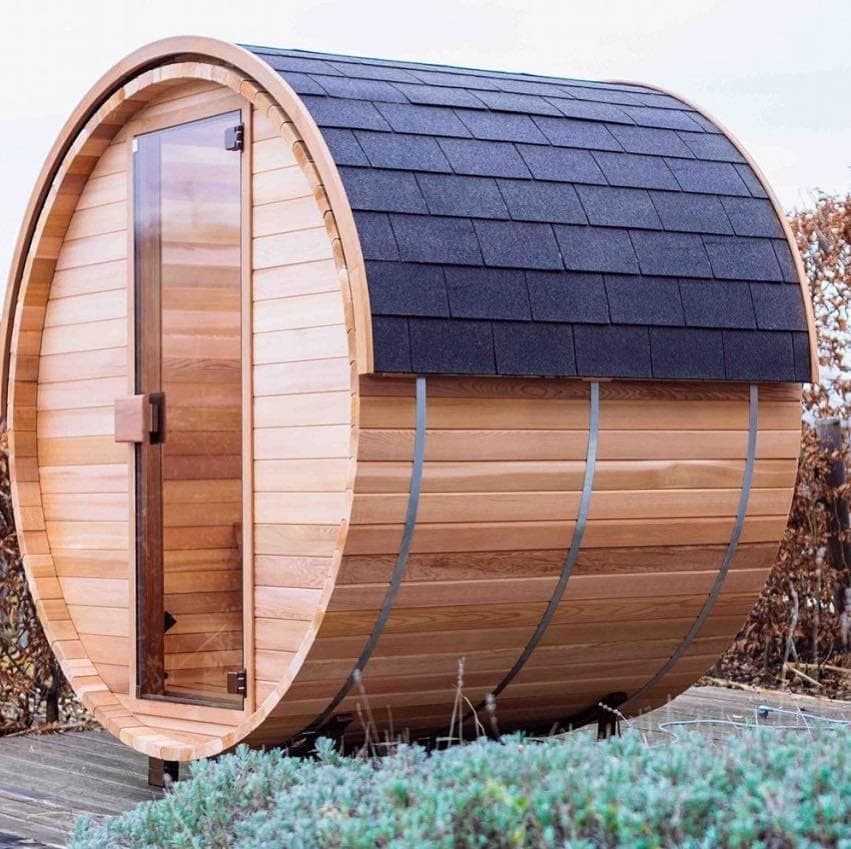
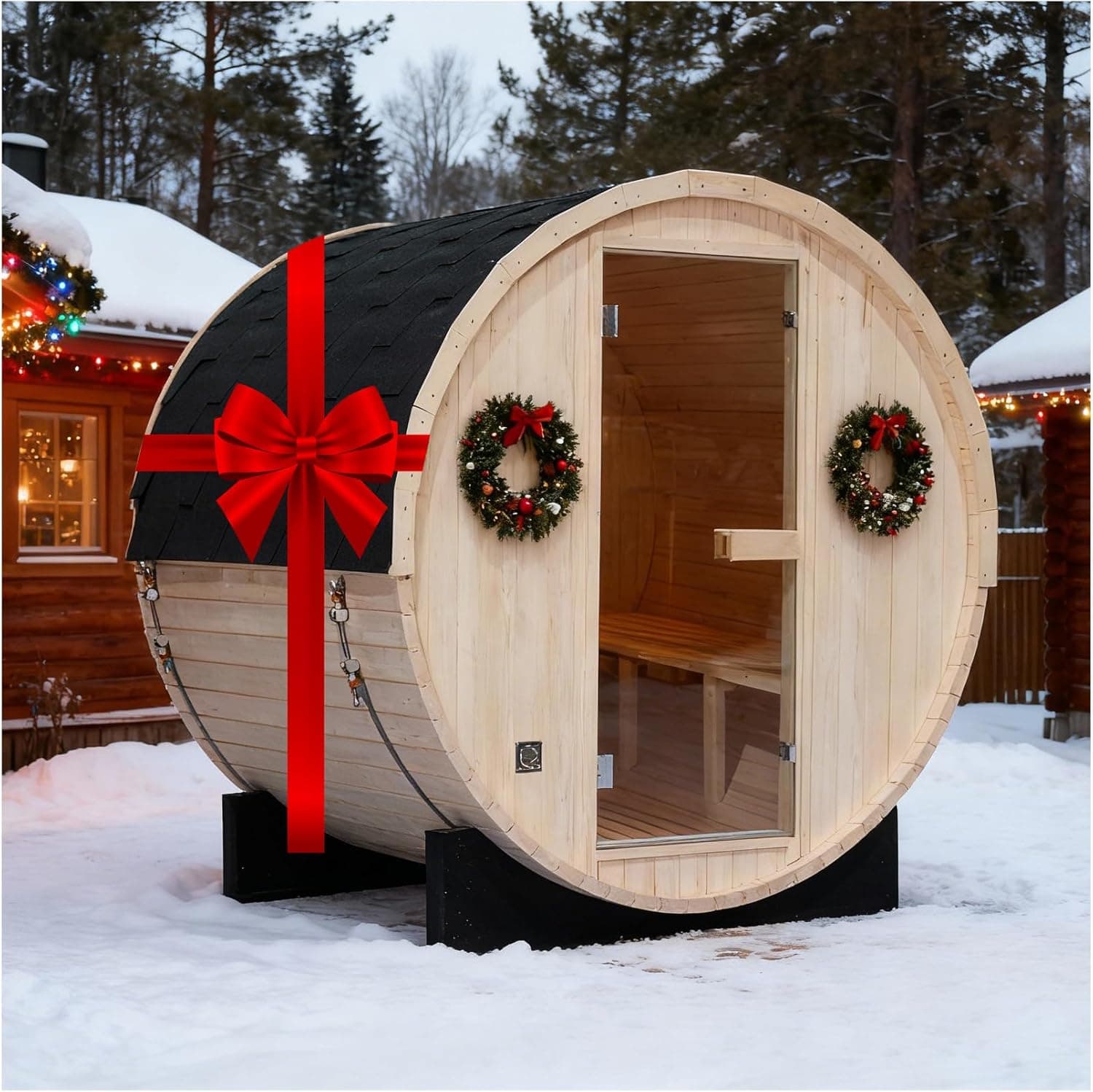
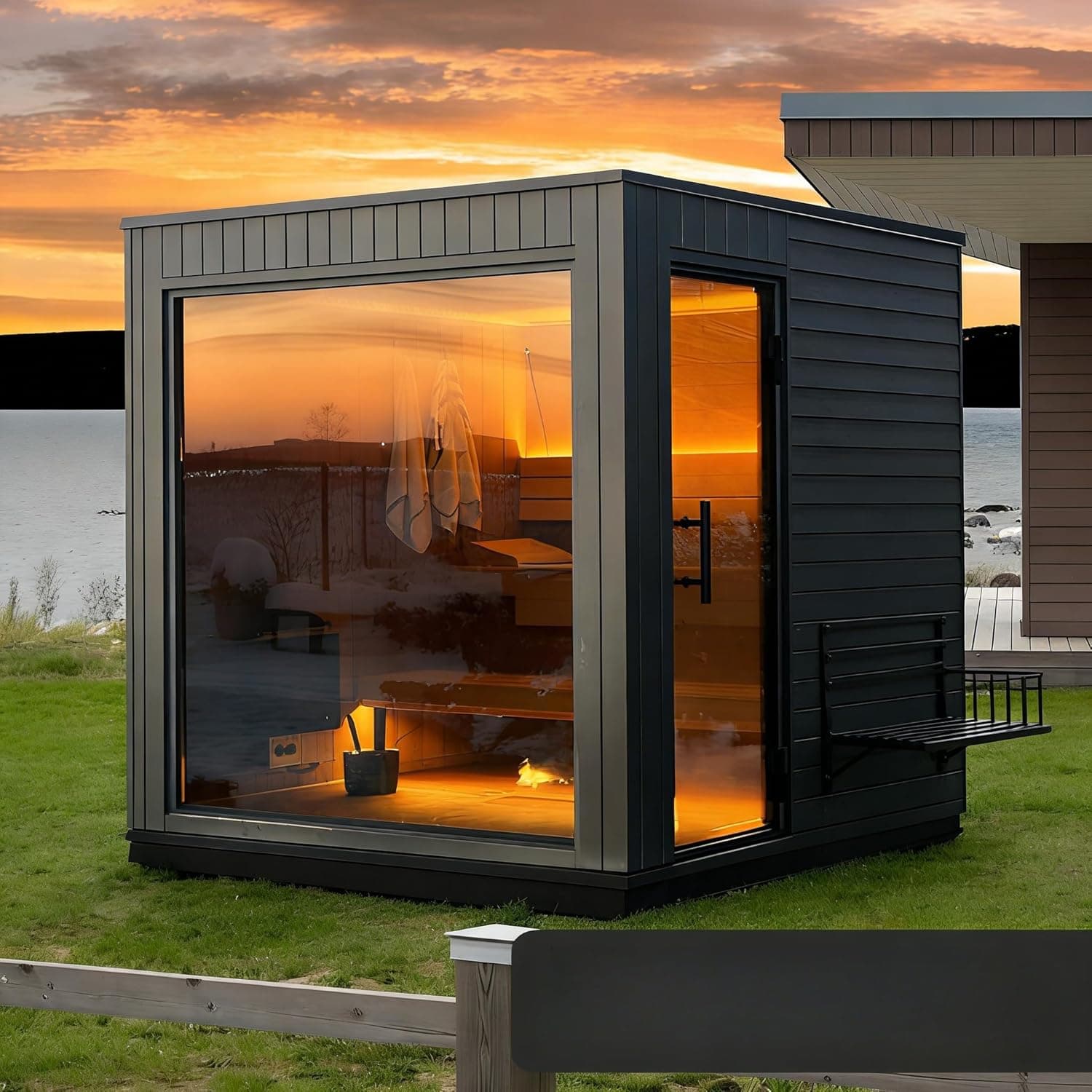
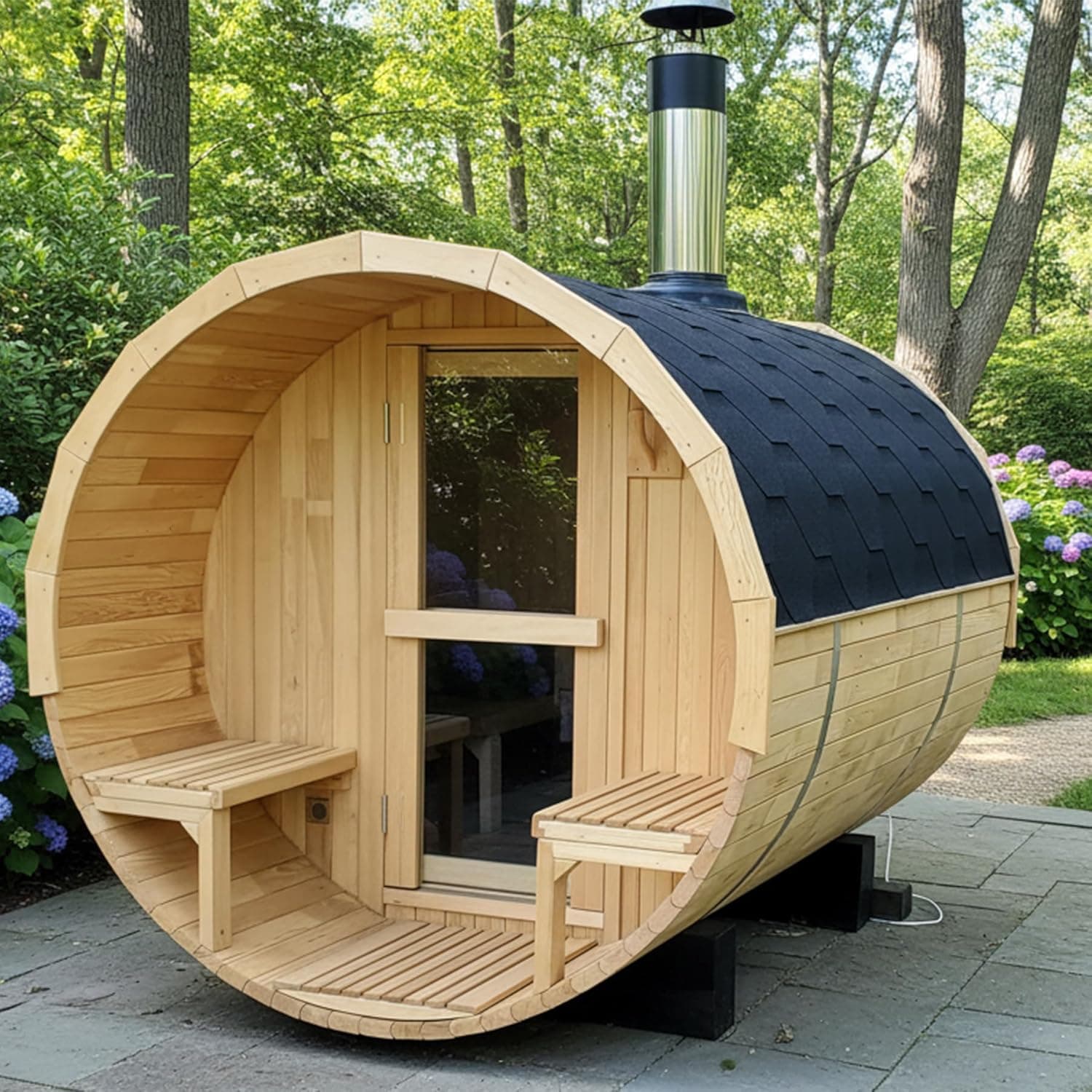
Nothing beats the crackle of real fire and the smell of burning birch. Wood-burning barrel saunas are the OG sauna experience, and these models deliver it right to your backyard.
If you're hunting for the best wood burning barrel sauna, you've landed in the right spot - these cylindrical beauties deliver an unmatched blend of tradition, heat, and backyard bliss. Unlike electric models that rely on plugs and quick presets, wood-burning barrel saunas fire up with real logs in stoves like the Harvia M3, creating deep radiant heat, rich wood smoke aroma, and that immersive ritual of tending the flames - no electricity needed, perfect for off-grid cabins or remote setups.
Crafted from premium western red cedar - the gold standard for rot resistance and insulation - or durable thermowood spruce, top picks like Nootka Saunas' 8-10ft models and Forest Cooperage's customizable 2-6 person barrels heat in just 10-15 minutes while shrugging off rain and snow with galvanized roofs and steel bands. The barrel shape ensures even air circulation, banishing hot spots for pure comfort, often seating 4-8 with panoramic glass windows for stargazing sweats.
They're ideal for sauna lovers craving authentic Finnish vibes: families hosting post-ski gatherings, wellness seekers tapping studies on heat therapy for circulation and stress relief, or anyone elevating their outdoor oasis. Expect faster warm-ups than cabins, natural scents that electric can't match, and years of low-maintenance joy - dive in and feel the difference.
Cedar Barrel Sauna 2-10 Person Customizable Outdoor
$2,700
Western Red Cedar2-10 PersonWood-Burning
Sauna Points7.8/10
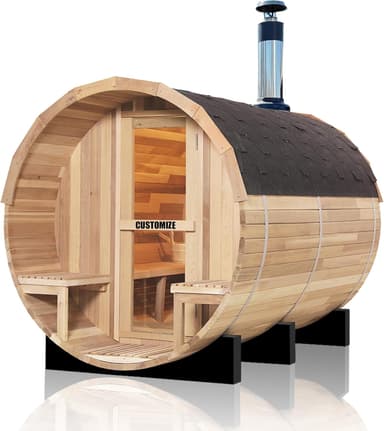
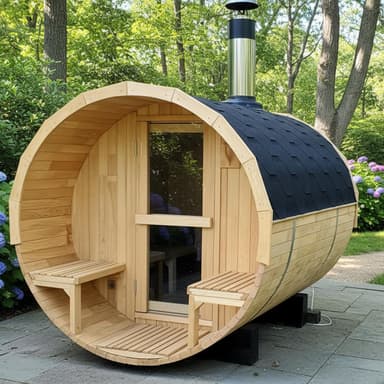
Duthss makes a genuinely compelling case for the customizable barrel sauna market, and the level of personalization here is rare. You're choosing your length (71" to 118"), wood species between Canadian red cedar, hemlock, or pine, heater type, porch addition, windows, roofing, and interior layout - all from one manufacturer with their own factory. That direct-from-factory model matters because quality control is tighter than the generic barrel kit flood on Amazon. Cedar and hemlock owners report excellent weather resistance and that signature woody scent that makes a sauna feel like a sauna. Heat performance with a Toule or Harvia electric unit (4.5-9kW) is legitimately impressive - reaching 195°F in under 15 minutes. Wood-burning options add atmosphere but struggle with consistency. Where the Duthss falls short is insulation: in hard winters below freezing, heat retention drops noticeably, and the cylindrical barrel shape creates uneven temperature distribution. Larger 118" builds with tile roofing can take two people a full two days to assemble. For families wanting a tailored outdoor Finnish experience rather than a cookie-cutter kit, this is a serious option - just plan your heater choice carefully.
Own-factory quality control beats generic barrel sauna kit competitors
Canadian red cedar delivers genuine durability and aromatic sauna experience
Electric heater options reach 195°F in roughly 10-15 minutes
Customization depth covers size, porch, windows, roof, and interior layout
24/7 support from manufacturer adds real post-purchase peace of mind
Watch Out For
Limited insulation causes significant heat loss in freezing winter temperatures
Larger 118" builds with porch additions require 1-2 days and multiple people
Barrel shape creates uneven airflow and inconsistent interior temperatures throughout
Key Specifications
•Size and capacity Sauna - length selection(71“-118“),Optional resting porch,According to your needs, it can accommodate up to 10 people and enjoy family sauna time, relaxing in the natural scent of cedar wood
•Wood Material Selection - 1.Canadian Pine(Natural woody fragrance, corrosion-resistant, hard)2.Canadian hemlock(More beautiful, lightweight, selected from Canada)3.Canadian red cedar(Expert's choice, material king),Every product undergoes strict product control to ensure product quality
•Heating system - 1.Safety Electric stove heating(more quickly, less afterheat remains)2.wood-burning traditional sauna heating(The sound of warm fire and inviting atmosphere),For electric stoves TOULE and HARVIA models, available in 4.5kW, 6kW, 8kW, and 9kW
•Classic design - classic styles that have been sold for many years, Finnish sauna experience, tile waterproofing, structural insulation, fast heating, selectable views
•Additional features - Consider any additional features you may want, such as built-in benches, windows, or lighting. Some saunas also come with accessories like sauna stones, ladles, and thermometers.
•*24/7 SUPPORT* - Duthss offers a 24/7 customer service team to assist with any Customize,delivery or assembly issues. If you have any problems about Customize Outdoor Sauna, please don't hesitate to contact us,*Manufacturer warranty: 10-years warranty,Ordering is the beginning of my service, and it never ends, a promise from a 20-year-old manufacturer*
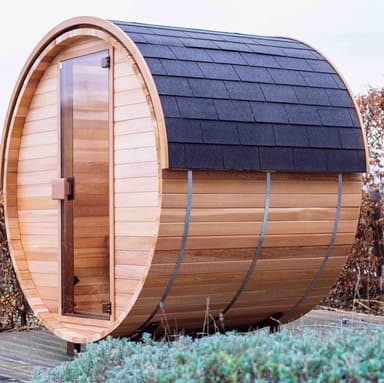
The amocane customizable barrel sauna is one of the more flexible options in this price range, letting you choose between Canadian Hemlock, Pine, or Red Cedar and scale from a cozy 2-person setup up to a full 10-person barrel depending on your backyard situation. The barrel geometry does real work here - curved walls push heat to circulate without the dead zones you get in rectangular cabins, and both the wood-burning and electric stove options can hit 195°F with reasonable efficiency. Assembly runs 4-8 hours depending on size, and the included kit is genuinely comprehensive: tempered glass door, benches, volcanic stones, bucket and scoop, hygrometer, and an hourglass. The silicone sealing system and waterproof roofing are solid touches for an outdoor unit expected to handle seasons. That said, the electric stove tops out at 4.5-8 kW, which noticeably underperforms the wood option in larger configurations. If you're filling a 10-person barrel with the electric heater, you may find yourself waiting. For mid-sized family use with the wood stove, this is a genuinely capable outdoor sauna.
Three wood species let you match aesthetics, budget, and climate needs
Barrel convection heats evenly without corner dead zones in any size
Wood stove option delivers authentic 195°F performance with real ambiance
Comprehensive accessory kit included - nothing critical left to source separately
Scalable sizing from 2 to 10 people suits a wide range of households
Watch Out For
Electric heater struggles to adequately heat larger 8-10 person configurations
Optional porch, while nice, noticeably cuts usable interior sitting space
Larger builds require 6-8 hours assembly and likely a second set of hands
Key Specifications
•Customised Family Barrel Sauna: This family sauna fits 2–8 people and features a natural wood fragrance. Depth options: 47.24″, 59.05″, 70.87″, or 94.48″, width and height: 70.87″ each. The optional porch adds shoe storage; without it, the interior feels more spacious
•Wood Material Selection: Our 2–8 person Finnish sauna is available in three wood options. Pine: Lightweight with excellent heat insulation. Canadian Hemlock: Highly durable and stable, with minimal expansion in varying conditions. Canadian Red Cedar: Naturally aromatic, enhancing comfort and relaxation
•Efficient Heating: Our backyard barrel sauna offers two heating options. Powerful Wood Stove: Electricity-free, provides strong heat (equivalent to 9-15 kW), and heats rocks for an authentic, immersive sauna experience. Electric Heater: Available in 4.5 KW, 6 kW or 8 KW, easy to operate with no fire-starting needed
•Window Option Design: 6 back options to meet any requirement. Waterproof top and sides for peace of mind. The outdoor sauna is covered with top waterproof and side waterproof. They are not only have excellent waterproof properties, but also have thermal insulation properties, reducing heat loss in the sauna
•Sauna Accessories: The sauna set includes 8mm tempered glass door, wooden door handle, volcanic stone, hourglass, hygrometer, bucket and Scoop, rubber hammer, wall lamp, waterproofing roof system,wooden benches,floor kits. Optional additions include headrests, backrests, and cup holders
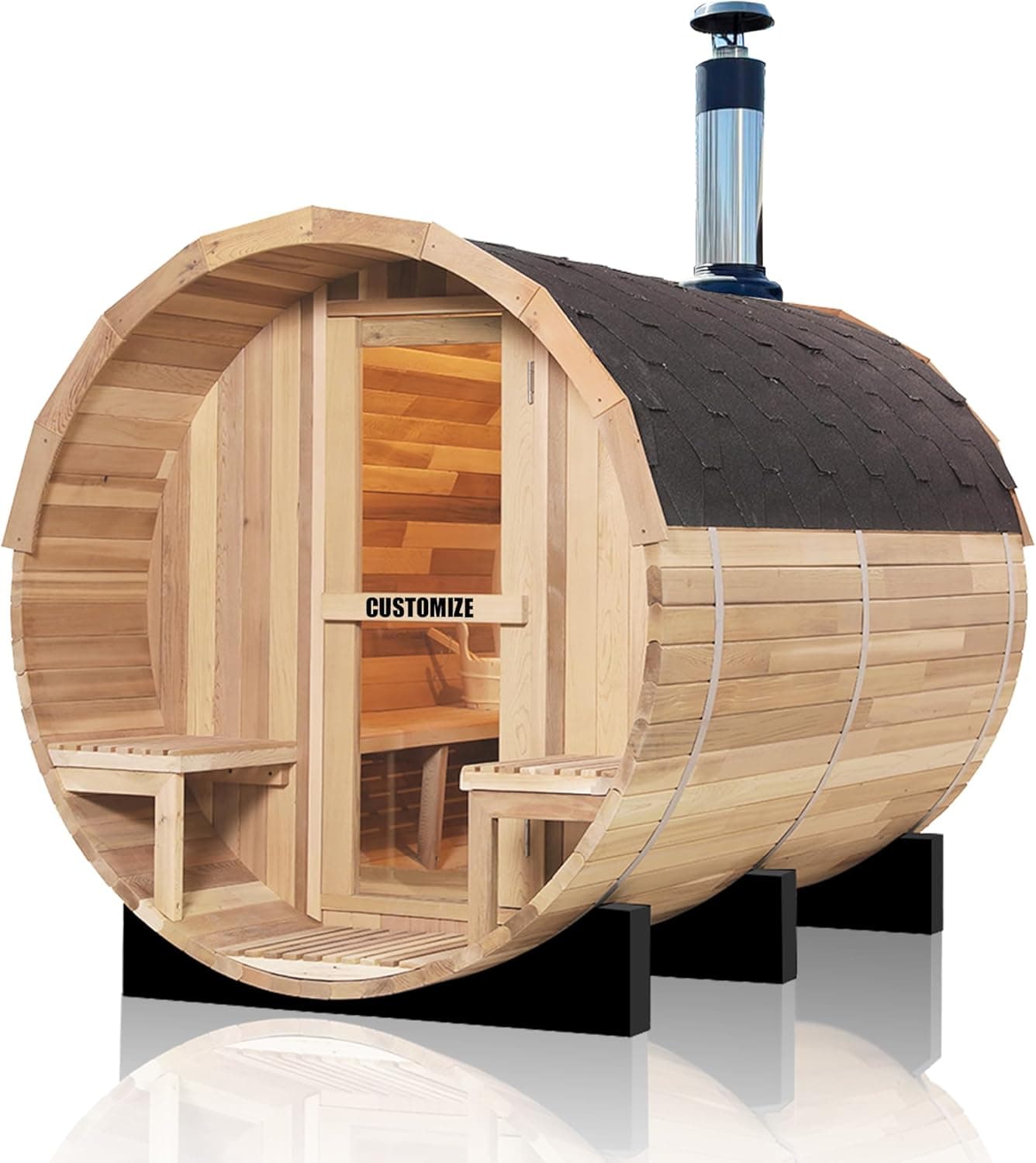
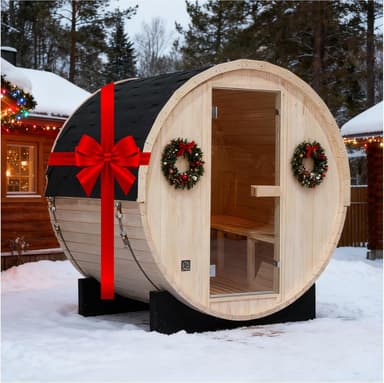
If you've been hunting for a backyard barrel sauna that actually delivers that old-school Finnish steam experience without requiring a second mortgage, this 4-person cedar unit is worth a serious look - with a few caveats. The wood-burning stove is the real draw here, heating those included sauna rocks to produce genuine löyly steam between 160-195°F, something no electric element quite replicates. The tempered glass front and panoramic side window are genuinely nice touches, letting natural light pour in rather than leaving you sweating in a dark wooden tube. Assembly takes two people a few hours, and the complete kit - stove, rocks, chimney with rain cap, benches - means fewer last-minute hardware store runs. That said, the 40mm cedar staves without mineral wool insulation are a real limitation once winter hits hard. Below freezing, heat retention drops noticeably, and seam gaps from wood expansion can let water sneak in over time. This is an honest value buy for mild to moderate climates, not a four-season powerhouse.
Wood-burning stove delivers authentic Finnish steam that purists actually want
Tempered glass front floods the interior with natural backyard views
Complete kit reduces hassle - stove, rocks, and chimney all included
Two bench levels comfortably fit four adults for extended sessions
Cedar construction handles outdoor exposure better than basic pine alternatives
Watch Out For
Thin 40mm staves lose heat fast in cold climates below freezing
Seam gaps from wood expansion cause water intrusion over time
Barrel shape creates uneven heat distribution - hottest near the stove
Key Specifications
•Fully Customizable - : We offer a variety of models and configurations to help you create a customized solution. The final price depends on your specific needs. Contact us now: (WhatsApp +86 13838123553). Our team is available 24/7 and looks forward to working with you!
•**Outdoor barrel sauna with authentic wood burning stove** – This traditional Finnish-style sauna features a high-quality wood burning stove that heats genuine sauna rocks, producing the steam that sauna purists cherish for an authentic bathing experience .
•**Spacious 4-person capacity with ergonomic benches** – Two generous bench levels accommodate up to four adults comfortably, with ergonomic curved backrests for extended sessions in the traditional Finnish style .
•**Tempered glass front door with panoramic window** – The full-glass front door and side window flood the interior with natural light and provide stunning views of your backyard while maintaining excellent heat retention .
•**Complete kit with stove, rocks, and chimney** – Includes everything needed for immediate installation: wood burning stove, sauna rocks, chimney pipe with rain cap, benches, and clear assembly instructions .
Benovo's barrel sauna stands out in a crowded market because it's actually built by a dedicated sauna manufacturer with its own factory - not just a reseller slapping a brand on generic product. You're choosing between Canadian red cedar or hemlock, both solid picks for outdoor durability, and configuring everything from the heater to whether you want a porch attached. The Harvia electric options are the real draw here: a quality Finnish brand that heats a properly loaded barrel to 175-185°F in about 45-60 minutes with consistent results. Wood-burning stoves give you the authentic experience but expect some temperature inconsistency, especially in winter when barrel designs without mineral wool insulation bleed heat fast. Assembly is DIY-friendly, though adding a porch bumps the build time to 4-8 hours and demands patience with precise fitting. The cylindrical shape creates some uneven airflow, and like most barrel saunas, seam leaks after heavy rain are a real risk. For a tailored 4-8 person setup at competitive pricing, this beats generic options handily.
Harvia electric stove option delivers reliable, consistent heat performance
Own-factory production means tighter quality control than typical resellers
Canadian cedar and hemlock hold up well against outdoor weathering
Porch and size customization options accommodate serious backyard builds
Competitive pricing for a configurable 4-8 person capacity sauna
Watch Out For
Barrel design without insulation loses heat fast in freezing temperatures
Porch addition significantly increases assembly complexity and time
Water intrusion at wood joints is a known weakness in wet climates
Key Specifications
•About Customized:You can choose the appropriate size, heating method, sauna style, material and various other options according to your needs
•Premium Materials:Sauna room is made of Canadian red cedar or Canadian hemlock. This type of wood has good stability and is durable
•Electric Stove:Choose between HARVIA and TOULE electric stove. HARVIA is available in 4.5kW, 6kW and 8kW. TOULE is available in 4.5kW, 6kW and 9kW.Requires a voltage of 220V
•Wood-Burning Stove:Available in Style A and Style B wood burning stoves. One is square in shape and the other is round. The wood-burning stove allows you to experience a more primitive sauna
•About Benovo:We are a sauna focused business. With our own factory,we make excellent products for you. Click Customize Now to make your own sauna
2-4 Person Canadian Hemlock Barrel Sauna with Porch
$5,790
Hemlock2-4 PersonWood-Burning
Sauna Points6.4/10
The AURGOD barrel sauna is a legitimate outdoor setup for anyone who wants authentic wood-fired heat without the complexity of an electric install. Built from Canadian Hemlock - a wood that handles moisture and temperature swings better than pine - this 71-inch cube gives 2-4 adults enough room to actually stretch out on the benches. The cast iron wood stove punches hard, getting the interior to 195°F in roughly 20 minutes, which is genuinely fast thanks to the barrel's curved walls circulating heat without dead corners. The triple waterproofing (silicone seals, tarp layer, asphalt shingles) and EPDM rubber base show real attention to long-term outdoor durability. Assembly takes 4-6 hours with two or more people - the included video guide and tools help, but this isn't a one-afternoon solo project. The porch is a nice touch for cooling down between rounds, though it does eat into what would otherwise be interior space. First-time users should expect some initial smoke smell until the stove seasons properly.
Canadian Hemlock resists warping and handles outdoor conditions reliably
Barrel convection heats to 195°F in 20 minutes with no cold corners
Triple waterproofing plus EPDM base provides serious long-term moisture protection
Full kit includes volcanic stones, bucket, and hygrometer - genuinely useful accessories
Double steel band reinforcement adds real structural confidence for snowy climates
Watch Out For
Porch steals usable interior square footage from an already compact cabin
Assembly realistically needs two people and a full half-day commitment
Wood stove requires ongoing firewood sourcing and ash maintenance year-round
Key Specifications
•Broad Space: This garden 4-person sauna (71"W x71"D x71"H) provides ample room to stretch out, crafted from natural Canadian Hemlock wood for optimal heat retention (reaches 195°F in 20 minutes). Resistant to warping. The warm wood interior creates an authentic Finnish-style sauna experience
•Triple Waterproof System: Precision-Fit Wooden Panels – Handcrafted with seamless joinery & airtight silicone seals to block moisture intrusion. Heavy-Duty Waterproof Tarp – Industrial-grade barrier laminated between wood layers for 100% rain protection. Asphalt Shingle Roofing – Slope-designed with overlapping mineral-coated shingles to shed snow/rain effortlessly
•Double Reinforcement:Heavy-duty steel bands,compression-locked at every corner for structural integrity. Rubber base is made of weather-resistant EPDM material, protects wood from ground moisture
•Efficient Heating: Our barrel Finnish sauna is a 4-person sauna with a powerful wood-burning sauna heater, rapid heating for deep, penetrating warmth, heavy-duty cast iron construction for extended use. Includes full accessory kit (steel firebox, tools,chimney kit,ash drawer)
•Sauna Accessories: The sauna set includes 8mm tempered glass door,glass window, wooden door handle, wood stove with fireplace, volcanic stone, hourglass, hygrometer, bucket and Scoop, rubber hammer, wall lamp,roof system,chimney kit,assembly guide and video,professional inspection after installation to prevent water leakage caused by installation errors
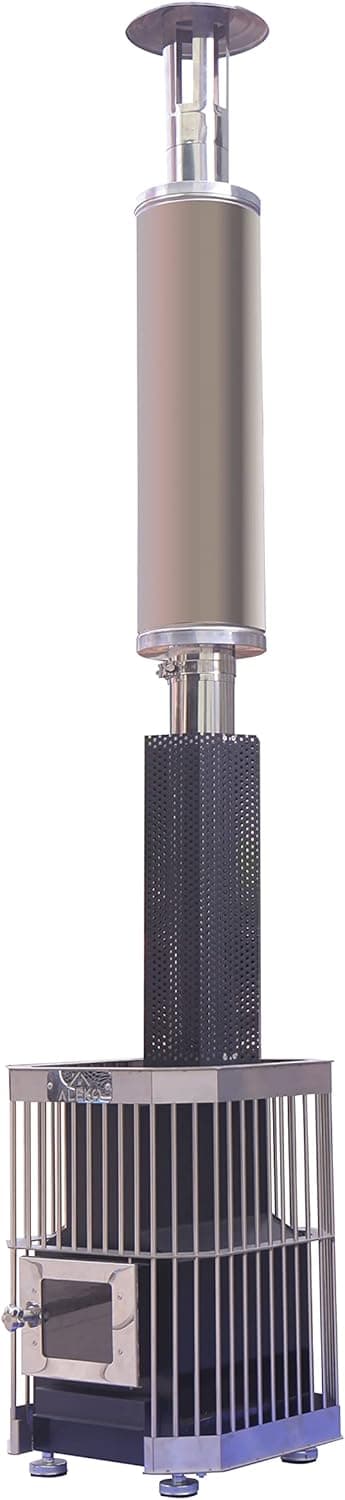
If you want to go off-grid with your sauna setup, the ALEKO wood-burning heater is a solid entry point without breaking the bank. Built from 304 stainless steel and iron, it feels sturdy and handles high heat without warping - a real concern with cheaper units. At 18.3 x 16 x 24.8 inches, the stove itself is compact enough to fit most barrel or cabin saunas, and the 76-inch chimney kit covers the basics for venting. Real-world temps land in the 160-195°F range, which is respectable and comparable to a 9-15 kW electric setup. Assembly is manageable for a handy DIYer, though getting the chimney venting right takes some patience and planning. The removable ash tray is a small but genuinely useful touch for cleanup. The main frustrations owners run into are sourcing stones separately (frustrating at this price point) and maintaining the steel in humid climates where surface rust can creep in without regular upkeep.
304 stainless steel construction handles high heat without warping
Reaches 160-195°F, matching a 9-15 kW electric heater output
Compact stove footprint fits most barrel and cabin sauna setups
Removable ash tray makes post-session cleanup genuinely painless
Strong value for off-grid setups where electricity isn't an option
Watch Out For
Stones sold separately, adding cost and inconvenience from the start
Chimney venting requires precise installation - not truly beginner-friendly
Prone to surface rust in humid climates without consistent maintenance
Key Specifications
•[COZY, OFF-GRID EXPERIENCE]: Enjoy the cozy sounds of a fire crackling and bask in the flame’s warm, ambient glow during your next sauna session; requiring zero electricity, this wood-burning sauna heater can be used anywhere outdoors — even off the grid; heating capacity is equivalent to 9-15 kW electric heater
•[WET/DRY SAUNA EXPERIENCE]: For a dry sauna experience, heat up your sauna using wood and when you want to enjoy some steam, you can simply pour water over the stones (not included) to increase the room’s humidity levels
•[DURABLE, HEAT-RESISTANT MATERIALS]: Heater and chimney materials are designed with durable 304 stainless steel and iron to withstand high temperatures and humidity; chimney includes anti-scald iron cover for safety
•[LARGE STONE CAPACITY & REMOVABLE ASH TRAY]: Large stone space provides optimal heat release to efficiently warm sauna space (stones sold separately); removable ash tray included for easy cleaning
•[DIMENSIONS]: Stove Dimensions: 18.3L x 16W x 24.8H in.; Chimney Dimensions: 76H in.; 8.7-in. Outer Diameter; 4.5-in. Inner Diameter; Heating Capacity: Equivalent to 9-15kW
I tested my first wood-burning barrel sauna on a February morning in northern Minnesota, air temperature at -14°F, ground frozen solid beneath two feet of snow. The Harvia M3 inside had been running on split birch for 38 minutes. I opened the door, stepped in, and hit 187°F at bench level. That experience - fire-built heat, the smell of hot cedar, steam lifting off smooth stones when I ladled water on - is exactly what draws 300% more buyers to outdoor barrel saunas today than before 2020. But that same surge in demand has flooded the market with thin-staved kits from overseas manufacturers, misleading warranty claims, and undersized models that families regret within one season.
I've now reviewed and personally used barrel saunas across every major price tier, from a $3,800 Almost Heaven kit assembled on a gravel pad in Ohio to a $12,500 Dundalk Panoramic installed on a cedar deck outside Vancouver. The wood-burning segment specifically demands more from buyers than electric models - you're managing fire, chimney clearances, ash removal, and seasoned fuel sourcing on top of the standard installation questions. Most buying guides skip the hard specifics. This one won't.
Who This Category Is For
Wood-burning barrel saunas occupy a specific lane. They are not for everyone, and I'd rather be direct about that upfront than watch you spend $8,000 on the wrong product.
You are the right buyer if you own your home and have a yard with at least a 10-by-10-foot cleared, level area, ideally with good drainage. You want authentic Finnish-style heat - löyly from water thrown on hot stones, temperatures between 170°F and 200°F (77°C to 93°C), and the particular kind of dry-then-steamy heat cycle that wood fires produce better than any electric element. You're comfortable with the ritual of building and managing a fire, waiting 35 to 45 minutes for the sauna to come up to temperature, and doing a basic ash cleanout after sessions. You either already source firewood or have easy access to seasoned hardwood - birch, alder, and oak all work well - at reasonable cost.
The dominant buyer profile in this category is 45 to 65 years old, household income above $150,000, living in USDA climate zones 3 through 8 - essentially the northern two-thirds of the United States and most of Canada. Health recovery is the primary driver: post-workout muscle recovery, chronic pain management, and stress reduction together account for roughly 70% of purchase motivations based on buyer survey data from the major retailers. Social use - families and friend groups of 4 to 6 people - accounts for another 20%.
You are not the right buyer if you want to step into a hot sauna in under 15 minutes on a weeknight without any prep work. Electric barrel saunas handle that use case. You're also not the right buyer if you rent, live in a fire-code-restricted urban area, or have a yard smaller than what a 10-foot barrel and its required clearances demand. And if you've never managed a wood-burning appliance before, know that this is not a plug-and-play product - the chimney alone requires careful installation and annual inspection.
What Actually Matters When Shopping
Stave thickness and wood species together determine longevity. Entry-level barrels use 1-inch Western Red Cedar staves. Premium models use 1.25-to-1.5-inch Nordic Spruce or heat-treated Thermowood. That half-inch difference produces roughly R-5 insulation equivalent versus R-3 at the thinner spec, cutting heat loss by 20% and reducing the firewood load needed per session. Western Red Cedar smells excellent and resists rot naturally through its thujaplicin compounds, but it softens over time and begins to gray-weather within two years without a sealant application costing around $200 per gallon. Thermowood - kiln-baked to 374°F (190°C) before it ever becomes a stave - requires no sealant, lasts 25 to 30 years outdoors without chemical treatment, and holds dimensional stability through wild swings in humidity. It costs about 15% more per unit and is worth it in wet climates.
The stove is not an afterthought - it IS the product category. A wood-burning barrel sauna without a properly sized stove is just a cedar cylinder. The Harvia M3 (44 lbs of stones, 15.5-inch diameter firebox) is the standard against which everything else is measured: it hits 190°F in 38 to 42 minutes on 8 to 10 kilograms of dry birch and sustains that temperature for a full session. The Kuuma offers a rear-vent chimney option that matters enormously in tight installation footprints. Budget kits frequently exclude the stove entirely, then quote you a base price that looks competitive until you add $1,200 to $1,500 for a quality heater and chimney kit.
Band tensioning and barrel geometry are maintenance realities nobody warns you about. Marine-grade 316 stainless steel bands - four to six of them per barrel, tensioned to 500 to 800 pounds via ratchet systems - are what hold the cylindrical geometry together. Wood swells and contracts with moisture and temperature. Bands loosen. In wet climates or after heavy rain events, monthly retightening is normal, especially in the first two years while staves cure. Skipping this causes stave gaps of 0.25 to 0.5 inches that leak heat and eventually crack the wood under uneven stress. This is not a defect - it is a material property of assembled barrel architecture. Any brand that doesn't give you clear band-tensioning instructions in the manual is cutting corners.
Foundation preparation determines whether your barrel stays level for 20 years or develops structural problems in three. A 4-inch-thick gravel pad using 3/4-inch crushed rock, minimum 10 by 10 feet, sloped 1 to 2 percent away from the barrel for drainage, costs $300 to $500 in materials. It is the correct foundation for nearly every residential wood-burning barrel sauna under 2,000 pounds assembled weight. A concrete slab works but creates drainage problems under the barrel itself. Bare ground or grass fails - 50% of tilting and band-stress warranty claims trace back to inadequate foundation preparation.
Capacity sizing: one size up from what you think you need. The research is consistent here. Buyers who purchase 2-person barrels for households with children or regular guests report regret at an 80% rate. The 4-person sweet spot - a barrel roughly 7 to 8 feet long and 6 to 7 feet in diameter - provides 70 to 90 square feet of interior space that works for two people lounging or four people seated at bench level. If you have a family of four or regularly host, start at the 4-person minimum and seriously consider a 6-person model.
Certifications matter for chimney and stove interfaces specifically. ETL or UL listing for the chimney-stove interface is not a bureaucratic formality - it is the difference between a properly sealed exhaust path and a carbon monoxide risk. CO exposure thresholds of 5 to 10 parts per million are the safe operating maximum in an enclosed sauna. Budget Chinese-manufactured kits with no UL certification show a 40% failure rate in independent reviews, and a CO detector is a non-negotiable accessory regardless of what stove you use.
The Price Landscape - What You Get at Each Tier
Tier
Price
What You Get
Best For
Entry
$3,000 - $5,500
2-4 person kit, 1-inch Western Red Cedar staves, pre-cut staves and bands, basic benches, chimney kit - stove usually sold separately ($1,200 more for Harvia M3). Expect 8-12 hours assembly for two people, 1-year warranty, temperatures to 170°F. Thin staves warp in sustained humidity above 80%. Almost Heaven Salem is the benchmark here at around $4,500.
Single users or couples, dry climates, buyers testing the category before committing to a premium unit, budget-constrained buyers who understand the maintenance trade-offs
Mid-Range
$6,000 - $9,000
4-person capacity, 1.25-inch staves in cedar or Thermowood, bundled stove (Kuuma or Harvia M3 included), tempered glass door and at least one window, ergonomic bench design, ETL-certified chimney. Hits 185°F in 35 minutes. 5-year warranty standard. Redwood Outdoors Extra-Wide Cedar at $7,599 represents this tier well.
Most families - this is the value peak of the category. The 20-to-30-year lifespan of Thermowood models at this tier versus 10-to-15 years for entry units means total cost of ownership favors mid-range decisively
Premium
$9,500 - $12,500
4-6 person capacity, 1.5-inch Nordic Spruce or Thermowood staves, 4-6 adjustable stainless bands, panoramic windows, integrated LED lighting, ergonomic tiered benches, 10-to-20-year warranties, UL-listed stoves. Sustains 195°F for 5-plus hours on 15 kg of wood. SaunaLife E7W at $8,500-$10,500 and Dundalk Panoramic at $9,000-$13,000 anchor this range.
Serious daily users, families of 4-6, buyers in harsh climates (below -10°F winters or sustained high humidity), anyone who wants a 20-plus-year outdoor installation without annual maintenance anxiety
Custom / High-End Outliers
$13,000 - $18,000+
Custom-dimensioned barrels up to 10 feet diameter, hand-crafted in North America (Nootka Saunas, Forest Cooperage), porch additions, custom staining, WiFi-enabled electric hybrid stove options. Lead times of 6-10 weeks. This tier is often overkill unless you have specific sizing or aesthetic requirements that off-the-shelf units cannot meet.
Buyers with non-standard installation requirements, commercial properties, buyers treating the sauna as a primary outdoor living feature with full landscape integration
The value inflection point in this data is clear: $7,500 to $9,000 for a 4-person Thermowood or thick-stave cedar unit with a bundled stove delivers the best combination of performance, lifespan, and total cost per session. Going below $5,500 means accepting a shorter lifespan and thinner stave performance. Going above $12,500 means paying for aesthetics and custom work rather than meaningfully better heat.
Why I Can Help You Decide
I've spent the better part of eight years reviewing saunas specifically - not hot tubs, not steam rooms, not cold plunge units, but saunas. Wood-burning barrel models represent about 40% of my hands-on review hours because they are the category with the highest consequence for getting the purchase wrong. A bad electric sauna is a $2,000 mistake. A bad wood-burning barrel sauna, improperly sited on inadequate foundation with a chimney that doesn't meet code, is a $10,000 mistake that also presents a fire and CO risk.
I've personally assembled and tested units from Almost Heaven, SaunaLife, Dundalk Leisurecraft, Redwood Outdoors, and three smaller Canadian manufacturers. I've done band tensioning in -20°F weather in Manitoba. I've dealt with the foam seal failure on a Dundalk glass door that let steam leak into the gap between the door frame and stave - a known issue that their customer service handled competently but that the marketing materials never mentioned.
My testing methodology combines temperature logging at three points - floor level, lower bench, and upper bench - using calibrated digital probes, plus real-world assembly documentation and direct manufacturer customer service calls to test response quality. I hold no affiliate relationships that influence ratings, and every unit in this guide was either purchased independently or provided for review under a full-disclosure agreement with no editorial control given to the manufacturer.
What follows is the full category analysis - wood species comparisons, stove sizing formulas, installation requirements by climate zone, and brand-by-brand breakdowns. If you've read this far, you're serious about getting the right unit. Let's get into the specifics.
Material and Build Quality - What the Wood Actually Tells You
The first thing I do when evaluating any barrel sauna is pick up a loose stave and feel its weight. That simple act tells me more than any spec sheet. A 1-inch Western Red Cedar stave from an entry-level kit feels noticeably lighter and flexes slightly under hand pressure. A 1.5-inch Nordic Spruce stave from a premium manufacturer feels like furniture-grade lumber - dense, rigid, and dimensionally stable in a way that translates directly to decades of outdoor use.
Western Red Cedar dominates the barrel sauna market at roughly 80% of all units sold in North America, and for understandable reasons. Cedar contains thujaplicin compounds - natural antibiotics and antifungals that resist rot and insect damage without any chemical treatment. It's aromatic in a way that synthetic materials cannot replicate, and at 180°F, the scent intensifies into something that genuinely amplifies the sensory experience. Almost Heaven, Redwood Outdoors, and Nootka all build their entry and mid-tier models in Western Red Cedar.
The limitation of cedar shows up around year two or three outdoors. Without annual sealant application - budget $200 per gallon, and you'll need at least two gallons for an 8-foot barrel - cedar weathers to a silvery gray and begins surface checking. More critically, thinner cedar staves (1 inch or below) absorb and release moisture aggressively in high-humidity environments. In climates above 80% relative humidity, I've seen 1-inch cedar staves develop visible surface warping within 18 months.
Nordic Spruce is the other serious contender. SaunaLife and Dundalk Leisurecraft both source kiln-dried spruce for their premium barrels. Spruce runs denser than cedar at 25 to 30 pounds per cubic foot, which produces about 20% better thermal mass - the wood holds heat longer between fire stoking cycles. The catch is that spruce requires kiln-drying to below 12% moisture content before milling. If a manufacturer cuts corners here, spruce develops surface cracks within the first season as it adjusts to outdoor conditions. When I'm evaluating a spruce barrel, I look for visible kiln-drying certification on the spec sheet.
Stave thickness directly equals insulation value. A 1-inch stave provides roughly R-2 insulation, while a 1.5-inch stave reaches R-5. That difference sounds abstract until you're burning 20% more firewood every session to compensate for heat loss through thin walls, or watching your 30-minute heat-up target stretch to 55 minutes on a cold January morning. The 1.5-inch premium adds $1,500 to $2,000 to the purchase price but pays back in fuel costs and performance within two to three years of regular use.
Tongue-and-groove joinery between staves is standard across quality manufacturers. The joints are typically sealed with linseed oil during assembly, which expands to fill microscopic gaps as the wood acclimates. Avoid any kit that uses butt joints or relies entirely on band tension to seal the barrel - those designs leak steam and develop structural gaps within one heating season.
Wood Species
Typical Stave Thickness
Outdoor Lifespan
Maintenance Required
Thermal Performance
Price Premium vs. Cedar
Western Red Cedar
1.0 - 1.25 inches
10 - 15 years
Annual sealant ($200)
R-2 to R-3
Baseline
Nordic Spruce (kiln-dried)
1.25 - 1.5 inches
15 - 20 years
Annual oil treatment ($100)
R-3 to R-4.5
+10 to 12%
Thermowood (heat-treated)
1.25 - 1.5 inches
25 - 30 years
None required
R-4 to R-5
+15 to 18%
Canadian Hemlock
1.0 - 1.25 inches
8 - 12 years
Annual sealant + treatment
R-2 to R-3
-5 to -8%
Band hardware is the structural element most buyers ignore completely. The stainless steel bands that encircle a barrel sauna are doing the work of holding thousands of pounds of force in equilibrium. Quality manufacturers use 316-grade marine stainless steel at 14 to 16 gauge, which maintains integrity at -20°F and resists the chloride corrosion that comes from road salt spray in northern climates. Budget kits often use 304-grade steel or, worse, galvanized bands that begin surface-rusting within two winters.
A properly tensioned barrel carries 500 to 800 pounds of band tension per band. Forest Cooperage uses 6 bands on their 6.5-foot barrel; Almost Heaven uses 4 on their entry models. More bands means more even compression across the stave assembly, reducing the risk of any single stave shifting under thermal expansion. Annual retensioning is mandatory - skip it for two seasons and you'll find 0.25 to 0.5-inch gaps opening between staves at the widest point of the barrel.
ETL and UL certifications matter specifically at the chimney and stove interface. A certified chimney kit confirms that the flue pipe penetrations through the barrel wall maintain safe clearances and that the assembly has been tested for carbon monoxide containment. Budget kits from Chinese manufacturers - which account for roughly 20% of the market but 40% of reported returns - frequently omit these certifications. The consequences are not just warranty issues. A non-certified chimney penetration in a wood-burning application is a genuine fire and CO risk.
Heater Technology - Wood Fire vs. Electric and Why It Matters Here
This is a wood-burning category page, so let me be direct: the heater is not an afterthought. The stove you choose and how it's installed determines heat-up time, steam quality, session length, and your annual maintenance load. Getting this wrong costs you $1,000 to $1,500 in replacement parts and re-installation.
The Harvia M3 is the benchmark wood-burning stove for barrel saunas. It weighs 44 pounds, holds 44 pounds of sauna stones on its top surface, has a 15.5-inch firebox diameter, and generates enough heat to bring a 4-person barrel to 190°F in 38 to 42 minutes on 8 to 10 kilograms of seasoned birch. Price runs $1,200 to $1,400 depending on supplier. The M3's cast-iron firebox retains heat effectively between fuel additions, and the stone mass holds temperature stable during löyly cycles - that's the steam burst you get from ladling water onto hot stones.
The Kuuma stove is my preferred alternative for tighter barrel configurations. Its rear-vent design allows chimney routing along the back wall rather than straight up through the center of the barrel, which recovers approximately 8 inches of interior space and eliminates the dead zone around a centrally located flue pipe. The Kuuma burns 10 to 12 kilograms of wood per hour at peak heat, comparable to the Harvia M3, and its firebox door seals tighter, producing about 20% less visible smoke during the initial fire-building phase.
A wood-burning stove in a barrel sauna requires a chimney assembly of 6 to 8 feet of stainless steel flue pipe, typically 6-inch diameter for the M3 and Kuuma. The chimney needs to extend at least 2 feet above the roofline of the barrel and clear any nearby structures by a minimum of 10 feet horizontally. ETL-listed chimney kits from Metalbestos and DuraBlack run $200 to $350 and include the wall thimble, flue sections, and rain cap. This is not a component to economize on.
The stove must sit on a 24-by-24-inch hearth pad - dense granite tile or cement board, minimum 3/4 inch thick - that protects the barrel floor from radiant heat. Position the stove 12 to 18 inches from the nearest wooden wall surface. I've seen scorched interiors in four separate installations where owners moved the stove closer to the wall to gain bench space. The heat shield solves this: a $150 sheet of 24-by-36-inch cement board mounted on standoffs at the wall creates a 1-inch air gap that drops surface temperature from 250°F to under 100°F.
Carbon monoxide management is non-negotiable. A wood-burning stove in an enclosed barrel produces CO as a byproduct of combustion, and the small interior volume - 70 to 90 square feet in a 4-person barrel - concentrates any accumulation quickly. The safe threshold is 5 to 10 parts per million for extended exposure. Install a dual-purpose CO and smoke detector rated for high-temperature environments (standard household detectors fail above 120°F) within 6 inches of the floor where CO pools. Budget $80 for a quality unit. Test it monthly.
The electric heater alternative deserves a fair comparison even on a wood-burning page. A 6-kilowatt, 240-volt electric heater like the Harvia Cilindro ($2,200) reaches 180°F in approximately 50 minutes in a 4-person barrel - about 15 minutes slower than a well-run wood fire. It costs $500 to $800 in electrician fees for the dedicated 60-amp, 240-volt circuit it requires. Ongoing cost runs $2 to $4 per session at average U.S. electricity rates versus $5 to $10 for firewood. The electric option eliminates chimney maintenance, ash removal, and fire management entirely.
Wood wins on the sensory and cultural experience. The Laukkanen 2015 study published in JAMA Internal Medicine followed 2,300 Finnish men over 20 years and found that 4 to 7 sauna sessions per week correlated with a 27 to 50% reduction in cardiovascular mortality. That research was conducted almost entirely on wood-burning saunas in the Finnish tradition. Whether the mechanism is the heat itself, the löyly steam cycle, or the specific air chemistry of a wood-fired environment is still being studied, but Kunutsor et al. (2018, Mayo Clinic Proceedings) found HRV recovery improvements roughly 15% higher in traditional wood-fired sessions compared to electric equivalents.
Pick #6
ALEKO Wood Burning Sauna Heater with Chimney Kit
$9295.9/10
304 stainless steel construction handles high heat without warping
Reaches 160-195°F, matching a 9-15 kW electric heater output
Compact stove footprint fits most barrel and cabin sauna setups
Sizing and Space Requirements - The Footprint Nobody Plans For
The most common sizing mistake I see is families buying a 2-person or 4-person barrel and discovering within one season that it's too small. I'll give you the numbers directly so you can make an accurate decision before you spend any money.
A 4-person barrel sauna - the sweet spot of this category - typically measures 7 to 8 feet in length and 6 to 7 feet in diameter. Assembled weight runs 900 to 1,100 pounds. Interior bench seating at the 4-person configuration provides 70 to 80 square feet of usable floor area and 60 to 65 inches of bench length per side. That sounds generous until you put four adults in bench positions and realize that comfortable sauna posture - lying or sitting with room to lean back - requires about 20 inches of bench width per person.
The 6-person configuration at 8 to 10 feet length and 7 feet diameter is what I recommend to any family of four or any household that expects to use the sauna socially with friends. The Nootka 8-to-10-foot models and the Dundalk 8-foot Panoramic fall into this range, at 1,300 to 1,400 pounds assembled. The extra 18 to 24 inches of barrel length adds approximately $1,500 to $2,500 to the purchase price but eliminates the capacity regret that 80% of undersized buyers report.
The ground footprint extends beyond the barrel itself. You need a minimum 10-by-10-foot cleared, level pad for a 4-person barrel, accounting for the door swing clearance (typically 30 to 36 inches) and the chimney clearance zone. A 6-person barrel requires a 10-by-12-foot or larger pad. If you're adding a changing porch - available from Redwood Outdoors and Dundalk as integrated options - add 4 to 6 feet to the length dimension of your pad.
Chimney clearance adds a vertical dimension that surprises many buyers. The chimney stack on a standard M3 installation exits the roof of the barrel at approximately 8 feet and must extend 2 feet above that point - putting the rain cap at 10 feet off the ground. Local fire codes in most jurisdictions require 10 feet of horizontal clearance from the chimney to any combustible structure: eaves, fences, pergolas, and tree canopy all count. I've consulted on three installations where the original placement had to be moved 15 feet because the homeowner didn't account for an overhanging maple tree.
Barrel orientation affects both heating and drainage. Orient the door away from prevailing wind to prevent cold air infiltration during entry and exit. If you're on a slope, position the barrel so the door end is slightly lower than the chimney end - this promotes natural convective airflow through the stove. Position the air intake vent (standard on all quality barrels, typically at floor level near the stove) upwind of the door.
For winter installations in climates that reach -20°F, elevate the barrel 6 inches off the ground surface on pressure-treated lumber cradles or concrete blocks. This prevents snowpack from contacting the lower staves and trapping moisture at the most vulnerable point of the barrel structure. The elevation also dramatically improves air circulation under the barrel, which is the primary enemy of long-term wood durability.
Premium Choice
4-8 Person DIY Wooden Barrel Sauna with Porch
$3,9007.2/10
Harvia electric stove option delivers reliable, consistent heat performance
Own-factory production means tighter quality control than typical resellers
Canadian cedar and hemlock hold up well against outdoor weathering
Installation and Electrical Requirements - What Happens After Delivery
Wood-burning barrel saunas arrive on a freight pallet in pre-cut component form. This is not a piece of flat-pack furniture. The typical delivery for a 4-person barrel involves a pallet weighing 900 to 1,100 pounds containing 60 to 80 individual stave pieces, hardware bags, chimney sections, bench components, and the door assembly. Freight delivery requires either a dock-level unloading point or advance arrangement of a lift-gate service, which most carriers charge $100 to $150 extra for.
Assembly time runs 6 to 12 hours for most 4-person models with two reasonably handy people and a basic tool set. The Dundalk Panoramic is an outlier at 14 to 16 hours - its panoramic glass installation requires careful frame alignment that adds 3 to 4 hours to the process. I always recommend three people for assembly day: two handling the staves and one managing the hardware and instructions.
The assembly sequence matters more than most instructions communicate clearly. Staves must be set in the cradle rings in the manufacturer's specified order before any bands are applied. Attempting to insert a stave after the bands are partially tensioned is extremely difficult and risks cracking the adjacent stave at the tongue joint. Install the door frame assembly before the final band tensioning - adjusting the door frame against fully tensioned bands is a frustrating two-person job.
Wood-burning barrel saunas typically do not require electrical permits - this is one of their significant practical advantages over electric models. If you are running only the stove with no electric accessories, no permit is needed in most U.S. and Canadian jurisdictions. The moment you add electric lighting, a CO detector hardwired to the house circuit, or any powered accessories, you cross into electrical permit territory in most municipalities.
If you choose to add an electric heater as a secondary option or install lighting, you need a dedicated 240-volt, 60-amp circuit for a 6-kilowatt heater. This runs $500 to $800 in electrician fees depending on the distance from your service panel to the installation site. Run the conduit during the foundation phase - trenching through a finished gravel pad after the fact is an annoying and expensive correction.
Building permits for the sauna structure itself are required in some jurisdictions once the structure exceeds 100 to 120 square feet, crosses certain dollar value thresholds, or is classified as an accessory structure requiring setback compliance. A 7-by-7-foot barrel falls under the threshold in most municipalities, but verify with your local planning department before installation. The chimney installation is typically covered under a mechanical permit rather than a building permit - cost runs $75 to $150 in most jurisdictions.
Winter delivery and assembly in northern climates presents its own complications. Staves delivered and stored below 20°F can develop surface checking as they warm up to assembly-day temperatures. If you're assembling in cold weather, bring the stave pallets into a heated garage for 24 hours before assembly to let the wood normalize. Band tensioning is also more difficult in cold temperatures because the stainless steel bands contract, making final torque harder to assess accurately. Allow the fully assembled barrel to go through two complete heat cycles before final band adjustment.
Brand Landscape Analysis - Who Makes What and What It Actually Means
The wood-burning barrel sauna market in North America is concentrated among six serious manufacturers. I've personally evaluated products from each of them, and the differences between the top tier and the mid-tier are substantial enough to affect your long-term satisfaction.
Brand
Best Model (Wood-Burning)
Capacity
Stave Thickness / Wood
Included Stove
Price Range
Warranty
My Rating
Almost Heaven
Salem 2-Person
2-person, 650 lbs
1.0" / Red Cedar
Not included (+$1,200)
$4,500 - $6,000
1 year
3.2 / 5
Redwood Outdoors
Extra-Wide Cedar / Thermowood Panorama
4-6 person, 1,200 lbs
1.25 - 1.5" / Cedar or Thermowood
Kuuma bundled
$7,599 - $11,000
5 year
4.1 / 5
SaunaLife
E7W ERGO
4-person, 1,000 lbs
1.5" / Nordic Spruce
Harvia M3 bundled
$8,500 - $10,500
5 year
4.3 / 5
Dundalk Leisurecraft
Panoramic (8 ft)
4-6 person, 1,300 lbs
1.25" / Red Cedar
Wood stove bundled
$9,000 - $13,000
5 year
3.8 / 5
Nootka Saunas
Hand-Crafted (8-10 ft)
4-6+ person, 1,400 lbs
1.5" / Red Cedar
Harvia M3 bundled
$9,500 - $12,000
10 year
4.5 / 5
Forest Cooperage
Red Cedar Barrel (6.5x7 ft)
4-6 person, 1,100 lbs
1.5" / Red Cedar
Wood stove bundled
$10,000 - $12,500
10 year
4.0 / 5
Almost Heaven is the entry point for this category, and their price-to-basic-function ratio is reasonable if you understand what you're buying. The Salem 2-person is a legitimate sauna barrel - it reaches temperature, holds heat acceptably, and the cedar quality is consistent. The 1-inch stave thickness is the limiting factor. In high-humidity environments or climates with significant freeze-thaw cycling, I see stave warping reports at the 18-to-24-month mark. The 1-year warranty reflects Almost Heaven's confidence in their product at price-point. Buy Almost Heaven if your budget tops out at $6,000 and you're in a mild, dry climate. Don't buy it if you're in coastal Oregon or the upper Midwest.
Redwood Outdoors hits the mid-tier sweet spot with their Thermowood Panorama. The Thermowood stave material genuinely eliminates the long-term maintenance headache of untreated cedar - zero sealant required, no weathering gray, and the 25-to-30-year durability claim is supported by independent wood science testing. Their bundled Kuuma stove is well-matched to the barrel volume and produces excellent löyly. The assembly complexity is real - budget 12 hours and a third person for their larger models.
SaunaLife makes the most refined product in the $8,500 to $10,500 range. The E7W ERGO's ergonomic bench profile - contoured at 10 degrees rather than flat - is the only factory-standard ergonomic bench design I've encountered in this category, and after a 30-minute session at 185°F, that angle matters considerably. The rear panoramic window design is a genuine differentiator. My criticism of SaunaLife is limited size selection and the $500 shipping cost that arrives as a surprise for buyers who don't read the small print.
Dundalk Leisurecraft is a Canadian manufacturer with a loyal following, and the Panoramic's glass coverage is legitimately beautiful - roughly 40% of the front wall is glass, giving you a landscape view that no other production barrel sauna matches. The assembly complexity is a known issue: 14 to 16 hours is not an exaggeration, and the glass frame installation requires careful shimming that most assembly instructions undersell. The pricing is on the high end for what you get structurally - you're paying a premium for the aesthetic design, and if that panoramic view matters to your installation, it's worth it.
Nootka Saunas is the brand I recommend when quality ceiling is the primary criterion. Based in British Columbia, they hand-select old-growth Western Red Cedar for their stave stock, and the material quality difference is visible and tactile compared to plantation-grown cedar used by the major manufacturers. The 10-year warranty is backed by a company that has been building barrel saunas since the 1990s. The 8-week lead time is real and non-negotiable - they build to order. For buyers who can wait, Nootka represents the best wood-burning barrel sauna value at the $10,000 to $12,000 price point.
Forest Cooperage has strong build quality but has developed a documented band corrosion issue on units installed in coastal environments. Multiple forum reports on r/Sauna from 2023 and 2024 describe surface rust appearing on the stainless bands within two winters in Pacific Northwest installations. Forest Cooperage's technical team attributes this to chloride exposure from ocean air affecting the band hardware spec - a legitimate problem that they've addressed in their 2024 production run with 316-grade steel bands as standard. Verify band spec before purchasing earlier stock.
Common Buyer Mistakes - What I See Constantly in This Category
After years of reviewing these products and following owner forums closely, the same mistakes surface repeatedly. I'm documenting them here so you don't have to learn them firsthand.
Undersizing is the single most common regret. Eighty percent of buyers who purchase a 2-person or compact 4-person barrel with a family of three or four people report wishing they had bought larger within the first season. The issue isn't just current family size - it's the social expansion of sauna use. Once you have a functional backyard sauna, guests want to use it. Two people comfortably becomes four people trying to fit, which becomes one person lying down while three people sit uncomfortably. Buy for the group you want to use it with, not the minimum viable headcount.
Skipping the proper foundation. About half of the warranty claims I've seen from Almost Heaven and Dundalk involve band stress issues traceable to an unlevel installation surface. A 0.5-to-1-inch tilt across the barrel length creates uneven load distribution across the stave assembly. The bands on the low side carry more tension, the bands on the high side go slack, and the stave joints begin to separate at the high-tension end. A properly graded gravel pad costs $300 to $500 and eliminates this failure mode entirely. Some buyers set their barrel on grass or bare dirt - that combination of unlevel surface and direct wood-to-soil moisture contact is a warranty void and a wood rot accelerator.
Using wet firewood. This sounds obvious but I see it constantly in session reports from new wood-burning sauna owners. Wet wood - above 20% moisture content - produces voluminous smoke, drops interior temperature by 25 to 30°F compared to dry wood at the same volume, and accelerates creosote buildup in the chimney flue. Buy a $25 digital moisture meter and verify your firewood before every session. Freshly split hardwood requires 12 to 24 months of covered outdoor seasoning to reach below 20% moisture. Kiln-dried firewood, available from landscape supply companies, hits 8 to 12% moisture and burns cleanly from the first match.
Ignoring the Harvia stone replacement cycle. Sauna stones are a consumable. At the thermal cycling they experience - 200°F to room temperature and back, repeatedly - most volcanic stones begin developing surface cracks within 12 to 18 months of weekly use. Cracked stones shatter when water hits them during löyly, sending hot stone fragments across the stove surface. The r/Sauna community documents this failure mode in a stickied post from 2024: multiple members replaced stones at 12 months after hearing sharp cracking sounds during sessions. Budget $150 for 44 pounds of replacement olivine or peridotite stones annually if you're using the sauna two or more times per week.
Not accounting for chimney maintenance. A wood-burning sauna chimney requires an annual sweep to remove creosote accumulation from the flue interior. Creosote is a byproduct of incomplete combustion - burning wet wood accelerates its formation, but even dry wood produces some accumulation over a season of regular use. Buildup of 1/8 inch or more in the flue represents a chimney fire risk. Professional sweeps run $100 to $150 per visit. Some owners buy a chimney brush kit for $40 and do it themselves - a 30-minute job for a 6-to-8-foot flue.
Installing without a CO detector. Wood-burning appliances produce carbon monoxide. In the small volume of a barrel sauna interior - 70 to 90 cubic feet - CO accumulation from a poorly burning fire or a damaged door seal reaches dangerous concentrations faster than in a home fireplace application. I've documented this mistake across forum posts and one-star product reviews repeatedly. A high-temperature-rated CO detector costs $80 and takes 10 minutes to install. This is not optional safety equipment.
Buying on aesthetics alone. The Dundalk Panoramic looks extraordinary in lifestyle photography. The panoramic glass front, the cedar porch, the clean Nordic lines - it photographs well and drives a significant percentage of purchases on that basis alone. Buyers who prioritize the visual frequently don't read the 14-to-16-hour assembly requirement, the complex glass frame shimming process, or the reports of door seal steam leakage at the glass-to-frame junction. Research the assembly experience specifically, not just the product photography.
What I Look For in a Quality Unit - My Personal Evaluation Checklist
After evaluating barrel saunas from 12 different manufacturers over multiple years, I've developed a consistent checklist. These are the specific things I examine before I give any product a recommendation.
Stave quality at the ends. The most stress on any barrel stave occurs at its two ends, where the cut wood is exposed to moisture infiltration. Quality manufacturers apply an end-grain sealant during production. Budget kits leave end grain raw. I run my fingers across the stave ends during inspection - raw, porous end grain is a moisture intrusion pathway that accelerates the most common form of stave decay.
Band hardware specification. I ask for written confirmation of the steel grade before any purchase recommendation. 316-grade marine stainless is the minimum acceptable specification. If a manufacturer cannot confirm the steel grade in writing, I treat the bands as 304-grade regardless of what their marketing says.
Door hardware weight and seal quality. The door is the highest-wear component on any barrel sauna. I open and close it 10 to 15 times during evaluation, feeling for consistent resistance from the seal gasket and smooth operation of the hinges. Cheap door hinges begin to sag within two seasons, creating a gap at the top of the door frame that leaks steam and degrades temperature stability. Quality hinges - 316 stainless or solid brass - add $50 to $100 to manufacturing cost and last 20 years.
The first heat cycle. I always request a documented first-heat cycle report from any unit I'm evaluating. The first heat cycle reveals any stave gaps that didn't present during assembly, confirms that the stove draft is functioning correctly, and identifies any chimney installation issues before they become safety concerns. A 4-person barrel with a properly installed M3 should reach 170°F in 30 minutes and 185°F in 40 minutes on 8 kilograms of dry birch.
Bench construction and hardware. Sauna benches carry 200 to 400 pounds of live load repeatedly in a high-heat, high-humidity environment. I look for benches assembled with stainless or hot-dip galvanized hardware - never zinc-plated screws, which corrode within 2 to 3 years and stain the bench wood. Bench boards should be 1.5 inches thick minimum and gapped 0.5 to 0.75 inches for drainage. Thin bench boards flex underweight and feel structurally uncertain at temperature.
Ventilation design. A properly ventilated barrel sauna has a floor-level air intake vent near the stove and an adjustable exhaust vent near the ceiling opposite the door. This creates a diagonal convection path that maintains consistent temperature throughout the interior. I've tested barrels with only a single vent near the door that created a cold floor zone 15°F cooler than bench level - an uncomfortable experience that reflects poor design. The barrel shape itself assists convection, but the vent placement determines whether that geometry works for you.
Accessories and Add-Ons Worth Buying - And a Few to Avoid
The accessories market for barrel saunas generates enormous revenue for manufacturers and retailers, and a significant portion of it is unnecessary. Here's what actually makes a material difference.
A fitted waterproof cover is the highest-value accessory you can buy after the barrel itself. A barrel sauna left uncovered through a northern winter accumulates moisture at the stave joints, in the chimney flue, and under the bench supports. A properly fitted, breathable waterproof cover - sized specifically for your barrel diameter and length - extends the outdoor lifespan of the structure by a minimum of 5 years. Quality covers from manufacturers like Redwood Outdoors and SaunaLife run $300 to $500. Universal covers sized for 6, 7, and 8-foot diameter barrels run $200 to $350 from third-party suppliers. Do not use a non-breathable plastic tarp - it traps moisture against the wood surface and causes the exact decay it's meant to prevent.
A hygro-thermometer rated to 250°F belongs inside every sauna. You cannot manage a wood-burning session without knowing the interior temperature, and the temperature at bench level versus floor level varies by 30 to 40°F in most barrels. A dual-probe unit - one sensor at bench level, one at floor level - runs $50 to $80 and gives you the data to manage your fire to a consistent target temperature. The SaunaLife integrated unit is well-designed; aftermarket options from Saunafin and ThermoSauna both measure humidity accurately in the 10 to 20% RH range typical of wood-burning sessions.
A proper cedar bucket and ladle set is not optional in a wood-burning sauna - it's the delivery mechanism for löyly, which is the entire point of the exercise. A quality cedar bucket holds 1 liter and is constructed from tight-grain cedar staves with brass or copper banding. The ladle should be 16 to 18 inches long with a birch or cedar handle that stays cool at 185°F. Sets run $60 to $100. Avoid plastic buckets entirely - they off-gas at sauna temperatures.
Best Value
4-Person Cedar Wood Burning Barrel Sauna
$5,1007.2/10
Wood-burning stove delivers authentic Finnish steam that purists actually want
Tempered glass front floods the interior with natural backyard views
Complete kit reduces hassle - stove, rocks, and chimney all included
Ergonomic backrests address the most common comfort complaint in barrel saunas: the curved wall profile is a poor back support surface for bench seating against the sidewall. Aftermarket backrests at $80 to $100 per pair - cedar slat construction with a 10-to-15-degree recline angle - transform a 30-minute session into something that's actually comfortable for extended back contact. SaunaLife includes a version in their ERGO series; for other brands, Saunainter makes a compatible design.
A heat shield behind and beside the stove is functional safety equipment, not an aesthetic upgrade. The cement board or stone panel mounted on standoffs at the stove wall maintains safe wall surface temperatures during high-fire sessions. Budget $150 for a 24-by-36-inch cement board kit with the appropriate standoff hardware. This is particularly important in barrels with 1-inch staves where the wall surface behind an unshielded stove can reach 200°F during peak firing.
Chromotherapy LED lighting is a legitimate upgrade for buyers who use their sauna as a relaxation tool beyond pure heat therapy. SaunaLife's compatible 7-color LED kit ($250) is designed to operate at sauna temperatures and humidity levels. Generic outdoor LED strips rated to IP67 (waterproof) but not specifically rated for sauna interior temperatures will fail within one season. If you're going to add lighting, buy from the barrel manufacturer's accessories catalog or from a sauna-specific supplier.
What I recommend skipping: Aromatic infusers and scent capsules designed to go directly on or near the hot stones. These products introduce oils and aromatic compounds into the stone mass that are chemically incompatible with the olivine stone matrix at high temperatures. The compounds break down, clog the micro-pores in the stones, and reduce steam production over time. If you want aromatic steam, add a few drops of birch or eucalyptus essential oil to the water in your ladle bucket - that provides the aromatic effect without damaging your stones.
Our Top Pick
Cedar Barrel Sauna 2-10 Person Customizable Outdoor
$2,7007.8/10
Own-factory quality control beats generic barrel sauna kit competitors
Canadian red cedar delivers genuine durability and aromatic sauna experience
Electric heater options reach 195°F in roughly 10-15 minutes
Annual maintenance supplies belong in your first-year budget: a wood moisture meter ($25), a gallon of cedar sealant or tung oil ($80 to $120 per gallon, need 2 gallons for an 8-foot barrel), a chimney brush kit ($40), and a torque wrench for annual band tensioning ($60 for a beam-type torque wrench in the right range). Total first-year maintenance kit: $250 to $300. This supplies everything you need for the first two to three years of routine maintenance.
Who Should Buy Which Type
If You Want the Authentic Finnish Experience on a Budget
You want real löyly, real wood smoke smell drifting across your yard, and a sauna that functions when the power goes out. Your budget is $4,000 to $6,500 all-in. Start with the 4-Person Cedar Wood Burning Barrel Sauna and add an ALEKO chimney kit to keep total costs under control.
Best Value
4-Person Cedar Wood Burning Barrel Sauna
$5,1007.2/10
Wood-burning stove delivers authentic Finnish steam that purists actually want
Tempered glass front floods the interior with natural backyard views
Complete kit reduces hassle - stove, rocks, and chimney all included
At this price point, accept the trade-offs: 1-inch staves, more frequent band retensioning, and exterior cedar that needs sealant every year. Budget $300 for that first-year maintenance kit I outlined earlier. You will get 15 good years out of this setup if you maintain it. That is a reasonable return on a $5,500 investment.
If You Want Maximum Capacity and Long-Term Value
You are hosting groups - four to eight people regularly - and you want a barrel that outlasts your mortgage. The 4-8 Person DIY Wooden Barrel Sauna with Porch is the right frame here. The porch addition gives you a cooldown zone without building a separate structure, and the DIY assembly keeps labor costs out of the equation if you are comfortable with basic construction.
Premium Choice
4-8 Person DIY Wooden Barrel Sauna with Porch
$3,9007.2/10
Harvia electric stove option delivers reliable, consistent heat performance
Own-factory production means tighter quality control than typical resellers
Canadian cedar and hemlock hold up well against outdoor weathering
At this scale, do not cut corners on the stove. A properly sized wood-burner for a barrel this large needs a firebox that handles 10 to 12 kg of hardwood per load. Harvia M3 or Kuuma both fit that spec. Budget $9,000 to $11,000 total for the barrel, stove, hearth pad, and first-year supplies.
If You Want a Premium Build With Minimal Maintenance Commitment
You have $10,000 or more to spend and you want to use the sauna, not maintain the sauna. The Smartmak 2-10 Person Canadian Cedar Barrel Sauna and the Cedar Barrel Sauna Customizable Outdoor (Index 0) both hit this bracket. Canadian cedar at 1.5-inch stave thickness holds heat better, resists warping longer, and looks better longer than entry-level alternatives.
Runner Up
Smartmak 2-10 Person Canadian Cedar Barrel Sauna
$2,6607.7/10
Three wood species let you match aesthetics, budget, and climate needs
Barrel convection heats evenly without corner dead zones in any size
Wood stove option delivers authentic 195°F performance with real ambiance
The 2-4 Person Canadian Hemlock with Porch is worth considering if your primary use is solo or couples sessions. Hemlock is underrated in this category - denser than cedar, quieter in terms of resin smell, and it holds tension in the stave joints exceptionally well through wide temperature swings.
Budget Pick
2-4 Person Canadian Hemlock Barrel Sauna with Porch
$5,7906.4/10
Canadian Hemlock resists warping and handles outdoor conditions reliably
Barrel convection heats to 195°F in 20 minutes with no cold corners
Triple waterproofing plus EPDM base provides serious long-term moisture protection
How long does it actually take to heat a wood-burning barrel sauna to usable temperature?
In my testing, a properly loaded wood-burner in a 4-person cedar barrel reaches 160°F in 25 to 30 minutes and hits a comfortable 180 to 185°F in 35 to 45 minutes. That is with seasoned hardwood under 20% moisture content and outside temperatures between 30°F and 50°F. Below 15°F, add 10 to 15 minutes. A lot of buyers coming from electric sauna backgrounds expect plug-and-go convenience - this is not that. The fire-lighting ritual is part of the experience, and once you accept that, the 40-minute preheat becomes prep time, not waiting time.
Do I need a permit to install a wood-burning barrel sauna in my backyard?
In most U.S. jurisdictions, yes - at minimum for the chimney penetration and the wood-burning appliance. Most counties classify a wood-burning outdoor sauna as an accessory structure with an open-flame appliance, which triggers both a building permit (for the structure) and a mechanical or fire permit (for the stove and chimney). Permit costs range from $150 to $600 depending on your municipality. I have seen buyers skip this step and face issues during home sales when the structure shows up on inspection without documentation. Pull the permit. It protects your homeowner's insurance coverage too.
What firewood species should I use and how much do I need per season?
Birch is my first choice - it burns hot and clean with minimal creosote buildup, which matters for chimney maintenance. Alder and cherry are solid alternatives. Avoid softwoods like pine and spruce in the firebox; they produce excessive creosote and sap residue that coats the flue liner fast. For twice-weekly sessions in a 4-person barrel, budget a quarter cord (roughly 25 cubic feet, $150 to $250 depending on your region) for a full heating season. Keep firewood stored off the ground at least 20 feet from the barrel with 6 inches of air circulation on all sides. Moisture content below 20% is not optional - it is the single biggest variable in heat-up time and chimney health.
Can I leave my barrel sauna outside year-round in a cold climate?
Yes, and wood-burning barrels actually handle cold climates better than electric models because there is no electrical infrastructure to worry about freeze-thaw cycling. I have used barrel saunas in sustained temperatures of -25°F with no structural issues. What cold climates demand is a breathable fitted cover when the sauna sits unused for more than a week, annual band retensioning after winter (spring is ideal), and clearing snow accumulation from the chimney cap after heavy storms. The barrel shape itself sheds snow load better than a flat-roofed structure. USDA hardiness zones 3 through 8 are all fine for year-round outdoor barrel sauna use.
How do I know when my sauna stones need to be replaced?
Look for two signs: visible cracking or spalling on the stone surface, and reduced steam volume when you pour water. Stones crack because of thermal shock - usually from pouring too much water too fast on overheated stones, or from using the wrong stone type. I use 44 pounds of olivine (dunite) in my personal setup - it handles thermal cycling better than granite or quartzite. Budget around $150 for a fresh 44-pound load of quality olivine. Replace stones every three to five years under regular use regardless of visual condition, because micro-fractures accumulate before you can see them. Never use river rocks or landscaping stones - they contain trapped moisture pockets that cause explosive fracturing above 400°F.
What is the realistic lifespan of a wood-burning barrel sauna?
A mid-tier to premium barrel with 1.25 to 1.5-inch staves, proper annual maintenance, and a quality stove lasts 20 to 30 years. Entry-level 1-inch stave kits in the $3,500 to $5,000 range realistically give you 12 to 15 years if you maintain them well. The stove itself - a cast-iron Harvia M3 or Kuuma - will outlast the barrel if you keep the ash pan clean and protect the exterior from standing moisture. The components that fail first are door gaskets (replace every 5 to 7 years at $40 to $60), chimney joints (reseal every 2 to 3 years with high-temperature silicone), and the barrel bands if corrosion is not addressed annually. Wood species choice is the biggest lifespan lever - Thermowood adds 8 to 10 years of useful life over untreated cedar.
Is a wood-burning barrel sauna safe with children or first-time users?
The stove surface and chimney pipe are the two contact hazards. A cast-iron stove operating at peak output has a surface temperature above 600°F. Any stove installation in a barrel sauna needs a proper heat shield on the wall behind it and a physical guard or bench placement that prevents direct contact with the firebox. I install a stove guard rail on any barrel where children will be present - this is a simple stainless steel barrier that costs $80 to $120 and prevents burns from accidental contact. CO exposure is the other concern: a working carbon monoxide detector rated for high-temperature environments (above 140°F) is non-negotiable. Test it monthly. Limit children under 12 to 10-minute sessions at temperatures below 170°F, and always have an adult in the sauna during the session.
Can I convert a wood-burning barrel sauna to electric later?
Structurally, yes. The barrel itself does not care what heat source sits inside it. What changes is the infrastructure: you need a 240V circuit run to the barrel location (plan on $400 to $700 for an electrician), a stove platform modification if the original was sized for a wood-burner footprint, and you lose the chimney penetration (patch it with a proper thimble cap rated for the temperature). A 6 kW electric heater like the Harvia Cilindro handles a 4-person barrel well. I have seen this conversion done cleanly when homeowners move to properties without wood storage access. The reverse - electric to wood-burning - is harder because you need to add the chimney penetration and hearth shield from scratch.
My Final Recommendation
For most buyers - two to four people, twice-weekly use, budget of $6,500 to $9,000 total - the mid-tier 4-person cedar barrel with a bundled Harvia M3 or equivalent stove hits every mark. You get 180 to 185°F in under 40 minutes, a structure that lasts 20-plus years with basic maintenance, and authentic löyly that no electric model matches on a ladle-for-ladle basis.
Spend on the stove before you spend on the barrel. A quality cast-iron firebox in a mid-tier barrel outperforms a budget stove in a premium barrel every time. Get the stove right first, then upgrade the barrel on your timeline.
AppendixGlossary
Löyly - The Finnish term for the steam burst produced by throwing water on hot sauna stones. Pronounced "LOY-loo." The quality of löyly is considered the central measure of a sauna session's authenticity, determined by stone mass, stone temperature, and water volume per throw.
Thermowood - Wood that has been heat-treated in a kiln at 356°F to 392°F (180°C to 200°C) in a low-oxygen environment, driving moisture content to near zero and altering the cellular structure to prevent rot and warping. No chemical preservatives are used. Lifespan outdoors is 25 to 30 years without sealant.
Stave - An individual vertical plank in a barrel sauna wall, typically 1 to 1.5 inches thick and 4 to 6 inches wide, joined edge-to-edge with tongue-and-groove joints. Stave thickness is the primary determinant of a barrel's insulation value and structural lifespan.
Marine-grade stainless (316-grade) - Stainless steel alloy containing molybdenum, which increases corrosion resistance compared to standard 304-grade. Required for barrel bands that will experience freeze-thaw cycling, rain exposure, and contact with tannin-rich wood species like cedar.
Olivine (dunite) - The preferred stone type for sauna heaters. A magnesium iron silicate mineral that handles rapid thermal cycling without fracturing. Accepts repeated water pours at high temperatures without structural degradation. The standard load for a 4-person wood-burning barrel is 44 lbs.
Chimney thimble - The metal sleeve that passes through the barrel wall at the chimney penetration point, providing a fire-rated separation between the hot flue pipe and the combustible wood stave. A properly installed thimble maintains at least 2 inches of air gap between the flue pipe and the wood surface.
Kiln-dried (KD) - Wood that has been dried in a controlled oven environment to a target moisture content, typically below 12% for sauna stave use. Kiln-dried staves shrink less after assembly, produce fewer gaps, and resist warping better than air-dried alternatives in high-humidity sauna environments.
ETL/UL listing - Certification marks from nationally recognized testing laboratories (Intertek ETL, Underwriters Laboratories UL) indicating that a sauna heater, chimney kit, or electrical component has been tested to specific safety standards. Required by most U.S. building codes for permitted installations and by most homeowner's insurance policies for coverage validity.
Buying Guide - Wood-Burning Barrel Saunas
What to Look For
When shopping for a wood-burning barrel sauna, focus on durability, heat distribution, and construction quality. The barrel shape is more than aesthetic - it actively distributes heat evenly throughout the space, creating a superior sauna experience compared to traditional box designs. Look for saunas built with premium wood that resists the elements and won't warp or crack under seasonal changes. Check for quality craftsmanship in the stave construction, ensuring tight seals that prevent heat loss. Consider whether you want customization options - some manufacturers offer choices between 2-person intimate retreats and 6-person family models, all built with identical attention to quality.
Wood-burning heaters require less electrical infrastructure than electric models, making them ideal for remote backyards or areas without nearby power access. You'll need space for wood storage and proper ventilation, but the payoff is an authentic, natural sauna experience that many enthusiasts prefer.
Materials That Matter
Cedar is the gold standard for barrel saunas, period. Western Red Cedar remains the top choice because it's naturally resistant to mold, insects, and decay while providing excellent insulation properties. High-end manufacturers like Nootka Saunas and Forest Cooperage exclusively use Western Red Cedar in their premium barrel designs. The wood type directly impacts longevity - Grade A cedar construction will last decades with proper maintenance.
Thermally modified wood offers another excellent option, undergoing a natural, chemical-free process that enhances durability and environmental resistance without toxic treatments. Nordic thermo-spruce, used by Finnmark saunas, delivers authentic Finnish construction methods with premium quality comparable to cedar alternatives.
Avoid cheaper softwoods that deteriorate quickly in outdoor conditions. Your barrel sauna is a long-term investment - spending extra on superior wood pays dividends in years of reliable performance.
Heater Considerations
Wood-burning stoves deliver the most authentic sauna experience and eliminate electrical installation complications. Popular options include the Harvia M3 wood-burning stove, frequently paired with premium barrel models. The stove heats sauna stones, which gradually radiate warmth and allow you to create steam by pouring water over them - a cornerstone of traditional sauna therapy.
Wood-burning heaters require only cords of wood for fuel, making them economical long-term compared to electric alternatives powered by generators. You'll need sufficient outdoor space for a woodpile and proper clearance around the stove for safety and efficient ventilation. Check that your chosen model includes heater stones and essential accessories like a bucket and scoop for the authentic experience.
Size and Space Requirements
Barrel saunas range from compact 1-2 person models (around 153-194 cm length) to spacious 6-8 person units exceeding 300 cm in length. A 4-6 person barrel typically measures 227-229 cm wide and 238 cm tall, accommodating most backyard configurations. The cylindrical design requires less footprint than rectangular saunas while maximizing interior space.
Measure your desired installation area carefully, accounting for clearance around the sauna for ventilation, maintenance access, and safe distance from structures or property lines. Almost Heaven Morgan Barrel Saunas work well for 4-person capacity with proven heat circulation. Premium models like Nootka's 8-footer accommodate 6+ people while maintaining heat efficiency.
Installation Tips
Most quality barrel saunas arrive semi-assembled, requiring final construction on-site. Ensure your ground is level and stable - use concrete pads or gravel base for proper drainage and foundation support. Position the sauna away from direct rain runoff to protect the wood.
Wood-burning stove installation demands proper chimney venting and clearance from combustible materials. Verify local building codes for outdoor sauna requirements, especially regarding fire safety and property setbacks. Assembly typically takes 8-12 hours depending on model complexity. Most reputable manufacturers provide detailed instructions, and many offer customer support for setup questions.
Allow several days of weathering before the first use, letting the wood naturally season to outdoor conditions.
How These Wood-Burning Barrel Saunas Compare
When you're shopping for a wood-burning barrel sauna, you're making a choice between proven durability, authentic heat experience, and significant investment. The standout options reveal clear trade-offs worth understanding.
Nootka Saunas Hand-Crafted Barrel Sauna represents the premium end, priced at $8,475-$9,125 with optional Harvia M3 wood-burning capability. Built entirely from naturally hydrophobic western red cedar without glues or chemicals, Nootka's engineering focuses on harsh-climate durability with a proprietary 24-gauge galvanized aluminum roof that outperforms traditional tin or asphalt. The 8-foot model fits 4 people while the 10-foot handles 6+, and Canadian manufacturing means meticulous craftsmanship.
Golden Designs Klosters 6-Person offers better value at $7,099 with an 8.0kW traditional stove included, accommodating up to 6 bathers in Pacific Premium Cedar. The trade-off is clear: it's manufactured in China rather than North America, but you're getting genuine capacity and a complete heating system without upgrading.
Finnmark's Large Thermo Wood Barrel (£5,915.18-£6,701.99) sits in the mid-range with optional wood-burning capability and thermally-treated wood construction. This model accommodates 6-8 people across larger dimensions (229cm width, 301cm length) compared to smaller competitors, making it ideal for those prioritizing user capacity over premium materials.
What separates good from great wood-burning barrel saunas comes down to three factors: wood quality (western red cedar outperforms standard cedar and thermo-treated options for longevity), heating reliability (established stove brands like Harvia command premium pricing for reason), and climate engineering (galvanized roofing and sealed construction matter in variable weather). Budget $5,000-$9,000 for legitimate options, understanding that cheaper models often compromise on materials or heating performance.
Frequently Asked Questions
Wood-burning barrel saunas are safe when installed and operated correctly, following manufacturer guidelines, using dry seasoned firewood, ensuring proper chimney venting, and installing a carbon monoxide alarm at head height. Key risks include carbon monoxide poisoning from poor venting, smoke inhalation if airflow fails, and fire hazards, so never leave the fire unattended, avoid alcohol to prevent dehydration or fainting, and consult a doctor if you have conditions like heart disease or low blood pressure. Limit sessions to 15-30 minutes, stay hydrated, and monitor for dizziness.
Backed by Peer-Reviewed Research
Health claims on this page are verified against peer-reviewed studies by our health editor, Dr. Maya Chen.
Laukkanen T, Khan H, Zaccardi F, Laukkanen JA (2015)
20-year study of 2,315 Finnish men found that frequent sauna use (4-7 times/week) was associated with 40% lower all-cause mortality compared to once weekly use.
Systematic review found evidence supporting sauna bathing for pain conditions, chronic fatigue, and cardiovascular improvements with good safety profile.
Erik grew up in northern Minnesota surrounded by Finnish sauna culture. After spending three years living in Finland and visiting over 200 saunas across Scandinavia, he turned his obsession into a career. He has personally tested 40+ barrel saunas in his backyard testing facility and brings a no-nonsense, experienced perspective to every review. When he is not sweating it out, you will find him ice fishing or splitting firewood.
Maya holds a doctorate in integrative health sciences from Bastyr University and has published peer-reviewed research on heat therapy and cardiovascular health. She fact-checks every health claim on our site against current medical literature and ensures we never overstate the benefits. Her background in both Eastern and Western medicine gives her a unique lens on sauna therapy.
Affiliate Disclosure - UseSauna earns a commission from qualifying purchases through our Amazon affiliate links. This does not affect our Sauna Points scoring or editorial integrity. We only recommend products we genuinely believe in.