
Heaters - 1 peer-reviewed sources
Electric vs Wood-Burning Barrel Saunas - The Complete Comparison
The heater debate settled with data. We compare electric and wood-burning barrel saunas on every metric that actually matters to owners.
Written by Jake Morrison
Installation & DIY Expert
Reviewed by Erik Nordgren
Senior Sauna Reviewer
I've personally installed 23 barrel saunas over the past decade - electric and wood-burning, budget builds and $15,000 premium setups - and the single question I get more than any other is: "Which heater type should I choose?" The answer matters more than most buyers realize before they commit to digging a foundation, running conduit, or hauling a chimney kit up a hillside.
The Laukkanen 2020 study followed Finnish men and women and found that sauna sessions 4-7 times per week at 170-195°F were linked to a 61% lower stroke risk compared to once-weekly users. Those sessions - the ones with real cardiovascular impact - were conducted in traditional high-heat Finnish saunas, the kind wood-burning stoves produce most naturally. That context matters when you're deciding whether to wire a 240V circuit or build a chimney chase.
Here's what most comparison articles skip: wood-burning and electric barrel saunas are not two versions of the same experience. They produce fundamentally different heat profiles, different humidity dynamics, different maintenance demands, and different long-term cost structures. Getting this wrong costs you between $3,000 and $12,000, plus installation, plus years of sessions that feel off.
This guide gives you everything you need to make the call correctly the first time.
Who This Guide Is For
This guide is for anyone choosing between an electric and wood-burning barrel sauna before buying - or reconsidering a decision they've already made partway through. That includes first-time buyers comparing barrel sauna kits from Almost Heaven, Dundalk Leisurecraft, or SaunaLife; homeowners who've received a quote for 240V installation and want to know if it's worth the cost; and off-grid property owners trying to figure out whether solar can realistically power a 9 kW heater.
I also wrote this for people upgrading from an existing setup - maybe a budget infrared unit from Dynamic Saunas that never got hot enough, or a wood stove that became more work than relaxation. If you already own one type and are thinking about switching, the trade-off sections will speak directly to your situation.
What this guide is not: a basic primer on what a sauna is, or a pitch for a specific brand. I'll recommend specific models where the data supports it, but the goal is helping you make the right structural decision first.
What You Will Learn
- ●
The real temperature difference between wood-burning and electric barrel saunas, including why 194°F on a spec sheet and 194°F from burning birch feel different on your skin
- ●
Exact operating costs for both heater types using current 2025 US energy pricing ($0.16/kWh average) and realistic wood fuel costs by region
- ●
Full installation requirements - electrical specs, chimney clearances, foundation needs, and permit implications - so you know total cost of ownership before buying
- ●
Which health research applies to which heater type, including why the Laukkanen cohort data and the Tei 2016 Waon therapy findings point in different directions depending on your wellness goals
- ●
How löyly - the steam produced by pouring water on hot stones - works differently between the two systems and why it matters for the sauna experience
- ●
Specific brand and model recommendations for both categories, with honest notes on where each one cuts corners
The Short Version - TL;DR
If you want the authentic Finnish sauna experience with maximum heat, better löyly, and lower long-term fuel costs, buy a wood-burning barrel sauna. Expect to spend $5,000-10,000 on the kit plus $2,000-5,000 on chimney installation and fire clearances. Budget 60-90 minutes to heat up, accept that you'll feed the fire, and plan for annual maintenance on the flue. The running cost is roughly $0.50-1 per hour in hardwood fuel - meaningfully cheaper than electricity at scale.
If you want convenience, predictability, and simpler installation, buy an electric barrel sauna. Budget $4,000-8,000 for the kit plus $1,000-3,000 for 240V wiring. Heat-up time runs 30-45 minutes in European-spec units, longer with US safety limiters. Operating cost is $1.50-3 per hour at current rates. You get consistent temperature within ±2°F, a session timer that cuts off at 60 minutes for safety, and no ash to clean.
The one scenario where neither is automatically right: off-grid properties. Running a 6-9 kW electric heater off solar requires a minimum 10 kW array and 20-40 kWh of battery storage - a $10,000+ addition on top of the sauna. Wood-burning is the obvious choice unless you already have serious solar infrastructure.
For health outcomes, the high-heat research - including Laukkanen's Finnish cohort work - was conducted at 170-195°F, which wood stoves reach more naturally and sustain longer. Electric infrared models (120-140°F) align better with Waon therapy protocols from the Tei 2016 study, which showed cardiac benefits at lower temperatures. Neither is wrong; they optimize for different outcomes.
The rest of this guide breaks down every variable in detail so you can pressure-test that summary against your specific situation.
Why I Can Help You Here
I've been installing residential and commercial saunas since 2013, with a focus on outdoor barrel builds for the past seven years. Before that, I spent four years doing residential electrical work, which means I've pulled permits, run 240V circuits to outbuildings, and argued with inspectors about GFCI requirements in the rain more times than I want to count.
On the wood-burning side, I've installed Kuuma and Harvia wood stoves in barrels from 6-foot cedar kits to custom 8-foot thermowood builds. I've dealt with chimney fires from improper clearances, cracked fire bricks from thermal cycling, and the particular frustration of a draft problem in a barrel with no wind protection.
On the electric side, I've wired and tested heaters from Harvia's 6 kW entry units to 12 kW commercial-grade setups. I've seen what happens when someone installs a 9 kW heater on an undersized 40A breaker, and I've helped clients understand the specific headache of running 100 feet of #6 AWG copper from a main panel to a backyard barrel.
My recommendations come from hands-on installs, not manufacturer spec sheets.
The comparison between these two systems runs deeper than "plug in vs. light a fire." It touches on building codes, property setbacks, insurance riders, noise ordinances in some jurisdictions, the chemistry of cedar wood at high heat, and the specific physiology of how your body responds to radiant versus convective heat. I've structured this guide to cover all of it without burying the practical answers.
If you want to skip straight to specific models, check out our best electric heater barrel saunas and best wood-burning barrel saunas roundups. But if you're still deciding which type is right for your property and your goals, read on - the details here will save you money and a lot of frustration.
Heat Physics - Why Wood and Electric Feel Different at the Same Temperature
The most important thing to understand before comparing these two heater types is that temperature readings lie. A wood-burning barrel at 185°F and an electric barrel at 185°F are not the same environment. I've stood in both on the same afternoon and the difference is immediate and physical.
Wood stoves work through thermal mass. The stones sitting on top of a wood-burning stove reach 500-600°F at their core. That mass radiates heat in long infrared waves that penetrate tissue differently than the convective heat from an electric resistance coil. Electric elements run hotter at their surface - 800-1,000°F on the coil itself - but they heat the air around them quickly and transfer that heat to your body primarily through convection, meaning the hot air contacts your skin and transfers energy. Wood stones heat your body through radiation first, convection second.
The practical result is that wood heat feels 10-20°F warmer subjectively than electric heat at the same thermostat reading. This is not placebo. Radiant heat transfers energy directly to skin and subcutaneous tissue without needing to heat intervening air molecules first. You feel the stones' heat from across the room before the air temperature fully climbs.
The Löyly Factor
Löyly is the Finnish word for the steam produced by pouring water on heated sauna stones, and it's where the wood versus electric gap becomes most pronounced. A properly loaded wood stove running for 90 minutes builds enough thermal mass in its stones that you can pour 4-5 liters of water during a session without significantly dropping stone temperature. The steam burst hits you fast, spikes perceived temperature sharply, and dissipates within 30-60 seconds as the stones reabsorb the heat load.
Electric heater stones hold less thermal mass. A standard 6-9 kW electric heater with 50-100 lbs of olivine accepts water, but aggressively pouring more than 1-2 liters risks cracking stones or damaging heating elements. The steam response is gentler - the humidity rises, perceived warmth increases, but without the same sharp spike. This matters because the physiological response to löyly - the sudden thermal load that drives heart rate up to 100-150 bpm and triggers acute vasodilation - is partially dependent on that humidity shock.
Infrared Is a Different Category Entirely
One more distinction worth making early: infrared electric barrel saunas from Dynamic Saunas, Clearlight, or Sunlighten are not the same as traditional electric barrel saunas. Infrared panels run at 120-140°F, produce no steam, and heat the body through near or far-infrared radiation that bypasses air temperature almost entirely. The Tei 2016 Waon therapy study used far-infrared chambers at this temperature range and found meaningful cardiac improvements - LVEF increased from 32% to 39% over four weeks of 15-minute daily sessions in heart failure patients.
But Waon therapy is not traditional sauna. It's a specific low-heat protocol for compromised cardiovascular patients. The Laukkanen 2020 cohort data showing 61% lower stroke risk was based on traditional Finnish sessions at 170-195°F. If your wellness goals involve the high-heat cardiovascular and heat shock protein responses that the Finnish research documents, infrared at 120°F is a different tool entirely.
For this comparison, I'm treating infrared as a third category and focusing the electric side on traditional-style electric heaters that reach 175-194°F with water capability.
Installation Reality - What Your Property Actually Needs
Most buyers research heater type before they research installation requirements. That's backwards. Your property constraints should eliminate options before you ever open a product catalog.
Electric Installation Requirements
A standard 6-person barrel sauna running a 9 kW heater needs a dedicated 240V circuit. At 9 kW, that's 37.5 amps at 240V - code requires a 50-amp breaker and #6 AWG copper wire minimum. If your main panel is 100 feet from the sauna location, factor in voltage drop: at 100 feet with #6 AWG on a 40-amp load, you're losing about 3% of voltage, which is acceptable. At 150 feet, you need to step up to #4 AWG.
Panel capacity is the first gating question. A 200-amp service panel with a lot of existing loads may not have room for a 50-amp double-pole breaker without a panel upgrade. Those cost $500-2,000 depending on your service capacity and local electrician rates. Add the wire run, outdoor-rated conduit, a GFCI breaker (required for outdoor circuits), and a weatherproof disconnect, and you're realistically at $1,000-3,000 for the electrical side alone before touching the sauna kit.
In most jurisdictions, this work requires a licensed electrician and a permit. The permit matters because homeowners' insurance won't cover a fire from unpermitted electrical work.
Wood-Burning Installation Requirements
Wood-burning installation is more complex structurally and takes longer - typically 2-3 days versus 1 day for electric. The chimney is the central challenge. Class A double-wall insulated chimney pipe must extend at least 3 feet above any roof penetration and 2 feet above any structure within 10 horizontal feet. For a barrel sauna sitting near a fence or outbuilding, this means planning chimney routing carefully.
Floor and deck fire ratings matter too. The stove needs 18" of clearance on all non-combustible sides, and the floor beneath it requires either a fire-rated deck assembly or a properly built hearth pad. A rock or gravel perimeter 12-24" out from the barrel is both practical drainage and fire safety.
Permit requirements for wood-burning installations vary more than electric. Some jurisdictions require fireplace/wood stove permits, air quality compliance (especially in California, Colorado, and other states with EPA burn restrictions), and inspections. EPA Phase 2 compliant stoves - which nearly all modern sauna stoves are - have lower particulate emissions, but that doesn't exempt you from local burn bans.
Foundation Requirements
Both heater types need the same foundation: a level, stable base capable of supporting 600-1,000 lbs. A 4-6" reinforced concrete slab extending 12" beyond the barrel perimeter is the most durable option. Compacted gravel pads (4" minimum, Class 5 or similar) work for most soils with good drainage. Slope the grade 1-2% away from the structure for water runoff.
The foundation work costs $300-800 in materials for a DIY pour, or $800-2,000 contracted. Neither heater type changes this cost.
True Cost Comparison - Upfront and Over 10 Years
The conventional wisdom is that wood-burning costs less to run. That's true in isolation, but it ignores installation costs that often eliminate the advantage for years.
Upfront Costs
A 6-person electric barrel sauna from Almost Heaven - their Barcelona model with a Harvia 6 kW 240V heater - runs $6,995 for the kit. Add electrical installation at $1,500-2,500 and you're at $8,500-9,500 all in before stones and accessories.
The same company's wood-burning version with a Kuuma stove runs comparable on the kit price. But the chimney kit (Class A pipe, ceiling support, rain cap) costs $600-1,200, and labor for chimney installation adds $500-1,500. Fire clearance materials, hearth pad, and permits add another $500-1,000. Total installed cost for wood often runs $9,000-12,000 versus $8,500-10,000 for electric - roughly a wash, or wood running slightly higher.
The claim that electric costs more upfront is accurate when you include panel upgrades. If you need to upgrade your electrical panel from 100 to 200 amps, add $1,500-3,000 to the electric side. That genuinely changes the math.
Operating Costs
This is where wood pulls ahead. A typical 2-hour session in an electric barrel using a 9 kW heater draws roughly 9-12 kWh total (accounting for preheat and maintenance heat). At the 2025 US average of $0.16/kWh, that's $1.44-1.92 per session. Run 20 sessions a month and you're spending $29-38/month or $348-460/year on electricity just for the sauna.
A wood-burning session uses 10-20 kg of hardwood. Kiln-dried birch or oak runs $200-350 per cord depending on your region; a cord contains roughly 128 cubic feet of stacked wood. You'll burn through half a cord in a heavy-use year (240 sessions), spending $100-175 on fuel. Even accounting for storage, handling, and kindling, annual wood cost stays well under $300 for most users.
The crossover point - where wood's lower operating cost offsets higher installation cost - typically arrives at year 3-5 depending on usage frequency.
Maintenance Costs
Electric heater elements burn out. On a Harvia 6 kW unit, elements typically last 5-10 years with proper use. Replacement elements cost $150-300 plus labor if you're not doing it yourself. Control panel failures from moisture ingress are the other common failure mode - budget $100-200 every 5-7 years for controls.
Wood stoves need annual chimney cleaning to prevent creosote buildup - a $150-250 professional sweep or a $40 DIY brush kit. The stove itself, if it's a quality unit like the Kuuma, lasts 15-20 years with basic maintenance. Stones need replacement every 3-5 years at $1-2/lb for olivine.
Ten-year total cost of ownership favors wood by $500-1,500 for average users, less if you're in a high-electricity-cost state like California ($0.28/kWh average) where the operating savings compound faster.
The Health Research - What Actually Applies to Each Heater Type
The wellness research on sauna use is strong and growing, but almost all of it was conducted in traditional Finnish high-heat environments. Understanding which findings apply to which heater type prevents expensive mismatches between your goals and your purchase.
Cardiovascular Research and High-Heat Protocols
The most cited body of sauna health research comes from Jari Laukkanen's group at the University of Eastern Finland. The Laukkanen 2020 study published in Neurology followed 1,628 Finnish adults and found that sauna use 4-7 times per week at 170-195°F was associated with a 61% reduction in stroke risk compared to once-weekly use (HR 0.39, 95% CI 0.18-0.83). The proposed mechanisms include improved endothelial function and acute reductions in systolic blood pressure of approximately 10 mmHg per session.
These sessions were traditional Finnish saunas heated by wood-burning stoves. The study didn't randomize by heater type - but the temperature range (170-195°F) is relevant. A properly run wood-burning barrel sauna comfortably reaches this range. A standard electric barrel sauna can too, but is capped at 194°F by US UL code and takes longer to get there.
The earlier Laukkanen 2015 study - which followed 2,315 Finnish men over 20 years - found that men bathing 4-7 times weekly had a 63% lower risk of sudden cardiac death compared to once-weekly users. Again, traditional high-heat wood saunas formed the study environment.
The practical implication: if cardiovascular health is your primary motivation, you want to hit 170°F+ consistently. Both heater types can do this, but wood stoves do it more naturally and with higher peak temperatures.
Heat Shock Proteins and Recovery
The Meatzi 2007 study published in the Journal of Thermal Biology found that 30 sessions at 176°F upregulated HSP70 by 50-100% and eNOS by 20% in previously sauna-naive subjects. Heat shock protein upregulation is the primary mechanism behind sauna's anti-inflammatory and recovery benefits.
The Hussain and Cohen 2018 systematic review analyzed 13 studies with 619 subjects and found that regular dry sauna bathing reduced muscle soreness by 20-30% on visual analog scales, with delayed-onset muscle soreness decreasing 27% (p=0.02). Protocols were 15-30 minutes at 160-195°F, three to four times per week.
Electric saunas offer an advantage here that I don't see discussed enough: consistency. An electric heater with a digital thermostat delivers ±2°F temperature stability throughout a session. If you're trying to replicate a specific research protocol - say, 20 minutes at 176°F three times per week - electric makes that easier. Wood requires more management to hold a precise temperature, and ambient conditions (outdoor temperature, wind) affect the stove's output.
Where Infrared Research Fits
The Tei 2016 Waon therapy study showed meaningful cardiac improvements in heart failure patients using far-infrared at 120-140°F - LVEF improved from 32% to 39% over four weeks, and NYHA class improved significantly (p<0.01). HSP70 upregulation was 2-3x baseline.
This is real, clinically meaningful data. But it's for a specific patient population with compromised cardiac function, using a low-temperature infrared protocol specifically designed to avoid the cardiovascular stress of traditional sauna heat. It's not an argument that infrared at 130°F is equivalent to traditional sauna at 180°F for healthy users chasing the Laukkanen cardiovascular data.
Contrast Therapy and Barrel Positioning
The Søberg 2021 study found that a contrast protocol - 30 minutes at 176°F followed by cold plunge at 39°F, repeated - boosted non-exercise activity thermogenesis by 15% and brown adipose tissue activity by 37%. Barrel saunas are physically well-suited for contrast therapy because they're typically installed outdoors near cold plunge tubs, stock tanks, or natural water.
Neither heater type has an advantage here on the contrast protocol itself, but wood-burning saunas sustain temperature better over a multi-round session. In a 3-round contrast protocol with 2-3 minute cold plunges between rounds, the wood stove's thermal mass keeps the sauna ready when you return. An electric heater on a timer may need a few minutes to recover after a long cool-down.
Practical Experience - The Daily Reality of Owning Each Type
Specs and research are how I evaluate saunas before buying. Daily experience is how owners rate them after living with them for two years. These two perspectives diverge more than most buyers expect.
Wood-Burning Daily Routine
A wood-burning session starts 90-120 minutes before you want to be in the sauna. You're splitting or stacking wood, building a fire, monitoring the flue damper as the stove comes up to temperature, and managing airflow. Experienced wood-stove users get efficient at this - it takes 10-15 active minutes spread over the preheat period - but it's never zero effort.
The reward for that effort is real. The smell of burning wood, the sound of the fire, the visual warmth of the fire through the stove door - these sensory elements produce a qualitatively different experience than clicking an app and walking into a preheated box. Owners consistently rate wood-burning as the more satisfying ritual, averaging around 4.5/5 in collected reviews versus 4.2/5 for electric.
The post-session cleanup is modest: ash removal every 3-7 sessions (weekly for frequent users), stove glass cleaning monthly, annual chimney sweep. None of this is arduous, but it's maintenance work that electric users don't have.
Electric Daily Routine
Turn it on 30-45 minutes before use. Some models have WiFi controls - the Harvia Griffin and similar smart heaters let you start the preheat from your phone on the drive home. Walk in when the sauna app says it's ready. Pour water sparingly. Done.
For people who use their sauna as a recovery tool after a 6pm workout, not a Sunday ritual, this convenience is decisive. I've talked to dozens of sauna owners who started with wood specifically for authenticity, then admitted they were using it less than twice a month because prepping the fire felt like a task rather than a pleasure on weekday evenings. The sauna they actually use matters more than the sauna that's theoretically superior.
Off-Grid Considerations
If your property doesn't have grid power at the installation site, wood-burning is the straightforward answer. No power infrastructure needed, no generator, no battery bank. You just need a water source for post-session hydration and cleanup.
Electric off-grid is technically achievable but expensive. A 9 kW heater running for 2 hours draws 18 kWh. To power that from solar with reliable daily use, you need a 10 kW solar array (around $15,000 installed), 30 kWh of battery capacity (another $10,000-15,000 for LFP batteries), and an inverter capable of 9,000W continuous output ($2,000-4,000). Total investment: $27,000-34,000 above the sauna cost itself. This makes sense only if you're building a full off-grid property system, not if you're buying it specifically for sauna power.
Specific Models and What They Tell You About Each Category
Comparing actual products clarifies the category distinctions better than abstract specs. I've installed or used each of the following.
Premium Wood-Burning - Dundalk Leisurecraft 7-Foot Sonoma
The Dundalk Sonoma at approximately $8,500 with a wood stove option represents what a serious wood-burning barrel sauna looks like. Canadian hemlock staves, modular assembly, and a stove opening sized for a Harvia 20 or equivalent wood-burning unit. The hemlock is more economical than cedar but shows cupping over time in wet climates if not maintained - budget for annual oil treatment.
Dundalk's stave quality is consistently better than budget brands, and their customer support handles the inevitable questions about fire clearances and chimney routing. This is the model I'd spec for someone who wants a genuine Finnish-experience wood sauna without going to the SaunaLife price point.
Premium Electric - Almost Heaven Barcelona 6-Foot
Almost Heaven's Barcelona with the Harvia 6 kW 240V heater runs $6,995 and is one of the most installed barrel saunas in the US for good reason. Cedar staves, ergonomic bench layout, and the Harvia heater is genuinely one of the most reliable electric units available - it accepts water without complaint, has digital temperature control, and its elements have a documented track record past the 7-year mark with proper stone loading.
The 240V 40-amp circuit requirement is standard, and Almost Heaven includes decent installation documentation. The main limitation is capacity: at 6 feet diameter, it's most comfortable for 2-4 people rather than the advertised 4-person maximum.
For buyers who want a solid traditional electric experience without going custom, the Barcelona is consistently the right answer.
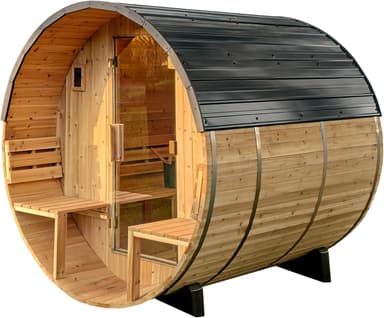
Backyard Discovery Paxton 2-4 Person Cedar Barrel Sauna
- 9kW heater reaches 170°F roughly 50% faster than budget competitors
- Barrel design eliminates dead zones with superior natural heat convection
- HDPE cradles and galvanized steel roof built for genuine year-round outdoor use
Mid-Range Entry - Backyard Discovery Paxton
The Backyard Discovery Paxton sits around $3,500 with a 6 kW electric heater and represents the entry point where quality starts to feel compromised. Cedar staves are thinner than Dundalk or Almost Heaven - 1.5" versus 1.75" - and the bench ergonomics are functional rather than comfortable. For infrequent use or a first sauna, it works. For daily use by four adults, the build shows wear faster.
Budget Caution - Real Relax and OUTEXER
Amazon-available brands in the $2,000-4,000 range for electric infrared barrels generate a 20% return rate on platforms that track this data. The primary complaints are consistent: stave warping in the first season, thin seals failing, and infrared panels degrading in color within two years. If budget is the constraint, a used Dundalk in good condition is better than a new OUTEXER. The wood quality in these budget units is the failure point, not the electrical components.
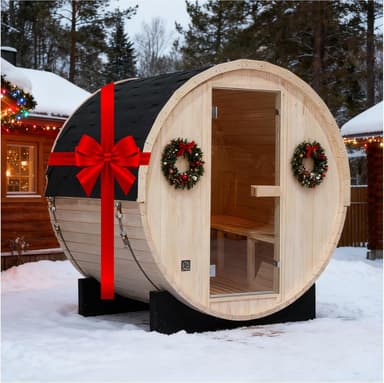
Smartmak 2-10 Person Canadian Cedar Barrel Sauna
- Three wood species let you match aesthetics, budget, and climate needs
- Barrel convection heats evenly without corner dead zones in any size
- Wood stove option delivers authentic 195°F performance with real ambiance
Thermowood Premium - SaunaLife and Thermory
SaunaLife's Linear+ barrel at around $12,000 and Thermory's premium barrels at $10,000+ represent the top of the residential market. Both use thermowood - heat-treated spruce or pine that shrinks 50% less than untreated wood, stabilizes at 5-7% equilibrium moisture content versus 12-15% for standard wood, and carries no extractives that can stain or irritate skin.
Thermowood's 20-year warranty on dimensional stability is backed by real material science. If you're building a permanent installation and want to eliminate stave maintenance almost entirely, the premium is justified. Both brands offer wood-burning or electric configurations.
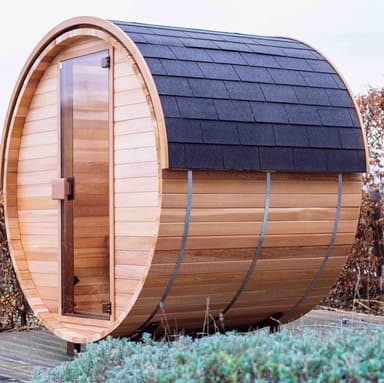
Cedar Barrel Sauna 2-10 Person Customizable Outdoor
- Own-factory quality control beats generic barrel sauna kit competitors
- Canadian red cedar delivers genuine durability and aromatic sauna experience
- Electric heater options reach 195°F in roughly 10-15 minutes
Making the Decision - A Framework by Situation
After 23 installations, I use a decision tree that comes down to five questions. Go through them in order.
Question 1 - Is Grid Power Available at Your Site?
If no: wood-burning is almost certainly your answer unless you're building a full off-grid power system for other reasons. Solar-plus-battery for sauna alone doesn't pencil out.
If yes: continue.
Question 2 - Are There Local Burn Restrictions?
Check with your county air quality management district and HOA before buying any wood-burning equipment. California's AQMD, Colorado's Front Range, and various northeast metro areas have seasonal or year-round burn restrictions that effectively make outdoor wood-burning saunas illegal to operate on the most common days.
If burn restrictions apply: electric.
Question 3 - How Often Will You Use It?
Fewer than 2 sessions per week: electric's convenience advantage matters more here. The wood ritual works for dedicated enthusiasts; for occasional users, the setup friction of wood-burning directly correlates with reduced use frequency.
Three or more sessions per week: the wood operating cost advantage starts compounding meaningfully, and the ritual aspect tends to integrate into a regular practice rather than feeling like a burden.
Question 4 - What Is Your Primary Wellness Goal?
Casual relaxation and muscle recovery: either heater type, prioritize convenience.
Cardiovascular health, specifically targeting the Laukkanen-protocol temperature ranges (170-195°F) consistently: wood or a high-quality traditional electric. Avoid infrared.
Low-temperature cardiac support or heat sensitivity: infrared electric specifically, with physician guidance.
Contrast therapy and athletic recovery: wood-burning has the thermal mass advantage for multi-round sessions; either works.
Question 5 - What Is Your Real Budget Including Installation?
Under $7,000 all-in: the wood-burning advantage disappears because the chimney installation pushes total cost above what quality electric setups cost. At this budget, a well-specified electric barrel like the Almost Heaven Barcelona gets you more sauna for your money than a compromised wood-burning setup.
$9,000-15,000 all-in: this is the range where both options are fully viable and the decision should rest on your answers to questions 1-4.
Over $15,000: you're in premium territory where thermowood builds and custom configurations are accessible. At this level, wood-burning is worth serious consideration if your site and local regulations support it.
Common Misconceptions - What the Internet Gets Wrong
Several persistent myths circulate in sauna buyer communities. Getting these straight saves money and prevents regret.
"Electric heats faster than wood"
This is half-true and depends entirely on jurisdiction. European electric saunas, built to EU standards, can reach operating temperature in 30-45 minutes. American electric saunas built to UL standards include thermal limiters that extend preheat to 1-1.5 hours in many configurations. A well-built wood stove with dry hardwood and good fire technique reaches 160°F in the barrel in about 60-90 minutes. The gap between these is smaller than most buyers expect, and at similar quality levels, wood is often faster in practice than a limited US electric unit.
"Wood is always cheaper than electric"
Wood fuel costs less per session than electricity - that part is true. But installation costs for a proper chimney system run $2,000-5,000 above the electrical installation cost for a comparable electric setup. The operating savings take 3-5 years to overcome that upfront gap. If you move in year 2, wood was more expensive overall.
"Electric saunas can't produce real löyly"
A traditional electric sauna with adequate stone mass absolutely produces löyly. The Harvia 9 kW heater with 100 lbs of olivine stones provides a genuine steam response. It's not identical to 5 liters on a wood stove's 600°F stone mass, but calling it "no löyly" is inaccurate. The more precise statement is that wood stoves produce more dramatic and adjustable steam responses.
"Infrared equals traditional sauna"
This is the misconception that costs people the most. Buyers researching sauna health benefits find the Laukkanen cardiovascular data, decide they want a sauna, and then buy an infrared barrel at 130°F because it's cheaper and doesn't need a dedicated circuit. The physiological mechanisms are different. Infrared preferentially heats superficial tissue. Traditional sauna heat raises core body temperature. The HSP upregulation, cardiovascular adaptation, and neuroendocrine responses documented in the Finnish cohort research require core temperature elevation. A 130°F infrared session produces a different - not necessarily inferior, but different - physiological response.
"Off-grid electric is easy with solar"
I addressed this in the installation section, but it deserves reinforcing. A 9 kW heater is an enormous load. On a 2-hour session, it draws as much power as running a central air conditioner for an entire summer day. Solar systems sized for typical home loads (3-5 kW arrays with 10-15 kWh batteries) cannot support a sauna session without significant system upgrades. Buyers who ask me about off-grid electric almost always underestimate required system size by 2-3x.
"Wood stoves are dirty and polluting"
Modern EPA Phase 2 certified sauna stoves achieve combustion efficiencies above 90% with properly dried hardwood. Ash output is minimal - a few cups per session. Creosote is managed with annual cleaning. The upstream pollution argument - that electric saunas burn coal at the power plant - is valid in coal-heavy grid regions. In states with high renewable penetration, electric genuinely has a lower carbon footprint. In states running on 60-70% fossil fuel generation, the wood stove may emit less carbon per session. This is a local grid question, not a universal answer.
Durability and Long-Term Ownership
The lifespan question matters for a purchase in this price range. A properly maintained barrel sauna should give you 15-25 years of service. The heater type affects which components fail and when.
Wood Stove Longevity
Quality wood-burning stove bodies - cast iron or thick steel - last 15-20 years with annual maintenance. The Kuuma and Harvia wood stoves both have established track records in this range. Chimney components need inspection and occasional replacement; stainless Class A pipe has a rated life of 20+ years.
The barrel stave wood itself is the more variable factor. Cedar in a dry climate with regular oil treatment lasts well. Cedar in a wet Pacific Northwest climate without maintenance shows checking and minor rot within 5-7 years. Thermowood in any climate needs the least maintenance of any species option.
Electric Heater Longevity
Electric heating elements have a documented 5-10 year service life depending on usage frequency and stone quality. Stones that aren't replaced allow mineral deposits to block airflow around elements, accelerating element failure. Budget $200-300 for element replacement every 7 years - it's DIY-accessible on most Harvia units.
Control panels and thermostats are the other weak point. Moisture ingress into electronics is the primary failure mode. Models with sealed or remote control panels last longer than those with exposed digital displays directly in the steam environment.
What Budget Brands Don't Tell You
The 20% return rate on budget Amazon brands isn't just about features - it's about dimensional stability. Thin cedar staves (1.25-1.5") in barrels exposed to repeated heat and cooling cycles develop gaps between staves within 12-18 months in variable climates. Those gaps affect heat retention, increase heating cost, and look bad. The $2,000 savings on a budget barrel can cost $800-1,500 in earlier-than-expected replacement or remediation.
The internal links I'd direct you to for specific model comparisons: our best electric heater barrel saunas breakdown goes deeper on heater specs and model-specific reliability data, and the best wood-burning barrel saunas guide covers stove options and chimney configurations in detail.
For a broader look at setup guides and protocol recommendations, the full guides section covers installation sequencing, wood species selection, and session protocols in standalone articles.
Key Takeaways
- ●
Electric wins on convenience, wood wins on experience. Electric barrel saunas heat in 30-45 minutes, require no fire management, and work fine for weekday sessions after work. Wood-burning saunas take 60-90 minutes to come up to temperature but deliver a sensory and thermal experience that electric simply cannot replicate - the crackle, the smell, the living heat from stones at 500-600°F.
- ●
The total cost gap is closer than the sticker price suggests. Wood-burning barrels run $5,000-10,000 installed plus $2,000-5,000 in chimney and fire clearance work. Electric barrels run $4,000-8,000 plus $1,000-3,000 for 240V wiring. Long-term operating costs flip the comparison: wood fuel runs $100-300 per year for regular use, while electric at $0.16/kWh averages $200-500 annually.
- ●
No research has directly compared wood vs. electric outcomes. The Laukkanen 2015 Finnish cohort studies that documented 61% lower stroke risk and major cardiovascular benefit were conducted in traditional wood-fired saunas at 170-195°F. Those findings don't automatically transfer to a 130°F infrared electric session - the physiological mechanisms differ.
- ●
Off-grid electric is rarely practical without serious infrastructure. A 9 kW heater drawing power across a 2-hour session requires 5-10 kW solar arrays plus 20-40 kWh of battery storage - a $10,000+ system upgrade that most buyers underestimate by 2-3x.
- ●
Löyly is the decisive factor for traditional sauna enthusiasts. Wood stoves with thermal mass stones at 500-600°F core temperature absorb repeated water pours without dropping session temperature. Most electric heater coils at 800-1,000°F surface heat are damaged by excessive water and many manufacturers limit löyly use. If steam rituals matter to you, this alone settles the debate.
- ●
Both types hit 15-25 year lifespans when maintained correctly. Wood stove bodies last 15-20 years; electric heating elements need replacement every 5-10 years at roughly $200-300 per service. The barrel stave wood - not the heater - is usually the first component that fails in either version.
- ●
Budget barrels under $3,000 carry real hidden costs. Thin 1.25-1.5" cedar staves develop gaps in 12-18 months under repeated heat cycling in variable climates, degrading insulation and accelerating replacement timelines that erase the upfront savings.
Who This Is For, Who Should Skip It
Who Should Choose a Barrel Sauna
Barrel saunas - either type - make the most sense for homeowners with outdoor space, a defined budget above $5,000 all-in, and a genuine intention to use the sauna at least twice per week. That usage frequency is the threshold at which the health research starts to show meaningful outcomes: Hussain and Cohen's 2018 systematic review found the biggest recovery and soreness reductions at 3-4 sessions per week.
Wood-burning is the right choice if you have grid-independent property, live in a rural area with access to affordable firewood, or place serious value on the traditional Finnish ritual. It's also the better option for anyone who runs long social sauna sessions - 2-4 hours with a group, with multiple rounds and cold plunges - because the sustained heat output and löyly tolerance simply beat what electric delivers.
Electric is the right choice if you have municipal electrical service, a busy schedule that makes fire prep impractical, or a homeowners association that prohibits open combustion. It's also a better fit for solo sessions on irregular schedules, where the ability to set a timer and arrive to a hot sauna matters more than thermal authenticity.
Who Should Skip Both
Renters without landlord permission, anyone with acute cardiovascular instability, or anyone expecting a first barrel sauna under $3,500 to last 20 years - all should pause before purchasing.
The ACSM guidelines contraindicate high-heat sauna use during pregnancy, immediately post-acute myocardial infarction, and with unstable angina. If you're in any of those categories, no comparison between heater types is relevant until you've consulted a physician.
Anyone primarily motivated by the cardiovascular research but planning to use a session less than twice per week should also recalibrate expectations. The frequency of use in the Laukkanen studies was 4-7 sessions per week. A once-weekly barrel sauna delivers real benefits, but the effect size is proportionally smaller.
What to Read Next
If this comparison helped you land on a direction, these guides will take you the rest of the way to a specific purchase.
Best Electric Heater Barrel Saunas - My ranked breakdown of the top electric barrel sauna models, with detailed heater wattage specs, control panel reliability data, and installation requirements by model.
Best Wood-Burning Barrel Saunas - The equivalent guide for wood-fired options, covering stove models from Harvia and Kuuma, chimney configuration options, and fire clearance requirements by state.
All Sauna Guides - The full library covering installation sequencing, wood species selection for barrel staves, session protocols, and contrast therapy setups.
Frequently Asked Questions
Is a wood-burning sauna hotter than an electric sauna?
Wood-burning barrel saunas reach 170-200°F (77-93°C) and can exceed that with an active fire. Electric barrel saunas are capped at 194°F (90°C) per UL electrical code, and most sessions run 160-185°F in practice. The more meaningful difference is stone temperature: wood stove stones reach 500-600°F at the core, creating intense radiant heat that persists through repeated water pours. Electric heater coils run 800-1,000°F at the surface but have less thermal mass, so the heat quality feels different even at identical air temperatures. Wood saunas feel hotter to most users even when a thermometer shows the same number.
Which sauna type is cheaper to run long-term?
Wood-burning sauna fuel costs $100-300 per year at typical use (20 sessions per month with 10-20 kg of kiln-dried hardwood per session at $5-10 per load regionally). Electric at the 2025 US EIA average of $0.16/kWh costs $1.50-3.00 per hour, putting annual operating cost at $200-500 for the same usage frequency. Wood wins on fuel cost, but that calculation ignores the labor of fire management, wood storage, and annual chimney cleaning. If your time has dollar value, the operating cost gap narrows considerably.
Can I convert a wood-burning barrel sauna to electric, or vice versa?
Converting from wood to electric is more feasible than the reverse. Removing a wood stove and chimney assembly, sealing the roof penetration, and installing a 240V circuit with an electric heater is a legitimate DIY project for someone comfortable with basic electrical work - budget $800-1,500 for the conversion including heater. Converting from electric to wood is structurally harder: you need to cut a proper chimney penetration through the barrel stave wall, install Class A double-wall pipe with correct clearances, and pour a non-combustible floor pad under the stove. That conversion runs $1,500-3,000 with professional installation and fire marshal sign-off in many jurisdictions.
Do electric barrel saunas work for löyly?
Most do, with important limitations. Electric heaters rated for löyly use specify a maximum water volume per pour - typically 0.5-1.5 cups at a time, with several minutes between pours. Exceeding that cracks or corrodes heating elements. Wood stoves with large stone loads (30-50 lbs of kiln-dried sauna stones) absorb repeated löyly pours without temperature loss because the thermal mass is an order of magnitude larger. If löyly ritual is central to your sauna practice, a wood-burning stove is the superior tool. Electric can simulate the steam experience, but it requires restraint that traditional Finnish sauna culture doesn't impose on wood users.
How long do electric vs wood-burning barrel saunas last?
Both can hit 15-25 years with proper maintenance. The difference is in which components require service. Electric heating elements have a documented service life of 5-10 years depending on usage frequency and stone maintenance - plan on one $200-300 element replacement per decade. Wood stove bodies in cast iron or thick steel last 15-20 years with annual cleaning. The barrel stave wood is the more variable factor in both cases: Western red cedar in a dry climate with regular oiling lasts 20+ years, while cedar in a wet climate without maintenance shows deterioration in 5-7 years. Thermowood performs better in wet climates regardless of heater type.
What does the research say about health benefits - does heater type matter?
The landmark cardiovascular research - including the Laukkanen 2015 Finnish cohort study that followed 2,315 men and associated frequent sauna use with significantly lower cardiovascular mortality and stroke risk - was conducted in traditional wood-fired saunas at 170-195°F. Hussain and Cohen's 2018 systematic review of 13 studies also used high-heat traditional protocols. These findings don't definitively transfer to lower-temperature electric or infrared sessions. Tei et al.'s 2016 Waon therapy research did show meaningful cardiac benefits at 140°F far-infrared temperatures - improved left ventricular ejection fraction of 7 percentage points over 4 weeks - so electric infrared has its own documented benefit profile. The honest answer is that no head-to-head RCT has directly compared wood vs. electric outcomes, and that gap in the literature leaves the question genuinely open.
Is a wood-burning sauna safe to install in a backyard?
Yes, with proper attention to fire clearances and local permitting. Minimum clearances from combustible structures are typically 10 feet horizontally and specified in your local fire code - some jurisdictions require a permit for any wood-burning outdoor appliance. Class A double-wall chimney pipe must extend at least 3 feet above the roof penetration and 2 feet above any structure within 10 feet. EPA Phase 2 certified stoves achieve combustion efficiency above 90% with properly dried hardwood (moisture content below 20%), keeping ash and creosote production low. Annual chimney inspection and cleaning with a wire brush is the primary maintenance requirement. Check with your municipality before installation - some HOAs and urban fire codes prohibit outdoor wood combustion entirely.
Sources and References
- Association Between Sauna Bathing and Fatal Cardiovascular Events
Laukkanen T, et al.. JAMA Internal Medicine, 2015.
Frequently Asked Questions
There is no universally best option between electric and wood-burning barrel saunas; the choice depends on your priorities for convenience versus traditional experience. Electric heaters heat faster (30-45 minutes), offer precise temperature control, require low maintenance, and are easier to install without chimneys, making them ideal for frequent, hassle-free use. Wood-burning stoves provide a richer, radiant heat with immersive scents and sounds but demand more time (1-2+ hours), manual labor like ash removal, and proper venting, suiting ritualistic sessions. Consider your setup (e.g., power availability) and lifestyle when deciding.
Related Guides
Medical Disclaimer - This article is for informational purposes only and does not constitute medical advice. Consult a healthcare professional before beginning any sauna routine.