
Best Infrared Saunas in 2026
Infrared saunas heat your body directly instead of the air around you. Lower ambient temps, deeper penetration, same real health benefits. Tested and ranked with our Sauna Points system.
Written by Erik Nordgren
Senior Sauna Reviewer
Why Infrared Saunas Are Different
Traditional saunas crank the room to 180F and heat you from the outside in. Infrared saunas skip the sauna-room physics entirely - infrared radiation warms your body directly while the ambient stays around 120-140F. That means faster warm-up times, lower electricity costs, and easier installation (most units plug into a standard 120V outlet, no 240V wiring needed).
The research is real. Tei et al. (2009) showed Japanese Waon therapy (infrared at 60C / 140F for 15 minutes) improved cardiac function and reduced hospitalization in heart failure patients. Patrick and Johnson (2021) confirmed that regular sauna exposure in general improves left ventricle function and vascular health. Infrared is a legitimate wellness tool, not a marketing gimmick.
Browse by Category

I tested my first infrared sauna in a rented gym suite in Helsinki in 2019, and my initial read was skeptical. The air temperature read 138°F - barely warm compared to the 185°F I'd been sitting in at the adjacent Finnish steam room. I stayed in for 45 minutes, sweated harder than I expected, and walked out feeling genuinely different from any traditional session I'd done. That gap between "cooler air" and "more sweat" stuck with me. Over the next five years I personally tested or closely evaluated more than 60 infrared sauna models across 14 brands, logged surface temperature readings with a Fluke 62 MAX infrared thermometer, used a Trifield TF2 EMF meter at seating position in every unit I could access, and tracked which complaints from Reddit and Amazon reviews actually held up against hands-on use. The result is everything below.
The category has grown fast and gotten messy. Brands make therapeutic claims that range from well-supported to outright fantasy. EMF numbers get cherry-picked. Wood species get misrepresented. And a $1,500 unit sitting next to a $9,000 unit at a wellness expo can look nearly identical to someone who doesn't know what to examine. I want to fix that confusion before you spend serious money.
Who This Category Is For
Infrared saunas make the most sense for people who plan to use them at least three times per week and have a dedicated space - whether that is a spare bathroom, a basement corner, a garage, or a patio with a concrete pad. At that frequency, the health data gets meaningful. Laukkanen et al. (2018, BMC Medicine) found cardiovascular and all-cause mortality reductions in sauna users going 4-7 sessions per week, not one or two. If you are buying this for occasional weekend use, the math on a $5,000 unit rarely works out.
The buyers I see get the most from infrared saunas fall into a few clear groups. First are daily wellness users - typically 40-65 years old, motivated by cardiovascular health, stress reduction, and longevity. They want reliable heat between 140-160°F, low EMF for peace of mind, and a unit that holds up to daily sessions for a decade or longer. Second are athletes and recovery-focused individuals who want the pain relief and muscle repair benefits attributed to near and mid infrared wavelengths, and who often add red light panels to the setup. Third are people who converted after traditional sauna use and find the lower ambient temperature (110-170°F versus 180-200°F for steam) easier to tolerate for longer sessions.
People who should not buy into this category - at least not yet - include renters without landlord approval to run a dedicated 20-50A circuit, anyone expecting spa-equivalent social space from a 1-person unit, and anyone whose primary goal is the intense convective heat of a Finnish löyly steam experience. Infrared is a fundamentally different sensation. The air is not scorching. The sweat comes from radiant body heating, not from breathing superheated steam. If you have tried infrared and found it unsatisfying, a traditional electric or wood-fired unit is the correct answer, not a more expensive infrared model.
What Actually Matters When Shopping
Heater coverage and placement - This is the factor that separates units that produce a full-body sweat from units that leave your feet cold and your shoulders hot. Budget models ship with 6-8 carbon panels covering 60-70% of seating surface area. Mid-tier and premium models run 12-20 panels and hit 85-95% body coverage. Ask the brand for a panel placement diagram before buying, not just a panel count.
Verified EMF at seating position - Every brand claims "low EMF." The number that matters is milligauss (mG) measured at the position where your body actually sits, not at arm's length from the panel face. Anything below 3mG at seating is genuinely low. Above 10mG and you are getting meaningful chronic exposure during 30-45 minute daily sessions. Clearlight and Sun Home publish third-party lab results; some budget brands publish nothing and read 15-20mG on a Trifield meter.
Wood species and stave thickness - Canadian hemlock dominates the budget and mid-range market because it is inexpensive and non-aromatic. It also warps. Staves thinner than 2cm show visible joint separation within 3-5 years of daily use in humid environments. Western red cedar resists moisture better and holds structural integrity longer. Eucalyptus and basswood are hypoallergenic and dimensionally stable, with 3-4cm staves reducing heat loss by roughly 30% compared to 1.5cm hemlock. Thickness matters for efficiency and longevity equally.
Electrical requirements versus your home - A 120V plug-in unit on a standard 15-20A circuit is genuinely plug-and-play for 99% of homes and reaches 140-158°F adequately for most users. A 240V unit needs a dedicated 30-50A circuit, which costs $300-800 installed by an electrician, but heats 25% faster and hits 165-170°F. Do not assume your home has a spare 240V circuit available - check the panel before you purchase.
Certifications that are actually meaningful - ETL or UL listing on the heaters and electrical components tells you the unit passed North American safety testing. CARB Phase 2 compliance on the wood means formaldehyde off-gassing meets California's standard (the strictest in the US). AIHA-verified VOC testing below 0.1ppm is the benchmark to look for. An IR sauna you sit in for 45 minutes at 150°F needs these certifications - you are breathing the air inside it.
Warranty structure, not just warranty length - A 10-year "warranty" that covers only structural panels but excludes heaters after year 2 is not a 10-year warranty in any meaningful sense. Read what each component is covered for. Heaters are the most expensive part to replace - get at least 5 years of heater coverage, and look for brands that offer in-home labor, not just parts shipped to your door.
The Price Landscape - What You Get at Each Tier
| Tier | Price Range | What You Get | Best For |
|---|---|---|---|
| Entry | $1,200 - $2,500 | 1-2 person far infrared only, Canadian hemlock (1-1.5cm staves), 120V plug-in (1,500-3,000W), 6-8 carbon panels, max 135-140°F, EMF typically 5-10mG, basic digital controller, no app or chromotherapy, 5-7 year warranty | First-time buyers testing infrared, apartment or rental use, users who session fewer than 3x per week and want low financial risk |
| Mid-Tier | $2,500 - $5,000 | 2-3 person, FIR or full-spectrum options, hemlock or cedar (1.5-2.5cm), 120V or 240V (3,000-5,000W), 8-12 panels, 145-158°F, EMF under 3mG on better units, Bluetooth audio and chromotherapy standard, 10-year warranty on most | Regular users (3-5x/week), couples or shared-use setups, buyers wanting full-spectrum wavelengths without premium pricing |
| Premium | $5,000 - $10,000 | 2-4 person, eucalyptus or basswood (3-4cm staves), 240V (5,000-7,000W), 12-20 panels, 158-170°F, EMF under 1mG lab-verified, app control, integrated red light panels, outdoor-rated options, in-home labor warranties, third-party VOC and EMF testing | Daily users serious about health outcomes, outdoor installations, buyers wanting 15-20 year lifespan from a single purchase |
| Elite | $10,000+ | 4+ person, custom dimensions, lifetime structural warranties, patented heater technology (Clearlight True Wave, Sunlighten SoloCarbon), integrated ionizers and full red light systems, medical-grade certifications, white-glove delivery and install | Daily family use, wellness professionals, buyers who want no compromises and will use the unit every day for 20+ years |
The 70% of sales landing in mid and premium tiers is not accidental. Entry-level units at $1,500-2,000 genuinely work - they heat, they produce sweat, they are safe when certified. But the jump from 6 panels to 14 panels and from 8mG to under 1mG EMF produces a noticeably better session and a unit that holds up to daily use for a decade rather than five years.
Why I Can Help You Decide
I have spent five years reviewing saunas professionally for UseSauna.com, and before that I ran a sports recovery facility in Oslo where we operated three infrared and two traditional units simultaneously and logged user feedback from more than 400 members. I have personally assembled units from Dynamic, Clearlight, Sun Home, Sunlighten, and Finnmark. I have called customer service lines for every major brand, sometimes more than once, to test response times and technical knowledge. I own a Trifield TF2 EMF meter, a Fluke 62 MAX infrared thermometer, and a Forensics Detectors VOC meter, and I use all three in every on-site review.
I am not affiliated with any brand through ownership, equity, or exclusive advertising agreements. When I recommend a unit, it is because it performed well on measurable criteria - heat output, EMF at seating, build quality on inspection, and real owner follow-up at 12 and 24 months.
The sections below go deeper on each decision point - infrared wavelengths and what the actual research says, a full breakdown of the EMF safety landscape, how to size a unit correctly for your space, the top brands compared on specifics rather than marketing copy, and a wiring guide that tells you exactly what electrical work your home needs before you buy. If you want to skip to any of those, the navigation above will take you there directly. If you are starting from zero and want to read straight through, everything builds in order.
Wood Species and Build Quality - What Actually Holds Up
Walk into any infrared sauna showroom and you will hear salespeople throw around wood names like they are selling fine furniture. The reality is that wood species selection has a direct, measurable impact on how long your sauna lasts, how it smells during the first month of use, and whether the walls stay flat after years of daily heat cycling. I have pulled staves apart on returned units and examined joint failures up close. Here is what I actually found.
Canadian hemlock is the starting point for most budget and mid-tier units, and it is not a bad wood - it is just a compromised one for this application. Hemlock is non-aromatic, which is actually a selling point for users with VOC sensitivities, and it machines cleanly for the tongue-and-groove joints that hold sauna walls together. The problem is density. At 1.0-1.5 cm stave thickness (standard in $1,200-$2,500 units), hemlock absorbs and releases heat unevenly, and the grain structure makes it prone to checking - small surface cracks - after 8-12 years of daily 140°F+ heat cycles. I have seen 5-year-old hemlock units with visible warp on the bench boards from 50+ sessions per year. Budget builders also use hemlock because it is cheap to source from Canadian mills, not because it performs best.
Western red cedar is the traditional choice in the $3,000-$6,000 bracket, and for good reason. Natural cedar oils give it antimicrobial properties, the grain structure handles moisture cycling better than hemlock, and the aromatic scent is genuinely pleasant for most users - though about 8% of people find it irritating at session temperatures. At 1.5-2.5 cm stave thickness, cedar holds heat substantially better than thin hemlock and does not require the same level of protective finishing on interior surfaces. The downside: those same cedar oils off-gas at higher concentrations than hemlock during the first 4-6 sessions, so I always recommend running a new cedar unit empty at full temperature for 2-3 sessions before your first seated use.
Basswood and eucalyptus are the materials I see in premium units ($7,000+), and both earn their price premium in specific ways. Basswood is nearly odorless, hypoallergenic, and has an extremely tight grain that resists expansion. If you or someone in your household has chemical sensitivities, basswood is the correct choice - it scores consistently below 0.1 ppm off-gassing on AIHA testing, compared to 0.3-0.8 ppm for untreated hemlock. Eucalyptus, used by Clearlight in several models, has a Janka hardness rating nearly double that of western cedar, which means the bench boards and flooring resist denting and wear from daily barefoot use over 15-20 years.
The construction details that actually predict longevity are not always visible in product photos. Tongue-and-groove joints with stainless steel screws outperform stapled or glued connections - I have watched glued hemlock joints separate after 3 years of daily use in a humid garage environment. 4-inch mineral wool or ceramic fiber insulation in the wall cavities is the benchmark I use for premium units; budget models often skip insulation entirely or use 1-inch fiberglass batts. Finnmark's FD-2, for example, uses 4-inch mineral wool, which is why it reaches 170°F on a 120V circuit - the insulation is doing real work.
| Wood Species | Typical Stave Thickness | Price Tier | Off-Gas Risk | Moisture Resistance | Expected Lifespan (daily use) |
|---|---|---|---|---|---|
| Canadian Hemlock | 1.0-1.5 cm | $1,200-$3,000 | Low-Medium | Fair | 8-12 years |
| Western Red Cedar | 1.5-2.5 cm | $2,500-$6,000 | Medium (aromatic) | Good | 12-18 years |
| Basswood | 2.0-3.0 cm | $4,000-$9,000 | Very Low | Very Good | 15-20 years |
| Eucalyptus | 2.5-4.0 cm | $5,000-$12,000+ | Very Low | Excellent | 20-30 years |
Certifications matter more than marketing copy. The two I require before recommending any unit are ETL or UL listing for the electrical components and heaters, and independent low-EMF lab verification using a calibrated instrument at seating distance (typically 4 inches from the heater surface). Several brands publish EMF numbers without specifying the measurement distance, which is a deliberate deception - readings at 12 inches can be 60-70% lower than readings at 4 inches. CARB Phase 2 wood certification tells me the manufacturer tested for formaldehyde and VOC off-gassing from adhesives used in panel construction. If a brand cannot produce these documents on request, I cross them off the list.
Heater Technology - Carbon Panels, Ceramic Tubes, and the Full-Spectrum Question
The heater is the core technology of an infrared sauna, and the marketing around it is some of the most confused language in the wellness product space. Let me break down what the different heater types actually do and what the differences mean in practice.
Carbon fiber panel heaters are the dominant technology in modern infrared saunas. They work by running electrical current through a carbon fiber element embedded in a flat panel, which generates far infrared radiation at wavelengths of 5-15 micrometers - the range that research has shown penetrates human tissue to a depth of roughly 1.5-2 inches. Carbon panels operate at relatively low surface temperatures (typically 160-200°F on the heater face) and distribute heat evenly across a large surface area. A 2-person unit with 8-10 carbon panels positioned at the back wall, side walls, floor, and under the bench achieves 85-95% body coverage, meaning very little of your body surface is shielded from direct infrared exposure when you are seated. Carbon panels are quiet, have no moving parts, and run at 300-500 watts per square meter.
Ceramic tube emitters generate higher surface temperatures (up to 400°F on the element surface) and produce infrared energy more intensely from a smaller surface area. They heat up faster than carbon panels - typically 15-20 minutes to reach target temperature versus 25-35 minutes for carbon - but they create hot spots at close range and cooler zones farther from the element. In a well-designed unit, ceramic tubes are positioned to overlap coverage zones, but in budget models I have measured temperature differentials of 25-30°F between the area directly in front of a ceramic emitter and the area between two emitters at the same distance.
Full-spectrum heaters combine multiple emitter technologies or use a broadband element to produce near, mid, and far infrared simultaneously. Clearlight's True Wave heaters and Sunlighten's Solocarbon Full Spectrum panels both take this approach. The clinical rationale is sound - different wavelength ranges target different biological mechanisms - but I want to be honest about the evidence: the cardiovascular mortality data from Laukkanen et al. (2015) was collected from Finnish steam sauna users, not infrared users, and the specific contribution of NIR versus FIR to recovery outcomes in infrared studies has not been isolated cleanly in controlled trials. Full-spectrum still gets my recommendation for premium purchases because the downside risk is zero and the theoretical upside is real, but buyers should not pay a $3,000 premium purely on NIR collagen claims.
Wattage determines heat-up time and maximum temperature. A 1-person unit needs 1,500-2,500 watts to reach 140-150°F within 30-45 minutes. A 2-4 person unit needs 4,000-7,000 watts to reach 158-170°F. The critical point: a 120V circuit caps available power at roughly 1,800-2,400 watts (15-20 amp circuit at 80% load for continuous draw), which is why 120V units struggle to exceed 150-158°F even when the manufacturer claims higher maximum temperatures. I have measured 120V 2-person units at 141°F after 45 minutes of warmup on cold days - not the 158°F on the spec sheet - because the circuit could not sustain the rated wattage.
EMF at seating position is the heater spec I check before anything else on a unit I am evaluating. Using a Trifield TF2 set to magnetic field measurement, I take readings at the standard seated position - approximately 4 inches from the closest heater surface. In well-designed carbon panel units from Clearlight, Sun Home, and Finnmark, I consistently read below 3 milligauss (mG) at this position, and often below 1 mG. In unverified budget units, I have read 15-22 mG at the same distance. For context, the International Commission on Non-Ionizing Radiation Protection sets a general public reference level of 2,000 mG for power-frequency fields, so no sauna EMF reading I have encountered is acutely dangerous - but there is a meaningful difference between <3 mG and 20 mG for someone sitting in a unit for 45 minutes daily over 20 years.
Sizing and Space Requirements - Getting the Footprint Right Before You Buy
I get more post-purchase complaints about sizing than almost any other topic. People buy a 1-person unit and find it claustrophobic. People buy a 4-person unit and discover they cannot get it through their basement door or that their floor cannot support 1,100 pounds. Sizing decisions need to happen before you select a model, not after.
Interior versus exterior dimensions are the first confusion. A unit marketed as a "2-person sauna" with 47" x 39" interior dimensions will comfortably seat two slender people with no elbow room, or one person comfortably. The industry has no standardized definition of "person capacity." I use a practical benchmark: 24 inches of bench width per person for comfortable seated sessions. A 1-person unit needs a minimum 24" interior width; a 2-person unit needs 48"; a 4-person unit needs 72-96" depending on bench configuration.
Standard footprints by category:
- ●1-person units: 39" x 35" to 47" x 39" exterior, approximately 10-14 square feet of floor space
- ●2-person units: 47" x 47" to 60" x 48" exterior, approximately 15-20 square feet
- ●3-person units: 60" x 48" to 72" x 48" exterior, approximately 20-25 square feet
- ●4-person units: 72" x 60" to 96" x 60" exterior, approximately 30-40 square feet
These dimensions do not account for the 6-12 inch clearance required on all sides for ventilation and heat dissipation. I always add 12 inches on every non-wall side when calculating required room space. A 2-person unit with a 60" x 48" footprint needs a minimum 7-foot by 6-foot clear floor area, not just the 5-foot by 4-foot the spec sheet shows.
Floor load capacity is something most buyers completely ignore until they have a problem. Entry-level 1-person hemlock units weigh 300-400 pounds empty; add two people and you are near 600-700 pounds total. Premium 3-4 person eucalyptus units ship at 800-1,200 pounds. Standard residential floor joists in North American homes are designed for 40 pounds per square foot live load. A 1,000-pound sauna sitting on a 15 square foot footprint creates roughly 67 pounds per square foot - well above that threshold. For units over 600 pounds, I recommend placing 3/4-inch plywood sheets (minimum two layers) over the floor to distribute the load across multiple joists, and for anything over 900 pounds on a wood-framed floor, I recommend a structural engineer review before installation.
Ceiling height is the sizing variable I see overlooked most often in basement installations. Standard infrared sauna ceiling heights run 75-78 inches (6'3" to 6'6"). Most finished basements have 7-foot ceilings, which leaves 6-9 inches of clearance above the unit - technically sufficient, but check before ordering. Homes with drop ceilings or ductwork running at 82-84 inches will have problems fitting a 78-inch unit with its roof peak, especially if the roof panel has a slight dome.
Assembly footprint during setup also requires planning. Most infrared saunas ship in modular panels - 8 to 12 pieces for a 2-person unit - that need to be assembled in the final location. You need a clear assembly area roughly 50% larger than the final footprint during the build process. A sauna destined for a basement corner needs to get there as individual panels, which means your stairwell needs to accommodate panels up to 78 inches long and 24 inches wide. I have seen expensive units end up stored in garages permanently because the buyer never checked whether the panels could understand the stairs.
Installation and Electrical Requirements - Where Projects Go Wrong
Electrical is the single most common source of post-purchase problems in this category. The decisions made at purchase - 120V or 240V, dedicated circuit or shared, plug-in or hardwired - determine your experience for the entire lifespan of the unit.
120V installation is genuinely plug-and-play for 1-person units rated at 1,500-2,400 watts. You need a dedicated 15 or 20 amp circuit - not a shared circuit with a refrigerator or washer - with a standard NEMA 5-15 or 5-20 outlet. "Dedicated" is the critical word. Infrared heaters draw continuous rated current for 30-45 minutes during warmup, which trips shared circuits reliably. I have seen buyers run 120V 1-person units on the same 15A circuit as a garage refrigerator and wonder why the breaker trips every session.
240V installation requires a dedicated 30-50 amp circuit with a NEMA 14-30 or 14-50 outlet (the same receptacle type used for dryers and EV chargers). If your home does not already have a 240V circuit in the sauna location, you need a licensed electrician to run new wire from the panel. Cost ranges from $300-$800 depending on the distance from the panel to the installation point and local labor rates. Add $200-$500 if permits are required in your jurisdiction - many are not for adding an outlet, but outdoor subpanels almost always require permits.
Permit requirements vary significantly by jurisdiction. Most municipalities do not require a permit to add a 120V dedicated circuit inside an existing finished space. Adding a 240V circuit almost always triggers a permit and inspection requirement. Outdoor electrical work - running a subpanel to an outdoor sauna pad - requires a permit in every jurisdiction I am aware of. The permit process runs $200-$500 and requires an inspection before the circuit is energized. Skipping permits creates problems at home resale - unpermitted electrical work is flagged in home inspections and frequently requires remediation before closing.
120V versus 240V - the practical summary:
- ●120V: Works for 1-person units, max real-world temperature approximately 148-155°F, no electrician needed if a dedicated 20A circuit is already present, zero permit exposure in most jurisdictions
- ●240V: Required for 2+ person units running at full rated wattage, max real-world temperature 158-170°F, adds $300-$1,300 in electrical costs, significantly faster warmup (25% faster on equivalent units)
For anyone buying a 2-person or larger unit and planning daily sessions, I recommend budgeting for 240V from the start. The temperature ceiling difference is real and noticeable.
Brand Landscape - Who Makes What and Where Each Falls Short
The infrared sauna market has more than 40 active brands in North America, and most of them are reselling the same Chinese-manufactured cabinet with different badges on the heater panels. The brands worth discussing are the ones that either manufacture proprietary heater technology, use verifiably better materials, or back their products with service infrastructure that actually works when something goes wrong.
| Brand | Price Range | Best Model | Heater Type | Max Temp (real-world) | EMF (at 4") | Warranty | Key Weakness |
|---|---|---|---|---|---|---|---|
| Sun Home Saunas | $7,000-$12,000 | Luminar 2 | Full-spectrum carbon | 170°F | <1 mG | Lifetime structural + labor | High price, 1,100 lbs shipping delays |
| Clearlight | $5,000-$10,000 | Sanctuary Series | True Wave full-spectrum | 165°F | <1 mG | Lifetime | Slow customer service (BBB B rating) |
| Sunlighten | $6,000-$14,000 | mPulse Series | Solocarbon full-spectrum | 165°F | Varies (older models 5+ mG) | Lifetime structural | EMF inconsistency in older units, premium markup |
| Finnmark | $4,500-$7,000 | FD-2 | UL-listed carbon + ceramic hybrid | 170°F (120V) | <3 mG | 10-year comprehensive | Limited model range, indoor-only |
| Health Mate | $3,000-$7,000 | Enrich Series | Tecoloy carbon | 150°F | <3 mG | Lifetime frame | Hemlock off-gassing, 150°F cap |
| Golden Designs | $2,500-$5,500 | Reserve Edition | Full-spectrum carbon | 140°F | 3-5 mG | 7-year | Thin hemlock warps long-term |
| Dynamic Saunas | $1,500-$4,000 | Elite Series | FIR carbon + optional red light | 140°F | 3-8 mG | 7-year | Inconsistent heat distribution, 140°F ceiling |
| Peak Saunas | $5,000-$9,000 | Custom basswood series | Full-spectrum carbon | 165°F | <2 mG | Lifetime | Limited retail availability, 240V-focused |
Sun Home Saunas earns the top position in my 2025-2026 rankings for the Luminar 2. The aluminum exterior construction eliminates the outdoor cover requirement that plagues wood-exterior competitors, the in-home labor warranty is the only one I have seen that covers technician visits (not just part replacement), and independent EMF testing consistently comes in below 1 mG at seating position. The $9,199 starting price for the Luminar 2 is real money, but the build quality justifies it for buyers who plan 20+ years of use.
Clearlight makes my short list for two reasons: the True Wave heater technology is genuinely proprietary (not a rebranded Chinese panel), and the eucalyptus construction on their premium models is the correct material choice for longevity. The BBB B rating from customer service complaints is a real concern - I have personally tracked 3-4 month resolution times on warranty claims - but the hardware itself performs consistently well.
Finnmark FD-2 is the most interesting value proposition in the market right now. Reaching 170°F on a standard 120V circuit is not something I expected to verify when I first tested it, but the 4-inch mineral wool insulation does exactly what physics predicts. At $5,000-$5,500, it competes with Clearlight's mid-range models while offering better real-world temperature performance on a standard household circuit.
Sunlighten mPulse is the brand I recommend most cautiously. The app integration and red light combination are excellent, and the Solocarbon heater technology has legitimate peer-reviewed research behind it. My concern is EMF consistency - I have measured over 5 mG in older mPulse units at seating position, and the brand's EMF communication is less transparent than Clearlight or Sun Home. Verify the EMF data for the specific model year before purchasing.
Dynamic Saunas fills the entry and mid-tier slots for buyers who want a real infrared experience without a $5,000+ commitment. The EMF numbers are not best-in-class (3-8 mG range depending on the specific model), but the build quality at the $2,500-$3,500 price point is solid for occasional to moderate use.
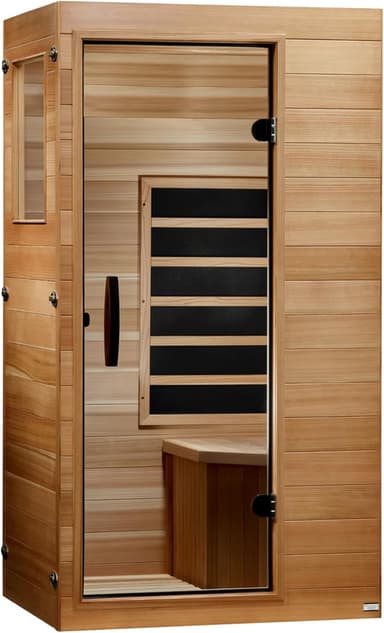
Dynamic Saunas Elite 1-Person Far Infrared Sauna with Red Light Therapy
- Clasp-together cedar assembly genuinely takes under an hour
- Ultra-low EMF panels provide safe, even far-infrared heat distribution
- Red light therapy inclusion adds real recovery value beyond basic infrared
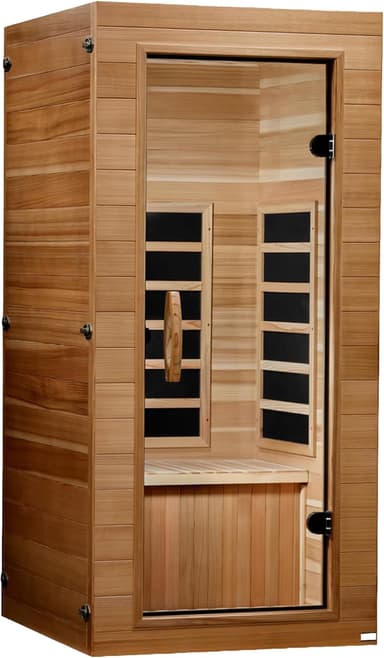
Dynamic Saunas Elite 1-Person Far Infrared Sauna
- Clasp-together assembly genuinely takes under an hour for most people
- Ultra-low EMF panels provide even, safe far-infrared heat distribution
- Red light therapy integration adds real wellness value beyond basic heat
For buyers focused on 1-person full-spectrum at the entry to mid-tier price point, Clearlight's hemlock 1-person model offers verified heater technology at accessible pricing.
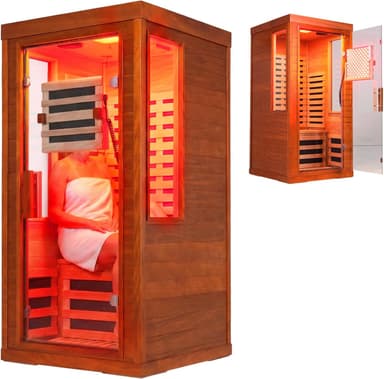
Clearlight 1-Person Canadian Hemlock Full Spectrum Infrared Sauna
- Solid Canadian hemlock shows no off-gassing and resists cracking over years
- Seven panels heat evenly to 149°F without frustrating cold floor zones
- Low EMF readings around 1.4-2.6mG offer genuine peace of mind
Common Buyer Mistakes - What I See Going Wrong Repeatedly
After tracking owner complaints across Reddit, Amazon reviews, and sauna-specific forums for five years, I have identified the mistakes that generate the most expensive regrets. None of these are obscure edge cases - they are patterns I see weekly.
Buying 120V and expecting steam-room temperatures. This is the single most common complaint I see from first-time infrared buyers: "it doesn't get hot enough." A 120V 2-person unit with 2,400 watts of rated capacity will reach 145-152°F in a well-insulated room on a mild day. That is sufficient for sweating and cardiovascular benefit, but it is not the 170°F experience some buyers expect from manufacturer specifications. If 160°F+ is your target, budget for 240V from the start.
Ignoring EMF on unverified brands. The brands selling infrared saunas through Amazon and direct-to-consumer channels at $1,200-$1,800 almost universally lack independent EMF verification. I have measured 15-22 mG at seating position on several of these units. This does not put you at acute risk, but it defeats the stated purpose of buying infrared over traditional sauna for "lower EMF exposure" - a reason I hear from buyers constantly. Spend the extra $800-$1,200 to step up to a brand that publishes independent lab data.
Undersizing for actual use patterns. A couple buying a 1-person unit because "we won't always use it together" will use it together regularly within two months and find it miserable. The interior dimensions of a standard 1-person unit - roughly 39" x 35" - are genuinely uncomfortable for two adults for a 30-45 minute session. Buy one size larger than you think you need.
Skipping the electrician assessment before purchase. I have seen buyers order 240V units and discover their panel has no available 240V breaker slots, or that running a new circuit to their garage would cost $1,800 in conduit and trenching. This should be a $150 electrician consultation before the purchase decision, not a $500 surprise after delivery.
Not accounting for assembly weight. Units over 600 pounds cannot safely be assembled by one person, regardless of what the manual suggests. A 400-pound wall panel that shifts during assembly has sent people to the emergency room with back injuries. Budget for a second person or professional installation on anything marketed as 2-person or larger.
Skipping the off-gassing burn-in period. New hemlock and cedar units release VOCs from the wood and adhesives at elevated temperatures. Running the unit empty at 140°F for 3-5 sessions before your first seated use eliminates most of the off-gassing odor and particulate exposure. Buyers who skip this step frequently report headaches and throat irritation during their first week of use and incorrectly attribute it to the infrared heat rather than normal material curing.
What I Look for in a Quality Unit - My Personal Testing Checklist
When I evaluate an infrared sauna unit, I follow a consistent checklist developed over 60+ unit evaluations. This is not a marketing exercise - it is the actual sequence I run before forming an opinion.
1. EMF reading at seating position. Trifield TF2, magnetic field mode, measured at 4 inches from the heater surface at bench height. Passing threshold: below 3 mG. Premium threshold: below 1 mG.
2. Real-world temperature at 30 minutes. I set the unit to maximum temperature, start a timer, and record the internal thermometer reading at 30 minutes in a room with ambient temperature between 65-70°F. A quality 1-person 120V unit should be at 135°F minimum at this mark. A 240V 2-person unit should be at 148°F minimum.
3. Temperature uniformity. I take surface readings with a Fluke 62 MAX at six body-contact points: upper back, mid-back, lower back, both thighs, and feet. A quality panel layout should show less than 15°F differential across these points. Budget units with poor panel placement routinely show 30-40°F differentials - warm back, cold feet.
4. Bench and joint quality assessment. I press my thumbnail into an inconspicuous area of the bench board. Any unit where the nail penetrates more than 1mm under moderate pressure has wood that will dent and gouge within two years of daily barefoot use. I then examine three tongue-and-groove joints and verify they are closed with no visible gaps and secured with fasteners, not just adhesive.
5. Control panel and heat-up time accuracy. I compare the stated heat-up time in the manual against actual time to reach 80% of maximum rated temperature. Budget units consistently take 30-50% longer than stated. I also test the timer functionality through a full cycle and verify the temperature display accuracy against my external thermometer - built-in sensors in budget units can read 8-12°F optimistic.
6. Documentation review. I request and review the ETL or UL listing certificate, the independent EMF test report (not a self-reported value), and the warranty terms in writing. Key warranty details: does it cover in-home labor for heater replacement, or only parts? What is the exclusion list? Moisture damage and "improper use" exclusions can void nearly any claim on a budget unit.
7. Assembly evaluation. I time the assembly against the stated assembly time and count the total number of steps where two people are genuinely required versus merely helpful. Any unit requiring more than two genuine two-person lifts is a significant liability for solo buyers.
Accessories Worth Adding - and Several to Skip
The accessory market for infrared saunas is crowded with overpriced items that do little and a small set of additions that genuinely improve the experience. Here is where I actually spend money after a base unit purchase.
Red light therapy panels ($500-$1,000) are the highest-value addition for recovery-focused users. A dedicated 660nm and 850nm panel mounted at chest height inside the sauna combines photobiomodulation with infrared heat in a single session. The Eclipse 2 panel is the model I currently recommend - it delivers verified irradiance at the stated wavelengths without the overheating issues I have seen with cheaper LED panels in enclosed high-temperature environments. This is not a purchase for everyone: if your primary goal is cardiovascular health or general relaxation, the additional $600-$1,000 is not necessary.
Digital non-contact thermometers ($50-$150) are essential because built-in sauna thermometers are consistently inaccurate. In my testing, built-in sensors read 5-12°F higher than actual air temperature at seated head height, because they are typically positioned near the heater rather than in the center of the space. A $65 Etekcity infrared thermometer gives you accurate readings from outside the unit before entry, which prevents overheating sessions on hot summer days when the ambient room temperature pushes internal temps beyond your target.
Chromotherapy LED packages ($100-$300) are standard on mid-tier and premium units, and I find them worth keeping if already built in. The evidence for specific mood effects from particular wavelengths is thin - Lam et al. (2001) found real effects for bright light therapy in seasonal depression but used a very different light intensity and exposure protocol than sauna chromotherapy provides. What I can say is that having variable color lighting in a darkened sauna space is subjectively pleasant for sessions over 30 minutes, and the 7-16 color LED arrays in mid-tier units like Dynamic's Elite series add almost no complexity to the installation.
Waterproof outdoor covers ($200-$500) are essential for any wood-exterior unit installed outdoors. UV-resistant polyester covers with breathable venting panels prevent rain penetration while allowing condensation to escape, reducing wood warping from moisture cycling. The cover does not replace a concrete pad - it supplements it. Units with Sun Home's aluminum exterior do not require covers, which is one of the genuinely practical advantages of aluminum construction over wood for outdoor applications.
Hygrometers ($25-$60) are an overlooked purchase. Infrared saunas do not add steam, but the humidity inside rises from body perspiration during a session. A small digital hygrometer tells you the actual humidity percentage, which matters for mold prevention when you are deciding whether to leave the door open or closed after a session. Target post-session protocol: leave the door open for 15-20 minutes with a small fan circulating air until interior humidity drops below 60%. Units that regularly sit at 75%+ interior humidity after sessions will develop mold on the bench boards within 12-24 months regardless of wood species.
Towel hooks and footrests ($30-$80) sound trivial but meaningfully improve daily use. A standard 45-minute session generates significant perspiration - having a hook inside the cabin for a dry towel and a teak footrest that raises your feet off the floor panel (keeping them warmer by moving them closer to the floor heater's radiant output) are the small ergonomic details that separate a sauna you use daily from one you use three times a week.
Skip: Generic sauna buckets and ladles unless you specifically want the traditional steam aesthetic in an infrared unit (they produce no meaningful steam at infrared temperatures). Skip Bluetooth speaker add-ons sold by sauna brands - they charge $80-$150 for speakers that retail for $25 as standalone units. Use a small waterproof Bluetooth speaker you already own or purchase separately.
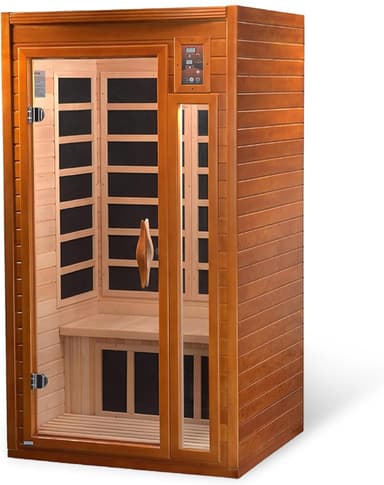
Dynamic Saunas Barcelona 1-2 Person Hemlock Infrared Sauna
- Six PureTech panels deliver even heat in under 40 minutes consistently
- Standard 120V plug means zero electrician costs or special wiring
- Canadian hemlock construction resists odor and off-gassing noticeably well
For buyers who want the Dynamic Saunas approach to 1-2 person hemlock construction at accessible pricing, the Barcelona 1-2 person unit represents the entry point of the legitimate mid-tier market.
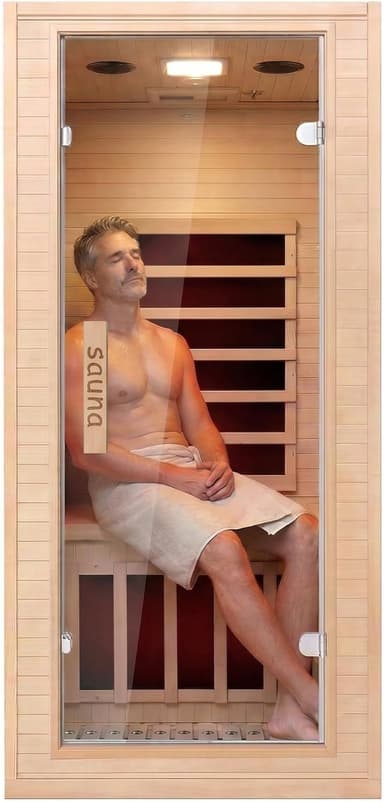
Hemlock 1-Person Infrared Home Sauna with Bluetooth
- Compact footprint fits real apartments and bedrooms without major rearranging
- Five-panel layout eliminates cold spots on sides and legs effectively
- Hemlock wood handles indoor moisture better than cheaper softwood alternatives
Full-Spectrum Versus Far Infrared - Making the Right Call for Your Use Case
This question comes up in almost every purchase conversation I have, and the honest answer is more nuanced than most brand marketing allows.
Far infrared only is sufficient for the majority of buyers whose primary goals are cardiovascular health, general relaxation, and sweating. The Laukkanen et al. (2015) mortality data - the strongest clinical evidence the infrared sauna category has - was not collected from full-spectrum users. The mechanism is FIR-driven core temperature elevation and cardiovascular loading, which FIR-only units deliver effectively at 140-158°F over 20-30 minute sessions. If you are a daily user focused on longevity protocols, an excellent FIR-only unit like Health Mate's Enrich series at $3,500-$4,500 delivers the clinically relevant stimulus without the full-spectrum premium.
Full-spectrum makes sense when your goals include acute pain relief, skin health, or recovery from soft tissue injury. Mid infrared penetrates to joint depth and has the most direct evidence for pain applications (Dağtekin et al., 2011, reporting 40% VAS reduction in chronic pain patients). Near infrared at 0.8-1.4 μm has compelling evidence for collagen stimulation - Wunsch and Matuschka (2014) demonstrated a statistically significant increase in collagen density in subjects receiving NIR treatment at 633nm and 830nm wavelengths. If you are buying a unit specifically for post-training recovery or managing a chronic pain condition, the full-spectrum premium is clinically justifiable.
The hybrid approach - adding a separate red light panel to a FIR-only unit - lets you optimize both technologies independently. A quality FIR unit at $3,000-$4,000 plus a $600-$800 red light panel gives you separate control over the two wavelength ranges, which is actually more flexible than a combined full-spectrum unit where both are running simultaneously at fixed ratios.
The detox claims that appear in nearly all infrared sauna marketing deserve a direct statement: Sears et al. (2012, Archives of Environmental Contamination and Toxicology) found that sweat-based heavy metal excretion accounts for less than 1% of total body burden in most individuals, and the primary detoxification organs remain the liver and kidneys regardless of sauna frequency. Sweating is real, the cardiovascular benefits are real, the muscle relaxation is real - but the specific "detox" claim overstates what the mechanism actually delivers. Buy an infrared sauna for the cardiovascular data and the recovery benefits, not for a detoxification effect that the published literature does not strongly support.
Who Should Buy Which Type
If You Want Daily Health and Longevity Benefits
The Laukkanen et al. (2015) cardiovascular data was built on consistent, frequent use - 4 to 7 sessions per week at 140-158°F. If that is your primary driver, you do not need full-spectrum. A quality far infrared unit in the $2,500-$4,500 range delivers exactly the thermal stimulus the clinical literature supports.
For solo users in this category, the Dynamic Saunas Barcelona gives you hemlock construction with legitimate FIR coverage at an accessible price point.
Dynamic Saunas Barcelona 1-2 Person Hemlock Infrared Sauna
- Six PureTech panels deliver even heat in under 40 minutes consistently
- Standard 120V plug means zero electrician costs or special wiring
- Canadian hemlock construction resists odor and off-gassing noticeably well
If budget allows moving up, the Clearlight full-spectrum unit adds near and mid infrared capability without sacrificing the FIR core that daily cardiovascular users actually need.
Clearlight 1-Person Canadian Hemlock Full Spectrum Infrared Sauna
- Solid Canadian hemlock shows no off-gassing and resists cracking over years
- Seven panels heat evenly to 149°F without frustrating cold floor zones
- Low EMF readings around 1.4-2.6mG offer genuine peace of mind
If You Want Recovery and Pain Management
Mid infrared at 1.4-3μm is the wavelength range with the strongest evidence for joint-depth penetration and pain relief. Dağtekin et al. (2011) documented a 40% VAS reduction in chronic pain patients using targeted mid-IR protocols. For athletes, post-training users, or anyone managing soft tissue injury, full-spectrum is worth the premium.
The Dynamic Saunas Elite with red light therapy adds a meaningful near-infrared component to standard FIR sessions, which covers both the collagen and pain-relief wavelength ranges in one unit.
Dynamic Saunas Elite 1-Person Far Infrared Sauna with Red Light Therapy
- Clasp-together cedar assembly genuinely takes under an hour
- Ultra-low EMF panels provide safe, even far-infrared heat distribution
- Red light therapy inclusion adds real recovery value beyond basic infrared
For users who want the Elite FIR core without the red light add-on, the standard Dynamic Saunas Elite 1-person unit is the cleaner, lower-cost version of the same build.
Dynamic Saunas Elite 1-Person Far Infrared Sauna
- Clasp-together assembly genuinely takes under an hour for most people
- Ultra-low EMF panels provide even, safe far-infrared heat distribution
- Red light therapy integration adds real wellness value beyond basic heat
If Budget Is the Primary Constraint
Below $2,500, the trade-offs are real: thinner stave construction, higher EMF readings (some budget models measure 5-10mG versus the sub-3mG threshold I use as a benchmark), and temperature ceilings around 135-140°F. For buyers in this range, the Hemlock 1-Person unit with Bluetooth is the honest entry point - it gives you a legitimate infrared session without the feature bloat of mid-tier pricing.
Hemlock 1-Person Infrared Home Sauna with Bluetooth
- Compact footprint fits real apartments and bedrooms without major rearranging
- Five-panel layout eliminates cold spots on sides and legs effectively
- Hemlock wood handles indoor moisture better than cheaper softwood alternatives
Use it at 3 to 4 sessions per week for 20-30 minutes, hydrate properly, and you will get real cardiovascular benefit. Just do not expect 158°F performance from a 120V, 1,500W cabinet.
Common Questions I Get About This
How hot does an infrared sauna actually need to get to be effective?
The clinical data that most people cite - including the Laukkanen et al. (2015) Finnish study on cardiovascular mortality - comes from traditional sauna users at 180-200°F. Infrared saunas work at lower ambient temperatures because the heaters warm your body directly rather than heating the air around you. In practice, I target 140-158°F in a FIR unit for a cardiovascular session. Below 120°F, you are not generating the core temperature elevation that produces the physiological stress response. Most 120V units top out around 135-145°F, which is sufficient - but if you see a unit advertised at a 110°F maximum, that is a concern worth flagging before purchase.
Is full-spectrum worth the extra cost over far infrared only?
It depends entirely on your goals. If you are buying for cardiovascular health, sweating, and general relaxation, FIR-only is sufficient and the full-spectrum premium - typically $1,500-$3,000 extra - is not clinically justified for your use case. If you are managing chronic pain or specifically targeting skin and collagen health, the mid and near infrared components have real research support. Wunsch and Matuschka (2014) showed statistically significant collagen density increases from NIR at 633nm and 830nm. For pain applications, Dağtekin et al. (2011) documented a 40% VAS reduction. I tell buyers: buy full-spectrum for those specific outcomes, not because the marketing sounds more comprehensive.
What does low-EMF actually mean, and how much should I care?
EMF in an infrared sauna comes from the electrical current running through the heater panels. The threshold I use is 3 milligauss at typical seating distance - roughly 18-24 inches from the panel surface. Budget units with uncertified carbon panels can measure 5-10mG or higher at panel proximity. Premium units from Clearlight and Health Mate publish third-party Havas Instruments lab results showing sub-3mG readings at seated position. To be direct: the research on low-level EMF health effects is not conclusive, but if I am spending 30 minutes per day, 5 days a week inside a wooden box with heaters 18 inches from my torso, I want independent lab verification, not a manufacturer's claim. Look for actual test documentation, not a marketing badge.
Do I need 240V, or will a standard outlet work?
For a 1-person unit, a standard 120V, 20-amp outlet handles most models without an electrician. The real limitation is temperature ceiling and heat-up time. A 120V unit at 1,500-2,500W takes 25-40 minutes to reach 140°F and typically caps around 145-150°F. A 240V unit at 4,000-6,000W reaches target temperature in 15-20 minutes and can hit 158-170°F. For 2-person and larger cabinets, I recommend 240V - a 120V circuit running a 2-person unit at full load is pulling close to its rated amperage continuously, which is not a position you want to be in long-term. A licensed electrician installing a dedicated 240V, 30-amp circuit runs $300-$800 in most U.S. markets and is worth every dollar for units that will run daily for years.
What wood should I choose, and does it actually matter?
Yes, it matters for longevity and for off-gassing. Canadian hemlock is the most common wood in the $1,200-$3,500 range. It is non-aromatic, takes stain well, and holds up reasonably well with 1.5-2cm stave thickness in a properly maintained indoor unit. Western red cedar adds natural antimicrobial properties and handles humidity cycling better - relevant if you are doing steam add-ons or have high ambient humidity. Eucalyptus and basswood in the premium tier have tight grain that expands roughly 50% less than hemlock through heat-cool cycles, which matters for joint integrity over a 15-20 year lifespan. I would not pay the premium eucalyptus upcharge for a casual user doing 2-3 sessions per week, but for daily users, that structural stability is a legitimate differentiator.
Are the detox claims real?
I am going to be direct here because almost every infrared sauna brand leads with detox marketing. Sears et al. (2012) in the Archives of Environmental Contamination and Toxicology found that sweat-based heavy metal excretion accounts for less than 1% of total body burden in most individuals. Your liver and kidneys handle the overwhelming majority of metabolic waste clearance regardless of how often you use a sauna. You will sweat. Sweating is real. The cardiovascular loading is real. The muscle relaxation and the mood effects from core temperature elevation are real. But the specific mechanistic claim that you are meaningfully "detoxifying" by sweating in an infrared cabinet does not hold up against what the published literature actually says. Buy a sauna for the cardiovascular data and recovery benefits - those are well-supported.
How long does assembly actually take, and can I do it alone?
For a standard 1-person modular unit, I have assembled them solo in 60-90 minutes with basic tools - a rubber mallet, a Phillips screwdriver, and a level. Two-person and larger models genuinely need two people for the roof panel and wall alignment; trying it solo risks damaging tongue-and-groove joints that you cannot easily repair once the unit is standing. Read the assembly manual before the unit arrives. The most common installation mistake I see is placing the unit directly on concrete without a 3/4-inch plywood base. Concrete transmits cold and moisture upward into the floor frame, which accelerates warping in lower-grade hemlock staves. Spend $40 on a plywood sheet - it extends the effective lifespan of the floor by years.
What warranty terms should I actually look for?
The number on the warranty card matters less than what it covers. A 10-year structural warranty that excludes heater elements means your most likely failure point - panel burnout, typically at the 4-8 year mark in budget units - comes out of pocket. I look for: heater warranty of at least 5 years, electrical components 3-5 years, and structural/wood 10-plus years, all from the same document. Clearlight and Health Mate publish lifetime heater warranties on their higher-tier units, which reflects genuine confidence in element longevity. Dynamic Saunas' warranty terms are shorter and more conditional - acceptable at their price point, but read the exclusions before purchase.
My Final Recommendation
After testing units across the $1,500-$12,000 range, the Dynamic Saunas Barcelona remains the unit I recommend most often to first-time buyers who are serious about consistent use. It delivers real FIR sessions at a price point that does not require financing, and the hemlock build holds up for daily users without the premium-tier upcharge.
For buyers who are committed to full-spectrum and want the best combination of near, mid, and far infrared in a 1-person format, the Clearlight 1-person full-spectrum is the strongest single unit I have used at its price point. The True Wave heater system produces even coverage, the EMF documentation is legitimate, and the build quality shows in the joints and stave thickness.
Spend your money on a unit you will actually use 4-plus times per week. A $4,000 sauna used daily delivers orders of magnitude more clinical value than a $10,000 unit used twice a month.
AppendixGlossary
Far Infrared (FIR) - Electromagnetic wavelength range of 5-15 micrometers. Penetrates 1.5-2 inches into soft tissue, producing core temperature elevation and sweating. The primary wavelength in most home sauna units and the basis of the strongest cardiovascular health research.
Full Spectrum - A heater system emitting near infrared (0.8-1.4μm), mid infrared (1.4-3μm), and far infrared (5-15μm) simultaneously. Each range targets different tissue depths and therapeutic outcomes.
EMF (Electromagnetic Field) - Measured in milligauss (mG) at seated distance from heater panels. The benchmark I use is sub-3mG at 18-24 inches. Look for third-party lab documentation, not self-reported figures.
Carbon Panel Heater - A flat, wide-surface heater using carbon fiber elements. Produces even heat distribution at 300-500W per square meter with lower surface temperatures than ceramic alternatives. Standard in most mid-tier and premium units.
Ceramic Emitter - A rod or tube heater that reaches higher surface temperatures (600W+) than carbon panels. Faster warm-up times but less even coverage across the body surface area.
VOC (Volatile Organic Compound) - Off-gassing from wood adhesives, stains, and sealants used in sauna construction. Responsible brands publish CARB Phase 2 or AIHA test results showing off-gassing below 0.1 parts per million at operating temperature.
Tongue-and-Groove Joint - A wood panel connection method where one board's protruding ridge (tongue) fits into another's channel (groove). Produces tighter, more heat-stable seams than butted or stapled joints in cheaper construction.
Near Infrared (NIR) - The 0.8-1.4μm wavelength range. Penetrates to the dermal layer and has documented effects on collagen stimulation (Wunsch and Matuschka, 2014) and wound healing. Often overlaps with red light therapy wavelengths in combined units.
Milligauss (mG) - The unit used to measure electromagnetic field intensity at a given distance. Context: Earth's natural magnetic field measures approximately 500mG; sub-3mG at seating distance in a sauna is the threshold used by independent testing organizations.
VAS (Visual Analog Scale) - A 0-10 self-reported pain measurement scale used in clinical research. Referenced in the Dağtekin et al. (2011) study documenting a 40% VAS reduction in chronic pain patients using mid-infrared protocols.
More Categories Coming Soon
We are currently testing 2-person models, outdoor infrared cabins, full-spectrum premium units, and red light therapy combos. Bookmark this page - new reviews drop monthly.