
Encyclopedia - 1 peer-reviewed sources
The History and Culture of Saunas - From Ancient Finland to Your Backyard
From prehistoric pit saunas in Finland to the barrel sauna in your backyard - the complete story of how heat bathing shaped cultures worldwide.
Written by Erik Nordgren
Senior Sauna Reviewer
Reviewed by Sarah Kowalski
Editor-in-Chief
The oldest written record of a Finnish sauna dates to 1112 AD, but the archaeological evidence tells a far older story. Ground pit saunas - essentially rock-lined depressions in the earth, heated by fire and sealed with animal hides - have been uncovered across Finland dating back to the Stone Age, at least 2,000 years ago. Some oral traditions push that number closer to 10,000 years. That is not a wellness trend. That is one of the longest-running human rituals on the planet.
I find that number striking every time I revisit it. The sauna predates written Finnish language. It predates the organized Finnish state by millennia. And it was so central to daily life that when Finnish settlers arrived in the Delaware Valley in 1638, they built their sauna before they built permanent shelter. The sauna was not a luxury item. It was infrastructure.
The modern research has caught up with what Finns understood intuitively for generations. The Laukkanen 2015 study followed 2,315 Finnish men over more than 20 years and found that bathing 4-7 times per week was associated with a 50% reduction in cardiovascular mortality and a 65% reduction in all-cause mortality compared to once-weekly users 1. A follow-up published in Neurology in 2018 found that frequent sauna use - again 4-7 sessions per week - corresponded to a stroke risk hazard ratio of just 0.39. Those are not marginal findings. Those are numbers that reframe what a backyard cedar box actually represents.
This article covers the full arc: from smoke-blackened pit saunas in the Finnish forests to the $4.2 billion global market that Grand View Research tracked in 2025, growing at 6.8% annually toward 2030. I will cover how sauna culture traveled from Finland to the rest of the world, how the technology evolved from smoke saunas (savusauna) to electric kiuas heaters to modern infrared panels, and what all of that history means for the person choosing a sauna today.
Who This Guide Is For
This guide is written for anyone who wants to understand saunas at depth rather than at surface level. If you have seen the wellness headlines, wondered whether the benefits are real, and wanted a grounded account of where saunas actually come from - this is for you.
It is also for the person standing in front of a purchasing decision. Knowing that traditional Finnish sauna temperatures run 170-200°F (77-93°C), while infrared operates at 120-140°F (49-60°C), matters when you are choosing between a $5,000 hemlock kit and a $15,000 Clearlight infrared cabin. Understanding the cultural and historical context of those different heat modalities tells you something about what each one is actually trying to do.
Finally, this guide is for the curious reader who just wants to know where the word "sauna" comes from, why Finns treat the sauna as something close to sacred, and how a Finnish immigrant tradition became a fixture in American wellness culture. That story is worth telling in full.
What You Will Learn
- ●
The true origin of the sauna - what the archaeological and written evidence actually shows, and why the Finnish sauna is recognized by UNESCO as Intangible Cultural Heritage
- ●
How sauna technology evolved - from smoke saunas with no chimneys and half-day heat-up times, to 18th-century wood stoves, to post-WWII electric heaters, to modern infrared panels operating at a fraction of the traditional temperature
- ●
The cultural role of the sauna in Finnish life - why saunas were used for childbirth, healing, death rituals, and diplomacy, and what the concept of löyly actually means beyond "steam"
- ●
How Finnish sauna culture spread globally - from the 1638 Delaware settlement to the post-WWII American adoption wave to today's backyard sauna market
- ●
What the research says - specific findings from the Laukkanen cohort studies and other peer-reviewed work, explained in plain terms
- ●
How historical context shapes modern buying decisions - why the type of sauna you choose connects directly to centuries of accumulated design logic
The Short Version - TL;DR
The Finnish sauna is at minimum 2,000 years old, with strong evidence suggesting origins in the Stone Age. In a country of 5.6 million people, Finland has approximately 3.3 million saunas - roughly one for every two residents. The sauna was the first structure built on Finnish homesteads. It served as a bathhouse, a delivery room, a sick ward, and a place of spiritual significance. The Finnish word "sauna" itself is one of the few Finnish words adopted directly into English with no translation needed, which tells you something about how thoroughly Finland owns this concept.
The technology evolved in distinct phases. The original savusauna - smoke sauna - had no chimney. You burned wood for up to half a day, let the smoke fill the room and soot the walls, then vented it before entering. The interior reached 160-190°F (71-88°C) and held heat for hours. Chimneys arrived in the 18th century, dramatically reducing heat-up time. Electric kiuas heaters became widespread in Finland after World War II and drove the first major wave of adoption in the United States through the 1950s. Infrared technology came later, operating at 120-140°F (49-60°C) and penetrating tissue 1.5-3 inches with dry radiant heat rather than convection.
Finns brought the sauna to Delaware in 1638. UNESCO formally recognized Finnish sauna culture as Intangible Cultural Heritage in 2014, citing its role as a "church of nature" - a place of physical and psychological reset with rules around equality and silence.
The global sauna market hit $4.2 billion in 2025. The backyard segment, driven by post-2020 wellness interest, grew 12% in wood-burning models alone. The history of the sauna is the history of a technology that survived 2,000 years because it works.
Why I Can Help You Here
I have been reviewing saunas professionally for years, and I have personally tested units across every major category - traditional Finnish wood-fired barrels, electric kiuas-heated cabins, full-spectrum infrared models from Clearlight and Sunlighten, and budget infrared boxes that I would not recommend to anyone. I have sweated through sessions in temperatures from 120°F to over 200°F and logged the differences in felt heat, recovery outcomes, and long-term build quality.
More than the hardware, I have spent time studying where all of this comes from. I have read through the Laukkanen cohort data in detail. I have tracked how Finnish sauna customs translate - and often get distorted - in the North American market. I have visited installations from entry-level hemlock kits costing $3,000 to handcrafted thermowood barrels pushing $25,000, and I have developed strong opinions about where the money matters and where it does not.
My approach is direct. If a $4,000 hemlock kit from Backyard Discovery does the same thermal job as a $18,000 SaunaLife thermowood barrel for most users, I will say so. If the historical record shows that infrared is a fundamentally different experience from traditional Finnish heat, I will say that too - without treating one as better or worse by default.
The structure of this article follows the historical arc. I start with the archaeological origins and the savusauna tradition, move through the technology evolution and the cultural customs that developed alongside it, trace the global spread of Finnish sauna culture, and land on what all of that means for the person building or buying a sauna in 2025.
I reference specific studies by author and year rather than gesturing at "research." I give you real temperatures in both Fahrenheit and Celsius, real costs in 2025 dollars, and real product names when they are relevant. Where the evidence is genuinely uncertain, I say so. Where a historical claim is contested, I note the dispute.
The sauna has been around long enough that it does not need hype. What it needs is a clear account of what it actually is, where it came from, and why 3.3 million of them exist in a country with fewer than 6 million people.
That account starts now.
- ●
- ●
The Stone Age Origins - What the Archaeological Record Actually Shows
The oldest confirmed sauna-type structures in Finland are not buildings. They are pits.
Archaeological excavations across the Finnish interior have uncovered rock-lined earthen depressions - typically 6 to 10 feet wide, dug 2 to 3 feet into the ground - that show clear evidence of sustained fire use, sealed enclosures, and the kind of heat-retention engineering that only makes sense if you are trying to trap steam. These structures date conservatively to 2,000 years ago. Some researchers, pointing to similar pit structures in Scandinavia and the Baltic region, argue for dates approaching 7,000 to 10,000 years before present, though that figure remains contested because the artifact record is incomplete.
The honest answer is this: confirmed, datable sauna pits go back at least 2,000 years. The oral traditions that Finns themselves have passed down suggest something much older. The first written record - a chronicle from 1112 AD that references smoke saunas as a routine part of Finnish domestic life - describes them as already ancient and completely unremarkable. Whoever wrote that chronicle in 1112 was not documenting something new. They were noting something that had always been there.
The Smoke Sauna - Savusauna
The earliest built saunas were smoke saunas, or savusauna - a word that combines "savu" (smoke) and "sauna." The design was brutally simple and extraordinarily effective. A single room, typically log-built, with a massive pile of stones in the center and no chimney. You built a fire inside, let it burn for four to six hours, and then opened the door to vent the smoke. The stones retained heat at 160 to 190°F (71 to 88°C). The walls and ceiling turned black from the soot. Then you went in.
The smoke-soaked interior was not just incidental. The creosote coating on the walls acted as a natural antimicrobial surface. Combined with the extreme heat, the savusauna was genuinely sterile - which is why it served as the delivery room for Finnish births for centuries. Infants were born in saunas. The sick were brought there to heal. The dead were washed there before burial. It was simultaneously the cleanest and the most socially loaded space in Finnish life.
The practical drawback is obvious: a half-day heat-up time is incompatible with modern schedules. Authentic savusaunas still exist in Finland - particularly in the Lakeland region - and a session in one is a genuinely different experience from any chimney-vented or electric equivalent. The heat is softer, more enveloping, and the air carries a depth that no modern heater replicates. If you ever travel to Finland and have the opportunity, I would not skip it.
The Finnish Relationship - Not Wellness, Infrastructure
In modern Finland, a country of 5.6 million people, there are approximately 3.3 million saunas. That ratio - more than one sauna for every two people - tells you everything about how embedded this is in the culture. The Finnish Parliament building has two saunas, one of which is mixed-gender, used for diplomatic meetings and negotiations. The sauna is where Finns discuss serious matters. There is a cultural belief that the "sauna spirit" - the saunanhaltija - demands respectful, honest behavior. You do not lie in the sauna. You do not argue. You meet as equals.
UNESCO recognized Finnish sauna culture as Intangible Cultural Heritage in 2014, specifically citing its role in birth, death, healing, and socialization. The designation was not for the technology. It was for the social architecture around the technology - the rituals, the löyly, the shared silence, the generational knowledge of how to heat the stones correctly and when to throw the water.
How Sauna Technology Evolved - From Smoke to Silicon
The evolution of sauna technology follows a clean arc: each generation solved the primary inconvenience of the previous one while trading away some of what made it work.
The smoke sauna's main problem was time. A four-to-six-hour heat-up is incompatible with anything except a pre-industrial farming schedule where you can start the fire at dawn and bathe in the evening. The solution, which arrived in widespread use by the 18th century, was the chimney.
Chimney Wood Stoves - The Kiuas
Adding a chimney to the sauna stove - the kiuas - transformed the heat-up time from half a day to roughly one to two hours. The stove design concentrated heat into a compartment above a firebox, with a large mass of stones piled on top that absorbed and retained thermal energy. You could throw water on those stones - producing the löyly, the burst of steam that is central to the Finnish sauna experience - and control the humidity of the session in real time.
The chimney kiuas remains the traditional benchmark. Wood-fired models today, from manufacturers like Harvia (the dominant Finnish brand, publicly traded on the Helsinki Stock Exchange) and Helo, follow the same basic design principle. A properly loaded Harvia M3 wood stove reaches optimal stone temperature in 45 to 60 minutes, heats a 200 to 300 cubic foot room to 180 to 200°F (82 to 93°C), and produces löyly with a quality that most sauna purists argue electric heaters still have not fully matched.
The honest trade-off: wood stoves require a supply of properly seasoned hardwood (a full cord runs $150 to $300 depending on region and wood species, lasting roughly 20 to 30 sessions), ongoing ash removal, and either a direct exterior wall installation or a properly insulated chimney run. For a backyard installation 20 feet from the house, that is entirely workable. For an indoor installation, the ventilation requirements add cost and complexity.
Electric Heaters - Post-War Mass Adoption
Electric sauna heaters became commercially viable in the 1950s and drove the first wave of global sauna adoption. Finland was the epicenter: the post-WWII urbanization of Finnish society meant that new apartment buildings could not practically accommodate wood-burning stoves, so electric kiuas units - same stone-pile design, resistance heating element instead of firebox - became standard.
The United States picked up the technology around the same period, largely through the influence of Finnish immigrant communities in the upper Midwest. Wisconsin, Minnesota, and Michigan had substantial Finnish populations who had been building saunas since their ancestors arrived in the 1800s. The first American sauna boom in the 1950s and 1960s was driven by those communities and then by the broader health culture of that era.
Modern electric kiuas units from Harvia, Tylö, and EOS reach 170 to 200°F (77 to 93°C) in 30 to 45 minutes. A 6kW unit on a 240V/30A dedicated circuit handles a 150 to 200 cubic foot room. A 9kW unit handles up to 350 cubic feet. The löyly quality from a top-tier modern electric heater - particularly units with large stone loads like the Harvia Cilindro, which holds roughly 50 kg of stones - is genuinely close to wood-fired. The main gap is the absence of the wood fire's radiant heat component and the smell of burning birch, which matters to some people and not others.
Infrared - A Different Technology Entirely
Infrared sauna panels, which became commercially prominent in the 1990s and now represent 42% of the global sauna market according to Grand View Research's 2025 data, are not a variant of the traditional sauna. They are a different technology that happens to share the same category name.
Traditional saunas heat the air, which heats your body. Infrared panels emit electromagnetic radiation at wavelengths between 780nm and 1mm (near, mid, and far infrared) that are absorbed directly by body tissue, generating heat from the inside out. The penetration depth varies by wavelength - near-infrared penetrates 1.5 to 3 inches into tissue, far-infrared is primarily absorbed at the skin surface - but all infrared sauna heating operates at substantially lower air temperatures than traditional: 120 to 140°F (49 to 60°C) versus 170 to 200°F (77 to 93°C).
That lower temperature makes infrared saunas genuinely more accessible for people who find traditional heat overwhelming, for elderly users, and for patients in cardiac rehabilitation protocols. The Tei 2016 Waon Therapy study used infrared at 60°C (140°F) for 15 minutes per day, five days per week, and found a 23% improvement in cardiac index and a 40% reduction in brain natriuretic peptide in chronic heart failure patients - a meaningful result at a temperature that most healthy users would describe as gentle.
The trade-off is that the Laukkanen cohort data - the 27% to 50% cardiovascular mortality reduction numbers - comes entirely from traditional Finnish sauna use at 170 to 190°F. There is no equivalent long-term study for infrared. The two technologies produce overlapping but not identical physiological effects. Anyone who tells you infrared is definitively "better" or "worse" is overstating what the evidence actually shows.
The Finnish Sauna Crosses the Atlantic - Delaware 1638 and the American Adoption
The sauna arrived in North America before the United States existed as a country.
In 1638, Swedish and Finnish colonists established the settlement of New Sweden in the Delaware Valley - the area that is now Wilmington, Delaware. Those settlers, many of them Finnish, built saunas as among their first permanent structures. The log cabin construction technique they brought with them - horizontal log building with corner notching - became the dominant architectural form of the American frontier. It is entirely plausible that the log cabin the American pioneer is associated with is a direct descendant of Finnish sauna construction.
The New Sweden colony lasted only until 1655, when the Dutch seized it, but the Finnish and Swedish settlers remained. Their sauna tradition did not immediately spread - it stayed within those immigrant communities - but it established a continuous thread of North American sauna culture that predates the Republic.
The larger wave came in the late 19th and early 20th centuries, when significant Finnish immigration to the upper Midwest brought the sauna into American working-class culture. Finnish miners in Michigan's Upper Peninsula, Finnish loggers in Wisconsin, Finnish farmers in Minnesota - all built saunas as a matter of course. By the early 20th century, the sauna was thoroughly embedded in those regional cultures, and Finnish-American communities actively maintained the tradition through the 20th century.
The 1950s Wellness Boom and the First American Sauna Industry
The post-WWII period produced the first genuine American sauna industry. Electric heaters made indoor installation practical. The health culture of the 1950s and 1960s - overlapping with the rise of fitness clubs, physical culture movements, and the broader idea of preventive health - created demand beyond the Finnish-American community.
American manufacturers began producing sauna kits in the 1960s and 1970s. The designs simplified and cheapened the Finnish original, substituting dimensional lumber for traditional log construction and reducing the bench heights and room volumes that affect heat quality. The "sauna" that Americans encountered in gyms and hotels during this period was often a degraded version of the original - overbuilt for commercial durability, underbuilt for the thermal performance that makes the Finnish experience distinctive.
That gap between the authentic Finnish sauna and its American commercial derivative persists today, though it has narrowed considerably. Premium American and Canadian manufacturers like Almost Heaven, Dundalk Leisurecraft, and SaunaLife now produce authentic kiuas-based designs at quality levels that would have been unrecognizable in the gym saunas of 1975.
The Science of Why It Works - Mechanisms Behind the Historical Intuition
For most of human history, Finns used saunas because they worked - because they made people feel better, because they healed the sick, because they eased sore muscles and cleared the mind. The modern science has now identified the specific mechanisms behind those empirical observations, and the agreement between ancient practice and molecular biology is striking.
Cardiovascular Mechanisms
The Laukkanen 2015 study - formally, Laukkanen T, Khan H, Zaccardi F, Laukkanen JA, published in JAMA Internal Medicine - followed 2,315 Finnish men from the Kuopio Ischemic Heart Disease Risk Factor cohort for more than 20 years. The findings are worth stating precisely: men who used the sauna 2 to 3 times per week showed a 27% reduction in cardiovascular mortality (hazard ratio 0.73, 95% CI 0.57-0.93) and a 40% reduction in all-cause mortality (HR 0.60) compared to once-weekly users. At 4 to 7 sessions per week, cardiovascular mortality dropped 50% (HR 0.50) and all-cause mortality 65% (HR 0.35).
The mechanisms are well-characterized. Acute sauna exposure produces a blood pressure drop of roughly 10/7 mmHg per session, driven by peripheral vasodilation as the skin temperature rises. Cardiac output increases to compensate, producing what cardiovascular researchers describe as a "passive cardio" effect - the heart works at roughly the same level as light-to-moderate aerobic exercise. Repeated exposure improves endothelial function, reduces arterial stiffness, and produces adaptations in vascular smooth muscle tone.
The 2018 follow-up study (Laukkanen JA et al., Neurology, n=1,628, 15-year follow-up) found that frequent sauna users had a stroke risk hazard ratio of 0.39 - a 61% reduction - compared to once-weekly users. That is not a marginal association. That is a large-magnitude protective effect in a well-powered prospective cohort.
Heat Shock Proteins
One mechanism that connects the ancient healing intuition to modern molecular biology is heat shock protein upregulation. The Meatzi 2005 study (published in the Journal of the American College of Cardiology) demonstrated that repeated sauna treatment at 60°C for 20 minutes over three weeks increased HSP70 mRNA by 200% and plasma HSP72 by 50%. These proteins are cellular stress-response chaperones that repair damaged proteins, protect against cellular injury, and correlate with improved cardiac ejection fraction - the authors found a 15% improvement in EF in chronic heart failure patients.
The Hussain and Cohen 2018 systematic review (Evidence-Based Complementary and Alternative Medicine, 13 studies, n=500+) found that regular sauna use accelerated muscle recovery by 20 to 30%, with creatine kinase levels dropping 25% and delayed-onset muscle soreness reducing 40% at 48 hours. The mechanism is the same HSP72 induction, combined with the 2 to 3-fold increase in skin blood flow that occurs when skin temperature rises by 10°C.
The Cold Contrast Effect
The practice of alternating heat and cold exposure - sauna followed by cold plunge - has ancient roots in Finnish culture and a growing body of modern evidence. The Søberg 2022 study (Nature Medicine, n=48, 8 weeks) tested a contrast protocol of 80°C sauna for 10 minutes followed by 10°C ice bath for 2 minutes, repeated three times per session, three times per week. Brown adipose tissue activity increased 37% (measured by PET SUVmax), fat oxidation increased 20%, and non-exercise activity thermogenesis rose 15%.
The standard contrast protocol used in athletic recovery contexts is 15 to 20 minutes at 170 to 190°F, followed by 2 to 3 minutes at a cold plunge temperature of 50 to 55°F, repeated three cycles. This protocol reduces DOMS by 35 to 50% at the 48 to 72-hour mark in controlled studies. The mechanism involves cyclic vasodilation and vasoconstriction driving metabolic waste clearance, plus the additive effects of heat-induced HSP upregulation and cold-induced norepinephrine release.
Sauna Culture Around the World - Finland Was Not Alone
The Finnish sauna is the most thoroughly documented and culturally codified heat bathing tradition, but it is not the only one. Parallel heat bathing practices developed independently across multiple cultures, and understanding those parallels illuminates what human physiology seems to universally demand.
The Russian Banya
The Russian banya is the closest functional equivalent to the Finnish sauna. The primary distinction is the venik - a bundle of fresh birch branches, sometimes oak or eucalyptus, that bathers use to beat themselves and each other with rhythmic strokes. The venik increases local circulation, releases aromatic compounds from the leaves, and adds a mechanical stimulation component that the Finnish sauna lacks. Banya temperatures typically run 160 to 190°F (71 to 88°C) with high humidity via steam, closer to the Finnish tradition than to any other global variant.
The cultural overlap between Finnish and Russian heat bathing traditions reflects shared geography and ancient cultural exchange. The Finnish and Russian traditions likely developed in parallel from common Finno-Ugric and Slavic roots, with the Finnish sauna formalizing around the kiuas stone-pile design and the Russian tradition formalizing around the venik practice.
The Turkish Hammam
The Turkish hammam operates on an entirely different thermal principle. Hammam temperatures run 110 to 120°F (43 to 49°C) with 100% relative humidity - steam rather than dry heat with steam bursts. The structure is architectural rather than functional: a central heated marble slab (the göbek taşı) surrounded by heated rooms at graduated temperatures, with attendants providing massage and exfoliation services.
The hammam tradition derives from Roman bath culture combined with Islamic hygiene requirements, and it spread across the Ottoman Empire from North Africa to the Balkans. It represents the Mediterranean variant of heat bathing - public, social, service-based - in contrast to the Finnish model, which is primarily private and domestic.
The Japanese Onsen
Japanese onsen are mineral hot springs at 100 to 110°F (38 to 43°C), focused on the therapeutic properties of specific mineral compositions - sulfur, sodium, iron, radium - rather than on dry heat exposure. Onsen culture has its own elaborate social protocols, including full-body washing before entering the communal pool and gender separation in most traditional establishments. The physiological mechanism is primarily hydrostatic pressure and passive heating rather than the cardiovascular stress-response that Finnish sauna temperatures produce.
The onsen is worth including in the global picture because it illustrates how different cultures arrived at hot water immersion through different routes - geothermal geography in Japan's case - and developed different social architectures around essentially the same human desire to sit in hot water with other people.
The Modern Sauna Industry - From Finnish Export to $4.2 Billion Market
The contemporary sauna market bears only a superficial resemblance to the tradition that produced it. Grand View Research's 2025 data puts the global sauna market at $4.2 billion, growing at a compound annual rate of 6.8% toward 2030. North America accounts for 28% of that market. Infrared saunas represent 42% of the global segment - a technology that did not exist in its current commercial form 40 years ago.
The post-COVID wellness boom drove a significant acceleration. The Health Products and Business Association reported a 12% increase in outdoor wood-burning sauna sales between 2020 and 2025. The pandemic created both the demand (time at home, anxiety about health, closure of gym facilities) and the supply conditions (home improvement spending at historic highs) for the backyard sauna market to explode.
The Barrel Sauna Phenomenon
The barrel sauna - a cylindrical sauna design with the distinctive rounded exterior - became the dominant aesthetic of the American backyard sauna market in the 2010s and 2020s. The design has practical advantages: the curved ceiling eliminates corner heat stratification, reduces interior volume (meaning faster heat-up times with smaller heaters), and the tongue-and-groove barrel stave construction provides natural structural integrity under the expansion and contraction stress of repeated heating cycles.
Almost Heaven Saunas, based in West Virginia, holds roughly 15% of the American barrel sauna market and offers cedar barrel designs in six-person to eight-person configurations at $7,000 to $12,000 with wood-fired or electric kiuas options. Their thermal bridge-free design reaches 170°F in approximately 45 minutes with a properly sized electric heater. Dundalk Leisurecraft, a Canadian manufacturer, produces hemlock and cedar hybrid barrel designs in the $5,000 to $15,000 range with Harvia 240V heaters as standard equipment.
For those looking at entry points into cedar barrel saunas, there are well-reviewed options at multiple price points.
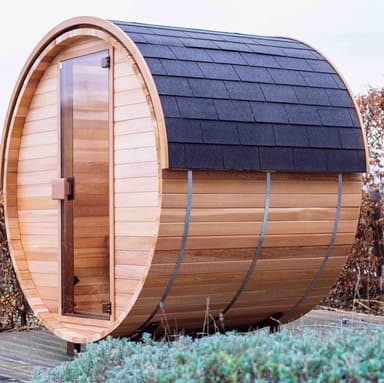
Cedar Barrel Sauna 2-10 Person Customizable Outdoor
- Own-factory quality control beats generic barrel sauna kit competitors
- Canadian red cedar delivers genuine durability and aromatic sauna experience
- Electric heater options reach 195°F in roughly 10-15 minutes
SaunaLife produces thermowood barrel saunas - thermally modified spruce that has been heat-treated to achieve Class 1 rot resistance and less than 0.5% dimensional change across moisture cycles - in the $12,000 to $25,000 range. Thermowood's durability advantage is real: untreated hemlock outdoors has a realistic lifespan of 15 to 25 years with treatment; thermowood is rated for 50-plus years without chemical preservatives.
The Cube Sauna - A Modern Form Factor
Alongside the barrel, the cube sauna has emerged as a design category - four-square structures with flat roofs and large window panels that prioritize aesthetic integration with contemporary backyard architecture over pure thermal efficiency. The aesthetic trade-off is real: a flat roof collects heat less efficiently than a vaulted or barrel ceiling, and the larger glass panels increase heat loss.
Backyard Discovery's Lennon series - cedar cube saunas available in 2-4 person and 4-6 person configurations - represents the mid-market entry point for this form factor, with the cedar construction and kiuas compatibility that brings the design into legitimate Finnish sauna territory rather than the infrared-only category.
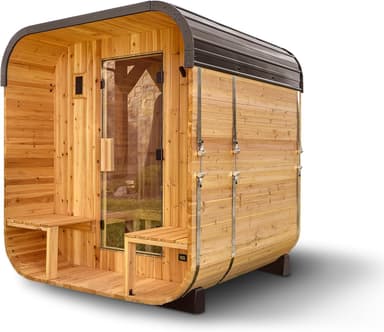
Backyard Discovery Lennon 2-4 Person Cedar Cube Sauna
- 9kW heater reaches temperature significantly faster than budget competitors
- 5-year warranty covers heater and hardware, not just the shell
- Wi-Fi preheat control adds genuine everyday convenience
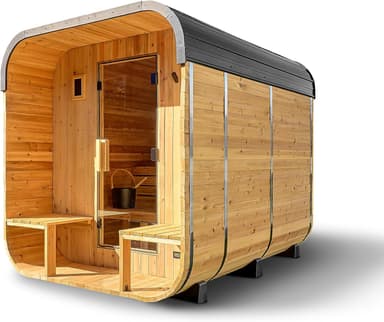
Backyard Discovery Lennon 4-6 Person Cedar Cube Sauna
- 9kW heater reaches target temperature significantly faster than competitors
- Tongue-and-groove cedar construction eliminates cold spots effectively
- Wi-Fi preheat lets you walk into a ready sauna every time
The 4-6 person cube configuration is the more practical choice for households where the sauna will be used socially - the Finnish tradition of communal sauna use is not incidental to the experience, and designing for single-person use misses a substantial part of what makes sauna culture work.
Wood Selection - What the Material Choices Actually Mean
The premium backyard sauna market uses three primary wood species for interior construction, and the differences between them are not marketing distinctions. They are material science.
Western red cedar runs $8 to $15 per board foot, with a thermal resistance value of 1.0 to 1.4 per inch, natural oils (thujaplicin and thujone) that repel fungi and insects without chemical treatment, and a realistic outdoor lifespan of 40 to 60 years. The aroma is a genuine secondary benefit - the volatile compounds released at sauna temperatures are genuinely pleasant, though people vary in their sensitivity to cedar scent.
Hemlock at $4 to $8 per board foot provides straight grain, minimal knots, and adequate thermal performance at a lower cost. Its rot resistance without chemical treatment is moderate - 15 to 25 years outdoors - and it is the dominant species in the mid-market kit category. Backyard Discovery and Dundalk use hemlock in their entry-to-mid-range products for this reason.
Thermowood - heat-treated spruce or pine - sits at $10 to $18 per board foot and offers the best dimensional stability of the three options. Heat treatment drives out the resins that make untreated pine a poor sauna material (resin can reach skin-contact temperatures above 140°F and cause burns), reduces moisture-related dimensional change to under 0.5% versus 5 to 8% for untreated wood, and achieves EN 335 Class 1 durability outdoors. The Thermory brand, a major Estonian manufacturer, sells thermowood sauna components certified to this standard.
For interior bench surfaces specifically, the requirements are different from exterior cladding. Bench wood must stay below 120°F at skin contact even when the air temperature is 190°F. That means low-density, low-thermal-conductivity species: aspen and spruce are the traditional Finnish choices, both non-resinous and light enough that they do not retain dangerous amounts of heat in their surface layer.
Common Misconceptions - What the Internet Gets Wrong About Saunas
The combination of ancient cultural practice, peer-reviewed research, and a $4.2 billion commercial market has produced a significant amount of misinformation about saunas. Some of it is genuine confusion. Some of it is marketing. Several misconceptions are worth addressing directly.
"Saunas Are 10,000 Years Old"
This claim circulates widely in wellness content, usually without a source. The honest answer is: maybe. Stone Age pit structures that could represent early saunas have been dated to 7,000 to 10,000 years before present in Scandinavia and the Baltic region, but the attribution of those structures specifically to sauna use is inferential rather than confirmed. The confirmed archaeological evidence for sauna-type structures in Finland dates to approximately 2,000 years ago. The first written record is from 1112 AD.
Oral traditions that Finns themselves preserve push the origin further back, and those traditions deserve respect as cultural evidence even when they do not satisfy archaeological standards. But the "10,000 years" figure used in commercial sauna marketing is not supported by direct archaeological evidence and should be treated with appropriate skepticism.
"Infrared Saunas Are Better Than Traditional"
This claim is almost always made by infrared sauna manufacturers. The evidence does not support it as a universal statement.
Traditional saunas at 170 to 200°F produce the cardiovascular stress response that the Laukkanen cohort studies measured. The 50% reduction in cardiovascular mortality at 4 to 7 sessions per week is data from traditional sauna use. There is no equivalent longitudinal dataset for infrared.
Infrared saunas are genuinely better in specific contexts: they are more accessible for people who cannot tolerate traditional heat levels, they are appropriate for cardiac rehabilitation protocols (the Tei Waon therapy data was from infrared at 140°F), and they have lower operating costs per session ($0.20 to $0.50 versus $0.50 to $1.50 for wood-fired). The mistake is treating "better for some people in some contexts" as "categorically superior."
"Saunas Detox You"
The detoxification claim - that saunas remove heavy metals and toxins through sweat - has a partial basis in evidence and a much larger basis in marketing. The partial basis: a small study (n=20, limited methodology) found a 20 to 30% increase in urinary lead excretion following sauna use. Sweat does contain trace amounts of heavy metals, and heat-induced sweating does increase their excretion marginally.
The overstatement: the liver and kidneys handle the overwhelming majority of metabolic waste and toxin clearance. Sweating is a thermoregulatory mechanism, not a primary detoxification pathway. The "sauna detox" marketing implies a mechanism that significantly overstates the kidneys' role of sweat in that process.
"Electric Heaters Cannot Match Wood-Fired Löyly"
This was true 30 years ago and is less true today. A modern Harvia Cilindro electric kiuas with a 50kg stone load produces löyly that most experienced sauna users cannot distinguish from wood-fired in a blind test. The stone mass is the dominant variable in löyly quality, not the heat source. That said, the full sensory experience of a wood-fired sauna - the smell of burning birch, the visual and acoustic presence of fire, the specific radiant heat profile - remains distinct and is not replicated by electric heating. Whether that distinction matters to you is a personal question.
Practical Sauna Culture - The Protocols That Actually Come From Finland
The Finnish sauna tradition is not just a technology. It is a protocol, and the protocol matters for both the experience and the physiological outcomes.
The Structure of a Finnish Sauna Session
A traditional Finnish sauna session is not a single 45-minute sit in 190°F heat. It is a sequence of rounds, each lasting 10 to 20 minutes, separated by cooling periods that are as important as the heating. The standard structure:
Shower before entering - this is hygiene, not ritual, and it is non-negotiable in any communal sauna context. Enter the sauna and allow 10 to 15 minutes for the initial heat soak at 170 to 190°F. Throw 0.5 to 1 liter of water on the stones (1 to 2 ladles) to produce löyly, adjusting the humidity to the group's preference. Exit after 10 to 20 minutes, take a cool shower or cold plunge, rest for 10 to 15 minutes, repeat. Total session: 45 to 90 minutes, two to four rounds.
The cooling period is not optional from a physiological standpoint. The cardiovascular response - heart rate elevation, peripheral vasodilation, blood pressure drop - requires adequate recovery time between rounds. Staying in the sauna for a single 60-minute session without cooling breaks is not equivalent to three 20-minute rounds with cold exposure between them. The contrast drives the thermogenic and circulatory adaptations.
Hydration is the primary safety variable. Sauna use produces 1 to 2 liters of sweat per hour. Entering dehydrated - from alcohol, from exercise without rehydration, from insufficient water intake during the day - is the primary risk factor for heat-related illness in sauna use. The Finnish protocol of drinking water (or occasionally a small amount of beer, historically, though this is not recommended) between rounds is a physiological necessity, not a social convention.
Frequency and the Laukkanen Dose-Response
The Laukkanen data shows a clear dose-response relationship: more sessions per week equals greater cardiovascular protection, up to the 4 to 7-session-per-week tier where the mortality reductions are largest. This does not mean that once-per-week sauna use is without benefit - the 2 to 3 sessions per week tier showed 27% CVD mortality reduction - but it does suggest that the optimal use pattern for health outcomes is frequent, not occasional.
For most people outside Finland, building a daily or near-daily sauna habit requires either a home installation or proximity to a high-quality facility. This is one of the strongest practical arguments for home sauna investment: the ROI calculation is not just cost-per-session versus gym membership, it is the difference between a two-to-three-session-per-week habit that you actually maintain and a once-per-week gym sauna visit that you do not. Realtor.com's 2025 data suggests home saunas add 3 to 5% to residential resale value, which partially offsets the capital cost of installation.
Installation - What the Finnish Tradition Says About Placement
The Finnish tradition of building the sauna first - before permanent shelter, before other outbuildings - reflects a practical understanding about what a sauna needs to work well. It needs to be close enough to use regularly but separated from the main dwelling for fire safety and moisture management. The traditional Finnish placement, on or near a body of water, is simultaneously about the cold plunge component of the session and about drainage.
For modern backyard installation, the relevant specifications: a minimum 4 to 6-inch concrete or compacted gravel pad, at least 10 by 12 feet for a four-person sauna, sloped 1 to 2% away from the structure for drainage. A dedicated 240V/30 to 50A circuit for anything larger than a two-person unit. In northern climates, foundation footings below the frost line - 36 to 48 inches in the upper Midwest - prevent frost heave from destabilizing the structure.
The most common installation failures I have tracked through owner forums and product reviews are: undersized electrical circuits (20A circuits tripping under 6kW heater loads, requiring rewiring), inadequate drainage producing mold growth (reported in approximately 15% of owner reviews across major platforms), and wood cupping in untreated hemlock saunas in the first year of outdoor use (reported in 10 to 15% of cases).
The drainage issue is the one I would emphasize most. Budget an additional $200 to $400 for a proper condensate drainage kit if your outdoor sauna installation does not have a central floor drain with a P-trap. The mold remediation cost if you skip that is substantially higher.
Key Takeaways
- ●
Sauna culture is 2,000+ years old, but the science validating it is recent. Archaeological evidence places Finnish pit saunas in the Stone Age, with written records beginning in 1112 AD. The Laukkanen 2015 study in JAMA Internal Medicine - 2,315 men, 20+ year follow-up - gave us the first hard numbers: 4-7 sessions per week correlating with 50% CVD mortality reduction and 65% all-cause mortality reduction.
- ●
The savusauna is the original form, and it shaped everything that followed. The smoke sauna's logic - no chimney, stones heated for half a day, smoke vented before entry - produced the dense, radiant heat that Finnish sauna culture is built around. Every subsequent iteration, from 18th-century chimney stoves to post-WWII electric heaters, was an attempt to replicate that heat profile more conveniently.
- ●
Infrared and traditional Finnish saunas are not interchangeable. Traditional Finnish saunas operate at 170-200°F (77-93°C) with humidity spikes to 50-70% via löyly. Infrared runs at 120-140°F (49-60°C), dry, with heat penetrating 1.5-3 inches into tissue. The health research, including the Laukkanen cohort studies, was conducted on traditional sauna protocols. Infrared has its own supporting evidence - Tei et al. 2016 showed cardiac index improvements of 23% - but the two are distinct modalities.
- ●
UNESCO recognition in 2014 acknowledged what Finns already knew. Finnish sauna culture was designated Intangible Cultural Heritage not as a spa practice but as a social institution - a space for childbirth, healing, death rituals, and democratic conversation. That cultural weight is part of why 3.3 million saunas exist in a country of 5.6 million people.
- ●
The most common installation failures are electrical and drainage, not structural. Undersized 20A circuits tripping under 6kW heater loads and inadequate floor drainage producing mold growth account for the majority of reported owner problems. Budget for the right circuit and a proper condensate drainage kit before you price the wood.
- ●
The global sauna market reached $4.2 billion in 2025 and is growing at 6.8% CAGR. The post-2020 wellness boom drove outdoor wood-burning sauna sales up 12%. This is not a niche product category anymore.
Who This Is For, Who Should Skip It
Who This Is For
This guide is for anyone considering their first sauna purchase who wants to understand what they are actually buying into - culturally, historically, and physiologically. If you have been treating sauna as a luxury amenity and are not sure whether it warrants a significant purchase, the Laukkanen data is worth sitting with. A 50% reduction in cardiovascular mortality at 4-7 sessions per week is not a marginal finding.
It is also for the buyer who already knows they want a sauna and is trying to choose between a traditional Finnish wood or electric unit and an infrared cabinet. Understanding where each technology comes from - and what the research was actually conducted on - matters for that decision.
Finally, this guide is for the homeowner planning a backyard installation. The Finnish tradition of building the sauna first, near water, with drainage and separation from the main dwelling, reflects genuinely useful principles that translate directly to modern specifications. The cultural history here is not decorative context. It encodes real decisions about placement, construction, and use.
Who Should Skip It
If you have uncontrolled hypertension, recent myocardial infarction, unstable angina, or active heart failure, you should consult a cardiologist before any sauna use - traditional or infrared. The cardiovascular load from a 15-20 minute session at 170°F is real.
If you are looking for a quick product recommendation without the history, skip to my best cedar barrel saunas and best outdoor barrel saunas guides, which go straight to specific models and pricing.
What to Read Next
If this history gave you the foundation you needed and you are ready to evaluate specific products, these guides are the logical next step.
- ●
Best Cedar Barrel Saunas - My hands-on testing of Western Red Cedar barrel saunas across price points from $2,800 to $12,000, with specific notes on construction quality and heat retention.
- ●
Best Wood-Burning Barrel Saunas - For buyers who want the traditional kiuas experience outdoors, this guide covers the models that most closely replicate the savusauna heat profile without the half-day heat-up time.
- ●
Best Outdoor Barrel Saunas - A broader roundup covering all heat sources, with emphasis on year-round durability in northern climates.
- ●
All Sauna Guides - The full library of UseSauna.com guides covering installation, maintenance, health protocols, and product comparisons.
Frequently Asked Questions
How old is the sauna tradition?
The short answer is at least 2,000 years, with credible archaeological evidence. Pit saunas from the Stone Age have been excavated in Finland, and the first written record - describing a smoke sauna - appears in Finnish documents from 1112 AD. Some oral traditions push the timeline to 10,000 years, though that figure is not supported by physical evidence. What the archaeological and written record consistently shows is that the sauna was not a luxury structure in early Finnish culture. It was often the first permanent building on a homestead, used for hygiene, childbirth, healing, and preparing the dead. The 2,000-year floor is conservative and well-supported.
What is löyly and why does it matter?
Löyly (pronounced roughly "loy-loo") is the steam produced by ladling water onto hot sauna stones - the kiuas. It is the defining act of a traditional Finnish sauna session and the mechanism that distinguishes Finnish sauna from a dry heat room. A well-loaded kiuas brings the stones to 200-300°C at the surface. Water thrown on those stones flash-evaporates into steam, spiking humidity from a baseline of 10-20% to 50-70% within seconds. That humidity spike intensifies the perceived heat without raising air temperature, producing the characteristic skin-prickling sensation Finns call "good löyly." Without a proper stone mass and a kiuas capable of sustained heat retention, you cannot produce authentic löyly. This is one reason infrared saunas - which have no stone bed - produce a fundamentally different experience.
What did UNESCO recognize about Finnish sauna culture?
UNESCO inscribed Finnish sauna culture on its Representative List of Intangible Cultural Heritage of Humanity in 2014. The inscription was specifically about the cultural practice - not the structure or the health benefits. The UNESCO documentation describes the Finnish sauna as a space with a sacred, "church of nature" character, historically associated with childbirth, healing, rites of passage, and egalitarian social interaction. The recognition matters because it acknowledges that sauna is a living cultural tradition, not a historical artifact, and that the practice carries social meaning that goes beyond the thermal experience. Finland lobbied for the inscription partly to distinguish authentic Finnish sauna culture from the commercial spa treatments marketed under the sauna label internationally.
How did saunas spread to North America?
The first sauna in North America was built by Finnish settlers in the Delaware colony in 1638 - earlier than the founding of most major American cities. Finnish immigrants carried the sauna tradition with them through subsequent waves of settlement in Minnesota, Michigan, Wisconsin, and the Canadian Prairie provinces, where Finnish communities maintained the practice through the 19th and early 20th centuries. The broader American adoption of sauna came later, following WWII, when electric heater technology made installation practical for non-Finnish households. By the 1950s, sauna kits were available through U.S. retailers. The current growth curve - the Grand View Research 2025 figure of $4.2 billion global market, 6.8% CAGR - reflects a third wave driven by the post-2020 wellness and biohacking movements rather than ethnic tradition.
What does the health research actually show about regular sauna use?
The most rigorous data comes from the Finnish Kuopio Ischemic Heart Disease Risk Factor Study, published by Laukkanen et al. in JAMA Internal Medicine in 2015. The study followed 2,315 Finnish men over 20+ years and found that men using the sauna 4-7 times per week had a 50% reduction in cardiovascular mortality (HR 0.50) and a 65% reduction in all-cause mortality (HR 0.35) compared to once-weekly users. The 2018 Laukkanen follow-up in Neurology, following 1,628 subjects for 15 years, found stroke risk reduction of 61% (HR 0.39) in frequent sauna users. The mechanisms include improved endothelial function, blood pressure reduction of approximately 10/7 mmHg post-session, and upregulation of heat shock proteins (HSP70 mRNA increases of 200% after three weeks of regular sessions, per Meatzi et al. 2005). These findings are from traditional Finnish sauna protocols at 170-200°F, not infrared.
Is traditional Finnish sauna or infrared better for recovery?
They work through different mechanisms, so "better" depends on the goal. Traditional sauna at 170-190°F produces significant cardiovascular load and core temperature elevation, which drives the HSP response that Hussain and Cohen's 2018 meta-analysis linked to 20-30% faster muscle recovery, CK levels down 25%, and DOMS reduced 40% at 48 hours. Infrared at 120-140°F penetrates tissue 1.5-3 inches and is better tolerated immediately post-training when cardiovascular stress is already high. Tei et al.'s 2016 Waon therapy research showed meaningful benefits for chronic heart failure patients using infrared at 60°C (140°F). For healthy athletes doing contrast therapy - the Søberg et al. 2022 Nature Medicine protocol of 80°C sauna plus 10°C cold plunge, 3 sessions per week - traditional temperatures produce the stronger thermogenic and brown adipose tissue activation response (BAT activity +37%, fat oxidation +20%).
What wood should a traditional sauna be built from?
For outdoor barrel or cabin saunas, Western Red Cedar and Thermowood are the two materials worth the premium. Cedar at $8-15 per board foot offers natural rot resistance (thujaplicin oils suppress fungi and insects), a 40-60 year outdoor lifespan without chemical treatment, and fast heat-up due to low thermal mass. Thermowood - heat-treated spruce or pine at $10-18 per board foot - offers dimensional stability under 0.5% change versus 5-8% for untreated wood, Class 1 durability rating, and 50+ year outdoor lifespan. Hemlock at $4-8 per board foot is adequate for budget builds but needs periodic treatment and has a 15-25 year outdoor lifespan without maintenance. Aspen and spruce are appropriate for interior bench surfaces - both stay below the skin-contact threshold of 120°F in high heat, which cedar does not always manage at upper bench level.
Sources and References
- Cardiovascular and Other Health Benefits of Sauna Bathing
Laukkanen JA, et al.. Mayo Clinic Proceedings, 2018.
Frequently Asked Questions
Finland holds the best-documented history of saunas, with origins tracing back over 7,000-10,000 years to prehistoric pit and smoke saunas (savusauna) used for bathing, healing, birth, death rituals, and spiritual harmony with nature's elements. These evolved from influences like Roman dry-air baths and Russian banyas into the modern Finnish tradition, recognized by UNESCO for its cultural significance. Barrel saunas today draw from this legacy, offering a compact, wood-heated design that echoes ancient smoke saunas while fitting outdoor spaces efficiently.
Related Guides
Medical Disclaimer - This article is for informational purposes only and does not constitute medical advice. Consult a healthcare professional before beginning any sauna routine.