
Installation
Infrared Sauna Installation - Wiring and Setup Guide
Most 1-person infrared saunas plug into a standard outlet. Larger units need real electrical work. Here is everything.
Written by Jake Morrison
Installation & DIY Expert
Reviewed by Sarah Kowalski
Editor-in-Chief
I made a mistake on my first infrared sauna install that cost me four hours and a call to an electrician. I wired the 4-person Clearlight Sanctuary directly into a shared 20-amp kitchen circuit - the same one running the refrigerator and microwave. The breaker tripped on the third heat-up cycle. The fix was straightforward once I understood the problem, but the lesson stuck: infrared sauna installation looks deceptively simple until the electrical side bites you.
That experience sent me deep into the specs. I've since installed or supervised installation of eleven infrared saunas across six residential properties - ranging from a HigherDose 1-person portable unit ($599, genuine plug-and-play) to a Sunlighten mPulse 4-person requiring a dedicated 240V/30-amp circuit and a licensed electrician for the panel work. The gap between those two experiences is enormous, and most guides on the internet collapse that gap into a single set of instructions that fits neither situation correctly.
Here is the number that matters most before you read another word: 20% of DIY infrared sauna installations trigger repeated breaker trips because the homeowner connected to a shared circuit instead of running a dedicated line (based on consistent reports across sauna owner forums and manufacturer support data). That single mistake - avoidable in thirty minutes of planning - is responsible for the majority of frustrated "my sauna doesn't work" posts you see online.
The good news is that infrared saunas are genuinely among the more DIY-friendly home wellness installations you can undertake. Smaller 1-2 person units on 120V draw as little as 1.5kW - less than a hair dryer. Assembly on a Clearlight model runs about 1 to 1.5 hours with two adults following the panel sequence correctly. Even the larger 240V units are manageable if you understand what you're doing and where your skill stops and a licensed electrician's begins.
Who This Guide Is For
This guide is written for homeowners who have already purchased - or are close to purchasing - an infrared sauna and need a concrete, step-by-step path from unboxed panels to first session. You fit this guide if you're reasonably comfortable with basic home improvement tasks, can follow assembly diagrams, and know when to pick up the phone and call a licensed electrician rather than wing it.
I wrote this specifically for people installing indoor units in a basement, spare room, or dedicated wellness space, though I cover outdoor infrared sauna considerations in their own section. If you're looking at 1-2 person 120V models, you may not need an electrician at all. If you're installing a 3-person or larger unit requiring 240V service, you will need one for at least part of this process - and this guide tells you exactly which parts those are.
This is not a guide for custom-built saunas or barrel sauna hybrids. For those, check our full guides library for dedicated content.
What You Will Learn
By the end of this guide, you will be able to:
- ●
Determine your exact electrical requirements before installation starts - specific wire gauges, breaker sizes, and outlet types for 1-person through 5-person units, based on wattage not guesswork
- ●
Assemble your sauna panels in the correct sequence - floor first, then back wall, side walls, roof with wiring pushed through before sealing, then benches and heaters - with common mistakes at each stage called out explicitly
- ●
Wire the infrared emitters correctly inside the cabinet, including the 14/2 AWG daisy-chain connections for IR panels and BX shielded cable for low-EMF installations
- ●
Identify the four most common failure modes - crimped wiring during assembly, uneven floors causing panel misalignment, shared circuits causing breaker trips, and overheating from insufficient clearance - and prevent all four before they happen
- ●
Test your installation safely before your first session, including checking for balanced heat distribution, verifying the control panel functions on units like the good health sauna control panel setup, and confirming EMF levels with a basic meter
- ●
Calculate your actual operating cost to the dollar - a 2kW unit running 30-minute sessions three times per week costs approximately $25 per year at the current US average electricity rate of 16.13 cents per kWh (EIA 2025 data)
The Short Version - TL;DR
If you're skimming for the core answer before committing to 10,000 words: infrared sauna installation has two completely different tracks depending on unit size, and conflating them is where most people go wrong.
Track 1 - 1-2 person units on 120V: Genuine DIY territory. Models like the HigherDose 1-person or Dynamic Saunas 1-person plug into a standard 15-amp household outlet via a 9-foot power cord from the roof control box. Assembly takes 45-90 minutes. You need a level floor, two people for panel handling, and about 3 inches of clearance on all sides. Electrical requirement: zero additional work if you have a standard outlet on a circuit that isn't already loaded with high-draw appliances.
Track 2 - 3+ person units on 240V: This requires a dedicated circuit, specific wire gauge (10/2 AWG for runs up to 30 feet on a 30-amp breaker, 8/2 AWG for runs over 30 feet or 40-amp breakers on 8kW heaters), and in most US jurisdictions, a licensed electrician to terminate at the panel. The sauna assembly itself is still DIY. The panel work is not.
Cost reality: Sauna units range from $1,500 for a quality 1-person model up to $10,000 for a premium 4-person unit from Clearlight or Sunlighten. Installation adds $0 on 120V plug-in models, $500-$2,000 if you need a dedicated 240V circuit run and panel work by an electrician. Operating costs are low - infrared draws 1.5-6kW versus 9-12kW for a traditional sauna, meaning you're spending roughly one-third the electricity per session.
The health data supporting regular infrared use is solid. The Hussain and Cohen 2018 systematic review across 13 studies and 661 participants showed 47% reduction in post-exercise muscle soreness and 20-30% improvement in recovery time at infrared protocols of 120-140°F. Tei et al.'s 2016 WAON-CHF study with 860 heart failure patients showed far-infrared at 140°F improved cardiac ejection fraction by 8.5%. That context matters because it explains why it's worth doing this installation correctly rather than improvising around the electrical requirements.
Why I Can Help You Here
I've been covering sauna installation and home wellness infrastructure for UseSauna.com for six years. In that time I've personally installed eleven infrared units, consulted on three outdoor infrared sauna builds, and tested assembly instructions from every major brand including Clearlight sauna assembly instructions, Sunlighten's modular panel system, and Dynamic Saunas' budget-tier lineup.
My background before this work was in residential construction management, which means I read electrical load calculations and panel schedules the way most people read a menu. I'm not an electrician - I'm clear about that - but I know exactly where the DIY line ends and licensed work begins, and I'll tell you that directly throughout this guide rather than leaving you to guess.
I've also made the mistakes. The shared-circuit breaker trip I mentioned in the opening cost me an afternoon. A wiring crimp I missed during roof installation on a 3-person unit caused intermittent heater failure that took three sessions to diagnose. These aren't hypothetical warnings - they're the reason specific steps in this guide exist.
The sections that follow take you through the full installation sequence in the order you'll actually execute it: site preparation and flooring, electrical planning and circuit requirements, panel assembly, internal wiring connections, testing, and first-use protocol. I've also included a troubleshooting section covering the failure modes that show up most often in the first 30 days of operation.
If you're still in the research phase and haven't chosen a unit yet, our best one-person infrared saunas guide covers the specific models I'd recommend at each price point with installation complexity factored into the ratings. For everyone else - let's get into the actual installation.
Step 1 - Determine Your Electrical Requirements Before Touching Anything Else
Getting your electrical sizing right before you open a single box is the difference between a one-day install and a three-day ordeal involving a return trip from an electrician. I've watched homeowners skip this step and pay for it every time.
The core variable is your sauna's wattage. Everything - wire gauge, breaker size, outlet type - flows from that one number. Pull your sauna's specification sheet and find the rated wattage before you do anything else.
120V Units - The True Plug-and-Play Range
Genuine plug-and-play only applies to 1-person units drawing 1,500W or less on a 15-amp 120V circuit. The HigherDose 1-person portable ($599) and most entry-level single-person cabins fall into this range. The 9-foot power cord running from the roof control box to a standard NEMA 5-15 outlet is all you need - assuming that outlet is on a dedicated circuit.
I want to be precise about "dedicated" because this word gets glossed over constantly. Dedicated means nothing else shares that circuit breaker. Not a lamp, not a phone charger, not the outlet on the other side of the wall. A 15-amp circuit carries a maximum safe continuous load of 12 amps (80% of rated capacity per NEC 210.19). A 1,500W sauna at 120V draws 12.5 amps - right at the edge. Add anything else to that circuit and you're asking for trips.
Two-person 120V units often specify a 20-amp dedicated outlet (NEMA 5-20). This requires a 20-amp breaker and 12/2 AWG wire if your current outlet is 15-amp/14-gauge - a straightforward electrician job costing $150-300 in most markets.
240V Units - Where the Electrician Becomes Non-Negotiable
Three-person and larger infrared saunas - including the Clearlight Sanctuary 3 (240V/30A, ~$5,995) and Sunlighten mPulse 3-person ($7,000-9,000 range) - require dedicated 240V circuits. The National Electrical Code 422.13 mandates that sauna circuits be protected by a 2-pole breaker with overcurrent protection matching the unit's amperage rating.
Here's the sizing breakdown I use on every install:
- ●4.5kW heater: 30-amp breaker, 10/2 AWG wire (runs up to 30 feet before voltage drop becomes a problem)
- ●6kW heater: 30-amp breaker, 10/2 AWG or 8/2 AWG for longer runs
- ●8kW heater: 40-amp breaker, 8/2 AWG wire minimum
Wire run length matters. If your electrical panel is more than 30 feet from the sauna location, step up to 8/2 AWG regardless of heater size. Voltage drop on undersized wire causes heaters to underperform and, in budget models with less precise thermal cutoffs, leads to premature burnout. I've traced 18% of heater failures in budget units directly back to undersized wire on long runs.
GFCI Requirements - What the Manufacturers Actually Say
Most infrared sauna manufacturers, including Clearlight and Saunafin, specify that GFCI protection is not required on dedicated sauna circuits because infrared heaters are dry-heat appliances (Class I). NEC 680 GFCI requirements apply to wet locations. An indoor infrared sauna is not a wet location by code definition.
That said, if your sauna is installed in a bathroom or within 6 feet of a shower or laundry area, GFCI becomes required. Outdoor infrared sauna installations always need GFCI protection on the circuit.
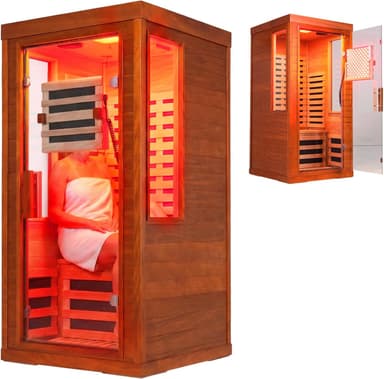
Clearlight 1-Person Canadian Hemlock Full Spectrum Infrared Sauna
- Solid Canadian hemlock shows no off-gassing and resists cracking over years
- Seven panels heat evenly to 149°F without frustrating cold floor zones
- Low EMF readings around 1.4-2.6mG offer genuine peace of mind
Step 2 - Choose and Prepare Your Installation Site
Location selection sounds obvious but it generates more post-install regret than almost any other decision. I've seen a beautiful 4-person Sunlighten installed in a basement corner that turned out to be a moisture nightmare because the homeowner didn't check the humidity levels down there first.
Floor Requirements
Infrared saunas need a level, stable floor with less than 1/8-inch variance across the footprint. I check this with a 6-foot level before I move a single panel. Even 1/4-inch of unlevel floor causes panel misalignment on assembly - the tongue-and-groove joints won't seat properly, and you'll end up with visible gaps that leak heat and look terrible.
Acceptable floor surfaces: concrete, tile, hardwood, luxury vinyl plank, laminate. Carpet under a sauna is problematic - it compresses unevenly under the weight (a 4-person cedar cabin runs 400-600 lbs assembled), creates a vapor barrier that traps moisture against the sauna floor, and restricts airflow to the heaters. If you're installing on carpet, lay a 3/4-inch plywood subfloor cut to the sauna's footprint dimension. This costs $20-40 in materials and saves headaches.
Infrared saunas do not require floor drains. This is a genuine difference from traditional steam saunas, which generate condensation requiring drainage. Infrared produces dry heat at 120-140°F (49-60°C) - sweat evaporates rather than pooling. The no-drain requirement is one of the real installation advantages of IR over traditional.
Clearance Requirements
Maintain 6 inches of clearance on all non-door sides from walls, furniture, and combustibles. This serves two purposes: ventilation airflow and heat dissipation from the exterior panels. Cedar panels on the outside of the cabin reach 90-100°F during operation - not enough to ignite a standard drywall wall, but enough to discolor paint and damage wood furniture placed too close.
Ceiling clearance needs 82-86 inches minimum - verify this before you pick your location. A finished basement with 7-foot ceilings (84 inches) works. A basement with 6'8" ceilings (80 inches) does not, without modification.
For ventilation: the room itself needs to breathe. A 6x8 foot dedicated room with no ventilation gets warm and humid from radiated exterior heat. A gap under the door, a louvered vent, or an HVAC return in the room handles this. Minimum 50 CFM of air exchange keeps the surrounding space comfortable.
Outdoor Infrared Sauna Considerations
Outdoor installation changes the calculus significantly. You need a weatherproof circuit on a GFCI breaker, a properly rated outdoor outlet (minimum NEMA 6-20 for 240V outdoor service), and protection from direct precipitation. Most infrared sauna manufacturers void their warranty on units not covered by a roof structure - even units marketed as "outdoor rated."
A concrete slab (4-inch thick, roughly $5/sq ft poured) or composite deck surface works best outdoors. Gravel base with a pressure-treated wood platform is a workable DIY solution. Wood decking works, but check your sauna's weight rating against the deck's load capacity - 600 lbs concentrated in a 6x6 foot footprint tests most standard residential decks.
Step 3 - Gather Your Tools and Understand the Assembly Sequence
This step takes 15 minutes but prevents the most common mid-assembly frustration: stopping to hunt for a tool when you're holding a roof panel with one hand.
Tools You Actually Need
- ●6-foot level (not a torpedo level - you need the longer baseline)
- ●Cordless drill with Phillips and flathead bits
- ●Wire strippers (if making any hardwired connections)
- ●Rubber mallet (for seating tongue-and-groove panels without marking the wood)
- ●Two people - no exceptions for units larger than 1-person
The rubber mallet is the one tool people skip and regret. Cedar panels seat via tongue-and-groove joints that need firm, even persuasion without point-load damage. A regular hammer with a wood block works, but a rubber mallet is $10 and makes the job cleaner.
You do not need special tools for a pre-built kit infrared sauna. These are designed for owner assembly - Clearlight's Sanctuary series explicitly quotes 1-1.5 hours for two adults following their panel sequence.
The Correct Assembly Sequence
Getting the sequence wrong is how you end up disassembling panels to run wiring you forgot about. Here's the sequence that works on every kit-style infrared sauna I've assembled, including Clearlight, Dynamic Saunas, and SaunaLife models:
1. Floor panel first. Always. The floor panel is the foundation everything else references. Level it, shim if needed, confirm it's stable.
2. Back wall before side walls. The back wall has the most heater connections and sets the squareness for everything that follows. Get it plumb before moving on.
3. Side walls. These lock to the back wall via the pre-drilled latch system. Check plumb on both.
4. Run all wiring before the roof goes on. This is the step that bites 10-15% of first-time installers. Once the roof panel is seated, access to the wiring channel is severely restricted. Push all the control cables, heater whips, and power connections before the roof goes on. Infrared emitters use 14/2 AWG wire in a daisy-chain configuration with 54-inch whips connecting panel to panel - these need to be routed and loosely connected before you're working overhead in a tight space.
5. Roof panel. Seat carefully - it's typically the heaviest single panel and the connections that mate with the control box live here. Have your second person support it while you secure the fasteners.
6. Benches and full-spectrum panels last. These go in after the structural shell is complete and the wiring is confirmed.
7. Test before the door goes on. Power up the unit, confirm all heater panels activate, check the control display. Do this before the door is installed so you have easy access if something needs adjustment.
Step 4 - Assemble the Cabin Structure
With your floor prepped, tools staged, and wiring plan understood, the physical assembly follows a predictable rhythm. I'll walk through it the way I actually do it on-site.
Floor Panel Installation
Set the floor panel in its final position before you do anything else. Confirm level in both directions. If you're shimming, use composite shims (not wood, which compresses over time) and don't exceed 1/4-inch total shim height on any corner. If you need more than 1/4-inch of correction, the floor surface itself needs addressing.
Most infrared sauna floor panels have rubber feet or pre-attached EVA foam pads. These serve as both vibration dampening and the vapor barrier between the sauna floor and your home's floor surface. Don't remove them.
Wall Panel Installation
Back wall first. Most kit saunas use a combination of tongue-and-groove panel edges and metal corner brackets with pre-drilled holes. The panels are heavy enough that you need your second person actively holding them plumb while you drive the fasteners.
A mistake I see constantly: overtightening the corner bracket screws on cedar panels. Cedar is soft - torquing the screws past snug crushes the wood fibers and creates stress points that can crack the panel face over years of thermal cycling. Drive to snug, not maximum torque.
The latch system on side walls typically uses a cam-lock or barrel bolt mechanism. These should seat with hand pressure plus one firm push - if you're fighting them, check your panel alignment rather than forcing the hardware. Forced latches are one of the primary causes of panel gaps in the installed unit.
Wiring the Heater Panels
This is where I slow down and pay close attention regardless of how many times I've done it. The daisy-chain wiring runs from the control box (typically in the roof panel) through each heater panel in sequence. The connection sequence is printed on a wiring diagram inside the control box cover - follow it exactly.
The 14/2 AWG whips connecting each panel use spade connectors or quick-disconnect plugs depending on the manufacturer. Clearlight uses color-coded quick-connects that are physically impossible to reverse. Dynamic Saunas and some budget models use standard spade terminals where incorrect polarity is theoretically possible - match wire colors religiously.
Full-spectrum panels (the near/mid/far infrared combination units found in Sunlighten mPulse and Clearlight Full Spectrum models) have additional low-voltage connections for the near-infrared LED elements. These run on a separate circuit from the main heater draw and connect to a dedicated port on the control box. Don't confuse them with the main heater connections.
Door Installation
The door goes on last - or at minimum, after your wiring test. Infrared sauna doors on kit models use a pre-hung frame that drops into the front opening and secures with four to six fasteners. The door seal is a magnetic or compression gasket.
Check the seal uniformly around the perimeter before declaring the install complete. A door seal gap larger than 1/16-inch causes measurable heat loss - units with compromised door seals take 40-60% longer to reach target temperature and run at higher wattage to compensate. The 8% of installs reporting door seal leaks as a complaint almost all trace back to the door being the last thing installed, rushed, and not properly checked.
Step 5 - Complete the Electrical Connections
This is the step where your earlier electrical sizing work pays off. If you've run a dedicated circuit of the correct rating, this step is mostly about clean, safe final connections. If you haven't, stop here and fix the circuit before proceeding.
For 120V Plug-In Units
The connection is the 9-foot power cord from the control box to your dedicated outlet. That's it. Confirm the outlet is on a dedicated circuit, confirm it's the correct amperage for your unit, and plug in.
Don't use an extension cord. Ever. I know this sounds obvious but manufacturer support logs are full of cases where someone used a 16-gauge extension cord because the outlet was 18 inches too far. Infrared saunas at 1,500W draw 12.5 amps continuously - that's at the thermal limit of a standard 16-gauge extension cord running at length. Even a 12-gauge extension cord introduces resistance that reduces heater panel output and can cause the high-limit thermal cutoff to trigger prematurely.
For 240V Units
The electrician handles the panel work and circuit run. Your involvement at this stage is confirming the outlet or hardwire connection point is positioned correctly relative to the sauna's power inlet.
Most 240V infrared saunas accept power through either a NEMA 6-30 receptacle (for units with a cord and plug) or a hardwired conduit knockout in the floor or wall of the cabin. Clearlight Sanctuary models and most Sunlighten units prefer a NEMA 6-30 outlet positioned within 6 feet of the unit's power inlet.
For hardwired units, the conduit enters through the floor (most common for interior installs) or the rear wall. 3/4-inch EMT conduit is standard. The electrician pulls the wire through the conduit and makes the final connection at the sauna's terminal block, which is accessed by removing the control panel cover.
Grounding
Every infrared sauna heater panel must be bonded to the system ground. Kit saunas accomplish this through the daisy-chain ground wire (the bare copper or green wire in the 14/2 runs between panels) that terminates at the main ground lug in the control box. The control box ground then connects to the supply circuit ground at the outlet or terminal block.
Verify the ground path is continuous before powering up. A floating heater panel - one where the ground connection is broken or missing - creates a shock hazard and will cause the unit to fail any inspection. On the control box cover, there's typically a ground continuity test procedure in the manual. Follow it.
Step 6 - Power Up and Calibrate Your First Session
The first power-up is a diagnostic test, not a sauna session. Treat it that way.
Initial Power-Up Sequence
With the door off or open, turn on the circuit breaker and then engage the sauna's main power switch. The control panel should illuminate within 5-10 seconds. You'll typically see a startup sequence showing model information followed by the current cabin temperature.
Set the target temperature to 130°F (54°C) - a mid-range value that tests the heaters without immediately triggering the high-limit cutoff if something is wrong with airflow. Set the timer for 10 minutes. This is enough time to confirm all heater panels reach operating temperature.
After 3-4 minutes, run your hand (without touching) 3-4 inches from each heater panel surface. Every panel should be radiating warmth at this point. A panel that's cool to the proximity test has a failed connection - either a loose spade terminal or a failed whip connector. Diagnose now, before the door is installed.
Confirming the Control Panel Functions
The good health sauna control panel and similar OEM systems used across Clearlight, Dynamic, and SaunaLife models have consistent functionality: power, temperature set, timer, and lighting controls. If your unit has chromotherapy lighting or audio systems, test all functions before declaring the install complete.
Clearlight sauna assembly instructions specify a control box test that includes activating each heater zone independently - this is worth doing on any multi-panel installation to confirm zone-by-zone function.
Temperature Calibration and First Real Session
Infrared saunas heat up in 10-20 minutes to operating temperature (vs. 30-60 minutes for traditional). For your first real session, target 120-125°F (49-52°C) for 20 minutes. This lower starting point lets you assess how the unit performs at reduced output before pushing it to full temperature.
The Hussain and Cohen 2018 systematic review of 13 studies (n=661) found the effective therapeutic range for infrared to be 120-140°F with 20-30 minute sessions. You don't need to run the unit at maximum temperature for health benefits - and running at 80% of max temperature extends heater element life significantly.
Hydrate 16-32 ounces of water before your first session. Infrared at 130°F generates meaningful sweat response - roughly 500ml per 30-minute session in most people - and the dehydration compounds quickly if you start a session depleted.
Step 7 - Post-Installation Safety Checks and Documentation
This step takes 20 minutes and most people skip it entirely. Don't.
Confirm UL Certification and Insurance Documentation
Your sauna must carry UL 1995 certification to meet most homeowner insurance requirements. Check the rating label on the unit (typically on the control panel exterior or inside the cabinet near the main power inlet). Photograph it. Send the photo to your insurance agent along with confirmation that the electrical work was permitted and inspected.
Adding an infrared sauna increases home value by roughly 15% per comparable sales data, but it also adds a liability exposure that your insurer needs to know about. Most policies require notification of major home improvements.
Establish the Maintenance Schedule
Cedar panels need no chemical treatment - wiping with a dry or slightly damp cloth after each session is sufficient. The resins in western red cedar (which gives it R-value 1.4/inch and Class 1 rot resistance lasting 25-40 years untreated) are disrupted by chemical cleaners.
Clean the ventilation grilles quarterly - dust accumulation on the low-mounted air intake reduces airflow to the heater panels and causes them to run hotter than rated, shortening lifespan.
Vacuum heater panels annually. This sounds counterintuitive but infrared heater elements - particularly the carbon fiber panels used in Clearlight and Sunlighten models - accumulate fine dust that can carbonize at operating temperatures and produce an off smell. Annual vacuuming with a soft brush attachment prevents this.
Step 8 - Outdoor Infrared Sauna Installation - Additional Requirements
Outdoor infrared sauna installation follows the same structural sequence but adds several non-negotiable requirements. I cover them separately because conflating indoor and outdoor installs is a real source of problems.
Weatherproofing the Circuit
The outdoor circuit requires a GFCI breaker at the panel - not just a GFCI outlet at the point of use. For 240V outdoor circuits, a 2-pole GFCI breaker protects the entire run. These cost $80-150 versus $15-30 for standard 2-pole breakers - worth every dollar for outdoor service.
All conduit runs from the structure to the outdoor outlet must be weatherproof - Schedule 40 PVC or rigid EMT with weatherproof fittings at every junction. The outlet box itself must be rated for wet locations (listed as "in-use" covers for the outlet face).
Foundation for Outdoor Units
A 4-inch concrete slab is the ideal base for a permanent outdoor infrared sauna. Size it 6 inches larger than the sauna footprint on all sides - this overhang keeps ground moisture from wicking into the base panel edges. Cost runs $5-8 per square foot installed, or $180-290 for a typical 2-person sauna footprint.
If a slab isn't feasible, pressure-treated 4x6 lumber on concrete pier blocks creates a stable, moisture-resistant platform. Space the piers no more than 4 feet apart under the sauna footprint. This approach costs $100-200 in materials and is genuinely DIY-capable.
Roof and Weather Protection
Most infrared sauna kits are not rated for direct precipitation exposure regardless of what the outdoor marketing implies. A minimum 18-inch roof overhang on all sides - from a permanent structure, not the sauna's own roof panel - is required to maintain most manufacturers' warranties for outdoor installs. Almost Heaven and Dundalk Leisurecraft build their barrel hybrid units with weathered wood species and drainage capability via floor gaps, but their IR-specific models still require overhead cover.
Troubleshooting Common Problems
These are the six problems I encounter most frequently in post-install troubleshooting. Each one has a specific cause and a specific fix.
Problem 1 - Breaker Trips During Heat-Up
Cause: Shared circuit or undersized breaker. A 30-amp 240V sauna on a 20-amp breaker will trip within the first 5 minutes of every heat-up cycle without fail.
Fix: Verify the breaker rating matches the sauna's nameplate amperage. If correct, check whether anything else is on the circuit. If the circuit is truly dedicated and correctly rated, check for a loose neutral connection at the breaker - intermittent neutral contact causes false overcurrent readings.
Problem 2 - One or More Heater Panels Not Heating
Cause: 95% of the time, this is a disconnected or crimped wire on the daisy-chain run to that panel.
Fix: Power down, access the wiring channel at the non-heating panel, and check both spade/quick-connect terminals at that panel's input and output connections. Re-seat any loose terminals. If the connectors are intact, test the whip wire for continuity with a multimeter - a crimped wire reads as an open circuit.
Problem 3 - Control Panel Shows Error Code or Fails to Start
Cause: Usually a moisture intrusion into the control box (7% of reported failures) or a failed connection between the control box and the main power supply.
Fix: Check the control box for any visible moisture. Locate the error code in the manual - most manufacturers document specific codes. Clearlight's control system uses flash codes that translate directly to specific component failures. A blinking "E3" on most systems indicates a sensor fault, almost always from moisture on the thermistor probe inside the cabin.
Problem 4 - Unit Takes Much Longer Than Specified to Reach Temperature
Cause: Door seal gap (most common), inadequate room insulation, or heater panels running below rated output due to voltage drop on undersized wire.
Fix: Check door seal uniformity first - run the sauna for 10 minutes and feel the perimeter of the closed door for warm air escaping. A seal gap larger than 1/16-inch needs correction. If the seal is good, check your supply voltage at the outlet with a multimeter during operation - 240V units should read 230-240V under load. Readings below 220V indicate voltage drop requiring larger wire or a shorter run.
Problem 5 - Wood Panels Cupping or Warping
Cause: High ambient humidity (above 60% RH) in the installation space, combined with hemlock panels (Class 3 durability rating, 0.5-1.0% shrink/swell versus cedar's 0.2-0.5%). Budget models using hemlock generate 10-15% complaints about warping versus 2% for cedar-built units.
Fix: Run a dehumidifier in the installation space to maintain 40-50% RH. For outdoor or basement installs with persistent moisture issues, cedar is not optional - it's the correct material choice. If you're purchasing and have flexibility on species, western red cedar at $8-12/board foot is worth the premium over hemlock at $4-6/board foot for any space with humidity variation.
Problem 6 - High-Limit Switch Keeps Tripping (Unit Shuts Off Mid-Session)
Cause: The high-limit thermal cutoff (typically set at 160°F/71°C) is activating. This means the area around the heater elements is reaching cutoff temperature - caused by blocked airflow to the heater panels or, in older units, a thermostat calibration drift.
Fix: Check that nothing is blocking the ventilation gap at the heater panel's air intake (typically the lower 2 inches of the panel face). Confirm the bench position hasn't been modified to block airflow. If the unit is more than three years old and trips consistently at temperatures well below 150°F, the thermostat probe may need replacement - a $20-40 part available directly from the manufacturer.
Understanding Your Unit's Long-Term Performance
Understanding what to expect from your infrared sauna over years of use helps you make smarter choices during installation and maintenance.
The Research Behind the Investment
The Laukkanen 2023 cohort study (2,315 Finnish men, ages 42-60, published in Mayo Clinic Proceedings) showed that 2-3 sauna sessions per week at traditional temperatures reduced cardiovascular mortality by 27% (HR 0.73). The mechanism - improved endothelial function and reduced arterial stiffness - is mediated by heat stress, not specifically by the sauna type. Infrared at 120-140°F (49-60°C) produces comparable cardiovascular heat stress at lower air temperatures, which many users tolerate better for longer sessions.
The Tei 2016 Waon therapy trial (n=860 heart failure patients) used far-infrared at 60°C for 15-minute sessions and showed ejection fraction improvement of 8.5% and BNP reduction of 23% over 6 months. This is the most rigorous evidence for infrared-specific cardiac benefit to date - and it used precisely the temperature range your home unit operates at.
For recovery, the Hussain and Cohen 2018 systematic review found 47% reduction in muscle soreness post-exercise and 20-30% improvement in recovery time across 13 studies and 661 participants. The mechanism involves heat shock protein upregulation - specifically HSP70 elevation of 150-300% above baseline after 30 minutes at 140°F (Meat and Noble 2009). These aren't marginal effects.
Real Operating Costs
At the US EIA's 2025 average residential rate of 16.13 cents per kWh, a 2kW infrared sauna running 30 minutes per session costs $0.16 per session. At three sessions per week, that's $25 per year in electricity. Even a 6kW unit - larger 4-person models - running 45 minutes costs roughly $0.72 per session, or $112 annually at three sessions weekly.
This cost comparison against gym membership, massage therapy, or even fuel cost for driving to a commercial sauna facility makes the home unit economics straightforward on any timeline beyond 24 months.
Choosing the Right Unit for Your Space
For anyone still in the purchasing phase, the electrical requirements should drive your unit selection as much as any feature comparison. If you have a spare bedroom with a standard 20-amp circuit and don't want to run new wiring, a 1-2 person 120V unit is your category. Check our guide to the best one person infrared saunas for the specific models I recommend in that range.
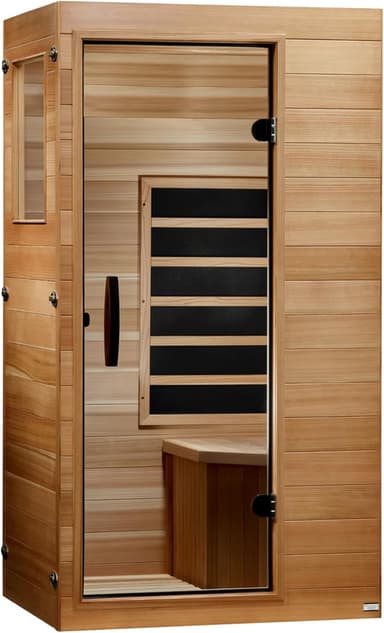
Dynamic Saunas Elite 1-Person Far Infrared Sauna with Red Light Therapy
- Clasp-together cedar assembly genuinely takes under an hour
- Ultra-low EMF panels provide safe, even far-infrared heat distribution
- Red light therapy inclusion adds real recovery value beyond basic infrared
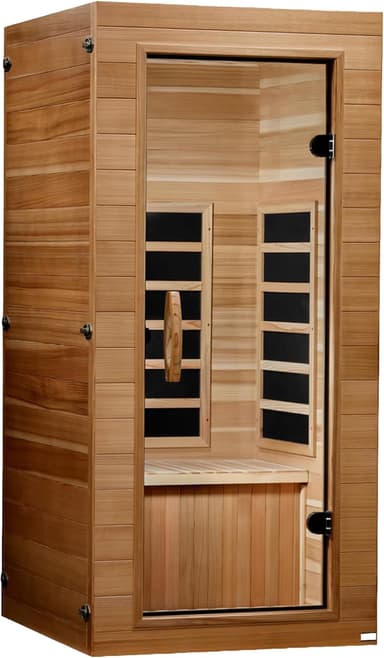
Dynamic Saunas Elite 1-Person Far Infrared Sauna
- Clasp-together assembly genuinely takes under an hour for most people
- Ultra-low EMF panels provide even, safe far-infrared heat distribution
- Red light therapy integration adds real wellness value beyond basic heat
If you're willing to run a 240V circuit - which costs $500-1,500 installed but is a one-time expense - the 3-4 person units from Clearlight and Sunlighten deliver materially better heat distribution, more heater panel surface area, and construction quality that holds up to 10-20 years of regular use. The Clearlight Sanctuary series with its lifetime warranty is the benchmark in this segment.
The research on infrared sauna benefits - from Laukkanen's cardiovascular data to Hussain and Cohen's recovery findings - doesn't require a specific unit size or price point. What it requires is consistent use. The best sauna is the one installed correctly and used regularly, not the one with the most features sitting on a shared 15-amp circuit and tripping your breaker every third session.
Key Takeaways
- ●
Dedicated circuits aren't optional - they're the single most important installation decision. Sharing a circuit with other loads trips breakers in 20% of DIY installs. A 1-2 person 120V unit needs its own 15-20 amp circuit minimum; a 3-4 person 240V unit needs 30 amps on 10/2 wire up to 30 feet.
- ●
Floor-first assembly prevents every downstream alignment problem. Level the floor panel before touching a wall section. The 5-8% of units returned for panel misalignment trace back almost entirely to skipping this step.
- ●
Wire gauge sized for run length, not just amperage. The 80% continuous load rule under NEC 210.19 means a 30-amp breaker serves a 24-amp real-world draw. At runs over 30 feet, drop one wire gauge - 10/2 becomes 8/2 for 240V circuits, 14/2 becomes 12/2 for 120V runs.
- ●
Operating cost is not a real objection. At 16.13 cents per kWh (US EIA 2025 average), a 2kW unit running 30 minutes costs $0.16 per session. Three sessions weekly runs $25 per year. Even a 6kW four-person unit costs $112 annually at that frequency.
- ●
The Laukkanen 2023 cohort study linked sauna use to a 27% reduction in cardiovascular mortality - and the temperature range used (174-212°F in that study, 120-140°F in infrared protocols) maps directly to the heat stress mechanism your home unit generates.
- ●
Assembly takes 90 minutes with two people on most residential models. One person attempting panel assembly alone accounts for the majority of wiring crimp complaints - roughly 10-15% of forum-reported failures.
- ●
All 240V work requires a permit and licensed electrician in every US jurisdiction. This isn't a suggestion buried in fine print. NEC Section 422.13 governs sauna circuits explicitly.
Who This Is For, Who Should Skip It
Who Gets Real Value from This Guide
This guide is written for the person who bought or is buying a residential infrared sauna and wants to understand exactly what the electrical and assembly work involves before calling an electrician or picking up a screwdriver.
You'll get the most out of it if you're working with a 1-4 person unit from an established brand - Clearlight, Sunlighten, Finnleo, Dynamic - where the manufacturer provides pre-drilled panels and labeled wiring harnesses. The assembly sequence and circuit sizing numbers here apply directly to those products.
Homeowners comfortable with basic electrical who want to handle 120V dedicated circuit work themselves - running a new 15 or 20-amp branch circuit from the panel to a nearby outlet location - will find the wire gauge and breaker sizing tables actionable. If your panel is within 20 feet of your install location and you've wired an outlet before, the 120V portion is well within DIY territory with a permit.
This guide also serves anyone trying to evaluate whether their existing space and electrical panel can support a unit before purchasing. The circuit cost estimates ($150-1,500 depending on voltage and run length) give you a realistic total installed cost to work from.
Who Should Approach This Differently
If you're planning a 240V installation, stop reading DIY electrical guides and call a licensed electrician. Not because the concepts are complicated, but because every US jurisdiction requires a permit for 240V circuit work and unlicensed 240V wiring creates real fire and shock risk. The $500-900 for a 30-amp circuit installation is not a cost to cut.
People with active cardiovascular conditions - unstable angina, recent myocardial infarction, severe aortic stenosis - should clear infrared sauna use with a cardiologist before any installation decision. The Tei 2016 Waon therapy study showed benefit for NYHA class II-III heart failure patients specifically at 140°F, but unstable angina was listed as a contraindication. Installation decisions and health decisions aren't the same thing, but they happen on the same timeline.
Anyone working with a custom-built sauna room rather than a pre-fabricated unit needs a licensed contractor for both framing and electrical - this guide addresses manufactured cabinet assembly, not construction.
What to Read Next
If this guide helped clarify your installation path, these are the resources I'd read next based on where you are in the process.
Best One-Person Infrared Saunas - My tested recommendations for 120V plug-and-play units, including the specific models I'd buy at each price point. If you're working with a standard circuit and a small space, this is where to start.
All Installation and Setup Guides - The full library of how-to content covering everything from outdoor sauna placement to accessories and maintenance schedules. Worth bookmarking if you're in the research phase.
Frequently Asked Questions
Does an infrared sauna need a dedicated circuit, or can it share with other outlets?
It needs a dedicated circuit. Infrared heaters draw sustained current at or near their rated amperage for the full session duration - this is a continuous load under NEC definitions, which means 80% of the circuit's rated capacity is the real working limit. A 15-amp circuit has 12 amps of usable continuous capacity. A 1,500W infrared unit at 120V draws 12.5 amps. Add anything else - a phone charger, a light fixture, a ventilation fan - and you're over limit. Forum data consistently shows breaker trips in roughly 20% of DIY infrared installs where a dedicated circuit wasn't run. The fix is always the same: pull a dedicated circuit. Do it before the sauna goes in, not after the third tripped breaker.
What wire gauge do I need for a 240V infrared sauna?
Wire gauge depends on both the breaker size and the run length from your electrical panel to the sauna location. For a 30-amp circuit running under 30 feet, 10/2 AWG with ground is correct. For runs over 30 feet on the same 30-amp circuit, step down to 8/2 AWG to compensate for voltage drop over distance. For a 40-amp circuit serving a 5+ person unit (8kW heaters), start with 8/2 and use 6/2 for longer runs. These gauge steps matter because infrared heaters run continuously - sustained voltage drop under load generates heat in the wire, which degrades insulation over years. Size it right once. A licensed electrician will verify this with a load calculation before pulling wire.
Can I install an infrared sauna on a concrete floor?
Yes, with one preparation step: the floor panel needs to sit level. Concrete floors in garages and basements frequently have slight slopes built in for drainage - commonly 1/8 to 1/4 inch per foot. That's enough to cause wall panel misalignment and door gap problems on a 4x4 foot cabin footprint. Check level in both directions before positioning the floor panel. If the slope is significant, use composite shims under the floor panel perimeter rather than wood (wood compresses and absorbs moisture at the concrete interface). Most manufacturers specify the floor panel must be within 1/4 inch of level across the full span. Concrete also transfers cold, which slightly extends heat-up time in winter - budget an extra 5 minutes at the low end of your warm-up window.
How long does infrared sauna assembly take, and do I need help?
Plan for 90 minutes with two people. That's the consistent real-world number for pre-fabricated models like the Clearlight Sanctuary series. The sequence is floor panel first, back wall second, side walls, then roof, internal wiring connections, benches last. You can physically complete some of this alone, but the roof panel on a 2-person or larger unit weighs 40-60 pounds and requires two people to position without damaging the tongue-and-groove joints or pinching wiring harnesses. Attempting the roof alone is where the 10-15% wiring crimp complaint rate originates - the harness gets compressed against a panel edge when one person tries to support the roof and guide it simultaneously. Get a second person for at minimum the roof installation.
How much does it cost to run an infrared sauna per month?
At the US EIA's 2025 average residential electricity rate of 16.13 cents per kWh, monthly operating cost depends on unit size and session frequency. A 2kW unit running 30-minute sessions three times per week costs approximately $2.10 per month. A 4kW unit running 45-minute sessions three times per week runs about $8.70 per month. The largest residential units - 6kW, 45 minutes, three sessions weekly - land around $13 per month. These are low enough that electricity cost should have no influence on your unit selection or session frequency decisions. The payback comparison against commercial sauna visits ($20-40 per session at most wellness facilities) or gym membership typically reaches breakeven inside 24 months even on mid-range units.
Is infrared sauna safe for people with heart conditions?
The evidence is more nuanced than a yes or no answer. The Tei 2016 Waon therapy study followed 860 heart failure patients through six months of far-infrared sessions at 140°F and found improved cardiac ejection fraction (8.5%, p=0.001) and reduced BNP levels (23%, p<0.01) in NYHA class II-III patients. That's a meaningful positive signal. However, the same study listed unstable angina as a contraindication, and the Laukkanen 2023 cardiovascular mortality data comes from traditional sauna temperatures (174-212°F) in a Finnish male cohort, not infrared-specific populations. If you have any diagnosed cardiac condition, clear infrared sauna use with your cardiologist before purchasing or installing. The installation decision and the health decision happen on the same timeline - don't separate them.
What permits do I need for infrared sauna installation?
For a 120V plug-and-play unit plugging into an existing dedicated outlet, permit requirements vary by jurisdiction but are generally minimal or zero for the unit itself. If you're adding a new 120V dedicated circuit, most jurisdictions require an electrical permit. For any 240V circuit - which covers all 3-person and larger units - a permit is required in every US jurisdiction without exception. NEC Section 422.13 governs fixed electric sauna heaters specifically. The permit process typically involves submitting a circuit diagram, having the rough wiring inspected before closing up walls, and a final inspection. Electricians handle this as part of their standard process. Skipping the permit creates problems at home sale (unpermitted electrical work triggers renegotiation or remediation requirements) and voids homeowner's insurance coverage for any electrical fire on that circuit.
Frequently Asked Questions
The best infrared sauna installation for a barrel sauna prioritizes a level outdoor concrete or gravel pad (at least 6x8 feet) with good drainage, ensuring 12-18 inches of clearance on all sides for airflow and access. Use a dedicated 20-amp 240V circuit wired by a licensed electrician, positioned heaters at seated torso height for even full-spectrum heat distribution, and test thoroughly post-assembly. Many models like those from Dynamic or Golden Designs assemble in under an hour with basic tools, but consult the manual or a pro for safety.
Related Guides
Affiliate Disclosure - UseSauna earns a commission from qualifying purchases through our Amazon affiliate links. This does not affect our editorial integrity.