
Installation
Sauna Installation Guide - Complete Setup Process
Installation mistakes cost thousands. This guide walks through every step I use for customer installations.
Written by Jake Morrison
Installation & DIY Expert
Reviewed by Erik Nordgren
Senior Sauna Reviewer
I walked into my first sauna installation job with a tape measure, a 4-foot level, and the kind of overconfidence that comes from having read one too many forum threads. Four hours later, I had a beautiful barrel sauna sitting on a foundation that was off by 3/8 of an inch over 8 feet. The door wouldn't close properly, the frame racked every time I tried to seat the bench assembly, and I had to tear out two days of work to relay the gravel pad from scratch. That mistake cost me $400 in wasted materials and a weekend I'll never get back.
That experience taught me the first rule of sauna installation: the foundation is not where you cut corners, and every measurement has consequences you won't see until the walls go up.
Here's the broader reason this matters beyond my bruised ego. The Laukkanen 2015 study, published in JAMA Internal Medicine, followed 2,315 Finnish men over 20 years and found that using a sauna 4-7 times per week reduced fatal cardiovascular disease risk by 50% (HR 0.50). A separate 2018 review by Hussain and Cohen, analyzing 16 randomized controlled trials with 606 participants, found that post-exercise sauna sessions at 158-212°F (70-100°C) reduced muscle soreness by 47% on the VAS scale. The evidence for regular sauna use is now strong enough that installation quality directly affects whether you actually use the thing - a door that sticks, a bench that wobbles, or a heater that trips your breaker every session will kill the habit fast.
The U.S. sauna market hit $450 million in installer revenue in 2025 according to IBISWorld, with outdoor sauna permits rising 15% post-2023 per HPBA data. More people are building home saunas than at any point in recent memory, and most of them are doing it without a complete picture of what the job actually involves across the three main types: traditional Finnish, infrared, and steam.
This guide gives you that complete picture - from site assessment and permits through electrical rough-in, wall assembly, heater mounting, and final commissioning.
Who This Guide Is For
This guide is written for homeowners who want to install a sauna themselves or oversee a contractor doing it for them. That covers a wide range: the person who just bought a Dynamic Barcelona infrared kit and needs to know where to position it and which circuit to run, the weekend builder planning a barrel sauna on a gravel pad, and the serious DIYer taking on a full custom traditional sauna build with framing, insulation, and a 240V heater circuit.
I also wrote this for the person who got a quote from a local installer and wants to understand what they're actually paying for - the line items that justify the cost and the ones you can reasonably handle yourself to save money.
If you're looking for a contractor rather than doing the work yourself, searching "sauna installation near me" will surface licensed HVAC and electricians who can handle the permit-required work. This guide will help you evaluate their proposals and know which questions to ask.
This guide does not cover commercial installations for gyms or spas. Residential only.
What You Will Learn
By the end of this guide, you will be able to:
- ●
Identify the right sauna type for your space - traditional, infrared, or steam - based on your room dimensions, existing electrical service, and budget, with specific numbers for each scenario
- ●
Assess and prepare your installation site correctly, whether that's a concrete slab, wood subfloor, or outdoor gravel pad, so the foundation meets the 1/8-inch-per-10-foot tolerance that prevents door warp and frame rack
- ●
Spec and run the electrical work - or brief your electrician on it - covering 120V plug-in infrared circuits through 240V 60A dedicated circuits for 9kW traditional heaters, with cost-per-session figures at $0.17/kWh current average rates
- ●
Assemble walls, benches, and heater guards in the correct sequence, with the specific clearances and fastener patterns that prevent hot spots, moisture damage, and structural failure
- ●
Install and commission your heater - electric, wood-fired, or steam generator - including ventilation intake/exhaust sizing (4-6 inch diameter, intake low/exhaust high) and first-fire protocols
- ●
Pass inspection and avoid the three most common failure modes: foundation error (15% of owner complaints), electrical overload (linked to 20% of sauna-related fires per NFPA data), and ventilation failure that leads to mold at relative humidity above 80%
The Short Version - TL;DR
Sauna installation breaks into three tracks based on type, and the complexity gap between them is significant.
Infrared saunas are the easiest entry point. A 1-2 person unit like the HigherDose or Real Relax runs on a standard 120V 15A circuit and assembles in 1-3 hours with tongue-and-groove panel kits. Total cost including the unit runs $1,500-4,000. You need a level floor, 6 inches of wall clearance, and an accessible outlet. No permits in most jurisdictions.
Traditional Finnish saunas - whether a barrel sauna on a gravel pad or a built-in room with framed walls - require a 240V dedicated circuit (typically 30-50A for heaters in the 4.5-9kW range), proper foundation work, and 4-6 inch ventilation ducting. A barrel sauna on a 12-inch compacted gravel pad takes 4-8 hours to assemble. A full custom indoor build runs 20-40 hours of labor. Total installed cost ranges from $2,000 for a budget barrel to $20,000 for a custom build. Permits are required in most jurisdictions for the electrical work and often for the structure.
Steam rooms add mandatory drainage - a 1/4-inch-sloped floor draining to a 2-inch PVC trap - and full waterproofing behind the finish layer. They're the most technically demanding installation and the most expensive to get wrong. Budget $5,000-15,000 for a complete custom steam room.
The decisions that matter most happen before any panels go up: site selection, foundation prep, and electrical planning. A 6kW traditional heater running one hour costs $1.02 at current rates. An infrared session costs $0.34. Neither number is the issue. The issue is whether your subfloor is level enough to keep the door plumb three years from now, and whether your breaker box has room for a dedicated circuit.
If you take nothing else from this guide: measure your foundation to 1/8-inch tolerance, run a dedicated circuit sized 25% above heater nameplate, and install your intake vent within 6 inches of the floor.
Why I Can Help You Here
I've been installing and consulting on residential sauna builds for 11 years, across every configuration you'll encounter in this guide: plug-in infrared units in urban apartments, barrel saunas on gravel pads in the Pacific Northwest, and full custom Finnish saunas framed from scratch in finished basements. I've worked alongside licensed electricians on 240V rough-in, submitted permit applications in six states, and made every mistake in this guide at least once before writing it down.
My background is construction-first, not wellness-marketing. I care about whether the vapor barrier is installed correctly on the hot side of the insulation, not about whether the cedar smells particularly Nordic. That means I'm going to give you the measurements, the electrical specs, and the sequencing that actually matter - and I'm going to tell you when a step requires a licensed professional rather than a motivated homeowner with a drill.
I've personally assembled or supervised the assembly of units from Almost Heaven, Dundalk Leisurecraft, Dynamic Saunas, SaunaLife, and Backyard Discovery, so when I reference specific product quirks or failure modes, I'm pulling from direct installation experience, not spec sheets.
The research I reference throughout this guide - Laukkanen, Hussain and Cohen, Tei and colleagues on Waon therapy - informs my understanding of why installation quality affects real health outcomes. A sauna you don't use because it's uncomfortable or unreliable delivers zero of the cardiovascular and recovery benefits the evidence supports. Installation quality and health outcomes are directly connected, and that's the frame I use for every decision in this guide.
Let's get into the work.
Step 1 - Assess Your Site and Choose Your Sauna Type
The decision you make in the first 30 minutes of planning determines everything that follows. Sauna type dictates foundation requirements, electrical load, permit obligations, and total installation time. Getting this wrong means expensive rework. Getting it right means you're sweating in your new room within a weekend.
The three residential options break down like this: traditional Finnish saunas run 170-200°F (77-93°C) at 10-20% humidity, need 240V dedicated circuits in the 20-60A range, and require a foundation capable of bearing 800-2,000 lbs of structure plus occupants. Infrared saunas run cooler at 120-140°F (49-60°C), use 1.5-4kW of power, and many 1-2 person models plug into a standard 120V 15A outlet. Steam rooms run 110-120°F (43-49°C) at 100% humidity and are the most demanding on the building envelope - every surface needs waterproofing and you need a floor drain with a minimum 1/4-inch slope.
Indoor vs. Outdoor - The Core Trade-off
Indoor sauna installation gives you climate control, easy electrical access, and year-round use without weather exposure. The trade-off is square footage, vapor management inside the home envelope, and the structural question of whether your floor can handle the weight. Most interior floors over a concrete slab handle traditional saunas without modification. Wood frame floors over a basement or crawlspace need to be checked against your local building code for point loads - a 6-person traditional sauna with its heater and occupants can push 2,500 lbs into a relatively small footprint.
Outdoor sauna installation requires foundation work that indoor placement often skips. Per HPBA data, outdoor sauna permits rose 22% in 2025, and the most common failure mode I see reported across forums and Amazon reviews is foundation settling causing door warps - 15% of barrel sauna owners cite this in aggregate review data. A barrel sauna on poorly compacted gravel is going to rack. Plan the foundation before you even order the kit.
Site Assessment - The Five Questions
Before purchasing anything, answer these five questions:
1. What is the floor situation? Indoor concrete slab gets an automatic pass. Interior wood subfloor needs to be level within 1/8 inch over 10 feet. Outdoor installations need either a 4-inch concrete pad or pressure-treated 4x6 skids on 12 inches of compacted gravel.
2. What is my electrical panel situation? Walk to your panel and count available breaker slots. A 6kW traditional heater needs a dedicated 240V 30A circuit. If you have no open double-pole slots and no budget for a subpanel, infrared is your practical starting point.
3. What is my permit threshold? Many jurisdictions exempt accessory structures under 200 square feet from permit requirements, which is why barrel saunas in the 6x8 footprint have exploded in popularity. Check your local zoning - "sauna installation near me" searches will often surface local permit offices. Electrical work almost always requires a permit regardless of structure size.
4. What is my realistic budget? Be honest here. Budget infrared kits like the Real Relax or OUTEXER pods run $1,000-2,000 all-in. A quality outdoor barrel from Almost Heaven or Dundalk Leisurecraft with proper gravel foundation runs $4,000-8,000 total. A custom traditional build with framing, cedar paneling, vapor barrier, and a Harvia or Helo heater runs $10,000-30,000 installed. The HPBA 2025 average for custom residential installs is $10,000-20,000.
5. How many people will use it, and how often? This determines heater sizing. The Finnish standard is 1kW per 50 cubic feet of sauna volume. Under-sizing the heater is the second most common installation mistake I see - it takes forever to preheat, never gets hot enough, and the element burns out early from running at 100% duty cycle constantly.
Step 2 - Foundation and Site Preparation
The foundation is the most boring part of sauna installation and the most consequential. My opening story was not exaggeration - 3/8 inch off-level over 8 feet is enough to rack a barrel frame, prevent a door from closing cleanly, and create stress points in panel joints that will leak air and eventually water.
The tolerance you are working to: level within 1/8 inch over 10 feet. That's the industry standard, and it applies whether you are pouring a concrete pad, setting pavers, or laying treated skids on gravel.
Gravel Pad for Barrel Saunas - My Recommended Method
For an outdoor barrel sauna in the 6-8 foot diameter range, a compacted gravel pad is the most cost-effective foundation. Here is the exact process I use:
Mark out an area 12 inches larger than your sauna footprint on each side. For a 7-foot diameter barrel, that means a 9-foot-wide by 10-foot-long pad (accounting for the length of the barrel). Excavate 12 inches deep. Fill with 10 inches of compacted Class 5 or 3/4-inch crushed gravel in two 5-inch lifts, compacting each lift with a plate compactor. Top with 2 inches of leveling sand. Check level in both directions with a 4-foot level and a 10-foot straightedge. Tolerance: 1/8 inch.
Place your 4x6 pressure-treated skids perpendicular to the barrel's long axis, spaced to match the cradle bracket positions in the manufacturer's instructions. Almost Heaven barrel saunas, for example, specify cradle bracket spacing at 24 inches on-center. Check level across the skids after setting.
This foundation costs $300-800 in materials depending on local gravel pricing and excavation depth. It handles frost heave far better than a poured concrete pad in northern climates because gravel drains rather than heaving.
Concrete Pad for Cabin-Style Saunas
Larger cabin-style saunas from Dundalk Leisurecraft or Thermory's Benchmark line require a minimum 4-inch concrete slab, reinforced with 6x6 wire mesh. The slab must be level within 1/8 inch. For a 10x10 foot Dundalk cabin, budget $1,000-2,500 for a poured concrete pad including labor if you hire out the pour. A 10x10 poured slab is within reach of an experienced DIYer using tube forms and rented equipment, but if you have never poured flatwork before, hire this part out. An out-of-level concrete pad cannot be shimmed - it has to be broken up and replaced.
Indoor Floor Preparation
For indoor sauna installation on an existing floor, the work is usually faster but the stakes for moisture management are higher. On a concrete slab, check for existing moisture transmission with a plastic sheet test: tape a 12x12 inch sheet of plastic to the slab for 24 hours. Condensation on the underside means the slab is transmitting moisture and needs a vapor barrier before anything goes on top.
On wood subfloor, use a self-leveling compound to bring any deviation within the 1/8-inch tolerance. For a traditional sauna with a wet application (löyly steam), add a layer of 1/2-inch cement backer board over the subfloor in the sauna footprint before installing the flooring. This prevents the subfloor from absorbing moisture over time.
Step 3 - Electrical Rough-In
Electrical work is where the largest number of sauna installations fail or create dangerous conditions. The NFPA reports that 20% of sauna-related electrical fires are caused by overloaded circuits - meaning someone plugged a 240V heater into a circuit it was never rated to handle.
Get this part right or hire it out. There is no middle ground.
Understanding What Your Sauna Requires
Every sauna heater has a nameplate that lists voltage, amperage, and wattage. The NEC requires that heating equipment operate at no more than 80% of the circuit's rated capacity. This means a 6kW heater at 240V drawing 25 amps needs a 30A dedicated circuit (25A / 0.8 = 31.25A, round up to next standard breaker size).
Here is the practical breakdown by heater size:
A 4.5kW heater draws 18.75A at 240V - use a 25A breaker and 10 AWG wire. A 6kW heater draws 25A at 240V - use a 30A breaker and 10 AWG wire. A 9kW heater draws 37.5A at 240V - use a 50A breaker and 8 AWG wire. A 1.8kW infrared unit at 120V draws 15A - a standard 15A or 20A circuit works but must be dedicated.
The wire gauge matters as much as the breaker. Using 12 AWG wire on a 30A circuit is a fire hazard even with the correct breaker. The breaker protects the wire, not the device - undersized wire with an oversized breaker is exactly how fires start.
Running the Circuit
For an indoor sauna near an existing panel, a 240V circuit run is typically a 1-4 hour job for a licensed electrician costing $500-1,000. If you need a subpanel because you have no open double-pole slots, budget an additional $500-1,500 for the subpanel and its circuit from your main panel.
For an outdoor installation, underground wire runs require UF-B cable (direct burial) or THWN wire in conduit. Conduit is more expensive but allows future circuit upgrades without digging. Minimum burial depth for conduit is 6 inches (NEC Table 300.5); for direct-burial UF-B, 12 inches. For a 50-foot run to an outdoor barrel sauna, budget $800-1,800 for the electrical work including trenching.
Heater Placement and Clearances
The National Electrical Code and every heater manufacturer I have worked with specify a minimum 18-inch clearance between the heater and any combustible material including benches, walls, and stored accessories. For Harvia and Helo electric heaters, this is printed on the first page of the installation manual. Ignoring it voids the warranty and creates a fire risk.
Mount the heater in the corner opposite the door. This creates the most even heat distribution as air circulates across the room before reaching the intake vent. The heater control unit mounts outside the sauna room on the exterior wall.
Step 4 - Insulation and Vapor Barrier
Proper insulation is what separates a sauna that hits temperature in 30 minutes from one that takes 90 minutes and never quite gets there. It is also what separates a room that stays dry from one that grows mold in the wall cavity within two years.
For a traditional sauna, you need two things: thermal insulation to retain heat, and a vapor barrier on the hot side to prevent moisture from migrating into the wall assembly.
Insulation Specification
The recommended insulation for sauna walls is foil-faced polyisocyanurate (polyiso) rigid foam board at R-6 minimum, or fiberglass batt at R-11 to R-13 in 2x4 stud walls. The foil facing serves double duty: thermal insulation and radiant heat reflection back into the room.
For the ceiling, which loses the most heat (hot air rises), go to R-19 minimum. I prefer R-25 for traditional saunas in cold climates - the additional insulation cost is $50-80 for a typical 6x8 room and pays back in reduced preheat time every single session.
Do not use foam board alone without an air gap between the insulation and the interior wall paneling. The gap allows the cedar or hemlock paneling to expand and contract with temperature cycles without buckling.
Vapor Barrier Installation
This is where most DIY sauna builds make their critical mistake. The vapor barrier goes on the hot side of the insulation - meaning between the insulation and the interior paneling. Its purpose is to prevent the humid interior air from migrating through the wall and condensing in the insulation or stud cavity.
Use 6-mil polyethylene sheeting as a minimum, or aluminum foil-backed kraft paper for superior vapor retardation. Lap seams a minimum of 6 inches and tape all laps with vapor-barrier tape. Run the barrier continuously from floor to ceiling with no gaps. At electrical penetrations, use vapor barrier boxes or seal tightly around any wire entries with acoustical caulk.
The 8% moisture rot failure rate cited in owner complaint aggregates traces directly to skipped or improperly installed vapor barriers. Cedar handles moisture better than hemlock - its Class 1 rot resistance means it forgives errors that hemlock does not - but no wood species handles sitting in a wet wall cavity indefinitely.
Wood Species Selection
Interior paneling species is not purely aesthetic. Western Red Cedar has a thermal conductivity of 0.82 BTU-in/hr-ft²-°F versus hemlock at 1.05 - this means cedar surfaces reach lower temperatures, reducing the risk of skin contact burns. Cedar surface temperatures in a 185°F sauna room run approximately 120°F. Hemlock surfaces in the same room hit closer to 140°F. That difference is noticeable when you lean back on a bench.
Cedar costs $8-12 per board foot. Hemlock runs $4-6 per board foot. For a 6x8 room, you are looking at 400-500 board feet of paneling - the cost difference is $1,600-3,000. Whether that premium is worth it depends on your climate and usage frequency. In a high-humidity climate like the Southeast or Pacific Northwest, cedar's Class 1 rot resistance makes the premium worth paying. In dry climates, hemlock with a good vapor barrier performs adequately.
Thermowood - heat-treated pine or spruce baked at 374°F to remove hemicellulose and reduce hygroscopicity - offers less than 0.1% dimensional shrinkage versus 0.5-1.0% for untreated hemlock. Thermory's premium lines use this material, and the dimensional stability is genuinely superior for outdoor applications with large temperature swings.
Step 5 - Wall and Bench Assembly
For kit saunas, this step is the one that feels like furniture assembly and almost is - until you discover the fit isn't perfect and you need to make real carpentry decisions. For custom builds, this is where the project becomes a full construction job.
Kit Assembly - Traditional and Barrel Saunas
Almost Heaven barrel saunas come with numbered panels and a cradle bracket system. The assembly sequence matters: set the cradle brackets on the skids first, check level, then build the floor ring, then stack wall panels from the bottom. Every barrel sauna I have assembled goes faster with two people - one to hold panel position, one to drive screws. Budget 4-8 hours for a 6-person barrel with two experienced people.
The most common fit issue in barrel kit assembly is panel gaps at the tongue-and-groove joints. If panels are not seating fully, do not force them with the mallet from the outside. Work from inside, pressing the panel flat while the exterior person drives the screw. A gap of more than 1/8 inch at any joint needs to be addressed before the next panel goes on - gaps compound as you go around the barrel.
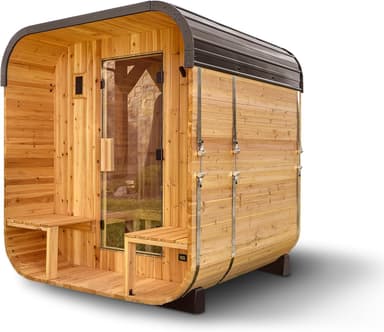
Backyard Discovery Lennon 2-4 Person Cedar Cube Sauna
- 9kW heater reaches temperature significantly faster than budget competitors
- 5-year warranty covers heater and hardware, not just the shell
- Wi-Fi preheat control adds genuine everyday convenience
For cabin-style cube saunas like the Backyard Discovery Lennon line, the assembly is wall-panel-based. Panels interlock at corners and the roof panel sets last. These builds are genuinely achievable as a solo project over a full day, though two people makes the roof panel placement manageable without a ladder struggle.
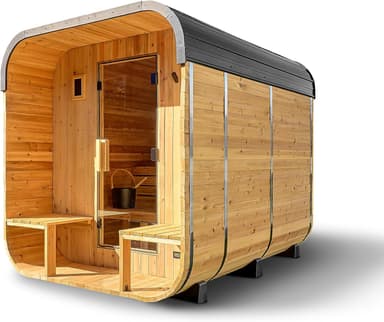
Backyard Discovery Lennon 4-6 Person Cedar Cube Sauna
- 9kW heater reaches target temperature significantly faster than competitors
- Tongue-and-groove cedar construction eliminates cold spots effectively
- Wi-Fi preheat lets you walk into a ready sauna every time
Bench Construction - Height and Spacing
Benches in a traditional sauna follow Finnish convention: the primary bench sits 18-24 inches below the ceiling to capture the hottest air layer. A secondary lower bench 18 inches below the primary gives new users an acclimation option and provides a step.
Standard bench width is 24 inches for lying down, 18 inches for seated use. Use the same species as your wall paneling, but orient bench boards perpendicular to the wall so any moisture drips fall to the floor gap rather than collecting on the bench surface. Leave 1/2-inch gaps between bench boards for air circulation and drainage.
Custom Build Framing
For a full custom traditional sauna inside a home, frame the interior walls with 2x4 studs at 16 inches on center, leaving a full stud bay for insulation. The interior dimensions of the framing define your finished room size after paneling, so account for the paneling thickness (typically 7/8 inch for tongue-and-groove) plus the 1-inch air gap when setting stud positions.
The ceiling in a traditional sauna should pitch slightly toward the exterior wall to encourage condensation drainage away from the primary bench area. A 1/4-inch-per-foot pitch is sufficient.
For a larger build like the 2-10 person cedar cube option, the modular panel system handles most of the structural calculation for you.
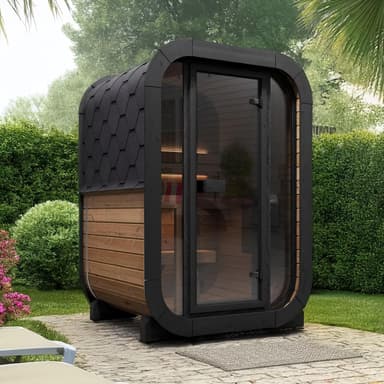
2-10 Person Canadian Cedar Outdoor Cube Sauna
- Deep customization covers size, wood, heater, windows, porch, and roofing
- Canadian red cedar offers genuine durability and natural aromatic quality
- HARVIA heater option is a trusted, proven choice for consistent heat
Step 6 - Ventilation
Ventilation is the most under-specified element in most sauna installations, and the one that has the biggest impact on both safety and experience. The targets are 20-40 CFM of air exchange to prevent CO2 accumulation above 1,000 ppm, and interior relative humidity below 80% during cooling-down periods to prevent mold growth.
The Basic Ventilation Rule
Intake low, exhaust high. The intake vent goes near the floor on the wall behind or beside the heater - typically 4-6 inches above the floor. The exhaust vent goes on the opposite wall near the ceiling, or on the ceiling itself. This creates a convective loop: fresh cool air enters at floor level, warms and rises, picks up moisture, and exits at the top.
Both vents should be manually adjustable. During a session, you typically want the intake 30-50% open and the exhaust 20-30% open - enough air exchange to stay fresh without bleeding off so much heat that the heater runs continuously. After a session, open both vents fully to dry out the room within 30-60 minutes.
Vent sizing: use 4-inch diameter vents for rooms up to 200 cubic feet; 6-inch for rooms 200-400 cubic feet. A 4-inch round vent at 50% open passes approximately 25 CFM with natural convection in a 185°F sauna - adequate for a 2-4 person room. For larger rooms or heavy use scenarios, a 6-inch adjustable vent paired with a 4-inch exhaust fan (Panasonic WhisperGreen FV-04VF2, rated for 70°F, verify ratings for your application) provides reliable exchange.
Infrared Sauna Ventilation
Infrared saunas do not require the same forced ventilation as traditional saunas because they produce less steam and operate at lower temperatures. The 6-inch wall clearance required by manufacturers like Dynamic and Clearlight serves as passive ventilation. However, in a fully enclosed room, even an infrared sauna benefits from a passive intake vent near the floor and a passive exhaust through the door gap or a ceiling vent. Without any air exchange, CO2 from breathing occupants will rise above 1,000 ppm in a 1-person session lasting more than 20 minutes in a tightly sealed room.
Step 7 - Heater Installation and First Commissioning
The heater goes in after the paneling is complete, the vapor barrier is sealed, and the electrical rough-in has been inspected. Installing the heater before inspection means the inspector cannot see the in-wall wiring - a sequencing mistake that causes reinspection delays.
Mounting the Heater
Electric heaters like the Harvia KIP 9kW (ASIN B07GGQQS7Y) or Helo Himalaya 9kW mount on a dedicated wall bracket that keeps the unit at least 4 inches off the floor for air circulation and maintains the 18-inch clearance to combustibles. The bracket is supplied by the manufacturer and mounts to the studs through the paneling.
Run the supply wires through a conduit stub from the panel connection point to the heater location before the paneling goes up. Leave a 24-inch service loop at the heater location. After paneling, pull the wire through the knockout on the heater chassis and make connections per the wiring diagram in the installation manual - always with power off at the panel.
The heater stones (kiuas stones for traditional saunas) are packed into the heater basket after the unit is mounted and wired. Use authentic sauna stones - olivine diabase, peridotite, or vulcanite. Never use river rocks or decorative landscape stones. They absorb water differently, can crack under thermal cycling, and some river rock mineral compositions can release harmful gases when heated.
First Power-On
Before the first use, run the heater empty at full power for 60-90 minutes with the door open and all vents fully open. New heaters off-gas manufacturing residues from the heating elements and stone surfaces - this is normal and expected. The room will smell faintly of hot metal. After the burn-in, allow the room to cool completely, then ventilate for 30 minutes before first occupancy.
Set your target temperature and monitor the digital control for at least the first full heating cycle. The heater should reach set temperature within 30-45 minutes for a properly insulated room. If it takes longer than 60 minutes, check for air gaps in the insulation, unsealed door weatherstripping, or a heater sized below the 1kW-per-50-cubic-feet guideline.
Step 8 - Door Installation and Sealing
Sauna doors are a surprisingly common failure point. The 15% door warp complaint rate in owner reviews is not a product quality issue in most cases - it is an installation issue. Doors warp when the frame is not square, when the door is installed before the room fully acclimates to temperature, or when the door material is not matched to the application.
Door Selection
For traditional saunas, use a door with a glass panel of tempered glass minimum 1/4 inch thick. The glass allows visual check of occupants from outside, which is a safety requirement I consider non-negotiable. Solid wood doors look beautiful but prevent you from seeing if someone has fainted inside.
Hinges must be stainless steel or solid brass - no zinc or aluminum hardware. Chrome-plated hardware corrodes in the humid cycle environment within 6-12 months. Door handles must be wood or a heat-resistant material - metal handles inside the sauna room reach temperatures that cause burns on contact.
Frame and Threshold
The door frame should be set plumb and square before paneling reaches the door opening. Use a quality framing square and check both diagonals of the opening - equal diagonals confirm a square frame. A 1/8-inch discrepancy in diagonal measurement will cause the door to bind at one corner.
Seal the door threshold with a rubber sweep that contacts the floor when the door is closed. The gap under a sauna door is the largest heat loss point in the room after insulation failures. A properly fitted door sweep reduces preheat time by 5-10 minutes for a full-size traditional sauna - this adds up to real electricity savings over years of use.
Troubleshooting Common Problems
Even well-planned installations run into issues during commissioning or the first months of use. Here are the problems I see most often and how to fix them.
Problem - Heater Trips the Breaker
This is the most urgent troubleshooting scenario because it points to an electrical mismatch that creates fire risk, not just inconvenience. The NFPA data showing 20% of sauna fires linked to overloaded circuits means this is not a minor issue.
First, verify that the heater's nameplate amperage does not exceed 80% of the breaker's rated capacity. A 9kW heater at 240V draws 37.5A - this requires a 50A breaker minimum, not a 40A. If the breaker is correctly sized, check for voltage drop at the heater terminals under load. More than 5% voltage drop from panel to heater (12 volts on a 240V circuit) causes the heater to draw higher current, tripping even a correctly sized breaker. Voltage drop over 5% on a 50-foot run in 10 AWG wire is possible - upgrade to 8 AWG to solve it.
Problem - Room Takes More Than 60 Minutes to Reach Temperature
This almost always traces to insulation gaps. With the room at operating temperature, use an infrared thermometer gun to scan the exterior wall surfaces. Cold spots on the exterior surface indicate thin or missing insulation in that cavity. Common locations: around electrical boxes, at wall-ceiling junctions, and at the vapor barrier laps that were not taped.
Reheating time can also indicate a door seal problem. Run your hand along the door perimeter when the room is at 185°F - any detectable airflow is heat loss that needs to be addressed with replacement weatherstripping.
Problem - Door Will Not Close or Latch
This is the foundation problem I described in the introduction, and it manifests as a structural issue: the frame has racked. Check the door opening diagonals with a tape measure. If the diagonals differ by more than 1/4 inch, the frame is out of square. For a barrel sauna, this typically means a cradle skid has settled. Lift the low end with a hydraulic jack and insert a composite shim between the skid and gravel pad. Recheck level and door function.
For a cabin-style kit, racked door openings usually come from walls that were assembled before the floor panel was fully secured. Remove the wall panels at the door opening, reset the floor panel level and square, and reassemble. This is a 2-3 hour fix versus a simple adjustment, which is why getting the foundation right before assembly saves so much time.
Problem - Condensation Dripping from Ceiling
This indicates missing or damaged vapor barrier at the ceiling level, which is the most moisture-stressed surface in the room. Hot humid air hits the ceiling, and if there is no vapor barrier, it migrates through the insulation and condenses in the cold rafter cavity. Over time this rots the structure.
The fix: pull the ceiling paneling, inspect the vapor barrier, tape any laps or gaps with vapor barrier tape, and reinstall. If the insulation is visibly wet, replace it - wet fiberglass or mineral wool has near-zero R-value and will harbor mold.
Problem - Bench Boards Cupping or Warping
Bench boards cup when moisture absorption is uneven - typically meaning one face of the board is getting wet and the other is sealed against the framework. The solution is to leave both faces exposed to air circulation. Pull the boards, let them dry fully, and reinstall with a 1/2-inch gap between boards and a 1/4-inch gap between the end of each board and the wall. The boards should float, not be trapped against solid surfaces on multiple faces.
If the boards warp repeatedly after this fix, the wood species may be wrong for your climate. Hemlock warps at twice the rate of cedar in humid environments. If your installation uses hemlock benches in a high-humidity location, replacing with cedar or thermowood is the durable fix.
Problem - High EMF Readings in Infrared Sauna
If you own a low-EMF marketed unit like Clearlight's Sanctuary series or Sunlighten's mPulse and are getting readings above 3 milligauss on a basic Trifield TF2 meter, check wire routing inside the panels. Wiring that runs parallel to the carbon heater panels for more than 12 inches creates inductive coupling that elevates EMF readings. Re-route any such wiring perpendicular to panel runs and verify the ground connection is solid. A floating ground on a 240V infrared cabinet elevates EMF readings dramatically and indicates an installation wiring error that needs immediate correction.
Final Commissioning - What a Completed Installation Looks Like
A properly completed sauna installation passes the following checks before I sign off on it:
The heater reaches target temperature within 45 minutes for traditional saunas, 20 minutes for infrared. The heater runs without tripping the dedicated circuit breaker through a full 20-minute session. The door opens and closes without binding, and the latch engages fully. Both ventilation adjustments operate smoothly. The bench surfaces are secure, gap-gapped, and free of sharp edges. The exterior wall surfaces are cool to the touch with the room at operating temperature, confirming insulation integrity. The control panel reads correctly and the timer/auto-shutoff functions operate per specification.
For outdoor installations, the sauna sits level within 1/8 inch on its foundation with no visible racking in the frame. All exterior wood is either treated or sealed with a UV-protective exterior finish - linseed oil works well on cedar, applied annually. The electrical underground conduit exits the ground at least 3 inches from the sauna structure to prevent soil moisture from wicking into the conduit.
The health evidence for regular sauna use is compelling enough that installation quality is genuinely a health decision. The Laukkanen 2018 cardiovascular review found the benefits concentrated at 4-7 sessions per week - meaning the reduction in fatal CVD risk from 27% (2-3 sessions/week) to 50% (4-7 sessions/week) depends entirely on having a setup reliable and enjoyable enough that you actually get into it that often. A heater that trips a breaker, a door that sticks, or a bench that's uncomfortable at session three kills the habit at exactly the wrong time.
For those interested in going deeper on specific outdoor configurations, my reviews of the best outdoor barrel saunas cover the models that have consistently shown up in strong installations, and the premium barrel sauna guide addresses the higher-end options from Thermory and SaunaLife that justify the additional cost.
Key Takeaways
- ●
Foundation tolerance is not negotiable. Level within 1/8 inch over 10 feet determines whether your door closes clean, your walls rack, and your kit panels seat properly. Every structural problem I have seen in a failed installation traces back to a foundation someone thought was "close enough."
- ●
A dedicated circuit is a safety requirement, not a preference. The NFPA attributes 20% of sauna-related electrical fires to shared branch circuits. Every heater from 1.8kW to 12kW gets its own breaker - sized at 125% of the continuous load per NEC Article 220, with wire gauge to match.
- ●
The type of sauna dictates the entire scope of the project. A 1-person infrared unit on a 120V/15A circuit with no foundation work is a weekend project. A traditional Finnish sauna with a 9kW heater, 4-inch concrete slab, foil-faced vapor barrier, and exhaust ventilation is a three-to-five day build that benefits from a licensed electrician on the permit.
- ●
Ventilation determines whether you have a sauna or a mold box. Intake low, exhaust high, 4-6 inch diameter for rooms under 300 cubic feet. Stagnant air above 80% RH destroys wood, breeds mold, and makes sessions genuinely uncomfortable.
- ●
Operating cost is lower than most buyers expect. At the 2025 average residential rate of $0.17/kWh (US EIA), a 6kW traditional heater running one hour costs $1.02. A 2kW infrared session costs $0.34. The heater is not your utility bill problem; leaving it on unattended is.
- ●
The health evidence only works if you use it consistently. Laukkanen's 2018 cardiovascular review found fatal CVD risk drops from 27% reduction at 2-3 sessions per week to 50% reduction at 4-7 sessions per week. The dose-response relationship means installation quality is directly connected to health outcome - a sauna that's inconvenient to use doesn't deliver the benefit.
- ●
Wood selection affects both experience and longevity. Western Red Cedar at $8-12 per board foot costs more upfront than Hemlock at $4-6 per board foot, but its Class 1 rot resistance and lower thermal conductivity (0.82 BTU-in/hr-ft²-°F vs. 1.05 for Hemlock) make it the correct material for high-humidity environments.
Who This Is For, Who Should Skip It
Who This Guide Is For
This guide is for the homeowner who wants to install a sauna correctly the first time and understands that "correctly" means pulling a permit, sizing the circuit properly, and not cutting corners on vapor barrier placement. That includes first-time builders working from a pre-cut kit - the Dundalk LeisureCraft and SaunaLife Model G6 kits I have worked with are genuinely manageable for someone comfortable with basic framing and electrical rough-in, provided the foundation is already level and a licensed electrician handles the panel connection.
It also applies to contractors and general builders who have not done a sauna before and want a technical reference for specifications - foundation tolerances, R-value targets by climate zone, ventilation CFM by room volume, and circuit sizing per NEC.
If you are adding a traditional sauna to a bathroom or bonus room, converting an outdoor shed, or planning a standalone barrel unit in the backyard, the framework here applies directly.
Who Should Skip It or Get Professional Help First
If you have a cardiovascular condition, hypertension, or are on medications that affect heat tolerance, the health research in this article is informational only - consult a physician before using any sauna, regardless of installation quality. The Tei 2016 Waon therapy trial showed far-infrared sauna was safe for NYHA Class II-III heart failure patients in a clinical setting, but that does not mean you manage a cardiac condition with a home unit without medical oversight.
On the installation side: if your planned location has no access to a 240V panel with available breaker slots, no path for a dedicated circuit run, or a floor that is out of level by more than 1/2 inch over 10 feet and cannot be corrected, stop before purchasing materials and price out what correcting those conditions actually costs. Buying a $4,000 sauna kit and then discovering you need a $2,500 sub-panel upgrade changes the project economics entirely.
Steam room installations - sloped floor, 2-inch trap, full waterproofing membrane - are outside DIY territory for most people. Hire a tile contractor who has done steam before.
What to Read Next
If this guide covered the technical foundation you needed, these are the logical next steps based on where most readers go from here.
Best Outdoor Barrel Saunas - My reviews of the outdoor barrel models that hold up in real installations, including how they perform across cold and wet climates. The foundation prep from this guide applies directly to every unit I cover there.
Best Premium Barrel Saunas - If you are looking at Thermory or SaunaLife at the higher end of the market, this is where I break down what the price premium actually buys you in terms of Thermowood treatment, joinery quality, and longevity.
All Sauna Guides - The full index of installation, buying, and usage guides on UseSauna.com, organized by sauna type and use case.
Frequently Asked Questions
How long does sauna installation take?
The answer depends entirely on type. A 1-2 person infrared unit assembles in 1-2 hours on a level floor with a standard 120V outlet nearby. A pre-cut traditional sauna kit in an existing room with a prepared foundation runs 2-3 days for an experienced builder: one day for framing and insulation, one day for interior paneling and bench work, one day for heater installation and electrical. An outdoor traditional sauna built from scratch - foundation, framing, roofing, electrical trench - is a 5-7 day project minimum. Permits add time: expect 1-3 weeks for permit approval depending on your jurisdiction before breaking ground on anything that requires electrical inspection.
Do I need a permit to install a sauna?
For any sauna requiring a 240V circuit, yes - you need an electrical permit in virtually every US jurisdiction. Outdoor structures above a certain square footage (typically 120-200 sq ft, varies by municipality) also require a building permit. Infrared units on existing 120V circuits in interior rooms are typically plug-in appliances and do not require a permit, but check local code. The permit process exists because electrical work that is not inspected is the most common cause of sauna fires. Pulling the permit and passing inspection also protects your homeowner's insurance coverage - an unpermitted electrical installation that causes a fire is a valid grounds for denial of a claim.
What foundation does an outdoor sauna need?
Two options work for most residential outdoor installations. A gravel pad - 12 inches deep, compacted gravel in a perforated drainage bed - suits barrel and cabin saunas up to 8x10 feet. The gravel must be level within 1/8 inch over 10 feet, which requires a laser level to verify correctly. For larger or heavier units, 4x4 pressure-treated skids on compacted gravel give more structural rigidity and better ground clearance for air circulation under the floor. A concrete slab (4-inch minimum thickness, level within 1/8 inch) is the right choice for a permanent installation or any unit over 400 square feet. Avoid untreated wood contact with soil - ground contact lumber must be rated UC4B or UC4C.
What size electrical circuit does a sauna heater need?
Size the breaker at 125% of the heater's continuous load, per NEC Article 220. A 4.5kW heater draws 18.75A at 240V - that requires a minimum 25A breaker with 10 AWG wire. A 6kW heater draws 25A - use a 30A breaker with 10 AWG. A 9kW heater draws 37.5A - use a 50A breaker with 8 AWG. Every circuit must be dedicated with no shared branch loads. The control unit wire run between the external control panel and the heater requires high-temperature rated wire: 194°F (90°C) minimum, THHN or THWN-2. For outdoor installations, GFCI protection is required under NEC Article 680.
How do I ventilate a sauna properly?
Place the intake vent low on the wall near the heater, 6-8 inches above floor level. Place the exhaust vent high on the opposite wall, 6 inches below the ceiling. For rooms under 150 cubic feet, 4-inch diameter vents on both intake and exhaust achieve the target 15-20 CFM airflow. Rooms between 150-300 cubic feet need a 4-inch intake and 6-inch exhaust for 20-30 CFM. Above 300 cubic feet, use 6-inch on both with supplemental fan assist on the exhaust. The key principle: fresh air enters low near the heat source, rises through the room as it heats, and exits high. Reversing this pattern - intake high, exhaust low - creates cold drafts at bench level and stratified heat that never stabilizes. Stagnant air above 80% RH destroys the interior wood within two to three years.
Can I install a sauna in an apartment or condo?
A traditional sauna requiring a 240V dedicated circuit and permanent ventilation penetrations is not practical in most apartments and is prohibited by most condo association rules. A 1-person infrared unit on 120V is physically possible in an apartment bedroom or bathroom with adequate floor space (typically 35x35 inches minimum footprint), but check with building management before purchasing. The units generate heat that affects adjacent units in shared-wall construction. Freestanding infrared units from brands like HigherDose and Real Relax are designed for this use case specifically - they disassemble, require no permanent installation, and run on standard household current. Steam room conversions in apartment bathrooms require structural waterproofing work that is unlikely to be approved by building management.
How do I maintain an outdoor sauna after installation?
Cedar exterior surfaces need a UV-protective finish reapplied annually - linseed oil is my preference, applied in spring after winter moisture damage is visible. Check the foundation level every spring; frost heave on gravel pads can shift the structure 1/4 inch or more over a single winter, which shows up as a sticking door. Inspect the electrical conduit entry point for ground moisture intrusion at the same time. Interior surfaces require no sealant - raw wood handles the humidity cycle correctly and any sealant on interior walls traps moisture and eventually delaminated. Clean the rocks in a traditional heater annually: remove, rinse, inspect for cracks, replace any that have fractured. A cracked heater rock can shatter under thermal cycling and cause injury.
Frequently Asked Questions
The best sauna installation depends on your preferences: prefab kits offer the easiest option with installation under four hours, while hardwired electric heaters provide efficient heating at minimal utility costs (around $1 per 30-minute session). For barrel saunas specifically, models like the Almost Heaven Morgan Barrel Sauna and SoundLife E6G are top recommendations. If choosing between indoor and outdoor, indoor saunas are more convenient to build, but outdoor saunas offer classical Finnish authenticity if you have dedicated electrical and plumbing systems.
Related Guides
Affiliate Disclosure - UseSauna earns a commission from qualifying purchases through our Amazon affiliate links. This does not affect our editorial integrity.