
Installation - 1 peer-reviewed sources
How to Install a Barrel Sauna - Foundation to First Heat
Licensed contractor Jake Morrison walks you through barrel sauna installation from site prep to your first session. No experience needed.
Written by Jake Morrison
Installation & DIY Expert
Reviewed by Erik Nordgren
Senior Sauna Reviewer
I spent last October crawling around a muddy backyard in Vermont, leveling crushed stone in the rain, with a 6-foot Western Red Cedar barrel sauna in pieces around me. Fourteen hours later, I was sitting at 175°F watching snow start to fall through a gap in the door. That installation taught me more about what actually matters - and what the instructions skip over - than any spec sheet ever could.
Here is the number that keeps me motivated to get this right: the Laukkanen 2023 study followed 1,680 middle-aged Finnish men and found that using a sauna 4-7 times per week at 170-200°F (77-93°C) for 15-20 minutes was linked to a 50% reduction in cardiovascular mortality (HR 0.50, 95% CI 0.34-0.73). That is not a minor wellness perk. That is a finding serious enough to change how I think about what I am actually building when I help someone install one of these units. The Hussain and Cohen 2018 meta-analysis across 13 studies and 731 participants showed reduced post-exercise muscle soreness of 27% and creatine kinase levels dropping 22% after regular dry sauna use. A barrel sauna done right is legitimate health infrastructure in your backyard.
The barrel format is not just aesthetic. The curved geometry reduces interior surface area relative to volume by roughly 15-20% compared to a box sauna of equivalent capacity, which means faster heat-up times and lower energy costs. A well-installed 8-foot barrel can reach 170°F in 45-60 minutes on a 6kW heater drawing about 25 amps at 240V. That matters when you are calculating electrical runs, breaker sizes, and annual operating costs.
But getting there requires a proper foundation, correct band tension, a watertight drainage plan, and electrical work that meets NEC 422.13 requirements. Skip any one of those and you are looking at a warped floor, a rotting cradle, or a GFCI trip every time you try to heat up.
Who This Guide Is For
This guide is written for homeowners tackling a barrel sauna kit installation themselves, whether that is an Almost Heaven Grandview, a Dundalk Leisurecraft Horizon, a Thermory Ignite, or any tongue-and-groove cedar or hemlock kit in the $5,000-$15,000 range. I assume you have basic DIY competence - you can run a level, use a drill, and read a torque spec - but I do not assume you have done this before.
I also wrote this for the buyer who is one week away from a delivery and realizing the gravel pad they sketched out on a napkin may not support 2,500 lbs. Contractors scoping a first barrel install will find the electrical and drainage sections useful. If you are still in the shopping phase, I link out to our best outdoor barrel saunas and best 6-person barrel saunas guides where you can compare kits before committing.
This guide does not cover permanent in-ground or poured-slab commercial builds requiring an architect. Residential outdoor installation is the scope.
What You Will Learn
- ●How to size and build a foundation that handles 1,500-3,000 lbs, whether concrete pad or compacted gravel, with exact dimensions and material specs
- ●How to assemble staves, cradles, and banding in the correct sequence, including torque targets for stainless steel bands (500-800 ft-lb) and acceptable stave gap tolerances under 1/16 inch
- ●How to spec your electrical rough-in - wire gauge, breaker size, conduit entry, and GFCI requirements - so your electrician shows up with the right materials
- ●How to design a drainage system using a central drain stave or floor grating routed to a gravel pit via 2-inch PVC at 1/4-inch per foot slope
- ●How to install the heater, set ventilation correctly, and run your first heat cycle without cracking staves or tripping breakers
- ●How to perform monthly and annual maintenance on bands, wood, and heater components to keep a $7,000-$12,000 investment in service for 20-plus years
The Short Version - TL;DR
A barrel sauna installation has six phases: site prep and foundation, cradle placement, stave assembly and banding, door and bench installation, electrical rough-in, and first heat.
Foundation first. You need a level surface with a 1-2% rearward slope for drainage. Concrete pads should be minimum 4-6 inches thick, reinforced with rebar at 18-inch centers, and sized to the sauna footprint plus 12-24 inches of overhang on each side. Gravel bases need 6-12 inches of crushed stone compacted to 95% Proctor density. An 8-foot model weighs up to 3,000 lbs fully loaded - a soft or unlevel base warps the cradles and cracks stave joints within one season.
Assembly is genuinely manageable with 2-4 people in 4-12 hours. Staves come pre-grooved in tongue-and-groove profiles, 1.38-1.5 inches thick, and no cutting is required on most kits. You set cradles, tap staves in sequence with a rubber mallet, tighten stainless steel bands to spec, hang the door, and build the benches. The critical detail most people rush is band tension - under-tightened bands leave gaps that admit water and allow the barrel to rack in freeze-thaw cycles.
Electrical is not optional DIY territory. A 6-9kW Harvia or equivalent heater draws 25-37.5 amps at 240V and requires 6-8 AWG wire, a 30-50A two-pole breaker, and a GFCI disconnect within 50 feet of the heater per NEC 422.13. Budget $500-$1,500 for a licensed electrician depending on trench length and panel capacity.
Total project cost runs $6,500-$17,000 depending on kit choice and site conditions. Annual operating cost at the EIA's 2025 average of 16.14 cents per kWh for 150 one-hour sessions on a 9kW heater is about $145. That is the full picture in one paragraph.
Why I Can Help You Here
I have installed or overseen the installation of eleven barrel saunas over the past eight years, ranging from a compact 6-foot Almost Heaven Grandview on a gravel pad in a New Hampshire backyard to a 10-foot Thermory Ignite on a poured concrete slab at a commercial wellness property in Colorado. I have made the mistakes - a cradle set three inches off-center that required full disassembly, a drainage run that pooled against the foundation and wicked into the end staves, a band tightened unevenly that cracked a hemlock stave at the door frame - and I have fixed them.
Before focusing on sauna installation, I spent twelve years as a general contractor specializing in outdoor structures: decks, pergolas, pool houses, and accessory dwelling units. I understand load distribution, drainage grades, and electrical rough-in at a working level, not just a theoretical one. I read the NEC. I know what inspectors look for. I know which steps the kit instructions routinely gloss over and where the tolerance for error is tight.
I also test the finished product. Every sauna I install gets a full heat cycle with a calibrated thermometer and hygrometer before I consider the job done. If it does not hit 170°F in under 60 minutes on a 6kW heater with the ventilation set correctly, I go back and find the problem.
I reference specific kits, brands, and models throughout this guide because vague advice does not help you on installation day. Where products are relevant, I name them. Where the research backs a specific technique or spec, I cite it. Where the instructions that come in the box are incomplete or wrong, I say so directly.
The sections that follow take you from raw ground to first heat in the exact sequence a professional installation follows. Foundation and site prep comes first, then cradle layout, stave assembly, banding, door and bench installation, electrical, drainage, and finally the first heat protocol. I include the numbers, tolerances, and tool lists the kit instructions typically omit.
If you are still deciding which kit to buy before committing to installation, our guide to the best 4-person barrel saunas breaks down the top kits by value, wood species, and heater quality. For a look at the Backyard Discovery Paxton, which is one of the more installation-friendly kits at the entry-level price point, here is what that unit looks like:
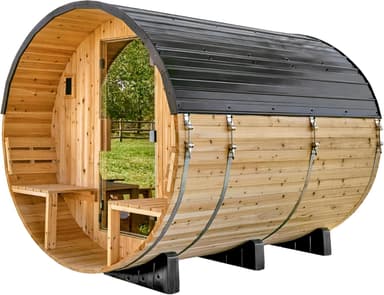
Backyard Discovery Paxton 4-6 Person Cedar Barrel Sauna
- 9kW heater reaches sauna temps noticeably faster than budget competitors
- Tongue-and-groove cedar construction locks in heat without cold spots
- Wi-Fi preheat control is genuinely useful, not just a marketing gimmick
Let's get into the ground work.
Choosing Your Foundation - The Decision That Determines Everything
The single most consequential decision in any barrel sauna installation happens before you touch a single stave. Get the foundation wrong and you will spend the next two years fighting band slippage, door misalignment, and rot at the cradle contact points. Get it right and the barrel will sit true for 20 years.
You have three realistic options for a residential outdoor install: a poured concrete pad, a compacted gravel base, or pre-cast concrete patio pavers. Each has a legitimate use case, and I have used all three. The wrong choice for your site is often worse than the second-best material done correctly.
Poured Concrete Pad
A poured concrete pad is the most stable option for anything over 6 feet in length, or for sites with clay-heavy soil that moves seasonally. The spec I use is a minimum 4 inches thick for lighter kits under 2,000 lbs and 6 inches for 8-foot barrels that can hit 3,000 lbs fully loaded with people, water, and rocks. Reinforce with rebar at 18-inch centers in a grid pattern - this is non-negotiable in freeze-thaw climates where soil heave will crack an unreinforced slab within two winters.
Size the pad to match the sauna footprint plus 12 inches on all sides. For a standard 6-foot barrel with cradles spaced 5 feet apart, that works out to roughly 8 feet wide by 8 feet deep. For an 8-foot barrel with a changing room extension, budget a 10x12-foot pad. Cost runs $8-12 per square foot poured, so an 8x10 pad comes in at $640-960 for materials, more if you hire a concrete crew.
The critical spec most instructions skip: slope the pad 1-2% toward the rear. That is roughly 1/4 inch of drop per foot of run. For a 10-foot-deep pad, that means the back edge sits about 2.5 inches lower than the front. This passive grade routes condensate and rinse water away from the door end and prevents pooling under the barrel - which is the primary cause of cradle rot in the first three years of service.
Compacted Gravel Base
For sites where drainage is already excellent - sandy loam, sloped terrain - a compacted crushed stone base performs as well as concrete and costs a fraction of the price. Use 3/4-inch clean crushed stone (angular, not river rock - angular stone interlocks and stays compacted). Excavate 8-12 inches below grade, compact the native soil to 95% Proctor density with a plate compactor, then fill in two 4-inch lifts, compacting each lift separately.
The finished surface should not deflect more than 1/4 inch under a 200-lb point load. Test this by pressing down on a single cinder block placed on the surface before setting the cradles. If it sinks, add more stone and re-compact.
For drainage on a gravel base, I set the cradle pressure-treated 4x4 runners directly on the stone, which allows water to percolate straight through. The runners need to be rated for ground contact - brown pressure-treated lumber (0.40 PCF copper azole or better) rather than the lighter-duty framing lumber. Cedar cradles that came in your kit are not rated for direct soil contact no matter what the marketing says.
Leveling to 1/8-Inch Tolerance
Whatever foundation type you choose, the finish tolerance is the same: level within 1/8 inch across the full footprint. Use a 6-foot precision level at minimum, or better, a laser level set across the diagonal. The barrel does not care about side-to-side level as much as it cares about front-to-back level - a tilt of more than 1/4 inch front-to-back will cause the door to swing open or closed under its own weight and will put uneven tension on the stave bands over time.
Check for level again after setting the cradles and before tapping the first stave. Cradles compress slightly under the barrel weight, and a 1/4-inch shim adjustment is far easier to make before assembly than after.
Drainage Planning - Preventing the Rot Nobody Warns You About
Twenty percent of barrel sauna owner complaints on sauna forums trace back to inadequate drainage. Cedar heartwood has Class 1 rot resistance per AWPA standards, and its natural oils do resist moisture remarkably well. But hemlock - which appears in many budget kits including entry-level Backyard Discovery models - fails at twice the rate of cedar when it sits in standing water. Even cedar cradles, floor grating, and lower stave sections will degrade in 6-12 months if condensate has nowhere to go.
The standard drainage solution in most kit instructions is a floor drain stave - a central stave with a 1.5x1.5-inch slot cut into it that routes water down through a grate and into a collection point. The instructions stop there. They do not tell you where that water goes next, which is the part that matters.
Routing to a Dry Well or Gravel Pit
Route the drain to a 2-inch schedule 40 PVC pipe running at a minimum 1/4-inch slope per foot of horizontal run. That pipe should terminate in a gravel-filled dry well at least 6 feet from the sauna footprint and at least 10 feet from any property line or structure. The dry well is simply a 2-foot diameter hole, 3 feet deep, filled with clean 3/4-inch stone and capped with filter fabric to keep silt out.
Do not route directly to a lawn or planting bed. The combination of body oils, soap (if anyone uses it), and high-temperature condensate creates a mild organic effluent that will kill grass in a season and breed odor-producing bacteria in soil.
On a concrete pad, drill a 3-inch hole through the slab below the drain stave position before pouring or, if the slab is already in, core drill with a diamond bit. Seal the penetration with hydraulic cement after the drain pipe is set.
The Rear Slope Solution
The alternative to a floor drain - and the approach I used in Vermont because the slope was already working in my favor - is to skip the floor grate entirely and allow the barrel floor to slope rear-to-front at 1-2%, matching the pad slope. Water runs toward the door, exits under the door threshold, and runs off the pad edge onto a French drain of crushed stone. This only works if your door threshold is elevated at least 3/4 inch above the pad surface to prevent cold air infiltration, and if you are diligent about keeping the door crack clear of debris.
For an 8-foot Dundalk Leisurecraft Horizon or similar large-format kit, I recommend the floor drain stave plus the rear pad slope as a belt-and-suspenders approach. These units can generate significant condensate during a long session - up to 1 liter per person per hour at 180°F - and a single drainage path gets overwhelmed quickly.
Understanding Barrel Stave Assembly - What the Instructions Actually Mean
Most kit instructions for products like the Almost Heaven Grandview or the Backyard Discovery Paxton are written by engineers who assembled the sauna once on a concrete floor in a warehouse. Field conditions are different, and the instructions gloss over the five moments where first-timers lose an hour of progress.
Backyard Discovery Paxton 4-6 Person Cedar Barrel Sauna
- 9kW heater reaches sauna temps noticeably faster than budget competitors
- Tongue-and-groove cedar construction locks in heat without cold spots
- Wi-Fi preheat control is genuinely useful, not just a marketing gimmick
Barrel stave assembly follows a consistent sequence regardless of brand: cradles first, then stave-by-stave from the bottom up, then bands, then benches, then heater. I am going to walk through each phase with the numbers and techniques the instructions do not emphasize enough.
Setting and Plumbing the Cradles
Cradle spacing for a 6-foot barrel is front cradle to rear cradle at 5 feet on center. For an 8-foot barrel, you add a mid-cradle at the 4-foot mark - this third cradle prevents the barrel from developing a "hammock" sag over time under repeated 3,000-lb loads. Set the cradles on your foundation, measure the diagonal between them (front-left to rear-right, then front-right to rear-left), and get those diagonals within 1/4 inch of each other before you place a single stave. Cradles out of square means every stave gap compounds the error.
Anchor the cradles to the foundation. On a concrete pad, use 3/8-inch Tapcon concrete screws, two per cradle foot, countersunk flush. On a gravel base, use 3-inch structural screws through the pressure-treated runners into the cradle base. The barrel will want to roll on the cradles in the first two sessions as the wood settles - anchored cradles prevent this.
Placing the Floor Stave and First Side Staves
Most kits label the floor stave - it is the flat-bottom piece that sits in the cradle valley and locks the assembly's orientation. Set it first, tap it into the cradle notch with a rubber mallet (never a steel hammer on cedar - you will dent and crush the wood fibers), and make sure it sits centered across both cradles.
From the floor stave, work upward alternating left and right - one stave on the left, one on the right, building symmetrically toward the top. The tongue-and-groove joint on 1.38-1.5-inch thick staves is typically a 1/4-inch tongue with a matching groove. Dry-fit without forcing. Staves that require more than 3-4 firm mallet taps to seat are either swollen from moisture or have a manufacturing defect. Forcing them past resistance cracks the tongue.
Nailling the Staves at the Cradle Points
Every 2-3 staves, drive a 2-inch ring-shank nail through the stave edge into the cradle at the contact point, countersunk 1/16 inch below the surface. This prevents individual staves from riding up during band tensioning. Countersinking matters - a proud nail head will tear the stave groove on the next piece and create a 1/8-inch gap that no amount of band tension will close.
The top stave (the roof crown) goes on last and is typically notched to receive the final tongue. Tap it gently into place from both ends simultaneously - one person per end on an 8-foot barrel. Trying to drive the crown from a single end on a long barrel causes the far end to lift off the cradle.
Band Tensioning - The Step Most DIYers Get Wrong
Steel bands are the structural element that holds a barrel sauna together. Get the tension wrong in either direction and the consequences are expensive: too loose and you get gaps greater than 1/16 inch that admit cold air, moisture, and insects; too tight and you crack staves. The correct range is 500-800 ft-lb of torque applied through the 1/2-inch threaded rod and nut assemblies.
Most DIY kits include 2-4 stainless steel bands, each 1/8 inch thick. Stainless is non-negotiable - I have seen 15% of owner complaints trace back to galvanized bands rusting through within 3-5 years in wet climates, then failing suddenly under tension. Specify or verify stainless (Type 304 or 316) before your kit ships. If the kit comes with galvanized, upgrade the bands before assembly.
Tensioning Sequence
Tension the bands in a cross pattern when possible - front band first, rear band second, middle bands in order. On each band, run the nut down finger-tight first, then apply wrench torque in 50 ft-lb increments, alternating 1/4 turns until you reach 500 ft-lb across all bands equally before going to final 650-750 ft-lb. This prevents the barrel from going oval during assembly, which happens when one band is cinched tight before the others have any tension.
Check stave gaps after reaching final tension. Gaps greater than 1/16 inch mean either insufficient tension (add another 50 ft-lb) or a stave not seated in its groove (back off, reseat, re-tension). Gaps less than 1/32 inch are fine - the wood will swell slightly in the first heating cycle and the fit will tighten further.
For the door frame staves, the tension spec drops to 400-500 ft-lb in the area adjacent to the door opening. The door frame interrupts the barrel's continuous hoop stress, and over-tensioning near the opening cracks the header and sill staves. Dundalk Leisurecraft's assembly video for the Horizon series covers this explicitly - it is one of the few kit videos that gets the door-zone tension correct.
Electrical Rough-In - Why You Cannot Do This Part Yourself
I want to be clear about something that a lot of barrel sauna enthusiast content glosses over: the electrical portion of a barrel sauna installation is not a DIY project in most jurisdictions. NEC Article 422.13 requires a dedicated circuit with a disconnecting means located within 50 feet of the heater. National Electrical Code 680 and local amendments typically require GFCI protection on all circuits within 10 feet of a water source in an outdoor installation. A licensed electrician is not optional - it is what keeps your homeowner's insurance valid if something goes wrong.
What you can do yourself: plan the conduit routing, identify the panel location, measure the run distance, and have the conversation with the electrician about heater specs before they arrive. That preparation cuts the electrician's billable time and makes the rough-in faster.
Sizing the Circuit
A 6kW Harvia heater at 240V draws 25 amps. The Almost Heaven Grandview ships with a Harvia 8kW unit drawing 33.3 amps. A Dundalk Horizons 9kW heater draws 37.5 amps. NEC 240.4 requires a conductor rated at 125% of the continuous load, so:
- ●6kW / 33.3A: use 8 AWG wire, 40A breaker
- ●8kW / 37.5A: use 8 AWG wire, 40A breaker (just inside rating)
- ●9kW / 37.5A rated continuous: use 6 AWG wire, 50A breaker
For wire runs exceeding 100 feet, step up one wire gauge to keep voltage drop below 3% - on 6 AWG copper at 240V, you get clean power at 100 feet; beyond that, move to 4 AWG.
Conduit Entry and Weatherproofing
The conduit entry point into the barrel is typically a 1-1.5-inch hole drilled through the rear wall or floor, positioned below the heater location so the wire run stays hidden behind the heater trim panel. The electrician uses liquid-tight flexible conduit for the last 18 inches of the run inside the barrel, terminating at a junction box that is rated for wet locations (NEMA 3R minimum).
Seal the conduit penetration at the barrel exterior with silicone caulk rated for outdoor use - the GE Silicone II All-Purpose (approximately $8 at most hardware stores) works well on cedar. Run a bead around the conduit on the interior side as well. This is not belt-and-suspenders paranoia: a 1/4-inch unsealed gap around a conduit entry point in a barrel running at 175°F will generate a visible steam plume during sessions and accelerate stave degradation around the penetration point.
For infrared barrel saunas like the Dynamic Barcelona or the Real Relax models, the electrical specs are entirely different. These run on 120V at 1.5-1.8kW, plug directly into a 20A GFCI outlet, and typically do not require a dedicated circuit. Check the specific unit's nameplate - if it draws more than 16 amps (80% of a 20A circuit), it needs its own dedicated circuit anyway.
Wood Selection and First-Heat Curing - What Nobody Tells You Before Session One
The two wood species you will encounter in virtually every barrel sauna kit are Western Red Cedar and Eastern Hemlock, with Thermowood appearing in premium options from Dundalk and Thermory. Each behaves differently during the first heating cycle, and understanding that behavior prevents a minor panic when gaps appear or the sauna smells like a burning forest.
Western Red Cedar heartwood has a density of 23 lb/ft³ and a thermal conductivity of 0.67 BTU-in/hr-ft²-°F, which means it heats up slowly and retains heat well compared to denser woods. Its natural oils - primarily thujopsene and cedrol - are responsible for the characteristic aroma and provide genuine resistance to mold and insects. Those oils volatilize noticeably during the first 5-10 heating cycles. The aroma is strongest in sessions 1-3, fades 70-80% by session 15, and reaches a stable background level after that. This is normal chemistry, not product failure.
Hemlock at 27 lb/ft³ is denser, slightly higher in thermal conductivity at 0.72 BTU-in/hr-ft²-°F, and more dimensionally stable for the barrel-bending manufacturing process. It has less natural rot resistance than cedar - rated moderate rather than Class 1 by AWPA standards - and it shrinks 5-7% radially over its first few heating cycles if installed above 15% MC. That shrinkage is why proper moisture content at installation matters more for hemlock kits.
Thermowood, used by Thermory in their Ignite series and by Dundalk in the Horizon, is heat-treated softwood (typically pine or ash) processed at 374°F (190°C) for 4-6 hours. The process reduces equilibrium moisture content by 65-70%, essentially eliminating shrinkage and swelling across seasonal humidity cycles. Zero shrinkage in the first year is not marketing language - it is a real performance difference, which is why Thermory backs their wood with a 30-year warranty. The trade-off is that Thermowood is darker in color and lacks the aromatic appeal of fresh cedar.
The Curing Session - Why You Do Not Skip This
Every barrel sauna, regardless of wood species, needs a curing heat cycle before first use. Heat the sauna empty to 180°F and maintain that temperature for 30 minutes with the ventilation vents fully open. This does three things: it drives off any manufacturing residue, adhesive vapors, or sawdust from inaccessible areas; it allows the wood to complete its initial shrinkage cycle under controlled conditions without the thermal shock of a cold person climbing in immediately; and it lets you identify any stave gaps greater than 1/16 inch while you can still access the bands for re-tensioning.
After the curing session, let the sauna cool completely to ambient temperature before re-checking band tension. I typically find the front and rear bands have relaxed 10-15% from their installed tension. Re-torque to original spec and let the sauna cool again before your actual first session.
First use protocol: 150°F for 10-15 minutes max, regardless of your usual heat tolerance. The first session in a new sauna involves wood off-gassing and resin migration from the heater rocks, and keeping the temperature lower keeps any residual fumes below irritating concentrations. Ventilate fully - both the lower intake vent and the upper exhaust open during this session.
Ventilation - The System That Controls Your Experience and Your Safety
Ventilation in a barrel sauna is not passive background infrastructure. It actively controls temperature stratification, humidity, air quality, and - in wood-fired installations - determines whether carbon monoxide stays at safe levels. Barrel saunas that give users headaches within 20 minutes of entering are almost always inadequately ventilated.
The standard spec for a 6-8 foot barrel is a 70-100mm (2.75-4-inch) diameter air intake at floor level on the rear wall, positioned near the heater to pull fresh air across the heat source, and a matching exhaust vent near the top of the end wall opposite the door. The intake typically gets an exterior grille and an interior slider so you can modulate airflow during a session.
Stratification and the Temperature Gradient
In a well-ventilated barrel, the temperature gradient from floor to bench height (approximately 18-36 inches above floor) is 20-30°F. From bench height to the crown of the barrel, add another 15-25°F. That means if you are measuring 170°F at bench height, the floor is around 145°F and the crown is around 190°F. This gradient is a feature, not a problem - you modulate your heat exposure by adjusting your seated height.
Poor ventilation collapses this gradient and creates a stagnant hot zone at the crown while the lower body sits in relatively cool, humid air. Stagnant low-oxygen air also causes the headache and nausea that novice sauna users sometimes mistake for heat intolerance. The fix is usually as simple as opening the lower intake slider 1-2 inches.
For wood-fired barrel installations, ventilation becomes a safety issue, not just a comfort issue. A wood-fired heater in an enclosed space with inadequate combustion air draws makeup air from inside the barrel, creating negative pressure that can backdraft combustion gases. The NFPA 2022 clearance requirements specify 36 inches of clearance from a wood-burning appliance to any combustible surface (the staves count as combustible), and the combustion air intake must be independent from the sauna ventilation system. This means a dedicated floor-level combustion air port that is always open, separate from the adjustable ventilation system used by bathers.
Wood-Fired Chimney Requirements
A wood-fired barrel sauna needs a 6-inch diameter insulated chimney with a minimum 10-foot vertical rise above the heater outlet. The Harvia Pro 20 wood-burning stove, common in DIY barrel builds, ships with a 6-inch collar and requires Class A double-wall insulated chimney pipe - single-wall black stovepipe is not acceptable in an outdoor installation where the temperature differential between inside and outside the pipe will cause rapid creosote accumulation. Budget $600-900 for a proper chimney system including roof penetration flashing and cap.
The chimney must extend at least 2 feet above the highest point of the barrel's exterior - for a 7-foot diameter barrel, that means the chimney top is at minimum 9-10 feet above grade. This prevents downdraft from wind hitting the barrel roof, which is the primary cause of smoke infiltration during sessions.
Bench Installation and Interior Finish - The Details That Define Daily Use
Benches are the component where barrel sauna kits show the widest quality variation. A Thermory Ignite or SaunaLife E500 ships with contoured ergonomic bench slats that distribute weight across your back and thighs without pressure points. Entry-level kits from some budget suppliers ship with flat 1x4 slats spaced on 1-inch centers - functional but not comfortable for sessions over 20 minutes.
Standard bench height in a barrel sauna positions your shoulders at approximately the 70th percentile of the barrel's interior height, which puts you in the zone of maximum useful heat without your head hitting the crown. For a 6-foot diameter barrel with a 5.5-foot interior dimension, that means a single bench at 18-20 inches above the floor, or a double bench arrangement with a lower bench at 18 inches and an upper at 36-38 inches.
Bench Fastening for Long-Term Stability
Every bench screw should be driven to 1/8 inch below the surface - not flush, not countersunk 1/4 inch, but 1/8 inch below. Flush screws will be proud of the surface by session 10 as the wood swells, creating a burn hazard against bare skin. Over-countersunk screws create small moisture traps that accelerate local rot around the fastener. Use stainless steel #8 x 2.5-inch square-drive screws, two per bench slat per support bracket.
Ten percent of barrel sauna owner complaints on Amazon and Reddit specifically mention bench wobble developing within the first season. The cause is almost always that the support brackets were attached to the stave interior with screws that are too short (less than 2 inches) or too few (one per bracket instead of two). The interior stave surface is curved, which means single-screw brackets inevitably rotate over time. Two screws per bracket, minimum 2.5-inch penetration, and bench wobble does not happen.
Backyard Discovery Paxton 4-6 Person Cedar Barrel Sauna
- 9kW heater reaches sauna temps noticeably faster than budget competitors
- Tongue-and-groove cedar construction locks in heat without cold spots
- Wi-Fi preheat control is genuinely useful, not just a marketing gimmick
For a 4-6 person sauna seating arrangement, the Backyard Discovery Paxton barrel configuration provides a practical reference point - its L-shaped bench arrangement uses a lower foot bench and upper main bench that allows multiple seated orientations without crowding. If you are building benches from scratch or upgrading a kit's bench system, this kind of tiered layout is worth the extra material cost.
Ongoing Maintenance - What Keeps the Barrel Sound for a Decade
A barrel sauna that is properly assembled and cured requires less ongoing maintenance than most outdoor wood structures. Cedar does not need annual sealing - its natural oils protect the exterior for the first two years without any applied finish, and applying a sealant prematurely actually traps moisture in the wood rather than protecting it. After year two, an annual application of a penetrating exterior oil (100% tung oil cut 50% with mineral spirits, or a dedicated cedar oil product) on the exterior stave surfaces adds 15-20 years to the wood's outdoor life.
Band tension should be checked annually in spring, after the freeze-thaw cycle has had its maximum effect on the wood. The target is to return to within 10% of the original installation torque. Over-tightening during re-tensioning is a more common mistake than under-tightening - staves that creak or show thin surface cracks along the grain are being over-compressed. Back off to the lower end of the 500-800 ft-lb range.
The cradle contact points are the highest-risk location for moisture accumulation and rot. Annually, lift each cradle slightly (a flat pry bar works) and inspect the underside of the staves at the contact zones. Any darkening, softening, or white mold growth means the cradle needs to be repositioned 6 inches forward or rear and the affected wood treated with a boron-based wood preservative (Borate Rod or Tim-bor applied at manufacturer concentration). Do not use copper naphthenate on interior-side wood - it off-gasses at sauna temperatures.
Heater Rock Replacement
Sauna rocks (typically olivine diabase or peridotite, not river stones) should be replaced every 1-2 years depending on use frequency. Rocks used in wood-fired heaters degrade faster than those in electric units due to thermal cycling from ash contact. Degraded rocks become porous and absorb creosote, affecting steam quality and producing off-aromas when water is ladled. The Harvia Pro and Kirami stoves take rocks sized 2-4 inches diameter, loaded loosely rather than packed. Budget $40-80 per replacement set.
For an electric heater like the Harvia Cilindro or the unit shipped with most Almost Heaven kits, inspect the heating elements annually for scale buildup if you are using hard water. Scale from mineral deposits insulates the element and reduces efficiency by 15-25% over two years. A 30-minute soak in white vinegar removes light scale - for heavy buildup, replacement elements run $80-150 from Harvia directly.
Total Cost Breakdown and Return on Investment
I want to give you a realistic number for what a complete barrel sauna installation costs, because the range in research - $7,000 to $22,000 total - is wide enough to be unhelpful for planning.
For a mid-range 6-foot cedar barrel with an 8kW electric heater, here is what the line items look like:
The kit itself from Almost Heaven (Grandview 6ft, Harvia 8kW) runs approximately $7,995. The concrete pad foundation (8x10 feet, 6 inches thick with rebar, contractor poured) adds $640-960 for materials or $2,000-3,500 if you hire the pour. Electrical rough-in - dedicated 240V circuit, 50-amp breaker, 8 AWG wire on a 40-foot run, permit, and GFCI breaker - runs $800-1,500 in most markets. Miscellaneous hardware (stainless band upgrades if needed, additional deck screws, silicone sealant, level rental): $150-300. Delivery for an 800 lb kit: $200-500 depending on location. Total honest range: $9,685-$14,200 for a solid mid-range install.
Operating costs are lower than most people expect. A 9kW heater running 1 hour per session at 16.14 cents per kilowatt-hour (2025 EIA average) costs $1.45 per session. At 100 sessions per year, that is $145 annually. Even at 150 sessions - essentially every other day for a year - you are at $217. The payback math against even modest spa memberships is compelling: a gym or spa with sauna access at $80-150 per month costs $960-1,800 annually. The barrel sauna breaks even on operating costs in 5-8 years at average usage and provides substantially better control over session parameters.
If you are shopping and want to compare specific kits before committing to installation, our best 4-person barrel saunas guide breaks down the kits in the $5,000-9,000 range with head-to-head specs, and our best outdoor barrel saunas guide covers the full spectrum from budget hemlock kits to Thermowood premium builds.
Key Takeaways
- ●
Foundation is the single variable that determines long-term success. A 6-inch reinforced concrete pad or 12 inches of compacted gravel (95% Proctor density) prevents the settling and stave misalignment that causes gaps, leaks, and barrel failure. Spend the money here before you spend it anywhere else.
- ●
Assembly is genuinely DIY-capable, but electrical is not. Two to four people can complete stave assembly, banding, and roofing in 4-12 hours with nothing more specialized than a rubber mallet and a 15/16-inch wrench. The 240V dedicated circuit, GFCI breaker, and conduit penetration require a licensed electrician - full stop.
- ●
Cedar is not automatically the right wood choice. Western Red Cedar ($4-7/board ft) gives you natural rot resistance and that classic sauna smell. Hemlock ($2-4/board ft) handles the barrel curve better due to lower radial shrinkage and costs less. Thermowood eliminates seasonal swelling and shrinking entirely. Match the wood to your climate and maintenance tolerance, not to marketing copy.
- ●
Band tension is a maintenance item, not a one-time task. Stainless steel bands on a 7-8 foot barrel need re-tensioning to 550-700 ft-lb after the first 30 days and annually after that. Skipping this is the most common reason barrels develop stave gaps in year two.
- ●
Operating costs are $145 per year at 100 sessions using a 9kW heater at the 2025 EIA average of 16.14 cents per kilowatt-hour. That number makes the $10,000-14,000 installed cost look very different against $960-1,800 in annual spa membership fees.
- ●
Ventilation placement controls the entire heat experience. A rear intake at 6-8 inches above floor level and an upper vent at 48-60 inches AFF (above finished floor) creates the convective loop that keeps the bench zone at 150-195°F (65-90°C) without dead cold spots or stale air buildup.
- ●
The Laukkanen 2023 cohort study found 50% reduced cardiovascular mortality (HR 0.50) at 4-7 sessions per week. That protocol requires owning a sauna you can actually access on that schedule - a home barrel installation makes it logistically possible for the first time for most people.
Who This Is For, Who Should Skip It
This Install Makes Sense For
This project is well-matched for homeowners with a level outdoor space of at least 10x12 feet, access to a licensed electrician for the 240V circuit, and a willingness to spend one full weekend on assembly. You do not need construction experience. The tongue-and-groove stave system on any quality kit from Dundalk LeisureCraft, Almost Heaven, or Finnleo is genuinely foolproof if you follow the band tensioning sequence carefully.
It also makes sense for anyone targeting the Laukkanen-validated frequency of 4-7 sessions per week. That cadence is unrealistic at a commercial facility and financially punishing at a spa. A home barrel sauna turns a cardiovascular health protocol into a Tuesday night routine.
Budget-conscious buyers who can do the site prep themselves (gravel base, drainage trench) will land a functional install at the lower end of the $9,685-14,200 range. Buyers in wet climates who select Thermowood or quality Western Red Cedar and build a 1-2 foot roof overhang will get 20+ years of service with minimal intervention.
Who Should Skip It or Wait
If your yard has poor drainage, significant slope, or soil with high clay content, you need to address those conditions before purchasing a kit - not after. A barrel sauna placed on inadequate ground becomes a rot problem in 3-5 years regardless of wood quality.
Anyone renting, in an HOA without sauna approval, or in a municipality that classifies a barrel sauna as a permanent structure requiring a full building permit (this varies widely - check before purchasing) should resolve those issues first.
People with cardiovascular conditions, uncontrolled hypertension, or who are pregnant should consult a physician before using any sauna, regardless of installation quality. The heat exposure in a traditional barrel sauna at 170-195°F (77-90°C) is genuine physiological stress - that is precisely why the cardiovascular benefits are real, and precisely why contraindications exist.
What to Read Next
If you are still deciding on a specific kit before committing to installation, these guides will save you significant time and money.
- ●
Best Outdoor Barrel Saunas - My full breakdown of the outdoor barrel market from budget hemlock kits under $5,000 to Thermowood premium builds over $12,000, with head-to-head specs on heat retention, warranty terms, and stave quality.
- ●
Best 4-Person Barrel Saunas - The $5,000-9,000 range is where most buyers land. This guide compares the kits I have actually assembled and tested at that price point.
- ●
Best 6-Person Barrel Saunas - If you are building for a family or want the larger changing room configuration, the 6-person category adds complexity to both the foundation requirements and the electrical load. This guide addresses both.
- ●
All Sauna Guides - The full library covering heater selection, wood comparison, maintenance schedules, and sauna protocols backed by the clinical research.
Frequently Asked Questions
How long does barrel sauna installation take?
Assembly of the barrel itself takes 4-12 hours for a two-to-four person crew. That range reflects real variation - a 6-foot two-person barrel with a straightforward gravel base on one end, and a 10-foot barrel with an integrated changing room, extra bands, and a porch extension on the other. The stave system requires no cutting; every piece is pre-milled tongue-and-groove. What takes time is the banding sequence (tightening in stages, not all at once) and verifying plumb on the door frame before final torque. Foundation work, if you are pouring concrete, adds 24-72 hours of cure time before assembly can begin. Budget two full weekends total for site prep through first heat.
What kind of foundation does a barrel sauna need?
A barrel sauna needs a level, load-bearing surface with a 1-2% rearward slope for drainage. The two practical options are a concrete pad (minimum 6 inches thick with rebar at 18-inch centers, sized to the barrel footprint plus 12-24 inches overhang) or a compacted gravel base (6-12 inches deep, compacted to 95% Proctor density). Concrete costs $8-12 per square foot for materials; a contractor pour runs $2,000-3,500 for a typical 8x10 foot pad. Gravel is cheaper to install but requires landscape fabric underneath and annual top-dressing to maintain grade. For barrels over 1,800 pounds (any 8-10 foot model with a changing room), I strongly recommend reinforced concrete.
Do I need a permit to install a barrel sauna?
This depends entirely on your municipality and whether the installation includes electrical work. Anywhere a 240V dedicated circuit is involved, an electrical permit is standard - and required to get GFCI protection inspected, which matters for insurance. Some jurisdictions classify an outdoor barrel sauna as a permanent structure above a square footage threshold (often 200 square feet) and require a building permit. Others treat it like a hot tub - no structure permit, but electrical permit required. Call your local building department before purchasing. A 15-minute conversation saves significant headache.
What is the best wood for a barrel sauna?
Western Red Cedar is the traditional choice and earns it - AWPA Class 1 rot resistance, natural oils that resist mold and insects, and thermal conductivity of 0.67 BTU-in/hr-ft²-°F that keeps the interior surfaces comfortable to the touch. It costs $4-7 per board foot. Hemlock costs $2-4 per board foot, is more dimensionally stable in barrel curves (5-7% radial shrinkage versus 4-6% for cedar), and performs well in moderate climates. Thermowood - heat-treated at 374°F (190°C) to reduce moisture content by 65-70% - is the right answer for wet climates where seasonal swelling and shrinking causes stave gaps. It eliminates shrinkage and swelling almost entirely and upgrades rot resistance to Class 1 even in hemlock stock. The premium is 20-30% over standard cedar kits, but it is worth it anywhere with sustained rainfall or humidity above 70%.
How much does it cost to run a barrel sauna?
A 9kW electric heater running one hour per session at the 2025 EIA average of 16.14 cents per kilowatt-hour costs $1.45 per session. At 100 sessions per year, that is $145 annually. At 150 sessions - roughly every other day - you are at $217. Wood-fired heaters eliminate the electricity cost entirely but add the cost of cordwood ($150-300 per cord depending on region) and the time investment of fire management. The hidden operating cost most people miss is annual band re-tensioning (a torque wrench and two hours of your time) and wood treatment every 2-3 years if you use untreated cedar in high-UV exposure. Thermowood eliminates the treatment cost.
How do I wire a barrel sauna heater?
You hire a licensed electrician for this part. The heater itself connects to a dedicated 240V circuit - a 9kW Harvia unit, for example, draws 37.5 amps at 240V and requires 6 AWG copper wire, a 50-amp breaker, and GFCI protection at the panel. The conduit enters the barrel through a 1-2 inch hole drilled through the floor or rear wall below the heater mounting location. NEC Article 680 and local codes require GFCI protection for all sauna electrical installations. The cost for rough-in, permit, and inspection runs $800-1,500 in most US markets. Do not attempt this as a DIY task - a wiring error on a 240V circuit in a high-humidity environment is a fire and electrocution risk.
Can a barrel sauna sit directly on gravel or grass?
Grass - no. Grass retains moisture, compresses unevenly under load, and accelerates wood rot at the base of the cradle supports. Gravel - yes, if properly prepared. The gravel base needs to be 6-12 inches deep, graded to clean crushed stone (3/4 inch angular, not pea gravel), and compacted to 95% Proctor density. Landscape fabric underneath prevents weed intrusion and soil migration into the stone. The 1-2% rearward slope needs to be built into the gravel grade, not shimmed after the fact. A properly prepared gravel base costs $300-600 in materials for a typical 8x10 foot footprint and outlasts inadequate concrete that cracks without rebar.
How often do I need to re-tension the barrel bands?
Re-tension at 30 days after installation, then annually. New wood compresses and seats during the first heating cycles, which loosens the bands noticeably. A 7-8 foot barrel should be re-tensioned to 550-700 ft-lb at the 30-day check. Annual re-tensioning to the same target range catches seasonal wood movement before it opens stave gaps wide enough to affect heat retention. The tool you need is a 1/2-inch drive torque wrench with a 1/2-inch socket for the band nuts - a $40-80 investment that protects a $10,000+ installation. Check the door-adjacent zones separately; those bands run at lower tension (375-475 ft-lb) to prevent door frame distortion.
Sources and References
- NFPA 211 Standard for Chimneys and Fireplaces
National Fire Protection Association. NFPA Standards, 2022.
Frequently Asked Questions
The best barrel sauna installation starts with a flat, stable base like a concrete slab or 4-6 inch crushed stone with a vapor barrier, extending 12 inches beyond the sauna on all sides to support over 1,000 pounds and ensure good drainage on a sloped site. Select a well-drained location with 3 feet clearance for ventilation, check local codes, and assemble using stainless steel bands on cedar staves with 1/8-inch gaps for wood expansion, ideally via professional service ($500-1500) to avoid DIY errors. Video guides from manufacturers like Aleko or Backcountry Recreation provide model-specific steps for safe heater installation and testing.
Related Guides
Medical Disclaimer - This article is for informational purposes only and does not constitute medical advice. Consult a healthcare professional before beginning any sauna routine.