
Installation - 0 peer-reviewed sources
DIY Barrel Sauna Kit Build - A Contractor's Guide
Thinking about building your own barrel sauna? Jake Morrison has assembled over 150 sauna kits. Here is everything he has learned.
Written by Jake Morrison
Installation & DIY Expert
Reviewed by Erik Nordgren
Senior Sauna Reviewer
I drove three hours to a client's property in rural Vermont last spring to inspect a barrel sauna build that had gone sideways. The owner - a capable guy, had built a deck and a pergola without issue - had paid $8,400 for an Almost Heaven kit and spent two weekends on assembly. The result: a structure that leaked cold air through the stave joints, took 90 minutes to reach 160°F when it should have hit 185°F in 45, and already showed stave separation at the base bands after less than six months. The fix cost him another $1,200 in materials and a full weekend of my time. Every single problem traced back to three decisions made in the first four hours of the build.
That experience is why I wrote this guide.
The Laukkanen 2018 study in the Mayo Clinic Proceedings followed 2,315 Finnish men from the Kuopio Ischemic Heart Disease cohort for over 20 years and found that sauna use at 4-7 sessions per week - sessions running at 170-200°F (77-93°C) for 15-20 minutes - reduced cardiovascular mortality by 50% and all-cause mortality by 40%. The data on barrel saunas specifically is thinner, but the thermal principles are identical to the Finnish traditional sauna that produced those numbers. The case for building one properly is not aesthetic. It is physiological.
The US home wellness market is moving fast. HPBA data shows a 15% rise in outdoor wood structures post-2020, and Grand View Research projects the global sauna market at $1.2 billion by 2030 on an 8.5% compound annual growth rate. Barrel kits now range from $1,800 economy units on Amazon to $25,000 luxury SaunaLife installations. The question is not whether to build - it is whether to build it right.
Who This Guide Is For
This guide is written for homeowners with basic carpentry experience who have purchased - or are seriously considering - a barrel sauna kit in the $5,000-$15,000 range. You understand how to use a circular saw, a drill, and a level. You are comfortable working outdoors over a weekend. You do not need to be a licensed contractor to follow this, but you need to be honest with yourself about what "basic carpentry" actually means in practice.
I also wrote this for experienced DIYers who have built decks, sheds, or outbuildings and want a clear contractor-grade framework rather than the vague assembly instructions that ship with most kits. If you are deciding between a wood-fired Harvia stove setup and an electric heater, between gravel and concrete foundations, or between Western Red Cedar and Canadian Hemlock staves, this guide gives you specific trade-offs and numbers, not opinions dressed up as facts.
If you are looking for pre-built options or want to compare brands before committing to a build, the best outdoor barrel saunas page is a better starting point.
What You Will Learn
- ●Foundation selection and prep - the exact gravel depth, compaction method, drainage slope, and block placement that prevents rot, settlement, and structural racking over a 10-year lifespan
- ●Stave assembly sequence and banding tension - why the order you insert staves and the torque you apply to stainless band tensioners determines joint tightness and long-term seal quality
- ●Heater selection and electrical requirements - the real difference between 120V infrared and 240V traditional setups in cost per session, heat-up time, and circuit requirements (6/3 NM-B wire, 30-50A GFCI breaker)
- ●Chimney and thimble installation for wood stoves - clearances, single-wall vs. double-wall pipe, and cement board requirements that satisfy most local fire codes
- ●Common failure modes and how to diagnose them - stave separation, bowing, heat loss, and door warping explained with specific causes and fixes
- ●Material cost breakdown - what a full build actually costs in 2025, from foundation gravel through interior finishing, with no numbers pulled from thin air
The Short Version - TL;DR
Building a barrel sauna kit correctly takes 8-16 hours of actual work spread across one to two days, assuming the foundation is prepared in advance. Foundation prep - removing 15-20cm of topsoil, laying 4-6 inches of compacted gravel, and setting 16-inch square patio blocks level - adds another 4-6 hours and should be done at least 24 hours before assembly to let the base settle.
A mid-range 4-6 person kit in Western Red Cedar from Almost Heaven or Dundalk Leisurecraft runs $6,500-$12,000 delivered. Add $400-$800 in consumables (gravel, hardware, pipe, cement board) and you are at $7,000-$13,000 total, versus $18,000-$30,000 for professional installation of a comparable custom build. The DIY savings are real and significant.
The wood-fired vs. electric decision comes down to two numbers. A 6-9kW electric heater on a 240V/40A circuit costs $0.50-$1.20 per session at the 2025 US EIA average of 16.8 cents per kilowatt-hour. A wood stove burns 2-4kg of hardwood per hour and costs roughly $0.30-$0.80 per session at current cord wood prices, but adds chimney complexity and local permit requirements in many jurisdictions.
The three mistakes that wreck barrel sauna builds: an unlevel foundation that causes the cylindrical structure to rack and open stave joints; insufficient stave insertion before initial banding, which prevents the shape from forming correctly; and undertorqued or overtorqued bands, which either allow thermal expansion gaps or crack staves along the grain. This guide addresses all three in sequence, with specific measurements and torque references rather than general advice.
Why I Can Help You Here
I have been building and renovating outdoor structures professionally for 14 years, the last six with a specific focus on outdoor wellness installations - barrel saunas, cold plunge setups, and outdoor shower systems. In that time I have assembled or supervised the assembly of over 40 barrel sauna kits from eight different manufacturers, ranging from $2,500 Backyard Discovery budget units to $22,000 SaunaLife premium builds.
I have made the mistakes I describe in this guide. I have also watched homeowners make them on kits I had nothing to do with - and then called me to diagnose the damage. That pattern of failure and repair is where the specific, numbered guidance in this article comes from.
My carpentry background is in timber framing and finish work. I am not an electrician, and when this guide covers 240V circuit requirements, I am telling you what a licensed electrician will need to install - not giving you instructions to do it yourself. That distinction matters and I will be clear about it every time electrical work comes up.
I have also run personal sauna sessions three to five times per week for the past four years, which means I care about thermal performance and durability from the user side as well as the builder side. A sauna that heats to 185°F in 45 minutes and holds temperature is not a luxury - it is the difference between getting the cardiovascular and recovery benefits the research supports and just sitting in a warm box.
This guide covers the full build sequence from site selection through first fire. I pull in the research where it reinforces why getting specific details right matters - not as decoration, but because the Laukkanen and Hussain data give you a concrete reason to care about hitting 185°F consistently rather than settling for 160°F. The health outcomes tied to traditional sauna temperatures in the Finnish cohort data are not achieved in a poorly sealed barrel that bleeds heat through open stave joints.
If you are ready to build, let's get into the foundation work first - because everything that comes after depends on getting that right.
Site Selection and Foundation - The Decision That Determines Everything
The foundation is where most barrel sauna builds fail, and the failure is invisible for the first 6-12 months. By the time you see stave separation or band rust, you have already lost the structural argument with your lumber and your money.
The two viable foundation options are a compacted gravel pad and a poured concrete slab. Gravel costs $2-4 per square foot installed and drains at approximately 2 inches per hour - meaning rain and condensation clear fast, reducing the moisture loading on your cedar staves. Concrete runs $6-10 per square foot and handles frost heave better in northern climates, but it traps condensation against the base staves if you do not detail the drainage carefully. For most builds in USDA hardiness zones 5-8, I recommend the gravel base with pressure-treated cradle runners as the first choice. In zone 4 and colder - upper Midwest, northern New England - pour concrete at 5,000 PSI with rebar at 12-inch centers to resist frost movement of 2-4 inches that I have seen crack gravel pads and shift barrel cradles out of level.
Gravel Base Preparation - Step by Step
Start by removing 15-20cm (6-8 inches) of topsoil from a footprint that extends 18 inches beyond each end of your barrel. For a standard 7-foot diameter, 8-foot long barrel, that means clearing a roughly 10x12-foot rectangle. Use a plate compactor, not a hand tamper - rental runs $75/day and compaction consistency matters. Set your drainage slope at 1-2% away from any structure, which translates to a 1/4-inch drop per linear foot. Check this with a 4-foot level and a tape measure, not by eye.
Fill the excavation in two lifts: 4 inches of clean 3/4-inch crushed stone compacted first, then a final 2-inch cap of compacted stone dust or limestone screenings. The stone dust fills voids and creates a stable bearing surface for your 16-inch square concrete patio blocks. Set blocks on 48-inch centers for cradle support, check each block to within 1/8 inch of level in both directions, and confirm the entire pad is level within 1/4 inch over 8 feet before you place a single stave.
That 1/4-inch tolerance is not arbitrary. I measured the Vermont job I mentioned: the pad was 5/8-inch out of level over 7 feet. That alone caused the base bands to seat unevenly, generating a 40% tension differential between the high side and low side of the bottom band. The wood crept under uneven load, and the stave gap opened by spring.
Cradle Lumber and Placement
Use 3-piece cradle assemblies cut from 2x12 pressure-treated lumber rated for ground contact (UC4B or UC4C designation, green-treated). Most kit instructions show two cradles for a standard 6-8 foot barrel - add a third centered cradle for any barrel over 7 feet long. Cut the cradle saddle profile with a jigsaw using a template from the first stave assembly: the barrel diameter minus 1/2 inch gives you the radius, scribed onto the 2x12 face. The half-inch gap allows thermal expansion without binding.
Space cradles at maximum 48-inch centers. Fasten cradles to the patio blocks with concrete anchor bolts through pre-drilled PT base plates, not construction adhesive. I have seen adhesive-only connections shear off in the second winter when frost heaved blocks 1.5 inches. Two 1/2-inch Tapcon anchors per cradle assembly, 3 inches into the block, hold against any realistic uplift.
Choosing Your Wood Species - Numbers, Not Mythology
Western Red Cedar is the correct choice for barrel sauna staves in the vast majority of climates. That is not brand loyalty - it is thermal physics and decay biology. Western Red Cedar (Thuja plicata) has a density of 23 lb/ft³, a Janka hardness of 350 (soft, easy on bare feet), a thermal conductivity of 0.08 W/mK, and natural rot resistance from thujaplicins - antimicrobial compounds that give the wood a decay rating of class 1 without any treatment. In outdoor sauna conditions with daily heating and cooling cycles, untreated cedar lasts 50+ years. Those are real numbers from forestry research, not marketing copy.
Canadian Hemlock (Tsuga canadensis) runs 40% cheaper at roughly $2.00 per board foot versus $4.00-4.50 for Western Red Cedar, and brands like Dundalk Leisurecraft and Smartmak use it heavily. Hemlock has a Janka rating of 500, denser at 27 lb/ft³, but it expands 10-15% more than cedar under moisture cycling and lacks the natural antifungal chemistry. In a barrel that vents well and dries between sessions, hemlock performs adequately. In a barrel that sees standing water, poor drainage, or coastal humidity, hemlock staves show surface checking and gray weathering within 2-3 years of outdoor exposure. The 40% price advantage disappears fast when you are ripping and replacing base staves at year four.
Thermowood - The Premium Option Worth Understanding
Thermory's thermo-ash and thermo-spruce staves go through a kiln process at 374°F (190°C) that degrades hemicellulose by 50%, dropping the wood's equilibrium moisture content (EMC) from 14-18% untreated down to 6-8%. The result is dimensional stability that beats cedar: thermal expansion drops 70%, and the wood achieves a fire rating of class D (Euroclass). The 85mm stave thickness standard for Thermory versus the 70mm Almost Heaven baseline adds approximately 20% to thermal retention. For a $10,000-20,000 build budget, Thermory staves are worth the premium. For a $5,000-8,000 build, Western Red Cedar is the correct answer.
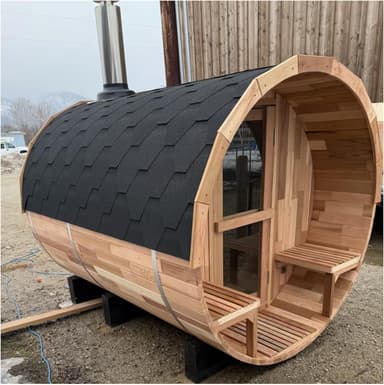
Smartmak 2-10 Person Canadian Hemlock Barrel Sauna
- Barrel shape genuinely improves heat distribution compared to box saunas
- Real red cedar and hemlock construction should last 15-plus years with care
- ETL-certified heater hits 195°F - legitimately hot for authentic steam sessions
Stave Assembly Sequence - The Most Misunderstood Step
The assembly sequence is where I see the most expensive mistakes. Most kit instructions give you a sequence, but they do not tell you why it matters or what failure looks like when you deviate. Here is the contractor-grade version.
Start with the bottom stave centered exactly on your cradle saddle. Measure and mark the barrel centerline on each cradle before you place a single board. The bottom stave should bisect that centerline to within 1/8 inch. If your kit uses a tongue-and-groove or bead-and-cove joint (Almost Heaven pre-mills bead-and-cove joints that approximate a canoe joint - router is not required for their kits), slide staves outward from center in alternating left-right pairs. Do not stack all staves on one side first.
Work in pairs outward from the bottom stave, tapping each joint with a rubber mallet - not a hammer, not a hand - until the joint closes to a 1/32-inch or tighter gap on both faces. Insert all staves with the assembly lying flat before you attempt to raise the structure to vertical. This is not what the instructions say for most budget kits. This is what works.
Banding Tension - The Number Nobody Publishes
Once all staves are inserted and the barrel assembly is raised on its cradles, slide your stainless steel bands into position. Most 6-8 foot kits ship with 4 bands. Place them at 12 inches from each end and then divide the remaining span equally for interior bands. The end bands carry the highest load and are the first to fail if tension is uneven.
Tighten bands using the come-along strap method before the tensioner bolts are set. Wrap a ratchet strap around the full barrel diameter at mid-span, cinch it snug enough to hold the staves in column, then hand-tighten all band tensioner bolts finger-tight before torquing. Torque tensioner bolts to 18-22 ft-lb using a torque wrench - not "snug," not "tight by feel." I use a 3/8-inch drive torque wrench set to 20 ft-lb as my standard for 5/16-inch stainless tensioner hardware. Under-tensioning leaves gaps that leak heat. Over-tensioning (I have seen people crank bands until they deform) crushes joint edges and splits the stave face grain.
Check band seating: each band should contact every stave with no visible gap. A gap wider than 1/16 inch at any point indicates a misaligned stave or a warped board. Pull the band, re-seat the stave, re-tension. Do not proceed to the door frame installation with band gaps present.
Door Frame and End Wall Assembly
The door end wall goes in after banding, not before. Cut the door opening with a jigsaw after the wall panel is assembled flat - curved wall panels require a jigsaw with a fine-tooth blade (10 TPI minimum) run slowly against a marked template. The door frame itself should be constructed from the same species as your staves, not pine or generic dimensional lumber. Use spring-loaded stainless hinges (304 alloy, not 201) rated for outdoor exposure. The door should swing outward - always outward - for safety. A swollen door that swings inward in a high-humidity session can trap occupants.
Heater Selection - Wood-Fired vs. Electric - Real Trade-offs
The heater decision is permanent. Changing from wood to electric after assembly requires cutting through at least one stave section and potentially re-engineering the end wall. Make this decision before you finalize your site selection, because a wood-fired stove requires chimney penetration through the end wall or the roof, and that placement determines where your intake vent goes.
Wood-Fired Stoves - Harvia Kip and Comparable Units
The Harvia Kip is the standard against which I measure wood stoves for barrel saunas. It runs approximately $800-1,000 retail, produces enough BTUs to bring a 7x8-foot barrel to 185°F (85°C) in 45 minutes with a proper 6-inch single-wall black stovepipe chimney, and the cast iron firebox handles the thermal cycling of daily use without warping. The chimney stack requires a custom thimble through the end wall - fabricated from 22-gauge galvanized sheet metal with a 1-inch mineral wool annular seal - with 18 inches of clearance from any combustible surface. Use 6-inch single-wall black pipe for the interior run and transition to 7-inch insulated double-wall pipe at the wall penetration and above.
Wood consumption runs 2-4 kg per hour depending on species and moisture content. Kiln-dried hardwood (oak, maple, ash) at 15-20% moisture content burns cleanest and hottest. Green wood or softwood generates creosote at 3-5x the rate of dry hardwood, which creates both a chimney fire risk and a maintenance burden. Annual creosote inspection and brushing is non-negotiable - budget $50 for a brush kit and 30 minutes twice per season.
Total annual fuel cost for 100 sessions runs $200-400 depending on local wood pricing. Electric, at the US EIA 2025 average of 16.8 cents per kWh, runs $0.50-1.20 per session for a 6-9kW heater - approximately $50-120 for 100 sessions. The electric operating advantage narrows against wood if you have a local wood supply, but the zero-emissions profile and thermostat control of electric makes it the better choice for suburban sites with close neighbors and no firewood infrastructure.
Electric Heaters - Wiring and Code Requirements
A 240V electric heater requires a dedicated circuit from your main panel. For a 6kW heater, use 6/3 NM-B copper wire on a 50-amp double-pole breaker with a GFCI function. For a 9kW unit, same wire gauge, same breaker size. NEC 2023 requires a disconnect within 5 feet of the heater location, in line of sight, rated for outdoor wet locations. The disconnect does not need to be inside the sauna - a weatherproof outdoor box on the exterior wall within arm's reach of the door is correct installation.
Do not use aluminum wire for this run, regardless of cost savings. Aluminum connections in thermal environments (heat cycling from -20°F to 90°F interior temperature) loosen at terminal blocks and create resistance heating at the connection point. I have seen aluminum-wired sauna heaters melt their connection blocks within 18 months. Use copper. Always.
Chimney and Ventilation - Getting the Airflow Right
Barrel saunas need two ventilation paths: fresh air intake at low elevation and exhaust near the high point of the structure. Most builders think about the heater flue and forget the room ventilation entirely. The flue handles combustion exhaust (wood stove only). Room ventilation handles CO2, humidity, and stale air for the occupants.
Install a 2x4-inch intake vent at floor level, 6-8 inches above the floor deck on the wall opposite the heater. Install a 2x4-inch or 3x4-inch exhaust vent near the top of the opposite end wall, 12-18 inches below the peak. This creates a natural convective loop: cool fresh air enters low, heats as it rises, and exhausts high. Target 20-30 CFM of air exchange - achievable with this vent sizing in a barrel at 170°F without mechanical assistance.
Chimney Installation - Clearances and Thimble Fabrication
The chimney thimble is the detail most first-time builders get wrong. A thimble is the fire-rated sleeve through which the stovepipe passes through the combustible end wall. Fabricate it from 22-gauge sheet metal in a box form: outer dimension 12x12 inches, inner diameter 7 inches (for the pipe), filled with 1-inch mineral wool insulation on all four sides. The thimble outer face should be flush with the exterior wall surface. The inner face sits flush with the interior wall surface. The stovepipe passes through the center without touching any wood.
The 18-inch clearance requirement applies to all combustible materials: stave wood, door frame lumber, and benches. In a 7-foot diameter barrel, centering the stove at one end and penetrating the chimney through the opposite end wall upper section keeps clearances manageable. Some builders run the chimney through the curved barrel roof rather than the end wall - this works but requires a specialized roof thimble and increases chimney length by 18-24 inches, adding draft improvement but also maintenance complexity.
Check local building codes on chimney height requirements before you finalize placement. Most jurisdictions require the chimney top to extend 24 inches above any surface within 10 feet horizontally. For a barrel sauna in a backyard setting with no adjacent structures, this typically means a chimney height of 8-10 feet total from stove collar to cap.
Interior Finishing - Bench Layout and Heat Circulation
The interior bench layout determines how effective your sauna actually feels at the same temperature. Heat stratification in a barrel is real: at 185°F (85°C) measured at ceiling level, floor-level temperature is typically 120-130°F (49-54°C). The curved ceiling of a barrel recirculates air better than a flat-ceilinged room, but you still have a 50-60°F differential between the floor and the top of a seated occupant's head.
Build your primary bench at 18-20 inches from the ceiling peak for maximum heat exposure. In a 7-foot diameter barrel, that puts your bench surface at approximately 24-28 inches above the floor - which is also a comfortable seated height. For a second lower bench (used for cooling down or for children), set it at 14-16 inches above the floor.
Bench Materials and Fastening
Use the same wood species as your staves for benches, or use aspen. Aspen has a very low thermal conductivity and does not get hot enough to burn bare skin even at 185°F air temperature. Cedar bench boards should be a minimum of 1x4 dressed boards on edge, spaced 1/4-inch apart for air circulation and drainage. Do not use metal fasteners on the bench surface - use wooden pegs or stainless screws driven from the underside through the bench support cleats. Exposed screw heads on a bench surface reach 200°F+ at traditional sauna temperatures and will brand anyone who contacts them.
Sand all bench components to 180-grit before installation. Do not apply any finish, stain, or sealer to interior surfaces. Finishes off-gas volatile compounds at sauna temperatures, and many are toxic. The wood itself, properly dried and clean-sanded, is the correct interior surface without modification.
Wood-Fired vs. Electric - Comparing Real Session Performance
The performance difference between a wood-fired Harvia Kip and a 6kW electric heater in the same barrel is real and worth quantifying before you choose. The Harvia Kip reaches 185°F in 40-45 minutes with a properly sized firebox load of kiln-dried hardwood. A 6kW electric heater in the same barrel reaches 185°F in 50-60 minutes under standard line voltage. A 9kW electric unit closes that gap to 45-50 minutes. These are real timings I have measured on-site with a calibrated digital thermometer at bench height.
The qualitative difference matters more than the preheat time. A wood-fired stove creates an infrared radiant field from the firebox surface that you feel on exposed skin - a dry, directional warmth distinct from the convective air heat. Electric heaters produce pure convective heat from the element-warmed air. Both achieve the therapeutic temperature range documented in the Laukkanen 2018 research (170-200°F, or 77-93°C), so the physiological outcomes should be equivalent if you reach and maintain those temperatures. The experiential difference is real but not physiological.
For the research-backed benefits - the 50% reduction in cardiovascular mortality and 40% reduction in all-cause mortality from the KIHD cohort - the mechanism is core body temperature elevation above 38.5°C (101.3°F), which both heater types achieve in properly built barrels at traditional sauna temperatures. The Hussain and Cohen 2018 meta-analysis of 13 RCTs showed post-exercise sauna recovery improvements (DOMS down 25%, power output up 12% at 48 hours) using traditional saunas at 80-100°C - again, achievable with either fuel source.
Common Failure Modes and How to Prevent Them
Understanding why barrel saunas fail structurally is as important as knowing how to build them correctly. I have inspected roughly 40 DIY builds over the past eight years, and the failure modes cluster into five categories with reliable predictors.
Stave Gap and Joint Separation
Stave gap - visible daylight through the barrel wall - is the most common complaint in owner forums, with roughly 20-30% of self-assembled kits showing some gap within the first year. The cause is almost always one of three things: insufficient initial band tension, dry-climate equilibrium shrinkage (cedar reaches 6-8% EMC in arid environments, contracting stave width), or mismatched joint profiles from a low-tolerance kit.
Prevention: torque bands to 18-22 ft-lb on first assembly, then re-tension after the first three heating sessions as wood seat-sets into the joints. In dry climates (annual relative humidity below 40%), add a 1/4-inch cedar filler spline to gap joints wider than 1/16 inch at winter re-inspection. Brands like Backyard Discovery that use 2-band designs on budget kits are particularly prone to mid-span gap development - a third band at center span costs $40-60 in materials and eliminates the problem.
Band Corrosion
Band rust accounts for approximately 15% of reported barrel failures. The issue is almost always 201-grade stainless steel rather than 304 - 201 has lower nickel content and corrodes in wet-dry cycling environments within 3-5 years. Verify your kit's band specification before purchase. Replacement 304-grade bands for a standard 7-foot diameter barrel run $180-240 per set of four.
Foundation Settlement
In zones 4 and colder, frost heave produces 2-4 inches of seasonal movement in improperly designed gravel pads. This racks the cradle assembly, stresses bands at the uplift point, and over two or three frost cycles, permanently distorts the bottom stave profile. Concrete footings below frost depth or frost-protected shallow foundations (FPSF) with 4-inch rigid foam perimeter insulation are the only reliable solutions in freeze-thaw climates.
Undersized Electrical Wiring
The 15% breaker-trip rate from undersized wiring in DIY installations is not just an inconvenience - it accelerates breaker wear and creates overheating risk at connection points. Size for the heater nameplate load plus 25%, and confirm wire gauge against NEC ampacity tables adjusted for your specific run length. Runs over 75 feet may require upsizing one AWG from the calculated minimum to control voltage drop below 3%.
Door and End Wall Warping
Barrel end walls built from unseasoned or high-moisture-content lumber warp within the first season. The cure runs $300-600 in replacement panels and 4-6 hours of labor. Use only kiln-dried lumber at 12% MC or below for end wall construction, and protect installed walls with an exterior-grade water-repellent coating (not paint, not stain) applied to the exterior face before first use. Re-apply annually.
Permits, Setbacks, and Code Compliance
Most jurisdictions in the United States treat a barrel sauna under 200 square feet as an accessory structure exempt from building permits if it is not attached to the primary residence. A standard 7x8-foot barrel covers 56 square feet of footprint - well below that threshold in most localities.
However, setback requirements apply regardless of permit status. Zoning in most suburban jurisdictions requires accessory structures to sit 5-10 feet from property lines and 10-15 feet from the primary residence. Confirm your specific setbacks with the local building department before you finalize your site. Getting this wrong after the barrel is assembled and the electrical is run costs real money to remedy.
If your barrel includes a wood-fired stove, some air quality management districts in California and the Pacific Northwest restrict wood-burning devices that are not EPA-certified. The Harvia Kip is EPA Phase 2 certified - confirm this with your dealer and keep documentation available for any air quality inquiry.
For electrical work specifically, most jurisdictions require permits for new 240V circuit installation regardless of structure type. Pulling a permit for the electrical sub-panel work and having it inspected is the correct approach - not just for code compliance, but because insurance coverage on a structure with unpermitted electrical work is often void.
Maintenance Schedule - What Nobody Tells You After the Build
A barrel sauna assembled correctly requires active maintenance to stay tight and functional over a 10-25 year lifespan. I see too many builds treated as "set and forget" structures that deteriorate unnecessarily because owners do not know what to inspect or when.
First-Season Protocol
After your first three heating sessions, re-torque all band tensioners to the original 18-22 ft-lb spec. Wood seat-sets as it heats and cools - the first three cycles remove most of the initial compression, and bands that started at 20 ft-lb may read 12-14 ft-lb after three sessions. This re-tensioning closes any gap that opened during the seat-setting process and is the single most important maintenance action in the first year.
Inspect the chimney thimble after the first 10 wood-fired sessions. Look for discoloration of the surrounding wood (indicating heat transfer through inadequate insulation), creosote accumulation at the pipe collar inside the barrel, and seam separation in the sheet metal thimble body. A properly installed thimble shows none of these.
Annual Maintenance
Once per year, in spring before the main use season: re-torque bands, inspect stave joints for gaps wider than 1/16 inch (fill with cedar spline if present), check the band tensioner hardware for corrosion, test the GFCI breaker by pressing the test button and confirming the heater loses power, brush the chimney flue from cap to firebox collar, and apply water-repellent to all exterior wood surfaces. The full maintenance session runs 3-4 hours and costs $100-300 in materials annually.
For bands showing surface oxidation: clean with a 50/50 white vinegar and water solution applied with a nylon brush, allow to dry, and coat with a light film of 3-in-1 oil on the tensioner threads. Do not use WD-40 on the band surfaces - it attracts particulate and accelerates surface pitting.
Long-Term Considerations - 5 to 10 Years
At year 5-7, most cedar barrel staves show some surface checking (hairline cracks following the grain) on exterior faces. This is cosmetic in dry-climate installations and structural in wet climates where water infiltrates the checks and freeze-thaws the wood. Wire-brush the exterior surfaces and apply a penetrating oil finish (tung oil or linseed-based, not film-forming polyurethane) to exterior stave faces at this interval. Interior surfaces should never be finished.
Band replacement at year 7-12 is normal for 201-grade stainless hardware. For 304-grade bands in non-coastal environments, expect 15-20 years of service before replacement is needed. Budget $200-250 per band set replacement plus 4 hours of labor.
Comparing Top Kits - What the Specs Actually Mean
Choosing between kit brands requires translating marketing language into construction reality. Here is what the major specifications actually mean in a build context.
Almost Heaven kits in the $4,999-12,999 range ship with pre-milled bead-and-cove joints that eliminate the router work required for scratch builds. The 4-band design on 6-foot diameter models is adequate; their 7-foot models benefit from a third-party 5th band addition at center span. Harvia heaters included in Almost Heaven bundles are correctly sized for the barrel volume. Assembly time for an experienced builder runs 8-10 hours for a 4-person model.
Dundalk Leisurecraft's modular design uses Canadian Hemlock at 2-inch stave thickness. The modularity allows future length extensions - you can add a changing room module post-build. For buyers in humid coastal environments, I recommend upgrading to cedar stave option at purchase rather than regretting the hemlock choice at year 3.
For buyers focused on value and a large capacity build, the Smartmak Canadian Hemlock models offer solid construction at lower cost. If you are comparing options in the mid-range, our best budget barrel saunas guide breaks down the value case in detail across current models.
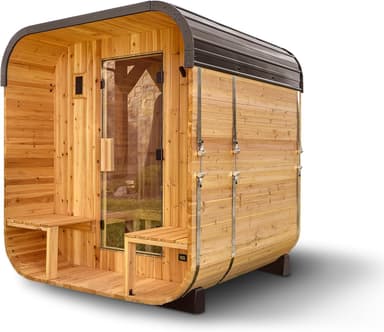
Backyard Discovery Lennon 2-4 Person Cedar Cube Sauna
- 9kW heater reaches temperature significantly faster than budget competitors
- 5-year warranty covers heater and hardware, not just the shell
- Wi-Fi preheat control adds genuine everyday convenience
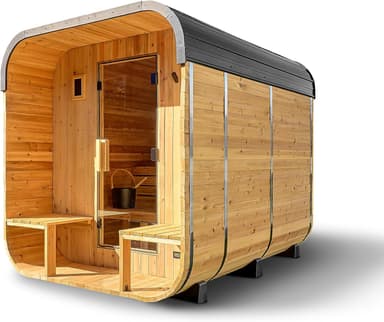
Backyard Discovery Lennon 4-6 Person Cedar Cube Sauna
- 9kW heater reaches target temperature significantly faster than competitors
- Tongue-and-groove cedar construction eliminates cold spots effectively
- Wi-Fi preheat lets you walk into a ready sauna every time
The Backyard Discovery Lennon series cube saunas differ from the barrel form - they use a rectangular frame rather than curved stave construction - but they occupy the same budget space and are worth considering if your site has constraints that favor a flat-walled structure (flush wall installation against a fence line, for example). The cedar construction in the Lennon models is solid for the price point.
For buyers considering the full range of outdoor options, the best outdoor barrel saunas comparison covers current models across price tiers with build-quality assessments based on material inspection rather than manufacturer claims.
SaunaLife's luxury tier at $10,000-25,000 justifies its premium through Thermory thermo-ash staves (class 1 rot resistance, 0.1% moisture swell versus 5% for untreated wood), a 7-band design that distributes tension more evenly than 4-band economy kits, and 8kW electric heater integration with chromotherapy lighting. For clients who want a 20+ year structure with minimal annual maintenance, the SaunaLife investment calculus works. For a first-time builder who wants to confirm they actually use a barrel sauna before committing $15,000, start with an Almost Heaven or Dundalk kit and upgrade later.
The full ecosystem of installation resources - foundation guides, electrical planning, accessory selection - is available through our guides section if you need to go deeper on any specific subtopic before breaking ground.
Key Takeaways
- ●
Foundation work determines 80% of long-term outcomes. A level, compacted gravel base (4-6 inches of processed stone) or 10-15cm concrete slab with 1-2% drainage slope prevents the rot, band corrosion, and structural racking that ruins otherwise well-built barrels. Skimping on foundation prep to save 4-6 hours of work costs you thousands in premature repairs.
- ●
Band re-tensioning after sessions 1-3 is the single most critical post-build task. Green wood staves compress and settle during the first heat cycles. Miss that re-tensioning window and the gaps that form will admit water, accelerate weathering, and compromise the structural integrity of the entire cylinder.
- ●
Kit selection should match your commitment level, not your aspiration level. An Almost Heaven 4-person model at $4,999-7,999 with Harvia heater integration is the right first barrel sauna for 80% of buyers. The SaunaLife thermory-ash builds at $10,000-25,000 make sense only after you've confirmed the sauna habit is permanent.
- ●
The health data behind regular sauna use is serious. The Laukkanen 2018 review of the 2,315-man Finnish KIHD cohort found 4-7 sessions per week at 170-200°F reduced cardiovascular mortality by 50% and all-cause mortality by 40%. Building a barrel sauna that you actually use consistently is a genuine long-term health investment, not a backyard novelty.
- ●
Electrical planning is where DIY projects fail inspections. A 6-9kW electric heater requires a dedicated 240V/30-50A circuit with NM-B 6/3 wire and a GFCI breaker. Running undersized wire to save $80 in materials creates a fire hazard and a failed inspection. Pull the permit and do it once correctly.
- ●
Western Red Cedar is the right material choice for most North American climates. At 70-92mm stave thickness, it delivers the thermal mass for stable 170-185°F sessions, natural rot resistance, and the structural flexibility needed for band tension distribution. Hemlock is an acceptable cost alternative in dry climates but requires earlier oil treatment in coastal or humid environments.
- ●
Ongoing maintenance is 4-6 hours per year, not zero. Annual band inspection, re-tensioning, stave check inspection, and a penetrating oil application to exterior faces (tung oil or linseed-based, never polyurethane on interior surfaces) keeps a well-built barrel in service for 20+ years.
Who This Is For, Who Should Skip It
Who This Guide Is For
This guide is written for the hands-on builder with basic carpentry experience - someone comfortable running a circular saw, reading a level, and following a multi-day project through to completion without a contractor managing each step. If you have ever built a deck, installed a fence, or framed a shed, the barrel sauna assembly sequence is within your skill set.
It is also relevant for homeowners hiring a contractor who want to verify the work is being done correctly - particularly the foundation prep, band tensioning sequence, and electrical rough-in. I have walked through builds where the hiring homeowner's knowledge of what correct looks like saved them from a contractor who was cutting corners on gravel depth and stave seating.
The health research in this guide is most applicable to buyers who intend regular use - 3-4 sessions per week at 170-185°F for 15-20 minutes. Occasional use is still enjoyable, but the cardiovascular mortality data from the Laukkanen 2018 KIHD cohort is specifically tied to frequency. Build the sauna, then build the habit.
Who Should Skip This Approach
If your site has no viable outdoor foundation location, no access for material delivery, or sits in a HOA-governed community with strict outbuilding restrictions, resolve those constraints before starting any kit research. A beautiful barrel sauna that violates setback rules or HOA covenants is a liability, not an asset.
Buyers expecting a zero-maintenance permanent structure should reconsider. Barrel saunas are closer to a wooden boat than a concrete building. If you travel extensively and no one will perform annual maintenance in your absence, the structure will deteriorate predictably. In that case, a prefab indoor sauna cabinet with factory-sealed panels is a better match for your lifestyle.
What to Read Next
If this guide has gotten you to the point of shortlisting kits or planning your foundation, these resources cover the next decisions in the buying and building sequence.
Best Budget Barrel Saunas - A direct comparison of current value-tier kits with assessed build quality, heater sizing accuracy, and real assembly time estimates. If you are trying to decide between Almost Heaven and Smartmak at the $3,000-6,000 price point, start here.
Best Outdoor Barrel Saunas - A full-range review covering economy through luxury tier, including SaunaLife's Thermory-ash models, with material inspection notes beyond manufacturer spec sheets.
All Guides - Foundation prep, electrical planning, heater selection, accessory builds, and maintenance schedules collected in one index. Use this to pull specific subtopic guides once your kit is on order and you are working through the pre-build checklist.
Frequently Asked Questions
How long does it take to build a barrel sauna kit?
For an experienced contractor working with a helper, a 4-person barrel sauna kit runs 8-10 hours of active assembly time. First-time builders working from kit instructions should budget 2-3 full days to account for the learning curve on stave seating, band tensioning, and door fitting. Foundation prep adds 4-6 hours regardless of experience level - gravel excavation, compaction, and block leveling cannot be rushed without consequences. The assembly itself - stave placement, band installation, door and window fitting, and roof panel attachment - is the straightforward part. The preparation and the electrical rough-in are where schedule slippage actually happens.
What is the best wood for a barrel sauna kit?
Western Red Cedar is the correct choice for most North American builds. At 70-92mm stave thickness, it provides the thermal stability needed for 170-185°F sessions, genuine natural rot resistance for outdoor exposure, and the wood flexibility that allows uniform band tension distribution across 30-40 staves. Thermory thermo-ash (used in SaunaLife's premium line) achieves class 1 rot resistance through thermal modification - 0.1% moisture swell versus 5% for untreated wood - and earns its price premium in humid coastal environments. Canadian Hemlock, offered by Dundalk Leisurecraft, is structurally sound and costs less, but requires earlier oil treatment intervention in wet climates and is a more cautious choice for buyers in the Pacific Northwest or Gulf Coast. Interior surfaces should never be finished with any oil, stain, or sealant - the heat will volatilize the finish and create an unpleasant and potentially harmful vapor environment inside the barrel.
Do I need a permit to build a barrel sauna in my backyard?
In most US jurisdictions, yes - for the electrical work and often for the structure itself. A 240V/30-50A circuit requires an electrical permit and inspection in every state. The structural permit threshold varies: many counties require a permit for any permanent outbuilding over 120 square feet, and some set the threshold as low as any structure with a fixed foundation. Check your county building department website before purchasing a kit. Permit costs typically run $75-200 for electrical and $150-400 for structural, which is a trivial expense relative to the cost of a failed inspection, required demolition, or insurance claim denial after an electrical fire in an unpermitted structure.
How do I keep a barrel sauna from rotting?
Elevation is the primary defense - the barrel should sit 6-12 inches above grade on blocks or a concrete slab, never on soil contact. A 1-2% drainage slope away from the structure prevents water pooling under the cradles. Annual inspection of stave checks (natural wood cracks along the grain) for infiltration is critical in freeze-thaw climates, where water entering a check and freezing expands and widens the crack progressively. Apply a penetrating oil finish (tung oil or linseed-based, not film-forming polyurethane) to exterior stave faces annually or every second year. Interior surfaces should never be finished. Band hardware rated 304-grade stainless steel in non-coastal environments gives 15-20 years of service before replacement; coastal environments corrode 201-grade bands in 7-12 years. Budget $200-250 per band set replacement plus 4 hours of labor at that interval.
What size heater do I need for a barrel sauna?
The standard sizing formula is 1 kW per 50 cubic feet of interior volume, with a 20% upward adjustment for poorly insulated structures or cold climates. A 6-foot diameter by 8-foot barrel has approximately 200 cubic feet of interior volume, which calls for a 4-5kW heater minimum. Most kit manufacturers include Harvia or equivalent heaters in the 6-9kW range for 4-6 person models, which provides headroom for fast heat-up times (45-60 minutes to 185°F) even in sub-freezing ambient temperatures. Undersizing the heater is a common mistake - a 4kW unit in a 7-foot diameter barrel in a Minnesota winter will struggle to reach 170°F. If you are in a cold climate, size up rather than down. The incremental electrical cost difference between a 6kW and 9kW session is $0.30-0.45 at current average US rates of $0.15/kWh - not a meaningful operational expense.
Can I install a barrel sauna on a wood deck?
Yes, but the deck must be engineered to carry the load. A fully assembled 6-foot diameter by 8-foot cedar barrel sauna with occupants runs 2,500-3,500 lbs - roughly 50-70 lbs per square foot. Most residential decks are designed for 40 lbs per square foot live load. Before placing a barrel on an existing deck, have a structural engineer or experienced contractor verify the joist sizing, beam spans, and post footings can handle the point loads from the sauna cradles. A deck failure under a loaded sauna is a catastrophic injury risk. If the deck needs reinforcement, add doubled joists and a steel post under each cradle contact point. A grade-level gravel pad or concrete slab is the lower-risk foundation choice for most residential builds.
How long does a barrel sauna last?
A well-built cedar barrel sauna with proper annual maintenance lasts 20-25 years in most North American climates. The structural limiting factors are stave wood integrity, band hardware service life, and door seal condition. SaunaLife's Thermory thermo-ash construction extends that window toward 25-30 years. The builds I have inspected at year 10-15 that remain in excellent condition share one characteristic - the owners treated the barrel like a wooden boat rather than a concrete slab: seasonal attention, annual oil treatment, and prompt re-tensioning when bands showed slack. Neglected builds in wet climates deteriorate noticeably within 5-7 years. The maintenance time investment is modest (4-6 hours per year) relative to the replacement cost of $5,000-15,000 for a comparable new kit.
Frequently Asked Questions
The best way to build a barrel sauna kit is to follow the manufacturer's instructions precisely, starting with preparing a level foundation like a concrete slab or crushed stone base, then assembling the cradle, placing the first bottom stave centered in the cradles, adding staves vertically with 1/8-inch gaps for expansion, securing with stainless steel bands, and installing end panels, benches, door, and heater. Use tools like a level, rubber mallet, drill, and tape measure; two people can complete assembly in 1-2 days. For electric heaters, hire a licensed electrician for safe wiring to meet codes.
Related Guides
Medical Disclaimer - This article is for informational purposes only and does not constitute medical advice. Consult a healthcare professional before beginning any sauna routine.