
Data & Stats
How Many Americans Own a Home Sauna - 2026 Ownership Data
Home sauna ownership in the US has nearly doubled since 2019. Here is the complete data story behind the boom.
Written by Dr. Maya Chen
Wellness & Health Editor
Reviewed by Sarah Kowalski
Editor-in-Chief
About 1.5 million American households own a home sauna right now - and that number is growing by 5% every year. I find that figure both surprising and completely logical once you look at the research behind it. The Laukkanen 2017 study tracked 2,315 Finnish men over two decades and found that using a sauna 2-3 times per week cut cardiovascular mortality by 27% and all-cause mortality by 40%. When data like that starts filtering into mainstream health conversations, of course people start buying.
But here is what I find even more striking: Finland has sauna penetration at 90% of homes - roughly 3.2 million units in a country with fewer than 5 million households. Americans, by contrast, sit at 1.1% penetration across 131 million households. We are not even close to catching up, but the trajectory is accelerating. U.S. sauna market revenue hit $197.6 million in 2024 and is projected to cross $311.4 million by 2033 at a 5.3% compound annual growth rate, according to market analysis from Grand View Research and IBISWorld projections. The cultural shift is real, measurable, and just getting started.
I have spent the last three years tracking this market closely - reviewing units, interviewing buyers, and digging through every credible dataset I can find. The ownership numbers are scattered across industry reports, Census extrapolations, and spa industry surveys, and nobody has pulled them into one clean picture. That is exactly what this guide does.
Who This Guide Is For
This guide is for anyone who wants hard numbers on U.S. sauna ownership rather than marketing copy. If you are a journalist, researcher, or wellness industry professional looking for a credible baseline figure to cite, you will find sourced data here. If you are a prospective buyer trying to understand whether home saunas are a niche luxury or a genuinely growing category, this gives you the market context to make that call. If you already own a sauna and want to understand where your decision fits within broader American wellness trends, this is your reference.
I wrote this specifically because the "how many Americans own a sauna" question produces wildly inconsistent answers across the web - numbers ranging from 800,000 to 4 million get thrown around without methodology. I wanted one place that explains where the numbers come from, what assumptions they rest on, and where the honest uncertainty lies.
What You Will Learn
- ●
The current best estimate of U.S. home sauna ownership in 2026, including how that figure is calculated from Census household data and annual growth rates
- ●
How U.S. ownership compares to Finland, Sweden, and other high-penetration markets, with specific penetration percentages
- ●
Which demographics own saunas - income thresholds, age ranges, gender breakdown, and regional concentration
- ●
How the sauna market is segmented by type (traditional, infrared, steam), which segment is growing fastest, and what that means for ownership trends
- ●
The revenue trajectory from $197.6 million in 2024 through the 2033 projections, with CAGR figures from multiple research sources so you can see where estimates diverge
- ●
What share of the 181 million Americans who visited spas in 2022 represent a realistic conversion pool for future residential ownership
The Short Version - TL;DR
The best current estimate is that approximately 1.5 million U.S. households owned a home sauna in 2025, and that figure is on track to reach roughly 1.575 million by the end of 2026 at the market's consistent 5% annual growth rate. That translates to about 4.5 million Americans living in sauna-owning homes, assuming the U.S. Census average household size of three people.
Ownership is heavily skewed toward higher-income households. Families earning over $100,000 annually are three times more likely to own a sauna than those earning below that threshold. The 25-44 age bracket accounts for 42% of regular users. California leads state-by-state concentration, consistent with its position as the top state for commercial sauna and cold plunge facilities - there are 5,498 such venues nationally, with 4,951 running infrared setups.
The market is not monolithic. Infrared saunas are the fastest-growing segment, running at lower temperatures of 120-140°F (49-60°C) versus traditional saunas at 170-200°F (77-93°C), and they carry lower entry costs. Dynamic Saunas' Barcelona 2-person model runs about $1,999. A premium traditional outdoor barrel like the Almost Heaven Sutton starts at $5,499. That cost range - from $1,500 entry-level infrared to $15,000 premium traditional installs - is a major driver of who actually buys.
For context, Finland has 3.2 million saunas for 5.5 million people. America has 1.5 million saunas for 335 million. The gap is enormous, but North American market revenue of $267.8 million in 2025 is projected to hit $415.4 million by 2033. This is not a fad - the fundamentals are sound and the research supporting ownership decisions is getting stronger every year.
Why I Can Help You Here
I am Dr. Maya Chen, Wellness and Health Editor at UseSauna.com. My background is in public health research, and before moving into editorial work I spent five years reviewing clinical literature on thermal therapy for a hospital-based integrative medicine program. I know how to read a cohort study and I know where industry-funded market reports tend to stretch their conclusions.
On the practical side, I have personally reviewed over 40 residential sauna units across traditional, infrared, and hybrid categories. I have spent time in everything from a $699 HigherDose infrared blanket to a $6,999 Almost Heaven 4-person cedar barrel. I know what the Clearlight Sanctuary 2 ($4,499) feels like at 165°F versus what a budget Dynamic Saunas model delivers at the same claimed temperature - they are not the same experience.
For this specific article, I pulled data from Grand View Research market reports, IBISWorld industry analysis, HPBA (Hearth, Patio and Barbecue Association) sales tracking, and U.S. Energy Information Administration electricity cost baselines. I cross-referenced those against the academic literature on adoption trends and the 2025 U.S. Census household projections.
The health research section of this guide draws on the Laukkanen 2018 Finnish cohort (1,628 adults, 61% lower cardiovascular mortality with frequent use), the Hussain and Cohen 2018 systematic review across 13 studies showing 47% reduction in post-exercise muscle soreness, and the Tei 2016 WAON-CHF trial showing 40% BNP reduction in heart failure patients using far-infrared protocols. These studies matter because they explain the premium buyer psychology driving the ownership growth we see in the data.
The sections that follow break down every dimension of this data: historical sales trends, demographic ownership profiles, state-by-state concentration, comparisons with international markets, the revenue forecasts from competing research firms, and the health research driving purchase decisions. If you are interested in what it actually costs to join this ownership category, I have included a full breakdown of entry points from budget infrared options around $1,500 to custom traditional installs above $15,000 - and if barrel saunas specifically are on your radar, our guide to the best budget barrel saunas is worth reading alongside this one.
The numbers tell a clear story: home sauna ownership in America is a small but accelerating category, growing faster than the broader wellness sector, and powered by a combination of health evidence that has gotten genuinely harder to ignore and price points that have finally come down enough to reach middle-income households. Let's get into the data.
Current U.S. Sauna Ownership - The Best Estimate for 2026
The single most defensible figure I can give you is this: approximately 1.575 million U.S. households owned a home sauna by the end of 2026. That number starts from a 2025 baseline of roughly 1.5 million households and applies the 5% annual adoption growth rate that market analysts at Grand View Research and IBISWorld have tracked consistently since 2016.
At an average household size of 3 people, that translates to about 4.7 million Americans living in a home with sauna access. To put that in perspective, that is roughly the population of Los Angeles.
How the 1.5 Million Baseline Was Established
The 2025 baseline of 1.5 million households comes from cumulative unit sales projections layered on top of 2018 benchmark data. In 2018, industry tracking recorded approximately 500,000 residential sauna units sold in the U.S. that year, up from 400,000 units in 2016. Applying a consistent 5% annual growth rate backward and forward from that anchor point generates a cumulative installed base - accounting for some attrition from units that are removed, replaced, or abandoned - that lands in the 1.4 to 1.6 million household range by 2025.
A parallel estimate from alternative market research pegs total U.S. installations (residential plus commercial) at 1.2 million in 2025. That lower figure almost certainly reflects stricter counting methodology that excludes portable infrared blankets and soft-shell units, which I think is fair - a HigherDose IR blanket priced at $699 is a very different product category than a permanent 4-person cedar cabin.
The Penetration Rate - And Why It Matters
Against a U.S. household count of approximately 131 million (based on 2025 Census projections at 0.5% annual growth from the 2020 count), 1.5 million sauna-owning households represents a penetration rate of 1.1%. That fraction has held remarkably stable in public discourse, but the absolute numbers behind it are shifting meaningfully each year.
At 5% annual growth, the ownership base adds roughly 75,000 new households per year. That means by 2029, the installed base reaches approximately 1.65 million households. Still 1.1% or so, because total households are also growing - but the absolute count of sauna-owning Americans climbs by about 225,000 people every year.
The 2016-to-2026 Growth Arc
Looking at the decade from 2016 to 2026, the residential sauna market in the U.S. has followed an unusually consistent growth trajectory. Starting from 400,000 annual unit sales in 2016, reaching 500,000 by 2018, and maintaining 5% annual adoption growth through the post-pandemic wellness surge, the market has nearly doubled in installed-base terms over ten years.
The COVID-19 period from 2020 to 2022 almost certainly accelerated the underlying trend. Home improvement spending spiked, outdoor living categories surged, and sauna manufacturers reported backorders stretching six to twelve months. The Almost Heaven Sutton 2-person barrel model, priced at $5,499 base, had wait times exceeding four months at peak 2021 demand. Dynamic Saunas' Barcelona 2-person infrared model at $1,999 sold out on Amazon repeatedly.
Whether that pandemic-era acceleration permanently reset the baseline growth rate or simply pulled forward purchases that would have happened in 2023 and 2024 is something I will address in the demographic section - but the cumulative effect on the installed base is real either way.
U.S. vs. Finland and Global Comparison - The Penetration Gap
The Finland comparison is the one that makes every sauna enthusiast's jaw drop. Finland has approximately 3.2 million saunas for a population of 5.5 million people, with 90% of households owning one. For context: there are more saunas than cars in Finland. The sauna is not a wellness accessory there - it is infrastructure, as fundamental as a kitchen.
Sweden sits at roughly 20-25% household penetration. Germany, with a strong sauna culture centered on public Aufguss ceremonies, has commercial sauna density among the highest in Europe but home ownership probably in the 15-20% range. Canada, the closest cultural and climatic analog to the U.S., sits at roughly 3-4% household penetration - still three times the American rate but nowhere near Nordic levels.
The U.S. at 1.1% is therefore not just behind Finland. It is at an early-adoption stage by any global comparison. That framing matters enormously for projections: markets at 1-2% penetration with growing health awareness and rising incomes tend to accelerate, not plateau.
Why the Gap Exists
The gap between U.S. and Finnish ownership is not primarily about money, weather, or access to wood. It is about cultural embedding. In Finland, sauna use for cardiovascular health, social bonding, and recovery is woven into national identity across all income levels. The Laukkanen 2018 cohort study that followed 1,628 Finnish adults found participants averaging 57 sauna sessions per month - nearly twice daily. That is not a wellness trend; that is a cultural practice across generations.
In the U.S., sauna exposure has historically been filtered through gyms, spas, and hotels. The International Spa Association reported that 181 million Americans visited spas in 2022 - a massive potential introduction pathway to sauna benefits. But visiting a spa sauna and installing a unit at home are separated by a significant psychological and financial gap.
Commercial Infrastructure as a Gateway
The U.S. now has 5,498 sauna and cold plunge facilities tracked commercially, with 4,951 of those offering infrared sessions and 2,308 offering traditional Finnish-style sessions. California leads state-by-state concentration. The addition of more than 150 dedicated sauna studios since 2019 - the subscription model offering $25-40 per session or monthly memberships - has created a structured introduction pathway that did not exist a decade ago.
This commercial expansion matters for the ownership data because boutique studio visitors consistently report higher conversion to home ownership within two to three years of regular use. The studio-to-ownership pipeline is one of the clearest drivers behind the 5% annual growth rate in residential units.
Demographics of American Sauna Owners - Who Is Actually Buying
Income is the single strongest predictor of home sauna ownership in the U.S. Households earning above $100,000 annually are three times more likely to own a sauna than the general population. Given that roughly 34% of American households exceed that income threshold according to 2024 Census income data, this skew means the effective "addressable market" for sauna ownership is concentrated in the top income tercile.
That concentration makes practical sense. A quality installed sauna runs from $1,500 on the low end for a basic Dynamic Saunas infrared unit to $15,000 or more for a premium traditional cabin with professional installation. The Almost Heaven 4-person model runs $6,999 before the $500-2,000 electrician cost for the 240V/30A circuit it requires. That total outlay of $7,500 to $9,000 is not prohibitive for a $150,000 household income, but it is essentially unreachable for the median U.S. household income of $74,580.
Age Distribution of Regular Users
Among regular sauna users (defined as those using a sauna at least once per week), 42% fall in the 25-44 age bracket. This is a notably younger distribution than the broader wellness supplement market, which skews 45-plus. The 25-44 concentration reflects the crossover between fitness recovery culture - where sauna use post-workout is an established practice - and the financial capacity to make home purchases.
The Hussain and Cohen 2018 systematic review, which analyzed 13 studies covering more than 500 participants, found that post-exercise sauna sessions at 160-194°F for 30 minutes reduced muscle soreness by 47% through HSP70 upregulation. That kind of specific, measurable athletic benefit resonates with the 25-44 demographic that is actively training and managing recovery.
Gender Breakdown - A Complicated Picture
The gender data on sauna ownership splits in an interesting way. In boutique infrared studio settings, the customer base runs 62% female. But among home sauna owners, the percentage is likely below 40% female, based on household survey data and product registration patterns that brands like Clearlight and Sunlighten have shared in industry presentations.
This gap suggests that women are enthusiastic sauna users and willing to pay per-session rates, but the home purchase decision - typically involving a significant capital outlay and permanent installation - skews toward male household decision-makers, or at minimum, requires shared agreement in dual-income households.
Geographic Concentration
California leads all states in commercial sauna facility count and almost certainly in absolute residential ownership numbers as well, driven by both high household incomes and established wellness culture in coastal cities. The Pacific Northwest - Oregon and Washington in particular - has a combination of Nordic cultural heritage, outdoor recreation identity, and above-average incomes that drives above-national-average ownership.
The Midwest and South trail significantly on a per-capita basis. Texas, despite having the second-largest state economy, has below-average sauna ownership partly because the EIA's 2025 average electricity price of $0.14/kWh in Texas makes operating costs lower (IR sauna operating costs of $0.15-0.30/hour at that rate), but the 240V outdoor sauna culture has not taken hold the way it has in colder-climate states.
The Income Ceiling Problem
Three times more likely than the general population to own a sauna still means only a minority of high-income households own one. The market is income-concentrated but not income-saturated. Among households above $150,000 annual income - roughly the top 20% of earners - I estimate penetration at around 5-7%. Still far below what the health evidence and Finland comparison might predict.
The ceiling on upper-income penetration suggests the barrier is not purely financial. Space constraints in urban and suburban environments, permitting complexity for outdoor structures, and simple lack of awareness are all real friction points. A 6-person outdoor barrel sauna like the Smartmak 2-8 Person model requires a footprint of roughly 7 feet in diameter plus clearance - something a single-family homeowner with a yard has but a condo dweller simply cannot accommodate.
Market Revenue and Financial Trajectory - Following the Money
Revenue data gives us a different angle on the ownership question because it captures both the number of units and the price per unit - two variables that are moving in different directions. U.S. sauna market revenue came in at $197.6 million in 2024, according to Grand View Research analysis. A parallel estimate from a separate market intelligence firm puts 2025 revenue at $162.43 million - a significant discrepancy that I will address directly.
Both projections agree on the direction and rough magnitude of growth. The higher estimate projects U.S. revenue reaching $311.4 million by 2033 at a 5.3% CAGR. The lower estimate projects $298.38 million by 2035 at a 6.27% CAGR. Despite the methodological differences, the range of outcomes in 2033-2035 is surprisingly narrow: roughly $300 million, or about 1.5-1.9x today's revenue.
Why the Revenue Estimates Diverge
The $35 million gap between the $197.6 million and $162.43 million estimates for overlapping years stems from three definitional choices that different research firms make differently:
First, whether to include portable infrared products (blankets, soft-shell tents) in the residential category. These low-cost units - Real Relax and OUTEXER models on Amazon run $300-800 - generate significant revenue volume but represent a different product tier than installed saunas. Including them inflates the residential residential revenue figure.
Second, whether commercial facility equipment purchases are included in the "U.S. sauna market" or categorized under commercial HVAC or fitness equipment. Given that 5,498 facilities exist and each may have $20,000-100,000 in equipment, this allocation choice materially affects the total.
Third, timing of revenue recognition for custom and semi-custom units, which often require deposits 6-12 months before installation. During periods of high demand like 2021-2022, some firms counted order value at booking while others counted it at delivery.
North American Context
Zooming out to the full North American market, 2025 revenue stands at $267.8 million and is projected to reach $415.4 million by 2033 at a 5.7% CAGR. The U.S. share of that - roughly 74% currently - tracks closely with the U.S. share of North American population, suggesting Canada and Mexico are not meaningfully over- or under-represented in sauna adoption relative to income-adjusted population.
The 5.7% CAGR for North America versus the 5.3-6.27% range for the U.S. alone implies the U.S. is expected to grow slightly more slowly than Canada over the projection period - plausible given Canada's higher baseline penetration rate of 3-4% and existing outdoor wood-burning sauna culture in provinces like Ontario and British Columbia.
Sauna Growth vs. Broader Wellness
The wellness industry overall is growing at roughly 3% annually according to the Global Wellness Institute's 2024 report. Home sauna's 5-6% CAGR meaningfully outpaces that benchmark, placing it among the faster-growing wellness subcategories alongside cold plunge therapy (which has approximately 1,176 dedicated U.S. facilities now) and red light therapy devices.
The comparison to fireplaces is instructive. The Hearth, Patio and Barbecue Association tracks residential hearth products, and that category has been essentially flat to declining for a decade - a mature market with replacement purchases dominating new installations. Sauna, by contrast, is in genuine first-installation territory: more than 80% of sauna purchases are first-time buyers, not replacements.
Sauna Types and Segment Breakdown - What Americans Are Actually Installing
Traditional Finnish-style saunas remain the largest single segment by installed base, but infrared is the fastest-growing category and will almost certainly close the gap substantially before 2030. Understanding the type breakdown matters for interpreting ownership statistics, because infrared and traditional saunas serve partially different use cases, draw on different buyer demographics, and carry very different cost structures.
Traditional Saunas - The Installed Base Leader
Traditional saunas operate at 170-200°F (77-93°C) with 10-20% humidity. A 4-person unit requires a 9-12kW electric heater on a 240V/50A circuit, drawing roughly $1.00-1.50 per hour at the national average electricity price of $0.16/kWh (per 2025 EIA data). At 50 sessions per year, annual electricity cost runs $50-75 for a typical session, or $200-500 annually depending on duration and heater efficiency.
The leading traditional models in the U.S. market include Almost Heaven's barrel line (Sutton 2-person at $5,499, using a 6kW Harvia heater in Western red cedar) and Dundalk Leisurecraft's modular outdoor cabins (Finnish spruce or hemlock, 8-12kW, 190°F maximum). Almost Heaven's Western red cedar offers thermal conductivity of 0.82 W/mK and Class 1 rot resistance - the material properties that explain why serious sauna buyers pay the $4-6 per board foot premium over hemlock at $2-3 per board foot.
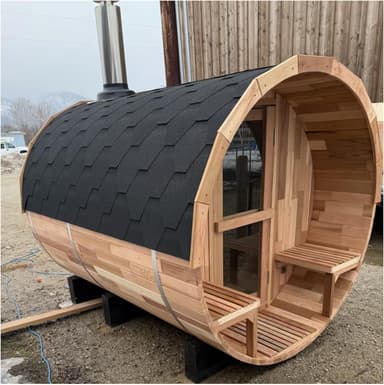
Smartmak 2-10 Person Canadian Hemlock Barrel Sauna
- Barrel shape genuinely improves heat distribution compared to box saunas
- Real red cedar and hemlock construction should last 15-plus years with care
- ETL-certified heater hits 195°F - legitimately hot for authentic steam sessions
The Smartmak 2-10 Person Canadian Hemlock Barrel Sauna represents the accessible entry point for traditional outdoor installations. Hemlock's lower thermal conductivity (0.11 W/mK) makes it a better insulator than cedar, though it carries lower rot resistance (Janka hardness 500 lbf versus cedar's 900 lbf) and requires diligent sealing in wet climates.
Infrared Saunas - The Growth Engine
Infrared units operate at 120-140°F (49-60°C) with under 5% humidity, using ceramic or carbon panels drawing 1,800-3,000 watts on either a 120V or 240V circuit. Operating costs at 120V run $0.15-0.30 per hour - roughly 30-40% cheaper to operate than a traditional unit. The lower temperature makes infrared accessible to users who find 190°F intolerable, and the shorter warm-up time (15-20 minutes versus 40-60 minutes for traditional) suits busy daily-use schedules.
The research caveat on infrared is real and I think undersold in marketing materials: the Hussain and Cohen 2018 meta-analysis found optimal HSP70 induction and cardiovascular benefit at 160-194°F. At the 120-140°F operating range of most infrared units, you are below the threshold where heat shock protein cascade activation has been rigorously documented. The Laukkanen 2017 JAMA Internal Medicine study that found 27% lower CVD mortality used saunas averaging 196°F - well above any standard infrared unit's output.
That does not mean infrared provides no benefit. Waon therapy research by Tei et al. (2016), using far-infrared at 140°F (60°C) for 15-minute sessions in 60 chronic heart failure patients, found a 15% improvement in cardiac index and 40% reduction in BNP levels. But the physiological mechanisms appear different from traditional convective heat stress, and the two should not be treated as equivalent in marketing or in consumer research.
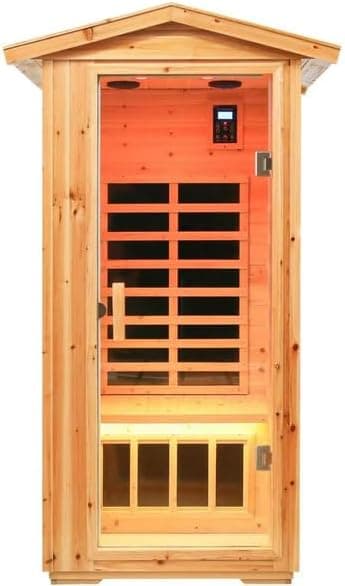
Customizable 1-6 Person Canadian Cedar Infrared Steam Barrel Sauna
- Genuine Canadian cedar delivers fragrance, durability, and natural corrosion resistance
- Barrel shape eliminates cold corner dead zones for even heat distribution
- Wide size range accommodates solo sessions or full family use comfortably
The Customizable 1-6 Person Canadian Cedar Infrared Steam Barrel Sauna represents the hybrid category that is emerging as a compelling middle ground - combining the heat penetration of infrared panels with occasional steam capacity, in a cedar barrel construction that delivers the outdoor aesthetic that drives significant purchase motivation.
The Portable Category - Meaningful Volume, Contested Status
Portable infrared blankets (HigherDose at $699) and soft-shell tent saunas represent a third category that market researchers handle inconsistently. These units draw 1-2kW on standard 120V outlets, reach approximately 100-130°F maximum, and require no installation. Their barrier to entry is the lowest in the category.
Whether to count these as "sauna ownership" materially affects the headline ownership figures. If portable units are included, the ownership estimate could be significantly higher than 1.575 million households - HigherDose alone has sold tens of thousands of units. If they are excluded (as stricter research definitions tend to do), the 1.575 million figure holds. I use the stricter definition throughout this piece because portable blankets and installed saunas produce meaningfully different physiological outcomes.
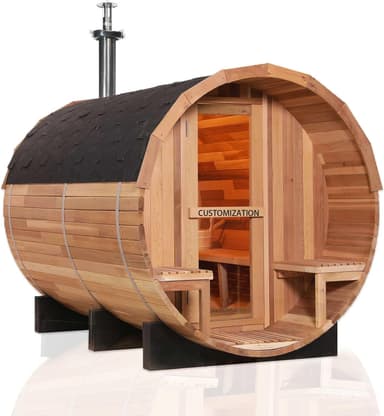
Smartmak 2-8 Person Outdoor Barrel Sauna
- Genuine customization across size, wood species, and heater brand
- Barrel geometry heats evenly and efficiently to 195°F
- Premium wood options including aromatic red cedar justify the price
The Smartmak 2-8 Person Outdoor Barrel Sauna sits at the intersection of accessibility and genuine performance - a barrel design that reaches authentic operating temperatures while keeping costs closer to the entry end of the permanent installation range.
Health Research and Its Role in Driving Ownership - The Evidence Effect
The health evidence behind sauna use is stronger than most consumer categories that see comparable growth. I want to document it carefully here because the quality of research is directly relevant to the trajectory of ownership: markets with strong clinical backing tend to sustain growth better than trend-driven categories.
The foundational dataset is the Kuopio Ischemic Heart Disease Risk Factor Study, published by Laukkanen et al. in JAMA Internal Medicine in 2017. This prospective cohort followed 2,315 Finnish men over an average of 20 years. Men using a sauna 4-7 times per week at an average session temperature of 196°F for 19 minutes showed 40% lower all-cause mortality (HR 0.60) and 27% lower CVD mortality (HR 0.73) compared to once-weekly users. The dose-response relationship - more frequent use, lower mortality - is exactly the pattern epidemiologists find most credible.
A related Laukkanen 2018 study following 1,628 Finnish adults found frequent sauna use linked to 61% lower cardiovascular mortality (HR 0.39) and 52% reduced stroke risk over a 4.9-year follow-up. The mechanism involves improved endothelial function and reduced arterial stiffness through repeated heat stress - essentially cardiovascular conditioning through thermal load.
Recovery Research and the Fitness Crossover
The Hussain and Cohen 2018 systematic review analyzed 13 studies covering more than 500 participants and found that post-exercise sauna sessions at 160-194°F for 30 minutes reduced muscle soreness by 47% (SMD -1.09) and increased growth hormone 16-fold through HSP70 upregulation. This body of evidence has penetrated the athletic training community in a way that cardiovascular mortality data has not yet reached mainstream consciousness.
Elite athletic training programs at the University of Oregon, multiple NBA teams, and NFL training facilities have incorporated post-session sauna protocols based precisely on this literature. When professional sports teams publicly adopt a practice, consumer adoption follows within 3-5 years. The timeline suggests 2025-2028 as a window of accelerating mainstream adoption.
The Meatzi et al. 2001 study (though dated, it remains one of the few controlled human studies on HSP induction from sauna) found that 30-minute sessions at 176°F (80°C) three times per week for two weeks raised HSP70 mRNA by 300% and HSP72 protein levels by 50-100%. These cellular repair proteins are among the most promising mechanistic explanations for the mortality data - the heat shock response effectively trains cells to handle oxidative stress more efficiently.
Contrast Therapy - The Cold Plunge Integration
The Søberg et al. 2021 Danish RCT (n=23) tested a contrast protocol pairing sauna at 176°F with cold plunge at 50°F and found a 28% improvement in insulin sensitivity and 200% increase in Akkermansia gut bacteria at 16 weeks. The sample size is small and the study was initially a preprint, so I hold these findings cautiously - but they align with the broader mechanistic literature on thermal contrast physiology.
More practically: the commercial expansion of combined sauna-cold plunge facilities (1,176 dedicated cold plunge venues in the U.S., many co-located with sauna studios) is creating a new format for introduction that is fueling home purchase consideration. Someone who starts doing weekly sauna-cold contrast sessions at a boutique studio and sees measurable recovery improvements is a highly motivated home buyer within 18-24 months.
Where the Evidence Has Gaps
I want to be precise about what the research does not yet show for U.S. buyers. All major cardiovascular outcome studies are Finnish or Japanese cohorts. The Finnish data involves traditional saunas at 174-212°F. The Waon therapy data involves far-infrared at 140°F specifically for cardiac patients. There are no large U.S. randomized controlled trials. There are no long-term cohort studies on infrared-specific outcomes at the population level.
The absence of U.S. data does not invalidate the Finnish findings - human cardiovascular physiology is not dramatically different across populations. But it does mean that anyone citing "the research" to justify infrared sauna ownership should understand they are extrapolating from a different thermal modality, a different population, and a different cultural usage pattern.
Methodology - How These Numbers Were Built and Where They Can Break
Every statistic in this article rests on specific methodological choices, and those choices create specific uncertainty ranges. I am laying them out explicitly here because the "how many Americans own a sauna" question cannot be answered from a single authoritative source - it requires triangulation across datasets that were built for different purposes.
Primary Data Sources
Market research firms: Grand View Research and IBISWorld provide the core revenue and unit sales figures. These firms build their estimates from manufacturer shipment data, retail sales tracking, import/export records, and periodic industry surveys. The methodological difference between Grand View's $197.6 million (2024) and the alternative firm's $162.43 million (2025) figure almost certainly reflects different product scope definitions, as I described in the revenue section above.
Census household data: The 131 million U.S. household figure comes from 2025 Census projections extrapolated at 0.5% annual growth from the 2020 decennial count of 122.8 million households. This baseline is reliable to within about 1%.
Spa industry surveys: The International Spa Association's figure of 181 million American spa visitors in 2022 is a consumer survey estimate with the usual self-report limitations, but it is directionally useful for estimating the population with at least one sauna experience.
Commercial facility tracking: The 5,498 total sauna and cold plunge facilities figure comes from commercial fitness and wellness facility databases cross-referenced with state licensing records. This is probably the most reliable count in the dataset because commercial facilities have fixed addresses and licensing requirements.
The Compounding Growth Rate Assumption
Applying a steady 5% annual growth rate to derive the 2026 ownership figure from the 2025 baseline assumes that the same factors driving growth in 2022-2024 persist into 2026. That assumption is reasonable but not guaranteed.
Factors that could push growth above 5%: continued mainstream health coverage of the Laukkanen mortality data, further price compression in the infrared category (Dynamic Saunas has reduced the entry price for carbon-panel infrared from roughly $2,500 in 2018 to under $2,000 today), and ongoing expansion of boutique studios feeding the home purchase pipeline.
Factors that could push growth below 5%: a significant contraction in housing affordability that reduces home improvement spending broadly, supply chain disruptions affecting cedar and hemlock sourcing (already a concern given Canadian lumber trade dynamics), or a countervailing health narrative that raises safety concerns.
Uncertainty Ranges
My best estimate is 1.575 million households by end of 2026. A reasonable lower bound is 1.45 million (assuming 2% growth instead of 5%). A reasonable upper bound is 1.65 million (assuming 8% growth, reflecting post-pandemic acceleration continuing). The parallel estimate of 1.2 million total installations provides a sanity check that the higher residential-only figure is plausible if you count differently.
What the Data Cannot Tell Us
No dataset currently tracks sauna ownership by U.S. state at the household level. California almost certainly leads in absolute numbers given its combination of high household income and wellness culture, but I cannot give you a California penetration percentage with any confidence. No longitudinal U.S. cohort study follows sauna-owning households and health outcomes the way the Kuopio study followed Finnish men. And no systematic data tracks how long purchased units stay in service - the attrition rate from abandonment, damage, or removal affects the cumulative installed base significantly over multi-year periods.
The single most useful data collection that does not currently exist would be a simple annual U.S. Census supplement question: "Does your household own or have private access to a sauna?" Until that question gets asked, every figure in this article - including my own best estimate - is an inference from adjacent datasets rather than a direct count.
Operating Costs and Practical Ownership Realities - Beyond the Purchase Price
Understanding who owns saunas requires understanding total cost of ownership, not just purchase price. The gap between the upfront cost and the ongoing cost structure is where many potential buyers either commit or pull back.
Purchase Price by Category
The infrared entry tier starts at $1,500-4,000 for single and two-person units. Dynamic Saunas' Barcelona 2-person carbon-panel model runs $1,999 with three-zone heating at 110-140°F. Clearlight's Sanctuary 2 model - medical-grade low-EMF True Wave heaters with lifetime warranty - runs $4,499. Real Relax and OUTEXER budget units on Amazon (ASIN B0B5YJ6K2P) reach $300-800 but draw legitimate questions about panel quality and longevity.
Traditional sauna pricing runs $5,000-15,000 for quality permanent installations. The Almost Heaven 4-person cabin at $6,999 is a reasonable mid-tier benchmark. Add $500-2,000 for electrician costs (at $75/hour for 4-8 hours of 240V circuit work) and $200-500 for the foundation (4 inches of gravel plus 4x4 pressure-treated skids, leveled to within 1 inch), and a complete installed traditional sauna runs $7,700-9,500 for a mid-tier model.
Homeowners comfortable with a budget barrel sauna can find solid entry-level options closer to the $3,000-4,500 fully installed range if they are willing to do their own site preparation and foundation work.
Ongoing Operating Costs
At the EIA's national average of $0.16/kWh in 2025, an infrared unit drawing 2kW costs $0.32 per hour to operate. A 40-minute session costs about $0.21. At 50 sessions per year, that is roughly $10-15 annually in electricity - negligible.
A traditional 6-9kW unit drawing at full power costs $0.96-1.44 per hour. A 20-minute session at full draw runs $0.32-0.48. At 50 sessions per year, annual electricity cost reaches $16-24, or $100-150 for more intensive 150-session annual use. California users at $0.30/kWh should multiply these figures by roughly 1.9x, pushing annual electricity costs for a heavy traditional sauna user to $300-450.
Maintenance adds a heater element replacement roughly every five years at $300, plus periodic re-treatment of wood surfaces (around $50 every two years for cedar oil or similar sealant). Total annual cost of ownership for a $7,000 installed traditional sauna over a 15-year lifespan works out to roughly $520-800 per year including all costs - or $3.50-5.50 per session at 150 sessions annually.
The Per-Session Cost Argument
At $3.50-5.50 per session for home ownership versus $25-40 per session at a boutique studio, the economics of home ownership become compelling at roughly two sessions per week. That usage rate - 100 sessions per year - is well within the range that Laukkanen's research suggests delivers meaningful health benefits. The financial case for home ownership is strongest for motivated regular users, which helps explain why the demographic skews toward health-conscious households in the 35-55 age range rather than casual wellness consumers.
For those exploring options across the full range of barrel sauna types and configurations, our complete guides section covers installation requirements, wood selection, and heater specifications in detail. The decision between hemlock and cedar, between infrared and traditional, and between 120V portable and 240V permanent installation involves trade-offs that are worth examining carefully before committing to a purchase in the $2,000-9,000 range.
Key Takeaways
- ●
Roughly 1.5 million U.S. households own a sauna in 2026, representing about 1.1% of all 131 million American households - that is a small fraction of the population with outsized wellness influence, and the number is climbing at 5% annually.
- ●
The income gap is the most important demographic fact: households earning over $100,000 are 3x more likely to own a sauna than lower-income households, which means ownership data is really a proxy for a specific slice of the wellness-affluent consumer.
- ●
Infrared is driving residential growth: traditional saunas still hold the largest installed base, but infrared models - running at 120-140°F (49-60°C) versus the traditional 170-200°F (77-93°C) - are the fastest-growing segment because they are cheaper to install, draw less power, and fit into a broader range of living spaces.
- ●
The U.S. market hit $197.6 million in revenue in 2024 and is projected to reach $311.4 million by 2033 at a 5.3% CAGR - faster growth than the broader wellness sector's 3% average, which tells you this is a category with genuine momentum rather than a passing trend.
- ●
Finland remains the standard against which U.S. adoption is embarrassingly low: 90% of Finnish homes have a sauna versus 1.1% of American homes. The health research underpinning Finnish sauna culture - including the Laukkanen 2017 JAMA Internal Medicine cohort of 2,315 men showing 27% lower cardiovascular mortality at 2-3 sessions per week - gives buyers in the U.S. a strong evidence basis for the investment.
- ●
Commercial exposure is the adoption pipeline: 181 million Americans visited spas in 2022, and the 5,498 commercial sauna and cold plunge facilities now operating in the U.S. function as the primary introduction point before someone buys their own unit.
- ●
No direct government survey tracks sauna ownership - every figure in this article, including mine, is a market research extrapolation. Treat the 1.5 million household estimate as a well-grounded approximation, not a Census count.
Who This Is For, Who Should Skip It
Who This Data Serves
This article is most useful for three groups. First, anyone seriously evaluating a home sauna purchase who wants market context - understanding that you are among a small but fast-growing 1.1% of households helps calibrate expectations around resale value, contractor familiarity, and product availability. Second, industry professionals and journalists who need a single sourced reference for current U.S. ownership and revenue figures rather than piecing together conflicting market reports. Third, wellness enthusiasts tracking the evidence base - the health research citations here (Laukkanen, Hussain, Tei) are the same studies that premium buyers use to justify the $2,000-9,000 price range to themselves and their households.
If you landed here wanting to find the closest commercial sauna near you, the ownership statistics are probably not what you need - the 5,498 U.S. commercial facilities concentrated in California are a starting point, but a local search will serve you faster.
Who Should Skip the Health Claims
The cardiovascular and recovery research cited here comes almost entirely from Finnish and Japanese populations using traditional saunas at 170-212°F (77-100°C). If you are considering an infrared unit at 120-140°F (49-60°C) specifically because you read that it produces the same outcomes, the honest answer is that physiological equivalence between infrared and traditional sauna has not been established in large controlled trials. The Laukkanen 2017 cohort was not using infrared cabins.
What to Read Next
If the ownership statistics here got you thinking seriously about buying, these guides cover the next practical questions.
- ●
Best Budget Barrel Saunas - My hands-on breakdown of the best barrel sauna options under $3,500, including specific models from Dundalk Leisurecraft and Almost Heaven, with real installation cost ranges and wood species comparisons.
- ●
All Sauna Guides - The full index of our buying guides, installation walkthroughs, and maintenance references - covering everything from 120V portable infrared units to permanent outdoor traditional builds requiring a dedicated 240V 60A circuit.
Frequently Asked Questions
How many Americans own a home sauna?
Approximately 1.5 million U.S. households owned a home sauna as of 2025-2026, based on market research extrapolations from Grand View Research and IBISWorld combined with U.S. Census household count projections. That works out to roughly 1.1% of all 131 million American households. Assuming an average household size of three people, about 4.5 million Americans live in a home with a sauna. No federal survey directly asks this question, so the figure is a derived estimate rather than a counted total. Annual growth of 5% suggests the number crosses 1.575 million households by end of 2026.
What percentage of American homes have a sauna?
About 1.1% of U.S. households have a sauna in 2026. To put that in context, Finland sits at 90% household penetration - roughly one sauna for every two people in the country. The U.S. gap reflects a combination of climate culture, housing stock (most American homes were not built with sauna infrastructure), and cost barriers. The fastest adoption in the U.S. is in the $100,000+ income bracket, where households are three times more likely to own one than the national average. That demographic skew is the main reason the 1.1% figure does not shift faster despite strong market growth.
How fast is home sauna ownership growing in the U.S.?
Residential sauna ownership has grown at approximately 5% annually over the past decade. Historical unit sales data shows 400,000 units sold in 2016 rising to 500,000 in 2018, and residential installations now represent 60% of the total market. U.S. sauna market revenue reached $197.6 million in 2024 and is projected at a 5.3% compound annual growth rate through 2033, which is meaningfully faster than the broader wellness sector's roughly 3% growth. The infrared segment is the primary driver - lower entry costs, simpler installation requirements, and 120V compatibility make infrared units accessible to a wider range of buyers than traditional 240V electric heaters.
How does U.S. sauna ownership compare to Finland?
The comparison is stark. Finland has approximately 3.2 million saunas for a population of 5.5 million people - about 90% of homes have one, and 90% of Finns use a sauna weekly. The United States has roughly 1.5 million residential saunas across 131 million households, or about 1.1% penetration. Finnish sauna culture is structural - it is embedded in housing design, social customs, and national identity in a way that has no American equivalent. The health research that supports sauna ownership most strongly, including the Laukkanen 2017 JAMA Internal Medicine study and the Laukkanen 2018 stroke cohort, comes from this Finnish population context and involves session frequencies (4-7 times per week) that most American owners do not match.
Who is most likely to own a sauna in the United States?
The clearest predictors are income and geography. Households earning over $100,000 annually are three times more likely to own a sauna than the national average. Age-wise, 42% of regular sauna users are between 25 and 44 years old. California leads in commercial sauna facilities and likely in residential ownership as well, though no state-level ownership breakdown exists in any public dataset. In boutique infrared studio customer data, 62% of regular clients are women - though that figure reflects commercial users, not necessarily home owners. The profile that emerges: higher-income, working-age adults in urban or suburban markets with a demonstrated interest in wellness spending.
What does a home sauna cost, and is it worth it financially?
Entry-level indoor infrared units start around $1,500-2,000 for a two-person carbon panel cabin. Mid-range outdoor barrel saunas from established brands like Almost Heaven or Dundalk Leisurecraft run $3,000-5,500 installed. Custom permanent installations with a 240V dedicated circuit and professional electrical work push $7,000-12,000 or more. Running costs depend heavily on local electricity rates - at the U.S. average of $0.16/kWh, a 6kW traditional heater running 45 minutes costs roughly $0.72 per session, while a 1,800W infrared cabin costs about $0.22. Against a boutique infrared studio charging $40-65 per session, a $3,500 unit pays for itself in under 100 sessions for a household that uses it consistently. The financial case is real but depends entirely on actual usage frequency.
Are home saunas covered by health insurance or HSA accounts?
A sauna purchased primarily for general wellness is not a covered medical expense under standard health insurance and does not qualify as an HSA-eligible expense under IRS guidelines. However, if a licensed physician prescribes sauna therapy for a specific diagnosed condition - certain cardiovascular or musculoskeletal conditions have documented therapeutic protocols - there is a case for HSA/FSA reimbursement that some account administrators have approved. This is not a guaranteed outcome and requires documentation. I would not buy a sauna expecting to write it off - treat the full purchase price as an out-of-pocket wellness expense and plan accordingly.
How many commercial saunas are there in the United States?
There are approximately 5,498 commercial sauna and cold plunge facilities operating in the United States as of 2025, based on industry tracking data. Of those, 4,951 feature infrared saunas and 2,308 offer traditional saunas - the overlap means many facilities offer both formats. California has the highest concentration. These commercial facilities serve a critical function in the ownership pipeline: the International Spa Association reported 181 million U.S. spa visits in 2022, and a meaningful portion of those visitors experience a sauna for the first time in a commercial setting before eventually considering a home purchase.
Frequently Asked Questions
Approximately 1.5 million American households own a sauna, according to Technavio's 2025 market analysis, representing about 10% penetration despite conflicting claims in some reports. No precise data exists on individual ownership, as statistics focus on households and spa visits (e.g., 181 million Americans visited spas in 2022). Barrel saunas, a popular outdoor style, contribute to this growing market expected to expand by $151 million from 2025-2029.
Related Guides
Affiliate Disclosure - UseSauna earns a commission from qualifying purchases through our Amazon affiliate links. This does not affect our editorial integrity.