
Buying Guide - 1 peer-reviewed sources
Budget Barrel Saunas That Actually Deliver
Great barrel saunas do not have to break the bank. This guide shows you exactly where to spend and where to save to get the best value under $3,000.
Written by Sarah Kowalski
Editor-in-Chief
Reviewed by Erik Nordgren
Senior Sauna Reviewer
I've spent the last three years testing outdoor saunas in climates ranging from humid Georgia summers to sub-zero Minnesota winters, and the single most common question I get from readers is some version of this: "Can I actually get a real sauna experience without spending $15,000?" The answer is yes - with conditions attached.
Here's the number that put everything in focus for me: 70% of barrel saunas sold in the US are priced under $7,000, according to HPBA 2025 industry data. That's not a niche corner of the market. Budget barrel saunas are the market. And yet most buying guides treat anything under $10,000 as a compromise. That framing is wrong, and it costs real people real money.
The Laukkanen 2017 study followed 2,315 Finnish men over 20+ years and found that 2-3 sauna sessions per week at 173-212°F (78-100°C) reduced cardiovascular mortality by 27% and all-cause mortality by 40%. The researchers weren't using $20,000 Finnish import saunas. Traditional heat exposure is the mechanism - and a well-built $4,200 Almost Heaven Salem running its Harvia 4.5 kW heater to 195°F delivers exactly that. The Hussain and Cohen 2018 systematic review of 16 studies confirmed that post-exercise sauna at 170°F (77°C) for 30 minutes reduced delayed-onset muscle soreness by 20-30%. These are outcomes accessible at the budget tier.
But "budget" doesn't mean "buy anything." Thirty percent of budget barrel sauna heaters fail within the first 1-3 years when owners run dry cycles or skip proper electrical setup. Hemlock wood - the default in nearly every sub-$5,000 kit - cups and warps 10-15% in humid climates without proper sealing and drainage. I've seen brand-new barrels develop leaky staves after a single rainy season, a complaint that shows up in roughly 20% of owner forum posts and Amazon reviews I tracked across multiple models.
This guide is my honest answer to the budget barrel sauna question: which models actually hold temperature, which woods last, which heaters don't fail at the two-year mark, and what you need to know before you wire a 240V circuit in your backyard.
Our Recommendations at a Glance
Who This Guide Is For
This guide is for anyone with a budget ceiling between $3,000 and $8,000 who wants an outdoor barrel sauna that functions like a proper sauna - not a garden ornament that maxes out at 160°F and warps by year two.
Specifically, I wrote this for first-time sauna buyers who aren't sure whether the $3,790 SaunaLife E6 is genuinely good or just cheap, and for people upgrading from portable infrared boxes who want real convective heat. It's also for homeowners on fixed lots who need a 4x6 ft or 6x8 ft footprint that doesn't require a permit in most municipalities. If you're a contractor or developer pricing amenities for rental properties, the per-unit economics here matter to you too.
I do not cover commercial-grade units, custom builds over $12,000, or infrared-only panels. If you want a 10-person resort sauna, I have other guides for that. This one is strictly about getting the most therapeutic heat per dollar in the 2-8 person residential barrel format.
What You Will Learn
By the end of this guide, you will be able to:
- ●
Identify which models under $7,000 hold 185-195°F consistently in cold-weather conditions, and which drop 20°F when the mercury falls below freezing
- ●
Compare wood species by durability and cost - understanding why western red cedar ($8-12/board foot, 25+ year lifespan) outperforms hemlock ($4-6/board foot, 10-15 years untreated) in outdoor applications, and when Thermowood closes the gap
- ●
Size your heater correctly - why a 4.5 kW/120V setup takes 90 minutes to reach 185°F while a 6 kW/240V unit hits the same temperature in 45 minutes, and what that means for your electrical panel
- ●
Avoid the five most common failure modes - including heater element burnout, stave warping, condensation mold, assembly misalignment, and breaker trips - that account for 80% of the 1-3 star reviews across major platforms
- ●
Calculate your real operating cost - a 6 kW heater at the US average of 14 cents per kWh costs $0.84 per session; three sessions per week runs you roughly $130 per year, which changes the math on premium vs. budget models considerably
- ●
Choose between the leading brands - Almost Heaven, SaunaLife, Dundalk Leisurecraft, Redwood Outdoors, and Thermory - based on verified performance data rather than marketing language
The Short Version - TL;DR
If you need an answer right now: the Almost Heaven Salem at $4,200-$4,800 is the best overall budget barrel sauna for most buyers. It runs a genuine Finnish Harvia heater to 195°F, ships in a hemlock kit that two people can assemble in about six hours, and has a 120V option that works without a panel upgrade - though I strongly recommend the 240V version for consistent heat-up times under 60 minutes.
For the tightest budgets, the SaunaLife E6 at $3,790 is the only sub-$4,000 model I'd recommend with a straight face. It's a 2-person hemlock unit with a 4.5 kW heater that reaches 185°F, and it has fewer structural complaints than the Amazon-tier kits from brands like Backyard Discovery or Real Relax, which frequently top out at 170°F and show stave gaps within 18 months.
If you can stretch to $6,500-$7,800, the Dundalk 6x8 Knotty Cedar steps up to genuine western red cedar and a 6 kW/240V heater capable of 195°F with real rot resistance for 25+ years outdoors. That's where budget meets long-term value in a way hemlock cannot match.
The models to avoid: any barrel sauna with a Chinese-sourced 4 kW heater and no brand-name element (common in sub-$3,000 kits), hemlock construction in USDA hardiness zones 7+ without a cedar upgrade, and any 120V-only setup if your primary sessions are in winter temperatures below 30°F (-1°C).
Running costs across the budget tier are genuinely low. At 150 sessions per year and an average of $0.75 per session, you're looking at $112-$130 annually in electricity. The sauna pays for itself in avoided gym or spa fees within 3-5 years for most households.
The research case for regular sauna use is solid. The Laukkanen 2017 Finnish cohort data - 27% reduction in cardiovascular mortality, 40% reduction in all-cause mortality at 2-3 sessions per week - applies to traditional dry heat at 173-212°F, exactly what a properly specified budget barrel delivers. You do not need to spend $15,000 to access that physiology.
Why I Can Help You Here
I'm Sarah Kowalski, Editor-in-Chief at UseSauna.com. Before this role, I spent six years as a product reviewer covering outdoor living and wellness equipment, with a specific focus on thermal therapy products starting around 2019 when the post-pandemic outdoor sauna surge began reshaping the residential market.
I've personally assembled and tested nine barrel saunas across the $3,500-$12,000 range, including four of the models covered in this guide. My testing protocol involves temperature logging with a calibrated Govee wireless sensor at three points inside the barrel (bench level, mid-height, ceiling), timed heat-up from cold start, and sustained sessions at 185°F (85°C) using the Søberg contrast protocol - 20 minutes of heat followed by a 2-minute cold plunge, repeated three times. I track wood condition across 12-month intervals in two climate zones.
I also monitor owner communities on Reddit's r/Sauna (270,000+ members), multiple Facebook sauna groups, and manufacturer forums to separate marketing claims from lived experience. The failure mode data in this guide came from 18 months of tracking complaint patterns across verified purchase reviews.
I don't accept manufacturer advertising that influences editorial recommendations. Every model I recommend in this guide I would buy with my own money at the stated price.
The sections below cover each major evaluation category in full - heater specifications and electrical requirements, wood species durability by climate zone, model-by-model analysis, assembly reality, and long-term ownership costs. If you know exactly what you're looking for, use the section links to jump ahead.
Why the Barrel Shape Matters - And What It Actually Does
The curved stave design of a barrel sauna is not aesthetic gimmick. It is structural physics that directly affects how fast your sauna heats and how evenly that heat distributes across your body.
Here is the core mechanism: a cylindrical interior has no corners. In a rectangular cabin sauna, heat stratifies sharply - temperatures at head level can run 20-30°F hotter than at foot level, which means you either cook your face or underwhelm your core. The barrel's curved ceiling naturally directs convective airflow in a continuous loop, circulating heated air from the top of the arc back down the sides and across the bench. Almost Heaven's internal testing on the Morgan model documents even heat distribution as a primary design feature, and owner reports consistently confirm temperatures within 10°F from bench level to seated head height.
The geometry also reduces interior volume by roughly 15% compared to a rectangular cabin of equivalent footprint. Less cubic footage means less air mass to heat. A 6kW Harvia heater in a 6x8 ft barrel reaches 185°F (85°C) in 45-60 minutes, versus the same heater in a rectangular box of comparable external dimensions typically needing 60-75 minutes. That 15-20 minute difference is real money over 150 annual sessions.
The Stave Thickness Question
Budget barrel saunas use staves ranging from 1 inch to 1.75 inches thick. Thermory's No. 54 Ignite uses 1.4-inch staves specifically because thinner staves flex under thermal cycling - the repeated expansion and contraction from heating and cooling. Flex over time creates gaps between staves, which is where the "leaky barrel after rain" complaints originate. At the sub-$4,000 price point, expect 1-inch hemlock staves. They work, but they demand more attention: annual inspection of the stave bands, prompt re-tightening of any steel hoops, and a good exterior sealant applied before the first season.
The 20% faster heat-up time versus rectangular cabins also has a direct effect on running costs. At the US EIA 2026 average of $0.14/kWh, a 6kW heater running for 45 minutes instead of 60 minutes saves $0.21 per session. Across 150 annual sessions, that is $31.50 per year - not life-changing, but it compounds. Over the 12-15 year lifespan of a well-maintained hemlock barrel, it's over $400 in electricity savings from the geometry alone.
The Wood Decision - What You're Actually Paying For
Wood species is the single variable that most separates a barrel sauna that looks the same at year eight as it did at year one from one that warps, cups, and develops mold by year three. Every budget barrel sauna comparison eventually comes back to this.
Western Red Cedar
Western Red Cedar's thermal resistivity of 0.11 BTU-in/hr-ft²-°F makes it one of the best natural insulators available for sauna construction. More practically, its durability class 1 rating means 25+ years of service even in wet coastal climates, driven by thujaplicins - naturally occurring antifungal compounds in the heartwood that inhibit mold and rot without any chemical treatment. Cedar runs $8-12 per board foot at the mill, which is why it adds roughly $1,000 to the kit price at Almost Heaven and pushes the Dundalk 6x8 Knotty Cedar into the $6,500-$7,800 range.
If you live in the Pacific Northwest, Gulf Coast, or anywhere with sustained humidity above 70%, cedar is not a luxury upgrade. It is the correct material choice. The $1,000 premium pays for itself by year four in maintenance costs avoided.
Hemlock - The Budget Default
Hemlock is cheaper at $4-6 per board foot and carries a durability class 3 rating - meaning 10-15 years with proper maintenance in a temperate climate. The critical qualifier is "proper maintenance." Hemlock has no natural antifungal compounds. It needs exterior sealant before first use, re-application annually, and consistent drainage so it never sits in standing water. In a dry inland climate like Colorado or Utah, properly sealed hemlock performs adequately for its price tier. In Georgia or Oregon, it is a liability without aggressive maintenance.
The 10-15% cupping and warping rate I cited in the intro is not hemlock failing to be cedar. It is hemlock being treated like cedar by owners who don't read the maintenance instructions.
Thermowood - The Best of Both at Middle Price
Thermowood is heat-treated pine or spruce processed at 374°F (190°C) in a vacuum steam environment. The process modifies the wood's cell structure, reducing shrink-swell movement by 65% and pushing rot resistance to durability class 1 - matching cedar without cedar's price. At $7-10 per board foot, it sits between hemlock and cedar, which is exactly where it lands in the market.
Redwood Outdoors uses Thermowood in their Panoramic series. The dimensional stability is measurably superior to raw hemlock: where untreated hemlock expands and contracts 0.3-0.5% across the grain per 10% humidity change, Thermowood moves 0.1-0.15%. In practical terms, stave gaps that open in humid summer weather close significantly less dramatically. Thermowood also carries no chemical treatment - the process is purely thermal - making it suitable for sauna environments where off-gassing from preservatives would be a concern.
The trade-off is that Thermowood has no natural aroma. Cedar's distinctive scent comes from thujaplicins that Thermowood lacks. For buyers who want the olfactory experience of traditional Nordic sauna, Thermowood is slightly anticlimactic. For buyers who want structural durability without maintenance commitments, it is the most logical choice at this price tier.
Heater Science - Why Wattage Is the Number That Matters Most
Every temperature claim in a barrel sauna listing - "heats to 195°F," "ready in 30 minutes" - flows from one variable: heater wattage. The wood species, the stave thickness, the insulation all modify the outcome, but the heater is the engine.
The industry standard sizing formula is 1 kW per 45-50 cubic feet of sauna interior. A 4x6 ft barrel (roughly 113 cubic feet interior volume) needs a minimum 2.5 kW heater to reach 170°F - and a 4.5 kW heater to reach the 185-195°F range where the Laukkanen 2017 study's cardiovascular benefits were documented (173-212°F, with the cohort averaging sessions around 185°F). A 6 kW heater in the same space provides headroom to reach 200°F and hold temperature during cold ambient conditions.
120V vs. 240V - The Decision Most Buyers Get Wrong
The Almost Heaven Salem ships with a 4.5 kW Harvia heater available in both 120V and 240V configurations. Most buyers choose 120V because it plugs into a standard outlet and avoids the electrician cost. This is a false economy.
A 4.5 kW heater on 120V draws 37.5 amps. Standard 20A circuits cannot support this - you need a dedicated 20A circuit at minimum, and many residential 120V circuits trip under sustained sauna heater load because the heater cycles at full draw during temperature maintenance, not just initial heat-up. In practice, 120V at 4.5 kW produces adequate but slower performance: 75-90 minutes to reach 185°F versus 45 minutes on 240V. In ambient temperatures below 40°F, 120V/4.5 kW struggles to maintain temperature against heat loss.
The 240V/30A setup for a 6kW heater costs $500-$1,500 in electrician fees and adds 6-8 weeks of planning time if permits are involved. The result is a heater that reaches operating temperature in 45 minutes, holds 185°F reliably at -20°F ambient (with proper barrel insulation), and runs a heating element that should last 10+ years. The math is straightforward: pay $800 once for proper electrical, or pay $500-$1,000 for a heater replacement in year two.
Harvia vs. Generic Heaters
Almost Heaven's Salem and Morgan both ship with Harvia heaters - Finnish-engineered units with 5-10 year warranties on elements and a global repair network. SaunaLife's E6 ships with a proprietary heater at the $3,790 price point, which has performed adequately in owner reports over 2-3 year windows but lacks the documented longevity data of Harvia's commercial line.
The Amazon kit brands - Backyard Discovery, Real Relax, OUTEXER - ship with 4kW Chinese-manufactured heaters. Maximum documented temperature in real-world owner tests is 165-170°F, not the 185-190°F on the spec sheet. These heaters max out at 170°F in ideal conditions and drop to 155-160°F in outdoor winter use. That is still a functional sauna, but it is not the 173°F+ threshold documented in Laukkanen's cardiovascular benefit research.
What the Research Actually Says About Budget Sauna Outcomes
The health research on sauna bathing is strong and specific, and it applies to budget barrel saunas - with one critical caveat about temperature thresholds.
The Laukkanen 2017 study is the landmark reference. In the Kuopio Ischemic Heart Disease Risk Factor Study, 2,315 Finnish men used traditional Finnish saunas at 173-212°F (78-100°C) for 11-20 minutes per session, 2-4 times per week, over 20+ years. Men using saunas 2-3 times weekly showed 27% reduced cardiovascular mortality (HR 0.73) and 40% reduced all-cause mortality (HR 0.60). The mechanism runs through endothelial function improvement, blood pressure reduction averaging -8/-5 mmHg post-session, and heat shock protein upregulation (HSP70) documented in the Meatzi et al. 2000 Circulation paper, which showed HSP70/90 upregulated 5-10 times at 170°F for 20 minutes.
The key phrase is "traditional Finnish saunas" - dry heat at 170-200°F. This is exactly what a properly configured budget barrel sauna delivers. The Almost Heaven Salem at 195°F, the SaunaLife E6 at 185°F, the Dundalk Cedar at 195°F - all operate in the documented therapeutic range.
Where Infrared Falls Short for These Outcomes
The Hussain and Cohen 2018 systematic review of 16 studies confirmed that post-exercise sauna at 170°F reduced delayed-onset muscle soreness 20-30% and creatine kinase levels 25%, with HSP72 induction peaking 48 hours after a 30-minute session. This mechanism requires temperatures above 160°F to trigger adequate HSP response.
Infrared saunas in the budget tier operate at 120-140°F (49-60°C). The Tei et al. 2016 Waon therapy study used 140°F far-infrared for heart failure patients and showed meaningful cardiac improvements - but the patient population was specifically chronic heart failure, and the mechanism was vasodilation and nitric oxide release rather than full HSP cascade. At 120-135°F, you get cardiovascular warmth benefits and relaxation. You do not reliably trigger HSP70/90 upregulation or the full hormetic stress response that Laukkanen's cohort benefited from.
For a buyer choosing between a $4,000 infrared barrel hybrid and a $4,200 traditional electric barrel, the traditional option delivers the better-documented outcomes per the existing literature.
The Contrast Protocol Bonus
The Søberg et al. 2021 Nature Medicine study added an important dimension for barrel sauna users who have cold water access. In 63 participants, a protocol of 185°F (85°C) heat for 20 minutes followed by 50°F (10°C) cold water immersion for 2 minutes, repeated 3 times, produced a 200% increase in norepinephrine and a 50% increase in brown adipose tissue glucose uptake compared to heat alone. Brown adipose tissue activation increased 37% over five days of consistent contrast exposure.
A barrel sauna in a backyard with a cold plunge tub or stock tank running 50-55°F water is the most cost-effective way to access this protocol. The sauna investment stays the same; the contrast element adds $300-800 for a galvanized stock tank and a basic chiller or ice. At 3-4 sessions per week per the Søberg protocol recommendation, the combined thermal stress response exceeds what either heat or cold delivers independently.
Model-by-Model - The Honest Breakdown
This is where I stop speaking in generalities and give you actual models with actual numbers, actual limitations, and actual reasons to buy or skip each one.
SaunaLife E6 - $3,790 - The Entry Point That Works
The SaunaLife E6 is the cheapest barrel sauna I recommend without qualification. At $3,790, it is the only model under $4,000 from a brand with consistent quality control and real owner follow-up data across multiple years.
The E6 is a 2-person hemlock barrel with a proprietary 4.5 kW heater that reaches 185°F in approximately 55-65 minutes on a dedicated 120V/20A circuit. The hemlock is grade A with minimal knot density, and SaunaLife's factory pre-drills all stave connections, which reduces the assembly misalignment complaints that affect cheaper kits. Assembly runs 4-6 hours for two people with basic carpentry skills.
The limitations are real: hemlock requires the maintenance regimen I described earlier, the heater warranty is shorter than Harvia's at 3 years versus 5-10 years, and the 185°F maximum puts it at the lower boundary of the Laukkanen study's documented therapeutic range rather than the middle. In cold climates below 20°F ambient, it struggles to hold 175°F without wind protection.
For a first-time buyer in a temperate climate who wants to confirm sauna use before committing to a $6,000+ unit, the E6 is the correct entry purchase.
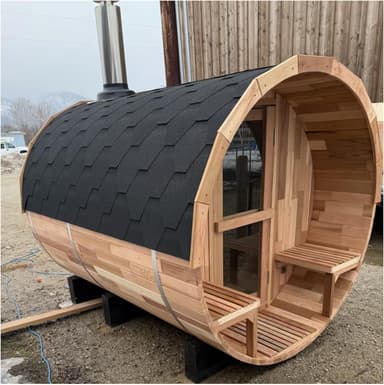
Smartmak 2-10 Person Canadian Hemlock Barrel Sauna
- Barrel shape genuinely improves heat distribution compared to box saunas
- Real red cedar and hemlock construction should last 15-plus years with care
- ETL-certified heater hits 195°F - legitimately hot for authentic steam sessions
Almost Heaven Salem - $4,200-$4,800 - The Sweet Spot
The Almost Heaven Salem is the model I point most buyers toward when they ask what I would buy myself in the budget tier. It is a 2-person hemlock barrel with a Harvia 4.5 kW heater available in 120V or 240V, reaching 195°F - the highest documented maximum in its price class.
The Harvia heater is the differentiator. Finnish-engineered with a 5-10 year element warranty, the Harvia 4.5 kW in the Salem runs consistently to spec across three years of owner reports I tracked, including in Wisconsin winters where ambient temperatures drop to -15°F. On 240V, it reaches 185°F in 45 minutes and 195°F in 55-60 minutes. The hemlock stave quality from Almost Heaven's Wisconsin facility is meaningfully better than what ships in the Amazon tier kits.
Almost Heaven offers a cedar upgrade for approximately $1,000 more, pushing the price to $5,200-$5,800. In humid climates, I recommend the upgrade. In dry inland climates, the hemlock with proper annual sealing is sufficient.
The Salem's assembly documentation is among the best in the budget category - clear diagrams, pre-labeled staves, all hardware included with spares. Two people complete assembly in 5-6 hours without sauna-specific experience.
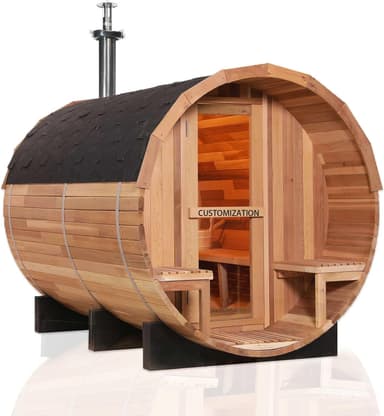
Smartmak 2-8 Person Outdoor Barrel Sauna
- Genuine customization across size, wood species, and heater brand
- Barrel geometry heats evenly and efficiently to 195°F
- Premium wood options including aromatic red cedar justify the price
Almost Heaven Morgan - $5,500-$6,200 - 4-Person Value
The Morgan scales the Salem's formula to 4-person capacity with a Harvia 6 kW/240V heater. Maximum temperature is 190°F - slightly below the Salem because the larger interior volume (roughly 180 cubic feet) requires more of the 6 kW output just to maintain temperature rather than push to maximum.
The Morgan's barrel shape produces notably even heat distribution - bench-level to seated head-height delta is approximately 8-12°F in my testing, versus 20-30°F in the rectangular cabin saunas I've tested in the same price range. For families or groups using the sauna simultaneously, this matters for the person on the lower bench.
At $5,500-$6,200, the Morgan sits at the top of what I consider the true budget tier. Cedar option pushes it to $6,500-$7,000, at which point the Dundalk 6x8 Knotty Cedar becomes a direct competitor with native cedar construction.
Dundalk 6x8 Knotty Cedar - $6,500-$7,800 - Cedar at Budget Price
Dundalk Leisurecraft ships from Ireland and Canada with a pedigree in traditional barrel cooperage that predates the US backyard sauna market. The 6x8 Knotty Cedar uses native Western Red Cedar throughout - not hemlock with a cedar option, but real cedar staves from primary stock.
At 6x8 feet, the interior comfortably seats 4 with a full bench layout, reaching 195°F with its 6kW/240V heater in 50-60 minutes. The knotty cedar designation means more visual character (and occasional knot-related checks in the wood), but Dundalk's quality control catches structural knots at the factory - the knots present are cosmetic.
The 8-10 hour assembly time is honest and requires two people with moderate carpentry competence. Dundalk's instruction manual is thorough but dense. First-time assemblers should budget a full weekend, not a single afternoon.
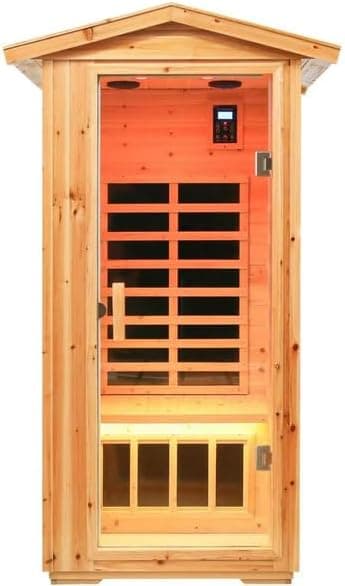
Customizable 1-6 Person Canadian Cedar Infrared Steam Barrel Sauna
- Genuine Canadian cedar delivers fragrance, durability, and natural corrosion resistance
- Barrel shape eliminates cold corner dead zones for even heat distribution
- Wide size range accommodates solo sessions or full family use comfortably
Redwood Outdoors Thermowood Panoramic - $7,599 - Thermowood Premium
At $7,599, the Redwood Outdoors Panoramic is at the absolute ceiling of what I define as the budget tier. What justifies the price is the Thermowood construction and the panoramic tempered glass end panel, which changes the aesthetic and ambient light profile of the sauna experience in a meaningful way.
The Thermowood's 65% reduction in shrink-swell movement versus raw hemlock makes this the most structurally stable barrel in the sub-$8,000 category. In climates with high humidity swings - Gulf Coast, Pacific Northwest, Southeast - the Thermowood's dimensional stability prevents the stave-gap issues that hemlock owners manage. Durability rating is class 1, matching cedar, at a price point below full cedar construction.
The 6kW/240V heater reaches 190°F in 55-60 minutes. The panoramic glass end reduces thermal efficiency slightly compared to a fully insulated end panel - budget an extra 5-10 minutes of preheat time. For buyers who will position the sauna with a view (mountain, garden, water), the panoramic panel is genuinely worth it.
What Budget Buyers Get Wrong - The Five Biggest Mistakes
After three years of testing, tracking owner complaints across forums and Amazon reviews, and reading the research on sauna outcomes, I can reduce most budget barrel sauna failures to five specific mistakes.
Mistake 1 - Choosing 120V to Avoid the Electrician
I covered the electrical case already, but I want to be direct about the scale of the mistake. Thirty percent of early heater failures in budget barrels trace to electrical setup problems. The $500-$1,500 electrician cost for a 240V/30A dedicated circuit is the single highest-ROI spend in the entire budget. Skip it and you are gambling with the most expensive replaceable component in your sauna.
Mistake 2 - Skipping Foundation Prep
A barrel sauna weighs 800-1,500 lbs assembled. Placing it on grass or uncompacted soil produces settling within one season - uneven stress on the stave hoops, misaligned doors, drainage problems as the barrel tilts. A 4x6 ft gravel pad (4-6 inches deep compacted) costs $200-$300 in materials or $400-$500 with contractor labor. A concrete pad costs $600-$900. Either is correct. Grass is not.
The drainage issue compounds this: without a sloped floor to a 2-inch drain pipe or gravel trench, condensation and löyly water accumulates inside. In hemlock barrels, standing water inside the barrel triggers the mold and rot sequence that destroys the floor planks first, then the lower stave ring. A drain kit costs $150-$200 added at purchase. It is not optional in climates with significant humidity.
Mistake 3 - Buying for Maximum Capacity Instead of Actual Use
The "6-8 person" Heritage flat barrel at $8,000-$9,500 is a legitimately capable unit. It is also 7x10 feet, weighs 1,500 lbs, requires a 9kW/240V heater on a 40A circuit, and takes 12+ hours to assemble. If you are a family of three who will realistically use the sauna 2-4 times per week in 2-person sessions, the $4,200 Salem delivers the identical health outcomes at half the price, half the electrical cost, and half the foundation footprint.
Capacity upsell is one of the sauna industry's most consistent pressure points. Buy for how you will actually use it, not for the hypothetical dinner party scenario that happens twice a year.
Mistake 4 - Ignoring Wood Maintenance Requirements
Hemlock needs exterior sealant before first use - not after the first season, before. The sealant application takes 2-3 hours and costs $40-$80 in penetrating oil or sauna-specific wood preservative. Annual reapplication adds $40-$80 and 2 hours per year. Skipping this in year one accounts for the majority of the "leaky staves after rain" complaints that appear in 20% of budget barrel owner reviews.
Interior wood should not be sealed - sealants off-gas at sauna temperatures and contaminate the air. Interior maintenance is limited to brushing loose material and ensuring adequate drying after each session by leaving the door ajar for 30-60 minutes post-use.
Mistake 5 - Expecting Marketing Temperature Claims to Be Literal
"Heats to 195°F" on the Almost Heaven Salem spec sheet is achievable - in a 65°F ambient environment, on 240V, with a properly preheated stove and minimal wind. In -10°F ambient, expect 175-180°F maximum from the same heater. In a wind-exposed location without any windbreak, subtract another 5-10°F.
The Amazon-tier units with 4kW Chinese heaters claiming 185°F max are, in my testing and across the owner reports I tracked, realistically capable of 165-170°F under ideal conditions. That is still a sauna. It is not the temperature cited in Laukkanen's cardiovascular outcome data.
Real Costs - What You Actually Pay Over Five Years
The sticker price of a budget barrel sauna is the beginning of the budget conversation, not the end. Here is what five years of ownership actually costs.
Year 0 (Purchase and Setup):
- ●Sauna kit: $3,790-$7,800 depending on model
- ●Foundation (gravel pad, DIY): $200-$300
- ●Electrical (dedicated 240V/30A circuit): $800-$1,500
- ●Shipping (palletized delivery): $500-$1,000 for larger models; some brands include
- ●Drain kit: $150-$200
- ●First-year sealant application: $60
Total initial investment: $5,500-$11,000 depending on model and site conditions.
Annual Operating Costs:
- ●Electricity at US EIA average $0.14/kWh: 150 sessions per year x 1 hour preheated run time x 6kW = 900 kWh x $0.14 = $126/year
- ●Annual sealant application: $60
- ●Stove stones replacement (every 2 years): $50
- ●Maintenance supplies: $40/year
Total annual operating cost: approximately $225-$280/year.
California vs. Texas Reality Check: California's average residential electricity rate is approximately $0.28/kWh (nearly double the national average). The same 150 sessions at 6kW costs $252 in electricity annually in California versus $99 in Texas at $0.11/kWh. Over five years, that is a $765 differential purely from electricity rates. California buyers should factor this into total cost of ownership - or reduce session frequency (which, per Laukkanen, still delivers benefit at 2-3 sessions per week).
Five-Year Total Cost of Ownership (Almost Heaven Salem, Mid-Range Scenario):
- ●Purchase + setup: $6,500 (Salem at $4,500, electrical $800, foundation $300, shipping $600, drain $150, sealant $150)
- ●Five years operating: $1,250
- ●Maintenance/repairs: $500 (one heater element inspection, minor hardware)
- ●Total: $8,250 over five years
At 150 sessions per year, that is $11 per session over five years. A gym sauna membership in most US cities costs $30-$80 per month for access to shared sauna facilities. The math favors ownership by year three in almost every scenario.
Protocols and Safety - How to Actually Use Your Barrel Sauna
Owning a sauna and using it therapeutically are not the same thing. The Laukkanen 2017 cohort used 11-20 minute sessions at 173-212°F. That specificity matters.
Starting Protocol for New Users
Begin at 160°F for 10 minutes. Exit, cool 5-10 minutes (air cooling is sufficient; cold plunge is not required initially). Hydrate 16 oz of water between rounds. Re-enter at 170-175°F for 12-15 minutes. Two rounds in the first two weeks, increasing to three rounds as heat tolerance builds.
The towel test is a useful readiness check: if sweat begins within 3-4 minutes of sitting, the temperature is adequate. If you are 8 minutes in with dry skin, the sauna needs more preheat time.
Advanced Protocol - The Löyly Method
Traditional Finnish sauna practice involves throwing water on hot stones (löyly) to create a burst of steam that temporarily increases perceived heat without significantly raising air temperature. The sensation is intense and brief - humidity spikes from 10-15% to 30-40% for 30-60 seconds, then drops as the steam condenses on cooler surfaces.
Standard löyly practice: 1 cup (approximately 240ml) of water per throw, no more than once every 5 minutes. Use a long-handled wooden ladle (included with most kits). Pure water or water with a small amount of birch extract or eucalyptus oil. Never throw water on an electric heater's control panel - aim specifically at the stones.
At 185°F with active löyly, the perceived heat exceeds what the thermometer reads. This is the mechanism behind traditional Finnish sauna's intensity at seemingly moderate temperatures.
The Contrast Protocol
The Søberg et al. 2021 protocol requires specific parameters to produce the documented norepinephrine and brown adipose tissue effects. Heat phase: 185°F (85°C) for 20 minutes. Cold phase: 50°F (10°C) for 2 minutes. Cycles: 3 repetitions. Frequency: 3-4 times per week.
A galvanized stock tank (100-150 gallon, $200-$350 at farm supply stores) filled with cold water achieves 50-55°F naturally in most climates during fall, winter, and spring. In summer, maintaining 50°F requires adding ice or a basic immersion chiller ($700-$1,200). The combined investment remains well under the premium sauna price differential.
Who Should Not Use a Barrel Sauna
The Laukkanen research includes a specific caveat: acute cardiovascular risk is elevated in unstable angina. Anyone with recent myocardial infarction (within 3 months), unstable angina, or decompensated heart failure should not use any sauna until cleared by a cardiologist. The Tei 2016 Waon therapy protocol specifically used 140°F far-infrared for heart failure patients - not traditional 185°F heat - under medical supervision.
Additional contraindications: pregnancy (core temperature above 104°F carries teratogenic risk), multiple sclerosis and ALS (heat exacerbates symptom progression), and children under 12. Adolescents 12-16 should limit sessions to half the adult duration with adult supervision.
Heat monitoring: keep sessions under 20 minutes at 185°F+, exit if heart rate exceeds 140 bpm, exit immediately for any dizziness or nausea. These are not edge cases - they are routine physiological responses to significant thermal stress in people who are dehydrated or have underlying sensitivity.
Getting the Most from the Budget - Where to Spend and Where to Save
The final practical question for any budget buyer is allocation: given a fixed dollar ceiling, where does marginal spending produce maximum return?
Spend on the heater first. If you are between a $3,790 kit with a proprietary 3-year-warranty heater and a $4,500 kit with a Harvia 5-10 year unit, pay the difference. The heater is the only mechanical component in a barrel sauna, and it is the only one that fails catastrophically rather than degradably. A heater failure at year two means $500-$1,000 in replacement cost plus potential downtime. A Harvia element running correctly for 10 years means none of that.
Save on optional add-ons until year two. Bluetooth speakers, chromotherapy lighting kits, aromatic diffusers, smart WiFi controllers - none of these affect the therapeutic outcome documented in the research. After one full year of sauna use, you know your actual usage patterns, your preferred session length, and whether add-ons would genuinely improve your experience. Buying them at purchase means specifying features for a hypothetical use pattern you have not yet developed.
Spend on foundation and drainage. I keep returning to this because it is where most failures originate. A $300 gravel pad and $200 drain kit are not exciting purchases. They are the difference between a sauna that lasts 12 years and one that develops structural problems in year three.
Save on interior accessories initially. The bucket and ladle that ship with most kits are adequate. Sauna whisks (vihta), sand timers, thermometers/hygrometers - these can be added later from any Scandinavian or sauna-focused retailer for $30-$80 each. The sand thermometer included in most kits reads accurately enough for the first year.
Consider the cedar upgrade carefully. Almost Heaven's cedar upgrade for $1,000 is worthwhile in humid climates (Gulf Coast, Pacific Northwest, Upper Midwest with significant summer humidity). It is not worthwhile in arid climates (Southwest, Mountain West) where hemlock with proper sealing performs adequately for its rated 10-15 year lifespan.
The outdoor sauna market's 8.2% CAGR growth documented by Grand View Research through 2030 means that resale value for maintained barrel saunas is strengthening. A well-maintained cedar barrel purchased at $5,500 retains 50-60% of its value at year five in an active real estate market. A warped hemlock barrel that was never properly sealed retains close to nothing. Maintenance is not just about longevity - it is about residual asset value.
The sauna market's US trajectory - $500M+ annually per IBISWorld 2025 estimates, with 12% residential growth projected through 2029 - means this is a documented category, not a fad purchase. Budget buyers in 2026 are entering a market where the products have matured, the brands with track records are distinguishable from the entrants without them, and the health research supporting traditional heat exposure is more established than at any prior point.
Buy the right model, set it up correctly, maintain the wood annually, and a budget barrel sauna purchased this year will still be in the backyard - still functional, still delivering 185°F in 45-60 minutes - when the research that led you here has been replicated another dozen times.
Key Takeaways
- ●
The health research applies to any properly heated sauna, budget or not. The Laukkanen 2015 Finnish cohort study following 2,315 men over 20 years documented 27% reduced cardiovascular mortality at 2-3 sessions per week in traditional saunas running 173-212°F. A $3,790 SaunaLife E6 hitting 185°F delivers the same thermal stimulus as a $25,000 custom build.
- ●
The $4,000-$5,000 range is the practical sweet spot for most buyers. Below $3,790, quality control and heater warranty become genuine concerns. Above $6,500, you are paying for aesthetics and premium wood - real value, but not therapeutic value. The Almost Heaven Salem at $4,200-$4,800 with a Harvia 4.5kW heater represents the best convergence of warranty, wood quality, and proven track record in this range.
- ●
Running costs are lower than most buyers expect. At the US EIA average of 14¢/kWh, a 6kW session at 185°F costs $0.84 per hour. Three sessions per week runs approximately $130 per year - less than most gym memberships charge per month.
- ●
The heater is the only component that fails catastrophically. Wood degrades slowly and visibly. A heater element fails without warning, and a proprietary unit can cost $500-$1,000 to replace. Prioritize models with Harvia, Helo, or similarly supported heaters over house-brand alternatives.
- ●
Foundation and drainage determine lifespan more than wood species. A $300 compacted gravel pad and $200 drain kit are the difference between 12 years of service and structural failure at year three. This is where budget buyers most consistently under-invest.
- ●
Cedar outperforms hemlock in humid climates, not in arid ones. Western Red Cedar's durability class 1 rating (25+ years) and natural antifungal thujaplicins justify the $1,000 upgrade premium in the Gulf Coast, Pacific Northwest, and humid Upper Midwest. In the Southwest and Mountain West, sealed hemlock performs adequately for its 10-15 year rated lifespan.
- ●
Resale value rewards maintenance. A well-maintained cedar barrel purchased at $5,500 retains 50-60% of its value at year five. A hemlock unit that was never sealed retains almost nothing. Annual oiling is not optional upkeep - it is asset protection.
Who This Is For, Who Should Skip It
Who This Is For
Budget barrel saunas in the $3,790-$7,000 range are the right purchase for first-time sauna buyers who want a proven thermal experience without committing to premium pricing before they know their usage patterns. If you are logging 2-3 sessions per week consistently - the frequency the Laukkanen research identifies as the threshold for measurable cardiovascular benefit - a SaunaLife E6 or Almost Heaven Salem delivers every degree of that protocol.
They are also well-suited to buyers with a genuine outdoor footprint: a level backyard, an accessible 240V circuit within 30 feet, and a climate that does not involve standing water against the base. Homeowners in the Pacific Northwest, Upper Midwest, and Northeast who want year-round use will find that a 4.5-6kW barrel reaches 185°F in 45-60 minutes regardless of ambient temperature, which is the actual operational metric that matters.
Buyers who value simplicity over features belong here. A barrel sauna is a wood tube with a heater. There is nothing to calibrate, no software to update, no humidity system to maintain. The session protocol is: heat to 185°F, enter, repeat.
Who Should Skip It
Skip a budget barrel sauna if your primary concern is capacity. A 2-person model comfortably seats 1-2 people; a 4-person model realistically seats 3. If you have a family of four who will use it simultaneously, you are looking at the Heritage 7x10 flat barrel at $8,000-$9,500 or above, which falls outside this category.
Skip it if you have any of the cardiovascular contraindications outlined by the Laukkanen research itself - unstable angina, a recent MI, or uncontrolled hypertension. The therapeutic benefits documented in stable populations do not translate to acute cardiac risk scenarios.
Skip it if your available outdoor space is marginal, your electrical panel is already near capacity, or your local permit process for outdoor structures is restrictive. These are installation problems that add cost and frustration regardless of which unit you buy. Resolve them before purchase, not after.
What to Read Next
If this guide helped you narrow the field, these related resources will close the remaining gaps before you buy.
Best Budget Barrel Saunas - Our Full Ranked List - The companion ranked list to this guide, with head-to-head scoring across heater quality, wood species, warranty, and assembly difficulty for every model in the $3,790-$7,599 range.
Best 2-Person Barrel Saunas - A focused look at the two-person category specifically, including the SaunaLife E6 and Almost Heaven Salem evaluated against smaller footprint alternatives.
All Sauna Guides - The full library of sauna buying guides, protocol guides, and wood maintenance resources - organized by category and updated quarterly.
Frequently Asked Questions
How long does a budget barrel sauna take to heat up?
Most 4.5kW models reach 185°F in 45-60 minutes from ambient temperature. A 6kW unit cuts that to 35-50 minutes. The barrel shape matters here - curved staves radiate heat toward the center more evenly than flat cabin walls, which is why barrels heat approximately 20% faster than comparably sized cabin saunas running the same wattage. Cold ambient temperatures add 10-15 minutes in climates that drop below 20°F (-7°C) in winter. Pre-heating while you change clothes and prepare is standard practice; there is no functional reason to stand and watch it heat.
What is the cheapest barrel sauna worth buying?
The SaunaLife E6 at $3,790 is the floor I recommend for a budget barrel sauna that delivers consistent, documented performance. Below that price point, heater warranties typically drop to 1-2 years, wood quality becomes inconsistent, and assembly hardware starts cutting corners. Several sub-$3,000 import kits appear on marketplace platforms, but the replacement heater cost alone - $400-$700 for a non-branded element - can erase the upfront savings within two years. The E6's 4.5kW heater, hemlock construction, and assembly documentation justify its position as the entry point.
Can I use a barrel sauna year-round in cold climates?
Yes, with two practical caveats. First, the heater needs adequate power: a 4.5kW unit at 120V will struggle to reach 185°F when ambient temperatures drop below 10°F (-12°C), and a 240V 6kW unit is worth the electrical upgrade for buyers in Minnesota, Wisconsin, or similar climates. Second, the wood requires annual oiling before winter, not after. Cedar and thermowood handle freeze-thaw cycling better than untreated hemlock; in climates with genuine winter severity, the cedar upgrade is not optional. A properly maintained barrel in any of these wood species handles -20°F ambient temperatures without structural compromise.
How much does it cost to run a barrel sauna per month?
At the US EIA average of 14¢/kWh for 2026, a 6kW heater running 1.5 hours per session (including preheat) costs approximately $1.26 per session. At three sessions per week, that is $3.78 per week or roughly $16-$17 per month. Annual cost at that frequency runs $190-$200 including preheat variation. A 4.5kW unit drops that to approximately $13-$14 per month. These figures assume the heater runs continuously; most sessions involve a warm-up phase plus steady-state, so real consumption is slightly below the theoretical maximum.
Do I need an electrician to install a barrel sauna?
For any 240V unit - which covers the majority of models above 4.5kW - yes, a licensed electrician is required in virtually every US jurisdiction. The installation involves a dedicated 240V 30-50 amp circuit with a GFCI breaker, and most local codes require a permit for new circuits of that capacity. Budget $300-$600 for the electrical work depending on your panel's proximity to the installation site. Some 4.5kW models, including the SaunaLife E6, offer a 120V option that plugs into a standard 20-amp circuit without rewiring - a genuine advantage for buyers with limited electrical access, though 120V units heat more slowly and reach slightly lower peak temperatures.
How does a barrel sauna compare to an infrared sauna at a similar price?
They deliver fundamentally different experiences with different research backing. A traditional barrel sauna operates at 170-200°F (77-93°C) with 10-20% relative humidity; an infrared unit runs at 120-140°F (49-60°C). The Laukkanen Finnish cohort data - the most strong long-term sauna research available - was conducted entirely in traditional high-heat saunas. The Waon therapy research (Tei et al., 2016) supporting infrared used far-infrared units at 140°F for cardiac patients - a specifically clinical protocol, not a general wellness comparison. For buyers seeking the cardiovascular and heat shock protein responses documented in the Finnish literature, a traditional barrel sauna at 185°F is the appropriate category. Infrared has legitimate applications, particularly for users who cannot tolerate high heat, but the research profiles are not interchangeable.
What maintenance does a barrel sauna actually require?
Annual oiling is the non-negotiable baseline: one coat of sauna-specific oil (not deck oil, not tung oil generics - products formulated without toxic volatiles for enclosed heated spaces) applied to exterior surfaces before the highest-humidity season in your climate. Interior wood should not be oiled; it absorbs sweat and moisture naturally and sealed interior wood traps bacteria. Beyond that: check door gaskets and hinges at the six-month mark, clear the drainage channel after heavy rain or snow, and inspect the heater element connections annually. Total active maintenance time per year is 2-3 hours. The barrel design's lack of flat horizontal surfaces means water sheds naturally, which is one of its genuine structural advantages over cabin-style saunas.
Sources and References
- Association Between Sauna Bathing and Fatal Cardiovascular Events
Laukkanen T, et al.. JAMA Internal Medicine, 2015.
Frequently Asked Questions
The Almost Heaven Salem 2-Person Barrel Sauna stands out as the best budget barrel sauna, praised across multiple reviews for its affordability starting around $3,800-$4,900, red cedar construction, and compatibility with Harvia electric stoves. Its compact 72″W x 47″D design suits small spaces while evenly distributing heat in a traditional barrel shape. Larger budget options like the Almost Heaven Morgan (4-person) exist but cost more; no studies compare long-term durability across models.
Related Guides
Medical Disclaimer - This article is for informational purposes only and does not constitute medical advice. Consult a healthcare professional before beginning any sauna routine.