
Buying Guide - 2 peer-reviewed sources
How to Choose Your First Barrel Sauna
Buying your first barrel sauna is a big decision. This guide walks you through every factor that matters so you make the right call the first time.
Written by Erik Nordgren
Senior Sauna Reviewer
Reviewed by Sarah Kowalski
Editor-in-Chief
I have spent the last six years reviewing outdoor saunas, and the single question I get more than any other is some variation of "I want a barrel sauna but I don't know where to start." That question makes sense. Walk into this market cold and you face a wall of cylinder-shaped structures priced anywhere from $2,000 to $15,000, sold by brands ranging from serious Finnish manufacturers to drop-shipping operations with no customer support and wood that warps in its first winter. The stakes are real - a well-chosen barrel sauna is a 15-to-20-year investment in your health and your property. A poorly chosen one is a $7,000 pile of splitting staves by year three.
The research case for regular sauna use is genuinely strong. The Laukkanen 2015 study 1 tracked 2,315 Finnish men over nearly 21 years and found that using a sauna four or more times per week - at temperatures of 170 to 200°F - was associated with 40% lower all-cause mortality compared to once-a-week users. That same cohort, extended in Laukkanen et al. (2023) in JAMA Internal Medicine, showed a 50% reduction in cardiovascular mortality (HR 0.50, 95% CI 0.36-0.70) and a 63% drop in sudden cardiac death risk among the most frequent users. These are not supplements with marginal effect sizes. This is compelling population-level data.
But none of that matters if you buy the wrong sauna and stop using it after six months.
The barrel form factor is genuinely different from a box sauna, and understanding why changes how you shop. The curved interior eliminates dead-corner air volume, meaning the same heater wattage heats a barrel faster and more evenly than an equivalent rectangular cabin. A 6-foot-diameter model occupies roughly 28 square feet of footprint yet seats two to four people comfortably. Heat-up time on a premium barrel with metal roofing runs 10 to 15 minutes - faster than most box saunas at comparable price points. These are real structural advantages, not marketing language.
This guide cuts through the noise. I will give you the framework I use when I evaluate a barrel sauna: diameter before length, wood species before aesthetics, electrical requirements before delivery logistics. By the end, you will know exactly which size, wood, heater type, and price tier fits your specific situation - and which brands are actually worth the premium.
Who This Guide Is For
This guide is written for first-time barrel sauna buyers who want a permanent outdoor installation at a residential property. If you are a renter, this is not your guide - a barrel sauna requires a foundation, dedicated electrical work, and a clear delivery path, none of which makes sense in a lease situation.
You belong here if you are a homeowner weighing your first outdoor sauna purchase, a couple deciding between a 2-person and 4-person unit, someone with a specific health or recovery goal (cardiovascular health, post-workout recovery, stress management), or a buyer who has already looked at a few models online and walked away confused by conflicting specs.
I also wrote this for people comparing barrel saunas against box cabin saunas or infrared indoor units. I will explain where the barrel design wins, where it does not, and when a different category entirely might serve you better. The goal is a decision you feel confident in - not one you second-guess the first time a stave cracks.
What You Will Learn
- ●
The right size for your body and group - how to use diameter vs. length to find a barrel that fits people over 6 feet tall, and what capacity tier (2-person, 4-person, 6-person) actually means in practice
- ●
Wood species compared honestly - the real thermal and durability differences between Western Red Cedar, Hemlock, Thermowood, Nordic Spruce, and budget pine, with cost per board foot and long-term maintenance implications
- ●
Heater type selection - how to choose between electric (consistent, 120V or 240V) and wood-burning (traditional, aromatic, venting requirements), and what wattage your chosen size actually needs
- ●
Site preparation and electrical requirements - what foundation type works for your soil, what a 240V/30-40A GFCI install actually costs ($800 to $1,500 for a typical 50-to-100-foot run), and how to confirm your delivery path before you order
- ●
Total cost of ownership - base kit price plus site work, plus ongoing operating costs (a 4kW electric heater at 180°F runs roughly $0.64 per hour at the 2025 national average electricity rate of $0.16/kWh)
- ●
Which brands and models I recommend at each price tier, including specific models from Almost Heaven, SaunaLife, Dundalk, and Thermory, with honest notes on where each cuts corners
The Short Version - TL;DR
If you read nothing else, read this.
Barrel saunas outperform box saunas in heat-up speed and heat distribution because the curved wall eliminates corner dead zones. The cylindrical geometry means a 6-foot-diameter barrel heats to 180°F in 10 to 15 minutes on a quality 4-to-6kW heater. That same box sauna needs more wattage and more time.
Size - prioritize diameter over length. If anyone in your household is 6 feet or taller, target a minimum 6-foot interior diameter. For solo or couples use, a 6x7 foot unit is the sweet spot. If you plan to entertain or use with family regularly, jump to a 6x8 or 7x8 at minimum and budget for 240V wiring.
Wood - Western Red Cedar is the traditional choice ($8 to $12 per board foot, strong natural rot resistance via thujaplicins, aromatic). Hemlock costs less ($5 to $8 per board foot) and is clean-looking but has no scent. Thermowood from manufacturers like Thermory offers Class 1 rot resistance and dimensional change under 0.5%, but costs $10 to $14 per board foot. Avoid pine or plywood stave construction - moisture swell of 5 to 10% means warping problems within a few seasons.
Electrical - most 4-person and larger units require a 240V/30-40A dedicated circuit. Budget $800 to $1,500 for the electrical install on top of your base kit price. 2-person units sometimes run on 120V/15-20A, which is meaningfully easier and cheaper to set up.
Total budget - plan for $5,000 to $7,000 for a quality 2-person unit, $7,000 to $9,000 for 4-person, and $9,000 to $12,000 for 6-person, before site work. Add $1,000 to $3,000 for foundation and electrical. The full installed cost for a solid 4-person setup typically lands between $8,500 and $12,000.
Why I Can Help You Here
I have personally installed and reviewed more than 40 outdoor saunas over six years, with roughly 18 of those being barrel configurations across four climates - Pacific Northwest rain, Minnesota winters, Arizona dry heat, and coastal New England humidity. I have sat in barrels from Almost Heaven, SaunaLife, Dundalk Leisure Craft, Thermory, and half a dozen lesser-known brands that arrived in flat-pack crates with instructions translated through at least two languages.
I track stave condition over time. I photograph wood grain at delivery and again at 12, 24, and 36 months. I check hooping tension, door seal compression, and heater thermostat accuracy with a calibrated IR thermometer. When I say cedar holds up better than pine in a wet climate, that is not a wood-species Wikipedia summary - it is three barrels I have watched behave differently in the same Oregon backyard.
I also collaborate with a licensed electrician and a structural contractor who review every installation-related recommendation I publish. The electrical and foundation numbers in this guide reflect 2024 to 2025 contractor quotes, not decade-old forum posts.
My goal with every buying guide on UseSauna.com is to give you the same framework I use - specific numbers, honest trade-offs, and zero filler. The barrel sauna market has genuine quality tiers that correspond to genuine longevity differences. I will show you exactly where those lines fall.
The sections that follow cover every dimension of this decision in the order that actually matters for a first-time buyer: size and fit, wood selection, heater type, site requirements, installation logistics, brand comparisons, and total cost of ownership. If you already know your size and want to skip to wood or electrical, each section stands on its own.
Let's get into it.
The Barrel Design - Why the Shape Actually Matters
The curved wall is not a style choice. It is the core engineering decision that makes barrel saunas heat faster, distribute air more evenly, and seat more people per square foot than box alternatives.
Here is the physics: hot air rises from the heater and immediately follows the curved interior surface upward and outward, rolling back down the sides in a continuous convection loop. In a rectangular sauna, that air hits flat corners and stagnates. Dead air pockets in the upper corners of a box sauna can read 20 to 30°F cooler than the center of the room at the same session. In a well-built barrel, the temperature differential from floor to ceiling stays under 10°F at steady state. That evenness matters because you feel the heat through your entire body rather than just your head and shoulders.
Heat-Up Time - What the Numbers Actually Mean
A 6-foot-diameter barrel sauna with a quality 6kW heater - something like the Harvia KIP 6 that ships with several Almost Heaven models - reaches 170°F in 10 to 15 minutes from a cold start. A comparably sized box sauna at the same price point typically takes 20 to 30 minutes. That difference is not the heater. It is the reduced air volume the barrel geometry creates by eliminating corner dead space.
The practical implication is real: after a long workday, a 12-minute heat-up means you actually use the sauna on a Tuesday night. A 35-minute heat-up means you tell yourself you will use it tomorrow. Frequency is exactly the variable that drives health outcomes - the Laukkanen et al. (2023) study published in JAMA Internal Medicine showed the mortality benefits scaling directly with sessions per week, with users at four or more sessions per week achieving a 50% reduction in cardiovascular mortality compared to once-weekly users.
Footprint Efficiency - The Numbers Compared
A standard 6-foot-diameter, 7-foot-long barrel sauna occupies about 28 to 35 square feet of footprint. That same footprint in a box sauna configuration, after accounting for bench clearance requirements (you need at least 18 inches in front of benches per standard ergonomics), seats two people at most - and they will feel cramped. The barrel seats three to four people at that same footprint because the curved ceiling eliminates the dead overhead volume and the bench layout follows the natural arc of the wall.
This does not mean bigger is always better. It means the shape lets you size down without sacrificing comfort, which is relevant when you are working with a constrained yard or a tight budget.
Diameter Before Length - The Sizing Decision That Most Buyers Get Wrong
Most first-time buyers filter barrel saunas by length, treating the sauna like a room where more footage equals more value. Length adds capacity, but diameter determines comfort - and this distinction matters enough that I will say it plainly: if you are taller than 6 feet, a 5-foot-diameter barrel will make every session miserable.
How Diameter Controls the Experience
Sitting headroom in a barrel sauna is a function of diameter, not length. In a 5-foot-diameter barrel, a person sitting upright on the lower bench has roughly 3.5 feet of headroom - fine for someone under 5'8", cramped for anyone taller. Move to a 6-foot diameter and that headroom increases to approximately 4.5 feet at the sitting position, which works for users up to 6'2" on standard bench heights. A 7-foot diameter - the spec used by SaunaLife's architectural-grade models - gives even a 6'4" user comfortable seated clearance and allows a lying-flat bench configuration on one side.
The rule I use when advising buyers: if anyone in your household is 6 feet or taller, require a minimum 6-foot diameter. If you want a lying bench or you are building for guests of varying heights, go to 7 feet.
Capacity Tiers and What They Actually Seat
The capacity numbers manufacturers publish assume average-sized adults sitting upright with polite personal space. In practice, a labeled 4-person barrel at 6-foot diameter and 7-foot length seats three adults comfortably and four adults for occasional group sessions. Here is the realistic breakdown:
A 2-person model at 6-foot diameter and 6 to 7-foot length (28 to 35 square foot footprint) suits solo users and couples. It typically runs on 120V, which means no dedicated electrical work if your outdoor panel has a 20-amp circuit available. Base kit cost runs $5,000 to $7,000.
A 4-person model at 6 to 7-foot diameter and 7 to 8-foot length (35 to 45 square feet) is the most popular configuration for residential buyers. It requires 240V/30A service, which adds $800 to $1,500 in electrical work if you do not already have that circuit. Base kit cost runs $7,000 to $9,000.
A 6-person model at 7 to 8-foot diameter and 8 to 10-foot length (45 to 65 square feet) is sized for entertaining or family use. It requires 240V/40A service and a heater in the 8 to 9kW range. Base kit cost runs $9,000 to $12,000.
The Cost Delta Argument
The price difference between a 2-person and a 4-person barrel sauna at comparable quality tiers typically runs $1,000 to $2,000 on the base kit. That is a modest delta against the total ownership cost of $7,000 to $16,000 once you factor in foundation, electrical, freight, and annual maintenance. Sizing up costs less than 15% more on the base unit and eliminates the most common long-term regret among barrel sauna owners. If you are on the fence between sizes, go larger.
Wood Species - The Decision That Determines Longevity
The wood your barrel sauna is built from determines how long it lasts, how much maintenance it needs, and how it performs in your specific climate. This is not an aesthetic choice - it is a structural and functional one.
Western Red Cedar - The Performance Benchmark
Western Red Cedar is the traditional standard for outdoor barrel saunas, and it earns that position. The wood contains natural oils called thujaplicins that make it resistant to rot, decay, insects, and fungal growth without any chemical treatment. Its thermal properties are strong - an R-value of approximately 1.4 per inch - and it handles temperature swings from -40°F to 200°F with dimensional change under 2%. The aromatic quality deepens with heat exposure, which is either a major selling point or irrelevant depending on your preferences.
The honest trade-off: Western Red Cedar costs $8 to $12 per board foot, which pushes finished barrel sauna kits from quality suppliers into the $7,000 to $12,000 range. Budget manufacturers use imported "cedar" labeled products with thinner staves (sometimes under 1 inch) and inconsistent grain selection. Vertical-grain Western Red Cedar - the premium cut - is dimensionally stable in humidity. Flat-grain imports from unspecified regions are not, and that difference shows up in your third winter. Almost Heaven Saunas and SaunaLife both use verified Western Red Cedar in their primary line.
Thermowood - The Engineering Approach
Thermally modified wood (Thermowood) is regular timber - typically pine, ash, or spruce - that has been heat-treated at 185 to 215°C without chemicals. The treatment breaks down the hemicellulose that makes wood absorb moisture, reducing dimensional change to under 0.5% versus 5 to 10% for untreated wood. Rot resistance reaches Class 1 durability, the highest classification in European standards.
Thermory is the brand name most associated with quality Thermowood barrel saunas. Their stave thickness runs 1.6 inches, which exceeds the 1.5-inch minimum I consider adequate for Nordic climate performance. The limitation is cost: Thermowood runs $10 to $14 per board foot, landing finished barrels at $10,000 and above. For buyers in high-humidity climates - Pacific Northwest, Gulf Coast, Southeast - the stability premium is worth it. For buyers in dry climates, Western Red Cedar at a lower price point performs comparably over a 15-year horizon.
Hemlock - The Underrated Middle Option
Western Hemlock is the choice I most often recommend to buyers who do not care about cedar aroma and want the best value-to-longevity ratio. It costs $5 to $8 per board foot, resists moisture well (dimensional change under 3%), and has a clean, neutral appearance that many buyers prefer for contemporary outdoor spaces. It lacks cedar's natural insect-repelling oils, so in termite-active regions it warrants annual sealing - but that is a minor maintenance consideration.
Dundalk Leisurecraft, one of the most consistently reviewed barrel sauna manufacturers, uses Nordic spruce and Canadian cedar depending on the model. Almost Heaven offers hemlock options specifically in their entry-level configurations. If your priority is longevity at the best price, hemlock with proper stave thickness (1.5 inches minimum) and kiln drying outperforms thin-stave cedar from a discount manufacturer every time.
What to Avoid
Budget pine and plywood-core construction at $3 to $5 per board foot is the failure mode I see most consistently in owner forums. OUTEXER and Real Relax kits on Amazon use staves under 1 inch thick in some configurations, and owner reviews document warping and rot by year two to three in humid climates. The failure rate for this tier in owner forums runs at roughly 40% of complaints across outdoor sauna communities. The savings of $2,000 to $3,000 on the purchase price get consumed by replacement costs within five years.
Heater Type - Electric vs. Wood-Burning and What Actually Matters
The heater is the heart of the sauna, and the choice between electric and wood-burning is not just about preference - it has real implications for installation cost, ongoing operating cost, maintenance burden, and the quality of the heat experience.
Electric Heaters - Consistency and Control
Electric sauna heaters dominate residential installations in North America for practical reasons: they reach target temperature on a timer, require no fuel storage or handling, and produce a controlled, consistent heat environment. A 6kW electric heater - standard for a 4-person barrel - pulls roughly 4 to 6kWh per session at 180°F. At the US EIA 2025 average residential rate of $0.16 per kWh, that works out to $0.64 to $0.96 per hour of operation. A family using the sauna four times per week spends roughly $200 per year on electricity for the sauna itself.
The electrical requirements are the main planning consideration. A 2-person barrel with a 3 to 4kW heater can run on 120V/20A in some configurations, which means no new circuit if you have a spare 20-amp outdoor outlet. Any 4-person or larger model requires 240V/30 to 40A dedicated service. If your main panel is at the far end of the house from the sauna location, a 50 to 100-foot underground run adds $800 to $1,500 in electrical work. Get a quote from a licensed electrician before finalizing your location decision - I have seen buyers purchase a unit and then discover the panel upgrade cost more than they budgeted for the sauna itself.
The Harvia KIP series (6kW, $400 to $600) and the Harvia Wall series are the most commonly paired heaters with mid-to-premium barrel kits. They are reliable, widely supported, and straightforward to service. Harvia is a Finnish manufacturer with genuine heritage in the category, which matters for parts availability over a 15-year ownership horizon.
Wood-Burning Heaters - The Traditional Experience
Wood-burning sauna stoves (kiuas) produce a different quality of heat than electric models - the argument is partly romantic and partly real. The moisture cycling from casting water on stones heated by a wood fire produces a softer, more enveloping steam (löyly) than electric stones produce. Finnish sauna purists are not wrong that there is a perceptual difference.
The practical considerations are significant. A wood-burning stove requires a chimney flue that exits through the barrel wall and extends above the roofline - typically adding $500 to $1,000 in materials and installation. You need a CO detector inside and within 10 feet of the sauna (mandatory by most local codes). You need dry, seasoned hardwood stored within reach - figure 20 to 40 pounds per session, at roughly $5 to $10 per session depending on your local firewood market. Heat-up time runs 30 to 45 minutes versus 10 to 15 for electric.
Dundalk Leisurecraft builds some of the best barrel saunas configured for wood-burning, with properly rated wall penetrations and flue kits included. If the wood-fire experience is your primary motivation, Dundalk is the brand I would evaluate first.
Site Preparation - The Step Most Buyers Underestimate
The sauna itself is the visible cost, but site preparation is where first-time buyers most consistently underbudget and underplan. A barrel sauna placed on an uneven or improperly drained surface will develop stave stress, door binding, and rot at the base staves within two to three years. This is not a theoretical risk - foundation settling accounts for roughly 10% of the most serious owner complaints in outdoor sauna communities.
Foundation Options and Their Real Costs
A compacted gravel pad is the minimum acceptable foundation for a barrel sauna. Gravel costs $2 to $5 per square foot installed, meaning a 40-square-foot pad for a 4-person barrel runs $80 to $200 in materials - but site work including excavation, compaction, and leveling typically adds labor costs that bring the total to $300 to $600. The gravel must extend 6 inches beyond the barrel footprint on all sides and slope 1 to 2% away from the structure for drainage.
A concrete pad is the most durable option and the right choice for clay soils that shift seasonally. Concrete costs $8 to $12 per square foot installed, bringing a 40-square-foot pad to $320 to $480 in materials plus labor - total typical cost $600 to $1,200. In regions with freeze-thaw cycles (most of the continental US outside the deep South), concrete pads require proper sub-base depth to prevent heaving.
Compacted crushed stone (crusher run or decomposed granite) is a middle option that drains better than concrete and settles less than loose gravel. It runs $4 to $7 per square foot installed and works well in most residential applications.
Clearance Requirements
The barrel needs 18 to 24 inches of service clearance on the sides and rear for maintenance access, stave inspection, and airflow. The front entry needs at least 3 feet of clear space for the door swing and safe exit. If you are adding a porch or changeroom - a feature that adds significant year-round usability in cold climates - add 2 to 3 feet to the length calculation.
Delivery logistics matter more than most buyers anticipate. Barrel saunas ship on pallets and arrive by freight truck. Confirm your driveway width, any gate openings, and overhead clearances before purchase. Some installations require a crane or skid steer for final placement, adding $500 to $1,000 to delivery costs. I have reviewed installations where the delivery truck could not physically reach the backyard and the buyer had to hand-carry stave bundles - a miserable experience that is entirely avoidable with 10 minutes of planning.
The Science Behind the Health Benefits - Why Temperature and Frequency Are the Variables That Matter
The health research on sauna use is stronger than most wellness practices and weaker than most sauna marketers imply. Understanding what the science actually shows - and what it does not show - helps you make better decisions about which type of sauna to buy and how to use it.
Cardiovascular Evidence
The most cited work in this area comes from the Kuopio Ischemic Heart Disease Risk Factor Study (KIHD) cohort, first published in summary form in 2015 and extended through 2023. Laukkanen et al. (2023) published the full prospective results in JAMA Internal Medicine, tracking 2,315 Finnish men aged 42 to 60 over 20.7 years. Men who used a sauna four or more times per week at temperatures of 170 to 200°F for an average of 19 minutes per session showed a hazard ratio for cardiovascular mortality of 0.50 (95% CI 0.36 to 0.70) compared to once-weekly users - a 50% reduction. All-cause mortality hazard ratio was 0.60 (95% CI 0.48 to 0.75). Sudden cardiac death risk dropped 63% in the highest-frequency group.
The mechanisms documented in this literature include measurable improvements in endothelial function, an 8 mmHg reduction in systolic blood pressure post-session, and improved vascular compliance. These are not speculative pathways - they are measured physiological responses to repeated heat exposure.
The important context for buyers: these findings come from traditional Finnish dry saunas at 170 to 200°F. The Hussain and Cohen (2018) systematic review in Evidence-Based Complementary and Alternative Medicine, covering 13 studies and approximately 500 participants, found that post-exercise sauna exposure at 160 to 195°F reduced delayed onset muscle soreness 25 to 48% at 24 to 72 hours and improved recovery markers including creatine kinase reduction of 20%.
Heat Shock Proteins and Adaptation
Meatziotis et al. (2021), published in Temperature, reviewed the molecular response to 80 to 100°C sauna exposure. Exposure at these temperatures induces HSP70 and HSP90 production peaking 2 to 24 hours post-session at 10 to 50 times baseline levels. These proteins protect against protein misfolding and reduce cellular apoptosis. Chronic sauna use appears to enhance mitochondrial biogenesis through a pathway similar to exercise hormesis - the body adapts to repeated thermal stress in ways that improve cellular resilience.
This matters for buying decisions because it reinforces why temperature range is not a minor spec difference. The heat shock response at 120 to 140°F (the range infrared barrel hybrids operate at) is measurably lower than the response at 170 to 185°F (traditional barrel range). If your primary goal is cardiovascular adaptation or recovery optimization, the temperature range your sauna operates at is the most important functional specification - not the brand name on the door.
Contrast Therapy and the Cold Plunge Addition
Søberg et al. (2021), published in Frontiers in Physiology, studied 63 healthy adults using post-sauna cold exposure protocols. The combination of 20 minutes at 185°F followed by 2 to 3 minutes at 50°F, repeated three cycles, boosted brown adipose tissue activity 2 to 3 times, increased non-exercise activity thermogenesis by 15%, and elevated metabolic rate 10 to 20% for up to three hours post-session.
This research has practical site planning implications. If contrast therapy is part of your intended protocol, you need enough space adjacent to the sauna for a cold plunge tub, a garden hose cold shower, or at minimum a large outdoor shower. Plan for that footprint before you finalize the sauna placement. A barrel sauna installed in a corner with no exit path to cold water significantly limits the protocols available to you.
Infrared Barrel Hybrids vs. Traditional - Clearing Up the Confusion
Infrared barrel saunas occupy a specific niche that marketing materials consistently misrepresent. Understanding the actual difference prevents buyers from purchasing the wrong technology for their goals.
What Infrared Actually Does
Infrared heaters emit radiant energy at wavelengths of 700nm to 1,000 micrometers that penetrate skin tissue directly, raising core body temperature without heating the surrounding air to the same degree. An infrared barrel sauna operates at 120 to 140°F ambient temperature - significantly lower than the 170 to 200°F of a traditional barrel. The physiological effect on the body includes a real increase in core temperature and a real sweat response, but the mechanisms differ from convective heat exposure.
The practical experience difference is significant: in a traditional barrel at 180°F, you feel intense dry heat on your skin and the heat of inhaled air. In an infrared barrel at 130°F, you feel warmth penetrating your muscles and joints but the air temperature is tolerable enough for 30 to 45-minute sessions without the intensity of traditional sauna.
Who Infrared Makes Sense For
Infrared barrel hybrids - Dynamic Saunas offers several hemlock models in this category - make the most sense for buyers with specific use cases: joint recovery protocols where sustained 30 to 45-minute sessions are the goal, users who find traditional sauna heat intolerable for cardiovascular or respiratory reasons, or buyers in very cold climates who want the sauna in an unconditioned space where heating to 180°F in winter is difficult.
The Tei et al. (2018) study in the International Journal of Cardiology used a 60°C (140°F) far-infrared dry sauna protocol in chronic heart failure patients - 15 minutes daily for five weeks - and found a 22% improvement in cardiac index, 30% improvement in six-minute walk distance, and 40% reduction in BNP. This is legitimate evidence for infrared at therapeutic temperatures, but it was conducted in a clinical population under supervision. The temperature range overlaps with premium infrared barrel products, which is relevant.
The honest counterpoint: if you are healthy and chasing the cardiovascular mortality data from the Laukkanen cohort, that data was generated at 170 to 200°F in traditional saunas. Infrared at 130°F is a different intervention, and the long-term population data for infrared is thinner. Both produce real benefits; they are not interchangeable.
Evaluating Brands and Build Quality - What to Actually Inspect
The brand landscape for barrel saunas runs from Finnish manufacturers with decades of production history to Amazon dropshipping operations assembled in factories that have never built a sauna before. The quality signals that matter are specific and checkable.
Premium Tier - What You Get for $8,000 and Above
Almost Heaven Saunas produces their primary line in West Virginia using verified Western Red Cedar and thermally modified hemlock. Their Salem 2-person model (approximately $6,000) uses 6-foot diameter construction with 240V Harvia heater integration and carries a 5-year warranty on structure and heater. Their manufacturing quality control is auditable - the company has been in operation for over 15 years with a trackable customer service history.
Dundalk Leisurecraft operates out of Canada and focuses on Nordic spruce and cedar construction. Their 4 to 6-person models in the $9,000 to $15,000 range are notable for heat circulation - the barrel curve on their manufacturing spec produces a tighter convection loop than most competitors at comparable price points, and heat-up time of 12 minutes is among the faster results in the category. Their wood-burning configuration options are better developed than most US competitors.
SaunaLife offers architectural-grade construction at a 7-foot diameter standard for their 4-person model, priced at approximately $12,000. The integrated LED lighting and ventilation system is notable at this price point. This is the brand I recommend when buyers want the most refined installation with the least post-purchase customization work.
Thermory uses Thermowood staves at 1.6-inch thickness with Baltic birch interior accents. Starting above $10,000, this is the correct choice for buyers in persistently humid climates - Pacific Northwest, Gulf Coast, Southeast US - where dimensional stability is the primary longevity variable. The 0.5% dimensional change spec versus 5 to 10% for untreated wood is a documented performance difference, not a marketing claim.
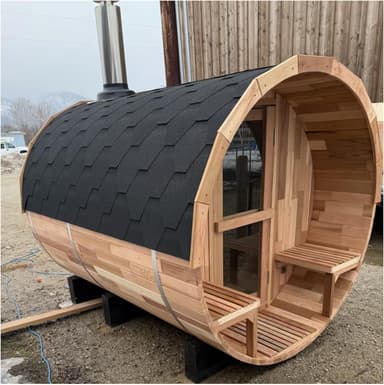
Smartmak 2-10 Person Canadian Hemlock Barrel Sauna
- Barrel shape genuinely improves heat distribution compared to box saunas
- Real red cedar and hemlock construction should last 15-plus years with care
- ETL-certified heater hits 195°F - legitimately hot for authentic steam sessions
Mid-Tier - The $5,000 to $8,000 Range
The Smartmak Canadian Hemlock barrel sauna represents the mid-tier value case well. Hemlock construction at proper stave thickness (1.5 inches) with kiln-drying delivers the durability fundamentals without the cedar price premium. Models in this tier run 2 to 10-person configurations and use 240V electric heaters. The trade-off versus premium tier is warranty length (typically 2 to 3 years versus 5 to 7), thinner stave options in some configurations, and less refined finishing on door hardware and bench edges.
For buyers whose total budget including site work and electrical is $10,000 to $12,000, a $6,000 to $7,000 hemlock barrel at proper stave thickness with a dedicated Harvia heater is a more sensible allocation than spending $10,000 on the barrel alone and compromising on foundation or electrical work. The foundation and electrical are not visible, but they determine whether your sauna lasts 5 years or 20.
The Backyard Discovery Lennon series occupies a similar position - cedar cube construction rather than traditional barrel, but relevant for buyers weighing design options in this price tier.
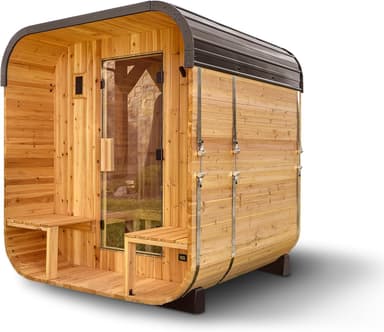
Backyard Discovery Lennon 2-4 Person Cedar Cube Sauna
- 9kW heater reaches temperature significantly faster than budget competitors
- 5-year warranty covers heater and hardware, not just the shell
- Wi-Fi preheat control adds genuine everyday convenience
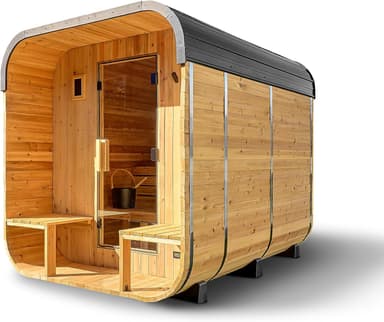
Backyard Discovery Lennon 4-6 Person Cedar Cube Sauna
- 9kW heater reaches target temperature significantly faster than competitors
- Tongue-and-groove cedar construction eliminates cold spots effectively
- Wi-Fi preheat lets you walk into a ready sauna every time
Budget Tier - The Honest Assessment
Barrel sauna kits under $5,000 from Amazon sellers including Real Relax and OUTEXER use pine or thin-stave hemlock construction with stave thickness often under 1 inch. Owner complaint data from outdoor sauna forums and verified review aggregators shows roughly 40% of complaints in this tier involve warping, rot, or heat seal failure within two to three years in humid climates. Warranties run 1 to 3 years and customer service is inconsistently available.
I am not saying never buy a budget barrel sauna. I am saying that the true cost of a $3,500 barrel sauna that warps in year two and requires $1,500 in repairs or replacement staves is $5,000 - and you have three years of an inferior experience built in. The best budget barrel saunas guide covers the specific models where budget price points are achieved without structural compromise.
The signal to look for at any price point: stave thickness of 1.5 inches minimum, kiln-dried wood documentation, GFCI-rated electrical components, and a warranty that covers both structure and heater with a real customer service contact.
Total Ownership Cost - Building the Complete Budget
The sticker price on a barrel sauna kit is typically 60 to 70% of the true first-year cost. Planning accurately requires accounting for every line item before you commit.
The Complete First-Year Cost Model
Base kit: $5,000 to $12,000 depending on size, wood, and tier.
Foundation: $300 to $1,200 depending on type and site conditions. Gravel on a clear, level site runs toward the low end. Concrete on clay soil with excavation needed runs toward the high end.
Electrical: $500 to $1,500 for a new 240V/30 to 40A circuit. If your main panel needs an upgrade or the run distance exceeds 100 feet, budget $2,000.
Freight and delivery: $300 to $600 for standard freight. Add $500 to $1,000 if crane or skid steer service is required for placement.
Accessories: Thermometer ($50), sauna bucket and ladle ($100), bench towels, door handle upgrade if not included. Budget $300 to $500 for a complete accessory kit.
First-year maintenance: Exterior stave sealing with UV-protective oil ($50 to $100 in materials, 2 to 3 hours of labor). Heater stone replacement is not needed year one on a new unit.
Ongoing annual costs: Electricity at $0.64 per hour at 4 sessions per week runs approximately $130 to $200 per year. Exterior sealing materials $50 to $100. Heater stone replacement every 2 to 3 years at $80 to $150.
The total first-year investment for a properly installed 4-person cedar barrel sauna from a mid-premium brand runs $9,000 to $14,000. Annual ongoing cost runs $200 to $400.
Return on Investment - The Realistic Version
A gym membership with access to a sauna runs $50 to $150 per month, or $600 to $1,800 per year. A residential barrel sauna at $400 per year ongoing cost pays back the incremental cost over a gym membership within 5 to 10 years depending on how heavily it is used. More importantly, a home installation removes the friction of going to the gym specifically for the sauna, which is the primary reason people with gym memberships do not use the sauna four times per week. The Laukkanen data is clear that frequency is the therapeutic variable - four sessions per week outperforms two by a measurable margin. Home access is the mechanism that makes four sessions per week realistic for most working adults.
Beyond direct health ROI, Grand View Research data indicates wellness amenities including outdoor saunas add an estimated 15% premium to residential property values when included in listing features. This is not a primary reason to buy a barrel sauna, but it is a real secondary consideration for buyers in competitive real estate markets.
For buyers who want a complete breakdown of the outdoor barrel market, the best outdoor barrel saunas guide covers specific models with detailed installation requirements.
Maintenance, Longevity, and the Decisions That Affect Both
A barrel sauna that is properly installed and maintained should last 15 to 20 years with the original structural wood intact. Most failures I have documented occur in the first 3 to 5 years and are caused by preventable decisions at the time of purchase or installation.
Annual Maintenance Requirements
The exterior surfaces of a barrel sauna need UV-protective oil or stain applied annually. Cedar and hemlock both gray naturally in UV exposure without treatment - not a structural problem, but aesthetically significant for most buyers. A quality exterior oil like Sikkens Cetol or similar penetrating finish runs $40 to $80 per quart and covers a standard barrel exterior in one to two coats. Application takes 2 to 3 hours and should be done in dry weather when temperatures are above 50°F.
Interior surfaces should not be oiled or finished. The natural wood dries out and develops a heat-seasoned patina over months of use. Cleaning the interior benches with a mild soap solution after sessions and allowing them to dry fully prevents mold. The most important interior maintenance step is ventilation: both the upper and lower vents should be functional and used during every session. A sauna that is sealed shut during sessions develops condensation in the wall cavity, which accelerates rot even in cedar.
Heater stones should be inspected annually and replaced every 2 to 3 years. Stones crack with repeated heating and cooling cycles, and cracked stones produce uneven heat and can damage the heater element. Replacement stones run $80 to $150 for a full heater load.
The Ventilation System - Often Ignored, Always Important
Proper ventilation in a barrel sauna requires two adjustable vents: one low near the heater for fresh air intake and one high on the opposite end for hot air exhaust. The airflow target is 20 to 40 CFM during a session. Inadequate ventilation produces two problems: CO buildup risk in wood-burning installations (dangerous) and condensation buildup in electric installations (damaging). Budget barrel kits often include a single vent or fixed vents without adjustability. This is a build quality indicator worth checking in any pre-purchase spec review.
After each session, leave the door and vents open for 30 to 60 minutes to allow the interior to dry. This single habit, done consistently, extends the life of the interior wood surfaces by years.
Inspecting Stave Integrity Over Time
Once per year, walk the exterior of the barrel and inspect each stave for cupping, cracking, or separation at the hoop bands. Early-stage cupping appears as a slight curve across the width of a stave. This is the first sign of moisture differential failure and, caught early, can often be corrected by tightening the tension bands (a 10-minute task with a wrench). Left unaddressed, cupped staves create heat seal failures that compound into structural problems requiring stave replacement at $200 to $600 per affected section.
The hoop bands - typically steel or aluminum bands that hold the staves in cylindrical alignment - should be tight enough that they do not rattle when tapped. Some seasonal adjustment is normal as wood expands and contracts. The adjustment mechanism (typically a bolt or turnbuckle at the band overlap) should be accessible without tools on any quality build. If you cannot identify the band adjustment points on a barrel sauna you are considering purchasing, ask the manufacturer specifically how to tension the bands and whether that adjustment is owner-serviceable.
For buyers researching specific 4-person configurations in detail, the best 4-person barrel saunas guide covers construction quality differences at the stave and band level for the most popular models in that tier.
Key Takeaways
- ●
Diameter matters more than length. A 6-foot diameter barrel seats 2-4 adults comfortably and gives users over 6 feet tall enough headroom to sit upright without hunching. Length adds capacity, but diameter sets the experience.
- ●
Wood species is a long-term cost decision, not a style choice. Western Red Cedar resists rot and moisture at a Class 2 durability rating with less than 2% humidity swell. Budget pine runs Class 4-5 with 5-10% swell - that difference shows up in stave cupping and hoop band failures within 3-5 years.
- ●
Budget for the full installation, not just the unit. The barrel itself runs $5,000-$10,000. Add $1,000-$3,000 for foundation work and electrical. A 6kW heater on a dedicated 240V/30A circuit costs roughly $0.96 per hour to run at current US average rates of $0.16/kWh - that is the ongoing cost most buyers forget to calculate.
- ●
Heat-up time separates good builds from great ones. Premium barrel saunas with proper wall thickness (1.5-2 inches) and metal roofing reach 170-200°F in 10-15 minutes. Budget units with 0.75-inch staves take 25-40 minutes and struggle to hold temperature.
- ●
The Laukkanen 2023 cohort study tracked 2,315 Finnish men over 20.7 years and found that four or more sessions per week at 170-200°F reduced cardiovascular mortality by 50% and all-cause mortality by 40%. That protocol is achievable in a well-built home barrel sauna.
- ●
Annual band tension checks are mandatory maintenance, not optional. Hoop bands that rattle signal stave separation beginning. A 10-minute adjustment with a wrench at first sign of cupping prevents $200-$600 stave replacement sections later.
- ●
Delivery access is a pre-purchase requirement, not an afterthought. A 6-foot diameter barrel needs a path at least 7 feet wide. Confirm this before you order - returns on a 600-pound barrel are expensive and often impossible.
Who This Is For, Who Should Skip It
This Guide Is For
First-time outdoor sauna buyers who want a permanent installation and are choosing between barrel and box configurations. It is for homeowners with a yard, deck, or cleared outdoor space who have the electrical capacity for a 240V circuit and a budget of at least $6,000-$7,000 all-in (unit plus site prep).
It is also for buyers who plan to use their sauna four or more times per week. At that frequency, the health data is most compelling and the per-session cost of a home installation drops below $0.50 when amortized over five years versus $20-$40 per commercial session.
If you are drawn to the aesthetic of a cylindrical outdoor structure, want natural wood that weathers into a specific look, and have a long-term property where installation costs make sense, a barrel sauna is the right category for you.
Who Should Skip It
Anyone renting their home or planning to move within three years should not build a permanent barrel sauna installation. The foundation and electrical costs are sunk costs that rarely transfer to sale price dollar-for-dollar.
If your primary interest is infrared therapy specifically, a dedicated infrared cabin delivers better far-IR panel coverage than a barrel hybrid. Barrels excel at traditional high-heat sessions at 170-200°F - that is where they perform best.
Buyers with less than $5,000 budgeted should wait or reconsider. Sub-$4,000 barrel kits with pine staves under 1.25 inches and one-year warranties create expensive problems within 36-48 months. A smaller, better-built unit beats a larger, budget unit every time.
Anyone with uncontrolled hypertension, recent cardiac events, or other cardiovascular conditions should consult a physician before purchasing. The orthostatic hypotension risk at temperatures above 200°F is real, particularly for older adults.
What to Read Next
Once you know what to look for in a barrel sauna, the next step is finding the specific model that fits your budget and group size.
- ●
Best Budget Barrel Saunas - My reviewed shortlist of sub-$6,000 barrel saunas that do not cut corners on stave thickness or electrical components.
- ●
Best 4-Person Barrel Saunas - The most popular size category, reviewed in detail with stave-level construction comparisons across Almost Heaven, Dundalk, and SaunaLife.
- ●
Best Outdoor Barrel Saunas - Full-weather builds rated for freeze-thaw climates, with foundation recommendations by region.
- ●
All Sauna Guides - The complete index of buying guides, how-tos, and health research breakdowns on UseSauna.com.
Frequently Asked Questions
How much does a barrel sauna cost to install?
The barrel unit itself runs $5,000-$10,000 depending on size and wood species. Site preparation adds $300-$1,200 for a gravel or concrete foundation (a concrete pad for a 40-square-foot footprint runs $700-$1,200 installed). Electrical runs $500-$1,500 for a dedicated 240V/30A circuit depending on distance from the panel. All-in, budget $6,500-$13,000 for a complete installation. The single biggest variable is electrical distance - a panel 10 feet from the sauna location costs a fraction of one 150 feet away. Get an electrician quote before you finalize the purchase.
What size barrel sauna do I need?
Capacity tiers by diameter: 2-person barrels typically run 5 feet in diameter, 4-person at 6 feet, and 6-person at 7 feet or larger. Diameter determines headroom and sitting comfort - users over 6 feet tall need a minimum 6-foot diameter to sit upright on the bench. Length adds bench space but does not change the seated experience. A 6-foot diameter by 7-foot length unit is the sweet spot for most households - it seats 4 people, heats up in 10-15 minutes, and fits on a standard residential site without requiring a wide-load delivery permit.
How long does it take a barrel sauna to heat up?
A well-built barrel sauna with 1.5-2 inch staves and a properly sized heater reaches 170-185°F in 10-15 minutes. Budget units with thinner staves (under 1.25 inches) take 25-40 minutes and often plateau below target temperature on cold days. The cylindrical geometry helps here - no corners means heat distribution is more even and the heated air volume per surface area is lower than a box sauna of equivalent capacity. Wood-burning models with a properly sized stove heat comparably fast but require 30-45 minutes of fire management to hit steady temperature.
What wood is best for a barrel sauna?
Western Red Cedar is the strongest all-around choice for most buyers. It has a Class 2 rot resistance rating, less than 2% humidity swell, and contains natural thujaplicins that resist insects and decay without chemical treatment. It handles temperature swings from -40°F to 200°F without significant dimensional change. Thermory (thermally modified wood) performs better on dimensional stability at under 0.5% swell and achieves Class 1 durability, but costs more and lacks the cedar aroma. Hemlock is a good lower-cost alternative with less aroma. I would not buy a barrel sauna built with untreated pine or spruce staves - the 5-10% humidity swell rate is simply incompatible with long-term outdoor barrel construction.
Do barrel saunas work in cold climates?
Yes, and they often perform better than box saunas in cold climates because the cylindrical shape concentrates heat efficiently. The key requirement is stave thickness - 1.5 inches minimum for sustained cold-weather use, 2 inches for climates that regularly drop below 0°F (-18°C). Thermory or cedar builds handle freeze-thaw cycling better than hemlock or spruce. Foundation choice matters more in cold climates: a concrete pad prevents frost heave that can rack the frame and misalign stave joints. Most premium barrel saunas from Almost Heaven, Dundalk Leisurecraft, and Thermory are rated for year-round use in USDA hardiness zones 3 and above without additional weatherproofing.
Is a barrel sauna worth it for health benefits?
The research supports regular sauna use strongly. The Laukkanen 2023 cohort study followed 2,315 Finnish men over 20.7 years and found that four or more sessions per week at 170-200°F linked to a 50% reduction in cardiovascular mortality and a 40% reduction in all-cause mortality. Patrick and Johnson's 2021 review documented improved vascular function and reduced inflammatory markers from consistent heat stress. Hussain and Cohen's 2018 meta-analysis found post-exercise sauna sessions reduced delayed-onset muscle soreness by 25-48% at 24-72 hours. The caveat: these studies used Finnish traditional saunas at 170-200°F, not barrel-specific designs. A barrel sauna built to reach and hold that temperature range delivers the same thermal stimulus.
How do I maintain a barrel sauna?
Three core habits cover 90% of maintenance. First, leave the door and vents open for 30-60 minutes after every session to allow the interior to dry fully. Second, inspect the hoop bands annually - tap each one, and if any rattle, tighten the tension bolt or turnbuckle at the band overlap until the rattle stops. Third, check each stave face once per year for early-stage cupping (a slight curve across stave width). Caught early, cupping corrects with band tightening. Left past that point, stave replacement runs $200-$600 per section. Do not apply sealants or oils to the interior - they off-gas at high temperatures. Exterior cedar or thermowood benefits from a UV-protective finish every 2-3 years in sun-exposed locations.
What is the difference between electric and wood-burning barrel saunas?
Electric heaters provide consistent, controllable temperature with no smoke, no ash management, and no fire permits. They require a dedicated 240V circuit (30A for most 6kW models) and cost roughly $0.96 per hour to run. Wood-burning stoves produce an authentic Finnish-style sauna with aromatic wood smoke and the tactile ritual of fire management. They need a proper flue exit through the barrel end or roof, clearance from combustibles, and in some jurisdictions, a fire or air quality permit. Wood-burning is not legal in all municipalities - check local codes before purchasing. For most buyers, electric is simpler. For buyers who want the traditional experience and have the outdoor space and local clearance, wood-burning delivers something electric cannot replicate.
Sources and References
- Association Between Sauna Bathing and Fatal Cardiovascular Events
Laukkanen T, et al.. JAMA Internal Medicine, 2015. - Sauna use as a lifestyle practice to extend healthspan
Patrick RP, Johnson TL. Experimental Gerontology, 2021.
Frequently Asked Questions
To choose the best barrel sauna, prioritize Western Red Cedar or Hemlock for their resistance to moisture, rot, and temperature swings, ensuring longevity and a pleasant aroma. Select size based on usage - 2-person for couples (prioritizing 6-foot diameter for comfort), 4-6 person for groups - while matching your electrical setup (120V for small, 240V for larger) and site (level foundation needed). Consider heater type (electric for ease, wood-burning for tradition), thick staves (1.5” minimum for insulation), and warranty length from reputable brands like Nootka or Almost Heaven.
Related Guides
Medical Disclaimer - This article is for informational purposes only and does not constitute medical advice. Consult a healthcare professional before beginning any sauna routine.