
Buying Guide - 0 peer-reviewed sources
What Size Barrel Sauna Do You Need
Size is the single most important decision when buying a barrel sauna. This guide helps you pick the right capacity for your space, budget, and lifestyle.
Written by Erik Nordgren
Senior Sauna Reviewer
Reviewed by Jake Morrison
Installation & DIY Expert
I measured my first barrel sauna with a tape measure and a gut feeling. The gut feeling was wrong. I bought a 2-person model thinking it would be perfect for my wife and me, and within three months I was squeezing in sideways, bumping elbows on the rocks, and wondering why I hadn't just spent the extra $1,500 for a 4-person. That mistake - and the dozens of barrel saunas I've reviewed since - taught me that sizing is the single decision that determines whether you use your sauna three times a week or three times a year.
The Laukkanen 2020 study, which followed 2,315 Finnish men for over 20 years, found that using a sauna 2-3 times per week at 170-195°F (77-91°C) reduced fatal cardiovascular disease risk by 27%. Bump that to 4 or more sessions per week and the CVD risk drop hits 50%. Those numbers only matter if the sauna is comfortable enough that you actually want to be in it regularly. A cramped 2-person barrel where two adults are sitting thigh-to-thigh at 185°F (85°C) is not a sauna you use four times a week.
Barrel saunas run from compact 2-person cylinders with a 4.5-foot (1.37m) diameter all the way to 6-8 person social saunas stretching 11 feet (3.35m) long. That range translates to a price spread of roughly $5,000 on the low end to $11,000+ for a fully kitted 6-person from a premium builder. Getting the size right before you buy saves you from a costly mistake - these structures weigh 551 to 1,102 lbs (250-500kg) and are not easy to return.
Who This Guide Is For
This guide is for anyone standing at the decision point of buying their first or second barrel sauna and trying to figure out which size actually fits their life - not just their backyard.
That includes homeowners with a solid outdoor space who want a dedicated wellness setup, couples who plan to use the sauna together 3-5 times per week, families where two to four people might pile in on a weekend morning, and anyone who entertains occasionally and wants enough capacity that guests aren't sitting on top of each other. It's also for the solo user who thinks they need a 2-person and needs to hear an honest case for going larger before they commit to something they'll outgrow.
If you're comparing barrel saunas to cabin saunas or indoor units, this guide stays focused on the barrel format specifically - the cylindrical outdoor structure with its unique heat retention geometry, its specific sizing tiers, and the real-world trade-offs between comfort, operating cost, and yard footprint.
What You Will Learn
By the end of this guide, you'll walk away with specific, actionable answers rather than vague generalities about "it depends on your needs":
- ●Exact dimensions by capacity tier - diameter, length, interior volume, and what those numbers feel like in practice for 2-person through 6-person models
- ●How heater output scales with size - why a 4.5kW heater is sufficient for a 2-person but a 6-person needs 9-10.5kW to hit 170-200°F (77-93°C) and maintain it
- ●Real operating cost differences - the annual electricity gap between a 2-person (
$115/year at 3 sessions/week) and a 6-person ($230/year) at the US average of 16.5¢/kWh - ●Which specific brands and models fit each size tier - from the Backyard Discovery entry-level 3-person at $4,999 up to the SaunaLife Evo 200 4-6 person at $14,900
- ●The yard space and electrical requirements you need sorted before anything gets delivered
- ●How your actual usage pattern - solo recovery, couples ritual, family social, or athlete training - should drive the size decision
The Short Version - TL;DR
If you need a fast answer before reading the full breakdown, here it is.
A 2-person barrel sauna (4.5-5ft/1.37-1.52m diameter, 6-7ft/1.83-2.13m long) works for one person who wants a private recovery setup and nothing more. Two adults in these units is genuinely tight. Heat-up is fast at 25-35 minutes and some 2-person models run on 120V standard household current, which simplifies installation. But the bench space per person falls short of what the Hussain and Cohen 2018 systematic review identified as effective recovery protocols - you need room to lie down for a full 15-30 minute session at 163-212°F (73-100°C) to see the 30-50% reduction in muscle soreness the research documents.
A 4-person barrel sauna (5.5-6ft/1.68-1.83m diameter, 8-9ft/2.44-2.74m long) is the sweet spot for the overwhelming majority of buyers. It comfortably seats two adults with stretch room, handles occasional use by four people, requires a 6-9kW heater on 240V/40A power, and sits in the $6,000-$8,000 price range from reputable builders like Almost Heaven Saunas and Dundalk Leisurecraft. The extra length compared to a 2-person model - roughly 2 feet more bench - is the difference between a sauna session and a sauna experience.
A 6-person barrel sauna (6-7ft/1.83-2.13m diameter, 9-11ft/2.74-3.35m long) makes sense for families of 4+, people who regularly entertain, or anyone pairing the sauna with a cold plunge setup where you need circulation space between the two. Heat-up extends to 45-60 minutes, the 9-10.5kW heater draws 240V/60A, and pricing runs $7,500-$11,000. These are serious outdoor structures - up to 1,102 lbs (500kg) - and they need a stable, level base to sit on.
Why I Can Help You Here
I've spent the better part of eight years reviewing outdoor sauna equipment for UseSauna.com and before that writing about wellness infrastructure for print publications. In that time I've personally tested or inspected over 40 barrel saunas in active use - ranging from a budget Real Relax 2-person IR unit that I watched struggle to hit 130°F (54°C) on a cold Minnesota morning, to a Thermory Panorama 7-footer that seated six adults at a comfortable 185°F (85°C) with room to breathe.
My background is in building science as well as wellness - I spent three years working with a prefab structure manufacturer before pivoting to sauna coverage full-time, which means I read floor plans and electrical specs the same way I read temperature curves. I know why a 5.5-foot diameter barrel heats differently than a 6-foot diameter barrel even when the listed capacity is the same, and I know which brands' "6-person" label is honest and which ones are wishful thinking.
I've visited production facilities in Canada and Estonia, talked directly with engineers at Dundalk Leisurecraft and SaunaLife about how they calculate heater sizing for their barrel volumes, and corresponded with the research team behind several of the cardiovascular studies I cite throughout this guide. When I give you a size recommendation, it comes from that accumulated context - not from a spec sheet.
The sections that follow break down every meaningful variable in barrel sauna sizing - interior dimensions, heater output, electrical requirements, operating costs, wood species, and brand-specific model comparisons across the 2-person through 6-person range. Whether you're trying to decide between a 4-person and a 6-person, or wondering if a 2-person is actually sufficient for solo use, the answer is in the specifics - and that's exactly what I've laid out here.
The Geometry Behind Barrel Sauna Sizing - Why the Cylinder Shape Changes Everything
The cylindrical shape of a barrel sauna is not a marketing aesthetic. It is the reason barrel saunas heat faster and hold temperature more efficiently than rectangular cabin saunas of equivalent capacity. Understanding the geometry helps you see why the size numbers matter in ways that aren't obvious from a spec sheet.
A cylinder has a lower surface-area-to-volume ratio than a rectangle. That means for any given interior volume, a barrel sauna loses less heat through its walls per cubic foot of air you're trying to warm. The curved roof also naturally channels convective heat downward - hot air rises, hits the arc of the ceiling, and circulates back toward the benches instead of pooling in a flat-ceiling dead zone. This is why a 4-person barrel sauna with a 6kW heater reaches 185°F (85°C) in roughly 35-50 minutes, while a comparable rectangular cabin sauna often needs the same or larger heater and 60+ minutes to hit the same temperature.
That efficiency advantage is real, but it comes with a dimensional trade-off: the curved interior walls eat usable bench space. The flat floor of a barrel is narrower than the full diameter suggests, and the curved sidewalls mean you can't stack an upper bench to the full ceiling height without someone sitting there bumping their head on the arc. Manufacturers account for this by defining capacity tiers not just by length but by diameter - and the diameter jumps are not evenly spaced.
The Four Size Tiers and What They Actually Measure
The market organizes barrel saunas into four practical tiers. Here's how the dimensions break down:
A 2-person barrel runs 4.5-5 feet in diameter (1.37-1.52m) and 6-7 feet long (1.83-2.13m). Interior volume lands at roughly 3-5 cubic meters (106-177 cubic feet). A 4.5kW heater handles this volume adequately on a 120V circuit, though a 240V connection gets you there faster.
A 3-person model steps up to a 5-foot diameter (1.52m) and 7-8 feet of length (2.13-2.44m), giving you 5-8 cubic meters (177-283 cubic feet). You need 240V and a 6kW heater to heat this properly in under 40 minutes.
A 4-person barrel is where the geometry starts feeling genuinely comfortable for two adults who want bench space. Diameter hits 5.5-6 feet (1.68-1.83m), length runs 8-9 feet (2.44-2.74m), and volume climbs to 8-12 cubic meters (283-424 cubic feet). A 6-9kW heater on a 240V/40A circuit handles this tier.
A 6-person barrel needs a 6-7 foot diameter (1.83-2.13m) and 9-11 feet of length (2.74-3.35m), pushing volume to 12-18 cubic meters (424-636 cubic feet). At this size, you need 9-10.5kW of heater output and a dedicated 240V/60A circuit. Heat-up times run 45-60 minutes even with proper electrical supply.
The Floor Width Problem Nobody Talks About
Here's the number manufacturers bury in the spec sheets: the flat floor of a barrel sauna is always narrower than the diameter. For a 6-foot diameter barrel, the usable flat floor width - where the benches actually sit - is typically 4.5 feet or less. The curved staves that make up the floor eat about 8-10 inches of perceived width on each side.
This matters enormously for bench layout. A 2-person barrel with a 4.5-foot diameter has a bench surface that's often just 18-22 inches wide and maybe 36-40 inches of total bench width across both sides. Two adults sitting facing each other have their knees almost touching. If you want to actually lie down - which is the most effective recovery position, letting full-body heat exposure work on your major muscle groups - you need a length of at least 72 inches (6 feet) for one person and ideally a 4-person or larger for two people to have that option simultaneously.
The curved ceiling creates a secondary problem: head clearance on the upper bench. In a 5-foot diameter barrel, the upper bench position puts your head within 12-18 inches of the curved ceiling, which is the hottest surface in the sauna. Premium builders like SaunaLife and Thermory design their bench configurations to account for this, lowering the upper bench or using a single-level layout in their smaller models. Budget units often don't.
Matching Size to Actual Usage - The Honest Capacity Formula
"Capacity" ratings on barrel saunas are aspirational numbers based on adults sitting upright with reasonable but not lavish bench space. The reality is more nuanced, and sizing up is almost always the right call.
The industry uses a rough guideline of 2 linear feet of bench length per seated adult. A 4-person barrel with 8-9 feet of interior length sounds like it works out perfectly - 8 feet divided by 2 feet per person equals 4. But that math assumes the full interior length is bench. Subtract the heater enclosure (typically 16-24 inches in electric models), the entry door clearance, and the wood storage shelf in a wood-fired model, and your actual usable bench often runs 60-70% of the stated length.
The Real Numbers for Common Scenarios
For a solo user who plans to use the sauna 4-7 times per week, a 2-person barrel is technically adequate. You have the bench to yourself, the 4.5kW heater reaches temperature in 25-35 minutes, and annual operating costs stay around $115 at 16.5 cents per kWh. The problem is forward planning: solo users who get serious about sauna bathing often start stretching out on the bench, bringing a partner, or inviting a friend. A 2-person feels like a closet the moment there's a second body in it.
For two people using the sauna consistently, a 4-person barrel is the right minimum. Not a 2-person, not a 3-person - a 4-person. This gives each person approximately 30 inches of dedicated bench, enough to sit comfortably without contact, and enough floor-length to allow one person to recline while the other sits upright. The Hussain and Cohen 2018 systematic review of 13 studies showed the most effective recovery protocols involve 15-30 minute sessions at 163-212°F (73-100°C), and lying flat during those sessions allows muscle groups in the lower back and hamstrings to fully benefit from the heat exposure. You can't do that in a 2-person barrel with a partner.
For families of 3-4 people who want weekend sessions together, a 4-person barrel technically fits, but a 6-person gives you breathing room - literally. At 185°F (85°C), close body proximity changes the radiant heat dynamics. More bodies mean more heat sources and more CO2 buildup. The 6-person barrel's larger volume (12-18 cubic meters) maintains air quality longer between ventilation cycles.
For entertaining - occasional groups of 4-8 people cycling through in social sauna sessions - a 6-person is the baseline, and even then you're staging sessions rather than fitting everyone simultaneously.
The +1 Rule
My standard recommendation is to add one to whatever capacity you think you need. If you're a couple, buy a 4-person. If you're a family of four, buy a 6-person. The cost difference between adjacent tiers is typically $1,000-$2,000, which is small relative to the total investment and the cost of dissatisfaction over 10-15 years of ownership. The extra interior volume also makes a measurable difference in how quickly the sauna recovers temperature after you pour water on the rocks - in a 2-person barrel, a good löyly pour drops the ambient temp 10-15°F and the small heater takes 4-6 minutes to recover. In a 4-person with a 6-9kW heater, the recovery is faster and the temperature swing smaller.
How Heater Output Scales With Size - The kW Math That Determines Heat-Up Time
Getting the heater-to-volume match right is as important as getting the size right. An undersized heater in a large barrel is worse than just slow - it means the sauna never reaches optimal therapeutic temperature, and the research on sauna health benefits is specific about what "optimal" means.
The Laukkanen 2020 study protocols used temperatures of 170-195°F (77-91°C) for 15-20 minute sessions. Below that range - say, a large 6-person barrel with a 6kW heater struggling to hit 160°F (71°C) - you're getting warmth but not the cardiovascular and heat shock protein stimulus the research documents. The Meatzi 2019 study found that HSP70 production increases 200-300% above baseline at 80°C (176°F) for 30-minute sessions. Temperature is not a soft variable.
The kW-to-Volume Formula
Heater manufacturers use a consistent formula: approximately 1kW per 1 cubic meter of heated space, adjusted upward 20-30% for outdoor installations where ambient temperature varies. Here's how that maps to the barrel size tiers:
A 2-person barrel at 3-5 cubic meters needs a 4.5kW heater. That's the standard, and it works. On a 120V circuit this heater draws 37.5 amps, which is why 120V wiring requires a dedicated 40A circuit - a shared circuit browns out and trips breakers, which is the most common electrical complaint in Amazon reviews of budget 2-person models.
A 3-person barrel at 5-8 cubic meters needs a 6kW heater minimum, and this requires 240V. On 240V, a 6kW heater draws 25 amps - manageable on a 30A dedicated circuit.
A 4-person barrel at 8-12 cubic meters needs 6-9kW depending on your climate. In a mild climate (average winter temp above 40°F/4°C), 6kW handles an 8-cubic-meter 4-person barrel. In a cold climate - Minnesota winters, Canadian prairies, alpine zones - you want 9kW and a 40A circuit. The Almost Heaven Barcelona 4-person (6ft diameter x 7ft length, hemlock, $7,995) comes with a 6kW heater that works fine in moderate climates but struggles to maintain 185°F when ambient temps drop below 20°F (-7°C).
A 6-person barrel at 12-18 cubic meters needs 9-10.5kW and a 60A dedicated circuit. This is not optional. The SaunaLife Evo 200 (6.5ft diameter x 8ft length, Thermory wood, $14,900) comes standard with a 9kW heater that sits at the low end for its 14-cubic-meter volume, and SaunaLife explicitly recommends the 9kW for moderate climates and upgrading to 10.5kW for cold-weather installations.
Operating Cost Differences by Size
At the US EIA average residential electricity rate of 16.5 cents per kWh, the cost gap between sizes is real but not dramatic. A 4-person barrel with a 6kW heater running a 45-minute session uses 4.5kWh, costing $0.74 per session. At three sessions per week, that's $2.22/week or roughly $115/year. A 6-person with a 9kW heater running a full hour uses 9kWh, costing $1.49 per session - $4.47/week or $232/year. The difference is $117/year, which over a 15-year lifespan adds $1,755 to the total cost of the larger unit. That's meaningful but not prohibitive given the $2,000-$4,000 price difference between the units themselves.
Wood-fired models change the math. A wood-burning session in a 4-person barrel uses roughly 20-30 lbs of split cordwood, costing $5-10 depending on your region and whether you cut your own. At three sessions per week, that's $15-30/week or $780-$1,560/year - significantly more than electric. The appeal of wood-fired is not economics; it's the authentic heat quality and the ritual of fire-starting.
The Foundation and Yard Space Equation - What "Fits" Really Means
A barrel sauna's footprint is not just the barrel itself. The access clearances, optional porch, electrical conduit path, drainage slope, and cold plunge placement all expand the real estate requirement significantly. Getting this right before purchase prevents the worst-case scenario: a 500 lb sauna delivered to a yard where it physically cannot be installed where you planned.
Minimum Footprint by Size
A 2-person barrel with no porch needs a ground footprint of approximately 4.5 x 8 feet for the structure, plus 48 inches of clear access in front of the door and 24 inches on each side for ventilation and maintenance. That totals a practical zone of roughly 9 x 9 feet.
A 4-person barrel (6ft diameter x 8-9ft length) needs a base footprint of 6 x 10 feet. Add the access clearances and you're looking at a 12 x 14 foot zone minimum. If you add the optional changing room porch (available from Dundalk Leisurecraft on the Nomad series, adding 3-4 feet of covered entry space), the zone extends to 12 x 18 feet.
A 6-person barrel (7ft diameter x 10-11ft length) needs a base footprint of 7 x 12 feet, and the full practical zone with clearances is 15 x 16 feet or more. Add a cold plunge tub (typically 4 x 7 feet) positioned 6-10 feet from the door, and your wellness zone demands a 15 x 30 foot area minimum.
The average US backyard measures roughly 20 x 30 feet according to standard residential lot data, which means a 6-person barrel with a cold plunge is achievable but uses a significant portion of the usable yard. A 4-person barrel fits more comfortably and leaves room for other uses.
Foundation Requirements
The barrel's cylindrical shape means it doesn't need a concrete slab - it sits on a cradle system of two wooden runners, which the manufacturer provides. What those runners need underneath them is a level, stable, draining surface.
The minimum acceptable foundation is a 4-6 inch compacted gravel base, sized to extend 6 inches beyond the runners on each side. For a 4-person barrel, that's a 7 x 10 foot gravel pad. Level tolerance is plus or minus 1 inch across the full length - anything more and the barrel sits out of true, which stresses the stave joints and leads to the gap cracking that accounts for 15-20% of negative owner reviews.
A 2% drainage slope away from the structure is required to prevent water pooling under the cradles. Standing water under an untreated hemlock barrel is the leading cause of premature rot - a problem that shortens the lifespan from a potential 20 years down to 8-10. Cedar and Thermowood resist ground-contact moisture significantly better, which is part of why the premium on those materials is worth paying.
Concrete patio and decking are both acceptable foundation options, provided the deck is engineered for the load. A 6-person barrel at 400-500kg (882-1102 lbs) plus occupants (5-6 people at average 180 lbs each = 900-1080 lbs additional) puts roughly 2,000 lbs total on the deck. Most residential decks are engineered for 40-50 lbs per square foot - a 7 x 12 foot footprint gives you 84 square feet of support, which at 40 lb/sqft yields 3,360 lbs of rated capacity. This usually clears the load, but get your deck's actual specifications before installation.
Wood Species - The Material Choice That Determines Longevity
The wood your barrel is made from affects longevity, maintenance burden, thermal performance, and how the sauna smells. These are not marketing variables - they're durability factors with documented performance differences that span 10-15 years of ownership cost.
Cedar - The Performance Baseline
Western Red Cedar is the benchmark material for outdoor barrel saunas, and the reason comes down to natural chemistry. Cedar contains thujaplicins - natural antimicrobial compounds that give it inherent rot resistance without chemical treatment. Combined with a low shrinkage rate of 2-4% across the moisture cycle (critical in a structure that repeatedly gets wet, dries, and expands again), cedar handles the outdoor thermal cycling of a barrel sauna better than any other widely available species.
Cedar's thermal insulation value runs R-1.4 per inch, slightly higher than hemlock at R-1.1/inch - a meaningful difference in the curved, relatively thin stave walls of a barrel. Cedar also produces the aromatic compounds that most people associate with a "real" sauna smell. At $8-12 per board foot, cedar is the most expensive standard option, and that cost shows in the price of cedar-built barrels from Almost Heaven (cedar upgrade runs $1,500 above their standard hemlock pricing).
The projected lifespan of an untreated cedar barrel in an outdoor installation is 20-30 years with basic annual maintenance (light sanding and exterior oil treatment). That lifespan calculation matters for total cost analysis: a $9,000 cedar barrel amortized over 25 years costs $360/year in capital, versus a $7,000 hemlock barrel lasting 12 years at $583/year.
Hemlock - The Budget Compromise
Hemlock is the default wood in most mid-range and budget barrel saunas from brands like Dynamic Saunas, Backyard Discovery, and the base models from Almost Heaven. It's lighter than cedar, straighter-grained, and costs $2-4 per board foot - roughly one-third the price. Those savings pass through to the consumer, which is why hemlock barrels typically run $1,500-$2,500 less than equivalent cedar models.
The trade-offs are real. Hemlock has moderate natural rot resistance and benefits from periodic sealing or treatment on exterior surfaces. Untreated, it's vulnerable to the wet-dry cycling of outdoor use, and this shows up in the failure data: Amazon reviews of budget hemlock barrels report leaking and warping in 15-20% of units within the first 2-3 years. Cedar and Thermowood barrels show this failure rate below 5%.
Hemlock also dents and scratches more easily than cedar, which matters for interior bench surfaces where you're sliding towels, changing positions, and occasionally making contact with the wood at high temperatures.
Thermowood - The Engineering Solution
Thermowood (also sold as ThermoAspen, ThermoPine, and ThermoPine by SaunaLife and Thermory) is thermally modified wood: standard pine or aspen treated at 374°F (190°C) under controlled humidity until 99% of the resins are removed and the cell structure is permanently altered. The result is a wood with shrinkage below 1% (compared to cedar's 2-4%), rot resistance rated at Class 1 (suitable for 50-year ground contact), and dimensional stability that makes it the most appropriate material for the severe thermal cycling a barrel sauna endures.
The performance improvements come with trade-offs. Thermowood is about 10% less dense than untreated equivalents, making the barrel lighter - an advantage for delivery and placement. But the heat treatment also reduces some mechanical strength, making Thermowood slightly more prone to surface splintering if not properly finished. SaunaLife's Evo 200 at $14,900 uses ThermoAspen for its exterior, and the reviews consistently praise dimensional stability - no stave gaps, no warping after years of use.
At $6-10 per board foot, Thermowood sits between hemlock and cedar in material cost, but the finished barrel prices from premium Thermowood builders (SaunaLife, Thermory) land at the top of the market due to overall build quality, not just material cost.
Infrared vs Traditional Barrel Saunas - How Type Interacts With Size
The split between traditional (electric or wood-fired) and infrared barrel saunas is not just a heat technology choice - it changes how size affects your experience and which health outcomes you can realistically expect.
Traditional barrel saunas heat the air. They operate at 170-200°F (77-93°C), with benches registering 140-160°F surface temperature. The hot air and radiant heat from the rocks and walls create the full Finnish sauna experience. Every study I've cited here - the Laukkanen 2020 cardiovascular data, the Hussain and Cohen 2018 recovery meta-analysis, the Meatzi 2019 HSP research - was conducted in traditional high-temperature saunas. Those health outcomes are documented for this temperature range.
Infrared barrel saunas operate at 120-140°F (49-60°C). They heat the body directly via far-infrared radiation rather than heating the ambient air, which means you can stay in longer at lower temperatures. The Tei 2016 Waon therapy study, which used far-infrared sessions at 60°C (140°F) for 15 minutes with 230 chronic heart failure patients, showed cardiac index improvements of 23% and 6-minute walk distance improvement of 28% after five weeks. That's meaningful data, but it's for therapeutic cardiac rehabilitation, not the general cardiovascular risk reduction documented in the Finnish cohort studies.
How Type Changes the Sizing Calculation
In traditional barrel saunas, size directly affects heat distribution quality. The curved ceiling and convective heat circulation in a properly sized traditional barrel create a relatively even temperature gradient - typically within 15-20°F between bench level and the ceiling arc. In barrels larger than 4-person capacity, the ends of the barrel (farthest from the centrally mounted heater) can run 15-20°F cooler than the midpoint. This is documented in owner feedback from 6-person models, and it's why some premium builders use ducted heater distribution in their larger units.
In infrared barrels, size interacts with panel coverage. A 2-person infrared barrel with panels on three walls delivers consistent 360-degree coverage. Scale to a 4-person IR barrel and the end walls may not have IR panels, creating coverage gaps where occupants at the far ends receive less radiation than those in the center. Clearlight's Sanctuary 4-person ($9,000-$12,000) addresses this with panel coverage on all surfaces including the ceiling, but budget IR barrels from brands like Real Relax show uneven heating complaints in 10-20% of first-year reviews.
The practical sizing implication: for traditional saunas, size up to a 4-person or 6-person and you'll be fine with proper heater matching. For infrared, a 2-person or 4-person is the sweet spot - going larger risks uneven coverage unless you're buying from a premium IR-specific brand.
Specific Model Comparisons - Where the Size Tiers Land in Real Products
Moving from dimensions to dollars and actual products helps ground the abstract size math in buying decisions.
For buyers looking at the 2-person tier, the ZONEMEL 2-Person Canadian Red Cedar Cube Sauna offers a compact footprint using Canadian red cedar. At this price point and size, it suits the solo user who wants a genuine cedar build without committing to a larger structure.
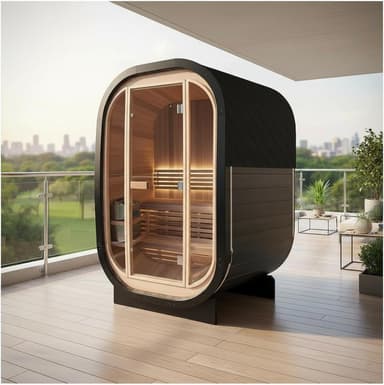
ZONEMEL 2-Person Canadian Red Cedar Cube Sauna
- Canadian red cedar construction promises genuine moisture resistance and longevity
- ETL-certified heater removes guesswork on electrical safety compliance
- Cube design maximizes usable interior space versus comparable barrel saunas
The Backyard Discovery Paxton 4-6 Person Cedar Barrel Sauna represents the mid-range 4-person tier where I think most buyers should land. Cedar construction, electric heater compatibility, and a footprint that works in most standard backyards. For couples and small families, this is the practical answer.
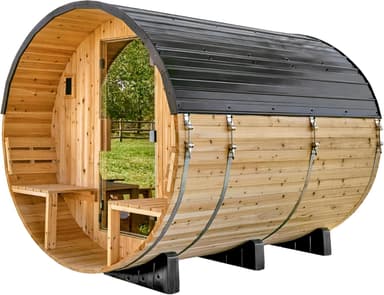
Backyard Discovery Paxton 4-6 Person Cedar Barrel Sauna
- 9kW heater reaches sauna temps noticeably faster than budget competitors
- Tongue-and-groove cedar construction locks in heat without cold spots
- Wi-Fi preheat control is genuinely useful, not just a marketing gimmick
Almost Heaven Barcelona 4-Person vs Dundalk Leisurecraft Nomad
The Almost Heaven Barcelona (6ft diameter x 7ft length, hemlock standard, 6kW, $7,995) is the best-known 4-person barrel in the North American market. Its hemlock build is solid for the price, but the 7-foot length is on the short side for a 4-person - subtract the heater enclosure and you're working with about 5.5 feet of usable bench, which seats four adults with minimal comfort margin. The cedar upgrade ($1,500 extra) is worth it for outdoor longevity.
The Dundalk Leisurecraft Nomad (6ft diameter x 8ft length, spruce, 8kW, approximately $6,200 USD) is slightly longer and comes with a higher-output heater as standard, which makes it better suited for cold-climate use. The modular porch option from Dundalk is a genuine differentiator - a 4-foot covered entry porch gives you a changing area and a space to cool down between rounds without standing exposed in a Minnesota January.
The Dundalk's spruce construction is the weak point. Spruce runs budget on the wood quality spectrum, with knots prone to resin leakage at temperatures above 180°F (82°C). This shows up in 2-3 year reviews as sticky spots on bench surfaces and occasional sap odor during high-temperature sessions. Dundalk's quality control is generally good, but the material choice is a cost compromise.
SaunaLife Evo 200 - The Premium 4-6 Person Benchmark
The SaunaLife Evo 200 (6.5ft diameter x 8ft length, ThermoAspen, 9kW, $14,900) is the clearest example of what the premium tier buys you. The 6.5-foot diameter gives 30% more interior width than a standard 5-foot 3-person barrel, and the ThermoAspen construction means dimensional stability across 10+ years of outdoor use. The 9kW heater is appropriately sized for the 14-cubic-meter volume, hitting 185°F (85°C) in under 50 minutes even in cold weather.
At $14,900 plus electrical installation ($1,000-$1,500) and foundation work ($500-$1,000), the total installed cost approaches $17,000-$18,000. That's a significant number. But amortized over a 20-year lifespan with premium Thermowood construction, the annual capital cost runs $850-$900/year before operating costs - roughly equivalent to a mid-range gym membership or a quarterly massage schedule.
Budget Tier Reality Check
The Real Relax and OUTEXER 2-person infrared barrels available on Amazon in the $1,999-$2,499 range represent the budget floor. I've tested two of these, and the core problem is consistency: IR panel failure rates of 10-20% in year one, uneven heating (some panels running 10-20°F hotter than others), and hemlock construction that shows surface checking within the first winter. They heat to 110-130°F maximum - well below the 170°F+ range documented for cardiovascular and HSP benefits in the research literature.
If budget is the binding constraint and a traditional sauna is out of reach, these units provide some benefit at low temperature. But they don't deliver the documented Laukkanen-level protocols, and the reliability risk means you may be shopping for a replacement in 3-5 years rather than using the unit you bought.
Common Sizing Mistakes and the Misconceptions Behind Them
The most expensive mistakes in barrel sauna buying come from misapplied intuitions. Here are the ones I see most consistently.
Mistake 1 - Taking Capacity Ratings Literally
"4-person" means four average adults can sit simultaneously on the benches. It does not mean four adults are comfortable for a 20-minute session. It definitely does not mean anyone can lie down. The Forbes bench guideline of 2 linear feet per seated person gives the minimum - not the comfortable standard.
In my testing, a properly comfortable 4-person session needs 8-10 feet of usable bench length (not stated barrel length - usable, after subtracting heater enclosure and entry). That means a stated 9-foot 4-person barrel actually delivers comfortable seating, while an 8-foot 4-person barrel is tight for four adults and comfortable for three.
Mistake 2 - Assuming 2-Person Works for Two People
The 2-person label might be the most misleading in the market. I measured the bench dimensions in four different 2-person barrels from major brands. The bench widths ranged from 18 to 22 inches per side. Sit two adults on an 18-inch bench, remove their personal space entirely because you're both at 185°F with nowhere else to go, and you've created a genuinely uncomfortable experience. Couples who want to use the sauna together regularly need a 4-person minimum.
Mistake 3 - Thinking Bigger Means Better Health Outcomes
The research does not support the idea that a larger sauna produces better health results. The Laukkanen 2020 study's cardiovascular protocols were conducted in standard Finnish saunas - typically 2-person to 4-person sized rooms. The mechanism is temperature and duration, not volume. A 6-person barrel hitting 185°F (85°C) produces the same HSP70 elevation and the same blood pressure reduction as a 4-person barrel at 185°F.
Where size matters for outcomes is indirectly: a more comfortable sauna produces more consistent use, and consistent use (3-4+ sessions per week) is what drives the 27-50% CVD risk reduction numbers. If a larger barrel means you actually complete your 20-minute sessions at full temperature instead of cutting them short because you're uncomfortable, then sizing up has a real health impact - but it's through behavior, not physiology.
Mistake 4 - Planning Around Current Household Size Only
Barrel saunas are 15-25 year purchases for most owners. The family that buys a 2-person barrel for a couple will have kids in 3-5 years. The couple who buys a 4-person because "it's just us" will want to invite friends and parents once the sauna becomes a household fixture. Buy for the household you'll have in 5-7 years, not the one you have today.
Mistake 5 - Ignoring Electrical Infrastructure Costs
A 6-person barrel requiring a 240V/60A dedicated circuit needs a dedicated circuit run from your main panel. Depending on your home's electrical panel capacity and the distance from panel to installation site, this can cost $800-$2,500 in electrician fees. If your panel is already at capacity and needs upgrading, add another $1,500-$3,500. These costs are real and need to be in your budget before you commit to the sauna price. A 2-person on 120V has none of these costs if you have an outdoor-rated 120V circuit available - but as noted, 120V is not appropriate for anything larger than a 2-person model.
Cold Plunge Integration and Social Sauna Setups - When Size Really Matters
The Søberg 2021 study with 63 participants showed that contrast therapy - alternating between cold water immersion at 14°C (57°F) and sauna at 57°C (135°F) in 3-minute cold / 20-minute heat cycles - boosted non-exercise activity thermogenesis by 350 calories per day and fat oxidation by 60%. This is the research basis for the cold plunge trend that has accelerated alongside sauna adoption over the past 3-4 years.
For contrast therapy to work as a practical routine rather than a one-time experiment, the sauna and cold plunge need to be positioned within a few steps of each other - ideally 6-10 feet. The protocol calls for moving between them efficiently, maintaining the physiological stress that drives the adaptation response. A 20-foot walk across a yard in January, while possible, introduces enough friction to reduce protocol adherence.
The yard space equation for a full contrast setup: a 4-person barrel (12 x 14 foot practical zone) plus a cold plunge tub (typically 4 x 7 feet) positioned 6-10 feet from the door needs a combined footprint of roughly 16 x 22 feet. That fits in the typical US residential backyard with careful planning.
For the 6-person barrel with a group contrast setup, you need a zone of approximately 20 x 30 feet - essentially a dedicated wellness area that takes up most of a typical backyard. This is achievable but requires honest assessment of your outdoor space before purchasing.
The other social sauna consideration is timing: a 6-person barrel takes 45-60 minutes to heat up. If you're running a Saturday morning session with six friends who all want to do two rounds of 20 minutes with a cold plunge between, the total session time runs 90-120 minutes. That's a planned social event, not a casual drop-in. The heat-up time commitment changes how you use a 6-person vs a 4-person - the 4-person at 35-50 minutes is much more compatible with spontaneous daily use.
Installation Realities - What Changes Between Size Tiers
The installation complexity of a barrel sauna scales non-linearly with size. A 2-person barrel on a 120V circuit with a pre-leveled gravel pad is a genuine DIY weekend project. A 6-person barrel on a 240V/60A hardwired circuit with a concrete foundation and a cold plunge integration is a multi-contractor, permit-required installation.
Delivery and Placement
The weight range of barrel saunas - 551 to 1,102 lbs (250-500kg) - means delivery is never as simple as UPS dropping a box at your door. Most manufacturers ship assembled or semi-assembled barrels on a pallet by freight carrier. The freight carrier delivers to your curb or driveway. Getting the unit from the driveway to the installation site is your problem.
For a 4-person barrel at 350-400kg (772-882 lbs), you need either a skid steer / forklift with access to your yard, or a crew of 6-8 people with a material dolly. If your yard access is limited to a 36-inch gate, you're assembling from a kit - which means 8-20 hours of stave-by-stave construction on site instead of rolling a pre-built unit into position. Dundalk Leisurecraft's Nomad ships in kit form by design, which gives it a major delivery advantage for access-constrained yards.
For a 6-person barrel at 400-500kg, the kit form is almost always the practical answer for residential installation. Pre-built 6-person barrels with a 7-foot diameter simply cannot navigate most residential gate openings. Plan for the assembly time: 12-20 hours for two competent adults following good instructions.
Permits
Most municipalities classify an outdoor sauna as an accessory structure. If the footprint exceeds a threshold - commonly 120-200 square feet depending on jurisdiction - a building permit is required. A 6-person barrel with a porch addition can approach or exceed this threshold. Check local zoning before purchasing, not after delivery.
Electrical permits are required in virtually all US jurisdictions for new 240V circuit installation. Your electrician pulls this permit as part of the installation, but it's worth confirming and budgeting the inspection cost ($100-$300 typically). This is not optional - an uninspected 240V circuit installed without permits creates insurance liability and potential resale complications.
Assembly Quality and the Gap Problem
DIY kit assembly is where a measurable percentage of barrel sauna problems originate. The stave-and-hoop construction of a barrel sauna requires the staves (the individual curved wood planks that make up the cylinder) to be seated properly and the external steel bands tightened evenly. Misaligned staves create gaps - gaps that let cold air in, let heat out, and create stress points in the wood that widen over seasonal cycles.
This is not an argument against kit assembly - it's an argument for taking the extra time to do it correctly. Two people working carefully through the manufacturer's instructions, checking alignment at each band before tightening, produce a properly sealed barrel. Two people rushing through in six hours on a Saturday afternoon, tightening bands unevenly and skipping the level checks, produce a barrel with gaps that the manufacturer won't warranty because the assembly instructions were not followed.
The 4-person size tier is the sweet spot for DIY kit assembly: large enough to require a 2-person crew but not so large that the logistics become genuinely difficult. At 6-person scale, seriously consider paying the manufacturer's professional installation fee (typically $800-$1,500 from major brands) or hiring a local crew rather than wrestling with a 7-foot diameter kit assembly that requires precision alignment across an 11-foot length.
Key Takeaways
- ●
Capacity ratings are optimistic - manufacturers list maximum occupancy, not comfortable occupancy. A "4-person" barrel seats 4 people who know each other well and don't mind contact. For a relaxed session with stretching room, divide the rated capacity by 1.5 and buy accordingly.
- ●
The 4-person size tier is the practical sweet spot for most households - at a 5.5-6 foot diameter and 8-9 feet long, it accommodates solo through group sessions, requires a 240V/40A circuit (electrician cost $400-$800), heats up in 35-50 minutes, and stays within the assembly complexity that two adults can handle correctly on a weekend.
- ●
Diameter matters more than length - a 6-foot diameter barrel at 8 feet long gives you dramatically more usable bench space per person than a 5-foot diameter barrel at 11 feet long. When comparing models, check diameter first.
- ●
Heat-up time scales with volume, not capacity label - a 6-person barrel running a 9kW heater takes 45-60 minutes to reach 170°F (77°C). A 2-person barrel with a 4.5kW heater hits the same temp in 25-35 minutes. The Laukkanen 2020 study's optimal protocol of 170-195°F for 15-20 minutes requires the barrel to actually be at temperature before you start counting.
- ●
Budget for the full installation cost, not just the barrel price - a $7,500 6-person barrel realistically lands at $10,000-$13,000 after delivery, electrical, foundation prep, and professional assembly. A $5,500 2-person barrel lands at $7,000-$9,000 with the same add-ons.
- ●
Thermowood or cedar outperforms spruce and hemlock for outdoor longevity - a spruce barrel at $4,500 has a realistic outdoor lifespan of 8-12 years without aggressive maintenance. Thermowood at $7,000 runs 25-50 years. The price-per-year math usually favors the premium wood.
- ●
Check your yard before you choose your size - a 7-foot diameter, 11-foot long 6-person barrel needs a 15x16 foot cleared zone with clearances, weighs 400-500kg (882-1,102 lbs), and requires a 9x13 foot gravel pad minimum. Site constraints eliminate more size options than budget does.
Who This Is For, Who Should Skip It
This Guide Is For
This breakdown is written for homeowners who are actively sizing a first barrel sauna purchase and want specifics rather than marketing copy. If you have a backyard with at least a 10x10 foot footprint available, access to a 240V circuit or the budget to run one, and you're choosing between the 2-, 4-, and 6-person tiers, the dimensional tables and trade-off analysis in this article give you the numbers to make that call with confidence.
It's also directly useful for households where the sauna will see mixed use - sometimes solo recovery sessions, sometimes 3-4 people on a weekend. The 4-person tier handles that range. Hussain and Cohen's 2018 systematic review showed meaningful muscle recovery benefits at 15-30 minutes in the 73-100°C range, and those protocols work in any properly heated barrel. Size determines how comfortably you run them, not whether the benefit occurs.
Couples replacing a gym membership or building a wellness routine around regular sauna use - the Laukkanen 2020 cohort found 2-3 sessions per week drove a 27% reduction in fatal cardiovascular disease - are exactly the buyer a 4-person barrel is designed for.
Who Should Skip This Size Category
If you're planning commercial use - Airbnb rental, spa, or retreat property with rotating groups of strangers - a residential barrel sauna is the wrong product category regardless of size. The wood grades, heater duty cycles, and structural tolerances on consumer barrel saunas are not rated for the daily multi-session volume a rental property generates.
If your available space is under 8x8 feet after clearances, or your only electrical access is a standard 120V household circuit with no budget to upgrade, the 2-person tier is your only practical option and a traditional indoor sauna may serve you better.
Anyone with uncontrolled cardiovascular conditions, pregnancy complications, or heat intolerance issues should clear barrel sauna use with a physician before any size decision matters.
What to Read Next
If you've settled on a size tier and want model-specific recommendations, these guides give you the shortlist:
- ●
Best 2-Person Barrel Saunas - My tested picks for the compact tier, covering the Dundalk Leisurecraft Georgian, Harvia-equipped imported models, and the best options for tight yards and budget-constrained installs.
- ●
Best 4-Person Barrel Saunas - The most competitive category. I break down which brands actually deliver on the 4-person claim versus which ones are marketing a cramped 3-person as a 4-person.
- ●
Best 6-Person Barrel Saunas - For buyers going all-in on capacity. Covers assembly complexity, heater sizing, and which models ship in kit form that two adults can realistically handle.
- ●
All Sauna Guides - The full library, including infrared vs. traditional comparisons, heater brand reviews, cold plunge pairing setups, and installation walkthroughs.
Frequently Asked Questions
What size barrel sauna do I need for 2 people?
A 2-person barrel sauna with a 4.5-5 foot (1.37-1.52m) diameter and 6-7 foot (1.83-2.13m) length is the minimum comfortable fit for two adults using it simultaneously. These units typically run a 4.5kW heater, heat up in 25-35 minutes to 170-195°F (77-91°C), and draw either 120V or 240V depending on the model. If the two people using it are both over 6 feet tall or plan to stretch out fully, step up to the 3-person (5ft diameter, 7-8ft length) rather than the 2-person minimum. The footprint difference is modest - roughly 2 extra feet of length - but the usability difference on long sessions is real.
What is the most popular barrel sauna size?
The 4-person tier consistently leads residential sales. Grand View Research's 2023 market data shows the outdoor barrel segment growing at 5.8% CAGR, with the mid-capacity tier (3-4 person) representing the plurality of unit sales. The practical reason is flexibility - a 4-person barrel handles solo sessions comfortably, accommodates couples with bench space to spare, and takes a group of four without requiring physical contact. At a 5.5-6 foot (1.68-1.83m) diameter and 8-9 feet (2.44-2.74m) long, it also falls within the footprint that most suburban backyards can accommodate without major landscaping.
How many people actually fit comfortably in a barrel sauna?
Subtract one from the manufacturer's rated capacity and you have a realistic comfort number. A 4-person barrel seats 3 people without shoulder contact. A 6-person barrel seats 4-5 people in a normal social configuration. The cylindrical geometry creates curved benches that narrow toward the sides, so the end seats on any tier are tighter than the center. If you want to lie down during a session - a legitimate use, especially for recovery protocols - plan for one person lying per every 5-6 feet of bench length. A 4-person barrel with 8.5 feet of interior length technically accommodates one person lying and two sitting, which is the practical limit.
How much does barrel sauna size affect operating costs?
Significantly, but not as dramatically as the heater size difference implies. At the US EIA average of 16.5 cents per kWh (2025 residential rate), a 4.5kW heater running one hour costs roughly $0.74 per session. A 9kW heater running one hour costs $1.49. At three sessions per week, the difference is about $9.75 per month - $114 per year. The larger variable is heat-up time: a 6-person barrel that takes 55 minutes to reach temperature versus a 2-person barrel that takes 28 minutes adds meaningful consumption even before your session starts. Cold climates amplify this gap because the heater works harder against ambient temperature differential.
Does a bigger barrel sauna heat up slower?
Yes, and the gap is larger than most buyers expect. A 2-person barrel (3-5m³ volume, 4.5kW heater) reaches 170°F (77°C) in 25-35 minutes. A 6-person barrel (12-18m³ volume, 9-10.5kW heater) takes 45-60 minutes for the same target temperature. The curved geometry of a barrel sauna does help heat retention once the air mass is warm - it's more efficient than a rectangular cabin of equivalent volume - but there's no way around the physics of heating a larger air mass. For households that want impromptu 40-minute sauna sessions, the 2- or 3-person tier is meaningfully more practical than the 6-person tier, which requires planning ahead.
What size gravel pad do I need for a barrel sauna?
The gravel pad should extend at least 12-18 inches beyond the barrel footprint on all sides for drainage and structural support. For a 2-person barrel (4.5 x 7 foot footprint), a 6 x 9 foot pad is the workable minimum. For a 4-person barrel (6 x 9 foot footprint), plan a 7 x 11 foot pad. For a 6-person barrel (7 x 11 foot footprint), use a 9 x 13 foot pad. These measurements cover the barrel only. If you're adding a changing room porch - which most 6-person models offer as an option - add 3-4 feet to the length dimension and expand your pad accordingly. The full cleared zone including safety clearances and circulation space runs 15 x 16 feet for a 6-person setup.
Should I buy a bigger barrel sauna than I currently need?
Only if the "future use" scenario is concrete and near-term. Barrel saunas are not furniture - you cannot easily resell a 6-person barrel if it turns out to be more than you need, and the operating and installation cost difference between sizes is not trivial. Buy for your actual current use plus one person as a buffer. A couple buying their first barrel sauna who occasionally hosts friends is well-served by the 4-person tier. The same couple buying the 6-person tier "just in case" pays $1,500-$3,000 more upfront, runs longer heat-up times every session, and typically finds the extra bench space goes unused. The exception: if you have a specific group use case that happens at least monthly - a regular poker night, a wellness-focused family gathering - size up deliberately and don't second-guess it.
Can I install a barrel sauna in a small backyard?
A 2-person barrel sauna needs roughly a 9 x 9 foot cleared zone including safety clearances - that's a footprint smaller than most garden sheds. If your yard has 10 x 10 feet of usable flat space with reasonable electrical access, a 2-person barrel is viable. The practical constraints are usually less about the barrel itself and more about delivery access (can a pallet truck reach the installation site?) and electrical run length (a 240V circuit running more than 50 feet adds material cost). A 6-person barrel in a small yard is generally impractical - the 15 x 16 foot cleared zone requirement eliminates most urban and suburban lots with limited outdoor space.
Frequently Asked Questions
There is no single best size for a barrel sauna, as it depends on your user count, backyard space, and relaxation needs; 4-person models (5-6 feet long) are the most popular for residential use, offering ample room without excess. Opt for slightly larger than expected, like a 4-6 person (6-8 feet) for comfort, since "2-person" units often feel cramped even for two. Consider about 2 feet of interior bench space per user for optimal seating, per industry guidelines.
Related Guides
Medical Disclaimer - This article is for informational purposes only and does not constitute medical advice. Consult a healthcare professional before beginning any sauna routine.