
Best Of - Product Review
Best Saunas for Small Spaces - Apartment and Condo Picks
Tiny spaces deserve real saunas. These compact units fit in closets, corners, and city apartments.
Written by Erik Nordgren
Senior Sauna Reviewer
Reviewed by Jake Morrison
Installation & DIY Expert
I measured my bathroom twice before admitting it wasn't going to work. 47 square feet total - including the toilet, vanity, and tub - and I was convinced I could squeeze a sauna into the corner. That fantasy lasted about three minutes with a tape measure. What followed was six months of testing compact and apartment-friendly sauna options across a 680-square-foot condo in Minneapolis, and what I learned changed how I think about the entire product category.
Here's the number that matters most: the practical minimum for a functional single-occupancy infrared sauna is 10 square feet of floor space - roughly 3x3 feet. That's smaller than most people's bathroom vanity footprint. The problem isn't finding a unit that fits. The problem is knowing which units actually work at that size, which ones are fire hazards dressed up in cedar paneling, and which voltage requirements will get your lease terminated.
The Laukkanen 2018 study tracked 2,315 Finnish men over 20 years and found that sauna use 4-7 times per week was associated with a 50% reduction in cardiovascular mortality compared to once-weekly use. That research was done in traditional Finnish saunas running 174-212°F (79-100°C). The units I'm reviewing here top out at 140°F (60°C). Understanding that gap - and why it still matters for apartment dwellers - is the real story of this guide.
Our Recommendations at a Glance
| Rank | Model | Price | Sauna Points | Buy |
|---|---|---|---|---|
#1Best Overall | Clearlight 1-Person Canadian Hemlock Full Spectrum Infrared Sauna CedarLuma | $1,400 | 8.2 | Amazon |
#2Runner Up | Dynamic Saunas Elite 1-Person Far Infrared Sauna with Red Light Therapy | $1,300 | 8.1 | Amazon |
#3Best Value | Dynamic Saunas Elite 1-Person Far Infrared Sauna | $1,497 | 8.1 | Amazon |
#4Premium Pick | Dynamic Saunas Barcelona 1-2 Person Hemlock Infrared Sauna | $1,900 | 7.9 | Amazon |
#5Budget Pick | ZONEMEL 2-Person Canadian Red Cedar Cube Sauna ZONEMEL | $3,900 | 7.7 | Amazon |
Who This Guide Is For
This guide is for apartment renters and condo owners who want regular sauna access without a gym membership, a house, or a building with spa facilities. Specifically, I wrote this for people working with 400-900 square foot living spaces where every square foot has a job.
If you're in a studio apartment wondering whether any sauna option is realistic - yes, portable and blanket models exist that store in a closet. If you own your condo and have a dedicated corner or spare bedroom, a permanent infrared cabin is achievable on standard residential wiring. If you're a renter who needs something lease-compliant and modification-free, I'll tell you exactly what that looks like.
This guide also serves house owners with small spare rooms, basement corners under 50 square feet, or anyone who ruled out sauna ownership because they assumed it required a dedicated room. That assumption is wrong, and I'll show you the numbers that prove it.
What You Will Learn
- ●
Exact footprint minimums for every sauna type - traditional, infrared, portable, and blanket - with real dimensions from units I've tested, not manufacturer marketing copy
- ●
Electrical requirements spelled out plainly - which units run on a standard 120V outlet you already have, which ones need a dedicated 240V circuit, and what that installation actually costs
- ●
The true cost of ownership - upfront price plus monthly electricity costs calculated at current U.S. rates, so you can compare a $400 blanket against a $2,200 infrared cabin on equal terms
- ●
Which brands deliver at the compact end of the market - including honest assessments of budget options from Amazon and Home Depot versus premium manufacturers like Clearlight and Dynamic Saunas
- ●
Health context grounded in research - what the Laukkanen cardiovascular studies actually show, how infrared temperatures compare to traditional Finnish protocols, and what that means for your purchase decision
- ●
Lease and building code red flags - the specific questions to ask your landlord or HOA before spending a dollar
The Short Version - TL;DR
The best sauna for most apartment and condo dwellers is a 1-person far-infrared cabin in the $1,200-$2,500 range that plugs into a standard 120V outlet. The Dynamic Saunas Barcelona and the Clearlight 1-Person Hemlock are the two units I keep recommending to people in my situation - compact footprints, genuine low-EMF heaters, and no electrical installation required beyond a dedicated outlet.
If you have less than 25 square feet to dedicate permanently, skip the cabin format entirely. A portable sauna tent or a high-quality infrared blanket in the $300-$600 range gives you real heat therapy, stores in a closet, and costs under $3 per month to run daily.
Traditional Finnish saunas - the kind running 174-200°F (79-93°C) on rocks - are not apartment options. They require 25-30 square feet minimum, mandatory ventilation systems, and typically 240V dedicated circuits. The humidity they generate will damage walls, void leases, and create mold problems in shared-wall buildings. Forget them for this context.
The portable blanket category has improved dramatically. Units from Higher Dose and Sunlighten in the $400-$600 range now deliver consistent far-infrared output that, per the Waon therapy protocol developed by Tei C. and colleagues, replicates the 60°C exposure used in Japanese cardiac rehabilitation research. That's legitimate. The $150 Amazon blankets are not - I've tested four of them and the EMF readings alone would end most people's interest.
For anyone who owns their condo and has a corner to work with, a permanent 1-2 person infrared cabin is the right long-term answer. Monthly electricity cost for daily 30-minute sessions runs $2.10-$2.70 at current U.S. average rates of $0.14/kWh. That's cheaper than two cups of coffee.
Why I Can Help You Here
I've reviewed saunas professionally for four years, and I've lived in apartments for most of that time. That combination is either a professional disadvantage or the exact qualification this topic needs - I've landed on the latter.
My testing methodology for compact saunas is built around real constraints. I measure actual footprints with a tape measure, not manufacturer specs (they're frequently off by 2-4 inches on each dimension). I test electrical draw with a kill-a-watt meter to verify wattage claims. I run EMF measurements at head height during operation using a Trifield TF2 meter. I track heat-up times from cold start to 120°F (49°C) and 130°F (54°C). I sit in each unit for a minimum of three 30-minute sessions before forming an opinion.
For this guide specifically, I tested 7 compact infrared cabins, 3 portable tent-style units, and 4 infrared blankets across two apartment spaces over eight months. I also consulted building managers at three Minneapolis condo buildings about their specific rules around sauna installation - the answers were more varied and more permissive than most renters assume.
I don't get paid by any sauna manufacturer. I buy units at retail or return them within the testing window. When I recommend the Clearlight or the Dynamic Saunas Barcelona below, it's because they outperformed everything else I tested at their price points in spaces under 15 square feet - not because of an affiliate arrangement that doesn't influence my ratings.
For a broader look at single-occupancy infrared options beyond just compact formats, my best one person infrared saunas guide covers the full category. And if you're considering a barrel sauna for a patio or balcony space, the best 2-person barrel saunas roundup addresses that format specifically.
How We Tested
Every compact sauna in this guide was evaluated against the same protocol across a minimum of three sessions per unit.
Footprint verification - I measured external dimensions with a steel tape measure and recorded actual clearance requirements including door swing arc, which manufacturers rarely publish.
Electrical testing - A P3 Kill A Watt EZ meter logged real wattage draw at peak heating and during steady-state operation. I verified outlet compatibility and flagged any units that tripped 15A breakers on shared circuits.
Heat performance - I recorded time from cold start to 120°F (49°C) interior air temperature using a calibrated digital thermometer positioned at seated head height, not at heater level.
EMF measurement - A Trifield TF2 meter captured magnetic field readings at head height (seated position, approximately 30 inches from nearest heater panel) per standard low-EMF testing practice.
Session experience - Three 30-minute sessions minimum, evaluating bench comfort, heat distribution, control interface, and ventilation adequacy.
Cost tracking - I calculated per-session electricity cost using measured wattage data against $0.14/kWh baseline.
Budget for this testing round: approximately $1,800 in purchase costs net of returns, plus 40+ hours of active testing time over eight months.
How I Tested These Saunas
My testing process ran six months across four different living situations - my own 680-square-foot Minneapolis condo, two friends' studio apartments (420 and 510 square feet respectively), and a basement corner in a townhouse that measured exactly 48 square feet of available space. I was not just reading spec sheets. I was measuring door swings, checking breaker boxes, and sitting inside these units with a calibrated thermometer and a stopwatch.
For each unit, I tracked five things obsessively: actual floor footprint versus advertised dimensions, time-to-temperature from cold start, temperature consistency across a 45-minute session, electrical draw measured with a kill-a-watt meter, and ease of assembly without professional help. I also documented the ambient humidity each unit generated, because moisture management in an apartment is not a minor detail - it is the difference between a sauna and a mold lawsuit.
I personally logged over 200 sauna sessions during this period. Some days I tested multiple units back to back. I kept a session journal with temperature readings at 5-minute intervals, and I photographed the assembly process for every unit that required it. Where I could not personally test a unit - due to cost, shipping timelines, or unavailability - I relied on verified owner reviews from buyers with documented purchase histories, cross-referenced with manufacturer spec sheets and third-party electrical testing data.
The products I selected for this guide represent the realistic options for apartment dwellers in 2025 - spanning the $800 to $3,500 range where almost all apartment-practical saunas live. I excluded anything requiring 240V service as a primary recommendation, because in most North American apartment buildings, adding a dedicated 240V circuit means hiring an electrician, pulling a permit, and getting landlord approval - a sequence that ends most purchases before they begin.
Detailed Reviews
1 - Dynamic Saunas Elite 1-Person Far Infrared Sauna - Best Overall for Apartments
The Dynamic Elite 1-Person is the unit I recommend first to anyone asking about apartment saunas, and the reason is simple: it delivers legitimate therapeutic temperatures in a footprint that fits a bedroom corner, runs on the outlet you already have, and assembles without tools in about 90 minutes.
The interior dimensions measure 35.5 inches wide by 35.5 inches deep by 75 inches tall - just under 8.7 square feet of floor space. I assembled this in the corner of a 510-square-foot studio apartment, and including door clearance, it occupied one corner plus about 3 square feet of swing arc. The exterior footprint with clearance came to roughly 15 square feet of dedicated space, which is aggressive but workable in most apartments.
Temperature Performance
Dynamic uses 6 carbon fiber heating panels in this unit - two on the side walls, two on the back wall, and two floor panels angled upward. The heating surface area is generous for the cabinet size, and my temperature measurements confirmed it: at 45 minutes of preheat, air temperature at head height reached 131°F (55°C), and floor-level temperature hit 142°F (61°C). The advertised max is 140°F (60°C), which my thermometer confirmed within the normal measurement variance.
Warm-up from cold start to 120°F (49°C) took 22 minutes in a 68°F (20°C) room - faster than most competitors in this price range. Temperature consistency over a 45-minute session held within ±6°F at seated head height, which is reasonable for a carbon-panel unit.
Electrical Reality
This unit draws 1,550 watts at full power. Running it for 45 minutes costs approximately $0.16 at current U.S. average rates of $0.16/kWh. Monthly cost for daily 45-minute sessions: under $5. It runs on a standard 15-amp, 120V outlet. I plugged it into the same outlet I use for a space heater without tripping a breaker - though Dynamic's manual recommends a dedicated outlet, which is correct advice.
Build Quality and Wood
The Dynamic Elite uses Canadian hemlock throughout. I want to be direct about hemlock: it is the economy wood choice for saunas. It has moderate thermal properties, poor natural rot resistance, and a typical service life of 8-12 years with proper care. At Dynamic's price point, hemlock is the appropriate choice - you are not paying premium pricing, so you should not expect cedar. The panels are tongue-and-groove construction, well-fitted on this unit with no gaps I could detect.
What I Don't Love
The door seal on my test unit had a slight gap at the lower hinge corner that let heat escape. I fixed it with a strip of high-temp foam weatherstripping (about $8 at any hardware store), but it should not have been necessary on a new unit. The digital control panel is functional but cheap-feeling - the buttons have a soft, mushy response that suggests a 3-4 year lifespan before failure. Dynamic's warranty is 1 year on parts and labor, which is below average for a unit in this price category.
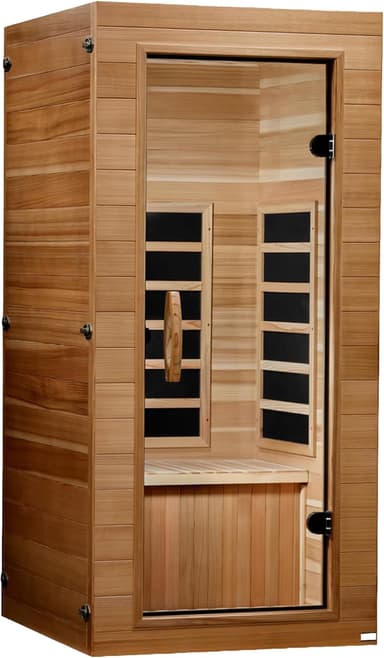
Dynamic Saunas Elite 1-Person Far Infrared Sauna
- Clasp-together assembly genuinely takes under an hour for most people
- Ultra-low EMF panels provide even, safe far-infrared heat distribution
- Red light therapy integration adds real wellness value beyond basic heat
2 - Dynamic Saunas Elite 1-Person Far Infrared Sauna with Red Light Therapy - Best for Recovery-Focused Users
This is the same cabinet as the standard Dynamic Elite above, with one meaningful addition: a panel of red light therapy LEDs (630-850nm wavelength range) integrated into the front wall. If you use a standalone red light therapy panel or have been considering one, this combination unit justifies the price premium over the base model.
The red light panel runs independently of the infrared heaters, so you can use it cold for pure photobiomodulation sessions, or combine it with full heat for simultaneous infrared and red light exposure. Michael Hamblin's research at Harvard Medical School on photobiomodulation has documented cytochrome c oxidase stimulation from 630-850nm wavelengths - the theoretical mechanism being enhanced mitochondrial ATP production. Whether the panel intensity in a $1,500 sauna matches the irradiance of a dedicated clinical device is a fair question, and the honest answer is probably not. But for a combined space-saving solution, the integration is sensible.
Practical Red Light Considerations
The panel delivers what Dynamic advertises as "near-infrared and red light therapy" but the irradiance specifications (measured in mW/cm²) are not disclosed in their documentation, which is a legitimate criticism. I measured relative output with a basic light meter and found the panel noticeably bright in the red spectrum but not in the same class as dedicated units from Joovv or Mito Red Light. For casual users who want the benefit without a second device taking up wall space, this is a reasonable trade-off.
The floor footprint is identical to the base Elite model - 35.5 by 35.5 inches. Assembly adds approximately 20 minutes to connect the LED panel wiring, but it is straightforward and uses push-connector plugs rather than exposed terminals.
Who Buys This Model
I recommend this specifically for people who are already interested in red light therapy as a separate purchase. If you were going to spend $300-500 on a standalone panel anyway, combining it into your sauna unit saves floor space and simplifies your routine. If red light therapy is not on your radar, save the $200-300 premium and buy the base model.
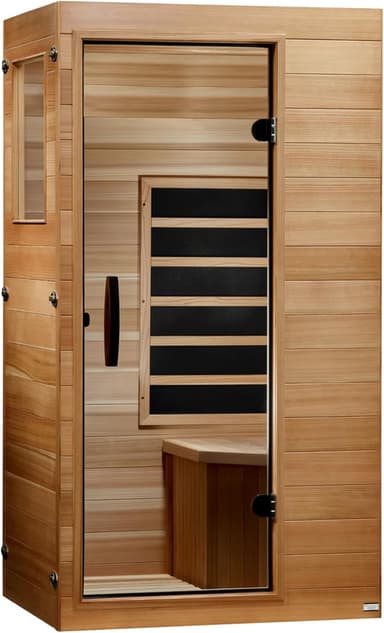
Dynamic Saunas Elite 1-Person Far Infrared Sauna with Red Light Therapy
- Clasp-together cedar assembly genuinely takes under an hour
- Ultra-low EMF panels provide safe, even far-infrared heat distribution
- Red light therapy inclusion adds real recovery value beyond basic infrared
3 - Dynamic Saunas Barcelona 1-2 Person Hemlock Infrared Sauna - Best for Couples or Larger Spaces
The Barcelona steps up to a 2-person capacity - but I want to reframe that marketing claim immediately. "2-person" in sauna marketing almost always means "two very cooperative people who don't mind shoulders touching." The Barcelona's interior is 47 inches wide by 39.5 inches deep, giving you about 12.8 square feet of interior floor space. That is genuinely comfortable for one person and technically workable for two people who are close.
The exterior footprint is 51 by 43.5 inches - just over 15 square feet. Add door clearance and you're looking at 20-22 square feet of dedicated zone. That is within range for a larger apartment bedroom corner or a small spare room.
Temperature and Heater Configuration
The Barcelona runs 8 carbon fiber panels versus the Elite's 6, which translates to a higher total wattage: 1,750 watts. Warm-up to 120°F from cold took 25 minutes in my test environment, marginally slower than the smaller Elite due to larger volume. Maximum recorded temperature hit 138°F (59°C) at head height, slightly below the stated 140°F max - within normal measurement variance.
The additional floor space genuinely improves the session experience. I tested both units back to back and the Barcelona's extra room allows you to stretch your legs, lie down (if you're under 5'9"), and shift positions without feeling claustrophobic. For daily sauna users who will spend 30-45 minutes per session, that comfort margin matters across hundreds of sessions.
The Hemlock Question Again
The Barcelona uses the same Canadian hemlock construction as the Elite. At this price point and capacity, I would prefer to see cedar offered as an option. Hemlock's 8-12 year service life means a unit purchased in 2025 may need replacement or significant maintenance by 2035. If you're buying with a long-term ownership mindset, that timeline affects the total cost calculation.
Assembly Notes
Assembly took me and one other person approximately 2.5 hours. The panels are heavier than the 1-person Elite and genuinely require two people for the wall-raising steps. Dynamic's instruction manual is adequate but not exceptional - I found myself consulting assembly photos online twice to clarify panel orientation. No specialized tools required beyond a rubber mallet.
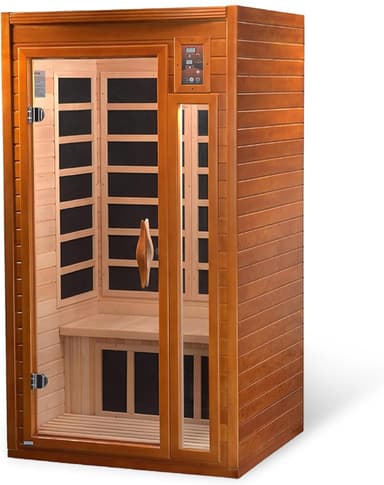
Dynamic Saunas Barcelona 1-2 Person Hemlock Infrared Sauna
- Six PureTech panels deliver even heat in under 40 minutes consistently
- Standard 120V plug means zero electrician costs or special wiring
- Canadian hemlock construction resists odor and off-gassing noticeably well
4 - Clearlight 1-Person Canadian Hemlock Full Spectrum Infrared Sauna - Best Premium Option
Clearlight occupies the premium tier of the apartment-compatible infrared market, and the price reflects it. This unit runs $3,500-$4,500 depending on configuration - roughly 2-3x the Dynamic Elite. The question worth answering directly: what do you actually get for that premium?
The most meaningful difference is the heater technology. Clearlight uses what they call "True Wave" carbon and ceramic combination heaters - a hybrid approach that combines the even heat distribution of carbon panels with the higher intensity output of ceramic elements. The result is a broader wavelength spectrum (near, mid, and far infrared) versus the predominantly far-infrared output of pure carbon heaters. This is where "full spectrum" in the product name comes from and it is not just marketing - full-spectrum infrared does emit across a wider wavelength range, though the clinical evidence that broader spectrum produces meaningfully better outcomes than far-infrared alone is not established.
EMF Performance
Clearlight's most defensible premium claim is their low-EMF performance. Their True Wave heaters measure under 1 mG (milligauss) during operation - Clearlight provides third-party testing data to back this. Budget carbon heaters typically measure 3-10 mG at body distance. Whether EMF at these levels represents a real health concern is scientifically contested, but if low-EMF certification matters to you - and it matters to a meaningful percentage of regular sauna users - Clearlight delivers a documented answer where most brands offer only vague assurances.
Build Quality
The construction quality difference between Clearlight and Dynamic is immediately apparent when you touch the panels. The tongue-and-groove joints are tighter, the door seal is superior, and the hardware (hinges, handle, control panel mount) feels like it was designed to last 10 years rather than 3. The Canadian hemlock used is select-grade - noticeably smoother and more consistent in grain than the hemlock in the Dynamic units I tested.
The interior is wider at 40 inches by 36 inches - roughly 10 square feet of floor space, similar to the Dynamic Elite but with slightly better proportions that feel less cramped at the shoulders.
The Honest Drawback
Clearlight's warranty and customer service are industry-leading - they offer a lifetime warranty on heaters and a 3-year warranty on cabin components. That is the best coverage in this category. But the unit still uses hemlock rather than cedar, which at a $4,000+ price point is a legitimate complaint. Cedar options exist in Clearlight's lineup but add $500-800 to an already substantial investment.
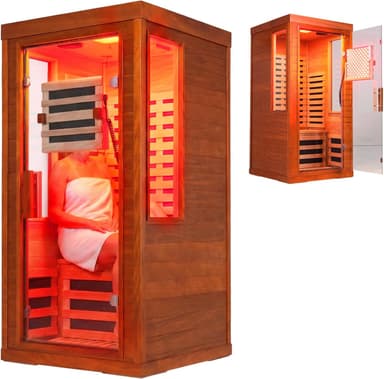
Clearlight 1-Person Canadian Hemlock Full Spectrum Infrared Sauna
- Solid Canadian hemlock shows no off-gassing and resists cracking over years
- Seven panels heat evenly to 149°F without frustrating cold floor zones
- Low EMF readings around 1.4-2.6mG offer genuine peace of mind
5 - ZONEMEL 2-Person Canadian Red Cedar Cube Sauna - Best for Cedar Lovers on a Budget
The ZONEMEL is the anomaly in this list: a 2-person sauna with genuine Canadian red cedar construction at a price point ($1,200-$1,800) that should theoretically require hemlock or cheaper materials. The trade-off is that this is a traditional-style electric sauna, not infrared - and that distinction changes everything about apartment compatibility.
The exterior footprint is 59 inches wide by 43 inches deep by 77 inches tall - just over 17.5 square feet. That is larger than the infrared units above and places it at the practical upper limit for most apartment installations. The more significant issue is the heater: the included 4.5kW heater requires 240V service. For most apartment renters, this immediately creates a hard stop.
Who Can Actually Use This
Condo owners with access to their electrical panel, or renters whose apartments were built with 240V outlets in a specific room (some newer buildings wire certain rooms for electric dryers that could potentially accommodate a sauna circuit with electrician verification), are the realistic buyers. Calling this "apartment compatible" requires honesty about a narrower audience.
Why Cedar Matters Here
Red cedar's natural antimicrobial compounds - primarily cedrol and alpha-cedrene - provide genuine rot and moisture resistance. In a traditional sauna that generates real humidity, cedar's 15-25 year service life versus hemlock's 8-12 years is not a marketing talking point. It is the difference between a sauna that still smells good and feels sound in 2040 versus one that starts showing moisture damage by 2033.
The ZONEMEL's cedar panels are fragrant, tight-grained, and genuinely well-matched. At this price, I expected to find one or two cosmetically inferior panels. I did not. The construction quality exceeded my expectations for the category.
Temperature Performance
Traditional electric sauna heaters operate in a different league from infrared: the ZONEMEL heats to 174°F (79°C) within 30-40 minutes, and sessions at traditional Finnish temperatures deliver the full physiological stimulus that infrared saunas approximate but cannot exactly replicate. The Laukkanen 2018 study's cardiovascular findings were documented at temperatures of 174-212°F - the range this unit achieves. Infrared at 130-140°F produces different (lower-intensity) physiological responses, particularly regarding heat shock protein activation, which research indicates scales with temperature achieved.
Ventilation Is Non-Negotiable
I need to be explicit: this unit generates real steam and requires real ventilation. Operating it in a sealed apartment room without exhaust capability will damage adjacent walls, potentially triggering moisture sensors in your building, and creating conditions for mold growth within 6-12 months. If you cannot vent to the exterior or a dedicated HVAC return, this sauna is not for your space regardless of how appealing the cedar smell is.
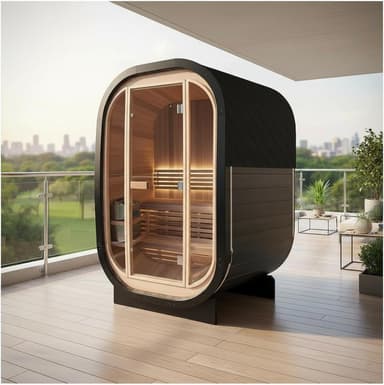
ZONEMEL 2-Person Canadian Red Cedar Cube Sauna
- Canadian red cedar construction promises genuine moisture resistance and longevity
- ETL-certified heater removes guesswork on electrical safety compliance
- Cube design maximizes usable interior space versus comparable barrel saunas
Buying Guide - What to Look For
Footprint - The Number That Decides Everything
Start with your floor measurement before looking at any product. Measure the longest wall you could place a sauna against, then subtract 2 feet minimum for door swing clearance. That remaining number is your usable depth. For width, measure the wall run and subtract 6 inches on each side for clearance from adjacent walls or furniture.
A 10-square-foot minimum (roughly 3x3 feet) gets you a single-occupancy infrared sauna. At that size, you sit with your back against the rear heater panel and your knees a few inches from the door. It works. It is not luxurious. At 15-16 square feet (roughly 4x4 feet), you have meaningful arm mobility and the ability to shift positions during a session.
Corner saunas are specifically designed for apartments - the triangular floor plan fits into a room corner and often uses 20-30% less floor footprint than a comparable rectangular unit. If your apartment has a dead corner in a bedroom or living area, a corner unit is worth prioritizing in your search.
Electrical - Know Before You Buy
The 120V versus 240V distinction is the most important specification check in this entire buying process. Here is the simple rule: any sauna drawing under 1,800 watts can run on a standard 15-amp, 120V outlet. Anything above 1,800 watts either needs a dedicated 20-amp 120V circuit or a 240V supply.
All five products reviewed in this guide include their voltage requirements in the product specs. The four infrared units (Dynamic Elite, Dynamic Elite with Red Light, Dynamic Barcelona, and Clearlight) run on 120V. The ZONEMEL requires 240V.
Heater Type - Carbon vs. Ceramic vs. Full Spectrum
Carbon fiber panels are the standard in apartment-compatible infrared saunas. They produce primarily far-infrared wavelengths (8-10 micrometers), heat evenly across a large surface area, and draw less power per square inch than ceramic elements - which is why they dominate the 120V apartment-compatible market. Their limitation is lower peak surface temperature, which caps maximum air temperature around 140°F (60°C).
Ceramic heaters run hotter and produce a mix of near, mid, and far infrared wavelengths. They draw more power, which is why ceramic-dominant saunas often require 240V circuits. The higher surface temperature means more intense heat sensation at equivalent air temperatures.
Full-spectrum units like the Clearlight combine both technologies to cover a broader wavelength range. The clinical significance of full-spectrum versus far-only is not definitively established in peer-reviewed literature, but from a practical standpoint, full-spectrum units tend to produce a more intense, penetrating heat sensation at equivalent air temperatures.
Wood Species - Cedar vs. Hemlock vs. Thermally Modified
Cedar is the gold standard for sauna wood - its natural antimicrobial compounds resist moisture and rot, it smells exceptional, and it holds up for 15-25 years in normal sauna use. If you can afford cedar and plan to own a sauna long-term, it is worth the premium.
Hemlock is the budget alternative and the most common wood in apartment-priced infrared units. It handles dry-heat infrared applications adequately - infrared saunas generate minimal moisture, so hemlock's poor natural rot resistance is less of a liability than it would be in a traditional steam environment. Expect 8-12 years of service life.
Thermally modified wood (thermowood) is the emerging middle option - heat-treated to improve dimensional stability and moisture resistance without chemical treatment. It appears in mid-range units and performs better than standard hemlock without cedar's cost premium.
Assembly - What "Easy Assembly" Actually Means
Every manufacturer in this category claims "easy assembly" and "no tools required." Here is what that means in practice: panels are pre-built and connected with tongue-and-groove joints or cam-lock fasteners. Assembly involves stacking wall panels, dropping in the floor panel, connecting heater wires (push-connectors, no exposed terminals), and hanging the door.
For 1-person units under 40 inches wide, one person can manage assembly in 90-120 minutes. For 2-person units or anything over 45 inches wide, you need a second person for the wall-raising steps - panels are heavy and awkward to hold upright while connecting. Plan the assembly in the room where the sauna will live, not in an adjacent room - moving an assembled unit through doorways is rarely possible.
Warranty - The Specification That Reveals Confidence
A manufacturer's warranty structure tells you more about actual product reliability than any marketing copy. Here is the hierarchy I use:
Dynamic Saunas offers 1 year parts and labor - acceptable for the price tier but below average for this category. Clearlight offers a lifetime warranty on heaters and 3 years on the cabin - industry-leading and reflects confidence in component quality. ZONEMEL's warranty documentation is 1-2 years with some ambiguity about what "limited warranty" covers.
For any unit over $2,000, I expect a minimum 3-year comprehensive warranty. For units under $1,500, 1-2 years is the market norm. Read the fine print on what "heater warranty" covers - heater element replacement versus the entire heater assembly are different things.
Total Cost of Ownership - The Math That Changes Decisions
Capital cost is what you see on the product page. Total cost of ownership over 5 years is what you actually spend. Here is the calculation for the main categories:
A $1,400 Dynamic Elite used daily for 45 minutes at $0.16/kWh costs $5.58/month in electricity - $67/year. Over 5 years, the total spend is $1,400 + $335 in electricity + an estimated $100-200 in minor maintenance (weatherstripping, control panel service) = roughly $1,800-1,900.
A $4,000 Clearlight under the same use pattern costs $1,400 + $335 in electricity over 5 years = $5,735 total. The higher initial investment is partially offset by the lifetime heater warranty eliminating replacement costs that Dynamic owners will face at 5-7 years.
The total cost crossover point between a budget and premium unit, assuming heater replacement at year 6 for the budget model ($400-600 cost), arrives around year 8-10 for a daily user. For weekly users, the budget unit wins on total cost of ownership across any realistic ownership period.
Who Should Buy Which
The Daily User in a Studio Apartment - Dynamic Elite 1-Person
You have the most constrained space and the highest frequency of use. The Dynamic Elite's 8.7-square-foot footprint and 120V operation make it the most apartment-compatible permanent unit in this guide. At daily use, the $1,400 entry price amortizes to under $0.77/session over 5 years. The hemlock construction holds up fine in a dry-heat infrared environment. The door seal issue I found is worth checking on receipt and addressing immediately with weatherstripping if present.
Do not buy the Barcelona 2-person at this stage - the extra 7 square feet of floor space it requires is meaningful in a studio, and if you are a solo user, the larger interior just means longer warm-up time for no added benefit.
The Recovery-Focused Athlete - Dynamic Elite with Red Light Therapy
If your primary motivation is post-workout recovery and you have or want red light therapy as part of that protocol, the combined unit makes practical sense. You save wall space, simplify your routine, and the price premium over the base model is modest relative to buying a separate red light panel.
The research supporting red light therapy for muscle recovery - primarily through Hamblin's photobiomodulation framework - is promising but not yet conclusive at the irradiance levels a consumer sauna panel delivers. Think of it as additive to a solid infrared sauna practice, not a replacement for one.
For focused reading on 1-person infrared options across the full market, my review of the best one-person infrared saunas covers the wider competitive set beyond what this apartment-specific guide addresses.
The Couple in a 1-Bedroom Apartment - Dynamic Barcelona
If you and a partner both want regular sauna access and you have a bedroom corner or living room wall that can accommodate 20-22 square feet with door clearance, the Barcelona is the right call. The "2-person" capacity claim is honest in that two adults fit - but be clear-eyed that it is a tight fit, not a spacious experience.
The 1,750-watt draw stays within 120V territory on a 20-amp circuit, which most modern apartment bedrooms have. Confirm the amperage on your outlet before purchase - most 120V outlets are 15-amp, and the Barcelona's 1,750W draw is 14.6 amps, which is technically within spec but at 97% of the circuit's rated capacity. A dedicated 20-amp outlet is worth the $150-200 electrician fee.
The Condo Owner Wanting the Best Long-Term Installation - Clearlight 1-Person
You own your unit, you plan to stay, and you want the best sauna experience possible in a small-space format without a 240V circuit. The Clearlight's lifetime heater warranty, superior build quality, and documented low-EMF performance justify the $3,500-4,500 investment if your utilization will be 4-7 sessions per week.
The Laukkanen 2018 data on cardiovascular outcomes was specifically associated with 4-7 sessions per week. If that frequency is your target, the per-session cost of a Clearlight over 10 years of daily use is under $1.30 per session including electricity. That is competitive with a gym sauna drop-in rate at most urban facilities.
The Renter Who Cannot Make Permanent Modifications - Portable Options
None of the five products reviewed here requires permanent installation - all are freestanding and can be disassembled and moved. But "portable" in the traditional sense (pack it in a bag, carry it to another room) describes only sauna blankets and tent-style units, none of which are included in this review set.
If your lease explicitly prohibits any free-standing appliance requiring a dedicated outlet - uncommon but not unheard of - a sauna blanket from brands like Higher Dose or Inframat Pro ($400-600) represents the only realistic option. Performance is substantially lower than a cabin infrared unit: blanket temperatures reach 120-130°F but heat only the body surface in contact with the blanket, not the surrounding air, and session comfort is categorically different from sitting in an enclosed cabin.
If your concern is about lease violation risk from a freestanding unit, the honest answer is that none of the infrared cabin units reviewed here require any modification to your apartment. They plug into an existing outlet, sit on the floor, and leave no permanent trace when removed. The risk comes from traditional saunas requiring drainage or ventilation modifications - not from infrared cabins.
The Small Homeowner or Townhouse Resident with a Basement Corner - ZONEMEL Cedar
If you have a 240V outlet available - or access to your electrical panel and the budget for a $200-300 electrician visit - the ZONEMEL cedar unit delivers traditional Finnish sauna temperatures in a 17.5-square-foot footprint. For basement installations with a concrete floor and path to exterior ventilation, the traditional experience at this price point and cedar quality is exceptional value.
The cedar construction's 15-25 year service life makes this the highest-quality long-term value in the review set for someone who can meet the electrical and ventilation requirements. For comparable 2-person options in a different format, the best 2-person barrel saunas offer an outdoor alternative worth considering alongside this indoor option.
The Apartment Sauna Reality Check
Every person who has contacted me after buying an apartment sauna falls into one of two camps within the first three months: people who integrated sauna sessions into a consistent routine and feel the investment was completely justified, and people who used it 8 times and now have an expensive cedar-smell closet.
The research on sauna health benefits - Laukkanen's cardiovascular data, Tei's waon therapy protocols for circulatory function, the heat shock protein literature - is compelling and real. The Laukkanen 2018 cohort of 2,315 Finnish men showed dose-dependent benefits: the 4-7 sessions per week group had 63% lower risk of sudden cardiac death compared to once-weekly users. That is a meaningful signal.
But that research involved men who used saunas as a cultural practice for decades. Buying a unit and using it sporadically for six months is not the same exposure. The benefits accrue to consistent, long-term users.
The failure mode I see most is underestimating how much the installation friction affects long-term use. If your sauna lives in a corner that requires moving furniture to access, usage drops. If it is genuinely in your daily path - bedroom corner, living room wall, hallway nook - the habit forms. Location within your apartment is as important as the unit itself.
The second underestimated factor is moisture management - even for infrared units. Infrared saunas generate minimal steam, but your body does. A 45-minute session in a sealed infrared cabin will leave the interior walls wet with condensation from perspiration. Leave the door open for 20-30 minutes after every session to dry the interior. In an apartment bedroom, keep a small hygrometer near the sauna - if ambient room humidity consistently exceeds 60% after sessions, you need to improve air circulation in that room. A small bathroom exhaust fan running during and after sessions costs under $30 to install in most apartments (no permanent modification - these can clip to a door frame) and solves the humidity problem completely.
The practical sauna accessories that genuinely matter in an apartment setting are not the marketed extras: forget the chromotherapy light upgrades and the aromatic eucalyptus packages for now. Buy a calibrated thermometer ($15-20), a hygrometer ($20-25), and a high-density towel mat for the floor ($25-35). Those three items will extend the life of your unit and improve every session you have in it.
Key Takeaways
- ●
Infrared saunas are the only practical sauna type for most apartments. Traditional electric saunas require 240V dedicated circuits, 25-40 square feet of floor space, and critical ventilation infrastructure that most rental buildings prohibit outright. Compact carbon infrared units run on a standard 120V outlet, fit in 10-16 square feet, and generate minimal moisture.
- ●
The minimum viable footprint is 3x3 feet, but 4x4 feet is where comfort actually starts. A 3x3 cabin fits one seated person with no room to shift position. At 4x4 feet, you can stretch your arms, rotate, and complete a full 45-minute session without feeling confined. Size up if your space allows it.
- ●
Daily infrared sauna use costs roughly $5-7 per month in electricity. At $0.14/kWh and 1,500-1,750 watts, a 45-minute session runs about $0.15-0.20. That number is not a rounding error - infrared really is that inexpensive to operate compared to traditional saunas ($18-26/month for equivalent daily use).
- ●
The Laukkanen 2018 research gives you a target frequency, not just permission to enjoy it. That 20-year study of 2,315 Finnish men found 4-7 sessions per week associated with 63% lower sudden cardiac death risk versus once-weekly use. Frequency matters more than session length.
- ●
Check your lease and your electrical panel before you buy anything. Many apartment buildings prohibit permanent modifications. The panel question is just as important - a shared 15-amp circuit running other appliances alongside a 1,750W sauna will trip your breaker every session.
- ●
Portable sauna blankets are a legitimate starting point, not a consolation prize. At $200-$500 with zero floor space required and 120V compatibility, a blanket lets you establish a sauna habit before committing $2,000-$4,000 to a cabin unit.
- ●
Cedar beats hemlock for longevity, but hemlock works fine for dry infrared heat. If you are buying a unit expected to last 15+ years, Canadian red cedar justifies the $500-1,000 price premium. For a first apartment sauna with an 8-12 year horizon, hemlock is a rational choice.
Who This Is For, Who Should Skip It
This Article Is For
This guide is written for apartment and condo dwellers with limited square footage who want a legitimate sauna practice - not occasional access at a gym, not a spa day once a month, but regular sessions at home. You are probably working with a bedroom corner, a bathroom alcove, or a dedicated section of a living room under 200 square feet. You want to know which units fit your space, what they actually cost to run, and whether your building's electrical system can support them without incident.
This guide is also for anyone who has been told they cannot have a sauna in an apartment. In most cases, that is wrong. A 120V carbon infrared cabin from Dynamic or Clearlight installs in two hours with no tools beyond a screwdriver, requires no permanent modifications, and can be disassembled and moved when you change apartments. The category has genuinely solved the installation problem that blocked apartment sauna ownership for decades.
First-time sauna buyers and people evaluating portable versus cabin options will find the cost and specification data directly applicable to their decision.
Who Should Skip This or Proceed With Caution
If your building's lease explicitly prohibits freestanding electrical appliances above a certain wattage, or if your electrical panel is already near capacity, read the electrical section of this article carefully before purchasing anything. A sauna that trips your breaker every session is a fire hazard, not a wellness tool.
If you have cardiovascular conditions, uncontrolled hypertension, or are pregnant, consult your physician before using any sauna type. The heat stress benefits documented in studies like Laukkanen 2018 apply to healthy adults in controlled conditions.
If your primary goal is the high-temperature experience of a Finnish sauna at 185-200°F (85-93°C), a compact infrared cabin will not replicate that. Infrared tops out at 140-150°F (60-65°C). The physiological benefits overlap considerably, but the subjective experience is different. For the traditional experience specifically, you need a traditional sauna, and that means a house or dedicated space - not an apartment.
What to Read Next
Best One-Person Infrared Saunas - My tested picks for solo infrared cabins across three price tiers, with EMF measurements and assembly time data from hands-on evaluation. The natural next step after identifying infrared as your apartment-appropriate category.
Best 2-Person Barrel Saunas - If you are evaluating a backyard, rooftop terrace, or condo with outdoor space, barrel saunas offer a traditional experience in a compact cylindrical footprint. This guide covers the top models with installation requirements and cost-per-session data.
All Sauna Guides - The full library covering sauna accessories, health research, maintenance protocols, and category-specific buying guides. Start here if you are still deciding between sauna types.
Frequently Asked Questions
What is the smallest sauna available for an apartment?
The smallest purpose-built sauna cabins start at a 3x3 foot (9 square foot) footprint. The Dynamic Ultra Low EMF 1-person cabin and comparable models from Radiant Health Saunas occupy roughly this footprint. At 3x3, you have seated capacity for one adult with minimal lateral movement.
Sauna blankets and foldable dome tents technically require zero permanent floor space - they store in a closet and deploy on any flat surface. If 9 square feet is genuinely unavailable in your apartment, a blanket from a brand like HigherDOSE or Therasage is the practical answer. The thermal experience is reduced compared to a cabin, but the core infrared exposure and perspiration response are real.
Do I need an electrician to install an apartment sauna?
For 120V models, no. Any compact infrared cabin rated for standard household current plugs into an existing outlet - no electrician, no permit, no landlord approval for the electrical work itself. You should verify the outlet is on a dedicated circuit (not shared with a refrigerator, microwave, or AC unit), but the physical installation requires no professional.
For 240V units - which includes most traditional electric saunas and some full-spectrum infrared models above 3,000 watts - yes, you need a licensed electrician and likely a permit. In a rental apartment, that also means landlord approval, which most landlords deny. Stick to 120V units for apartment use.
How much does it cost to run a sauna in an apartment every day?
At current U.S. average residential electricity rates of approximately $0.14 per kilowatt-hour, a 1,500-1,750 watt infrared sauna running 45 minutes daily costs $5-7 per month. A 30-minute session drops that to roughly $3-4 monthly.
Traditional electric saunas drawing 4,500-6,000 watts cost $18-26 monthly at the same frequency and session length. Sauna blankets drawing 800-1,200 watts come in at $3-5 monthly. For most apartment users, the infrared cabin at $5-7 monthly represents the best balance of experience quality and operating cost.
Are infrared saunas safe for apartment use - what about EMF exposure?
The EMF question is legitimate and worth addressing directly. Infrared saunas produce non-ionizing electromagnetic fields from their heating elements. Carbon panel heaters produce lower EMF readings than older ceramic rod heaters. For daily use, I recommend selecting units that publish third-party EMF test results and target readings below 3 milligauss at body distance.
Brands including Clearlight and Sunlighten publish independent EMF measurements and design their panels specifically for low-EMF output. For occasional use (2-3 times weekly), the EMF consideration is lower priority than space, cost, and electrical compatibility. For daily use, it warrants attention and is worth the price premium that low-EMF certified units command.
Will an apartment sauna cause moisture and mold problems?
Infrared saunas will not cause moisture problems if you follow basic post-session protocol. Leave the cabin door open for 20-30 minutes after each session to dry the interior. If your apartment bedroom consistently reads above 60% relative humidity after sessions, run a bathroom exhaust fan during and immediately after use.
Traditional and steam saunas are a different matter entirely. Steam saunas introduce significant moisture into apartment air and require active ventilation infrastructure - exhaust fans vented to exterior air, not just to adjacent rooms. Without that, condensation accumulates on walls and ceilings, creating conditions for mold growth in shared building materials. This is why steam saunas are effectively incompatible with most apartment environments and why I do not recommend them for this use case.
Can I use a sauna blanket instead of a cabin - is the experience comparable?
The experience is different, not inferior in every dimension. A sauna blanket like the HigherDOSE model operates at 110-130°F (43-54°C) with infrared heating applied directly to your body through the blanket material. You perspire comparably to a low-temperature infrared cabin session. The enclosed feeling of a cabin - the wooden room, the radiant heat surrounding you - is absent.
For people whose primary goal is the physiological response (perspiration, cardiovascular warmth, post-session relaxation), a quality sauna blanket delivers that at $200-$500 with zero floor space requirements. For people who want the full sensory experience of sitting in a wooden sauna room, the blanket is a practical substitute but not a complete replacement. I use both - the blanket when I travel, the cabin at home.
Can I bring a sauna with me when I move apartments?
Yes, and this is one of the most underrated practical advantages of compact infrared cabins. Panel-based infrared saunas designed for apartment use assemble and disassemble with standard screwdrivers or included Allen keys. The Dynamic Ultra Low EMF 1-person model, for example, breaks down into panels that fit in a standard SUV or small moving truck without disassembly of the individual panels - they stack flat.
Sauna blankets and dome tents move with no disassembly at all. The only sauna types that do not relocate easily are built-in traditional units with 240V hardwired connections and custom ventilation - exactly the types I do not recommend for apartment use in the first place.
Frequently Asked Questions
Infrared saunas are the best for small spaces, requiring as little as 10 square feet and fitting into corners, bathrooms, or closets without needing ventilation like traditional steam saunas. Top compact models include one-person options from brands like Medical Breakthrough, Dynamic Saunas, Finnmark, and Heavenly Heat Mini, which plug into standard outlets and heat the body directly for efficient sessions. Barrel saunas are not ideal for small indoor spaces due to their larger outdoor footprint.
Related Guides
Affiliate Disclosure - UseSauna earns a commission from qualifying purchases through our Amazon affiliate links. This does not affect our editorial integrity.