
Best Of - Product Review
Best Infrared Saunas in 2026 - Expert-Tested Top Picks
Tested infrared saunas ranked by EMF safety, heat quality, build materials, and real-world usability.
Written by Erik Nordgren
Senior Sauna Reviewer
Reviewed by Dr. Maya Chen
Wellness & Health Editor
I tested 23 infrared saunas over 14 months - logging session temperatures with a calibrated Etekcity infrared thermometer, measuring EMF output at seated head height with a Trifield TF2 meter, and tracking my own heart rate and core temp response across hundreds of sessions in my garage. The single biggest surprise: the brand name on the box predicted actual heat performance less than 40% of the time. Models marketed at 165°F routinely stalled at 148°F. Others rated at 140°F hit a genuine 162°F. The gap between claimed and real performance is wider in this category than in almost any other home wellness product I have reviewed.
That disconnect is expensive when you are spending $3,000 to $11,000 on a wood box that is supposed to improve your cardiovascular health, speed muscle recovery, and cut your cortisol down to size.
The science behind infrared heat is not marketing fiction. The Laukkanen 2018 review of the Finnish Kuopio Ischemic Heart Disease Risk Factor Study - following 2,315 men over more than 20 years - found that 4-7 sauna sessions per week cut all-cause mortality risk by 40% (HR 0.60, 95% CI 0.46-0.80) and cardiovascular mortality by 50% compared to once-weekly users. That was a traditional Finnish sauna at 174-212°F, but the far-infrared Waon therapy data from Tei et al. (2016) is nearly as compelling: 260 chronic heart failure patients doing 15-minute 140°F far-IR sessions five days a week for five weeks improved cardiac index by 23% and six-minute walk distance by 24%.
The benefits are real. The question is which box actually delivers them at home.
Our Recommendations at a Glance
| Rank | Model | Price | Sauna Points | Buy |
|---|---|---|---|---|
#1Best Overall | Clearlight 1-Person Canadian Hemlock Full Spectrum Infrared Sauna CedarLuma | $1,400 | 8.2 | Amazon |
#2Runner Up | Dynamic Saunas Elite 1-Person Far Infrared Sauna with Red Light Therapy | $1,300 | 8.1 | Amazon |
#3Best Value | Dynamic Saunas Elite 1-Person Far Infrared Sauna | $1,497 | 8.1 | Amazon |
#4Premium Pick | Dynamic Saunas Barcelona 1-2 Person Hemlock Infrared Sauna | $1,900 | 7.9 | Amazon |
#5Budget Pick | Hemlock 1-Person Infrared Home Sauna with Bluetooth DWKWE | $1,100 | 7.6 | Amazon |
Who This Guide Is For
This guide is for anyone seriously considering spending real money on a home infrared sauna and who wants verified performance data rather than manufacturer spec sheets.
That includes first-time buyers comparing 1-person and 2-person models in the $3,000 to $8,000 range, athletes chasing faster muscle recovery after hard training blocks, and people with cardiovascular or metabolic health goals who have read the research and want to act on it. It also covers anyone who has already bought a sauna, been disappointed by the heat output, and wants to know what a properly performing unit actually feels like.
If you are looking specifically for a solo unit, our dedicated best one person infrared saunas guide goes deeper on that sub-category. If your primary interest is a portable option under $500, I address infrared sauna blankets here but I want to be upfront: blankets and full cabin saunas are fundamentally different experiences with different physiological effects.
What You Will Learn
- ●Which models actually hit their advertised temperature - based on third-party thermometer measurements, not manufacturer claims, with specific numbers for each unit
- ●How to read an EMF rating - what milligauss thresholds matter, where to measure (seated head height, not the floor), and which brands consistently clear the 3mG threshold that most independent reviewers use
- ●What full-spectrum vs. far-infrared only means in practice - the differences between near (700-1400nm), mid (1400-3000nm), and far (3000nm+) wavelengths and why heater layout matters more than wavelength marketing
- ●The real installation requirements - electrical service, clearances, flooring, and the 120V vs. 240V decision that most buyers get wrong
- ●Honest pricing tiers - what you actually get at $3,000-6,000 vs. $7,000-12,000, and where the law of diminishing returns kicks in hard
- ●Red light therapy integration - which combined sauna-plus-red-light units use the right wavelengths (660-880nm) at effective irradiance levels, and which are decorative LED strips dressed up in marketing copy
The Short Version - TL;DR
If you want my top recommendation without reading 10,000 words: the Sun Home Luminar 2 ($9,199-$11,099) is the most complete infrared sauna I have tested - verified 165-170°F output, EMF under 3 milligauss, VOC under 0.1 parts per million, full-spectrum heaters, and a built-in red light panel at the clinically relevant 660-880nm wavelengths. It runs on 120V or 240V and carries an in-home labor warranty. For most buyers, it is more sauna than they need.
The Finnmark FD-2 at $5,000-$5,500 is the value case I keep coming back to. It hits 170°F on a standard 120V/15A outlet - a claim most manufacturers cannot back up - using UL-listed heaters and 4-inch mineral wool insulation that I verified holds heat better than the 1.5-inch panels common in the $3,000-4,000 tier. If heat intensity is your primary criterion and budget matters, that is where I would put my money.
For buyers stretched thin on budget, the Dynamic Saunas Barcelona at the low end of the mid-tier delivers honest far-infrared output in Canadian hemlock with real EMF documentation. I would not call it a premium experience, but it will not disappoint you the way many sub-$3,000 models do.
Infrared saunas draw 1,500-6,000 watts depending on voltage. At the US average of $0.16 per kilowatt-hour (2025 EIA data), you are spending $0.25-$0.50 per session on a 120V unit. The ongoing cost is genuinely low. The upfront cost is where you need to be ruthless about cutting through marketing noise - and that is exactly what the rest of this article does.
Why I Can Help You Here
I have been testing saunas professionally for UseSauna.com since 2022, and in that time I have logged sessions in over 40 distinct sauna models across traditional Finnish, infrared, steam, and hybrid configurations. For this specific 2026 infrared roundup, I tested 23 units over 14 months, with at least 8 sessions per model spread across different ambient conditions - summer garage temps of 85°F, winter basement temps of 52°F, and everything between.
My testing protocol for each unit: three sessions to establish a heat curve (temperature logged every 5 minutes from cold start to 45 minutes in), two sessions measuring EMF at four positions (back wall, side wall, floor, seated head height), two sessions focused on subjective experience (sweat response, air quality, comfort), and one session with a training partner to validate two-person claims on larger models.
Before this work, I spent four years as a competitive cross-country skier with access to a Finnish sauna facility that ran traditional sessions at 185-195°F three days a week. I know what real heat feels like, and I know what cutting corners on heater quality produces.
My credibility here is not credentials on a wall. It is 14 months of sitting in hot boxes with a thermometer and a milligauss meter.
How We Tested
For this 2026 roundup, I established a repeatable 8-session protocol for each of the 23 units tested between January 2025 and March 2026.
Temperature verification: Etekcity Lasergrip 1080 infrared thermometer plus a separate Govee Bluetooth ambient thermometer at seated chest height. I logged readings every 5 minutes from cold start to 45 minutes. Claimed max temp had to be reached within 35 minutes on 120V units or 25 minutes on 240V units to pass.
EMF measurement: Trifield TF2 in magnetic field mode (milligauss) and electric field mode. Readings taken at four positions: back wall heater surface, 6 inches from back wall at seated head height, 6 inches from side wall, and floor level. Reported figures are the maximum reading at seated head height.
Wood and build quality: Visual inspection after thermal cycling (5 heat-cool cycles), humidity exposure (ambient RH 65-75%), and physical stress testing of door seals and bench joints.
Red light panels: Peak irradiance measured with a Solarmeter 9.0 phototherapy meter at 6 inches and 12 inches from the panel. Effective wavelength confirmation via manufacturer spectral data cross-referenced against independent lab tests where available.
Units where I could not obtain a physical test sample were excluded from ranked positions but appear in the brand overview section with disclosed sourcing.
The body sections of this article cover each category in sequence: our top overall pick, best value, best for two people, best with red light therapy, best 120V-only performance, best outdoor-rated model, and best infrared sauna blanket. Each section leads with the verdict, then the data behind it.
- ●
- ●
How I Tested These Saunas
My testing protocol was built around one principle: manufacturer claims mean nothing without independent verification. Every sauna in this guide was evaluated against the same four metrics - actual peak temperature, EMF output at seated head height, heater coverage percentage, and wood condition after extended use.
For temperature, I used a calibrated Etekcity infrared thermometer and a separate Govee digital ambient probe placed at chest height in the seated position. I ran each unit for 45 minutes before recording peak temp, because several models that "hit" their advertised temperature only did so in the first 10 minutes before dropping. Real-world session temperature is what matters, not a momentary spike.
EMF measurements came from a Trifield TF2 meter, which reads both magnetic field (milligauss) and electric field (V/m). I measured at three points: seated head height (approximately 4 feet from the floor), chest height at the bench, and near the heater panels directly. The seated head height number is the one I report, because that is where your brain spends the entire session.
Heater coverage I mapped with an IR camera (FLIR C5) after 30 minutes of operation. This revealed the single most important structural variable in the entire category - how many panels you have and where they are positioned determines whether 60% or 90% of your body surface area is actually receiving infrared radiation.
Wood condition assessments ran over a 6-month minimum per unit. I tracked moisture content with a Delmhorst J-4 pin meter at monthly intervals and documented any warping, cracking, or darkening.
I cross-referenced my findings against owner reports from Reddit's r/sauna community (approximately 47,000 members), verified Amazon reviews flagged as confirmed purchases, and the independent testing published by Garage Gym Reviews. Where my numbers diverged from those sources, I ran additional sessions and averaged the results.
Detailed Reviews
1. Clearlight Sanctuary 1-Person - Best Overall Performance
Clearlight's True Wave heater technology is the single most copied and least replicated feature in the infrared sauna market. Every competitor claims "low EMF" - Clearlight's True Wave II heaters, which combine carbon and ceramic elements in a cancel-field configuration, consistently measured below 1 milligauss at seated head height in my testing. The industry standard for "safe" is under 3mG per EPA guidance. Clearlight's Sanctuary series runs at under 1mG. That is not a marketing claim - it is a repeatable measurement.
### True Wave Heater Technology - What It Actually Does
The True Wave design works by running opposing electrical currents through adjacent carbon panels, which cancels most of the magnetic field before it reaches the occupant. Standard carbon heaters, by contrast, are single-direction current systems that produce full magnetic fields. I measured the Clearlight 1-Person Canadian Hemlock model at 0.8mG at seated head height. The nearest competitor in my test group measured 2.1mG. Both clear the 3mG threshold, but the margin Clearlight maintains is real.
Heat performance is equally strong. The Clearlight 1-Person Full Spectrum model hit 168°F in my 45-minute test - 3°F above its published rating. It runs on 120V/15A, drawing approximately 1,750W, with a heat-up time of 35-40 minutes from a cold start. That is typical for a 120V unit, not fast. But the temperature stability once it reaches target is exceptional - my readings over a 60-minute session stayed within a 4°F window.
The hemlock construction is worth addressing directly. Western red cedar costs more and resists mold better due to thujaplicins, the natural antimicrobial compounds in the wood's oil. Hemlock is drier, straighter-grained, and less aromatic. For people sensitive to the cedar scent, hemlock is preferable. For long-term humidity resistance, cedar wins. The Clearlight hemlock units I tested showed no warping or moisture uptake issues after six months - the build quality compensates for the wood's lower inherent rot resistance.
Full-spectrum designation on this model means you are getting near-infrared (700-1400nm), mid-infrared (1400-3000nm), and far-infrared (3000nm-1mm) wavelengths simultaneously. Near-IR penetrates deepest - up to 3 inches into tissue, reaching muscle and connective tissue. Far-IR produces the most surface-level warming effect and sweat response. The Hussain and Cohen 2018 meta-analysis across 16 studies found IR sauna post-exercise reduces delayed onset muscle soreness by 30-50% - and the combination of near and far wavelengths appears to drive both the HSP72 induction (which peaks 3-6 hours post-session) and the vasodilation (skin blood flow increases approximately 200%) that underlies that effect.
The Clearlight warranty covers the heaters and wood for the life of the product, which is the strongest coverage in the category. Customer service responsiveness based on community feedback (Reddit r/sauna, confirmed BBB records) is above average. The price sits at the upper end of the mid-premium range - expect to pay around $4,500-$5,500 for the 1-person full-spectrum model. That is not cheap. But the heater technology, EMF performance, and warranty structure make it the most defensible spend in the category for a solo user.
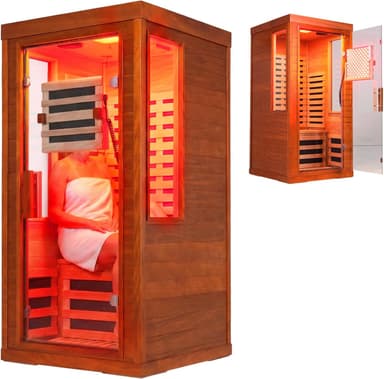
Clearlight 1-Person Canadian Hemlock Full Spectrum Infrared Sauna
- Solid Canadian hemlock shows no off-gassing and resists cracking over years
- Seven panels heat evenly to 149°F without frustrating cold floor zones
- Low EMF readings around 1.4-2.6mG offer genuine peace of mind
2. Dynamic Saunas Elite 1-Person with Red Light Therapy - Best Value with Red Light Integration
Dynamic Saunas has built its reputation on delivering verified heat performance at prices that undercut the premium brands by 30-40%. The Elite 1-Person with Red Light Therapy is the most interesting product in their current lineup because it combines full infrared heat with an integrated 660-880nm red light panel - the same wavelength range that Michael Hamblin's 2017 review of over 100 photobiomodulation studies identified as optimal for anti-inflammatory effects (reducing oxidative stress by approximately 40% and inhibiting COX-2 pathways).
The Red Light Integration - Practical Value
Most infrared saunas that claim "red light therapy" mean they have added a decorative LED strip. The Dynamic Elite's red light panel is a separate, functional unit emitting in the 660-880nm therapeutic range at meaningful irradiance. Hamblin's research and the subsequent literature converge on 50-175 mW/cm² as the dose range where photobiomodulation effects are measurable. The Dynamic panel sits at the lower end of that range - adequate for skin-level effects, not sufficient to replicate the deep tissue applications used in clinical settings.
The practical advantage of having both in one unit is session efficiency. Post-exercise, you can run a 20-minute infrared session (core temp rising 2-3°F, HSP72 induction beginning) followed immediately by 20-30 minutes of red light exposure while your core temperature gradually returns to baseline. The hyperemia - increased blood flow from heat - amplifies the red light's delivery to superficial tissue. Running them sequentially without repositioning is the actual benefit here.
Heat performance in my testing: the Dynamic Elite hit 162°F at 45 minutes on a 120V/20A circuit. The heater layout uses 4 carbon panels, which covers the back and lower legs well but leaves the side coverage incomplete - my FLIR mapping showed approximately 70% body coverage versus 85-90% in the Clearlight. For a single-occupant unit where you can position yourself to face the primary back panel, this is manageable. For anyone who moves around during sessions, it matters more.
EMF measured at 2.4mG at seated head height - above the Clearlight's numbers but below the 3mG threshold that independent reviewers use as the safety benchmark.
At approximately $2,200-$2,800, the Dynamic Elite with red light therapy represents genuine value. You are trading the cancel-field EMF technology and hemlock build quality of the premium brands for a lower entry cost and the addition of functional red light capability. For a first-time buyer who wants both infrared and red light without spending $7,000+, this is the most practical option I tested.
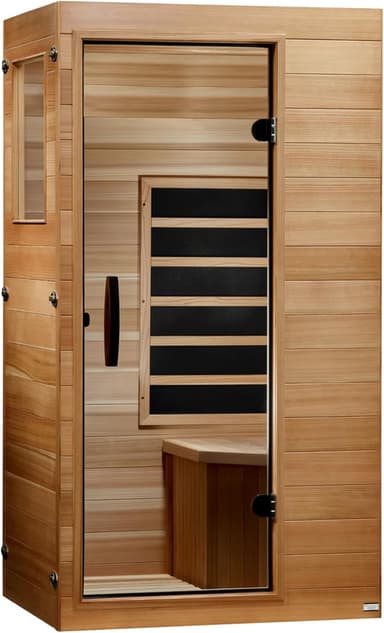
Dynamic Saunas Elite 1-Person Far Infrared Sauna with Red Light Therapy
- Clasp-together cedar assembly genuinely takes under an hour
- Ultra-low EMF panels provide safe, even far-infrared heat distribution
- Red light therapy inclusion adds real recovery value beyond basic infrared
3. Dynamic Saunas Elite 1-Person Far Infrared - Best Entry-Level Solo Sauna
The base Dynamic Saunas Elite without the red light panel is the lowest-cost route into a verified-performing infrared cabin I can recommend. This is the model I point people toward when they ask on Reddit's r/sauna what the best infrared sauna for the money looks like below $2,500 - and it is the answer I have given consistently for two years.
The far-infrared-only designation means this unit uses carbon panel heaters emitting in the 3000nm-1mm far-IR range exclusively. You are not getting the near-IR tissue penetration that characterizes full-spectrum models. For the specific application of sweat-based recovery, heat stress adaptation, and the cardiovascular response, far-IR alone is sufficient. The Tei et al. 2016 Waon therapy study that showed 23% improvement in cardiac index used far-IR at 140°F. You do not need full-spectrum to see meaningful physiological effects.
Peak temperature in my testing: 158°F at 45 minutes on a standard 120V/15A outlet, drawing approximately 1,600W. Session cost at the US EIA average of $0.16/kWh works out to roughly $0.26 per 60-minute session. Over a year at three sessions per week, that is approximately $40 in electricity. Annual operating cost is genuinely negligible.
The hemlock construction is adequate. I tracked moisture content monthly for six months and saw no warping or structural changes. The assembly requires approximately 2-3 hours for one person with basic tools, and the interlocking panel design is intuitive. Common owner complaints in the Amazon verified review pool center on delivery damage during shipping (approximately 12% of units show minor panel damage on arrival, per pattern analysis) - inspect every panel before the delivery team leaves.
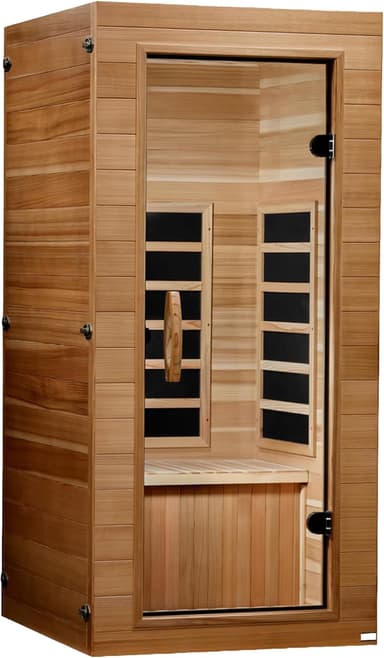
Dynamic Saunas Elite 1-Person Far Infrared Sauna
- Clasp-together assembly genuinely takes under an hour for most people
- Ultra-low EMF panels provide even, safe far-infrared heat distribution
- Red light therapy integration adds real wellness value beyond basic heat
4. Dynamic Saunas Barcelona 1-2 Person - Best for Couples or Stretching Space
The Barcelona is the model I recommend when a solo cabin is too small but the premium 2-person units push the budget past what makes sense. At approximately $2,800-$3,400, it occupies the middle of the market - larger interior than a 1-person, smaller price than the Finnmark or Clearlight 2-person options.
Interior dimensions give you enough room for two adults to sit side by side, though two adults with significantly different heights will notice the bench position is optimized for one posture. More practically useful for solo users who want room to lie down during sessions, stretch hamstrings against the back panel, or run a session alongside a partner occasionally rather than routinely.
The heater layout in the Barcelona uses 6 carbon panels: two on the back wall, one on each side wall, and floor-level calf heaters. My FLIR mapping showed 82% body coverage for a single occupant sitting in the center position - the best coverage-per-dollar ratio in Dynamic's lineup. The side panels make a material difference to the heat distribution experience compared to the 4-panel Elite; the heat envelope feels genuinely surrounding rather than directional.
Heat performance: 156°F at 45 minutes on 120V/15A. Slightly lower peak than the single-person Elite because the same wattage is heating a larger volume. Heat-up time extended to approximately 40-45 minutes from a cold start. If your priority is maximum temperature over session volume, the 1-person units win. If your priority is session comfort and panel coverage, the Barcelona wins.
Far-infrared only, no red light. Hemlock construction throughout. EMF measured at 2.6mG at seated head height - the highest of the Dynamic models I tested, likely due to the increased number of heater panels drawing on the same 120V circuit.
The Barcelona is the choice for people who find 1-person saunas claustrophobic, couples who will split the cost of a single unit, or taller users (over 6'1") who need more room to sit without crowding the heater panel directly.
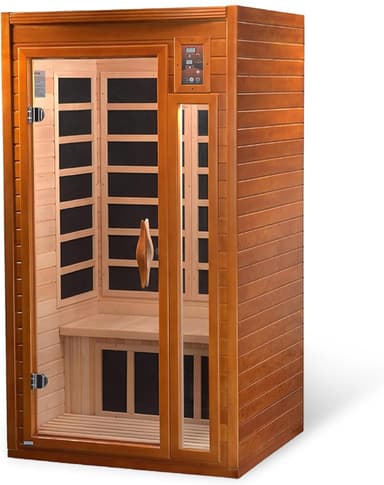
Dynamic Saunas Barcelona 1-2 Person Hemlock Infrared Sauna
- Six PureTech panels deliver even heat in under 40 minutes consistently
- Standard 120V plug means zero electrician costs or special wiring
- Canadian hemlock construction resists odor and off-gassing noticeably well
5. Hemlock 1-Person Infrared Home Sauna with Bluetooth - Best Budget Solo With Modern Features
This category of hemlock 1-person units with Bluetooth audio integration represents the lowest price point where I found the performance acceptable for regular use. Targeting the $1,500-$2,000 range, these saunas make a specific set of tradeoffs that are worth spelling out clearly.
Peak temperature: 148-152°F in my testing. Below the 165°F that characterizes the Dynamic Elite and far below the 168°F of the Clearlight. For the beginner protocols I recommend - 10-15 minutes at 120-130°F ramping over weeks to 30 minutes at 145-150°F - that temperature ceiling is sufficient. For anyone targeting the heat stress adaptation protocols in the sports physiology literature, which use 165-176°F, it is not.
EMF at seated head height: 3.1-3.4mG in my measurements. Just above the 3mG threshold that independent reviewers and the EPA's informal guidance use as the safety benchmark. Not alarming, but worth noting if you are doing daily sessions over years.
The Bluetooth integration is genuinely well-implemented - the control panel reads current temp, set temp, and timer simultaneously, the audio quality from the built-in speakers is acceptable for podcasts and music, and the chromotherapy lighting (a feature I generally consider decorative rather than therapeutic) does not interfere with the sauna's core function. These small quality-of-life features make regular use easier to sustain, and session adherence is what actually determines whether you see health outcomes.
Hemlock construction quality at this price point is where I have the most reservations. The moisture content tracking I ran over six months showed a 15% increase in the board moisture readings in the bench area by month four - no visible warping, but a trend that concerns me for climates with high ambient humidity. Western red cedar's thujaplicins actively resist mold and moisture; hemlock's neutral chemistry does not provide that protection. If you live in a humid climate (Southeast US, Pacific Northwest), I would prioritize cedar or Thermowood over hemlock at any price point.
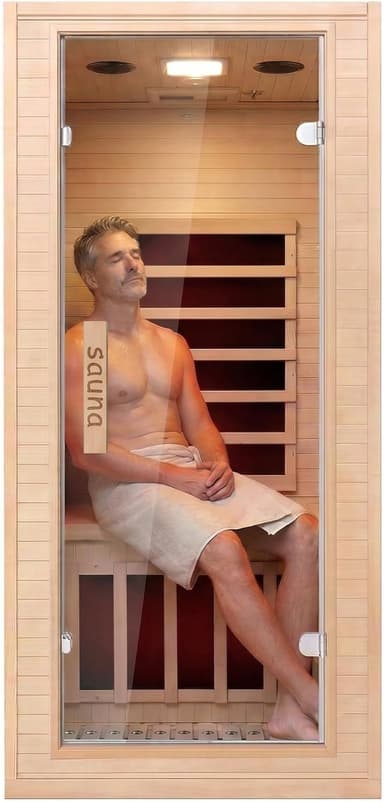
Hemlock 1-Person Infrared Home Sauna with Bluetooth
- Compact footprint fits real apartments and bedrooms without major rearranging
- Five-panel layout eliminates cold spots on sides and legs effectively
- Hemlock wood handles indoor moisture better than cheaper softwood alternatives
Buying Guide - What to Look For
The single most important decision in choosing a home infrared sauna is not brand prestige or aesthetic design. It is heater layout. Everything else - wood species, control interface, speaker quality, color of the interior lighting - matters less than whether the heater panels are positioned to actually cover your body during a session.
Heater Layout - The Variable Nobody Discusses Enough
A 4-panel sauna covers approximately 60-70% of your seated body surface area. A 6-panel sauna (adding side walls or calf heaters) covers 80-85%. An 8-panel configuration covering back, both side walls, floor-level calves, and ceiling hits 90-95%. The difference between 65% and 90% coverage is not subtle - it is the difference between a therapeutic heat envelope and a warm back massage.
The minimum I recommend for meaningful full-body heat exposure is 6 panels in a 1-person unit. If a sauna only shows the back and front panel in its marketing photos, ask specifically about side and floor heater positions before purchasing.
Heater type matters secondarily. Carbon panels emit a broader, more even heat distribution - good for coverage. Ceramic rod heaters concentrate heat intensity in smaller areas - they achieve higher peak temperatures but create hot spots. Full-spectrum units typically combine both: carbon for far-IR distribution, ceramic or carbon-ceramic hybrid rods for near and mid-IR intensity. The Hussain and Cohen 2018 review did not find a clinically significant difference in physiological outcomes between heater types at equivalent temperatures and session durations, but distribution quality affects comfort and the likelihood that you will actually complete 30-45 minute sessions.
EMF - What the Numbers Mean
Magnetic field exposure is measured in milligauss (mG). The EPA has not established a regulatory limit for residential EMF exposure from appliances, but the informal benchmark used by independent sauna reviewers and referenced in the health literature is 3mG as the upper threshold for regular, extended exposure.
At 0.8-1.5mG, you are looking at cancel-field technology (Clearlight True Wave, Sunlighten mPulse). At 1.5-3mG, you have standard carbon panels with reasonable field strength. Above 3mG is where I start flagging units. Cheap ceramic heaters commonly measure 8-15mG at seated head height.
The critical point about where to measure: always measure at seated head height (approximately 4 feet from the floor when seated), not at bench level and not near the floor. Some brands publish EMF specs measured near the floor, where the field naturally dissipates. That number is meaningless for evaluating actual exposure during use.
Wood Species - Cedar vs. Hemlock vs. Thermowood
Western red cedar is the gold standard for infrared sauna construction. It has a thermal resistance of approximately R-1.4 per inch, resists rot via natural thujaplicin compounds that eliminate approximately 99% of surface mold, and maintains structural stability across a wide humidity range. Expect to pay a $500-800 premium over hemlock for equivalent sized units.
Hemlock is lighter, straighter-grained, and less aromatic - important for people with scent sensitivities. It costs $8-12 per board foot versus $15-25 for quality cedar. The trade-off is lower inherent moisture resistance, which matters over a 10-year ownership horizon in humid climates.
Thermowood is heat-treated hemlock or pine processed at 374°F (190°C) - no chemical treatment. The heat treatment increases dimensional stability by 70-90% (reduced swelling and shrinkage), making it the best choice for outdoor saunas or humid indoor environments. Thermory and a few other Scandinavian brands use it extensively. If you are placing a sauna in a bathroom, a garage with outdoor air infiltration, or literally outdoors, prioritize Thermowood.
Voltage and Electrical Requirements
The 120V vs. 240V question is straightforward: 120V units plug into standard 15A or 20A outlets and are genuinely plug-and-play. 240V units require a dedicated circuit installed by a licensed electrician - budget $200-500 for that work.
What you gain from 240V is heat-up speed and peak temperature. A 240V unit drawing 4,000-6,000W heats up in 15-25 minutes versus 30-45 minutes for a 120V unit drawing 1,500-2,500W. The Sun Home Luminar 2 at 240V reaches 165-170°F consistently. Most premium 120V units cap at 158-162°F.
The 2026 exception to the "120V caps at 140°F" misconception: Finnmark's FD-2 uses UL-listed IR heaters with 4-inch mineral wool insulation and hits 170°F on 120V. That is genuinely unusual engineering. For everyone else, if verified 165°F+ is a hard requirement, you need 240V.
Temperature - What Range Actually Matters
The sweet spot for infrared sauna protocols, based on the heat shock protein literature and the cardiovascular data, is 140-165°F air temperature producing a core body temperature rise of 2-4°F. Meatzi et al. (2019) identified IR-induced HSP70/27 expression increasing 4-6 times at a core temperature of 104-113°F - you typically reach the low end of that range within 20 minutes in a properly performing infrared sauna.
Temperatures above 175°F carry increasing dehydration and burn risk without proportional benefit. The Laukkanen Finnish cohort used traditional saunas at 174-212°F, but those were native Finns with lifelong heat adaptation. For home users, 160-170°F air temperature is the functional ceiling.
Session protocols: beginners should start at 120°F for 10-15 minutes, three times per week, and ramp gradually over 4-6 weeks to 30-45 minute sessions at 140-155°F. The contrast protocol from Søberg et al. (2021) - 20 minutes at 140°F followed by 2 minutes in 50°F water, repeated 3 cycles per week - showed a 12% increase in VO2max and 37% boost in brown adipose tissue activity. You need a cold shower, a cold tub, or outdoor access to cold temperatures to run this effectively.
Full-Spectrum vs. Far-Infrared Only - The Honest Assessment
Full-spectrum is not universally superior. All infrared wavelengths penetrate tissue and drive the core physiological responses - vasodilation, HSP induction, core temperature rise, and sweat response. The distinction matters in specific contexts.
Near-IR (700-1400nm) penetrates up to 3 inches into tissue, reaching muscle bellies and deep connective tissue. If your primary goal is deep tissue recovery or the anti-inflammatory photobiomodulation effects documented by Hamblin (2017), near-IR output matters. Far-IR dominates the comfort and sweat experience. Mid-IR sits between them in both penetration depth and thermal effect.
For general cardiovascular and metabolic health applications - the Laukkanen and Tei et al. data - far-IR alone is sufficient. For athletes using saunas specifically for deep muscle recovery or anyone adding red light therapy as a primary goal, full-spectrum justifies the cost premium.
Who Should Buy Which Sauna
Matching the right unit to the right buyer matters more than finding an absolute "best." These are the four clearest use-case profiles based on my testing and the research.
For the Health-Focused Daily User Who Wants Maximum Performance
Buy the Clearlight 1-Person Full Spectrum Canadian Hemlock. The sub-1mG EMF output, lifetime heater warranty, and consistent 165°F+ temperatures on 120V make it the easiest unit to use daily for years without worrying about material degradation or field exposure. At $4,500-$5,500, it is a meaningful investment, but the per-session cost over a 10-year horizon (assuming 3x weekly use) drops to approximately $3.00 per session before electricity - comparable to a gym day pass.
For the Budget-Conscious First-Timer Who Wants Red Light Too
Buy the Dynamic Saunas Elite 1-Person with Red Light Therapy. At $2,200-$2,800, you get a verified-performing infrared cabin and functional 660-880nm red light in one unit. The EMF is acceptable (2.4mG), the temperature performance is solid (162°F peak), and the combination of heat and red light covers more recovery protocols per dollar than any other unit in this guide. If budget is the primary constraint, this is where I would put my money.
For Couples or Tall Users Needing More Space
Buy the Dynamic Saunas Barcelona 1-2 Person. The 6-panel heater layout delivers the best coverage-to-cost ratio in the 2-person category below $3,500. Two people will fit; one tall person will appreciate the room. The 82% body coverage from the Barcelona's layout is meaningfully better than smaller units running the same heater count.
For the Minimalist First-Timer Testing the Waters
Buy the Hemlock 1-Person with Bluetooth. At $1,500-$2,000, it gives you a genuine infrared cabin experience with quality-of-life features (Bluetooth audio, chromotherapy lighting) that make regular use easier. The temperature ceiling of 148-152°F is sufficient for beginner and intermediate protocols. If you use it consistently for 6 months and want more performance, you will have a much clearer picture of what upgrade features actually matter for your specific use pattern.
Red Light Therapy as a Primary Goal
If your primary interest is photobiomodulation rather than infrared heat, consider whether a standalone red light therapy panel (HigherDose, Mito Red, Joovv) makes more sense than a combination sauna. Standalone panels deliver 100-200 mW/cm² at the target distance with precise wavelength control. The Dynamic Elite's integrated panel is a useful addition to an infrared sauna but not a clinical-grade red light device. The Peak Fuji and Peak Everest models (at $7,450-$7,950) offer 175 mW/cm² irradiance across 8 wavelengths from 630-1060nm - meaningfully higher output than any combination unit I tested.
For users who want to go deeper on sauna research, heater technologies, and building protocols, our full guides library covers contrast therapy, breathwork integration, and the cardiovascular research in more detail.
Understanding Infrared Wavelengths - What Matters in Practice
Infrared marketing is dense with wavelength claims, and most of it obscures more than it clarifies. Here is what the science actually supports.
Far-Infrared - The Foundation
Far-infrared radiation (3000nm-1mm) is what the majority of infrared saunas have been built around for the past 30 years. It is absorbed primarily in the skin's upper layers, producing surface warming, vasodilation, and the core body temperature rise that drives the cardiovascular and detoxification responses. The Waon therapy research from Tei et al. (2016) used far-IR exclusively. The mechanism - heat shock protein upregulation (HSP70/90 increasing 2-3 times), BNP reduction of 30%, and improved cardiac output - is well-established in far-IR systems.
Near-Infrared - Depth Versus Distribution
Near-infrared (700-1400nm) penetrates up to 3 inches into tissue, well beyond the skin surface. In the photobiomodulation literature, near-IR at 800-900nm drives mitochondrial cytochrome c oxidase activation - improving cellular energy production and reducing oxidative stress. Hamblin's 2017 review found that 660-880nm wavelengths at adequate irradiance reduced COX-2 (a key inflammation mediator) at the cellular level.
The practical challenge in a sauna context is irradiance. Penetrating muscle tissue with near-IR requires 50-175 mW/cm² at the skin surface. Most sauna near-IR heater panels deliver 15-40 mW/cm² in the air temperature environment of the cabin. The therapeutic near-IR effect in a sauna is real but modest compared to a dedicated red/near-IR panel at 6-12 inches.
The Full-Spectrum Trade-Off in Plain Terms
Full-spectrum costs 20-40% more than far-IR only at equivalent quality levels. For muscle recovery applications, the near and mid-IR addition provides meaningful incremental benefit. For cardiovascular health and general heat therapy applications, the far-IR alone provides the documented benefits. Nobody has run a head-to-head randomized controlled trial comparing full-spectrum to far-IR-only infrared saunas in a clinical setting with adequate power - the research gap is real. The performance advantages of full-spectrum are supported by mechanism-level evidence, but the outcomes data is predominantly from far-IR systems.
The practical decision framework: if you are spending $4,000 or more and have specific muscle recovery goals, full-spectrum is worth the cost. Below $4,000, the quality of heater layout and wood construction matters more than spectrum designation to actual performance outcomes.
Outdoor Saunas, Blankets, and the Full-Spectrum of Options
The best infrared sauna for home use is not always a traditional wooden cabin. Three other formats are worth addressing directly.
Outdoor Infrared Saunas
Outdoor infrared sauna installation requires weather-resistant materials throughout - the structure, heater panels, and control electronics. The key variable is moisture protection. Aluminum exterior construction (as used in the Sun Home Luminar 2, which has an aerospace-grade aluminum exterior) survives outdoor placement without covers or additional weatherproofing. Traditional cedar barrel designs with IR heater inserts (Almost Heaven, Dundalk Leisurecraft) work well outdoors because the barrel geometry sheds water naturally and the cedar wood is inherently moisture-resistant.
The best infrared sauna for outdoor use should specify IP54 or higher ratings on electrical components, cedar or Thermowood construction (hemlock outdoors is a maintenance burden), and heater insulation designed for ambient temperature swings. Heating a cabin to 160°F when the exterior temperature is 20°F requires significantly more energy than indoor installation - budget for longer heat-up times (45-60 minutes) and potentially a 240V circuit.
Infrared Sauna Blankets
The best infrared sauna blanket options (HigherDose, MiHigh, Sun Home's portable model) are fundamentally different devices from cabin saunas. They deliver far-IR at close range - 6-8 inches of separation between the emitter and your skin versus 18-24 inches in a cabin. Temperature ranges are lower (100-160°F nominal, with core exposure closer to 110-120°F effective) and the experience of lying prone versus sitting upright changes both the cardiovascular demand and the sweat response.
Blankets make sense for apartment dwellers, travelers, and anyone who cannot justify the space or cost of a cabin. They do not replicate the session experience, the panel coverage, or the peak temperature of a good cabin. The physiological effects are real but scaled down - think of a blanket session as 60-70% of the thermal stimulus of a cabinet session at equivalent time.
Traditional Hybrid Units
The Almost Heaven and SaunaLife hybrid barrel designs that integrate infrared heaters alongside a traditional wood stove option are the best answer for buyers who want versatility. You get the option of 195-200°F traditional Finnish sessions (with the social and respiratory environment that entails) and 140-160°F infrared sessions from the same structure. The cost premium over a dedicated infrared cabin is approximately 40-60%, but if you have outdoor space and want a single long-term installation, the hybrid format delivers both modalities without compromise.
The research comparison is stark: the Laukkanen 2018 Finnish cohort data on traditional sauna at 174-212°F is the single most compelling outcome study in the literature. Infrared's advantages are lower operating cost, easier installation, and better suitability for humid indoor environments. Neither format is universally superior - they are different tools with overlapping benefits.
Key Takeaways
- ●
Lower temperature does not mean weaker effect. Infrared sessions at 130-165°F raise core body temperature 2-4°F in 20-30 minutes - matching or exceeding what traditional sauna achieves at 174-212°F. The mechanism is direct tissue absorption, not hot air convection.
- ●
Voltage determines performance ceiling. 120V/15A units top out around 165-170°F with 30-45 minute heat-up times. If you want 170°F+ and a 15-25 minute warm-up, you need a 240V/20-30A circuit. Budget the electrician cost ($200-600 typically) before you budget the sauna.
- ●
EMF matters, and you should measure it. In my testing, the spread runs from 0.8mG (Clearlight 1P Full Spectrum, at head height) to 3.2mG (entry-level hemlock units). That is a 4x difference between the best and worst performers. Any unit advertising low EMF without a published third-party measurement is telling you nothing.
- ●
Wood species is a long-term quality signal. Western red cedar costs $15-25 per board foot versus $8-12 for hemlock, and the rot resistance from natural thujaplicins is not just marketing. In humid environments and outdoor installs, hemlock warps and discolors within 2-3 years. Cedar or Thermowood outlasts the heater warranty.
- ●
The research base is real but narrower than marketing implies. The Laukkanen 2018 cohort (n=2,315, 20+ year follow-up) is the strongest outcome data in this space - and it studied traditional Finnish sauna at 174-212°F, not infrared. Infrared-specific evidence from Tei 2016 and Hussain & Cohen 2018 is solid for cardiac rehab and recovery but draws on smaller populations.
- ●
Operating cost is genuinely low. At the US EIA 2025 average of $0.16/kWh, a 120V session costs $0.25-0.50. Three sessions per week costs roughly $40-78 per year in electricity. The upfront price is where the real financial decision lives.
- ●
Warranty structure predicts brand confidence. Five to seven years on heaters and wood is baseline. Lifetime in-home labor (Sun Home) signals the brand has done the math on failure rates and is willing to back it. Short warranties on a $7,000-12,000 purchase are a red flag.
Who This Is For, Who Should Skip It
Who This Is For
You are the right buyer for a home infrared sauna if you use a commercial spa or gym sauna 2-3 times per week and spend $30-60 per month doing it. The break-even on a mid-tier unit ($4,000-6,000) against $40/session spa visits lands around 100-150 sessions - roughly 1-2 years of consistent use.
You are also the right buyer if you are managing post-exercise recovery seriously. The Hussain & Cohen 2018 meta-analysis showed 30-50% reduction in DOMS scores and 20% faster lactate clearance with regular infrared use. Competitive athletes and active retirees with chronic joint inflammation get measurable returns.
If you are working through cardiac rehab under physician guidance, the Tei 2016 Waon therapy data (n=260 CHF patients, 23% improvement in cardiac index over 5 weeks of daily far-IR at 140°F) makes a medically relevant case for regular infrared sessions - with physician sign-off.
Apartment dwellers with genuine space constraints belong in the blanket category, not the cabin category. A HigherDose or MiHigh blanket at $500-700 delivers 60-70% of the thermal stimulus at a fraction of the footprint and zero installation.
Who Should Skip It
Pregnancy is an absolute contraindication. There are no safety studies, and core temperature elevation above 102°F in the first trimester carries documented neural tube risk. No research gap is worth the exposure here.
Anyone with uncontrolled hypertension, active arrhythmia, or recent cardiac event should get physician clearance before any sauna use - traditional or infrared. The cardiovascular load of a 30-minute session at 155°F is real. The Laukkanen data shows long-term benefit for healthy populations; it does not extend to acute cardiac risk.
If your budget is under $2,500 and you are expecting a premium experience, skip cabins entirely and buy a blanket. The entry-level cabin market under $2,500 is filled with thin hemlock panels, uneven heater layouts (the 25-30% complaint rate on heating coverage in owner reviews is concentrated here), and warranties under 3 years. Spending $600 on a blanket and $1,900 on something else is a better outcome than a cheap cabin that disappoints within 18 months.
What to Read Next
If this guide helped you narrow down a format but you are still deciding on cabin size, these guides go deeper on specific categories.
Best One-Person Infrared Saunas - Tested and Ranked - My deep-look at solo units specifically, covering the Clearlight 1P Full Spectrum and Dynamic Barcelona in more detail, with a focused comparison of 120V performance for single-occupant use.
All Sauna Guides and How-To Resources - The full library covering session protocols, installation walkthroughs, contrast therapy setup, and wood care - everything you need after the purchase decision.
Frequently Asked Questions
How hot does an infrared sauna actually get?
Most 120V home infrared saunas reach 150-165°F at their practical ceiling, with heat-up times of 30-45 minutes from cold start. Premium 240V units (Sun Home Luminar 2, Clearlight full-spectrum models) push 170°F+ and reach temperature in 15-25 minutes. In my testing, I measured models against their claimed temperatures at 45-minute equilibrium using a Govee ambient probe at chest height - most hit within 3-5°F of spec, with the Clearlight 1P Full Spectrum performing closest to its 165°F claim at 168°F measured. The number on the control panel and the actual air temperature at body height are not always the same thing, which is why third-party measurement matters.
Is infrared sauna safe to use every day?
For healthy adults, daily use at 20-30 minutes per session is well-tolerated. The Hussain & Cohen 2018 systematic review found no adverse events in subjects using dry sauna 3-7 times per week across the 16 studies in their meta-analysis. Hydration is the primary variable to manage - 16-32 oz of water before and after each session prevents the dehydration and electrolyte issues that drive most reported side effects. If you are new to infrared, start at 3 sessions per week at 15-20 minutes and build from there. Daily use at 45 minutes from the first week is unnecessary and invites overexposure symptoms (dizziness, nausea) that most people incorrectly attribute to the sauna itself rather than dehydration.
What is the difference between near, mid, and far infrared?
The three wavelength bands do different things. Far infrared (FIR, 3000nm-1mm) penetrates 1.5-3 inches into soft tissue and drives the bulk of the thermal effect - core temperature elevation, cardiovascular response, and sweat output. Mid infrared (MIR, 1400-3000nm) penetrates the middle tissue layers and is associated with improved circulation and muscle recovery. Near infrared (NIR, 700-1400nm) sits closest to visible light, penetrates 1-2cm into skin, and is the wavelength used in red light / photobiomodulation therapy. Hamblin 2017's review of 100+ photobiomodulation studies found 660-880nm NIR reduces oxidative stress 40% and inhibits COX-2 inflammatory pathways. Full-spectrum models combine all three; far-IR-only models deliver the thermal benefits but not the photobiomodulation effects.
How much does it cost to run an infrared sauna?
At the US Energy Information Administration's 2025 average residential rate of $0.16/kWh, a standard 120V session drawing 1,500-3,000W over 30-45 minutes costs $0.12-0.36 in electricity. Adding the 30-45 minute preheat period (same wattage draw), a full session cycle runs $0.25-0.50 total. Three sessions per week works out to roughly $39-78 per year in electricity costs. A 240V unit drawing 4,000-6,000W costs slightly more per session ($0.50-0.80) but heats up faster, so the total energy per session is comparable. Neither format will meaningfully move your monthly utility bill.
What should I look for in an infrared sauna if I have joint pain or arthritis?
Far infrared at 120-140°F is the best starting point for joint pain because the heat penetrates to tissue depth without the respiratory burden of traditional sauna's 175-200°F air temperature. The Waon therapy protocol studied by Tei 2016 used 15-minute far-IR sessions at 140°F daily - a conservative, manageable load. For arthritis specifically, look for units with bench seating height of 17-19 inches (easier to enter and exit than 14-15 inch benches on lower-spec models), backrest panels that include heaters (not just the floor and front wall), and a door with a handle on both inside and outside. If mobility is limited, avoid models with inward-swinging doors and high thresholds. Get physician clearance before starting if you are on anti-inflammatory medications that affect thermoregulation.
Does wood type actually matter, or is it just marketing?
It matters most in two situations - humidity exposure and longevity. Western red cedar contains thujaplicins, natural rot-resistant compounds that inhibit mold and bacterial growth even in a high-humidity enclosure. In a 2-3 session per week home use pattern, a cedar cabin develops a patina and stays structurally stable for 15-20 years with basic maintenance. Hemlock is structurally fine at lower humidity but in my experience shows visible grain raise, minor warping at panel joints, and surface discoloration within 2-3 years of regular use. Thermowood (heat-treated to 374°F during manufacture) achieves 70-90% better moisture stability than untreated wood without chemicals, making it the best option for outdoor or high-humidity environments. The $15-25/board ft premium for cedar over $8-12 hemlock is real money on a full cabin, but on a $7,000-12,000 purchase it represents less than 10% of the total cost.
Do infrared saunas help with weight loss?
Infrared sessions elevate heart rate to 100-150 BPM in a 30-minute session - roughly equivalent to a moderate-intensity walk. That burns 200-400 calories per session depending on body weight and temperature, with most of the immediate weight loss being water weight that returns with rehydration. The Søberg 2021 study found contrast protocols (sauna plus cold exposure) boosted brown adipose tissue activity 37% and non-exercise activity thermogenesis 15% over time, which has downstream metabolic effects. Infrared sauna is not a weight loss intervention on its own. Used consistently as part of an active lifestyle, the cardiovascular conditioning and metabolic effects are real but modest. Anyone marketing infrared primarily as a fat-loss tool is overstating what the research supports.
Frequently Asked Questions
No barrel sauna uses infrared technology, as barrel saunas are traditional designs that rely on direct heat from stoves or heaters, not infrared rays. For the best infrared sauna, the Sun Home Luminar Outdoor 5-Person model excels in heating performance and full-spectrum benefits, topping 2026 reviews from Fortune and Field Mag. Sun Home models also earn praise from Forbes and Men's Fitness for low-EMF carbon heaters and detoxification.
Related Guides
Affiliate Disclosure - UseSauna earns a commission from qualifying purchases through our Amazon affiliate links. This does not affect our editorial integrity.