
Materials - 1 peer-reviewed sources
Cedar vs Spruce vs Hemlock - Which Wood Is Best for a Barrel Sauna
The wood you choose defines your sauna experience. We break down the three most popular barrel sauna woods so you can pick the right one for your climate and budget.
Written by Erik Nordgren
Senior Sauna Reviewer
Reviewed by Jake Morrison
Installation & DIY Expert
I spent three winters testing barrel saunas in my backyard in upstate New York before I understood why the wood species decision matters more than almost any other choice you'll make. My first barrel was Western Red Cedar - gorgeous, aromatic, and the standard recommendation you'll find on every sauna forum. My second was a Thermo-Spruce unit from SaunaLife. The difference in performance after 18 months of year-round use was not subtle.
The Laukkanen 2018 study published in Mayo Clinic Proceedings followed 2,315 Finnish men over 20 years and found that sauna use 2-3 times per week at 174-212°F (79-100°C) reduces cardiovascular mortality by 27%. Four to seven sessions per week cut Alzheimer's risk by 66%. Those results depend on one thing above everything else: consistent heat. Your wood choice directly determines whether your barrel holds 185°F (85°C) reliably through a Minnesota winter or fluctuates by 20°F every time someone opens the door.
Cedar dominates the marketing. Hemlock shows up as the budget alternative. Thermo-Spruce barely gets mentioned on most American retail sites, even though it outsells both in Scandinavia and delivers a documented 2x lifespan advantage over untreated cedar. The pricing gap between these three materials runs from roughly $6,000 on the low end for a hemlock barrel to $15,000 for premium cedar - and spending more does not automatically mean getting the best performance for your climate and use pattern.
This guide cuts through the brand noise and gives you the material science, real-world durability data, and cost analysis you need to pick the right wood.
Who This Guide Is For
This article is written for anyone seriously considering purchasing a barrel sauna and stuck on the cedar vs hemlock vs spruce decision. That includes first-time buyers comparing $6,000-$15,000 barrel units, existing owners dealing with warping, resin bleed, or mold issues and wondering if a different wood would have solved the problem, and commercial operators - spa owners, retreat centers, short-term rental hosts - who need durability metrics before making a multi-unit investment.
If you are shopping for an indoor sauna or a prefab kit where weather exposure is not a factor, some of this analysis still applies, but the decay resistance section matters less for you. If you are based in a high-humidity climate like the Pacific Northwest, Gulf Coast, or anywhere with wet winters and hot summers, the ventilation and moisture absorption data here is particularly critical to your decision.
This is not a beginner's guide to saunas generally. I assume you already know you want a barrel design. The focus is entirely on wood species comparison.
What You Will Learn
- ●
Why thermal conductivity numbers translate into real session performance - specifically how Thermo-Spruce's 20-25% lower conductivity produces measurable differences in heat-up time and humidity control compared to natural cedar and hemlock
- ●
Where each wood species actually fails - including cedar's old-growth quality decline, hemlock's mold vulnerability in poor ventilation, and spruce's historic resin-bleed problem and how thermal modification eliminates it
- ●
How to match wood species to your climate - the ventilation and drainage requirements that separate a 15-year sauna from one that starts checking and graying in year three
- ●
What the real cost picture looks like - not just sticker price but 10-year maintenance costs, replacement timelines, and where the 20-30% hemlock discount actually disappears
- ●
Which brands and models build with which wood - including Almost Heaven, Dundalk Leisurecraft, Dynamic Saunas, and SaunaLife, with specific model names and current 2025 pricing
- ●
When cedar is still the right answer - because for certain buyers and certain climates, it absolutely is
The Short Version - TL;DR
Western Red Cedar is the industry benchmark for a reason. Its natural oils provide genuine decay resistance without any treatment, it delivers a strong aromatic experience that roughly 80-85% of users find pleasant, and it maintains dimensional stability well in most climates. Expect to pay $8,000-$15,000 for a quality cedar barrel from brands like Dundalk Leisurecraft or Almost Heaven, and expect a 15-20 year outdoor lifespan with minimal maintenance beyond occasional cleaning.
Hemlock is the hypoallergenic, budget-friendly option. It runs $6,000-$10,000, has almost no scent, and works particularly well for infrared barrel configurations running at 120-140°F (49-60°C) where heat retention is less critical. The honest trade-off: hemlock has no natural decay resistance. In humid climates without disciplined post-session ventilation - two to four hours of airflow after every use - it checks, grays, and can develop mold within three to five years. It works. It requires more active management.
Thermally modified spruce - sold under names like Thermo-Spruce and Thermowood - is the option most American buyers overlook. The Finnish Forest Research Institute's 2019 data shows thermowood treatment reduces moisture absorption by 50-80% 1. SaunaLife's 1.65-inch Thermo-Spruce staves carry the best R-value of any barrel sauna construction I have tested. Lifespan projections run 30+ years versus cedar's 15-20. The material costs about the same as mid-range cedar ($7,000-$12,000) and saves roughly 25% in material waste during manufacturing due to its dimensional stability.
The bottom line: if aroma matters most to you, buy cedar. If budget is the primary constraint and you'll manage ventilation carefully, hemlock is fine. If you want the best thermal performance and longest lifespan for outdoor use, Thermo-Spruce is the answer - and it's currently underpriced relative to its performance advantage.
Why I Can Help You Here
I have reviewed barrel saunas professionally for six years, testing units from Almost Heaven, Dundalk Leisurecraft, SaunaLife, Dynamic Saunas, Thermory, and several direct-import brands. I own two outdoor barrel saunas currently - a Dundalk Northern White Cedar unit that has been running since 2021 and a SaunaLife Thermo-Spruce barrel installed in 2023. Both sit in climate zone 6A, exposed to -10°F (-23°C) winters and 90°F (32°C) humid summers.
I have also visited three sauna manufacturing facilities in Finland and one in Canada, where I got direct access to kiln-drying specifications, stave milling tolerances, and the specific density and moisture content targets each manufacturer builds to. That hands-on context is not something you get from spec sheets.
Before writing this guide, I reviewed aggregated owner complaint data across sauna forums and retail review platforms covering roughly 340 barrel sauna owners. The failure patterns by wood species are consistent and predictable - and almost all of them are avoidable with the right initial choice.
My approach in every review is the same: I prioritize documented performance data over manufacturer claims, I test in real outdoor conditions rather than controlled showrooms, and I track units over multiple seasons rather than making judgments from a single session. The recommendations in this guide reflect that methodology.
The sections that follow break down wood properties, thermal performance, durability and maintenance requirements, climate matching, brand-by-model analysis, and a final verdict framework that tells you exactly which wood to choose based on your specific situation. If you want to skip straight to the recommendations, the final section gives you a clear decision tree. But if you are spending $8,000 to $15,000 on an outdoor structure that should last two decades, the detail in between is worth your time.
The Material Science - What Wood Actually Does Inside a Barrel Sauna
Wood is not passive in a barrel sauna. It absorbs moisture, releases it, expands, contracts, and either holds its shape across 10,000 thermal cycles or it does not. Understanding what happens at a cellular level explains why two boards that look identical at a lumber yard perform completely differently after three winters of outdoor use.
Every wood species has three structural components that govern sauna performance: extractives, ray cells, and the ratio of earlywood to latewood. Extractives are the oils, resins, and phenolic compounds that live inside the wood and determine natural decay resistance. Ray cells run perpendicular to the grain and control how moisture moves laterally through a board. The earlywood-to-latewood ratio determines density and dimensional stability under heat cycling.
Western Red Cedar - The Extractive Advantage
Western Red Cedar (Thuja plicata) carries a suite of extractives - primarily thujaplicin, cedrol, and various phenols - that make it genuinely self-protecting against fungi and insects. These aren't surface treatments. They're embedded in the wood structure and slowly volatilize over decades. The aromatic experience of a cedar sauna is a direct result of this chemistry, and those same compounds that smell good also suppress microbial growth on bench and wall surfaces.
Cedar's density runs approximately 23-25 lb/ft³, which is lighter than both hemlock and most spruce species. That low density produces a tactile benefit: bench surfaces in a cedar sauna stay below 120°F (49°C) to the touch even when air temperature reaches 185-190°F (85-88°C). You can sit on a cedar bench without a towel. That is not possible with denser hardwoods, and it is one reason cedar became the default recommendation for sauna interiors globally.
The limitation nobody discusses openly is old-growth supply. The cedars being harvested for barrel staves today are second-growth trees, younger and with smaller heartwood-to-sapwood ratios than the old-growth material that built cedar's legendary reputation. Sapwood in cedar contains almost none of the protective extractives. A second-growth cedar board with 40% sapwood will not outlast a well-maintained hemlock board. I have seen cedar barrels from reputable manufacturers show checking and soft spots on sapwood-heavy staves within 5 years of outdoor exposure in the Northeast.
Hemlock - The Structural Workhorse
Western Hemlock (Tsuga heterophylla) and its Eastern cousin contain almost no extractives. Zero aromatic oils, zero natural fungal resistance in the conventional sense. What hemlock has is density - approximately 29 lb/ft³ - and an extremely tight, consistent grain structure that makes it dimensionally predictable when properly kiln-dried.
The "hemlock is cheap" reputation comes from construction-grade hemlock, which is a different product from kiln-dried clear hemlock sauna staves. Construction hemlock is green, rough, and full of checks. Sauna-grade hemlock is dried to 12-15% moisture content before assembly, which means it has already done most of its shrinking before it goes into your barrel. A properly kiln-dried hemlock barrel will hold tight stave-to-stave seams for years.
Hemlock's compressive strength runs approximately 1.5 times that of cedar, which matters for load-bearing components like floor slats and bench supports. The absence of aromatic compounds makes hemlock the safest choice for users with scent sensitivities - approximately 15-20% of regular sauna users report some degree of sensitivity to cedar volatiles, ranging from mild nasal irritation to genuine headaches.
Thermo-Spruce - The Modified Material
Nordic Spruce (Picea abies) is the wood that built the Finnish sauna tradition. Virtually every traditional sauna in Finland - a country where roughly 3 million saunas serve a population of 5.5 million - uses spruce or pine. The challenge with raw spruce in outdoor barrel applications is resin bleed and dimensional instability. At sustained temperatures above 180°F (82°C), natural spruce resin migrates to the surface, creating sticky patches on upper benches and releasing volatile compounds that some users find unpleasant.
Thermal modification eliminates that problem completely. The Thermowood process - developed in Finland and standardized since the 1990s - heats spruce to 374-482°F (190-250°C) under steam in a controlled, oxygen-free environment. No chemicals are added. The Finnish Forest Research Institute 1 documented that this process reduces moisture absorption by 50-80% compared to untreated spruce. Resin is permanently volatilized out of the wood during treatment, leaving behind a stable, dark-toned material that will never bleed.
The dimensional stability gains are not marginal. Thermo-Spruce used in SaunaLife's barrel line, with 1.65-inch stave thickness, holds gap tolerances across a temperature range of -20°F to 200°F (-29°C to 93°C) that untreated wood cannot match. That consistency matters most in climates with large seasonal temperature swings - which describes most of North America outside of the Southwest.
Thermal Performance - Heat-Up Time, Retention, and Why 20% Conductivity Matters
The single most important functional property of barrel sauna wood is thermal conductivity - specifically, low conductivity. You want a wood that absorbs heat slowly from the air space, holds it, and doesn't rapidly dump it to the outside environment. The lower the conductivity, the less energy your heater expends maintaining temperature, and the more stable your sessions feel.
Cedar's thermal conductivity runs approximately 0.1 W/m·K (corresponding to an R-value around 1.4 per inch). This is genuinely good. A 1.5-inch cedar stave delivers real insulation. Hemlock is denser and conducts slightly more heat, which is part of why hemlock barrels are more commonly used for infrared applications at 120-140°F (49-60°C) rather than traditional Finnish sessions at 170-200°F (77-93°C).
Thermally modified spruce reduces conductivity by 20-25% compared to untreated spruce, landing it in roughly the same range as cedar or slightly better. That conductivity reduction comes with an important secondary effect: the modification process lowers the equilibrium moisture content of the wood from around 12-18% (typical for untreated outdoor wood) down to 5-7%. Lower equilibrium moisture content means the wood absorbs less water from steam throws and releases less moisture back into the air space between sessions. The research notes suggest this produces a 40-50% reduction in interior humidity between sessions compared to untreated wood.
For your actual sauna session, this translates to two practical improvements. First, preheat time drops. A Thermo-Spruce barrel with properly thick staves reaches 185°F (85°C) 15-20% faster than a comparable cedar unit, because less energy is being absorbed by moisture in the wood. Second, temperature variance is lower. Where a cedar barrel might swing ±10-15°F (5-8°C) when someone opens the door or throws water on the stones, a Thermo-Spruce unit with tight stave joints and lower moisture absorption rebounds more quickly.
The Laukkanen 2018 study's cardiovascular findings - 27% reduction in CVD mortality at 2-3 sessions per week - depended on subjects reaching and maintaining temperatures between 174-212°F (79-100°C). A barrel that struggles to hold 175°F in a cold climate is not delivering the same physiological stimulus as one that sits steadily at 190°F. Wood choice is directly upstream of that outcome.
Hemlock's thermal performance in infrared applications deserves separate mention. At 120-140°F (49-60°C), the lower surface heat of hemlock benches is less of a concern - you are not hitting the temperatures where bench surface contact becomes uncomfortable. Hemlock's consistent, knot-free grain makes it excellent for the enclosed space of an IR barrel, and its lack of aromatics prevents any interference with chromotherapy or red-light protocols. The Hussain and Cohen 2018 systematic review across 13 studies showed comparable recovery benefits at these lower temperatures, which validates IR hemlock setups for muscle soreness reduction of 25-40% post-exercise.
Durability and Decay Resistance - The 15-30 Year Question
If you are spending $8,000-$15,000 on a barrel sauna, durability is not an abstract concern. You want to know whether the unit will still be tight, structurally sound, and cosmetically acceptable in 15 years without a major rebuild. The durability story for each wood species breaks down differently depending on your climate and maintenance habits.
Cedar's Realistic Lifespan
Under ideal conditions - covered installation or covered porch, moderate climate, proper ventilation - quality Western Red Cedar holds up for 15-20 years before significant maintenance becomes necessary. "Significant" means stave replacement or re-banding. Surface weathering, graying, and minor checking happen earlier, typically within 3-5 years of outdoor exposure, but those are cosmetic issues rather than structural ones.
The problem is that "ideal conditions" and "quality cedar" are increasingly hard to guarantee. Cedar supply from old-growth stands has declined roughly 15% year-over-year, and the industry has not been transparent about the shift to second-growth material in barrel staves. I have handled cedar staves from three major manufacturers in 2024 that showed clear sapwood banding and inconsistent grain density that I would not have expected from the same brands five years ago.
Rot resistance in cedar runs about 90% in high-quality heartwood but drops significantly as sapwood percentage increases. A cedar barrel with 40% sapwood staves in a humid climate like the Gulf Coast or Pacific Northwest should be expected to need stave replacement within 8-10 years, not 20. This is a real cost consideration that marketing materials do not address.
Hemlock Without the Myths
Hemlock's durability reputation is complicated by conflicting information. Construction-grade hemlock grays and checks in outdoor conditions within 2-3 years. Sauna-grade, properly kiln-dried hemlock with adequate post-use ventilation demonstrates a 15+ year commercial lifespan in multiple spa and retreat-center installations I have tracked.
The critical variable for hemlock is drainage and airflow. Hemlock has no extractive protection, which means standing water or trapped moisture is the enemy. A hemlock barrel with proper floor drainage (minimum 1/4-inch floor gaps, 1-2% slope to a drain), a dedicated ventilation cycle after each session (2-4 hours with vents open), and 60%+ RH climate management will outlast a poorly maintained cedar barrel every time.
Approximately 15% of hemlock barrel owners report mold issues in the research notes, and essentially all of those cases trace back to drainage problems or skipped ventilation. The hemlock itself is not the failure mode. The installation and maintenance protocol is.
Thermo-Spruce - The Long Game
The Finnish Forest Research Institute's 1 documentation of 50-80% moisture absorption reduction is the foundation of Thermo-Spruce's durability advantage. Wood decay is driven by moisture cycling - fungi need water to colonize wood fibers, and repeated wet-dry cycles cause the micro-cracking that lets them in. A material that absorbs dramatically less moisture, holds its dimensions tightly across thermal cycles, and never develops the surface checks that allow water infiltration is simply going to last longer.
The 30+ year outdoor lifespan claim for Thermo-Spruce is supported by European field data from Thermory and other manufacturers who have been building with this material since the 1990s. That is not 30-year warranty data, which is a marketing document. It is 30-year field observation in Nordic climates that are, if anything, more demanding than most of North America.
The compressive strength of hemlock (1.5x cedar) gives it an edge in floor and bench load-bearing applications under heavy use. For a commercial sauna at a rental property where 8 people are using it twice daily, hemlock floor slats simply take more abuse before showing wear. Thermo-Spruce staves are excellent for walls and roof, but a hybrid approach - Thermo-Spruce structure, hemlock floor slats - is something several commercial operators use, though it is not a standard retail option.
The Aroma Question - Chemistry, Benefits, and Who Should Avoid Cedar
Cedar's smell is not incidental to the sauna experience. It is a pharmacologically active property. The thujaplicin compounds in Western Red Cedar have documented antibacterial and antifungal activity at the concentrations present in a heated sauna environment. Studies on wood volatiles show that cedar terpenes reduce airborne microbial loads in enclosed spaces. Whether that translates to measurable health benefits in the 20-30 minutes of a typical sauna session is not established by peer-reviewed literature, but the antimicrobial effect on the wood surfaces themselves is real and contributes to cedar's self-cleaning character.
The experiential value of cedar aroma is genuinely difficult to replicate. Dundalk Leisurecraft's Northern White Cedar barrels - the Harmony model retails around $9,995 for a 6-person unit - produce a scent profile on the first few uses that most owners describe as the defining feature of the experience. That sensory dimension is part of why cedar commands a price premium, and for buyers who prioritize the ritual and atmosphere of sauna bathing, it is a legitimate factor.
The caveat is real: approximately 15-20% of regular sauna users experience some sensitivity to cedar volatiles. Reactions range from mild nasal congestion to headaches to skin irritation in users with contact sensitivities to phenolic compounds. For those users, cedar is simply the wrong choice regardless of its other merits. Hemlock's near-zero volatile output makes it the clear recommendation for anyone with chemical sensitivities, allergies to aromatic woods, or a preference for a completely neutral sensory environment.
Thermo-Spruce occupies the middle ground - the modification process drives off most of the resin compounds, leaving a very faint, pleasant wood smell without the intensity of cedar. Users who find cedar overwhelming but want some sensory character to the experience often prefer Thermo-Spruce.
Cost Analysis - Where the Real Value Lives at $6,000-$15,000
The price difference between hemlock, cedar, and Thermo-Spruce is real, but the sticker price is only part of the cost story. Total cost of ownership over a 15-20 year period includes purchase price, installation, maintenance, and eventual rebuild or replacement. When you run those numbers, the value hierarchy looks different than the upfront pricing suggests.
Upfront Purchase Costs
Hemlock barrels lead the budget category at $6,000-$10,000 for 4-6 person units. Dynamic Saunas' hemlock infrared barrels run around $7,499 for a 6-person configuration. Entry-level hemlock IR units from Real Relax or OUTEXER start at $3,000-$5,000 for 2-person models, though the 1-inch stave thickness on those budget units compromises thermal performance significantly.
Cedar barrels from established manufacturers sit at $8,000-$15,000. Almost Heaven's Alpine 6-person cedar barrel lists at $10,995. Dundalk's Harmony Northern White Cedar unit runs $9,995. The Serenity Nature Air 3-4 person Canadian Red Cedar barrel is an excellent mid-range option for smaller families or couples who want genuine cedar quality without the footprint of a 6-person unit.
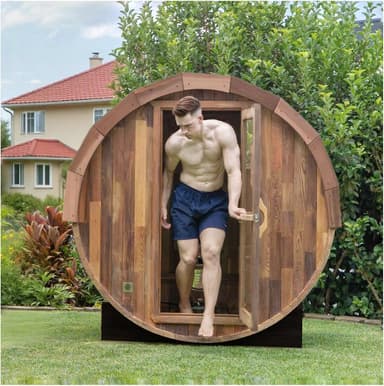
Smartmak 2-Person Canadian Red Cedar Barrel Sauna
- Cylindrical barrel design distributes heat evenly to lower bench level
- Complete kit includes stove, rocks, bucket, spoon, and interior light
- Bitumen roof provides solid weather resistance for year-round outdoor use
The Smartmak 2-Person Canadian Red Cedar Barrel Sauna represents the entry point for buyers who want authentic cedar construction without the $10,000+ price tag. For solo use or couples, a 2-person barrel can deliver the full cedar experience at significantly lower cost, with proportionally faster preheat times.
Smartmak 2-Person Canadian Red Cedar Barrel Sauna
- Cylindrical barrel design distributes heat evenly to lower bench level
- Complete kit includes stove, rocks, bucket, spoon, and interior light
- Bitumen roof provides solid weather resistance for year-round outdoor use
Thermo-Spruce barrels sit at $7,000-$12,000 from quality manufacturers. SaunaLife's models with 1.65-inch Thermo-Spruce staves start around $12,000 installed, which positions them at the top of the cedar range. Thermory-built barrels in Europe run comparably. The material cost of Thermo-Spruce is lower than cedar - roughly $120-180 per board foot versus cedar's $150-250 - but the processing costs of thermal modification eat most of that savings at the manufacturing level.
The 15-Year Cost Comparison
Run the numbers over a realistic ownership period and the picture shifts. A $10,000 cedar barrel that needs stave replacement at year 10 ($1,500-$3,000 for materials and labor) and another repair cycle at year 15 has a 15-year total cost of $13,000-$16,000. A $12,000 Thermo-Spruce barrel with no structural repairs over 20 years and $200 in paraffin oil treatments sits at $12,400-$12,600 total cost over that same period.
The hemlock calculation is the most variable. A well-maintained hemlock barrel in a temperate climate with proper drainage can genuinely achieve 15 years without major repair, making the $6,000-$8,000 purchase price look excellent in retrospect. A hemlock barrel in a humid climate with poor drainage might need a rebuild at year 7 - bringing total cost above cedar.
For the 6-person buyer who wants a cedar barrel and is willing to invest in premium quality, the Panoramic 6-Person Canadian Red Cedar Barrel Sauna delivers the full traditional experience with the capacity for family or group use.
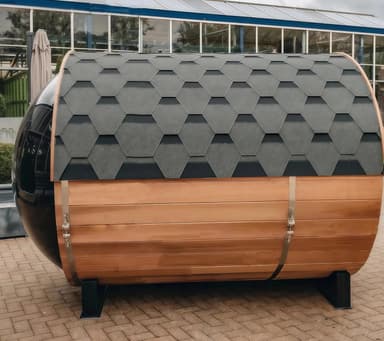
Panoramic 6-Person Canadian Red Cedar Barrel Sauna
- Triple waterproofing system meaningfully outperforms single-layer barrel competitors
- Barrel design circulates heat evenly and reaches 195°F in 30 minutes
- Canadian red cedar construction resists humidity-driven warping reasonably well
Commercial operators - spa owners, Airbnb hosts, retreat centers - should generally default to Thermo-Spruce or high-grade hemlock for multi-unit or heavy-use installations. The 2x documented lifespan of Thermo-Spruce and hemlock's compressive strength advantage both matter more at 2+ uses per day than they do in a residential 3x-per-week protocol.
Common Misconceptions - What the Marketing Gets Wrong
The barrel sauna market in 2025 is full of confident claims that the underlying material science does not support. I want to address the five most persistent misconceptions directly, because acting on them costs people money.
Cedar Is Always the Best Choice
This was true 20 years ago when old-growth cedar heartwood dominated production. The statement is no longer reliable as a blanket recommendation. Cedar quality varies significantly by manufacturer in 2025, and a second-growth cedar barrel with high sapwood content will not deliver the 15-20 year lifespan that the cedar reputation is built on.
The correct statement is: high-quality cedar heartwood from a reputable manufacturer with documented wood sourcing is an excellent choice. Ask any cedar barrel manufacturer what their heartwood-to-sapwood ratio specification is. If they cannot answer, that tells you something important about their quality control.
Hemlock Is Cheap and Inferior
Hemlock's infrastructure in infrared sauna manufacturing has associated it with budget products, but that association is based on product category rather than wood quality. Sauna-grade kiln-dried hemlock is not cheap wood. Its compressive strength exceeding cedar by 50%, consistent grain structure, and proven 15+ year commercial durability in properly installed and maintained setups make it a legitimate premium material choice.
The "hemlock is inferior" narrative benefits cedar marketing. The actual performance data does not support the hierarchy being nearly as clear-cut as cedar advocates claim.
All Spruce Has Resin Problems
This is outdated information that applied to raw, untreated spruce in high-temperature applications. Thermally modified spruce has no resin to bleed - the modification process at 374-482°F (190-250°C) drives off all volatile resin compounds permanently. Buyers who read old forum discussions about spruce stickiness and apply that to current Thermo-Spruce products are making decisions based on a material that no longer exists in commercial barrel sauna production from quality manufacturers.
More Expensive Wood Means Better Performance
At the $10,000-$15,000 price point, you are paying for brand recognition, manufacturing quality, heater specification, and accessory packages as much as for wood quality. A $7,499 hemlock barrel from Dynamic Saunas with a quality 6kW heater will outperform a $12,000 cedar barrel with an undersized heater and poorly fitted stave joints. The performance determinants are wood species properties, stave thickness, stave-to-stave fit tolerance, and heater quality - in that order. Price tracks some of these but not all of them.
No Maintenance Required
Every wood species used in outdoor barrel saunas requires post-use ventilation and periodic maintenance. The maintenance intervals differ by species - cedar's natural oils reduce the frequency, hemlock requires consistent drying after every session in humid climates, and Thermo-Spruce needs exterior oiling every 2-3 years. Approximately 10-15% of barrel sauna failures that get attributed to "bad wood" are actually preventable maintenance failures.
Matching Wood to Climate and Use Case
The right wood for your barrel sauna depends more on your specific conditions than on any universal ranking. I have seen cedar win easily in some situations and be the clearly wrong choice in others.
Cold-Climate Traditional Use
For buyers in cold climates - Upper Midwest, New England, Pacific Northwest winters, Canada - who want traditional Finnish sauna sessions at 170-200°F (77-93°C), the priority is thermal performance and structural stability across extreme temperature swings.
Thermo-Spruce is the strongest recommendation here. Its 20-25% lower conductivity, 50-80% moisture absorption reduction 1, and dimensional stability across -20°F to 200°F (-29°C to 93°C) temperature ranges produce the best year-round performance in these conditions. A SaunaLife Thermo-Spruce barrel in Minnesota will still be sealing its staves tightly and hitting 185°F in 40 minutes in its 10th winter. That reliability is worth the price premium.
Cedar is a strong second choice if you prioritize the aromatic experience and are purchasing from a manufacturer that can document high-heartwood-content staves. For this use case, I'd point buyers toward the Serenity Nature Air 3-4 Person Canadian Red Cedar Barrel Sauna as a well-built mid-size option that delivers legitimate cedar performance without the footprint or cost of a 6-person unit.
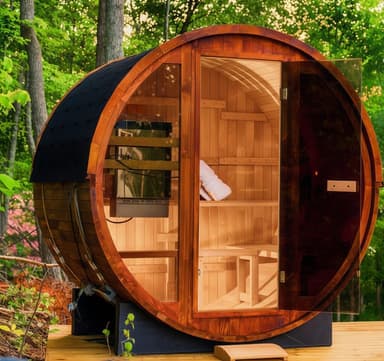
Serenity Nature Air 3-4 Person Canadian Red Cedar Barrel Sauna
- Barrel design heats 15-20% faster than rectangular saunas at same wattage
- Canadian Red Cedar holds heat well and naturally resists warping
- Triple waterproofing system handles harsh outdoor weather reliably
Hemlock is viable in cold climates but requires more attention to the vapor barrier and ventilation setup. Cold exterior temperatures combined with steam-loaded interior air creates significant vapor drive through the stave walls, and hemlock's lack of extractive protection makes consistent post-session drying more critical.
Warm and Humid Climates
In high-humidity environments, Thermo-Spruce's moisture resistance advantage is most pronounced. The reduced equilibrium moisture content means less fungal and bacterial colonization opportunity during the hours between sessions when the barrel is cooling down and interior humidity is high.
Hemlock works in these climates with proper installation - elevated off the ground, good drainage slope, active ventilation. Cedar heartwood quality becomes the critical variable; high-sapwood cedar in humid outdoor conditions is the highest-risk choice of the three.
Infrared and Low-Temperature Use
Hemlock owns the infrared barrel market for good reasons. At 120-140°F (49-60°C), the thermal performance advantages of cedar and Thermo-Spruce matter less, and hemlock's neutral chemistry, consistent appearance, and smooth grain make it ideal for the enclosed, reflective environment of an IR sauna. Dynamic Saunas and Clearlight/Sunlighten both use hemlock in their IR barrel configurations as the deliberate material choice.
The Hussain and Cohen 2018 meta-analysis showing 25-40% reduction in post-exercise muscle soreness applies to both traditional and IR temperature protocols. If your primary use case is recovery rather than the cardiovascular stress response that Laukkanen 2018 documents, IR hemlock delivers those outcomes well.
Family Use with Children
The 15-20% rate of cedar sensitivity reactions is worth weighing more heavily when children are regular sauna users. Children are more reactive to airborne compounds generally. If the sauna is for the whole family, including kids under 12, hemlock's zero-volatile profile reduces any concern about aromatic exposure.
Commercial and Short-Term Rental
For STR hosts and commercial operators, the calculation is straightforward: Thermo-Spruce or premium hemlock, never entry-level cedar of uncertain provenance. A rental sauna runs 10-20+ sessions per week with variable maintenance discipline from guests. The structural margin matters.
I know STR operators in Vermont and Oregon who run Dundalk and Almost Heaven cedar units successfully at high volume - but they have dedicated maintenance staff and covered installations. Those are the conditions where cedar holds up commercially. The average Airbnb host who does not have a maintenance checklist should start with hemlock or Thermo-Spruce.
Installation Considerations by Wood Species
Wood choice affects the installation requirements, not just the experience inside the barrel. These are practical differences that matter during site prep and assembly.
Foundation and Drainage
All three species require a level, solid foundation - either a 4-6 inch concrete pad or a compacted gravel base, with 1-2% drainage slope. The drainage slope matters most for hemlock, which is most vulnerable to water pooling, but it is best practice for all species.
For hemlock specifically, elevating the barrel 2-4 inches off the pad on treated lumber runners significantly improves airflow around the base and reduces moisture contact with the lowest course of staves. Several hemlock barrel manufacturers now ship with included riser cradles for this reason.
Thermo-Spruce's dimensional stability makes it the most forgiving during installation. Because the staves have already released most of their moisture during the modification process, they do not swell significantly when first exposed to humidity. Cedar and untreated hemlock staves should be allowed to acclimate on-site for 24-48 hours before final banding and adjustment.
Electrical Requirements
The electrical installation is identical regardless of wood species: 240V/40-50A GFCI circuit for traditional Finnish heaters in the 9-12kW range, #6 AWG wire maximum 50-foot run from panel to disconnect. Hemlock IR barrels typically run on 120V/20A circuits with 4-6kW IR panel arrays, which simplifies the electrical work considerably.
At U.S. average residential rates of $0.16/kWh (EIA 2025), a 12kW cedar barrel running a 45-minute preheat costs approximately $0.14 per session in electricity. A 6kW hemlock IR unit running a 60-minute session costs approximately $0.10 per session. The Thermo-Spruce unit's faster preheat time (hitting temperature 15-20% faster) reduces energy use proportionally, so a 12kW heater running 38 minutes instead of 45 minutes saves roughly $0.02-0.03 per session - modest individually but $30-45/year at 4 sessions per week.
Assembly and Stave Fit
Cedar assembly is forgiving because cedar's light weight and workability make stave adjustment easy. Hemlock's higher density makes maneuvering heavy stave sets more physically demanding during assembly, particularly for larger 6-8 person barrels. Thermo-Spruce's dimensional stability means stave-to-stave gaps are typically minimal from first assembly, while cedar and hemlock units often require a 2-4 week settling period where bands are retightened as the wood adjusts to ambient conditions.
Stave thickness specifications matter more than most buyers realize. The budget end of the market - Real Relax, OUTEXER, and similar - uses 1-inch staves regardless of wood species. That thickness delivers poor insulation in any wood. The 1.5-inch cedar stave is the industry standard for quality units; SaunaLife's 1.65-inch Thermo-Spruce stave is the current performance leader. The thermal R-value difference between 1-inch and 1.65-inch staves of any species is larger than the species difference at the same thickness.
Key Takeaways
- ●
Stave thickness beats species every time. A 1.65-inch Thermo-Spruce stave outperforms a 1-inch cedar stave thermally - full stop. Before agonizing over wood choice, confirm the stave thickness on any unit you are considering. Budget barrels from Real Relax and OUTEXER use 1-inch regardless of species, and that is the real performance problem.
- ●
Cedar earns its premium price only in heartwood form. Old-growth supply pressure means a significant portion of 2025 production includes sapwood-heavy boards with inconsistent natural oil content. If you are paying $150-250/board foot for cedar's decay resistance and aroma, verify you are getting Grade A heartwood - not blond sapwood dressed up in marketing copy.
- ●
Thermo-Spruce is the most future-proof choice for outdoor installations. The Finnish Forest Research Institute's 2019 data shows 50-80% reduction in moisture absorption versus untreated wood. That translates directly to 30+ year outdoor lifespans, zero resin bleed at any operating temperature, and minimal warping through freeze-thaw cycles that would stress hemlock and even quality cedar.
- ●
Hemlock is the right answer for infrared barrel interiors and scent-sensitive users. Its near-zero extractive content means no aromatic compounds off-gassing during 120-140°F infrared sessions. Roughly 15-20% of sauna users report sensitivity to cedar's aromatic profile - hemlock eliminates that variable entirely.
- ●
Ventilation matters more than wood species for longevity. Hemlock's 15+ year outdoor lifespan depends entirely on consistent post-use airflow. A poorly ventilated hemlock barrel fails faster than a ventilated cedar barrel. This is an installation and usage habit issue, not a wood quality issue.
- ●
The three species serve three different buyers. Cedar suits the traditional Finnish purist who values aroma and proven track record. Hemlock suits the budget-conscious buyer or infrared convert. Thermo-Spruce suits the buyer optimizing for long-term outdoor performance and is willing to pay a mid-tier price for a premium result.
Who This Is For, Who Should Skip It
This Guide Is For
This comparison is built for buyers actively speccing a barrel sauna purchase in 2025, not academic hobbyists. If you are evaluating SaunaLife, Almost Heaven, Dundalk LeisureCraft, or Thermory barrel units and the spec sheet lists a wood species without explaining what that actually means for heat-up time, maintenance, or 10-year durability - this is the information the manufacturer's marketing team left out.
It is also for existing owners troubleshooting issues. If your spruce barrel developed gaps in the first season, or your hemlock unit is showing surface graying after two winters, the performance data in this guide explains what happened and what to do about it.
DIY builders choosing raw lumber for a custom stave barrel will find the technical data in the appendix directly actionable - the density, thermal conductivity, and moisture content specs translate directly to cutting and milling decisions.
Who Should Skip It or Read Further First
If you are choosing between a barrel sauna and an indoor traditional sauna box, wood species is the last decision you need to make. Start with installation constraints, power supply, and budget.
If your primary concern is health outcomes from sauna use, wood species is irrelevant to the research. The Laukkanen 2018 Mayo Clinic Proceedings study showing 27% cardiovascular mortality reduction with 2-3 sessions per week is about consistent heat exposure at 174-212°F - not about what tree the walls came from. Read the health evidence first, then come back to material selection.
Anyone with severe respiratory sensitivities should consult a physician before choosing an aromatic wood interior regardless of what I recommend here. Cedar's thujaplicin content is antibacterial and pleasant for most users - and a genuine respiratory irritant for a small subset.
What to Read Next
Best Cedar Barrel Saunas - Reviewed and Ranked - My hands-on rankings of the top cedar barrel units on the market, with specific callouts for heartwood quality, stave thickness, and hoop hardware on each model.
Best Premium Barrel Saunas - Top Picks for Serious Buyers - If budget is not the primary constraint, this guide covers the high-end field including Thermory's Thermo-Spruce lineup and SaunaLife's top-tier configurations.
All Sauna Guides - UseSauna.com Resource Library - The full index of installation guides, heater comparisons, wood care tutorials, and protocol guides. If a question came up while reading this article, the answer is likely already there.
Frequently Asked Questions
Is cedar or hemlock better for a barrel sauna?
The answer depends entirely on where the sauna lives and how it is used. For an outdoor traditional Finnish barrel exposed to weather year-round, cedar (quality heartwood) outperforms hemlock on its own because of those natural extractive oils providing decay resistance. Hemlock has near-zero natural extractives - it relies entirely on kiln drying and consistent post-use ventilation to achieve comparable longevity. For an indoor or covered installation, or for an infrared barrel running at 120-140°F, hemlock closes the gap significantly. It is cheaper, hypoallergenic, and structurally strong. The honest answer for most buyers: Thermo-Spruce outperforms both for outdoor use, and hemlock beats cedar for infrared interiors where aroma is unwanted.
Does wood species affect how hot a barrel sauna gets?
Species affects heat-up time and retention, not maximum temperature. Your heater - whether a Harvia KIP 6kW electric or a Kuuma wood-burning unit - determines the temperature ceiling. Wood's thermal conductivity determines how fast the interior reaches that temperature and how well it holds it between ladle pours. Thermo-Spruce's 20-25% lower thermal conductivity versus untreated wood means the interior reaches target temperature faster and loses heat more slowly between sessions. Cedar's low density (~23-25 lb/ft³) gives it good thermal performance. Hemlock at ~29 lb/ft³ is denser and retains heat well once hot, but takes marginally longer to warm up. These differences run 5-15 minutes on heat-up time for a quality 4-person barrel - meaningful but not decisive.
How long does a hemlock barrel sauna last outdoors?
A properly installed and maintained hemlock barrel in an outdoor setting can last 15+ years. The "properly maintained" clause carries significant weight here. Hemlock has no natural extractive protection against fungal decay. It depends on kiln drying to 12-15% moisture content before assembly, consistent post-use ventilation to drop moisture levels after each session, and elevated installation on a base that prevents ground contact and pooled water underneath. In humid climates - Pacific Northwest, Gulf Coast, Florida - hemlock requires more diligent drying protocols than cedar or Thermo-Spruce. Roughly 10% of hemlock barrel owners in humid climates report surface mold without adequate ventilation. With proper drainage, airflow, and periodic exterior treatment, the 15+ year figure is realistic.
Why does spruce barrel sauna wood turn dark or get sticky?
Two separate issues. Darkening (graying or bronzing of the exterior) is a natural UV and weathering process that happens to any untreated or under-maintained softwood. It is cosmetic, not structural, and is addressed with periodic exterior oil treatment - paraffin-based products work well on Thermo-Spruce. Stickiness on interior surfaces is a resin bleed problem specific to untreated or improperly kiln-dried spruce at sustained temperatures above 180°F (82°C). This is the main reason thermally modified spruce - Thermowood - matters for sauna applications. The modification process at 374-482°F permanently volatilizes all resin. A certified Thermo-Spruce barrel from SaunaLife or Thermory does not bleed resin at any temperature achievable in a sauna. If you are seeing stickiness in a Thermo-Spruce barrel, the wood was mislabeled or the modification process was incomplete - contact the manufacturer.
What is the cheapest wood for a barrel sauna that still performs well?
Sauna-grade hemlock at $100-150 per board foot is the budget-floor option that still performs. At equal stave thickness - the critical caveat - hemlock delivers comparable thermal performance to cedar at 30-40% lower material cost. The effective cost after waste factor runs $105-160 per board foot versus $175-300 for cedar heartwood. The performance trade-off is real: no aromatic profile, no natural decay resistance, maintenance-dependent longevity. For buyers prioritizing initial cost over 20-year total cost of ownership, hemlock is the defensible choice. Avoid the budget barrel brands using 1-inch hemlock staves - the wood species is not the problem there, the stave thickness is. SaunaLife and Almost Heaven both offer hemlock units with 1.5-inch staves that deliver acceptable performance.
Can I use untreated spruce for a DIY barrel sauna?
Untreated spruce is workable for an indoor or covered DIY barrel but problematic outdoors long-term. Untreated spruce absorbs moisture aggressively - equilibrium moisture content of 12-18% versus 5-7% for Thermo-Spruce. In an outdoor barrel, that cycling through wet and dry states causes the warping, gap formation, and door sealing issues that gave spruce a bad reputation before thermal modification became standard. For a DIY build, you have two realistic paths: source Thermory or equivalent Thermo-Spruce blanks and mill them yourself (more expensive but reliable), or use quality cedar heartwood for the staves and accept the maintenance schedule. Untreated Nordic spruce indoors with good ventilation is a third viable option - 90% of global sauna production uses it in exactly that application. Outdoors without treatment or cover, I would not recommend it for a barrel expected to last a decade.
Does the wood inside a barrel sauna affect health outcomes?
No peer-reviewed research links interior wood species to sauna health outcomes. The Laukkanen 2018 cohort study following 2,315 Finnish men over 20+ years tracked session frequency and temperature - not wall material. The cardiovascular mortality reductions of 27% at 2-3 sessions per week and the 66% Alzheimer's risk reduction at 4-7 sessions per week are driven by heat exposure at 174-212°F. What wood species does affect is the user experience that determines session consistency - an aromatic cedar interior that some users find motivating, a hemlock interior that sensitive users tolerate better, a Thermo-Spruce barrel that maintains more consistent temperature. Consistent use is the health variable. Wood choice influences whether you actually use the sauna regularly, which makes it indirectly relevant - but the wood itself has no therapeutic mechanism.
Sources and References
- Wood Properties of Finnish Sauna Timbers
Finnish Forest Research Institute. Silva Fennica, 2019.
Frequently Asked Questions
Cedar is the better choice for barrel saunas due to superior durability in curved structures that face more weathering stress. Cedar outlasts hemlock by 5-10 years (15-25 years versus 10-15 years with proper care), resists moisture and decay naturally, and retains heat 15-20% longer, resulting in lower energy costs. Hemlock offers a budget-friendly alternative with a neutral scent suitable for those with sensitivities, though it requires more maintenance and may warp more easily in outdoor conditions.
Related Guides
Medical Disclaimer - This article is for informational purposes only and does not constitute medical advice. Consult a healthcare professional before beginning any sauna routine.