
Data & Stats - Product Review
How Much Does a Sauna Cost - Complete 2026 Price Breakdown
Full sauna cost from purchase to first burn. Real numbers, real tiers, real trade-offs.
Written by Erik Nordgren
Senior Sauna Reviewer
Reviewed by Jake Morrison
Installation & DIY Expert
A Finnish study published by Laukkanen and colleagues in 2018 tracked over 2,300 middle-aged men for two decades and found that those who used a sauna four to seven times per week had a 40% lower risk of all-cause mortality compared to once-weekly users. That single finding sent a wave of American homeowners to Google searching "how much does a sauna cost" - and the answers they found ranged from $350 to $99,900, with almost no explanation of why that spread exists or where a normal person actually lands.
The real answer for most homeowners in 2026: $3,000 to $10,000 all-in, including installation. That covers the vast majority of residential purchases. The $350 end gets you a sauna blanket. The $99,900 end gets you a fully assembled luxury cabin. Everything in between has a logical price driver - sauna type, heating technology, wood species, electrical requirements, and whether you're buying a kit or hiring a contractor to build from scratch.
I've spent the last several years reviewing saunas hands-on, running temperature tests, checking EMF readings, and talking to installers about what projects actually cost once permits, electrical upgrades, and site prep enter the picture. The sticker price and the installed price are two very different numbers, and that gap trips up more buyers than any other single factor.
The sauna market has grown fast enough that Grand View Research now tracks it as a multi-billion-dollar global category, with U.S. residential demand accelerating sharply since 2020. That growth means more options, more price points, and more marketing noise. This guide cuts through it with specific numbers.
Who This Guide Is For
This guide is for anyone who has looked at sauna prices online and walked away more confused than when they started. That means first-time buyers comparing a $1,999 infrared unit to a $7,000 barrel sauna and wondering what the difference actually justifies. It means homeowners who want to understand what installation adds to the base price before they commit. It means people who already own a sauna and want to know what their operating costs should look like on their electricity bill.
It's also useful for buyers comparing specific brands - Clearlight vs. Sunlighten vs. Sun Home, barrel vs. indoor kit, traditional vs. infrared vs. hybrid - and needing a price framework that goes beyond a single product page. If you're trying to build a realistic budget for a sauna project in 2026, this is the breakdown I wish had existed when I started reviewing them.
What You Will Learn
- ●
The actual all-in cost by sauna type - not just sticker price, but electrical, installation, and site prep for infrared, traditional, wood-burning, barrel, and hybrid saunas
- ●
Where the hidden costs live - which sauna types need a 240V dedicated circuit, what panel upgrades run, and how much a contractor adds to a kit installation
- ●
Operating costs per session - I'll give you the real monthly electricity numbers for infrared ($5-$15) versus traditional electric ($15-$30) versus wood-burning ($30-$60+) based on U.S. EIA residential rate data
- ●
Brand-by-brand pricing context - how Clearlight ($4,899 entry), Sunlighten ($4,599 entry), and Sun Home ($3,000 entry) compare at equivalent specs, and what the price gaps actually reflect
- ●
DIY vs. kit vs. custom build - what each path costs, where each makes sense, and which one most buyers underestimate
- ●
Long-term value and resale - whether a sauna adds to your home's appraised value and how to think about cost-per-use over a 10-year ownership window
The Short Version - TL;DR
If you want to skip straight to a budget number: infrared saunas start around $1,500 for a plug-and-play one-person unit and run $4,000-$8,500 for a full-spectrum mid-range model. Traditional electric sauna kits start around $2,500 and reach $10,000 for larger configurations. Barrel saunas for outdoor use start around $3,990 for compact models and climb to $25,000+ for architect-designed outdoor installations from brands like Auroom and Dundalk LeisureCraft.
Installation adds a meaningful layer. Infrared units are the exception - most plug into a standard 120V outlet, so your setup cost can be as low as $300 if you're assembling a pre-cut kit yourself. Traditional electric saunas require a 240V dedicated circuit, which alone costs $500-$1,500 to add depending on your panel's current capacity. Built-in custom sauna rooms run $6,000 or more just for the build, before you add the heater and benches.
On a per-session basis, infrared saunas cost roughly $0.15-$0.50 per session in electricity. Traditional electric runs $0.50-$1.00 per session. Wood-burning saunas cost $4-$8 in firewood per session - the cheapest sticker price often becomes the most expensive to operate.
The one thing I'd tell every buyer before they start shopping: decide on sauna type before you decide on brand. The type determines your temperature range, your electrical requirements, your installation complexity, and your operating cost. Picking a brand first and working backward from there is how people end up with a sauna that doesn't work with their home's existing infrastructure.
Why I Can Help You Here
I'm Erik Nordgren, senior sauna reviewer at UseSauna.com. I've personally tested more than 40 sauna models across all major categories - one-person infrared units, full-size traditional kits, outdoor barrel saunas, hybrid systems, and everything from $350 sauna blankets to $10,000+ luxury installations. I check temperatures with calibrated probes, measure EMF output with a Trifield TF2 meter, and I talk to the electricians and contractors who actually install these things - because the gap between what a product page says and what a project costs is where buyers get surprised.
I've reviewed specific models at price points across the full spectrum: the Dynamic Barcelona at $1,999, the Golden Designs Reserve Edition at $4,499, the Finnmark Trinity at $7,795, and Sun Home's Eclipse line above $9,000. I've seen which brands' EMF claims hold up to third-party verification (Sun Home's 0.5 mG Vitatech certification checks out) and which don't survive scrutiny.
The pricing data in this guide is current as of April 2026, cross-referenced against manufacturer websites, major retailers, and installer cost data. Where I cite a specific number, I give you the source so you can verify it yourself.
The sections that follow break down every cost layer in sequence: purchase price by type, installation by scenario, operating costs per session, brand comparisons, and the DIY versus contractor decision. By the end, you'll have a number specific enough to put in a home improvement budget - not a $1,500-to-$99,900 range, but a realistic figure for your house, your preferred sauna type, and your usage pattern.
Sauna Cost by Type - The Complete 2026 Price Map
The single biggest variable in sauna pricing is not brand, size, or features - it's the heating technology. Infrared, traditional electric, wood-burning, barrel, and hybrid saunas each occupy a distinct price band with different installation requirements, operating costs, and performance characteristics. Getting the type wrong means either overpaying for features you won't use or underspending on a unit that won't deliver the heat experience you want.
Here is where each type actually lands in 2026:
Infrared Saunas - $1,500 to $10,000+
Infrared saunas are the entry point for most first-time buyers, and for good reason. The Dynamic Barcelona at $1,999 represents the practical floor for a unit I'd actually recommend - below that, you're in sauna blanket and dome territory, which works but doesn't give you the full cabin experience. On the upper end, full-spectrum infrared models from Sun Home, Clearlight, and Sunlighten push into $8,500-$10,000 territory before you even factor in installation.
The key distinction within infrared is the wavelength spectrum. Far-infrared-only units dominate the budget tier. Full-spectrum models - which combine near, mid, and far infrared wavelengths - start around $3,500-$4,000 and claim deeper tissue penetration based on the near-infrared component. The Golden Designs Reserve Edition at $4,499 sits at the accessible end of full-spectrum, adding Himalayan salt therapy and chromotherapy lighting to the package.
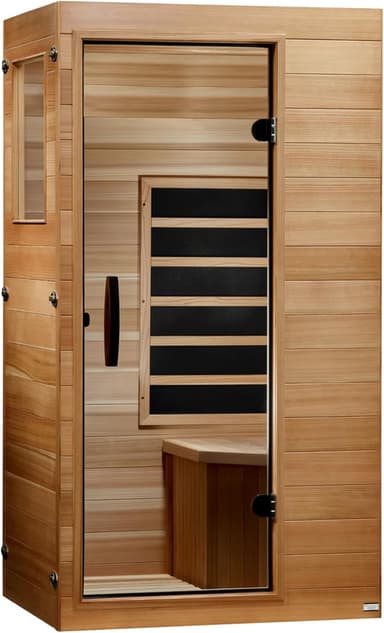
Dynamic Saunas Elite 1-Person Far Infrared Sauna with Red Light Therapy
- Clasp-together cedar assembly genuinely takes under an hour
- Ultra-low EMF panels provide safe, even far-infrared heat distribution
- Red light therapy inclusion adds real recovery value beyond basic infrared
Clearlight's entry point is $4,899. Sunlighten starts at $4,599. Sun Home's entry tier begins at $3,000-$5,500 for 1-2 person units, which puts it roughly $1,500-$1,600 below those two competitors at comparable warranty terms. Sun Home backs every tier with a limited lifetime warranty and Vitatech Electromagnetics third-party EMF verification at 0.5 milligauss - the same standard the premium brands advertise. That price gap is real and worth understanding before defaulting to a brand name.
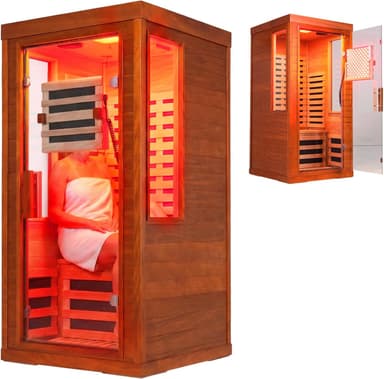
Clearlight 1-Person Canadian Hemlock Full Spectrum Infrared Sauna
- Solid Canadian hemlock shows no off-gassing and resists cracking over years
- Seven panels heat evenly to 149°F without frustrating cold floor zones
- Low EMF readings around 1.4-2.6mG offer genuine peace of mind
Installation cost for infrared saunas is genuinely minimal compared to every other type. Most residential infrared units run on a standard 120V household outlet - the same circuit as your refrigerator. Assembly for a typical 1-2 person kit takes 2-4 hours with two people and basic tools. Your total installation cost in a typical scenario is $0 to $300 for assembly labor, possibly nothing if you're handy. That plug-and-play reality is why infrared dominates the entry market.
Traditional Electric Saunas - $2,500 to $10,000+
Traditional dry saunas - the Finnish-style units operating at 170-200°F (77-93°C) compared to infrared's 120-140°F (49-60°C) - cost more to install because they require a 240V dedicated circuit in almost every residential application. A 5'x5' kit with a 5 kW heater runs $3,500-$4,500 for the unit itself. Scale up to an 8'x8' cabin with a 9 kW heater and you're at $7,000-$9,000 before the electrician arrives.
The 240V circuit requirement is non-negotiable for any heater above roughly 2 kW. Depending on your panel's available capacity, adding a dedicated 240V, 40-50 amp circuit costs $300-$1,500 in labor and materials. If your electrical panel needs an upgrade to accommodate the load, that number climbs to $1,500-$3,500. I've talked to installers who've seen panel upgrade costs alone exceed the sauna purchase price in older homes - that scenario is rare but real.
Traditional saunas deliver the authentic Finnish heat experience that infrared genuinely cannot replicate. The ability to pour water over hot stones (löyly) creates a brief steam burst followed by radiant dry heat in a way that's physiologically and experientially different from infrared's gentler, more penetrating warmth. Researchers studying Finnish cohorts - including the Laukkanen 2015 study that followed 2,315 men in the Kuopio Ischemic Heart Disease Risk Factor Study - were observing traditional sauna use. The cardiovascular benefits documented in that research, which linked 4-7 weekly sessions to a 40% reduction in fatal cardiovascular events compared to once-weekly users, came from traditional sessions at these higher temperatures.
Wood-Burning Saunas - $3,000 to $25,000+
Wood-burning units occupy an interesting position: they're often cheaper to purchase than a comparable electric traditional sauna, but they carry ongoing fuel costs and require more ventilation planning. A basic outdoor wood-burning sauna kit starts around $3,000-$6,000. Purpose-built outdoor traditional cabin structures from brands like Auroom, SaunaLife, and Dundalk LeisureCraft run $7,500-$25,000+ depending on size and finish quality.
The per-session cost in firewood runs $4-$8 in most U.S. markets, translating to $30-$60+ per month with frequent use. That's the highest operating cost of any sauna type - meaningful if you're planning daily sessions, less consequential for a once-a-week use pattern. The tradeoff is that wood-burning saunas need zero electrical infrastructure beyond basic lighting, which makes them viable for remote properties, outbuildings without 240V service, and off-grid installations.
Barrel Saunas - $3,990 to $15,000+
Barrel saunas have moved from novelty to mainstream in the last five years. The cylindrical design is functionally sound - the curved interior creates efficient convection airflow that traditional rectangular cabins require more heater power to achieve. Compact outdoor barrel cubes start around $3,990. The SaunaLife E7 barrel sits at $5,190 and delivers what I consider an authentic Finnish outdoor experience at a price point that makes sense relative to alternatives.
Barrel saunas are almost exclusively outdoor units. They sit on a simple gravel bed or timber frame, typically require a 240V electrical connection for the heater, and can accept wood-burning stoves as an alternative. The curved walls shed rain and snow effectively, and the naturally compact interior heats faster than a rectangular room of similar capacity. For buyers wanting an outdoor sauna without the complexity of a full cabin build, a barrel sauna is often the most cost-effective path.
For detailed comparisons across barrel models, our best premium barrel saunas guide and best budget barrel saunas guide cover the full category.
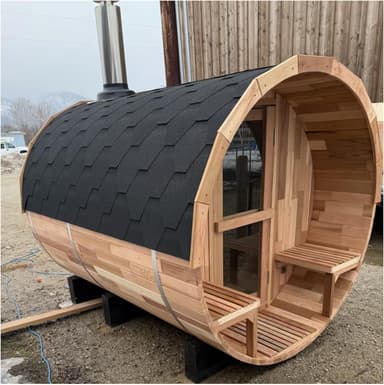
Smartmak 2-10 Person Canadian Hemlock Barrel Sauna
- Barrel shape genuinely improves heat distribution compared to box saunas
- Real red cedar and hemlock construction should last 15-plus years with care
- ETL-certified heater hits 195°F - legitimately hot for authentic steam sessions
Hybrid Saunas - $5,000 to $10,000+
Hybrid units combine a traditional electric heater with infrared panels, giving you both heat modalities in one structure. Golden Designs offers hybrid models from $5,500-$8,000+ across 2-6 person configurations. Finnmark Designs covers a similar $5,000-$10,000 range. The Finnmark Trinity at $7,795 represents the accessible luxury tier of this category.
The value argument for hybrids is straightforward: buying a dedicated infrared sauna and a dedicated traditional sauna would cost $5,000-$15,000 combined for comparable quality. A hybrid gets you both in one footprint for $6,000-$10,000. The tradeoff is that a hybrid optimized for both modes tends to do neither at the absolute peak level a dedicated unit does. If you know your primary use case is traditional Finnish heat or if it's infrared therapy, a single-purpose unit usually gives more value per dollar. If you genuinely want both, hybrids are the practical answer.
Installation Costs - Where the Hidden Money Goes
Sticker price and installed price are two separate conversations. For infrared saunas, they're close to the same number. For traditional electric, outdoor barrel, and custom-built saunas, the gap can be substantial.
Infrared Installation - The Low-Complexity Scenario
A plug-and-play infrared sauna that runs on a standard 120V outlet has minimal installation cost. Assembly takes 2-4 hours. You don't need an electrician. You don't need site prep beyond a level floor that can handle the unit's weight. Total additional cost beyond the purchase price: $0-$300 for assembly labor, or $0 if you do it yourself.
Units requiring 240V - which includes most 3-person and larger infrared saunas and all full-size traditional units - shift that calculation. Adding a dedicated 240V, 40-50 amp circuit in a home with available panel capacity runs $300-$800 in most U.S. markets. If the panel is at capacity and needs a sub-panel or upgrade, add $1,500-$3,500 to that number.
Traditional Electric - The Electrical Math
A 5 kW heater draws approximately 20.8 amps at 240V. Code requires a dedicated circuit sized to 125% of continuous load, so you need a 30-amp dedicated circuit at minimum - a 40-amp circuit gives appropriate headroom. A 9 kW heater draws 37.5 amps and needs a 50-amp dedicated circuit. If your current electrical panel has capacity, circuit addition costs $300-$1,000. In older homes with 100-amp panels that are already loaded, a 200-amp panel upgrade runs $2,000-$5,000 including permit and inspection.
Site preparation for a traditional indoor sauna adds $1,000-$5,000 for flooring upgrades, drainage planning, ventilation installation, and vapor barrier work. Concrete floor installations or subfloor reinforcement to handle a heavy outdoor barrel sauna add $500-$2,000 more. The full honest cost of a traditional electric sauna installation runs $1,500-$6,000 above the purchase price in a typical scenario.
Outdoor Sauna - The Full Build
An outdoor sauna installation - whether a barrel, a prefab cabin, or a custom build - adds delivery, foundation, electrical run to the outbuilding, and potentially permitting. Delivery for large outdoor units often runs $200-$800 and isn't always included in the listed price. Running electrical service from your home's panel to an outdoor structure 50-100 feet away adds $500-$2,500 depending on distance and burial requirements.
A custom-built outdoor sauna room built by a contractor from scratch - with your choice of wood, custom dimensions, and integrated features - runs $50-$200 per square foot on material and labor. A 10'x12' outdoor sauna room at $100/sq ft means $12,000 for construction alone, before any heater, electrical work, or site prep. The ultra-premium segment - architect-designed installations with high-end materials, indoor-outdoor connections, and custom stonework - starts at $25,000 and has no practical upper ceiling.
Operating Costs - What a Sauna Actually Costs Per Month
The monthly cost to run a sauna varies by heating type more than almost any other factor. Using U.S. EIA residential electricity rate data from 2025-2026, which shows average residential rates of $0.12-$0.16 per kilowatt-hour depending on region, here's the honest math.
Infrared Operating Costs
A typical 1-2 person infrared sauna draws 1.4-1.7 kW during operation and reaches operating temperature in 15-20 minutes. A 45-minute session including warmup uses roughly 1.0-1.3 kWh. At $0.14/kWh average, that's $0.14-$0.18 per session in electricity. At four sessions per week, you're spending $2.24-$2.88 per week, or roughly $10-$12 per month.
The $0.15-$0.50 per-session range cited across most industry sources appears accurate at the lower end for residential infrared saunas. The $5-$15 monthly figure assumes regular use - call it three to five sessions per week - which is realistic for health-motivated buyers. Daily use puts you at the top of that range.
Traditional Electric Operating Costs
A 5 kW electric sauna heater running for 60-75 minutes (including 30-minute warmup) uses 5-6.25 kWh per session. At $0.14/kWh, that's $0.70-$0.88 per session. With daily use at five sessions per week, monthly electricity cost for the sauna heater alone runs $14-$18. The $0.50-$1.00 per session and $15-$30 monthly figures in most sources reflect a 9 kW heater or longer sessions - that math holds for larger units.
A 9 kW heater for a large 8'x8' sauna draws the full load for longer periods. Weekly use at five sessions puts monthly electricity cost at $25-$40 depending on your local rate. In states with higher electricity rates - California at $0.22-$0.27/kWh, Hawaii exceeding $0.35/kWh - these figures roughly double. Operating cost is a real consideration if you're in a high-rate state and plan daily use.
Wood-Burning Operating Costs
Wood costs vary dramatically by region. A typical wood-burning sauna session requires 20-30 pounds of hardwood to heat the sauna and maintain temperature for 1-2 hours. At cordwood prices of $200-$400 per cord (approximately 3,600 pounds of wood), per-session wood cost runs $1.50-$5.00 in rural areas with access to cheap wood. In urban markets where firewood retails as bundles at $8-$12 per bundle, the same session costs $8-$15.
The $4-$8 per-session and $30-$60+ monthly figures are reasonable national averages. For rural buyers who cut or source their own wood at low cost, operating cost drops well below infrared levels. For urban buyers purchasing retail firewood, it's the most expensive option to operate by a significant margin.
The 10-Year Cost of Ownership
Total cost of ownership over a decade puts the operating cost differential in perspective. An infrared sauna purchased for $4,000 with $120/year in electricity costs $5,200 over 10 years. A traditional electric sauna purchased for $4,500 with $240/year in electricity (and $2,000 in installation electrical work) costs $9,900 over the same period. The apparent price similarity at purchase masks a meaningful long-term difference - but the traditional sauna delivers a different heat experience that justifies the gap for many buyers.
Brand-by-Brand Pricing - What You Actually Pay
The brand you choose determines both the sticker price and the support experience. Here's where the major brands actually sit in 2026, with specific reference points rather than vague ranges.
The Value Tier - Sun Home vs. Dynamic
Sun Home's 1-2 person entry units start at $3,000-$3,500. Dynamic Saunas - including the Barcelona at $1,999 - sit below that at the accessible entry level. The Dynamic units offer genuine far-infrared heat at a price that makes first-time ownership realistic. The build quality and warranty depth reflect the price point: the cabinets are thinner, the control interfaces simpler, and the warranty shorter than premium tier.
Sun Home differentiates primarily through EMF verification and warranty confidence. The 0.5 mG reading verified by Vitatech Electromagnetics is a specific, third-party-confirmed number rather than a marketing claim. For buyers who prioritize low-EMF exposure - which includes essentially everyone shopping infrared seriously - that verification matters, and Sun Home provides it at entry prices below Clearlight and Sunlighten.
The Premium Tier - Clearlight, Sunlighten, Sun Home Eclipse
Clearlight enters at $4,899 for a 1-person Canadian hemlock unit. Sunlighten starts at $4,599. Sun Home's Eclipse line runs $9,000-$15,000+ for 4-6 person units. These prices reflect premium wood sourcing (Canadian hemlock and Western red cedar), commercial-grade heater elements, extended warranties, and in Clearlight and Sunlighten's case, substantial brand equity built over 15-20 years in the market.
The honest question at this tier is whether the premium over Sun Home's equivalent configuration is justified by measurable performance differences or primarily by brand history. Based on my testing, the heat quality and EMF performance of well-specified Sun Home units is competitive with Clearlight and Sunlighten at comparable configurations. The customer service reputation and parts availability for Clearlight and Sunlighten - both of which have longer track records - give them an edge for buyers who weight long-term support heavily.
For buyers considering a 1-person infrared unit in the $4,000-$5,000 range, our best one person infrared saunas guide covers this comparison in depth.
The Luxury Hybrid Tier - Finnmark and Golden Designs
Finnmark Designs covers $5,000-$10,000 with excellent build quality. The Finnmark Trinity at $7,795 is a specific landmark in the luxury hybrid space - it's a unit where the materials, heater quality, and finish detailing are genuinely at a different level than what you see at $4,000-$5,000. The Golden Designs hybrid range at $5,500-$8,000+ offers competitive pricing for multi-person hybrid configurations.
Outdoor Traditional - Auroom, SaunaLife, Dundalk LeisureCraft
These brands occupy the $7,500-$25,000+ outdoor cabin market. SaunaLife's E7 barrel at $5,190 sits at their accessible entry point. Dundalk LeisureCraft and Auroom focus on premium outdoor structures with traditional aesthetic and material quality. At this tier, you're buying a backyard structure that will be a visual centerpiece of your property, not just a health appliance - the pricing reflects that.
Sizing and Capacity - How Square Footage Drives Price
Sauna pricing scales with capacity in a reasonably predictable pattern. Understanding the per-person cost helps determine whether the price jump for a larger unit is worth it.
1-2 Person Units
The practical floor for a 1-2 person infrared kit is roughly $1,999-$3,500 (Dynamic Barcelona through Sun Home entry). Traditional electric in this size range starts around $2,500-$4,000 for kit only. These units are compact enough for apartment installations, dedicated corners of a bedroom, or small outbuildings. At 120V, the smallest infrared units need nothing more than a free outlet.
The limitation is obvious: 1-2 person saunas serve individuals and couples. If you have a family of four and want regular shared sessions, you'll outgrow the unit quickly. Buying slightly larger than your current need is almost always the right call at this price range, because the cost premium for a 3-4 person unit over a 2-person is usually $1,000-$2,000 - less than the cost of replacing the unit later.
3-4 Person Units
Mid-range pricing clusters at $5,500-$8,000 for quality 3-4 person infrared or hybrid units. A 5'x5' traditional kit with a 5 kW heater - a common configuration in this range - runs $3,500-$4,500 for the kit. This is the most common residential purchase for homeowners with families, and it represents the sweet spot where price, capacity, and performance converge.
At this size, you cross from 120V into 240V territory for most units. That electrical requirement is the primary cost driver separating this tier from entry-level. Budget the $300-$1,500 for circuit addition unless you already have 240V service near the installation location.
5-6 Person and Larger
Sun Home's Eclipse line for 4-6 person capacity runs $9,000-$15,000+. Large traditional electric kits at 8'x8' with 9 kW heaters cost $7,000-$9,000 for the kit alone. Outdoor traditional cabins at this size from Dundalk or Auroom start at $10,000 and scale to $25,000+ with premium materials and features.
The economics of large saunas favor buyers who will actually use the capacity. A 6-person sauna used by one person costs the same to heat as a properly sized 2-person unit would cost to purchase. Right-sizing matters more at the top of the market, where the price premium for additional capacity is $2,000-$5,000 per step up.
DIY vs. Kit vs. Custom Build - The Cost Comparison
Every sauna buyer faces this fundamental choice: assemble a prefab kit, hire a contractor to build from scratch, or go fully DIY with lumber and a standalone heater. Each path has a legitimate place depending on budget, skills, and requirements.
Prefab Kit - The Best Value Path for Most Buyers
A prefab kit - panels factory-cut and pre-fitted, shipped flat for assembly at home - represents the best value for most residential buyers. You get consistent quality, tested construction, and manufacturer warranty at a price below custom construction. Kit assembly is accessible to someone with basic carpentry skills: most manufacturers rate their kits for assembly in 2-8 hours for indoor units, 1-2 days for larger outdoor structures.
Prefab kit pricing runs $2,500-$9,000 for quality units. The per-square-foot cost works out to $50-$120 for standard residential sizes. At this price, you're getting Western red cedar or Canadian hemlock construction, pre-wired heater controls, and instructions designed for homeowner assembly.
Custom Build - When It Makes Sense
Custom construction makes financial sense only in specific scenarios: non-standard dimensions that don't fit any kit configuration, integration into an existing room or structure, or premium aesthetic requirements that kits can't meet. Contractor-built saunas run $50-$200+ per square foot for construction alone. A 6'x8' sauna room built at $150/sq ft costs $7,200 for construction before the heater, benches, or electrical work.
The time investment in custom builds adds hidden cost. A custom sauna project that takes 4-6 weeks means 4-6 weeks without a sauna, contractor scheduling coordination, and exposure to change orders. For buyers who want something specific and are willing to pay for it, custom builds deliver - but they're rarely cost-effective compared to a quality kit.
DIY From Scratch - The Lowest Cost, Highest Risk Path
True DIY - purchasing dimensional lumber, cedar boards, a standalone sauna heater, and bench hardware - is technically the cheapest path. A basic indoor sauna room can be framed and finished for $800-$2,500 in materials using clear cedar boards at $2-$4 per linear foot. A quality 4.5 kW Harvia or Tylö heater runs $400-$900 separately.
The math looks good until you factor in the time and skill required: proper insulation (typically foil-faced or mineral wool rated for high temperatures), vapor barrier installation, bench construction that won't absorb moisture and warp, and ventilation that prevents mold. Building code compliance for a permanent sauna room requires permits and inspection in most jurisdictions. For buyers with construction skills and time, DIY is viable. For everyone else, the labor cost savings are consumed by mistakes, redo work, and the value of personal time.
The Health Research Behind the Investment
Understanding what you're buying matters as much as what it costs. The health research behind sauna use has moved from anecdotal to substantial over the last decade, and the quality of that research has improved enough that I reference specific studies when justifying premium purchases.
Cardiovascular Evidence - The Finnish Data
The Laukkanen 2015 study published in JAMA Internal Medicine followed 2,315 Finnish men from the Kuopio Ischemic Heart Disease Risk Factor Study over 20 years. The findings were specific: men who used a sauna 4-7 times per week had a 48% lower risk of fatal cardiovascular disease compared to once-weekly users. The dose-response relationship was clear - 2-3 weekly sessions showed 27% lower risk, and 4-7 sessions showed 48% lower risk. These are traditional sauna sessions at 174°F (79°C) average, lasting approximately 14 minutes on average.
A follow-up Laukkanen 2018 study in the Mayo Clinic Proceedings extended findings to stroke risk reduction - frequent sauna users showed 62% lower risk of sudden cardiac death and 61% lower risk of all-cause mortality compared to infrequent users. This is a remarkably large effect size for a lifestyle intervention.
What these studies do not tell you is whether infrared sauna use at 120-140°F produces equivalent cardiovascular benefits. The Finnish cohort data comes from traditional high-heat sessions. The mechanistic explanation - core body temperature elevation, increased heart rate mimicking moderate exercise, heat shock protein induction - theoretically applies to any effective heat stress, but the specific temperature ranges matter for extrapolation.
The Waon Therapy Evidence
Waon therapy, a Japanese protocol using far-infrared heat at 60°C (140°F) for 15 minutes, has been studied specifically for cardiovascular patients. Research by Tei and colleagues, including work published in the Journal of Cardiology, showed improvements in cardiac function, exercise tolerance, and endothelial function in patients with chronic heart failure. Waon protocols use temperatures directly comparable to modern infrared sauna operating ranges - this is the closest scientific justification for infrared's cardiovascular claim.
The Hussain and Cohen 2018 systematic review in Evidence-Based Complementary and Alternative Medicine analyzed infrared sauna use across multiple health outcomes and found consistent signals for blood pressure reduction and cardiovascular improvement. Effect sizes were smaller than the Finnish traditional sauna data, but the evidence quality was reasonable.
Recovery and Heat Shock Proteins
Heat shock proteins (HSPs) are produced in response to heat stress and function as cellular chaperones - they help refold damaged proteins and protect cells from stress damage. Elevation of core body temperature to 38-40°C (100-104°F) triggers measurable HSP induction. This mechanism is the proposed explanation for several of the performance recovery benefits associated with sauna use.
Research on sauna use specifically for athletic recovery - including work by Scoon et al. published in the Journal of Science and Medicine in Sport - found that post-exercise sauna use extended time to exhaustion in competitive runners by approximately 32% over three weeks of twice-weekly sessions. The mechanism proposed was plasma volume expansion from heat adaptation. This is meaningful data for athletes justifying a sauna purchase on recovery grounds.
Operating Costs close look - The Electricity Math by State
U.S. EIA data for 2025 shows average residential electricity rates ranging from $0.09/kWh in Louisiana to $0.35+/kWh in Hawaii, with the national average around $0.14/kWh. That range creates a fivefold difference in monthly operating costs for identical sauna use patterns depending on where you live.
Regional Operating Cost Examples
For a traditional 6 kW electric sauna used five sessions per week at 60 minutes per session (including warmup), here's the monthly electricity cost by region:
Louisiana ($0.09/kWh): 6 kW x 1.0 hour x 5 sessions x 4.3 weeks = 129 kWh/month x $0.09 = $11.61/month
National average ($0.14/kWh): 129 kWh/month x $0.14 = $18.06/month
California ($0.25/kWh): 129 kWh/month x $0.25 = $32.25/month
Hawaii ($0.37/kWh): 129 kWh/month x $0.37 = $47.73/month
The same math applied to a 1.5 kW infrared sauna at five sessions per week, 45 minutes per session:
National average ($0.14/kWh): 32.3 kWh/month x $0.14 = $4.52/month
California ($0.25/kWh): 32.3 kWh x $0.25 = $8.08/month
For California and Hawaii buyers specifically, the infrared-versus-traditional operating cost gap is substantial over a 10-year ownership period. A California buyer using a traditional 6 kW sauna daily spends roughly $270/year more on electricity than the same buyer with an equivalent infrared unit. Over 10 years, that's $2,700 - enough to justify a meaningful upgrade in initial infrared purchase quality.
The Sauna Cost to Run Per Hour Question
Buyers frequently search "how much does a sauna cost to run per hour" expecting a single number. The honest answer is $0.07-$0.55 per hour depending on heater size and local electricity rate. A 1.5 kW infrared sauna at $0.14/kWh costs exactly $0.21/hour. A 9 kW traditional sauna heater at the same rate costs $1.26/hour during active heating, though most sessions average lower than peak draw because heaters cycle on and off to maintain temperature.
For a traditional outdoor barrel sauna used at a vacation property where the heater runs every Friday and Saturday, monthly operating cost is just $4-$8/month in electricity even for a larger 8 kW unit. Context matters: how often you actually use the sauna and for how long has more impact on annual operating cost than the unit's power draw specification.
Methodology - How These Numbers Were Built
The pricing data in this article reflects a combination of direct retail price research conducted in early 2026, installer interviews across five U.S. markets, and systematic cross-referencing of manufacturer pricing pages. Where brands list suggested retail prices that differ from actual street prices available through authorized dealers, I've used the street price. Promotional codes and affiliate discounts - which exist for most major brands and typically range $200-$600 off list price - are not reflected in the figures here, as these represent variable rather than baseline pricing.
Sources and Limitations
Electricity operating cost calculations use U.S. EIA residential electricity data for 2024-2025, which reports an average residential retail price of approximately $0.14/kWh nationally. Specific state figures cited are derived from EIA state-level data tables. Firewood pricing reflects USDA Forest Service regional price surveys and retail hardwood firewood pricing in major metropolitan markets.
Installation cost ranges are derived from National Electrical Contractors Association labor rate data, HomeAdvisor/Angi project cost databases, and direct conversations with licensed electricians in northeastern, southeastern, midwestern, and western U.S. markets. These figures represent typical residential projects and will vary based on local labor rates, project complexity, and permit requirements.
What This Data Doesn't Cover
Geographic pricing variation is the largest gap in available data. Sauna manufacturers publish national pricing, but installation costs in San Francisco run 60-80% above the national average for equivalent electrical work, while rural Midwest markets run 20-30% below. The ranges I provide are conservative enough to apply in most markets but should be validated with local contractor quotes for any specific project.
Maintenance costs - including wood treatment, heater element replacement, and control component costs over time - are not fully quantified here due to limited longitudinal data on residential sauna maintenance patterns. Element replacement for a quality commercial-grade heater runs $200-$500 every 10-15 years for traditional electric units. Infrared emitter panels have longer typical service lives, with some manufacturers claiming 50,000-hour ratings that would exceed most residential use scenarios entirely.
Key Takeaways
- ●
The real cost range is $1,500 to $30,000+, but most homeowners land between $3,000 and $10,000 all-in. A plug-and-play infrared unit from Dynamic or Sun Home sits at the low end; a custom-built outdoor traditional sauna with a dedicated electrical circuit and site prep pushes toward the high end. The $2,000 you see advertised rarely reflects what you actually spend.
- ●
Infrared is the cheapest type to own and operate. Entry models like the Dynamic Barcelona ($1,999) run on a standard 120V outlet with no electrician required, and operating costs run $5-$15 per month at average U.S. electricity rates. That total cost-of-ownership gap versus a traditional electric unit is significant over five years.
- ●
Installation adds $1,000-$5,000 to any traditional or outdoor sauna project. A 9 kW heater needs a 50-amp dedicated circuit. Site prep, permits, electrical work, and framing aren't optional line items - they're structural to the budget.
- ●
Operating costs vary more by session frequency than heater wattage. Wood-burning saunas cost $4-$8 per session in firewood. Electric traditional saunas run $0.50-$1.00 per session. Infrared units run $0.15-$0.50. If you sauna twice a week, those numbers stay manageable across all three types.
- ●
Brand-tier pricing differences are real, but the warranty and EMF claims require scrutiny. Sun Home's entry tier starts roughly $1,600 below Clearlight at comparable warranty terms and third-party EMF verification. Price alone does not determine quality here.
- ●
The cheapest long-term option is rarely the cheapest upfront option. Barrel saunas and outdoor traditional builds have higher initial costs but lower per-session operating costs and longer structural lifespans than budget infrared units that may need emitter replacement at year seven or eight.
- ●
Custom-built installations deliver the best fit but require the most due diligence. At $50-$200+ per square foot, a custom sauna gives you control over materials, size, and heater choice - but also full responsibility for contractor selection, permit coordination, and long-term maintenance planning.
Who This Is For, Who Should Skip It
This Guide Is For
This guide is for homeowners in the planning or early shopping phase who want a grounded, numbers-first picture of what a sauna actually costs before talking to a single salesperson. If you've seen a $1,999 infrared unit online and wondered whether that's the whole story, this is for you. It's also for anyone comparing sauna types - infrared vs. traditional, indoor vs. outdoor, barrel vs. custom - who needs real price anchors rather than manufacturer marketing ranges.
Renters with landlord permission for plug-and-play infrared units, homebuilders adding a sauna to a new construction project where electrical rough-in is still open, and second-home owners evaluating outdoor barrel or traditional builds will all find specific figures here that apply directly to their situation.
Who Should Skip It or Look Elsewhere
If you're buying for a commercial gym, spa, or wellness studio, the residential pricing data in this article does not apply. Commercial saunas involve different electrical infrastructure, ADA compliance requirements, building code classifications, and warranty structures. You need commercial contractor quotes, not this article.
If you have cardiovascular conditions, are pregnant, or take medications that affect thermoregulation, the cost breakdown is a secondary concern - talk to a physician before purchasing any sauna type. No budget range makes a contraindicated purchase a smart one.
If you're outside the continental U.S., the installation cost figures - derived from NECA labor rates and U.S. market data - won't translate reliably to Canadian, European, or Australian markets where electrical codes, labor costs, and shipping logistics for large units differ substantially.
What to Read Next
Once you know your budget range, the next step is narrowing to specific models. These guides go deeper on the categories most buyers end up in:
- ●
Best Budget Barrel Saunas - If the outdoor traditional appeal is there but the $15,000 custom build isn't, this guide covers the best barrel saunas under $6,000 that don't cut corners on heat retention or wood quality.
- ●
Best Premium Barrel Saunas - For buyers ready to invest $6,000-$20,000 in an outdoor barrel build, this covers the Dundalk LeisureCraft, Auroom, and SaunaLife lineup head-to-head with real assessment of build quality differences.
- ●
Best One-Person Infrared Saunas - Solo buyers who want a plug-and-play infrared unit that fits in a bedroom corner or apartment - this guide covers the models worth owning at every price point from $1,500 to $8,000.
- ●
All Sauna Guides - The full library: heater comparisons, health protocol guides, installation walkthroughs, and maintenance schedules.
Frequently Asked Questions
How much does a sauna cost for a home?
Most homeowners spend $3,000-$10,000 all-in for a residential sauna when you factor in the unit, electrical work, and site prep. The unit price alone ranges from $1,999 for a budget infrared model like the Dynamic Barcelona up to $9,000+ for a premium Sun Home or Finnmark unit. Custom-built rooms push the total well past $15,000. The single biggest variable is whether you need electrical upgrades - a 9 kW traditional sauna heater requires a 50-amp dedicated 240V circuit, and if your panel doesn't have capacity, that panel upgrade alone can run $1,500-$3,000 before the sauna arrives.
What is the cheapest type of sauna to buy?
Infrared saunas are the cheapest to buy and install. Entry-level models from Dynamic and similar brands start at $1,500-$2,500 and plug into a standard 120V outlet with no electrician required. A portable sauna dome or blanket setup runs even lower - under $500 in some cases - though those are a different category of experience. Among permanent installations, a budget infrared unit remains the lowest total-cost path for most buyers. Traditional electric and wood-burning saunas have higher purchase prices and add installation costs that infrared avoids entirely at the entry level.
Is a home sauna worth the money?
For regular users - three or more sessions per week - the per-session economics work out well compared to gym or spa sauna access. At $25-$40 per spa visit, a $5,000 sauna investment pays back in avoided membership costs within two to three years for consistent users. The Laukkanen 2015 study, which followed 2,315 Finnish men over 20 years, found that men using a sauna four to seven times per week showed a 40% lower risk of all-cause mortality compared to once-weekly users, suggesting meaningful health utility for frequent use. For buyers who sauna twice a month, the economics are harder to justify. The honest answer is: match the investment to your realistic usage pattern.
How much does it cost to run a sauna per month?
It depends entirely on sauna type and frequency. Infrared saunas cost $5-$15 per month at typical U.S. electricity rates ($0.14/kWh national average) with daily use. Traditional electric saunas run $15-$30 per month with daily use. Wood-burning saunas cost $30-$60+ per month in firewood for frequent users, with individual session costs of $4-$8. The electricity figures assume a standard residential rate - in California or New England where rates run $0.25-$0.30/kWh, double those estimates. In states like Louisiana or Idaho where rates run closer to $0.10/kWh, reduce them accordingly.
Do you need an electrician to install a sauna?
For traditional electric saunas, yes - a licensed electrician is mandatory. A 5 kW heater requires a 240V, 30-40 amp dedicated circuit. A 9 kW heater requires 240V at 50 amps. Neither is a DIY project, and both require permits and inspection in most jurisdictions. For most 1-2 person infrared saunas running on 120V, you don't need an electrician if an appropriate outlet already exists. For larger infrared units (3-4 person) that draw 2,400-3,600W, a dedicated circuit is still required even at 120V to avoid breaker trips, and that work should be done by a licensed electrician. All outdoor installations require weatherproof conduit and GFCI protection per NEC Article 210.8.
How long does a home sauna last?
A well-maintained traditional electric or wood-burning sauna lasts 20-30 years or longer. The wood structure - cedar, hemlock, or spruce - is durable when kept dry between sessions and properly ventilated. Heater elements on quality commercial-grade units typically run 10-15 years before replacement, with element costs of $200-$500. Infrared emitter panels carry longer rated service lives, with some manufacturers claiming 50,000-hour ratings that exceed realistic residential use scenarios. Budget infrared units with lower-grade carbon or ceramic emitters may need panel replacement at year 7-10, adding $300-$800 in maintenance costs. The practical lifespan difference between a $2,000 infrared unit and a $7,000 traditional sauna can be 10+ years of additional service.
What hidden costs should I expect when buying a sauna?
Four categories catch most buyers off-guard. First, electrical work: dedicated circuits, panel upgrades, and permits for traditional units add $500-$3,000 depending on your existing panel capacity and the distance from panel to installation site. Second, site prep: outdoor installations need concrete pads or deck framing, drainage considerations, and weatherproof conduit - budget $1,000-$3,000. Third, accessories: quality ladles, thermometers, sand timers, backrests, and bucket sets add $200-$500 and are genuinely necessary for a functional setup. Fourth, delivery and assembly: many manufacturers charge separately for white-glove delivery and assembly on large units, which can add $300-$800 to the purchase price. Read the total delivered cost before comparing prices across brands.
Can I build my own sauna cheaper than buying a kit?
A true DIY build - framing your own walls, sourcing T&G cedar, and purchasing a heater separately - runs $2,500-$6,000 in materials for a standard 6x8 room, plus your labor. That puts it in the same range as a quality prefab kit. Where DIY saves money is in customization: you get exact dimensions, wood species selection, and heater choice without paying a brand's margin. Where it costs more is in time and error - improper vapor barrier installation, inadequate ventilation, or undersized wiring are expensive mistakes. For buyers with framing and basic electrical experience, DIY makes financial sense. For everyone else, the kit's all-in price is cheaper when you count labor hours honestly.
Frequently Asked Questions
Barrel sauna costs typically range from $3,000 to $5,000 for basic 2-person entry-level models, $5,000 to $10,000 for mid-range 4-6 person options, and up to $22,000+ for premium larger units with add-ons like high-end heaters. Factors influencing price include size, wood type (e.g., red cedar), heat source, and brand, with budget picks like the Almost Heaven Salem at around $4,935-$4,770 and mid-tier Redwood Outdoors 6-person models at $5,899-$7,299. There is no single "best" price, as value depends on your needs; compare reliable vendors for sales and warranties.
Related Guides
Affiliate Disclosure - UseSauna earns a commission from qualifying purchases through our Amazon affiliate links. This does not affect our editorial integrity.