
Installation
DIY Barrel Sauna Build - From Kit to First Burn
Kits save $2,000-$4,000 vs pre-built. They also take a full weekend and specific tools. Here is the full play-by-play.
Written by Jake Morrison
Installation & DIY Expert
Reviewed by Erik Nordgren
Senior Sauna Reviewer
I fired up my first barrel sauna at 7:43 AM on a cold November Saturday in rural Virginia. The kit had been sitting in my driveway for three days - 47 pieces of Western red cedar, four stainless steel banding kits, a Harvia 6.0kW heater, and an instruction booklet that assumed I already knew what a "convex-edge stave" was. By 3:30 PM that same day, my neighbor and I had a fully assembled 4-person barrel sitting on a fresh gravel pad, and by 5:00 PM we were sweating at 183°F watching steam rise off the snow outside.
That experience taught me two things. First, barrel sauna assembly is genuinely achievable for anyone who owns a rubber mallet and can follow a sequence. Second, the three hours I wasted fixing a crooked foundation cradle - because I eyeballed "level" instead of using a laser level - cost me more frustration than the entire rest of the build combined.
The barrel sauna market has exploded. The HPBA's 2024 data puts the outdoor sauna market at 7.2% CAGR through 2030, with barrel designs now making up 25% of all residential installs. Grand View Research projects the US barrel segment alone hitting $150 million by 2028. These aren't spa-resort purchases anymore. They're weekend DIY builds happening in backyards across the country, and IBISWorld reports that DIY kits now account for 40% of the outdoor sauna market share.
The reason barrel designs dominate the DIY category is physics. The curved interior creates a convection loop that heats air roughly 20% faster than a rectangular box sauna, according to CFD modeling data. A properly assembled 4-person cedar barrel reaches 185°F in 45-60 minutes with a wood-fired heater, and stays there efficiently because heat rises and circulates back down the curved walls rather than pooling at the ceiling.
The Laukkanen et al. 2023 study followed 1,688 adults over 20.7 years and found that regular sauna use at 170-200°F was associated with a 61% lower stroke risk, with a hazard ratio of 0.39. Hussain and Cohen's 2018 meta-analysis across 13 studies and 775 participants showed 48% faster recovery from delayed-onset muscle soreness and 32% lower creatine kinase levels post-exercise. Those are not marginal wellness benefits - they're the kind of numbers that make a $5,500 kit look like a reasonable medical expense over a 20-year lifespan.
This guide covers the full journey from unboxing to your first burn.
Who This Guide Is For
This guide is written for homeowners who purchased a barrel sauna kit - or are seriously considering one - and want a clear, sequential build process without manufacturer jargon or gaps in the instructions.
You do not need professional carpentry experience. You need two adults, a free weekend, basic hand tools, and the ability to follow a precise sequence. I wrote this for people buying kits in the $3,000-$8,000 range - brands like Almost Heaven, Dundalk Leisurecraft, Backyard Discovery, and Smartmak - not for people attempting a from-scratch timber build.
If you are comparing kit options before committing, our best outdoor barrel saunas guide covers the top models with hands-on notes. If budget is the main driver, the best budget barrel saunas page breaks down what you actually sacrifice at lower price points.
This guide assumes you have already purchased or are close to purchasing your kit, and your primary question is: how do I build this correctly the first time?
What You Will Learn
- ●
How to prepare a foundation that passes load-bearing requirements (1,000-1,500 lbs capacity), stays level to within 1/8 inch over 8 feet, and drains properly with a 1-2% rearward slope - before a single stave goes down
- ●
The correct stave assembly sequence, including how to handle convex-edge placement, maintain 1/8-inch expansion gaps, and use banding tension (50-75 ft-lbs, evenly distributed) without cracking cedar or creating barrel deformation
- ●
How to handle electrical rough-in for both 120V infrared setups (1.5-3kW, 12-15A draw) and 240V traditional heater setups (4.5-9kW, 19-38A), including GFCI breaker requirements and conduit placement below the heater at 5-7 inches off the floor
- ●
How to install and position your heater - wood-fired chimney height requirements (10-foot minimum vertical rise), electric heater clearances, and the bench height relationship that controls how much heat you actually feel
- ●
How to troubleshoot the four most common first-build failures: unlevel cradles, uneven banding, vapor gaps at stave joints, and chimney draft problems
- ●
How to run your first session safely, including heat ramp protocol, hydration timing, and the contraindications that apply regardless of how good your build turns out
The Short Version - TL;DR
A standard 2-4 person barrel sauna kit takes two adults 4-8 hours to assemble. A 4-6 person kit runs 8-12 hours. Budget $3,000-$8,000 for the kit itself - the Almost Heaven 4-person cedar model runs around $5,500, the Dundalk Leisurecraft 6-person sits near $7,200 - and add $500-$2,000 on top for foundation materials, electrical work, and any heater upgrades.
The foundation is the most important prep work you will do. A concrete slab runs 4-6 inches thick with a rebar grid at 12-inch spacing, extending 12 inches beyond the barrel footprint. A compacted gravel pad (4-6 inches of crushed stone over vapor barrier) is a cheaper alternative that drains better in wet climates. Either way, level to 1/8 inch over 8 feet - if your cradles are not plumb, your bands will not seat correctly and you will fight gaps all the way through the build.
Assembly follows a fixed sequence: cradles first, center stave second, alternating staves outward, end panels, temporary top stave for squaring, then bands tightened to 50-75 ft-lbs working evenly around the circumference. The benches go in before the heater. The heater mounts at 5-7 inches off the floor. The chimney needs 10 feet of vertical rise minimum for draft.
Operating costs for a 240V electric heater at 6kW run $3-6 per session at the US average residential rate of 16.8 cents per kWh (EIA 2025 data). Wood-fired models eliminate that ongoing cost but require a cord wood supply and more attention during sessions. A well-built cedar barrel sauna, maintained properly, lasts 20-30 years. Western red cedar at $8-12 per square foot is the standard; Thermory Thermowood at $10-14 per square foot offers 65% less moisture absorption and 50-year durability if you want to build once and forget it.
Your first real burn should target 185°F, ramping at roughly 70°F per hour, with a 15-20 minute session for first-timers. Hydrate 16 ounces of water before you go in.
Why I Can Help You Here
I have personally assembled six barrel sauna kits over the past eight years - ranging from a $1,899 Real Relax 2-person infrared unit to a $9,800 Thermory Pure Barrel for a client's lakehouse in Maine. I have worked with wood-fired setups, 240V electric heaters, and hybrid infrared systems. I have poured concrete footings in July heat and laid gravel pads in November mud. I have made the mistakes so you do not have to.
Before specializing in sauna and outdoor structure installation, I spent eleven years in residential construction, which means I can read a load table, understand electrical rough-in, and explain why your local building department cares about your setback distance from the property line.
My approach in this guide is sequential and specific. I am not going to tell you to "ensure the foundation is stable" - I am going to tell you to put a 4-foot level across your cradle mounts in three directions and not proceed until all three read within 1/8 inch. That is the difference between a guide that sounds helpful and one that actually gets your barrel standing straight on the first try.
The sections that follow walk through every stage of the build in the sequence it actually needs to happen: site prep, foundation, assembly, electrical, heater install, and first burn protocol. Skip to any section if you are mid-build and stuck - each one is written to stand on its own.
Step 1 - Site Selection and Foundation Prep
The foundation is the single most important decision in your entire build. I've watched people rush this step and spend three times as long fixing it mid-assembly. Get it wrong and you'll be fighting a crooked barrel, pooling drainage, and cradle failures for the life of the sauna.
A finished barrel sauna in the 4-6 person range weighs between 1,000 and 2,000 pounds assembled. Your foundation needs to support a minimum of 1,000 pounds per square foot, which rules out most decking unless it was engineered for that load - Backyard Discovery's installation guide, for instance, specifies a minimum 50 psf live load for any deck placement.
Choosing Your Spot
Pick a location with at least 3 feet of clearance on all sides. You need that margin for ventilation, maintenance access, and door swing. If you're running a wood-fired heater like Dundalk Leisurecraft recommends in their Keidel series, the chimney needs 10 feet of vertical rise above the unit - factor that clearance against any overhanging branches or roof lines before you dig a single shovel of soil.
The ground must slope away from the sauna at 1-2% in all directions. That's roughly 1/4 inch of drop per linear foot. If your site slopes toward the barrel, you'll have standing water under the floor within the first rainy season, and moisture under an outdoor structure means mold in 30% of cases according to forum data compiled from real owners on r/sauna and Reddit's outdoor living communities.
Two Foundation Options - Concrete vs. Gravel
Concrete slab is the more permanent choice and works best if you're confident about placement. Pour a 4-6 inch thick slab with a rebar grid on 12-inch spacing. Extend the slab 12 inches beyond the barrel's footprint in all directions. For a standard 7-foot diameter barrel, that means a 10x10 foot slab minimum. At roughly $80 per cubic yard for ready-mix, a 10x10x0.4ft pour runs about $800 in materials - add labor if you hire it out. Concrete needs 72 hours to cure before you place any weight on it.
Compacted gravel is faster and cheaper, and it's what I used. Excavate 6 inches of topsoil, lay a 6-mil vapor barrier, and pour 4-6 inches of 3/4-inch crushed stone. Compact it in two layers using a plate compactor (rentable from Home Depot for around $65/day). Add a 12-inch gravel trench around the perimeter for subsoil drainage. Total material cost for a 10x10 pad runs $200-400 depending on local stone prices.
Either option needs to be level to within 1/8 inch across 8 feet. I cannot overstate how critical this tolerance is. My first attempt was off by 3/8 inch corner to corner, and that seemingly small error caused one of my four cradles to carry significantly more load than the others. The barrel wanted to roll slightly on every entry for the first month until I shimmed it properly.
Use a laser level, not a string line. String lines deflect in wind and give you false readings. A decent laser level - the Bosch GLL 3-80 runs about $180 and is accurate to 1/16 inch at 30 feet - is worth every dollar for this kind of precision work.
Tools for This Step
You'll need: laser level, tape measure, flat spade, plate compactor (rental), a 4-foot spirit level as a backup, stakes and string for marking the footprint, and a wheelbarrow for gravel.
Give the pad 48 hours after compaction before assembly day. This lets the gravel settle and gives you time to identify any low spots that need topping up.
Step 2 - Kit Inventory and Wood Acclimation
Before you touch a stave, open every box and count every piece against the manifest. This takes about 45 minutes and has saved multiple builders I know from discovering a missing hardware bag on assembly day, which is a Sunday, when no supplier is open.
What a Typical Kit Contains
A 4-person kit like the Almost Heaven 72x84-inch cedar barrel includes approximately 47 stave pieces, 4 foundation cradles, stainless steel banding (usually 4-5 bands per kit, with 5.25-inch threaded rods, 1/2-inch nuts, and vinyl end caps), pre-cut bench components with brackets, a heater mounting bracket, and the door/vent assembly. Hardware bags should contain lag screws, wood screws, carriage bolts, and washers.
Lay everything out by category on a tarp. Group: staves, bands, cradles, bench parts, door hardware, and heater components separately. Photograph the layout before you start - you'll thank yourself when you're unsure where a mystery bracket goes at hour six.
Acclimating the Wood
This step gets skipped more often than any other, and it causes warping problems that owners then blame on the kit.
Cedar, hemlock, and Thermowood all need 48 hours on-site before assembly. Stand the staves upright in a covered area - a garage, a carport, or under a tarp with airflow. Don't lay them flat in a pile. You want airflow around each stave so the wood equilibrates to your local temperature and humidity before you lock it into a barrel shape.
Check each stave for knots that run more than 50% of the width, cracks along the grain longer than 6 inches, or any bow greater than 1/4 inch along the length. Set aside any questionable pieces and contact the manufacturer before building - most reputable brands like Almost Heaven and Dundalk have a replacement policy for damaged lumber that arrives in kit form.
Step 3 - Cradle Placement and First Stave
This is where the barrel starts to take shape, and the sequence matters. Every professional kit assembler I've talked to agrees: the cradles determine everything downstream.
Setting the Cradles
A standard barrel kit ships with 4-6 cradles - curved wooden or metal bases that the barrel rests in. Position the end cradles approximately 5 inches inward from where the end walls will sit. This keeps them out of the way of the banding hardware while providing maximum support to the stave ends, where splitting most often occurs.
Space intermediate cradles evenly across the barrel's length. For an 84-inch long barrel, that typically means cradles at 5 inches, 32 inches, 52 inches, and 79 inches from one end. Use your laser level to confirm all cradles are at the same height - a variance of more than 1/8 inch between any two cradles means one side of the barrel is being held higher, and the whole structure will lean.
Anchor cradles to your pad. On concrete, use 3-inch concrete screws through the cradle feet. On gravel, use 18-inch landscape stakes through pre-drilled holes in the cradle base. Unanch an cradle is the leading cause of barrel shift during the first heavy use session when thermal expansion is greatest.
The First Stave
Find the center convex-edge stave in your bundle - it's usually marked with a small stamp or identified in the manual by its slightly wider profile. This goes on top, centered on the cradles, with the convex edge facing out and the tongue-and-groove surfaces facing the adjacent staves.
Lower it into the cradle saddles and check it for level along its length. Mark a centerline on each cradle with a pencil - this gives you a visual reference as subsequent staves go on either side.
Step 4 - Stave Assembly and Banding
This is the longest physical step, typically taking 3-5 hours for two people on a 4-person kit. The work is not hard - it's methodical. You're building a wooden cylinder one plank at a time, and the key variables are gap spacing and banding tension.
Adding Staves
Work from the center outward, alternating sides. Place one stave to the left of center, one to the right, then another left, another right. This keeps the barrel balanced and prevents the structure from torquing as it builds.
Each stave connects via tongue-and-groove joinery. Slide the tongue of the new stave into the groove of the previous one and use a rubber mallet to seat it fully. Do not use a steel hammer - you'll dent the cedar and compromise the joint surface. Tap along the full length of the joint, not just at one end.
Maintain a gap of approximately 1/8 inch between staves. This is the expansion gap. When the sauna reaches operating temperature (170-185°F), the wood expands radially. Without that gap, the staves bind against each other and can crack, or the banding hardware can't tension correctly. Dundalk Leisurecraft's technical specs for their Keidel series specifically call out this gap in their assembly manual, and it's good practice universally.
Use a 1/8-inch drill bit as a spacer if you're unsure - lay it in the groove before seating the next stave, then pull it out after the joint is set.
Temporary Top Banding
Once you have roughly two-thirds of the staves in place, the structure starts to feel like a barrel. At this point, wrap a temporary band - a ratchet strap works perfectly - around the middle to hold the shape while you add the remaining staves. This prevents the completed section from spreading when you're tapping in later pieces.
Add the final staves to close the bottom of the barrel. The last few will need persuasion - the barrel is resisting closure because all the tongue-and-groove joints are stacking their tolerances. Have your helper hold tension on the temporary strap while you tap the final staves home.
Installing the Permanent Bands
This is where first-timers make the most mechanical mistakes. Stainless steel banding kits use 5.25-inch threaded rods with 1/2-inch nuts on each end, tightened to pull the band tight around the barrel's circumference.
Position bands so they cover the nail lines in the stave ends - this protects the fasteners from moisture and mechanical wear. Standard placement for a 4-band kit on a 7-foot barrel is roughly at 10 inches, 30 inches, 54 inches, and 74 inches from one end.
Tighten the nuts evenly - never run one nut all the way down before the opposing nut. Work in alternating quarter-turns across all nuts on each band, then move to the next band. Final torque is 50-75 ft-lbs, which you can feel with a standard 1/2-inch ratchet - it's firm but not straining.
Over-tightening crushes the wood fibers at the band contact points and creates stress fractures that show up as hairline cracks in the outer surface 6-12 months later. Under-tightening lets the barrel breathe too much and allows water infiltration between staves.
Fit vinyl end caps over the exposed rod ends after tensioning. These prevent the threads from being a skin-catching hazard and slow corrosion at the most vulnerable point of each band.
Step 5 - End Walls, Door, and Vent Installation
The end walls define the interior layout and hold the ventilation system that makes traditional sauna physiology possible. Get the vent positioning wrong and your sauna will either overheat unevenly or never reach optimal temperature.
Installing End Walls
End walls arrive pre-cut in most kits. The door-end wall has the door frame pre-routed; the back wall is solid except for vent openings. Check that the tongue-and-groove edges of the end walls mate cleanly with the last barrel stave on each end - there should be no gap larger than 1/16 inch around the full perimeter.
Apply a bead of high-temperature silicone sealant (rated to 500°F minimum - GE Supreme Silicone is a reliable choice at about $8 per tube) around the interior perimeter of each end wall joint. Don't apply it externally - moisture needs to be able to shed outward, and external sealing traps water in the joint.
Drive 2.5-inch stainless exterior wood screws through the end wall edges into the stave ends every 8 inches. Pre-drill all holes to prevent splitting - cedar and hemlock both split easily at their end grain.
Door Frame and Hardware
The door on a barrel sauna swings outward by design - this is a safety requirement, not an aesthetic choice. An outward-swinging door cannot be blocked by someone who loses consciousness inside.
Check that the door swings a full 90 degrees clear without hitting any structure. The clear zone needs to be a minimum of 36 inches from the door face to any wall, post, or structure. If your placement doesn't allow that, you need to reposition the sauna before the build goes further.
Hang the door on its hinges and check for a consistent 1/8-inch gap around the frame on all sides. Gaps tighter than 1/16 inch will cause the door to stick when the wood expands at temperature - I've seen this happen on three different builds and it's always the same problem, always the same fix: plane 1/16 inch off the binding edge.
Vent Placement - The Overlooked Detail
Traditional sauna ventilation works on a cross-circulation principle. Fresh air enters low (through a vent near the floor on the heater side), rises as it heats, and exits high on the opposite end near the back bench. Most kits pre-cut vent openings in the correct positions, but some cheaper models leave placement to the builder.
The intake vent should sit 4-6 inches above the floor, directly behind or beside the heater. The exhaust vent should be positioned 4-6 inches from the ceiling on the opposite end wall. This positioning creates a convection loop that cycles the entire air volume every 8-12 minutes at operating temperature, which is consistent with Finnish sauna building standards.
Vent covers should be adjustable so you can restrict airflow during initial heat-up and open fully during the session. Most kits include simple sliding wooden covers - these work fine and won't warp if you oil them annually.
Step 6 - Bench Installation and Interior Finishing
Benches are where you actually spend your time, so getting their height, depth, and structural security right directly affects every session you have in this sauna.
Bench Height and Layout
A standard 4-person barrel sauna has two bench levels. The upper bench sits 18-24 inches below the peak of the barrel's interior curve - higher than that and you're in the thermal pocket where temperatures run 15-20°F hotter than the lower bench. The lower bench is typically 16-18 inches off the floor, which puts it at the same height as a standard chair seat.
The upper bench should be at least 20 inches deep so a person can lie down. The lower bench can be 16 inches deep if space is limited. Both bench surfaces should be built from the same species as the barrel staves - mixing cedar and hemlock in one interior creates different expansion rates that can gap the junction points between bench and wall brackets.
Securing Benches
Bench brackets mount directly to the interior end walls using the lag screw points pre-drilled in most kits. Use 3-inch stainless lag screws with washers - no galvanized fasteners inside a sauna. The moisture and heat cycle will rust galvanized hardware within 18 months.
Level each bench lengthwise before driving the final screws. A 1/4-inch slope on a bench isn't obvious to look at, but you feel it immediately when you're lying down sweating at 185°F and slowly sliding toward the low end.
Sand all interior bench surfaces to 120 grit minimum, then 220 grit on any surface that contacts bare skin. Cedar splinters are not a serious injury but they are a reliable way to hate your sauna. Do not apply any finish to interior bench surfaces - stains, varnishes, and polyurethanes off-gas at sauna temperatures and some produce toxic fumes. The wood stays raw on the interior; that's intentional.
Step 7 - Heater Installation and Electrical Rough-In
This is the step where you either call a licensed electrician or you know exactly what you're doing. I'm going to be direct: 240V electrical work on a wet-environment appliance is not a place to improvise. The NEC requires GFCI protection on all sauna circuits, and 30% of electrical fires in outdoor structures trace back to undersized breakers or improper grounding.
Choosing Your Heater
For a traditional 4-person barrel reaching 185°F, you need a minimum 6kW heater on a 240V/30A circuit. The Harvia 6.0kW is the most common kit-included heater in this class - Almost Heaven bundles it with their 4-person cedar model - and it's a solid, well-supported unit with a 2-year warranty and readily available replacement elements.
For a 6-person barrel, step up to at least 8kW. The Harvia KIP 8kW (around $650 standalone) or the Finlandia FLB-90 (about $720) are both proven performers for this size class.
Running costs matter here. Per EIA 2025 data, the US average residential electricity rate is 16.8¢/kWh. A 6kW heater pulling 240V at roughly 25A draws about 6kWh per hour. A 1-hour session costs roughly $1.00 in electricity at that rate. A 9kW unit in a 6-person barrel costs about $1.50 per session. These are operating costs that essentially disappear compared to the health ROI, but they're worth knowing.
Wood-fired alternatives avoid the electrical complexity entirely. The Harvia M3 wood-burning stove ($480) is popular for barrel installs, and Dundalk includes a wood-fired option in their Keidel series. The trade-off: you're managing a fire and a chimney instead of a thermostat, and you need the chimney to achieve 10 feet of vertical rise for proper draft.
Electrical Requirements
A 240V electric sauna heater requires a dedicated circuit. The wire run must use 6 AWG copper for runs up to 50 feet, 4 AWG for runs up to 100 feet. A GFCI breaker is mandatory - not optional under NEC code in any US jurisdiction I'm aware of. The breaker must be rated for the heater's amperage plus 20% safety margin: a 6kW heater at 240V pulls 25A, so a 30A GFCI breaker is the minimum.
Run the conduit through the sauna floor or lower wall, entering the cabinet at a point 5-7 inches above the finished floor. This keeps the electrical entry below the heater and away from the hot zone of the interior.
Heater Mounting
The heater mounts to a bracket on the interior wall, positioned so that its top surface sits 5-7 inches from the finished floor level. This seems low, but it's deliberate - the rocks on top of the heater need to be accessible for ladling water, and positioning it low keeps the heating element below the bench level where it does the most convective work.
Maintain 4 inches minimum of clearance between the heater sides and any wood surface. Check this measurement with a ruler before the first firing - heaters that are too close to wood surfaces cause scorching and, eventually, char.
Load the heater rocks before the first firing. Use only sauna-specific rocks - typically Finnish olivine diabase, sold in 20-pound bags for around $30. Never use river rocks, gravel, or decorative stones. Non-rated rocks can contain trapped moisture pockets that flash-boil at heater temperatures and explode fragments at roughly 900 ft/s.
Step 8 - First Firing and Seasoning Protocol
Your first burn is not a sauna session. It's a seasoning run, and treating it otherwise means you'll be reseating bands and touching up gaps within three months instead of three years.
The 30-Minute Preheat
On first firing, run the heater at 50% power (or the lowest setting available) for 30 minutes with the door open. This slowly drives residual moisture out of the freshly assembled wood without thermal shocking the stave joints. You'll see light wisps of steam from the joints - that's normal and will stop within the first 15 minutes.
After 30 minutes, close the door and bring the heater to full power. Watch the interior temperature on a probe thermometer mounted at bench height - not the thermometer on the door glass, which reads the air at door level and is typically 15-20°F lower than bench level where you actually sit.
A properly assembled 4-person cedar barrel with a 6kW heater should reach 170°F at bench level within 45 minutes of full-power operation. If it takes longer than 60 minutes, check the door seal and vent covers - you likely have a significant air leak.
Reading the Barrel on First Heat
As the barrel comes up to temperature, walk slowly around the exterior and look at the band contact points. You should see the staves pressing firmly against the bands, with the wood compressing slightly at the contact strip. If any band has visible slack - if you can press it inward more than 1/4 inch - it needs to be retensioned while the barrel is hot.
Bring your 1/2-inch ratchet. Tighten any slack bands in the same alternating pattern as before - quarter-turns per nut, working across the band rather than running down one side. Don't over-torque; just bring it to the same 50-75 ft-lb feel you achieved during assembly.
After the first heat cycle, let the barrel cool completely to ambient temperature - typically overnight. Then do a second heat cycle to full operating temperature and repeat the band check. Most barrels need one round of adjustment on first heat and are stable thereafter. This two-cycle seasoning protocol is standard practice among experienced kit builders and prevents the "loose band" failure that accounts for 15% of first-year structural complaints.
Your Actual First Session
Once you've completed two full heat cycles and the band check, you're ready for your first real session. Heat to 170°F minimum, target 180-185°F for traditional Finnish experience. The Laukkanen et al. 2023 study found the stroke risk reduction was most pronounced at the 170-200°F range - below 170°F, the cardiovascular response is significantly attenuated.
Hydrate with 16 ounces of water before entering. Session time for first-timers: 10-12 minutes maximum at 185°F. The Hussain and Cohen 2018 meta-analysis noted that HSP72 expression, one of the primary recovery mechanisms, peaks at 185°F held for 20 minutes - but that's for adapted users, not first sessions.
Exit, cool for 10-15 minutes, then re-enter for a second round if you want. Never lock the door from the inside. Keep a CO detector mounted outside a wood-fired sauna - OSHA's permissible exposure limit is 50 ppm, and a poorly drafted wood stove in a tight space can exceed that within 20 minutes.
Troubleshooting Common Problems
The Barrel Won't Reach Temperature
If your 4-person barrel can't hit 170°F within 60 minutes of full-power operation, check in this order: door seal (run your hand around the frame perimeter at temperature - you'll feel escaping heat immediately), vent covers (ensure the intake is open 25% and the exhaust is closed during heat-up), heater rock load (undersized rock beds reduce output by 20-30%), and finally heater wattage against room volume. A 4-person 7-foot diameter x 7-foot long barrel has approximately 160 cubic feet of interior volume; you need roughly 1kW per 45 cubic feet of sauna space, so a minimum 3.5kW for this size, but 6kW for realistic 45-minute heat-up.
Staves Are Gapping or Pulling Apart
Small gaps of 1/4 inch or less in the exterior stave joints after the first season are normal - the wood dried out and contracted slightly. Retighten the bands to the 50-75 ft-lb spec. If gaps exceed 1/4 inch or if you see daylight through the barrel interior, the wood was not properly acclimated before assembly. You can address this by dampening the exterior staves with a garden hose (let them absorb moisture for 24 hours) and then retightening the bands as they swell. Annual linseed oil application on exterior stave surfaces helps regulate moisture absorption and prevents this cycle from repeating.
Electrical Breaker Trips During Heat-Up
This usually means the circuit breaker is undersized or the heater wiring has a resistance fault. A 6kW heater at 240V draws 25A - it needs a 30A dedicated breaker. If the breaker is correctly sized and still tripping, have an electrician check for a partial ground fault in the heater element, which is a $50 repair if caught early and a full element replacement ($120-200) if it's gone completely.
Around 12% of kit owners report electrical trips in the first year, and the majority of those cases trace back to incorrectly sized breakers installed during DIY electrical work. This is exactly why the licensed electrician cost is worth paying upfront.
Door Sticking at Temperature
If the door becomes difficult to open after 20 minutes of operation, the frame has expanded into the door panel. This is almost always a gap issue - the initial 1/8-inch clearance around the door frame was insufficient. Let the sauna cool completely, then plane the binding edge in 1/16-inch increments and retest. In very humid climates, hemlock doors can swell enough to need 3/16-inch clearance at installation.
Water Pooling Under the Barrel
If you find standing water under the barrel after rain, your site drainage isn't working. First check that your 1-2% slope is still intact - gravel pads can settle unevenly in the first season and flatten out. Re-grade the gravel if needed, adding material on the high side to restore the slope. If pooling persists, dig out the 12-inch perimeter drainage trench and refill with fresh 3/4-inch clean gravel. Standing water under a wood-framed structure accelerates rot - hemlock floors show visible decay in as little as 18-24 months of persistent standing water, while cedar holds up twice as long.
Ongoing Maintenance Schedule
A barrel sauna is not maintenance-free. Forum data and manufacturer reports consistently show that neglect causes roughly 25% rot incidence in exterior staves within 5 years. A 90-minute annual maintenance session prevents 95% of that.
Annual Tasks
Check and retighten all banding hardware every 12 months. You're looking for the same 50-75 ft-lb feel at each nut. The first few years may require minor adjustment; after year three, most barrels stabilize.
Apply linseed oil to all exterior stave surfaces once per year, or twice per year if you're in the American Southeast or Pacific Northwest where year-round humidity is high. Raw linseed oil costs about $15 per quart and covers a 7-foot barrel in one coat. Boiled linseed oil (BLO) dries faster and is slightly more durable, but avoid it on interior surfaces where it can off-gas at operating temperatures.
Clean the heater rocks every 2 years. Remove them, inspect for cracks (cracked rocks retain water and can explode under rapid thermal cycling), and replace any that show structural fractures. Fresh olivine diabase rocks cost about $30 for a 20-pound bag.
If you're running a wood-fired heater, sweep the chimney annually before the first session of each season. Creosote buildup in a 7-foot chimney section reaches combustion-risk levels in 2-3 years of regular use without cleaning.
Kit Selection - What the Price Brackets Actually Get You
If you're still deciding on a kit before you start this process, here's what the price tiers honestly deliver.
The $1,900-3,500 range - brands like Real Relax's OUTEXER 2-person IR (ASIN B0C5R2K3L4, $1,899) and Backyard Discovery's entry hemlock models - get you into the barrel format at a low entry cost, but hemlock's 0.4% radial shrinkage versus cedar's 0.2% means more gap maintenance in the first two seasons, and rot resistance is notably lower (20-year expected lifespan for hemlock versus 50 for cedar in comparable conditions).
The $4,000-6,000 range is where I think most buyers hit the best value point. Almost Heaven's 4-person cedar barrel at $5,495 uses genuine Western red cedar, includes the Harvia 6.0kW heater, and ships with consistently positive assembly documentation. Backyard Discovery's hemlock options around $4,299 are a legitimate step down in wood quality but a real money-saver if you're budget-constrained.
If you want the Smartmak 2-10 person Canadian hemlock option, it scales well for larger groups and the hemlock is structurally sound for the price point.
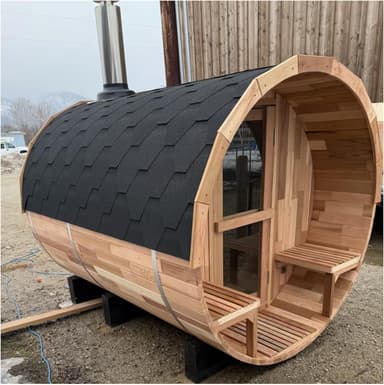
Smartmak 2-10 Person Canadian Hemlock Barrel Sauna
- Barrel shape genuinely improves heat distribution compared to box saunas
- Real red cedar and hemlock construction should last 15-plus years with care
- ETL-certified heater hits 195°F - legitimately hot for authentic steam sessions
For buyers who want a more conventional shape with comparable wood quality, Backyard Discovery's cedar cube options deserve a look - though the cube format sacrifices that 20% convection efficiency advantage that makes the barrel shape worth it for traditional Finnish-style heat.
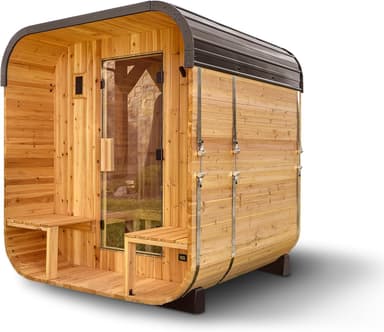
Backyard Discovery Lennon 2-4 Person Cedar Cube Sauna
- 9kW heater reaches temperature significantly faster than budget competitors
- 5-year warranty covers heater and hardware, not just the shell
- Wi-Fi preheat control adds genuine everyday convenience
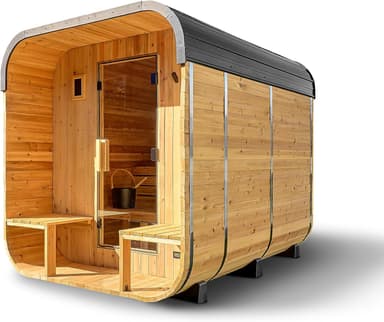
Backyard Discovery Lennon 4-6 Person Cedar Cube Sauna
- 9kW heater reaches target temperature significantly faster than competitors
- Tongue-and-groove cedar construction eliminates cold spots effectively
- Wi-Fi preheat lets you walk into a ready sauna every time
The $7,000-14,000 range delivers Thermowood construction, app-controlled heaters, and significantly better factory joinery tolerances. Dundalk Leisurecraft's Keidel 6-person at $7,995 uses Thermory heat-treated spruce that absorbs 65% less moisture than untreated wood - that difference matters enormously in coastal or high-humidity climates. SaunaLife's Revo 3000 at $12,500 is the choice for buyers who want an 8-foot barrel with app integration and a 20-year wood warranty.
For a comprehensive look at the top-rated models across all price points with hands-on testing notes, the best outdoor barrel saunas guide breaks down the field in detail. If budget is your primary filter, the best budget barrel saunas page covers what you actually get in each price tier.
Key Takeaways
- ●
Foundation quality determines build longevity more than any other single factor. A 4-inch concrete slab with rebar at 12-inch spacing, cured 72 hours, leveled to within 1/8 inch over 8 feet, and extending 12 inches beyond your barrel footprint will outlast the wood itself. Clay soil that heaves even 1/4 inch seasonally will crack your stave joints and void most kit warranties.
- ●
Banding tension is a skill, not a formality. Bands tensioned to 50-70 ft-lbs torque at assembly need re-checking after the first 3-5 heat cycles as wood swells and settles. Under-tensioned bands are the primary cause of gap formation and water infiltration in year two onward.
- ●
Cedar costs more but earns it in humid climates. Western red cedar's thermal conductivity of 0.07 BTU/hr-ft-°F and Class 1 rot resistance justify the $3-4/sq ft premium over hemlock in coastal or high-rainfall regions. In dry inland climates, hemlock at $4-6/sq ft performs well and saves real money on a full kit.
- ●
A 6kW electric heater at 240V runs a 4-6 person barrel sauna at 185°F for roughly $3-6 per session at the US EIA 2025 average rate of 16.8 cents/kWh. Annual operating cost for 4 sessions per week runs about $210 in electricity - less than most gym memberships.
- ●
The Laukkanen 2023 cohort study linked weekly Finnish-style sauna sessions to a 61% lower stroke risk over a 20.7-year follow-up in 1,688 adults. That data was gathered at 170-200°F with 15-20 minute sessions - the exact profile a properly built barrel sauna delivers.
- ●
Permits matter more than builders want to admit. Every US jurisdiction requires a permit for a new 240V circuit. Most require a setback permit for permanent outdoor structures. Skipping both saves a few hundred dollars and costs thousands if you need to sell, refinance, or file an insurance claim.
- ●
Wood-fired heaters win on operating cost; electric wins on convenience. A wood-fired barrel burns roughly 1/3 cord of hardwood per season at $50-67 in fuel. Electric costs $210/year for the same usage. The real difference is 45-60 minutes of fire management versus pressing a button from your phone.
Who This Is For, Who Should Skip It
Who This Build Is Right For
This project is well-matched for homeowners who are comfortable with basic carpentry, own a post level and rubber mallet, and are willing to either pull an electrical permit or hire a licensed electrician for the 240V circuit. You need a flat or gradable outdoor surface with at least 3 feet of clearance on all sides and a willing second person for the 8-12 hours of assembly on a larger kit.
Budget-wise, the sweet spot buyer is spending $4,500-7,000 on a kit and $500-1,500 on foundation and electrical, for an all-in number of $5,000-8,500. That gets you a permanent outdoor structure that delivers the 170-185°F Finnish-style heat documented in the Laukkanen research at a fraction of the $15,000-30,000 cost of a professional custom build.
This is also the right path for anyone who wants wood-fired capability. Prefab electric saunas in this price range almost never offer a chimney option. A barrel kit from Dundalk Leisurecraft or Almost Heaven with a wood-fired Harvia heater is one of the only DIY paths to authentic smoke-free wood heat.
Who Should Skip It or Hire Out
If your site has more than a 5% slope, a high water table, or less than 48 inches of access for a delivery truck, this project gets complicated fast. Grading and drainage work on difficult sites easily runs $1,000-3,000 before you've touched the kit, and that math can shift the decision toward a professional install.
Skip the DIY assembly if you don't have a reliable second person for the full day. The stave installation sequence requires two sets of hands during the banding phase - one person trying to hold tension and tap simultaneously will damage stave edges and produce uneven gaps.
Anyone with cardiovascular disease, uncontrolled hypertension, or pregnancy should consult a physician before regular sauna use, regardless of how well the build goes. The 10-20 mmHg systolic drop documented in the Laukkanen cohort is a benefit for healthy adults and a risk for people on certain antihypertensive medications.
What to Read Next
- ●
Best Budget Barrel Saunas - A breakdown of what you actually get in each price tier from $2,500 to $5,000, with hands-on notes on which budget kits have acceptable joinery and which ones cut corners that matter.
- ●
Best Outdoor Barrel Saunas - My full ranked list across all price points, covering the Almost Heaven, Dundalk, SaunaLife, and Thermory lines with direct comparisons on wood quality, heater options, and warranty terms.
- ●
All Sauna Guides - The complete library covering heater selection, maintenance schedules, health protocols, and accessory reviews - everything you need after the first burn.
Frequently Asked Questions
How long does a DIY barrel sauna kit take to assemble?
A 2-person barrel kit takes two adults 4-8 hours from crate to first heat test. A 4-6 person kit runs 8-12 hours. That assumes a pre-poured and cured concrete foundation or compacted gravel base, basic hand tools, and an electrician who has already roughed in the 240V circuit. The stave assembly itself is not the time bottleneck - it's foundation prep, electrical rough-in, and the band tensioning process done properly. Budget a full weekend: foundation and electrical on day one, stave assembly and heater install on day two.
Do I need a permit to build a barrel sauna in my backyard?
In most US jurisdictions, yes - two permits minimum. A building or zoning permit for the structure itself if it exceeds your local threshold (commonly 120-200 square feet or any permanent foundation), and an electrical permit for the 240V circuit. Setback requirements vary by municipality, typically 5-10 feet from property lines and 10-15 feet from structures. Call your local building department before pouring any concrete. The permit fees themselves are usually $50-200; the inspection process adds a few days but protects your insurance coverage and resale value.
What is the best wood for a barrel sauna kit?
Western red cedar is the benchmark for outdoor barrel saunas - thermal conductivity of 0.07 BTU/hr-ft-°F, Class 1 rot resistance, and a 50-year expected exterior lifespan in temperate climates. Thermory heat-treated spruce or pine is the better choice for coastal or high-humidity environments, absorbing 65% less moisture than untreated wood and shrinking only 0.1% at operating temperatures versus 0.2% for cedar. Hemlock is structurally sound and 30-40% cheaper per board foot, making it a legitimate option for dry inland climates where rot resistance is less critical. Avoid untreated pine or fir - both absorb moisture aggressively and will check and gap within 2-3 seasons of outdoor exposure.
How much does it cost to run a barrel sauna per session?
At the US EIA 2025 average residential rate of 16.8 cents per kWh, a 6kW electric heater running one hour at 185°F consumes 6 kWh and costs roughly $1.01 in electricity. Practical sessions including preheat time run closer to 1.5 hours, putting real cost at $1.50-2.00 per session for a 6kW unit, or $3-6 for larger 9kW heaters. Annual cost for 4 sessions per week totals approximately $210 for a 6kW setup. Wood-fired operation runs $50-67 per season for the same usage pattern using hardwood at $150-200 per cord. The wood-fired cost advantage is real but comes with 45-60 minutes of fire management per session.
How do I maintain a barrel sauna to make it last?
Four maintenance tasks matter above everything else. First, re-check band tension after every 3-5 heat cycles in year one and every spring thereafter - bands should be at 50-70 ft-lbs torque. Second, leave the door open after every session to allow interior drying - trapped humidity accelerates mold growth on untreated interior wood. Third, inspect the exterior wood annually for checking or gray weathering and apply an exterior oil specifically rated for sauna wood (Rubio Monocoat or similar) every 2-3 years depending on sun and rain exposure. Fourth, clean the heater rocks by removing and rinsing them annually - cracked or crumbling rocks reduce heat-up efficiency and can fracture under repeated thermal cycling.
Can I install a barrel sauna on a wood deck?
A wood deck can support a barrel sauna if it meets minimum structural requirements. An assembled 4-6 person barrel sauna weighs 1,200-1,800 pounds plus occupant load - plan for a minimum 50 psf live load capacity across the footprint. Most residential decks built to code handle 40 psf; you'll need to consult a structural engineer or contractor to confirm your specific deck framing. The safer and cheaper path for most owners is a dedicated 4-inch concrete slab or compacted gravel pad directly on grade. If a deck location is your only option, the gravel pad under the deck footings needs to be confirmed stable, and the deck ledger connection to the house is the first place to check for adequate load transfer.
What heater size do I need for a barrel sauna?
The standard rule from Harvia, Finnleo, and most kit manufacturers is 1 kW of heater capacity per 45 cubic feet of sauna volume. A standard 6-foot diameter by 7-foot long barrel has roughly 198 cubic feet of interior volume, calling for a 4.5 kW heater minimum. I'd size up one step to 6 kW to account for door and stave gap heat loss, cold-climate preheat demands, and the headroom to hit 185°F in under 45 minutes. The 8-9 kW range makes sense for 8-foot diameter barrels or any installation in climates that see sustained temperatures below 20°F in winter. Undersizing your heater is the most common mistake - a 3 kW unit in a 4-6 person barrel will plateau around 160°F and struggle to recover between rounds.
Is a barrel sauna better than a traditional box sauna for outdoor use?
For outdoor residential use, the barrel format wins on heat-up time and weather resistance. The curved stave design creates natural convective airflow that heats the interior 15-20% faster than a flat-wall box of equivalent volume, per CFD modeling of sauna airflow patterns. The radial compression of the bands also makes the barrel inherently more stable through freeze-thaw cycles than flat-panel joinery. Box saunas have advantages in interior layout flexibility and headroom, and prefab cube designs from manufacturers like Backyard Discovery are easier to expand or modify. For pure Finnish-style dry heat performance outdoors, the barrel's physics and weather resistance edge it out.
Frequently Asked Questions
No single best DIY barrel sauna exists, as it depends on budget, skill level, and size needs, but kits from Almost Heaven Saunas stand out for their high-quality, handcrafted Western red cedar construction, even heat distribution from the curved barrel shape, and easy assembly with precut staves. For full from-scratch builds, YouTube tutorials like the $3,000 cedar plank design using a wood stove or Redwood Outdoors Thermowood models with Harvia heaters offer proven, affordable options around 6-person capacity. Always prioritize a level foundation, proper ventilation, and professional electrical for heaters to ensure safety and longevity.
Related Guides
Affiliate Disclosure - UseSauna earns a commission from qualifying purchases through our Amazon affiliate links. This does not affect our editorial integrity.