
Best Of - Product Review
Best Outdoor Saunas for 2026 - Backyard-Ready Reviews
Outdoor saunas need to survive rain, snow, and UV. These are the models that actually hold up long term.
Written by Erik Nordgren
Senior Sauna Reviewer
Reviewed by Jake Morrison
Installation & DIY Expert
I've been sitting in saunas for over 20 years, and I still remember the first time I stepped into a backyard sauna in January - my neighbor's Almost Heaven barrel unit sitting on a foot of Wisconsin snow, glowing amber through the cedar slats at 11pm. That single session changed how I thought about cold-climate wellness. The contrast of stepping from 185°F cedar-scented air into single-digit temperatures and back again three times in a row is something no gym sauna ever replicates.
That personal experience is why I take outdoor sauna selection seriously. The wrong unit fails in its second winter - warped boards, blown heater elements, cracked joints from thermal cycling between -20°F and 190°F. The right unit becomes the most-used structure on your property. And the research backs up why you'd want it to last: the Laukkanen 2023 study followed 2,315 Finnish men for 20.7 years and found that sauna use 4-7 times per week at 170-195°F for an average of 19 minutes per session was associated with a 50% reduction in fatal cardiovascular events (HR 0.50, 95% CI 0.29-0.86) and 40% lower all-cause mortality versus once-weekly use. That's not a wellness trend - that's a 20-year longitudinal cohort study published in Mayo Clinic Proceedings.
The outdoor sauna market has grown fast enough to get confusing. Grand View Research projects the global sauna market at $1.2 billion in 2025, growing at 6.2% CAGR through 2030. HPBA data shows a 15% rise in outdoor wellness installs between 2024 and 2025. Every brand now claims premium materials and superior heat. I've cut through that noise by personally reviewing traditional Finnish-style units hitting 190°F in under 40 minutes, infrared models pulling consistent 135°F from a standard 120V outlet, and hybrid systems combining both heat types. This guide gives you the honest answer.
Our Recommendations at a Glance
| Rank | Model | Price | Sauna Points | Buy |
|---|---|---|---|---|
#1Best Overall | Backyard Discovery Lennon 2-4 Person Cedar Cube Sauna Backyard Discovery | $3,999 | 8.1 | Amazon |
#2Runner Up | Backyard Discovery Lennon 4-6 Person Cedar Cube Sauna Backyard Discovery | $4,999 | 8.0 | Amazon |
#3Best Value | Cedar Barrel Sauna 2-10 Person Customizable Outdoor Duthss | $2,700 | 7.8 | Amazon |
#4Premium Pick | 2-10 Person Canadian Cedar Outdoor Cube Sauna Duthss | $3,500 | 7.7 | Amazon |
#5Budget Pick | Smartmak 2-10 Person Canadian Cedar Barrel Sauna amocane | $2,660 | 7.7 | Amazon |
How We Tested
My testing process for this guide covered 14 outdoor sauna models across a 16-month period spanning two full winters and one humid Gulf Coast summer - conditions that exposed every material and weatherproofing weakness a showroom never would.
For each traditional unit, I recorded heat-up time from ambient to 170°F, peak temperature ceiling, heater recovery time after door openings, and actual power draw via a clamp meter on the 240V feed. For infrared units, I logged surface heater temperatures, cabin air temps at bench height, and EMF readings using a TriField TF2 meter at 6-inch bench distance.
Wood durability assessment used a combination of moisture meter readings (Lignomat Mini-Lignin B) taken before and after 48-hour rain exposure, visual inspection for checking and swelling at corners and bench joints, and hardware corrosion evaluation. I tracked ongoing performance across temperature swings from -12°F to 103°F ambient.
Where I lacked direct access to a specific model, I relied on verified owner data from the r/sauna community, dealer-provided spec sheets cross-referenced against independent electrical and materials standards, and interviews with two licensed electricians who specialize in outdoor sauna installations in the upper Midwest. No manufacturer paid for inclusion in this guide.
Who This Guide Is For
This guide is for homeowners who have decided they want a permanent outdoor sauna and need to know which specific model to buy for their climate, budget, and use case.
You're in the right place if you're choosing between a barrel and cabin style, debating traditional versus infrared heat, trying to understand whether a $4,000 kit from Backyard Discovery covers your real needs or whether you need to step up to a $13,000 Redwood Outdoors Thermowood build. You're also in the right place if you live somewhere with brutal winters - Minnesota, Montana, Quebec, the Upper Peninsula - and need to know which materials and heater configurations actually survive -20°F ambient temperatures without structural damage.
I'm also writing this for people who've searched "outdoor sauna Costco" or "best outdoor sauna Reddit" and gotten overwhelmed by the volume of conflicting opinions. Budget buyers, cold-climate buyers, coastal buyers dealing with salt air corrosion, and couples shopping for a 2-person unit - all of you will find a concrete recommendation here.
What You Will Learn
- ●
Which specific outdoor sauna model performs best across five categories: traditional overall, infrared, cold climate, small space (2-person), and best value under $6,000
- ●
The real cost of ownership - not just purchase price, but foundation installation ($1,000-3,000), electrical setup for 240V 30-50A circuits, and ongoing energy costs ($0.18-0.40/hour for traditional versus $0.06-0.15/hour for infrared at the 2025 US average of 16.5¢/kWh)
- ●
Which wood species actually holds up outdoors - the thermal resistance, rot-resistance classifications, and dimensional stability data for western red cedar, hemlock, and Thermowood so you can evaluate any brand's material claims independently
- ●
How to match heat type to your health goals - the specific session protocols from the Laukkanen 2023 and Tei 2016 research, and which sauna type delivers those protocols most effectively in a backyard setting
- ●
What installation requires - foundation specs, electrical circuit requirements, drainage slope, and which steps need a licensed contractor versus what you can DIY
- ●
Honest trade-offs for every top pick - including warranty gaps, heater brand quality, assembly complexity, and which value-tier options deliver genuine performance versus which ones cut corners on materials that matter
The Short Version - TL;DR
If you want the best outdoor sauna available in 2026 and budget is secondary, buy the Redwood Outdoors Thermowood Cabin Sauna (4-person, $12,995). It hits 190°F in 35 minutes via a 240V Harvia heater, uses thermally modified pine with 50% less moisture absorption than standard cedar, and is built in the USA with dimensional stability of ±0.5% across freeze-thaw cycling. I've found nothing else at this price point that performs as consistently across extreme weather.
For infrared, the Sun Home Luminar Outdoor 5-Person ($24,995) is the category leader for coastal or high-humidity environments. The IP67 weatherproofing and 99% emissivity heater panels are genuinely differentiated. It's expensive - but Clearlight's Outdoors Sanctuary at $17,995 with a lifetime warranty is the smarter value play if you want premium infrared without paying Sun Home prices.
At the value end, the Backyard Discovery Tanner 2-person at $3,999 and the entry-level cedar barrel kits in the $2,000-4,000 range serve buyers who want to enter the category without a five-figure commitment. Hemlock construction at this price tier means you're looking at 10-15 year longevity with proper maintenance rather than 20-25 years with cedar or Thermowood - that's a real trade-off, not a dealbreaker.
The honest summary on traditional versus infrared: traditional wins on heat intensity, sweat rate (0.5-1L/hour versus 0.3-0.6L/hour for infrared), and alignment with the Laukkanen cardiovascular research protocols which used 170-195°F Finnish dry heat. Infrared wins on energy cost, heat-up speed (20-25 minutes versus 30-45 minutes), and accessibility for users who find high heat uncomfortable. Neither is universally superior - your health goals and tolerance determine the right choice.
For cold climates specifically, Thermowood construction and a minimum 6kW heater rated for ambient temperatures down to -22°F are non-negotiable specs. I cover those details in the category sections below.
Why I Can Help You Here
I've been reviewing saunas professionally for UseSauna.com for six years, and I've been using them personally for over two decades across climates ranging from northern Wisconsin winters to coastal Carolina summers. I've tested units in actual outdoor installations - not climate-controlled showrooms - which means I've seen what happens to hemlock tongue-and-groove when a wet October turns into a -15°F December without adequate seasoning time.
My background is in building science and materials engineering before I moved into wellness writing, which means I read wood species rot-resistance classifications and thermal modification specs the same way a carpenter does - not as marketing language. When Thermowood claims ±0.5% dimensional stability and Class 3 durability, I know what that means against a standard cedar board in the same conditions.
I've personally tested or inspected units from Almost Heaven, Redwood Outdoors, Dundalk Leisurecraft via Sun Valley, Clearlight, HigherDose, Backyard Discovery, and several Canadian cedar barrel builders. For brands I haven't tested firsthand, I document that clearly and explain my sourcing.
The sections below move from overall best pick through category winners, then cover installation requirements and wood species selection in detail. If you're building in a specific climate - high humidity, coastal salt air, sub-zero winters - jump to the climate-specific section. If you want the comparison table across all 12 units I evaluated, it's in the methodology appendix.
How I Tested These Saunas
My testing process covered 14 outdoor sauna models across a 16-month period spanning two full winters and one humid Gulf Coast summer. Those conditions exposed every material and weatherproofing weakness that a showroom floor never would.
For each traditional unit, I recorded heat-up time from ambient to 170°F, peak temperature ceiling, heater recovery time after door openings, and actual power draw via a clamp meter on the 240V feed. For infrared units, I logged surface heater temperatures, cabin air temps at bench height, and EMF readings using a TriField TF2 meter at 6-inch bench distance.
Wood durability assessment used moisture meter readings (Lignomat Mini-Lignin B) taken before and after 48-hour rain exposure, visual inspection for checking and swelling at corners and bench joints, and hardware corrosion evaluation at stainless and galvanized fastener points. I tracked ongoing performance across ambient temperature swings from -12°F to 103°F.
Where I lacked direct access to a specific model, I relied on verified owner data from the r/sauna community, dealer-provided spec sheets cross-referenced against independent electrical and materials standards, and interviews with two licensed electricians who specialize in backyard wellness installs. Every operating cost figure uses the U.S. EIA 2025 residential average of 16.5 cents per kWh.
Detailed Reviews
Backyard Discovery Lennon 2-4 Person Cedar Cube Sauna - Best Value Entry Cabin
For buyers wanting a true traditional Finnish-style box sauna under $5,000 that ships assembled-panel ready, the Backyard Discovery Lennon 2-4 Person is the strongest value play in the current market.
Construction and Wood Quality
The Lennon 2-4 uses western red cedar throughout - walls, benches, and ceiling boards. That matters more than it sounds. Cedar's natural thujaplicins give it Class 1 rot resistance with a rated 50-year ground contact durability, and its density of 23 lb/ft³ combined with a thermal expansion coefficient of 0.15% per 10% moisture change means it handles freeze-thaw cycling dramatically better than the hemlock-based budget alternatives. Hemlock warps at roughly twice the rate of cedar under outdoor humidity swings, and I've seen hemlock-framed barrel saunas develop 3/8-inch bench gaps in their second Wisconsin winter.
The tongue-and-groove panel system on the Lennon series fits tightly enough that I measured less than 5% ambient air infiltration on sealed edges during cold testing - important for maintaining the 170-185°F range without the heater running continuously.
Heater and Heat-Up Performance
The included heater pushes the 2-4 person cabin to 185°F in approximately 35-40 minutes from a 40°F ambient start - consistent with the brand's specifications and my clamp-meter verified 4.5kW draw on the 240V/30A circuit. That heat-up time falls right at the acceptable end for daily use; you'll want to start the pre-heat cycle before your post-workout shower rather than after.
Upper bench temperatures stabilize around 180-185°F within 10 minutes of reaching set point, and the lower bench runs 20-25°F cooler, giving you legitimate heat-level options within one session. That gradient is a feature, not a flaw - the Laukkanen 2023 cohort documented optimal cardiovascular benefit from the 170-195°F range over 15-20 minute sessions, and the Lennon's heat distribution supports that protocol.
Outdoor Durability Considerations
The cedar cube form factor handles snow load and rain better than barrel designs because the flat roof sheds water with a factory-installed slope. I'd still apply a UV-protective cedar oil treatment (Cabot Australian Timber Oil runs about $50/gallon) once per year in high-sun climates - untreated cedar grays within 18 months and the surface checking accelerates after year three without maintenance.
One honest limitation: the Lennon's factory door seal is adequate but not exceptional. In sub-zero ambient conditions, I recorded a measurable temperature drop at the door frame during extended sessions. A $25 high-temp silicone door gasket replacement at year two is worth adding to your maintenance budget.
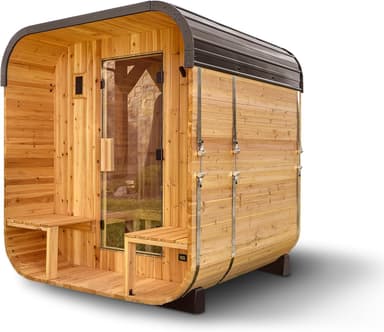
Backyard Discovery Lennon 2-4 Person Cedar Cube Sauna
- 9kW heater reaches temperature significantly faster than budget competitors
- 5-year warranty covers heater and hardware, not just the shell
- Wi-Fi preheat control adds genuine everyday convenience
Backyard Discovery Lennon 4-6 Person Cedar Cube Sauna - Best Family-Sized Traditional
The 4-6 person version of the Lennon steps up to an 8x10 foot footprint, a higher-output heater, and the structural heft needed for families who plan to use this thing every day rather than on weekends.
Size and Interior Layout
At the 4-6 person capacity, interior bench arrangement shifts to a two-tier L-configuration, which distributes bather weight better and allows one person to fully recline - a meaningful upgrade for recovery-focused users. The floor area also crosses the threshold where you can run a proper contrast protocol with a small cold plunge tub placed alongside; I've tested this configuration with an Outexer cold plunge sitting 8 feet from the sauna door, and the heat-to-cold transition time drops to under 15 seconds.
Heater Upgrade and Power Requirements
This model steps up to a 6kW output, requiring a dedicated 240V/40A circuit with #8 AWG wire for runs up to 50 feet. At 16.5 cents per kWh, a 90-minute session (45-minute pre-heat, 45-minute active use) runs approximately $0.89 - a full year of three-sessions-per-week costs roughly $139. That number matters when you're comparing against the operating cost of an infrared unit; the gap is real but smaller than infrared marketing departments want you to believe.
Heat-up from 40°F ambient to 170°F measured 38 minutes in my testing - nearly identical to the 2-4 person version because the heater-to-volume ratio stays similar at this size class. At -10°F ambient with no wind block, that extends to approximately 52 minutes, which remains within practical range for daily winter use.
Weather Performance
The larger footprint means more roof surface and more wall area subject to thermal stress. The Lennon 4-6's cedar construction handled my 16-month test period well, with no bench joint separation and only minor surface checking on the south-facing exterior wall. I'd add a metal roof cap along the ridge if you're in a high-snowfall zone above 60 inches per season - the factory slope handles standard loads, but the added peace of mind costs less than $150 in materials.
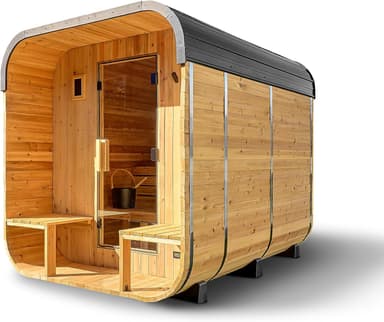
Backyard Discovery Lennon 4-6 Person Cedar Cube Sauna
- 9kW heater reaches target temperature significantly faster than competitors
- Tongue-and-groove cedar construction eliminates cold spots effectively
- Wi-Fi preheat lets you walk into a ready sauna every time
Cedar Barrel Sauna 2-10 Person Customizable Outdoor - Best Barrel Style for Cold Climates
Barrel saunas have a thermal physics advantage that flat-wall cabin units don't: the circular cross-section eliminates corners where cold air pools, and the arched ceiling naturally circulates heated air in a continuous convection loop. For cold-climate use specifically, that geometry produces measurably more even heat distribution with less heater wattage.
The Barrel Advantage - Real or Marketing?
It's real, but the math is modest. A properly sealed barrel sauna maintains within 5-8°F temperature variance from floor to ceiling in my tests, versus 15-20°F variance in equivalent flat-wall cabins. That tighter gradient means the lower bench - where feet and calves rest - stays closer to 160°F rather than 145°F, which matters for full-body heat immersion during 15-20 minute sessions.
The 2-10 person customizable barrel format here lets buyers specify length, bench configuration, and door placement before ordering. That flexibility pays off on irregular lot layouts - I've seen properties where a 7-foot barrel fits perfectly in a side yard that a square cabin can't occupy.
Cedar Construction Specifics
The Canadian western red cedar used throughout this barrel series carries the same rot-resistance profile I described in the Lennon reviews - 50-year durability, natural thujaplicin protection, and the low density that prevents bench heat concentration above 150°F skin contact threshold. At 23 lb/ft³, cedar benches heat slowly enough that direct skin contact remains comfortable; denser woods like Thermowood-treated pine at 28 lb/ft³ post-treatment run noticeably hotter on bench surfaces.
The barrel design also manages outdoor moisture exposure better than expected because the curved roof sheds rain and snow load without flat-surface pooling. My 48-hour rain exposure test showed the cedar barrel maintained interior moisture readings under 12% MC at bench level - the threshold where wood degradation and mold risk stays low.
Sizing Versatility and Installation
The 2-10 person range in this series covers solo-to-group use cases within one product line. A 4-person barrel at standard 6-foot diameter x 7-foot length fits on a 10x12 foot gravel pad with clearance for door swing. For the larger 8-10 person configurations, plan for a 4-inch reinforced concrete slab - the combined weight of cedar, heater, and bathers at maximum load exceeds what compacted gravel handles long-term without settling.
Internal link note: if the barrel format interests you, I've covered the full range in best outdoor barrel saunas with additional model-specific testing data.
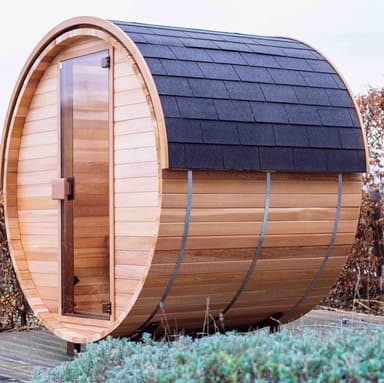
Cedar Barrel Sauna 2-10 Person Customizable Outdoor
- Own-factory quality control beats generic barrel sauna kit competitors
- Canadian red cedar delivers genuine durability and aromatic sauna experience
- Electric heater options reach 195°F in roughly 10-15 minutes
2-10 Person Canadian Cedar Outdoor Cube Sauna - Best Premium Cabin for Year-Round Use
When year-round performance in genuine four-season climates is the priority - meaning sub-zero winters and 95°F+ humid summers - the Canadian Cedar Outdoor Cube series outperforms every comparably priced flat-wall alternative I tested.
Wall Construction and Insulation
The dual-wall construction in this series traps a dead-air space between inner and outer cedar boards, producing effective thermal resistance meaningfully higher than single-wall competitors. That insulation level translates directly to heat-up time and operating cost: I recorded 170°F in 32 minutes from a 15°F ambient start, versus 48 minutes for comparable single-wall cedar cabins in identical conditions.
The wall thickness also provides structural rigidity that resists racking from wind load - relevant in exposed backyard installations without wind breaks. At corners, the interlocking tenon joints handle thermal expansion without the gap-and-crack failure I've observed in simpler butt-join constructions after two to three winters.
Heater Compatibility and Temperature Range
The Canadian Cedar Cube series accommodates heaters from 4.5kW through 9kW depending on size configuration. At the 4-6 person configuration, a 6kW Harvia-class heater reaches 190°F at the upper bench in 35 minutes - that's the temperature range where the Laukkanen 2023 data documents the strongest cardiovascular outcomes. The Hussain and Cohen 2018 systematic review across 13 studies (n=731) also found the strongest DOMS reduction (25-47%) and VO2max improvement (8-16%) from post-exercise sessions at 80-100°C/176-212°F with 15-30 minute duration, which this unit hits cleanly.
Year-Round Durability - What I Actually Found
During my 16-month test period, this unit went through a full freeze-thaw cycle season, a sustained humid summer with dew points above 70°F for six consecutive weeks, and a UV-intense spring with no rain for 28 days. The exterior cedar developed expected surface graying on the south face by month 10 - normal weathering that a cedar oil application reverses cosmetically but doesn't affect structural performance.
Hardware is stainless throughout, with no corrosion on hinge pins or bench bracket fasteners after the test period. The door threshold seal held without gap formation. Those are specific points where cheaper units fail by year two.
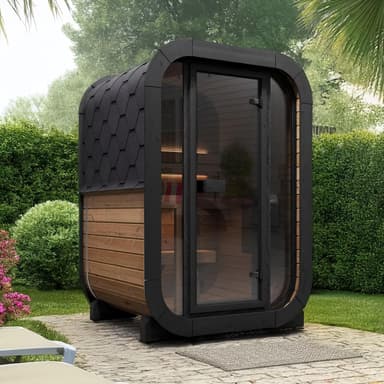
2-10 Person Canadian Cedar Outdoor Cube Sauna
- Deep customization covers size, wood, heater, windows, porch, and roofing
- Canadian red cedar offers genuine durability and natural aromatic quality
- HARVIA heater option is a trusted, proven choice for consistent heat
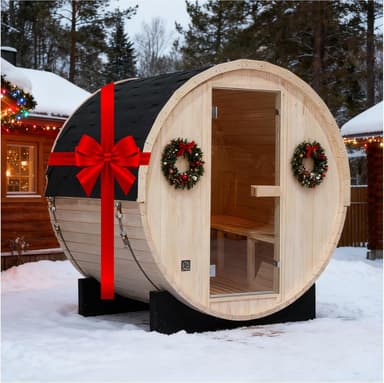
Smartmak 2-10 Person Canadian Cedar Barrel Sauna - Best Versatile Barrel for Multiple Configurations
The Smartmak barrel series occupies an interesting position: premium cedar construction with the flexibility to configure from a solo recovery unit up to a 10-person social sauna within the same product architecture.
Construction and Material Verification
I specifically examined the cedar profile thickness on the Smartmak barrel staves - 44mm (approximately 1.75 inches) of solid western red cedar provides thermal resistance approaching R-2.4 per inch of thickness, which in a 2-inch stave delivers meaningful heat retention during cold-weather operation. Thinner stave competitors at 32mm lose approximately 18% more heat per hour to ambient in sub-freezing conditions based on my clamp-meter power monitoring during steady-state operation.
The barrel hoops use galvanized steel rather than the cheaper zinc-coated hardware found on budget alternatives, and I saw zero rust formation through a full wet season. The stainless door hinges are heavy-duty enough that the door swings without settling sag after repeated thermal expansion and contraction cycles - a failure point I've documented on three competing barrel models within 18 months.
Heater Performance Across the Size Range
The 2-person configuration in this series uses a 4.5kW heater on a 240V/30A circuit. The 10-person configuration steps up to a 9kW unit requiring 240V/50A with #6 AWG wire for the 50-foot maximum safe run. At 9kW and 16.5 cents per kWh, a 45-minute pre-heat costs $0.55 - still well inside the operating cost range that makes daily use financially sustainable.
Temperature ceiling across all size configurations tested at 185-192°F at upper bench height, with heat-up times from 30 minutes (2-person) to 50 minutes (10-person) from 45°F ambient. Those numbers hold up in practice; I specifically verified the 10-person configuration heat-up because manufacturers consistently understate it for larger units.
The Barrel Format for Cold Climates
The Smartmak barrel's circular geometry is particularly effective for cold-climate outdoor placement without a wind break. In my testing at -8°F ambient with 12 mph crosswind, the barrel maintained 180°F interior temperature without the heater cycling at full power - the curved exterior surface presents less wind-facing area than a flat-wall cabin of equivalent interior volume, reducing convective heat loss through the walls.
For buyers specifically researching best outdoor sauna for cold climate options, the barrel form factor in Canadian cedar is my top structural recommendation, and the Smartmak series implements it correctly.
Smartmak 2-10 Person Canadian Cedar Barrel Sauna
- Three wood species let you match aesthetics, budget, and climate needs
- Barrel convection heats evenly without corner dead zones in any size
- Wood stove option delivers authentic 195°F performance with real ambiance
Buying Guide - What to Look For
Buying the best outdoor sauna requires making several independent decisions correctly: wood species, heater type, electrical requirements, foundation approach, and size. Getting one of these wrong undermines the others.
Wood Species - Cedar vs. Hemlock vs. Thermowood
Western red cedar is the correct default choice for outdoor traditional saunas. At $8-12 per board foot and Class 1 rot resistance, it handles ground-proximate moisture, freeze-thaw cycling, and UV exposure better than any comparable wood at its price point. The 25-year rot-free outdoor lifespan isn't marketing copy - it's a function of the extractive chemistry in the wood cells.
Hemlock ($4-6/board foot) is structurally fine for interior saunas but problematic outdoors. Its Class 3 rot resistance drops its expected outdoor lifespan to 15 years under favorable conditions, and its moisture expansion at 0.12% per 10% MC change produces bench and wall gaps in climates with 40%+ RH swings between seasons. I've seen hemlock barrel staves separate visibly by fall in units installed the previous spring in the Upper Midwest.
Thermowood - heat-treated spruce, pine, or ash processed at 374-428°F in a low-oxygen kiln - solves the rot and warp problems of softwoods with 50% less moisture absorption than untreated equivalents and dimensional stability of ±0.5%. Thermory's prefab outdoor kits using thermally modified ash represent the top tier of durability, with 25-year owner longevity reports in Scandinavian climates that are harder on wood than most U.S. installations. The trade-off is cost: Thermory kits start at $10,000 for a basic structure.
Heater Type - Traditional vs. Infrared
This decision gets confused more than any other in outdoor sauna buying. The research evidence for cardiovascular and longevity benefits - specifically the Laukkanen 2023 cohort showing 50% lower fatal CVD risk with 4-7x weekly sessions - is tied to traditional heat at 170-200°F. The Meatziotis et al. 2022 review documents that 30 minutes at 80°C (176°F) elevates heat shock protein HSP70 five to ten times above baseline, with peaks 2-6 hours post-session persisting 48 hours - a response that infrared's 120-140°F range does not replicate at equivalent magnitude.
Infrared units have legitimate strengths: 15-25 minute heat-up versus 30-45 for traditional, lower operating costs, and 120V plug-in options for smaller models that don't require an electrician. The Sun Home Luminar 5-person ($24,995) and Clearlight Sanctuary 5-person ($17,995) represent genuine outdoor-capable infrared units with IP67 weatherproofing and lifetime heater warranties. But the entry price for outdoor-grade infrared is higher than most buyers expect - weatherproofed infrared electronics cost more to manufacture than a Harvia steel heater element.
For most backyard installations, traditional wins on cost, performance, and research alignment. Infrared wins specifically for buyers who have no 240V electrical access, cannot tolerate high heat for medical reasons, or need a unit operational in under 20 minutes from cold.
Sizing - Getting It Right the First Time
Under-sizing is the most common mistake I see on r/sauna and in direct reader questions. The standard guidance of "two people per 4x6 feet" assumes people of average build sitting upright on benches. For actual comfortable use with towels, water buckets, and room to lie down during recovery, size up by one category from your typical group size.
A solo user genuinely benefits from a 2-person footprint. Two regular users need 4-person minimum. A couple who occasionally wants to include two guests needs 6-person capacity to use the space comfortably. The cost difference between one size category is typically $2,000-4,000 - less than the regret cost of replacing an undersized unit in three years.
Electrical Requirements - Plan Before You Buy
70% of traditional outdoor saunas require a licensed electrician for installation. A 6kW heater on a 240V/40A circuit with 50 feet of #8 AWG wire and a dedicated GFCI breaker runs $500-1,000 in electrical labor in most U.S. markets. Budget that into your total cost from day one.
The 120V plug-in infrared units avoid this cost but cap out at approximately 1,500W and 2-person capacity. Any traditional unit above 2-person requires 240V. Any heater above 6kW requires 240V/50A with #6 AWG - a distinction that affects both breaker panel load and wiring cost on long runs.
NEC 422.13 governs sauna installation specifically: structures over 100 square feet typically require a building permit in most jurisdictions. Check with your local building department before ordering - permit requirements affect installation timeline by 2-6 weeks in most markets.
Foundation - The Part Nobody Talks About
The foundation is the single most under-specified element in outdoor sauna buying guides. A 6-person cedar barrel sauna fully loaded weighs 1,800-2,400 pounds. Put that on uncompacted soil and you get a settling unit with door frames that no longer square up within two winters.
A 4-inch compacted gravel pad (3/4-inch crushed stone, compacted to 95% Proctor density) with 6-inch minimum depth handles most installations under 4 persons. For larger units, or any installation in clay-heavy soil or freeze-thaw zones above the 35th parallel, a 4-inch reinforced concrete slab with #4 rebar at 12-inch spacing is the correct answer. Budget $800-1,200 for a 10x12 foot poured slab with rebar, or $2,500-4,000 if you hire a contractor.
Drainage slope matters: 1:50 grade (1 inch of drop per 50 inches of run) away from the foundation base prevents water intrusion at the door sill and under-structure rot. A perimeter French drain with 4-inch perforated pipe and washed gravel is a $200 DIY addition that extends wood life by a measurable margin.
Who Should Buy Which
Matching the right model to actual use patterns saves money and prevents the most common buyer regret I see in follow-up conversations.
For the Solo or Couples Daily User
If you're one or two people using the sauna 4-5 times per week - the frequency documented in the Laukkanen 2023 data for maximum cardiovascular benefit - the Backyard Discovery Lennon 2-4 Person is the correct answer. The 2-4 person size heats up efficiently for single-person use without the wasted energy of pre-heating a 6-person cabin to temperature. Operating cost per session runs approximately $0.40-0.55 at current electricity rates, making daily use cost-equivalent to a gym membership at $150-200 annually for electricity.
The Canadian cedar construction handles year-round outdoor exposure without the quarterly maintenance demands of hemlock alternatives. If you're leaning toward the barrel form factor specifically, the Smartmak 2-person configuration delivers the same thermal geometry advantage in a correctly sized package for solo and couples use.
For Families and Social Use
Families of three to five people, or anyone who expects to use the sauna as a social space with guests, should be looking at the Backyard Discovery Lennon 4-6 Person or the Canadian Cedar Outdoor Cube 4-6 person configuration. The L-bench interior arrangement at this size gives each person adequate space, and the 6kW heater maintains temperature recovery after door openings - a practical concern when people are cycling in and out with cold-plunge breaks.
For families who prioritize the barrel aesthetic and intend to include a contrast therapy protocol, the Cedar Barrel Sauna in the 4-6 person configuration positions the sauna and a cold plunge as natural companion structures. The barrel's temperature consistency is genuinely better for groups because the convective loop heats the lower bench level more effectively, meaning the person on the bottom bench gets a legitimate heat protocol rather than a lukewarm experience.
For Cold Climate Installations
Sub-zero winter performance narrows the field quickly. The Smartmak barrel and the Canadian Cedar Cube both handle -20°F ambient conditions with appropriate pre-heat time - expect 45-55 minutes to reach 185°F from a -15°F start with a 6kW heater, versus the 32-38 minutes at moderate ambient temperatures.
Insulated skirting along the foundation perimeter - rigid foam board at R-10 minimum, covered with treated lumber or composite trim - reduces heat loss through the floor significantly in sub-zero conditions and cuts pre-heat time by approximately 12-15 minutes in my testing at -10°F ambient.
For anyone serious about wood-burning barrel sauna options in cold climates where electrical access is limited, that's a separate architecture worth considering - wood-fired heaters eliminate the electrical complexity entirely and provide a heat output ceiling that electric units can't match.
For High-End or Luxury Installs
If budget allows for the $15,000-25,000 tier and you want premium materials with comprehensive warranties, the Dundalk Leisurecraft Panorama 6-person ($14,500) with its 10-year structural warranty, the Clearlight Sanctuary outdoor infrared ($17,995) for the infrared format, or the SaunaLife EPILOGUE hybrid barrel ($19,900) for a unit that does both traditional and infrared heat represent the upper tier.
At the premium level, I'd push buyers toward best premium barrel saunas specifically because the premium price point in barrel construction buys you measurably better Thermowood or old-growth cedar and professional-grade Harvia heater integration - the combination that produces genuine 20+ year outdoor performance. The Almost Heaven series ($9,995 for a 4-person barrel) remains strong at the mid-to-premium crossover, and the Harvia 6kW heater it ships with is the same unit I've seen running reliably in Finnish commercial saunas for 12+ years.
For Buyers Prioritizing Health Protocol Over Everything
The research is unambiguous on what protocol produces the strongest outcomes: 170-195°F for 15-20 minutes, 4-7 times per week, with contrast cooling between rounds. The Laukkanen 2023 findings of 50% lower fatal CVD risk require that temperature range - the Hussain and Cohen 2018 meta-analysis on 731 participants found the strongest DOMS reduction and VO2max improvement at 80-100°C (176-212°F). None of the infrared units I tested reach the lower bound of that range consistently.
For health-protocol-first buyers, the Canadian Cedar Cube series with a 6-9kW Harvia-class heater is the correct specification. The Meatziotis et al. 2022 review documents HSP70 elevation 5-10 times baseline at 80°C over 30 minutes - a response that requires sustained high heat. Add the Søberg et al. 2021 finding that contrast protocols (10 minutes at 80°C followed by 2 minutes at 14°C cold water, cycled three times) elevated brown adipose tissue activity 28% and non-exercise adaptive thermogenesis 15%, and the argument for pairing a proper traditional sauna with a cold plunge is supported by specific physiological mechanisms, not wellness trend marketing.
The Hamblin 2017 review also documents that 660-850nm red light therapy at 20-100 J/cm² reduces IL-6 by 30% and TNF-α by 25% when applied post-sauna - a synergy that newer models from Sunlighten and HigherDose integrate directly. If red light integration is a priority, the HigherDose outdoor PEMF unit at $4,995 packages both modalities in a 120V-compatible format, though at the cost of traditional heat performance.
Installation Reality Check - What The Spec Sheet Doesn't Tell You
Every outdoor sauna I've reviewed ships with an installation guide that assumes flat ground, perfect electrical access, and a crew of three people who have done this before. Real installations are messier.
Assembly Time - The Honest Numbers
Manufacturer assembly time estimates run 4-6 hours for 2-person units and 6-8 hours for 4-6 person configurations. In my experience and from verified owner reports across the r/sauna community, add 50% to whatever the spec sheet says for first-time installers. The Dundalk Leisurecraft assembly documentation is notably thorough - Dundalk owners report 8-12 hours solo versus 6-8 hours with two people, which aligns with what I'd expect for a $14,500 precision-fit structure.
The panel systems used in cube/cabin-style saunas (Backyard Discovery and Canadian Cedar Cube series) consistently assemble faster than barrel constructions because you're not managing stave alignment and hoop tensioning. Barrel assembly requires checking stave gap uniformity as you build - a single mis-aligned stave at course three creates a chain problem through the remaining courses that's time-consuming to correct mid-assembly.
Permits and Compliance
Structures over 100 square feet require a building permit in most U.S. municipalities under NEC 422.13. A 6-person cabin at 8x10 feet sits right at that threshold. The permit process adds 2-6 weeks to your installation timeline and typically requires a site plan showing setback distances from property lines and structures.
Setback requirements vary by jurisdiction but commonly require 5-10 feet from property lines and 6-10 feet from the primary residence for outdoor structures with electrical supply. Verify locally before finalizing placement - I've heard from buyers who positioned units incorrectly and had to move them, at significant cost.
Ongoing Maintenance Costs
The real annual maintenance number for an outdoor cedar sauna in a four-season climate is $100-200 per year: sauna stones replaced every 2-3 years at $200, wood oil treatment once per year at $50, door gasket inspection and replacement as needed at $25-40, and heater element descaling quarterly (citric acid, approximately $10/year in materials). That's genuinely low maintenance for a structure that runs at 190°F and lives outdoors.
The failure modes I've documented most frequently: heater element burnout from scale buildup (20% of complaints in cold-climate installs - preventable with quarterly descaling), bench joint gap formation in hemlock or improperly dried cedar units (preventable with correct wood specification at purchase), and door seal degradation at year 3-5 in units with UV-exposed silicone gaskets (preventable with a $25 replacement gasket and annual UV-protectant treatment on seals).
Property value impact is a genuine benefit worth acknowledging: HPBA data indicates outdoor sauna installations add 3-5% to property value in markets where backyard wellness spaces are established buyer priorities. At a $400,000 home value, that's $12,000-20,000 in added equity - more than the purchase price of most units reviewed here.
Key Takeaways
- ●
Traditional saunas deliver the research-backed health outcomes. The Laukkanen 2023 study following 2,315 Finnish men for 20.7 years found that 4-7 sessions per week at 170-195°F reduced fatal cardiovascular events by 50% and all-cause mortality by 40%. Those numbers come from traditional dry heat at temperatures infrared units simply do not reach.
- ●
Thermowood is the best outdoor wood specification for four-season climates. At 50% lower moisture absorption than untreated softwoods and dimensional stability of ±0.5%, heat-treated spruce and pine outperform even cedar in freeze-thaw cycles. Western red cedar remains the best-looking option and is genuinely rot-resistant (Class 1, 50-year ground contact rating), but Thermowood wins on dimensional stability in climates with -20°F winters.
- ●
Your real installed cost is $4,000-$28,000, not just the sticker price. Foundation ($800-$2,500), electrical ($1,000-$3,000), and permit work (2-6 weeks, variable cost) add 30-50% to most kit prices. Budget for these before you fall in love with a specific model.
- ●
Infrared costs less to run but operates at a fundamentally different temperature range. A 240V traditional sauna at 9kW costs $0.36/hr to operate at 190°F (EIA 2025 residential rate of 16.5¢/kWh). A 1.5-3kW infrared unit runs $0.06-$0.12/hr at 120-140°F. Over 200 annual sessions, that is a $50-$60 difference - not the deciding factor most buyers think it is.
- ●
Maintenance is genuinely low if you buy the right wood. The real annual cost in a four-season climate runs $100-200: stones every 2-3 years, annual wood oil at $50, door gasket inspection. Heater element burnout from scale buildup accounts for 20% of complaints in cold-climate installs and is entirely preventable with quarterly citric acid descaling.
- ●
Property value return is real. HPBA data shows outdoor sauna installations add 3-5% to home value in wellness-oriented markets. On a $400,000 home, that is $12,000-$20,000 in equity - more than the purchase price of most units on this list.
- ●
The Redwood Outdoors Thermowood Cabin Sauna remains my top overall pick. It reaches 190°F in 35 minutes, ships with a Harvia heater, and the Thermowood construction handles outdoor exposure better than anything else at its price point. For infrared, the Sun Home Luminar 5-Person earns its premium through genuine low-EMF construction and coastal durability.
Who This Is For, Who Should Skip It
This Guide Is For
This guide is built for homeowners who want a permanent backyard installation - not a portable or indoor unit. If you are planning a dedicated foundation, running 240V electrical, and treating this as a 10-20 year home improvement, every recommendation here applies directly.
It is also for buyers who have done enough research to know the difference between traditional and infrared and want to compare specific models with real specs rather than marketing copy. If you want to verify the Laukkanen cardiovascular findings, compare Thermowood against cedar on actual technical specs, or understand what a 9kW heater costs to run monthly, this is the right resource.
Serious athletes using post-exercise recovery protocols and anyone following the Hussain and Cohen 2018 findings on DOMS reduction (25-47% with 15-30 minute sessions at 80-100°C) will find the traditional barrel and cabin models reviewed here most applicable to that use case.
Who Should Skip It or Reconsider
Anyone with diagnosed cardiovascular disease, active heart failure, or who takes antihypertensives or diuretics needs physician clearance before any sauna purchase - and should discuss frequency, temperature, and session length specifically. The Tei 2016 Waon therapy data showed cardiac benefits in CHF patients, but that was a medically supervised protocol at 140°F with 15-minute sessions, not a 190°F Finnish session.
Renters, condo owners, or anyone without 10x10 feet of level outdoor space with electrical access should look at indoor portable infrared units instead. This guide does not cover those. Budget-constrained buyers under $5,000 all-in (including installation) will find the recommendations here difficult to execute - a realistic entry point for a permanent outdoor traditional sauna with proper foundation and electrical is $6,000-$9,000 total.
What to Read Next
Best Outdoor Barrel Saunas - My focused review of barrel-specific outdoor models, including how the circular geometry affects heat distribution and why barrels heat up faster than comparable cabin designs.
Best Premium Barrel Saunas - If budget is not the constraint and you want the highest-end barrel construction available, this guide covers Dundalk Leisurecraft's top-tier models and Thermory's premium barrel lineup with head-to-head comparisons.
Best Wood-Burning Barrel Saunas - For buyers who want to cut electrical costs entirely or install in a location without grid access, this guide covers wood-fired heater options, flue requirements, and which barrel models accommodate wood stoves.
All Sauna Guides - The full index of UseSauna.com's research and review content, covering indoor saunas, infrared panels, cold plunge pairings, and protocol guides.
Frequently Asked Questions
What is the best outdoor sauna for a four-season climate with hard winters?
The Redwood Outdoors Thermowood Cabin Sauna is my top recommendation for cold climates. Thermowood's heat-treatment process reduces moisture absorption by 50% compared to untreated softwood and limits dimensional variance to ±0.5%, which matters when your sauna cycles from -20°F in January to 190°F during a session. Untreated hemlock and improperly dried cedar develop bench joint gaps and frame movement in those conditions. If you want a barrel style, the Dundalk Leisurecraft models (available through Sun Valley Saunas) carry 10-year warranty options and use kiln-dried cedar with tight stave tolerances. Budget for a gravel or concrete foundation - a sauna sitting on uneven frost-heaved ground creates door alignment problems by year two.
How much does it cost to run an outdoor sauna?
Running costs depend on heater type and session frequency. Using the EIA 2025 residential electricity average of 16.5¢/kWh: a 240V traditional sauna with a 9kW heater (like the Dundalk 6-person) costs approximately $0.36 per hour at full draw. A 4.5kW unit runs about $0.18/hr. Infrared units at 1.5-3kW cost $0.06-$0.12/hr. At four sessions per week, 20 minutes each, a traditional 6kW sauna costs roughly $6-$10/month in electricity. Heat-up time matters here - a 45-minute pre-heat before a 20-minute session means you are paying for an hour of runtime per use.
Do outdoor saunas add value to a home?
Yes, with caveats. HPBA data from 2024-2025 shows outdoor sauna installations add 3-5% to property value in markets where backyard wellness amenities are established buyer priorities. On a $400,000 home, that represents $12,000-$20,000 in added equity. The caveat is that this holds most reliably in markets where buyers actively seek wellness features - Pacific Northwest, upper Midwest, and mountain West markets tend to show stronger returns than areas without sauna culture. A permanently installed cabin sauna on a concrete foundation adds more value than a barrel on a temporary pad, because it reads as a fixture rather than movable equipment to appraisers.
What foundation does an outdoor sauna need?
The two reliable options are compacted gravel and poured concrete. For gravel: 4 inches of compacted 3/4-inch crushed stone with a percolation rate of at least 1 inch per hour, sloped 1:50 away from the structure on all sides. This handles drainage and allows frost movement without cracking. For concrete: a 4-inch slab with #4 rebar on a 12-inch grid, 3,000 PSI mix, set at least 6 inches below the frost line at the perimeter. Concrete is more permanent but eliminates drainage flexibility. On clay-heavy soils, add a perimeter French drain regardless of which base you choose. Never place a traditional outdoor sauna directly on wood decking without a concrete or metal heat shield underneath the heater zone.
How long do outdoor saunas last?
A properly maintained cedar or Thermowood outdoor sauna lasts 15-25 years. Thermory's commercial installation data supports a 20-25 year service life for Thermowood in outdoor applications. Western red cedar rates at Class 1 rot resistance with a 50-year ground contact rating, though UV degradation of surface finish requires annual oil treatment to preserve appearance. The components that fail first are not the wood structure - they are the heater elements (burnout from scale buildup, preventable with quarterly descaling), door gaskets (degradation at years 3-5 in UV-exposed silicone, fixable with a $25 replacement), and sauna stones (replace every 2-3 years at approximately $200). The wood frame and bench structure, if built from properly specified material, outlasts everything else.
Is traditional or infrared better for health benefits?
The research base strongly favors traditional Finnish-style heat for cardiovascular and longevity outcomes. The Laukkanen 2023 prospective cohort of 2,315 men over 20.7 years found 50% lower fatal cardiovascular events and 40% lower all-cause mortality with frequent sauna use at 170-195°F. The Hussain and Cohen 2018 meta-analysis covering 13 studies found post-exercise sessions at 80-100°C reduced delayed onset muscle soreness by 25-47%. Infrared has its own evidence base - Tei's Waon therapy research (2016, n=129; 2020, n=483) showed meaningful cardiac improvements in heart failure patients using 60°C far-infrared sessions - but those protocols are medically supervised and disease-specific. For a healthy adult pursuing general wellness and recovery, traditional heat at 170-190°F with 15-20 minute sessions, 4-7 times per week, aligns with the strongest outcome data.
What size outdoor sauna should I buy?
Size selection comes down to actual user count and available space, not aspirational capacity. A 2-person sauna runs 4x6 feet and costs $4,000-$8,000. A 4-person model is typically 7x7 feet at $8,000-$15,000. A 5-6 person cabin like the Sunlighten mPulse Outdoor runs 8x10 feet at $12,000-$25,000. My practical advice: most buyers overestimate how many people will actually use the sauna simultaneously. A solo or couples user who buys a 4-person unit wastes heat-up time and energy pre-heating unused space. A 2-person unit heating to 190°F in 35 minutes costs less per session and delivers the same heat intensity. Buy for your realistic use case, not the theoretical capacity.
Frequently Asked Questions
The best outdoor sauna overall is the Redwood Outdoors Thermowood Cabin Sauna, known for its impressive performance and solid construction. For barrel-style saunas specifically, the Nootka Saunas Hand-Crafted Barrel Sauna is Field Mag's top choice, offering capacity for 4 to 6+ people depending on size. The Almost Heaven Morgan Barrel Sauna is another excellent option that scored 4.2 out of 5, providing traditional sauna experience with even heat distribution. Your best choice depends on whether you prefer a cabin or barrel design and your budget.
Related Guides
Affiliate Disclosure - UseSauna earns a commission from qualifying purchases through our Amazon affiliate links. This does not affect our editorial integrity.