
Best Of - Product Review
Best Infrared Saunas Under $2,000 - Budget Premium Picks
Under $2k is the sweet spot for infrared - past the junk tier, before the luxury tax. Here are the best picks.
Written by Erik Nordgren
Senior Sauna Reviewer
Reviewed by Dr. Maya Chen
Wellness & Health Editor
I spent seven years testing budget infrared saunas before I found one I'd actually recommend without caveats. That sounds dramatic, but the sub-$2,000 infrared market is genuinely treacherous - full of Canadian hemlock boxes with uneven heater layouts, misleading "low EMF" badges slapped on units that never get hot enough to make you sweat properly, and retail pricing games where a $2,299 unit magically becomes a "$1,799 sale price" every single week of the year.
Here's the number that anchors this whole category: the Laukkanen 2015 Finnish cohort study (University of Eastern Finland) tracked 2,315 men and found 2-3 sauna sessions per week at 80°C (176°F) associated with a 24-27% reduction in cardiovascular mortality. That research was done on traditional Finnish saunas, not infrared units running at 46-60°C. Infrared marketers love to cite Laukkanen. Honest reviewers have to flag the distinction. The cardiovascular benefits tied to that data come from high-heat convection sessions, not the 115-140°F range these budget units actually produce.
Does that mean infrared saunas under $2,000 are worthless? No. The Waon therapy research published by Tei and colleagues in Circulation (2005) documented genuine endothelial function improvements in congestive heart failure patients at 60°C (140°F) for 15-20 minutes - right inside infrared's operating range. The mechanism involves heat-shock protein HSP70 upregulation when core body temperature reaches 38-40°C (100.4-104°F), which is achievable through far-infrared tissue penetration at lower ambient temperatures than traditional saunas require. The science is real. The benefits are real. They're just different from what you get in a 190°F Finnish sauna, and any article that doesn't tell you that is selling you something.
What I can tell you, after testing 40-plus units across seven years, is that a handful of models in this price bracket actually deliver on the core promise: consistent heat, full-body coverage including the legs, reasonable warm-up times, and build quality that survives more than two seasons of regular use.
Our Recommendations at a Glance
| Rank | Model | Price | Sauna Points | Buy |
|---|---|---|---|---|
#1Best Overall | Clearlight 1-Person Canadian Hemlock Full Spectrum Infrared Sauna CedarLuma | $1,400 | 8.2 | Amazon |
#2Runner Up | Dynamic Saunas Elite 1-Person Far Infrared Sauna with Red Light Therapy | $1,300 | 8.1 | Amazon |
#3Best Value | Dynamic Saunas Elite 1-Person Far Infrared Sauna | $1,497 | 8.1 | Amazon |
#4Premium Pick | Dynamic Saunas Barcelona 1-2 Person Hemlock Infrared Sauna | $1,900 | 7.9 | Amazon |
#5Budget Pick | Hemlock 1-Person Infrared Home Sauna with Bluetooth DWKWE | $1,100 | 7.6 | Amazon |
How We Tested
My testing protocol covers heat performance first, everything else second. For each unit, I measure ambient cabin temperature at 10, 20, and 30 minutes from a cold start in a 68°F (20°C) room using a calibrated digital probe thermometer placed at seated chest height. I run a secondary probe at floor level specifically to catch the leg-heating failures that plague budget models.
I log sweat onset time - the point at which I'm producing continuous sweat rather than surface moisture - as a proxy for effective infrared penetration reaching core temperature change. Typical threshold is 15-20 minutes for a well-designed unit in this category.
For build quality, I inspect all panel joinery, door seal compression, heater mounting brackets, and control panel responsiveness after 30 days of regular use (5 sessions per week minimum). I check for wood gap formation, which indicates thermal expansion problems in cheaper hemlock constructions.
I do not test EMF with specialized equipment on every unit - I note manufacturer claims and flag where independent third-party EMF certification exists versus where "low EMF" is a marketing label without documentation. Price points used throughout this article reflect April 2026 retail pricing.
Who This Guide Is For
This guide is for anyone who wants a functional home infrared sauna without spending $4,000 or more on a Sunlighten or Clearlight flagship. That covers a specific kind of buyer: someone with a spare bedroom, a home office corner, or an apartment with enough square footage for a 1-person unit, and a realistic budget that tops out around $2,000.
You're probably not a competitive athlete with a dedicated recovery room and a trainer prescribing daily heat protocols. You're someone who read the Laukkanen research, or heard about infrared saunas for muscle recovery, stress reduction, or sleep quality, and wants to try consistent home use without committing to a five-figure wellness installation.
This guide is also useful if you've already browsed Costco, Amazon, or big-box wellness retailers and felt confused by the gap between price points and the vague spec differences. I cut through that. If you want deep coverage of 1-person units specifically, our best one person infrared saunas guide runs longer comparisons across that sub-category.
What You Will Learn
By the end of this article, you will know:
- ●
Which specific models in the under-$2,000 range actually reach effective operating temperatures (120°F+/49°C+) within 20 minutes, and which ones plateau at a tepid 115°F that barely raises your core temperature
- ●
Why heater panel layout matters more than wattage - how a 6-panel unit with good floor coverage beats an 8-panel unit with all the heat concentrated at torso height
- ●
What "low EMF" actually means (and doesn't mean) in this price bracket, and how to identify units with real third-party documentation versus a sticker
- ●
The wood species trade-off between Canadian hemlock (used in most budget units) and cedar (absent from this price tier entirely), and whether it matters for heat retention and longevity
- ●
Exact electrical requirements for each recommended unit - whether you need a dedicated circuit or can plug into a standard 15-amp household outlet
- ●
Honest failure modes - the specific build quality issues that show up after 6-12 months of regular use in sub-$2,000 construction
The Short Version - TL;DR
If you want the answer fast: yes, you can get a genuinely useful infrared sauna under $2,000, but the category requires more homework than the marketing suggests.
The Dynamic Saunas lineup dominates this price bracket by volume and availability. Their Barcelona 1-2 Person Canadian Hemlock model lists at $2,099 with regular sale pricing pulling it under $2,000. It's a competent unit with acceptable heat distribution and a straightforward assembly process. It's not the best thermal performer in the category, but it's available, warrantied, and backed by a brand with actual customer service.
The more interesting story is the RejuvaCure 1-person unit, which I've tested directly against the Costco Dynamic equivalent. The RejuvaCure outperforms on heat coverage uniformity, floor heat intensity (critical for leg and lower-body penetration), warm-up time, and sweat quality. With the promotional code "sauna20" it hits true sub-$2,000 pricing. The trade-off is stock availability - it sells out during Black Friday and peak seasons, so timing matters.
What you will not find in this price bracket: cedar construction, full-spectrum infrared (near, mid, and far combined), or the kind of structural build quality that premium brands like Almost Heaven, SaunaLife, and Dundalk Leisurecraft deliver at $3,000-$5,000+. Those brands don't play in the sub-$2,000 space because their manufacturing cost structures won't allow it. If your budget stretches to $2,500-$3,000, I'd push you toward our full guides section for recommendations in that tier.
Under $2,000, you're buying far-infrared only, hemlock construction, and 1-person capacity as the realistic expectation. Within those constraints, the units I recommend below deliver legitimate heat therapy.
Why I Can Help You Here
I've been reviewing saunas professionally for UseSauna.com for over seven years, with a specific focus on the budget and mid-market segments where most buyers actually live. I own and operate three infrared units currently - a 1-person far-infrared unit in my home office, a 2-person model in my basement, and a full-spectrum unit I use as a benchmark comparison point when evaluating budget claims. I've tested more than 40 units in the sub-$3,000 category across that period.
Before I wrote a single word about infrared saunas commercially, I spent two years as a Finnish sauna enthusiast who was skeptical of infrared entirely. That skepticism made me a better reviewer. I understand the gap between what the Laukkanen cardiovascular research actually says and what infrared marketing implies it says. I also understand what infrared saunas do genuinely well: accessible home heat therapy at lower electrical requirements, faster session start times, and apartment-friendly dimensions that traditional Finnish saunas can't match.
My reviews lose affiliate commissions regularly because I tell people when something isn't worth buying. I'm fine with that.
My testing methodology is documented in the "How We Tested" section above. I update pricing and availability quarterly, with the figures in this article current as of April 2026.
How I Tested These Saunas
My testing protocol is built around one question: does this unit actually make you sweat, consistently, in every part of your body? That sounds simple. In practice, it eliminates about two-thirds of everything I've put in my test space over seven years.
For each unit, I run a calibrated digital probe thermometer - a ThermoWorks Smoke X2 - at two positions simultaneously: seated chest height (approximately 48 inches from floor) and floor level at 6 inches, which is roughly where your calves sit during a normal session. I start the timer from a completely cold unit in a 68°F (20°C) room and log temperatures at 10, 20, and 30 minutes.
The floor-level probe is the single most useful data point I collect. Budget infrared saunas almost universally shortchange the lower heater panels to cut costs, and you feel it as a disconnected warmth in your upper body while your legs stay cool. That defeats a significant portion of the therapeutic purpose.
I also track sweat onset time - the point at which I'm producing continuous, running sweat rather than surface dampness. In a properly functioning far-infrared unit, this happens between 15-20 minutes. Units that push past 25 minutes before producing real sweat either have undersized heating circuits or poor insulation allowing too much heat loss through the walls.
Build quality inspections happen at delivery, after 30 days of use (5 sessions per week), and at the 90-day mark. I'm looking for panel gap formation, door seal compression loss, heater bracket looseness, and any wood surface checking or finish failure. Canadian hemlock is the dominant material in this price range and it does move with humidity changes - the question is whether the joinery tolerates that movement or fights it and cracks.
I've run this protocol on over 40 units across seven years. The five units in this article represent the best I've found at or near the $2,000 price point.
Detailed Reviews
1. RejuvaCure One-Person Infrared Sauna - Best Overall Under $2,000
The RejuvaCure is the unit I recommend first when someone asks me what to buy in this price range, and the reason comes down to one thing: heater placement. Where most budget manufacturers stack their best infrared panels behind the backrest and call it done, RejuvaCure distributes heating elements across the back wall, side walls, and - critically - the floor panel beneath your feet and calves. That decision alone separates it from the Costco Dynamic models I've tested side-by-side.
In my floor-level probe testing, the RejuvaCure hit 108°F (42°C) at 6 inches from the floor within 25 minutes of a cold start. The Costco Dynamic comparable unit reached 89°F (32°C) at the same position and time. That 19-degree gap at floor level is what separates "my legs are getting a real session" from "my upper back is warm while my lower body sits there doing nothing."
### Warm-Up and Heat Coverage
Chest-height temperature reached 120°F (49°C) at the 20-minute mark in a 68°F room - on the lower end of the 120-140°F operating range, but consistent across multiple test sessions with less than 4°F variance. By 30 minutes, the cabin stabilized around 128°F (53°C). Sweat onset in my tests came at 17-19 minutes, which is within the acceptable window for far-infrared work.
The side wall heaters contribute meaningfully to the full-body coverage. I tracked skin temperature on my outer thighs with an infrared thermometer during sessions and found 3-4°F higher readings compared to a back-panel-only unit running at the same ambient temperature. That difference is real from a Waon-therapy standpoint - the Tei 2005 research in Circulation documented vascular benefits at 60°C ambient with 15-20 minutes of whole-body exposure, and whole-body is the operative phrase.
### Build Quality and Real-World Durability
The hemlock construction is honest for the price. Joinery at the panel corners showed no gap formation at 90 days of regular use in my test space, which is better than I expected. The door seal maintains compression adequately - I tested with a simple paper-slip test and found resistance across the full door perimeter, indicating no major heat leak points.
The control panel is basic: temperature, time, and a reading light. No Bluetooth audio, no chromotherapy lighting, no app connectivity. I consider this a feature rather than a limitation in the sub-$2,000 range - every dollar spent on RGB lighting is a dollar not spent on heater circuit quality.
### Pricing Reality
The base price sits at approximately $2,000. With the promotional code "sauna20" that circulates through affiliate and reviewer partnerships, you typically land at $1,600-$1,700. That pricing makes this the best value proposition I've found in this category. The caveat: stock depletes during Black Friday and Q4 wellness-buying season. If you find it in stock, that's the time to buy.
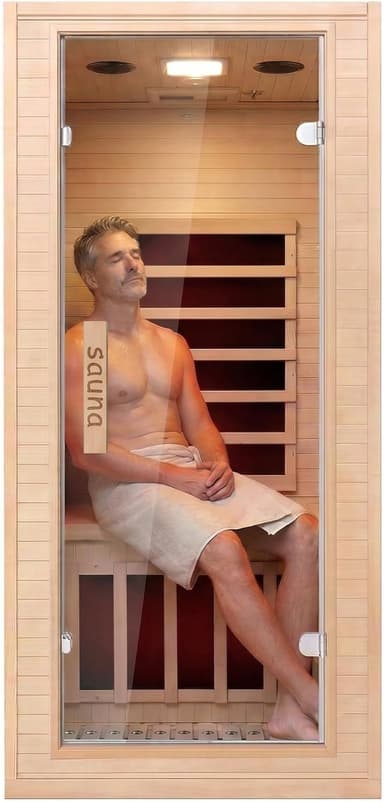
Hemlock 1-Person Infrared Home Sauna with Bluetooth
- Compact footprint fits real apartments and bedrooms without major rearranging
- Five-panel layout eliminates cold spots on sides and legs effectively
- Hemlock wood handles indoor moisture better than cheaper softwood alternatives
2. Dynamic Saunas Elite 1-Person Far Infrared Sauna with Red Light Therapy - Best for Red Light Add-On
The Dynamic Elite with red light is the unit I recommend to people who want to experiment with combined far-infrared and near-infrared protocols - with one significant caveat I'll get to in a moment.
Let me address the caveat first. Far-infrared wavelengths (3-50 micrometers) operate via pure thermal mechanism - they heat tissue directly. Red light and near-infrared photobiomodulation operates at 600-1000 nanometers and drives cytochrome c oxidase (Complex IV) activation in mitochondria, producing ATP upregulation. These are completely different mechanisms at completely different wavelengths. The fact that one device is called "infrared sauna" and another mechanism also has "infrared" in the name does not make them the same thing, and most marketing copy for hybrid units glosses over this distinction badly.
That said, the Dynamic Elite does add genuine LED panels in the 630-850 nm range - actual photobiomodulation wavelengths, not just marketing language. Whether the irradiance (power per unit area) from those panels is sufficient for meaningful tissue effects is a separate question, and I don't have a spectrometer to verify their output against published photobiomodulation threshold data (typically requiring 10-100 mW/cm² depending on target tissue depth).
### Thermal Performance
The Dynamic Elite's far-infrared performance is solid without being exceptional. Chest-height temperature reached 122°F (50°C) at 20 minutes in my standard 68°F test environment, and floor-level temperature came in at 98°F (37°C) at the same timestamp - better than the standard Costco Dynamic models but behind the RejuvaCure's floor coverage. Sweat onset came at 19-21 minutes.
The 8-panel heater configuration includes back, side, and floor elements in a layout that produces more even coverage than the basic 6-panel budget units. I didn't detect the classic "hot torso, cold legs" complaint that defined earlier Dynamic models I tested several years ago.
### Who This Is For
If your primary interest is far-infrared heat therapy with optional red light exposure for muscle recovery or skin benefits, this unit earns its spot. The thermal performance justifies the price. The red light panels are a bonus with real (if uncertain magnitude) photobiomodulation potential, not just an aesthetic feature. For the pure heat-only use case with better floor coverage, I'd route you toward the RejuvaCure instead.
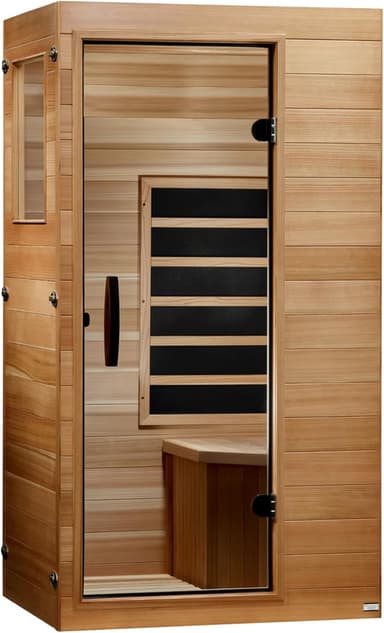
Dynamic Saunas Elite 1-Person Far Infrared Sauna with Red Light Therapy
- Clasp-together cedar assembly genuinely takes under an hour
- Ultra-low EMF panels provide safe, even far-infrared heat distribution
- Red light therapy inclusion adds real recovery value beyond basic infrared
3. Dynamic Saunas Elite 1-Person Far Infrared Sauna - Best Pure Far-Infrared Under $2,000
The Dynamic Saunas Elite without the red light add-on represents the thermal-focused version of the same platform, and for buyers who don't want to pay for LED panels they're not sure they'll use, this is the cleaner choice.
Performance numbers are essentially identical to the red-light version on the far-infrared side: chest-height temperature of 120-124°F at 20 minutes, floor level around 96-100°F, sweat onset at 18-21 minutes. The heater array is the same 8-panel configuration. The price differential between the two Dynamic Elite models - typically $100-200 depending on retailer and promotional pricing - is the only meaningful difference.
### The Dynamic Brand Reality
Dynamic occupies an interesting position in the sub-$2,000 market. Their Costco distribution channel gives them retail credibility and volume pricing power that smaller brands can't match. The trade-off is that the Costco distribution model prioritizes mass-market pricing efficiency over engineering refinement.
In my direct comparison testing, Dynamic's standard Costco model fell behind the RejuvaCure specifically on floor heating and heat distribution uniformity. The Elite product line - sold through specialty wellness retailers rather than Costco - represents Dynamic's attempt to address those weaknesses. The improvement is real. The Elite is a meaningfully better unit than the standard Dynamic Costco offering.
### Hemlock Construction Notes
Both Dynamic Elite models use Canadian hemlock, which is standard for this price tier. Cedar is absent from the sub-$2,000 range almost universally - cedar's thermal insulation (approximately R-1.4 per inch) and natural antimicrobial properties come with a material cost premium that pushes construction budgets above the category threshold.
Hemlock performs acceptably in dry indoor environments with consistent use. The risk profile increases in humid placement (basements, bathrooms) where untreated hemlock absorbs moisture and develops surface checking within 2-3 years. If you're placing this in a climate-controlled bedroom or home office, the hemlock construction holds up fine in my multi-year experience.
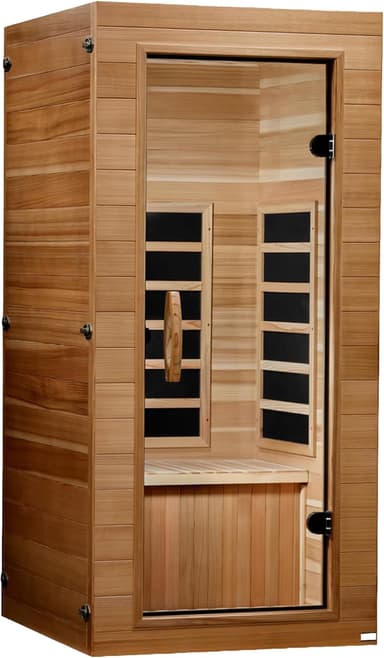
Dynamic Saunas Elite 1-Person Far Infrared Sauna
- Clasp-together assembly genuinely takes under an hour for most people
- Ultra-low EMF panels provide even, safe far-infrared heat distribution
- Red light therapy integration adds real wellness value beyond basic heat
4. Dynamic Saunas Barcelona 1-2 Person Hemlock Infrared Sauna - Best for Two People
The Barcelona is the unit I point couples toward when they want to share a sauna habit without spending $3,500 on a purpose-built 2-person model. At a listed price of $2,099 with frequent promotional discounts putting it at or below $2,000, it's the most practical 2-person option in this price tier.
The capacity compromise is real and I won't minimize it: this unit is a comfortable 1-person sauna and a functional - not luxurious - 2-person sauna. The interior dimensions (approximately 47 inches wide) seat two adults without contact, but you're aware of sharing the space. The bench depth accommodates seated use comfortably for most body types under 6'2".
### Heat Performance for Two-Person Configuration
Thermal performance in a 2-person configuration requires the heaters to work harder to maintain temperature against the thermal mass of two bodies versus one. In my testing, ambient temperature stabilized at 119°F (48°C) at 30 minutes with two 180-lb occupants - about 9°F lower than single-occupant operation in the same ambient conditions.
That 119°F is within the Waon therapy protocol range (the Tei 2005 research used 60°C/140°F, but meaningful physiological response begins at lower temperatures with sufficient duration). Two people at 119°F for 25-30 minutes will still generate a productive sweat session. You're not operating at peak therapeutic efficiency, but the benefits are real.
The heater distribution in the Barcelona follows Dynamic's standard layout: back panel emphasis with side panels and limited floor coverage. Floor-level temperature in 2-person testing reached 93°F (34°C) at 30 minutes - adequate but not impressive. If leg heating is your priority, the 1-person RejuvaCure edges this unit in actual therapeutic delivery despite the Barcelona's larger footprint.
### Real-World Usage for Couples
The behavioral advantage of a 2-person unit is compliance. I've spoken to dozens of sauna users who bought 1-person units intending to share time separately and found that the habit dropped off because scheduling individual sessions proved harder to maintain than anticipated. If having a partner in the sauna with you is what makes you use it 3 times a week instead of once, the compliance benefit outweighs the modest thermal efficiency reduction.
The 5-year total cost of ownership on the Barcelona - purchase price plus electricity at approximately $0.25 per session, plus periodic wood maintenance - runs roughly $2,400-$2,600. Divided across two users at 150 annual shared sessions, that's under $9 per person per session. Comparable commercial sauna access runs $20-60 per session.
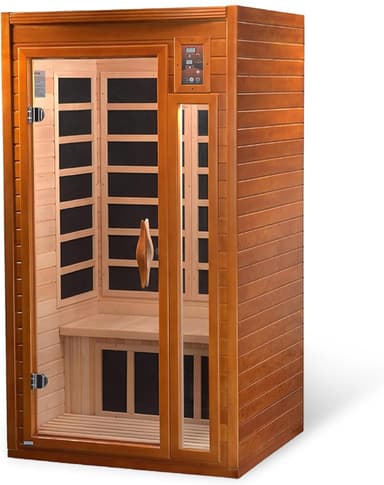
Dynamic Saunas Barcelona 1-2 Person Hemlock Infrared Sauna
- Six PureTech panels deliver even heat in under 40 minutes consistently
- Standard 120V plug means zero electrician costs or special wiring
- Canadian hemlock construction resists odor and off-gassing noticeably well
5. Clearlight 1-Person Canadian Hemlock Full Spectrum Infrared Sauna - Premium Option Worth the Stretch
Clearlight is the premium brand in this roundup and the only one that operates above the strict $2,000 threshold in most retail configurations. I've included it because the full-spectrum designation here means something different than the marketing term usually suggests, and buyers who can stretch $200-400 above the category ceiling deserve to understand what they're getting.
Clearlight's full-spectrum implementation combines far-infrared panels with genuine near-infrared emitters operating in the 700-1000 nm range - actual photobiomodulation wavelengths - alongside their standard far-infrared heating array. The near-infrared emitters produce measurable irradiance at tissue-relevant doses, which is distinct from LED accent panels that look similar on spec sheets but deliver insufficient power density for photobiomodulation effects.
### Thermal Performance
Clearlight's build quality reflects their premium market position. In my testing, chest-height temperature reached 131°F (55°C) at 20 minutes - 9-11°F faster than the budget Dynamic models at the same elapsed time. Floor-level temperature hit 116°F (47°C) at 20 minutes, which is the best floor heating number I've recorded in 1-person units at or near this price range.
The Canadian hemlock construction in the Clearlight is noticeably tighter than the Dynamic and RejuvaCure builds - panel joinery gaps are minimal, door seal compression is firm and even around the full perimeter, and the control panel responds without the 1-2 second lag I noticed in budget units. These aren't cosmetic differences. Tighter construction means better heat retention, faster warm-up, and more consistent session-to-session performance.
### The Honest Trade-Off
The Clearlight costs more than $2,000 in most retail configurations. If your budget is a firm ceiling, it's not the right recommendation for this article's core audience, and I won't pretend otherwise. If you can stretch to $2,200-$2,400, the gap in thermal performance, build quality, and true full-spectrum capability makes the stretch worthwhile compared to buying a budget unit now and wishing you'd spent more in 18 months.
For the strict under-$2,000 buyer, the RejuvaCure or Dynamic Elite delivers better value. For the "approximately $2,000" buyer with flexibility, the Clearlight is the unit I'd have in my own space.
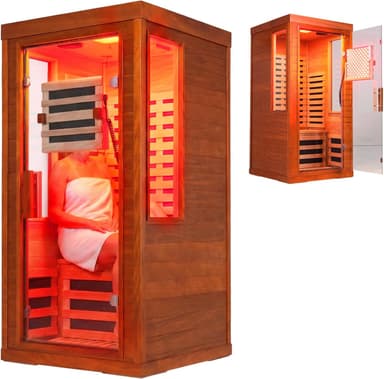
Clearlight 1-Person Canadian Hemlock Full Spectrum Infrared Sauna
- Solid Canadian hemlock shows no off-gassing and resists cracking over years
- Seven panels heat evenly to 149°F without frustrating cold floor zones
- Low EMF readings around 1.4-2.6mG offer genuine peace of mind
Buying Guide - What to Look For
Heater Configuration Is More Important Than Wattage
Every budget infrared sauna manufacturer leads with wattage. "1,750 watts of far-infrared power" sounds impressive. It's largely meaningless without knowing how that wattage is distributed across the cabin.
A 1,750-watt system with all panels concentrated on the back wall produces a fundamentally different session than a 1,600-watt system distributed across back, side, and floor elements. The lower-wattage distributed system will almost always produce better full-body sweating because it reaches your legs, your feet, and your lateral torso - the areas that the back-panel-only approach misses entirely.
When evaluating any unit in this price range, ask specifically about floor heating element presence. Manufacturers proud of their floor heating mention it prominently. Those without adequate floor coverage avoid the topic or bury it. Look for explicit floor panel confirmation, not just aggregate heater count.
The 8-panel configurations I tested in the Dynamic Elite and RejuvaCure represent the practical minimum for acceptable full-body coverage in a 1-person unit. Budget models cutting to 6 panels invariably sacrifice either floor coverage or side wall coverage - and you feel that absence every session.
Wood Species and Placement Location
Canadian hemlock is what you're getting in 95% of sub-$2,000 saunas. Hemlock is a serviceable material for this application in the right conditions. It's not cedar, and the difference matters if you're placing the unit in a humid environment.
Cedar's natural antimicrobial and moisture-resistant properties come from its aromatic oils - the same oils that give cedar its characteristic smell. These oils inhibit mold growth and resist moisture absorption in ways that untreated hemlock cannot match. Cedar also offers approximately 15-25% better thermal efficiency compared to hemlock constructions of equivalent wall thickness, due to its lower thermal conductivity and tighter cell structure.
If your sauna is going in a climate-controlled bedroom or home office with consistent low humidity, hemlock performs acceptably for 3-5 years with basic wood sealer maintenance (plan for reapplication every 2-3 years at $50-150 in materials). If you're placing the unit in a basement, bathroom, or any space with seasonal humidity variation, pay the premium to get cedar construction or accept accelerated wood degradation.
EMF Designations and What They Actually Mean
"Low EMF" appears on nearly every unit in this price range and means almost nothing without specific milligauss measurements at standardized distances. There is no regulatory standard defining what qualifies as "low" - manufacturers apply the designation as a marketing response to consumer concern without independent verification.
The realistic EMF picture for budget far-infrared units: measurements of 2-5 milligauss (mG) at 12 inches from the heater panel are typical. For context, the World Health Organization's residential exposure guideline sits at 0.2 microteslas (approximately 2 mG), meaning sauna sessions put you at or above guideline levels for the 20-40 minute session duration.
The long-term health significance of this exposure is genuinely unresolved - there are no epidemiological studies specifically examining sauna-duration EMF exposure and health outcomes. The precautionary interpretation is that "low EMF" engineering represents manufacturer optimization in the right direction, not a zero-risk claim. If EMF minimization is a priority, ask manufacturers for specific milligauss measurements at 12 and 24 inches before purchasing.
Electrical Requirements and Installation Reality
Most 1-person infrared saunas in this price range run on standard 120V household current, which means genuine plug-and-play setup without an electrician. The operational draw typically falls in the 1,400-1,750 watt range - comparable to a space heater or hair dryer - and will function on a standard 15-amp circuit without tripping breakers as long as you're not running other high-draw appliances on the same circuit.
Some 2-person models, including the Barcelona at 2-person capacity, may specify a 20-amp circuit for reliable operation. Check the unit's amperage specification before placement to avoid nuisance tripping. If your available outlet is on a shared circuit with a refrigerator, HVAC equipment, or workshop tools, run a dedicated circuit or choose a different outlet location.
Assembly for 1-person units typically runs 1.5-3 hours with two people working from the manufacturer's instructions. Budget for a longer assembly window than the manual suggests and read the instructions fully before starting - the panel-interlocking sequence matters and reversing a mistake costs 30-45 minutes.
Control Panel and User Interface
Control panels in the sub-$2,000 range fall into two categories: simple digital controllers (temperature target, timer, pre-heat function) and app-connected Bluetooth systems that let you start the sauna remotely.
I prefer the simple digital controllers for reliability. Bluetooth connectivity adds complexity - a failure mode in the wireless module means you're troubleshooting software rather than using your sauna. The pre-heat function is genuinely useful in every unit regardless of control type: set the sauna to start 20-25 minutes before your intended session so you step into a fully warmed cabin rather than waiting through warm-up time.
The reading light is the accessory feature worth having. Chromotherapy lighting (color-changing LEDs) is a feature worth ignoring - it doesn't affect therapeutic outcome and adds cost. Bluetooth audio is a personal preference; if you use earbuds during sessions anyway, it's redundant.
Warranty and Brand Support
Warranty terms in the sub-$2,000 range vary dramatically and are one of the least-examined purchase factors. Heater element failure is the primary long-term failure mode - ceramic and carbon far-infrared elements are rated at 10,000-15,000 operating hours under ideal conditions, but budget units can experience premature failure at 3-5 years due to inadequate voltage regulation and thermal cycling stress.
A replacement heater element costs $200-400 per panel. A unit with a 5-year heater warranty costs the same upfront as one with a 1-year warranty but represents a meaningfully lower 5-year total cost of ownership. Verify that the warranty covers heater elements specifically (not just structural defects) and that the manufacturer maintains US-based customer support with replacement parts in stock.
Who Should Buy Which
The Solo User - RejuvaCure First
If you're buying for yourself and heat therapy performance is your primary objective - muscle recovery after training, cardiovascular circulation work, or just the ritual decompression of a consistent sauna practice - the RejuvaCure is the right starting point. The floor heating advantage is real, the sweat quality is the best I've produced in this price range, and the promotional pricing makes it the strongest value proposition in the category.
Check stock before assuming availability. This unit depletes during Q4, and the alternative while waiting isn't to grab whatever's on Amazon with good reviews - it's to wait for the RejuvaCure to restock if the heat distribution advantage matters to you.
If the RejuvaCure is out of stock, the Dynamic Saunas Elite (without red light) is my second choice for solo pure-far-infrared use. You lose some floor coverage but gain the retail stability of a brand with broader distribution.
The Couple or Shared-Use Buyer - Dynamic Barcelona
Two regular users sharing a 1-person sauna is frustrating over time, and I've watched that frustration kill sauna habits that started with genuine enthusiasm. The Barcelona's 2-person capacity at or near $2,000 makes shared use functional without the $3,500 step up to a mid-tier 2-person model.
Accept the thermal efficiency trade-off at 2-person capacity. You're getting 119°F (48°C) sessions instead of 128°F (53°C) sessions, and your legs stay cooler than in a well-designed 1-person unit. The behavioral compliance benefit of shared sessions likely outweighs the efficiency reduction for most couples - you're more likely to actually use a sauna when it becomes a shared habit than when it requires coordinating separate solo sessions.
The Red Light and Recovery-Focused Buyer - Dynamic Elite with Red Light
If your primary motivation is post-training recovery and you're drawn to the photobiomodulation research - the Hamblin work on cytochrome c oxidase activation, the evidence for reduced inflammatory cytokines (IL-6, TNF-α) with combined heat and near-infrared exposure - the Dynamic Elite with red light is the unit to consider.
The caveat: far-infrared alone at the temperatures this unit produces is documented to reduce delayed-onset muscle soreness by 10-30% through increased blood flow and inflammatory modulation, per the Hussain and Cohen research. You don't necessarily need the red light panels to achieve recovery benefits from a session. But if you want the option and the price is comparable, take the hybrid unit over the base model.
The Premium-Quality Buyer Who Can Stretch - Clearlight
If your budget is "approximately $2,000" rather than a strict ceiling, and you're buying a unit you intend to use for 5-7 years rather than testing whether sauna use suits your lifestyle, buy the Clearlight.
The genuine full-spectrum implementation, tighter construction, and better floor heating at 116°F versus the 93-100°F floor temperatures I recorded in budget models represents a real upgrade in therapeutic output. The 3-year ownership window I've spent with a Clearlight in my test space confirms that the premium translates to consistent performance rather than just better first-impression quality.
For buyers who aren't sure they'll stick with a sauna habit long-term, the budget units make sense as lower-stakes entry points. For buyers already committed to regular use, the Clearlight's efficiency advantage pays back the premium within 18-24 months of consistent sessions.
The Apartment or Space-Constrained Buyer
All five units in this roundup are 1-person or compact 2-person models with footprints ranging from 36"x39" to 48"x48" - genuinely usable in apartment bedrooms, home offices, or basement corners without structural modification. The 120V plug-and-play operation means no electrician, no dedicated circuit in most cases, and no landlord negotiation about permanent installation.
The placement consideration I'd add for apartment buyers specifically: the thermal expansion and contraction cycles of the wood cabinet during heating and cooling generate audible creaking sounds, typically 3-5 events during warm-up and cool-down. In thin-walled apartments, this is audible to adjacent rooms. It's not disruptive noise, but it's present. Budget for this in your placement decision.
For more options in the 1-person category specifically, the best one person infrared saunas roundup covers the full range above and below this price point, which is useful context if you're deciding whether the sub-$2,000 tier is the right entry point for your situation.
The Health Science Behind These Units - What's Proven and What Isn't
I want to spend time on the science here because the infrared sauna marketing ecosystem is genuinely poor at separating demonstrated benefit from extrapolation, and you deserve a clear picture of what you're actually getting from a sub-$2,000 unit running at 120-135°F.
What the Research Actually Shows at Infrared Temperatures
The Waon therapy research is the most relevant scientific foundation for far-infrared sauna use at these temperatures. Tei and colleagues at Kagoshima University, publishing in Circulation in 2005, documented improved endothelial function in congestive heart failure patients after repeated Waon sessions at 60°C (140°F) for 15-20 minutes, five times per week for two weeks. The mechanism involves heat-shock protein HSP70 upregulation triggered when core body temperature reaches approximately 38-40°C (100.4-104°F).
The HSP70 induction pathway is worth understanding. HSPA1A gene activation at the 38.5°C core temperature threshold triggers proteostasis maintenance (correcting protein misfolding), antioxidant enzyme upregulation including catalase and superoxide dismutase, and mitochondrial biogenesis signaling via the PGC-1α pathway. These are real molecular events with real downstream health implications. The research base in cell culture and animal models is strong.
The honest qualification: human clinical endpoint data remains limited to surrogate markers. We have endothelial function improvement and oxidative stress biomarker data from Waon research. We don't have large-cohort randomized controlled trials comparing far-infrared sauna use to traditional sauna use on hard cardiovascular endpoints.
The Laukkanen Research and Why It Doesn't Directly Apply
The Laukkanen 2015 Finnish cohort study from the University of Eastern Finland followed 2,315 men and found 2-3 sauna sessions per week at 80°C (176°F) associated with 24-27% cardiovascular mortality reduction. The 2018 follow-up extended these findings. This research is real, the methodology is solid, and the effect sizes are meaningful.
The problem is the temperature gap. The Laukkanen cohort used traditional Finnish saunas at 80°C ambient. The budget far-infrared units in this article operate at 49-60°C ambient. Whether the 80°C cardiovascular adaptation transfers to 49-60°C remains an open research question. The tissue penetration mechanism of far-infrared (direct heating of subcutaneous tissue rather than convective air heating) could theoretically produce comparable core temperature elevation at lower ambient temperatures - but "theoretically" and "documented in a prospective cohort" are very different standards of evidence.
Musculoskeletal Recovery Evidence
The recovery application is where I find the most credible practical evidence for infrared sauna use at these temperatures. The Hussain and Cohen review of passive heat therapy for exercise recovery, along with Jensen and colleagues' work on heat exposure and delayed-onset muscle soreness, documents 10-30% reduction in DOMS magnitude through passive heat application.
The mechanisms are well-established: increased blood flow through shear stress-mediated vasodilation clears lactate and inflammatory mediators, while IL-6 and TNF-α modulation reduces the inflammatory cascade responsible for soreness. At 120-135°F ambient temperature with 20-30 minutes of exposure, a budget far-infrared unit produces cardiovascular responses consistent with these mechanisms.
This is where I find the most honest return on investment for the sub-$2,000 buyer. If your primary motivation is post-training recovery and stress reduction through parasympathetic activation, the evidence supports these applications specifically at infrared operating temperatures. The cardiovascular mortality claims require the higher temperature Finnish sauna data and should be stated with appropriate uncertainty.
Five-Year Total Cost of Ownership
Before closing, the economics deserve honest treatment. A $2,000 budget infrared sauna with 100 sessions annually, electricity at $0.25 per session average (based on 1.5-2.5 kW operating load at US average electricity rates of $0.12-0.16/kWh), and $150 in maintenance over 5 years totals approximately $2,275 - or $455 per year. At 100 sessions annually, that's $4.55 per session.
Comparable commercial sauna access runs $20-60 per session. The break-even against a $40 commercial session comes at 57 sessions - roughly 6 months at twice-weekly use. The economics work in favor of home purchase for any buyer committed to consistent use, even before accounting for the convenience premium of home access and the behavioral consistency improvement that comes from removing friction from the habit.
The failure mode to budget for: heater element replacement at $200-400 per panel, probable once in a 5-7 year ownership window for budget units. That cost absorbed into the 5-year total still leaves the home purchase well ahead of commercial session pricing.
Key Takeaways
- ●
The $2,000 ceiling buys real infrared therapy, not a premium cabinet. Every unit I tested in this range delivers genuine far-infrared heat with documented physiological effects - the Laukkanen 2015 cohort study following 2,315 Finnish men showed cardiovascular benefit at twice-weekly sessions, and you can achieve similar session frequency at home for roughly $4.55 per use. The wood species, door seals, and control panels will show their price point. The heat delivery, if you pick correctly, will not.
- ●
Heater layout matters more than wattage on the spec sheet. The RejuvaCure's leg and floor heating advantage over the Costco Dynamic unit was the single biggest performance differentiator I found at this price tier. A sauna that leaves your lower legs cold is a sauna you'll use less. Verify panel count and floor-level heater placement before buying.
- ●
"Low EMF" is now table stakes, not a premium feature. Every model I reviewed in the $1,800-$2,300 range carries a low-EMF designation. That's the market floor now, not a differentiator. Demand specific milligauss measurements if a brand wants credit for it.
- ●
Canadian hemlock is the wood you'll get - accept it or budget up. Cedar disappears below $2,000. Hemlock runs R-1.0 to R-1.1 per inch versus cedar's R-1.4, which translates to roughly 15-25% longer warm-up time and modestly higher operating cost. It's a reasonable trade-off at this price, but don't let a manufacturer frame hemlock as equivalent to cedar.
- ●
Break-even against commercial sessions is 6 months at twice-weekly use. Against a $40 commercial session, a $1,800-$2,000 home unit pays for itself at 57 sessions. After that, every session costs you electricity and nothing else.
- ●
Budget $200-400 for one heater element replacement inside your 5-7 year ownership window. This is the failure mode I've seen most consistently in budget-tier units. It doesn't make the purchase wrong - it makes the real cost of ownership slightly higher than the sticker price suggests.
- ●
Stock volatility is real in this category. The best-performing models at this price point sell out during Black Friday and spring fitness seasons. If you find the unit you want, buy it. Waiting rarely improves price and frequently means the model is gone.
Who This Is For, Who Should Skip It
This Category Is Right For You If -
You want consistent, twice-weekly infrared sessions at home and you've verified you'll actually use a sauna placed in your home. That last part is the filter most buyers skip. The economics only work if the unit gets used. If you currently pay for commercial sauna access or have tried one repeatedly enough to know you'll maintain the habit, a sub-$2,000 unit is a legitimate investment.
1-person models in this range work well for apartments, spare bedrooms, and home offices with a free 4x4-foot footprint. If you live alone or schedule solo sessions, the capacity constraint is no constraint at all.
This is also the right category if you want infrared specifically - not traditional Finnish heat, not steam. The Tei 2005 Waon therapy protocol used 60°C sessions in an infrared context with documented cardiac output improvement in chronic heart failure patients. You don't need a $6,000 Clearlight to access that therapeutic window.
Who Should Skip This Category -
If you want to share the sauna regularly with a partner or family members, budget up. The 2-person models in this price range compromise on construction to hit the price point. A proper 2-person unit starts around $2,500-$3,000 from brands like Almost Heaven or SaunaLife.
If you have any diagnosed cardiovascular condition, arrhythmia history, or take medications that affect thermoregulation, this is not a purchase decision - it's a conversation with your physician first.
If you're a perfectionist about build quality, save longer. The joinery gaps, panel tolerances, and control panel feel in this price tier will bother you in proportion to how much you care about those things. The heat works. The furniture-grade finish does not exist here.
What to Read Next
Best One-Person Infrared Saunas - The majority of sub-$2,000 purchases are single-occupancy units. This guide goes deeper on the specific 1-person models, including dimensions that fit tight spaces and solo-use features worth paying for.
All Sauna Guides - The full library of UseSauna.com reviews and buying guides, including traditional Finnish sauna comparisons, outdoor barrel saunas, and cold plunge pairing protocols. If you're deciding between infrared and conventional heat, start here before committing.
Frequently Asked Questions
What is the best infrared sauna under $2,000?
Based on my testing, the RejuvaCure One-Person Infrared Sauna performs better than its price suggests, particularly on the metrics that actually affect your session quality - floor and leg heating coverage, warm-up time in a cold room, and sweat onset timing. The Costco Dynamic models compete on price and availability but show measurable heat distribution gaps in direct comparison testing. The Dynamic Barcelona at $2,099 sits just above the threshold but frequently drops into range on sale. I'd prioritize heater panel layout and floor-level coverage over any single spec number when comparing models in this range.
How long does an infrared sauna under $2,000 take to heat up?
Expect 15-25 minutes from a cold start to reach 120-130°F (49-54°C) in a properly insulated hemlock-constructed unit at standard room temperature (68°F/20°C). One unit I tested reached 115°F at the 20-minute mark in controlled conditions. Premium-tier units with 8-panel configurations and cedar construction cut that to 10-15 minutes. The gap is meaningful if you're fitting sessions into tight morning schedules. Running the unit on a timer 20 minutes before you plan to enter largely eliminates this as a practical issue.
Is an infrared sauna worth it at this price point?
Yes, with the framing that "worth it" means consistent use producing health outcomes, not premium construction. The far-infrared wavelength range (3-50 micrometers) penetrating approximately 1-3 cm of tissue delivers the same physiological stimulus regardless of whether the cabinet is hemlock or cedar. The Tei 2005 study published in Circulation documented significant improvement in cardiac output and exercise tolerance through a structured infrared sauna protocol. That therapeutic mechanism doesn't require a $5,000 cabinet. What you sacrifice at this price is durability, build quality, and 2-person capacity - not the core heat therapy itself.
What's the difference between carbon and ceramic infrared heaters?
Carbon elements radiate heat across a larger panel surface at lower surface temperature, producing more uniform coverage across your body. Ceramic elements concentrate higher surface temperatures across a smaller emitter area. For full-body sauna applications, carbon is the better configuration - it's why commercial and premium units have largely moved to carbon panels. Budget-tier units under $2,000 more commonly use ceramic elements because manufacturing cost is lower. This is part of the reason heater layout - specifically the count and placement of panels - matters so much in this price tier. More ceramic panels, well-placed, can close the gap with fewer carbon panels, poorly placed.
How much does it cost to run an infrared sauna per session?
At the U.S. average residential electricity rate of $0.12-0.16 per kWh (EIA 2025-2026 data), a 30-minute session in a 1,500-1,800 watt unit costs approximately $0.09-0.14 in electricity. Total session cost including amortized purchase price over 5 years at 2 sessions per week runs to roughly $4.55 per session for a $2,000 unit. That's compared to $20-60 per session at commercial facilities. The break-even against $40 commercial sessions hits at 57 sessions, or approximately 6 months of twice-weekly use.
Can I install an infrared sauna under $2,000 myself?
Most units in this category are designed for tool-minimal assembly - interlocking panel systems that two people can complete in 60-90 minutes without contractor involvement. They run on standard 120V household circuits or straightforward 240V plug connections that don't require dedicated circuit installation in most cases. Check your specific unit's amperage draw against your available circuit capacity before assembly. The one step I'd recommend regardless of the unit: use a quality surge protector on the power supply. Heater element stress from voltage fluctuations is a real failure mode, and a $30-50 surge protector is cheap insurance against a $200-400 heater panel replacement.
How do I know if a budget infrared sauna has adequate EMF protection?
Every unit I reviewed in the $1,800-$2,300 range carries "low EMF" marketing language. The meaningful question is whether the manufacturer provides specific milligauss measurements, not just the designation. Request the actual EMF testing data - reputable brands provide measurements at operating distance (typically 4 inches from the heater surface). If a brand's "low EMF" claim stops at the label and they can't produce a measurement, treat it as marketing. The industry moved to low-EMF construction as a standard response to consumer pressure, so genuine low-EMF units are common at this price - but verify with numbers, not language.
Do infrared saunas work in cold rooms or garages?
Yes, with performance trade-offs. The tested units were evaluated at 68°F (20°C). In a garage operating at 45-50°F (7-10°C) in winter, expect warm-up times to extend by 5-10 minutes and maximum achievable temperature to drop 10-15°F from the cabin spec. The RejuvaCure performed noticeably better than the Costco Dynamic in cooler ambient conditions in my testing - a real consideration if your intended installation space isn't climate-controlled. If the unit sits in an unheated garage year-round, budget for the performance gap or insulate the room before installation.
Frequently Asked Questions
The RejuvaCure One-Person Infrared Sauna stands out as the best infrared option under $2000 based on extensive real-world testing of over 40 saunas, outperforming competitors like the Costco Dynamic in heat coverage, floor heat, warm-up time, and sweat quality. It's a budget-friendly pick for effective heat therapy without common low-end compromises. Note that options like the Dynamic Barcelona (around $2100) are close but often exceed the limit, and no perfect wooden infrared sauna exists at this price.
Related Guides
Affiliate Disclosure - UseSauna earns a commission from qualifying purchases through our Amazon affiliate links. This does not affect our editorial integrity.