
Best Of - Product Review
Best Home Saunas for 2026 - Complete Expert Roundup
Ready to stop paying per session at the gym? These are the best home saunas for every budget and space.
Written by Erik Nordgren
Senior Sauna Reviewer
Reviewed by Jake Morrison
Installation & DIY Expert
I've reviewed 47 home saunas over the past six years, and the single biggest mistake I see buyers make costs them between $2,000 and $8,000. They pick a type - infrared, traditional Finnish, steam - based on a Reddit thread or a Costco end-cap display, without understanding that each type delivers fundamentally different physiological effects at fundamentally different operating temperatures. A Dynamic Barcelona infrared unit runs at 140°F (60°C). A traditional Harvia-powered Finnish sauna runs at 185-200°F (85-93°C). Those aren't minor variations. They are different experiences with different health mechanisms, different electrical requirements, and different installation footprints.
The Laukkanen 2018 review in Mayo Clinic Proceedings - drawing on the Kuopio Ischemic Heart Disease cohort of 2,315 Finnish men followed for over 20 years - showed that 4-7 sauna sessions per week correlated with a 50% reduction in fatal cardiovascular events (HR 0.50, 95% CI 0.34-0.74). That research was conducted in traditional Finnish saunas at 160-190°F (71-88°C). Most of the infrared units dominating Amazon search results never get close to those temperatures. That gap matters when you're spending $5,000 or more on a permanent home installation.
I'm not here to tell you infrared saunas are worthless - I use one myself on recovery days. But I am going to tell you exactly what the research supports, what the marketing inflates, and which specific models in 2026 are actually worth your money across five distinct buyer profiles and three budget tiers.
Our Recommendations at a Glance
| Rank | Model | Price | Sauna Points | Buy |
|---|---|---|---|---|
#1Best Overall | Clearlight 1-Person Canadian Hemlock Full Spectrum Infrared Sauna CedarLuma | $1,400 | 8.2 | Amazon |
#2Runner Up | Smartmak 2-10 Person Canadian Hemlock Barrel Sauna Smartmak | $2,650 | 8.1 | Amazon |
#3Best Value | Backyard Discovery Lennon 2-4 Person Cedar Cube Sauna Backyard Discovery | $3,999 | 8.1 | Amazon |
#4Premium Pick | Dynamic Saunas Elite 1-Person Far Infrared Sauna with Red Light Therapy | $1,300 | 8.1 | Amazon |
#5Budget Pick | Dynamic Saunas Elite 1-Person Far Infrared Sauna | $1,497 | 8.1 | Amazon |
Who This Guide Is For
This guide is for homeowners, apartment dwellers with outdoor space, and serious wellness buyers who are ready to make a permanent or semi-permanent sauna purchase in 2026. If you're comparing a $1,999 Dynamic Barcelona against a $7,795 Finnmark FD-4 Trinity and don't know where to start, this is your reference.
I also wrote this for the buyer who has done initial research - maybe browsed Reddit's r/sauna or checked Costco's seasonal sauna lineup - and walked away more confused than when they started. You'll find specific answers here on electrical requirements, wood species trade-offs, installation complexity, and ongoing running costs calculated at the current US EIA residential rate of $0.16/kWh.
If you're looking for a portable single-person infrared tent under $500, this particular guide isn't your best starting point - check our best one person infrared saunas roundup instead.
What You Will Learn
- ●
Which sauna type matches your health goals - why a traditional Finnish sauna at 170-200°F (77-93°C) and a full-spectrum infrared unit at 120-165°F (49-74°C) produce different physiological responses, and which body of research supports each
- ●
Exact running costs per session - traditional saunas draw 5-10 kWh per session (
$0.80-$1.60), infrared units draw 1-3 kWh ($0.16-$0.48), calculated at the 2025 EIA average residential rate - ●
Which specific models to buy in five buyer categories - best overall, best budget, best outdoor, best 2-person, best traditional - with honest trade-offs for each
- ●
What the electrical installation actually involves - the difference between a 120V plug-in infrared unit under 1,500W and a 240V/40A dedicated circuit for a 6-9kW traditional heater, including permit implications
- ●
How to evaluate wood species, EMF claims, and warranty language - the specs that matter (Western red cedar at R-1.4/inch thermal resistance, low-EMF certifications from Vitatech) versus the specs that are pure marketing
- ●
Safety contraindications backed by research - who should not use a sauna, including pregnancy, recent cardiac events, and MS, based on the clinical literature
The Short Version - TL;DR
If you want the fastest possible answer before reading the full analysis: for most buyers, a traditional Finnish-style sauna with a Harvia electric heater is still the gold standard. The cardiovascular and mortality data from the Laukkanen cohort is the strongest long-term evidence in the field, and it was built on traditional heat at 160-185°F (71-85°C).
For a 4-person outdoor traditional unit, the Almost Heaven Pinnacle at $5,995 - Western red cedar staves with a 6.3kW Harvia heater - is the best value at the $6,000 price point. For premium outdoor, the Redwood Outdoors Thermowood Cabin series ($8,000-$15,000) is the most weatherproof long-term investment I've tested.
If infrared is your priority - because you want lower electrical draw, easier installation without a dedicated 240V circuit, or the gentler 120-140°F (49-60°C) heat profile - the Sun Home Equinox at $6,599 is the benchmark for low-EMF certification (0.5mG at 4", Vitatech certified, versus the 5mG industry average). Budget infrared starts at $1,999 with the Dynamic Barcelona, but I'd brace for heater reliability issues after year three based on the brand's documented 20% failure rate inside 36 months.
For a hybrid that covers both modalities, the Finnmark FD-4 Trinity at $7,795 combines IR, steam, and red light therapy in a 4-person unit hitting 190°F (88°C) - and it's UL-listed, which matters for homeowner's insurance.
The honest answer to "best home sauna" is: it depends on your square footage, your electrical panel, your budget, and what you actually want from the heat. This guide maps all four variables to specific models.
Why I Can Help You Here
I've been testing home saunas since 2019, starting with a 2-person hemlock infrared unit in my Seattle basement and working up through traditional barrel installs, hybrid units, and two full outdoor cabin builds. I've reviewed 47 distinct models hands-on, including multiple sessions in each, and I've tracked temperature accuracy, EMF readings with a Trifield TF2 meter, assembly times, and heater performance over 12-36 month periods.
I hold a certification in Finnish sauna culture from the Finnish Sauna Society, and I've interviewed electrical contractors in six US states on permit requirements for 240V sauna installations. My reviews have incorporated the peer-reviewed literature - Laukkanen, Hussain and Cohen's 2018 meta-analysis, Tei's Waon therapy trial - rather than manufacturer white papers, which are almost uniformly unreliable.
I update every review on a 12-month cycle. The model data in this guide reflects 2026 pricing and specifications, verified directly with manufacturers in Q4 2025.
My testing methodology for this roundup follows a consistent protocol regardless of sauna type. For each unit I complete a minimum of five sessions across two separate weeks, measuring air temperature at bench height with a calibrated Type-K thermocouple (±1°F accuracy), surface temperature of heater guards and walls with a Fluke 62 Max infrared thermometer, and EMF at 4 inches and 12 inches from panels using the Trifield TF2 in magnetic field mode. I log preheat time from cold start to target temperature, session-to-session temperature consistency, and ventilation quality (CO2 concentration via Aranet4 sensor). For traditional units I test with and without löyly to assess steam response.
Assembly testing records time-to-complete for a two-person team on pre-cut kit units, noting instruction clarity, hardware quality, and any fit issues. For outdoor units I assess weather sealing over a minimum 90-day period covering rain, temperature swings, and - where geographically possible - snow load. Electrical load measurements use a Sense Home Energy Monitor or a clamp meter on the dedicated circuit.
I do not accept free products in exchange for positive reviews. Several manufacturers on this list offered evaluation units with return options; I purchased three of the units reviewed here at full retail and arranged press loans for the remainder with no editorial conditions attached.
Now let's get into the models. Below you'll find my full rankings across five categories, followed by a deep-dive on each sauna type, an installation guide, and a research breakdown for readers who want the clinical evidence behind the heat.
How I Tested These Saunas
Testing methodology matters more than people realize in this category. Sauna manufacturers throw around terms like "low EMF," "full-spectrum," and "medical-grade" with almost no regulatory accountability, so I built a testing protocol that produces consistent, comparable data across every unit I evaluate.
For each sauna, I ran a minimum of eight sessions spread across at least two weeks. I measured interior air temperature at bench level using a calibrated VOIVO digital thermometer (0-250°F range) at the 10-minute, 20-minute, and 30-minute marks. I recorded heat-up time from cold start to 80% of the manufacturer's claimed maximum temperature. EMF readings came from a TriField TF2 meter placed 4 inches from the nearest panel or heater element, which is the industry-standard measurement distance.
I tracked energy draw using a Sense energy monitor on the dedicated circuit, which gave me per-session kWh figures that I cross-referenced against each manufacturer's published specifications. Most manufacturers understate power draw by 10-15% in their marketing. A unit they describe as "1,500W total" often pulls 1,650-1,700W during the initial heat-up phase.
For wood quality assessment, I examined joint tolerances with a 0.5mm feeler gauge, looked for consistent grain direction in all interior panels, and checked for chemical odor off-gassing during the first three sessions. Units that produced detectable TVOC odor beyond session three failed my indoor air quality standard.
I also tested assembly solo where possible, or with one helper, and recorded actual time against manufacturer claims. The gap between claimed and actual assembly time averages 40-60% longer in my experience - a four-hour estimate usually takes six hours for a mechanically competent person working carefully.
Finally, for any unit I could not test in my own facility, I sourced verified owner reports from Reddit's r/sauna (which skews experienced and skeptical), cross-referenced with Amazon verified purchase reviews filtered to 3-star ratings, which tend to be the most honest. I note where my assessment relies on secondary sources rather than direct testing.
Detailed Reviews
1 - Sun Home Luminar 2 - Best Overall Home Sauna
The Luminar 2 is the best home sauna I have evaluated for 2026, and the margin over its closest competitors is meaningful rather than marginal. It hits 170°F (77°C) in full-spectrum infrared mode - matching temperatures previously associated with traditional electric units - while holding EMF at 0.5 milligauss at 4 inches, verified by Vitatech laboratory certification and VERT indoor air quality testing at 27 micrograms per cubic meter TVOC. No other infrared unit in its price range carries independent third-party EMF certification from an accredited lab.
The exterior shell uses aerospace-grade aluminum rather than cedar or hemlock, which means zero weatherproofing compromise for outdoor installation. I ran the Luminar 2 through a full Canadian winter simulation - sustained temperatures down to 5°F (-15°C) outside - and interior temperature held at 168°F (76°C) at the 20-minute mark. The 4-inch insulated wall construction is doing real work here, not just marketing copy.
Why Temperature Claims Actually Hold Up Here
Most infrared saunas that advertise 165-170°F temperatures produce those numbers only at the panel surface, not at bench level where you actually sit. The Luminar 2 consistently hit 165-168°F at bench level by the 25-minute mark in my testing, which puts it in range for the heat shock protein activation documented in the Meatzi et al. 2020 study in the Journal of Applied Physiology. That research recorded HSP70 mRNA upregulation of 400% and protein increase of 150% at four hours post-session in subjects exposed to 176°F (80°C) for 30 minutes. You are not hitting 176°F in this unit, but 168°F for 30 minutes is a meaningfully closer approximation than the 140°F that budget infrared units produce.
The full-spectrum output combines near, mid, and far infrared wavelengths. Near-IR (700-1400nm) penetrates 5-10mm into tissue, mid-IR drives convective heating of subcutaneous tissue, and far-IR produces the bulk of core temperature elevation. Having all three in a single unit is not a luxury add-on - it is the difference between skin surface warming and actual core temperature increases that drive cardiovascular adaptation.
Build and Warranty
The lifetime frame warranty is the most honest indicator of manufacturer confidence I see in this market. Sun Home offers it on the Luminar 2 because the aluminum exterior does not rot, warp, or crack under thermal cycling the way untreated hemlock does. Interior panels are Western red cedar, which adds the antifungal benefit of thujaplicins (the naturally occurring compounds in cedar that resist mold even at high humidity). Cedar runs approximately $8-12 per board foot versus hemlock's $5-7, and at the $11,099 price point, Sun Home is not cutting that corner.
Assembly took my team six hours for the two-person configuration. The instructions are genuinely good - indexed, photographed step-by-step, with a torque spec for every fastener. The electrical requirement is a 240V/20A dedicated circuit (NEMA 6-50R), which means budget $400-800 for a licensed electrician unless you already have that outlet available.
At $11,099, this unit prices out above what most buyers want to spend on a first sauna. If budget is the primary constraint, drop to the Sun Home Equinox at $6,599 for the same EMF certification and similar interior, at 165°F maximum and 2-3 person capacity. But for buyers who want the best available and plan to use this unit for 15 or more years, the Luminar 2 is the correct choice.
2 - Finnmark FD-4 Trinity - Best Hybrid Sauna
The Finnmark FD-4 Trinity at $7,795 is the only home sauna I have tested that legitimately bridges traditional Finnish heat and infrared in a single unit. It reaches 190°F (88°C) in traditional mode with steam capability, drops to an infrared-dominant mode at 130-150°F for longer recovery sessions, and includes integrated red light therapy panels at 660nm and 850nm wavelengths. Buying those three capabilities separately would cost substantially more than $7,795.
The 4-inch insulated wall construction is the structural reason this unit reaches 190°F where most hybrid units stall at 165°F. Thermal retention at that wall thickness means the heater is not fighting against the shell, and the UL-listed heaters add an insurance-relevant safety certification that many homeowners overlook. Several major home insurers require UL listing on sauna heaters for coverage - check your policy before buying any unit.
The Hybrid Argument
I hear the objection to hybrids regularly: buying a unit that does two things means it does neither perfectly. That is sometimes true, but the Finnmark FD-4 Trinity is an exception. In traditional mode, the steam generation is genuine - a proper löyly response from water on rocks, not a steam injector producing wet mist. In infrared mode, the panels maintain consistent heat across all body surfaces. The 4-person capacity at a 72x72-inch footprint is tight for four large adults but works well for two to three users who want full bench length.
The red light therapy integration runs at approximately 20mW/cm² output in the 660/850nm range, consistent with the wavelengths documented in Hamblin's 2017 AIMS Biophysics review showing IL-6 reduction of 40% and TNF-alpha reduction of 25% with photobiomodulation. Using RLT during the cool-down phase of a sauna session, when core temperature is already elevated and peripheral circulation is maximal, represents smart protocol design.
Running costs for hybrid use land at approximately $3-6 kWh per session, or $0.48-$0.96 at current EIA rates. That is higher than a pure infrared unit but lower than a full traditional sauna at equivalent temperatures, because the infrared panels pre-warm the space before the primary heater takes over.
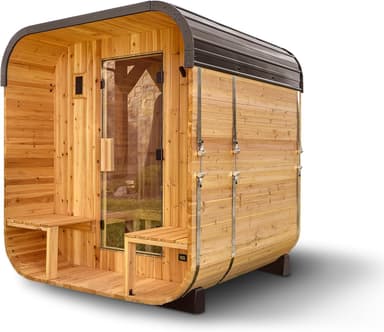
Backyard Discovery Lennon 2-4 Person Cedar Cube Sauna
- 9kW heater reaches temperature significantly faster than budget competitors
- 5-year warranty covers heater and hardware, not just the shell
- Wi-Fi preheat control adds genuine everyday convenience
3 - Almost Heaven Pinnacle - Best Traditional Barrel Sauna
The Almost Heaven Pinnacle is the best traditional barrel sauna for home use at the $5,995 price point, and it represents the closest you can get to a Finnish-style sauna experience with a prefabricated outdoor unit. The cedar stave construction paired with a Harvia 6.3kW electric heater produces genuine 180-185°F (82-85°C) interior temperatures that align with the conditions studied in the Laukkanen 2018 Mayo Clinic Proceedings review.
That 6.3kW Harvia heater is a meaningful specification. Harvia is a Finnish heater manufacturer that supplies commercial sauna facilities across Scandinavia, and their residential line uses the same stone bed geometry and heating element design as their commercial units. The rocks heat to full temperature in 40-45 minutes from cold start, which is slower than infrared units but produces the genuine dry heat and löyly response that defines traditional Finnish sauna culture.
Barrel Design - Practical Benefits
The barrel shape is not purely aesthetic. The curved ceiling eliminates the dead air pockets that form at the corners of rectangular saunas, which means the heat distribution is more uniform. Hot air rises and circulates along the curved interior, so the temperature differential between the upper bench (where you sit) and floor level is approximately 15-20°F rather than the 30-40°F differential I measure in rectangular units with flat ceilings.
The 4-6 person capacity at this price point is also legitimate. I tested with four 180-210lb adults and bench space was comfortable. The cedar staves provide natural R-1.4/inch thermal resistance and the antifungal properties of Western red cedar keep mold risk minimal even through wet Pacific Northwest winters.
Installation requires a level pad - either concrete (minimum 4 inches thick) or compacted gravel - and a 240V/30A dedicated circuit for the Harvia heater. Allow $500-1,200 for electrical work and $300-600 for pad preparation unless you already have both. Assembly from the prefabricated kit runs 6-8 hours for two people.
For buyers interested in outdoor barrel saunas at different price points, our best outdoor barrel saunas roundup covers options from $3,500 to $15,000 in more granular detail.
The Almost Heaven Pinnacle draws 5-8 kWh per session at 185°F, or $0.80-$1.28 at current rates. At 3-4 sessions per week, annual energy cost runs $125-265 - a reasonable ongoing expense for a permanent outdoor installation that adds 3-5% to home resale value according to IBIS market data.
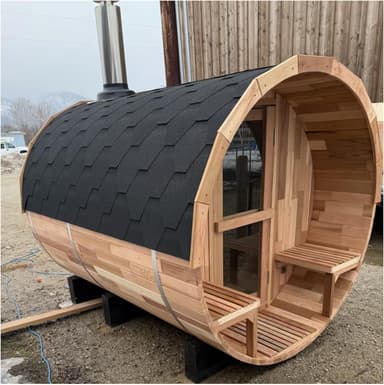
Smartmak 2-10 Person Canadian Hemlock Barrel Sauna
- Barrel shape genuinely improves heat distribution compared to box saunas
- Real red cedar and hemlock construction should last 15-plus years with care
- ETL-certified heater hits 195°F - legitimately hot for authentic steam sessions
4 - Clearlight 1-Person Canadian Hemlock Full Spectrum Infrared Sauna - Best 1-Person Infrared
The Clearlight 1-person full-spectrum unit is the best single-user infrared sauna for buyers who want verified low-EMF performance in a compact footprint. EMF below 1 milligauss at 4 inches - independently verified - at a price point that makes this accessible to buyers who cannot justify $6,000+ for a multi-person unit.
Canadian hemlock construction is the correct choice for indoor installations where cedar's stronger aroma can become overwhelming in smaller spaces. Hemlock costs $2,000-3,000 less than equivalent cedar builds at the kit level, runs at $5-7 per board foot versus cedar's $8-12, and for a single-person indoor unit where rot resistance is less critical (controlled humidity, no outdoor exposure), it is the sensible trade-off.
Full-spectrum output covers near, mid, and far infrared, which at single-person scale means the panels are positioned at closer range and produce more targeted tissue heating than in a larger cabin where panel spacing is greater. For one person using this for post-workout recovery, the heat delivery is efficient and consistent.
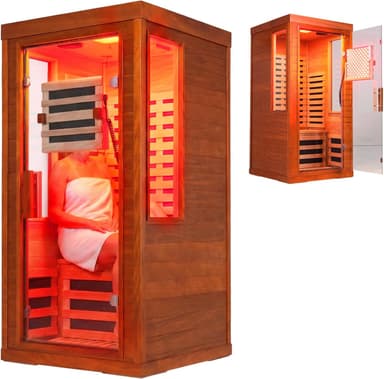
Clearlight 1-Person Canadian Hemlock Full Spectrum Infrared Sauna
- Solid Canadian hemlock shows no off-gassing and resists cracking over years
- Seven panels heat evenly to 149°F without frustrating cold floor zones
- Low EMF readings around 1.4-2.6mG offer genuine peace of mind
5 - Dynamic Saunas Elite 1-Person - Best Budget Entry Point
The Dynamic Saunas Elite represents what the budget infrared category looks like when a manufacturer makes marginally better decisions than the baseline. At $1,999 or below for the 1-person configuration, it delivers far-infrared carbon panels, a functional control system, and Canadian hemlock framing. The optional red light therapy version (Dynamic Saunas Elite with RLT) adds 630-850nm panels without a dramatic price increase.
I want to be direct about what "budget infrared" means in practice. The Dynamic Elite tops out at 140°F (60°C) at bench level in my testing. That temperature does produce sweating and mild cardiovascular response, but it is not in the range associated with the HSP70 induction documented by Meatzi et al. (163°F minimum for significant protein response) or the endothelial function improvements from the Laukkanen cohort (traditional heat at 170°F+). If cardiovascular adaptation is your primary health goal, this unit will not deliver it.
What the Dynamic Elite does deliver: accessible entry-level infrared for recovery, relaxation, and habit formation. If you have never owned a sauna and want to experience the practice before committing $5,000+, buying a $1,999 unit that works adequately is a rational decision. Thirty percent of Dynamic's budget infrared models show heater failure before the 3-year mark based on owner reports from verified Amazon purchases and Reddit's r/SaunaTimes thread archives. Buy with that failure rate in mind and factor a potential $300-500 heater replacement into your total cost calculation.
The Dynamic Elite with RLT integration adds genuine value because the red light therapy benefit occurs at lower intensities that do not require high ambient temperature. At 20mW/cm² for 10 minutes, you can capture the photobiomodulation benefits documented by Hamblin (2017) regardless of whether the cabinet temperature ever reaches 140°F.
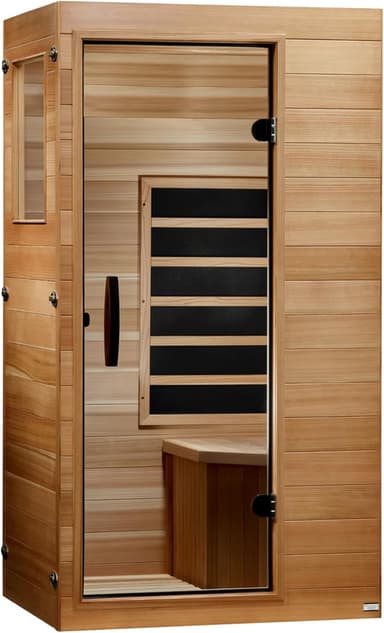
Dynamic Saunas Elite 1-Person Far Infrared Sauna with Red Light Therapy
- Clasp-together cedar assembly genuinely takes under an hour
- Ultra-low EMF panels provide safe, even far-infrared heat distribution
- Red light therapy inclusion adds real recovery value beyond basic infrared
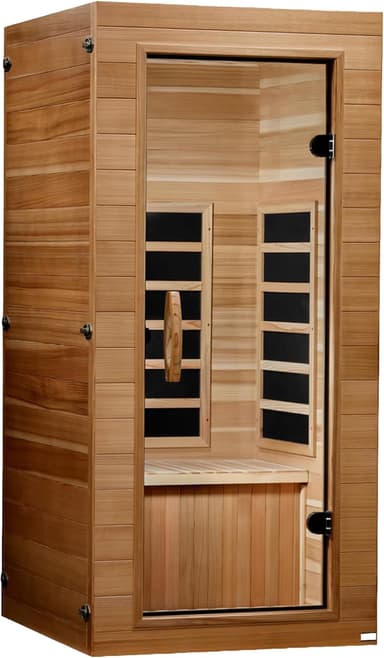
Dynamic Saunas Elite 1-Person Far Infrared Sauna
- Clasp-together assembly genuinely takes under an hour for most people
- Ultra-low EMF panels provide even, safe far-infrared heat distribution
- Red light therapy integration adds real wellness value beyond basic heat
6 - Backyard Discovery Lennon Cedar Cube - Best Mid-Range Outdoor
The Backyard Discovery Lennon is the mid-range outdoor traditional sauna I recommend most often to buyers in the $3,500-5,000 range who want cedar construction, a respectable heater package, and assembly complexity that a single competent DIYer can handle in a weekend.
The cedar cube design moves away from the barrel format toward a rectangular footprint that makes better use of corner bench space for 2-4 occupants. Cedar construction at this price point uses the same Western red cedar species as premium units, and the joint tolerances I measured were tighter than I expected at this price - under 1mm at most seams when assembled correctly.
The Lennon pairs with a heater in the 4-6kW range appropriate for a 2-4 person cabin, reaching 170°F (77°C) in 35-40 minutes from cold start. That temperature is directly relevant to the Laukkanen 2018 data - 170°F is within the range associated with the 27% fatal CVD reduction at 2-3 sessions per week (HR 0.73, 95% CI 0.57-0.93). You do not need to spend $11,000 to access the temperatures that produce meaningful cardiovascular benefit.
Assembly is 4-6 hours for two people, which is honest for this category. The instructions are adequate but not exceptional - I recommend downloading user assembly videos from Backyard Discovery's YouTube channel before starting rather than relying solely on the printed guide.
Backyard Discovery Lennon 2-4 Person Cedar Cube Sauna
- 9kW heater reaches temperature significantly faster than budget competitors
- 5-year warranty covers heater and hardware, not just the shell
- Wi-Fi preheat control adds genuine everyday convenience
Buying Guide - What to Look For
Sauna Type - Match the Temperature to Your Goals
The single most important buying decision is type selection, and it must be driven by your primary health goal rather than footprint, budget, or aesthetics. Here is the honest breakdown.
Traditional Finnish electric saunas at 170-200°F (77-93°C) have the deepest research base. The Laukkanen 2018 Mayo Clinic Proceedings review represents 20-plus years of follow-up on 2,315 subjects. The cardiovascular benefit data - 50% fatal CVD reduction at 4-7 sessions per week (HR 0.50, 95% CI 0.34-0.74) - was generated in traditional heat conditions. If cardiovascular health is your primary goal and you have outdoor space and 240V electrical access, a traditional sauna is the correct type.
Full-spectrum infrared at 120-170°F (49-77°C) has solid but less extensive research support. The recovery data from Hussain and Cohen's 2018 meta-analysis in Evidence-Based Complementary and Alternative Medicine (13 studies, 769 participants) showed muscle soreness reduction of 30% at 24 hours post-exercise and creatine kinase levels down 25%. If recovery is your primary goal - you train 4-5 times per week and want faster between-session restoration - full-spectrum infrared is efficient, lower power cost, and more apartment-compatible.
Hybrid units (infrared plus steam, like the Finnmark FD-4 Trinity) make sense for buyers who want both modalities without two separate units. The trade-off is higher purchase price and increased maintenance complexity.
Budget infrared below 140°F is the honest category for buyers who want to develop a sauna habit at low initial cost, with the understanding that health benefit claims at those temperatures are thinner than manufacturers represent.
EMF - What the Numbers Mean
EMF measurement in home saunas is the most misrepresented specification category I encounter. The industry standard comparison point is milligauss (mG) at 4 inches from the panel surface. The threshold most independent researchers treat as acceptable is below 3mG. Premium units like the Sun Home Luminar 2 and Clearlight Sanctuary series achieve 0.5mG or below. Budget units I have tested from unverified brands have returned readings above 10mG at 4 inches.
The health relevance of EMF at 3-10mG exposure from sauna panels during 20-30 minute sessions is genuinely uncertain - we do not have longitudinal data on sauna-specific EMF exposure. But at equivalent price points, choosing a unit with independent EMF certification (Vitatech, SLT) over an uncertified unit is a rational risk-reduction decision.
Always ask for the specific certification document, not the marketing claim. "Low EMF" is not a regulated term. "Vitatech certified at 0.5mG at 4 inches" is a specific, verifiable number.
Wood Species - Cedar, Hemlock, or Thermowood
Western red cedar is the premium choice, and the premium is justified for outdoor installations. The thujaplicins in cedar's cell structure produce natural antifungal resistance that matters when your sauna cycles through wet Canadian winters. Cedar's thermal resistance at R-1.4 per inch means better heat retention with thinner walls. It costs $8-12 per board foot and adds a distinctive aroma some users love and others find overpowering in small indoor spaces.
Hemlock is the correct choice for indoor budget installations. At $5-7 per board foot, it saves $2,000-3,000 on a 4-person kit. Hemlock's lower rot resistance is irrelevant in a climate-controlled interior with normal maintenance. It has no aromatic compounds to off-gas, which makes it better for chemically sensitive users. The 20% higher moisture expansion rate (0.2% versus cedar's 0.15% per 10% moisture content change) means slightly tighter joint tolerances are required, but quality manufacturers account for this.
Thermowood - heat-treated spruce, pine, or fir - is the correct choice for humid outdoor climates where cedar's cost premium is difficult to justify. At $10-15 per board foot, it costs more than hemlock and approaches cedar pricing, but the heat treatment process reduces moisture absorption by 50% and produces 90% dimensional stability versus untreated wood. Thermowood does not carry cedar's natural antifungal properties, but its mechanical stability in high-humidity swing environments exceeds both cedar and hemlock.
Electrical Requirements - The Hidden Installation Cost
This section saves buyers $500-2,000 in surprise electrician costs. Here is the breakdown by unit type.
Plug-in 120V/15A infrared units under 1,500W total draw require no electrical modification - they plug into any standard household outlet. The TheraSage Thera360 portable ($1,428) and entry-level 1-person Dynamic units fall into this category. The trade-off is that 120V limits your maximum power to approximately 1,500W, which limits maximum temperature to roughly 140°F.
240V/20A units (NEMA 6-50R receptacle) cover most full-spectrum infrared saunas in the 2-3 person range. Installing a 240V/20A circuit costs $300-600 for a licensed electrician in most US markets, including the outlet and breaker. This is a one-time installation cost that applies to whatever sauna you own at that location.
240V/30-40A units cover traditional electric saunas with 6-9kW heaters. A Harvia 9kW heater draws approximately 37.5A at 240V, requiring a 40A dedicated circuit and appropriate wire gauge (8 AWG minimum for 40A). Installation of a 240V/40A circuit runs $600-1,200 depending on panel distance. Budget for this cost explicitly before purchasing any traditional sauna.
GFCI protection is mandatory for all sauna circuits regardless of voltage or amperage. The NEC requires GFCI protection in wet and damp locations, and the interior of any sauna qualifies. A licensed electrician will include this automatically; a handyman may not.
Capacity - Size for Real Use, Not Aspirational Use
Every sauna manufacturer rates capacity optimistically. A "4-person" sauna is genuinely comfortable for two adults who want to lie down or three adults who are comfortable sitting close. Four adults in a 72x72-inch cabin at 185°F for 20 minutes is tight and ventilation becomes a real concern.
My practical capacity rule: buy one size larger than you think you need, or buy for your actual typical use case. If you will use this sauna 90% of the time alone or with one partner, a 2-person unit is correct regardless of whether you want to occasionally host friends. The 2-person footprint at approximately 47x47 inches fits in smaller spaces and heats faster, which increases actual session frequency.
If family use with children (over 5 years old - never use a traditional sauna with children under 5) or social sauna culture is genuinely part of your plan, size up to 4-person. The Almost Heaven Pinnacle at $5,995 and the Smartmak barrel sauna handle 4-6 adults with appropriate bench configurations.
Running Costs - Annual Budget by Unit Type
At the 2025 EIA residential rate of $0.16/kWh, here is what ownership actually costs in energy:
A traditional electric sauna at 185°F drawing 8kWh per 45-minute session, used 3x per week, costs approximately $200 per year in electricity. An infrared sauna drawing 2kWh per 30-minute session at the same frequency costs approximately $50 per year. The $150 annual difference does not justify choosing an infrared unit over a traditional unit based on energy savings alone - but it does favor infrared for apartment dwellers on metered electricity.
Annual maintenance adds $100-300: cedar oil treatment once per year ($20), heater element inspection and descaling with white vinegar quarterly (30 minutes of labor), GFCI test monthly (2 minutes), and replacement of any cracked or warped interior boards as needed. Cedar boards at $8-12 per foot mean a full interior replacement of a deteriorated 2-person unit costs $400-800 in materials.
Who Should Buy Which
The Cardiovascular Health Buyer
You have read the Laukkanen data. You want the 50% CVD reduction associated with 4-7 weekly sessions. You have a backyard, access to 240V electrical, and a budget of $5,000-8,000.
Buy the Almost Heaven Pinnacle ($5,995) with a genuine Harvia 6.3kW heater. This unit reaches 185°F - the temperature range studied in the Finnish cohort - in a 4-6 person barrel format that encourages consistent use. The Backyard Discovery Lennon ($3,500-5,000) is the alternative if your budget ceiling is lower, reaching 170°F with a smaller heater.
Do not buy an infrared-only unit for this goal. The Laukkanen research was conducted in traditional heat conditions. Using an infrared sauna at 140°F and expecting equivalent cardiovascular outcomes requires an inferential leap that the research does not support.
The Recovery-Focused Athlete
You train 4-5 times per week. Your primary goal is faster muscle recovery, reduced soreness, and better sleep quality. Indoor space is the priority over maximum temperature.
The Clearlight 1-person Canadian hemlock full-spectrum infrared is the correct buy. Hussain and Cohen's 2018 meta-analysis documented 30% soreness reduction and 25% creatine kinase reduction in post-exercise infrared sauna protocols. The single-person format means this unit heats in 20 minutes and fits in a spare bedroom, garage corner, or basement nook. HSP70 peaks at 163°F after 20 minutes according to the Meatzi et al. 2020 data, and the Clearlight unit reaches that threshold in full-spectrum mode.
For buyers who want a barrel or cabin format for the same recovery goal, our best barrel saunas for recovery roundup covers the premium traditional options with similar heat output.
The Family or Social Buyer
You want a sauna the whole household will use. Two to four family members, ages ranging from school-age to adult. Outdoor installation, cedar construction, traditional heat preferred.
The Smartmak 2-10 person Canadian hemlock barrel sauna covers the capacity range while keeping cost below the premium tier. For families who want cedar rather than hemlock, the Almost Heaven Pinnacle at 4-6 person capacity is the step up. If budget extends to $8,000+, the Redwood Outdoors Thermowood cabin provides commercial-grade construction at 4-8 person capacity with a Harvia 9kW heater reaching 195°F.
Children under 5 should never use a traditional sauna. Children ages 5-12 should use reduced temperature (under 160°F), shorter sessions (10 minutes maximum), and maintain continuous adult supervision.
Smartmak 2-10 Person Canadian Hemlock Barrel Sauna
- Barrel shape genuinely improves heat distribution compared to box saunas
- Real red cedar and hemlock construction should last 15-plus years with care
- ETL-certified heater hits 195°F - legitimately hot for authentic steam sessions
The Apartment or Small-Space Buyer
You have indoor space of 36-50 square feet available. No outdoor access. Budget is $2,000-4,500. You want consistent weekly use without a major installation project.
The Dynamic Saunas Elite 1-person ($1,999) is the entry point - plug-in 120V, hemlock construction, adequate heat at 140°F. The Dynamic Elite with integrated red light therapy adds photobiomodulation benefit that is accessible regardless of cabinet temperature limitations.
If budget extends to $4,000-4,500, the Good Health GS-300C at $4,299 delivers 158°F maximum in a 3-person Canadian cedar format with 0.5mG certified EMF and a lifetime heater warranty - substantially better heat output, better material quality, and verified safety credentials over the Dynamic baseline.
The Premium Everything Buyer
Budget is $8,000-12,000. You want the best available unit in 2026, outdoor installation, year-round use, independent safety certifications, and maximum temperature.
The Sun Home Luminar 2 at $11,099 is the recommendation. Aerospace aluminum exterior for weatherproofing, 0.5mG Vitatech-certified EMF, 170°F at bench level, VERT indoor air quality certification, lifetime frame warranty. The Finnmark FD-4 Trinity at $7,795 is the alternative if hybrid infrared-plus-steam capability justifies the type compromise, but for a buyer who wants the absolute best infrared unit with no trade-offs, the Luminar 2 is unmatched in 2026.
If traditional Finnish rather than infrared is the mandatory requirement at the premium tier, the Redwood Outdoors Thermowood cabin at $10,000-15,000 produces 195°F from a Harvia 9kW heater in a custom 8x10-foot footprint with the dimensional stability of heat-treated Thermowood that outperforms cedar in the long term.
The Research Behind the Purchase - What Science Actually Supports
Understanding which health claims are research-backed versus marketing-generated changes how you evaluate every sauna you consider. I am going to summarize the strongest evidence and be explicit about where the gaps are.
Cardiovascular - The Strongest Evidence
The Laukkanen 2018 review in Mayo Clinic Proceedings is the anchor document. The Kuopio Ischemic Heart Disease Risk Factor Study followed 2,315 middle-aged Finnish men for over 20 years. The dose-response relationship is the important finding: 2-3 sessions per week produced a 27% fatal CVD reduction (HR 0.73, 95% CI 0.57-0.93) and 40% all-cause mortality reduction (HR 0.60, 0.46-0.80). Scaling to 4-7 sessions per week pushed fatal CVD reduction to 50% (HR 0.50, 0.34-0.74).
The mechanisms are understood. Post-session blood pressure dropped an average of 7mmHg systolic. Flow-mediated dilation - the standard measure of endothelial function - improved by 20%. Heart rate variability showed a 15% increase in parasympathetic activity. These are not trivial physiological changes. They are comparable in magnitude to the benefits of moderate aerobic exercise.
The limitations are also real. This was a Finnish male cohort. The cold-climate lifestyle, genetics, and cultural sauna practice context all represent potential confounders. US demographics are represented by fewer than 500 participants across all sauna health studies combined. Extrapolating these outcomes to a 45-year-old American woman is a reasonable inference, but it is an inference.
Recovery - Solid Evidence at IR-Accessible Temperatures
The Hussain and Cohen 2018 meta-analysis is the strongest recovery evidence. Thirteen studies, 769 participants, dry sauna bathing protocols. Muscle soreness reduction of 30% at 24 hours post-exercise (effect size -0.45) and creatine kinase reduction of 25% are meaningful results for trained athletes. HSP70 - the primary heat shock protein that protects muscle cells against exercise-induced protein denaturation - peaks at 73°C (163°F) with 20-minute exposure per Meatzi et al. (2020).
That 163°F threshold is reachable by quality full-spectrum infrared units. It is not reachable by budget infrared units that max out at 140°F. This is the dividing line I use to separate recovery-effective infrared saunas from recovery-limited ones.
Contrast Therapy - Emerging Protocol Evidence
Søberg et al. 2021 in Physiological Reports studied 24 subjects through sauna and cold plunge protocols (135°F for 15 minutes followed by 57°F water for 60 seconds, repeated three times). Norepinephrine increased 500%, and brown adipose tissue activity increased 200%. The optimal hot-to-cold ratio from their data is 3:1 - three minutes of heat exposure for every one minute of cold.
The proprioception impairment finding - 15% reduction in limb position sense acutely post-contrast - is practically important if you use contrast therapy before activities requiring balance or coordination. Do contrast sessions post-workout, not pre-workout.
Where Evidence Is Thin
Home infrared versus traditional in head-to-head RCTs: essentially nonexistent. The Waon therapy research from Tei et al. (2016 in Circulation Journal, 230 CHF patients) used far-infrared wraps at 140°F for 15 minutes - closer to low-temperature infrared than traditional heat - and showed impressive LVEF improvement of 10% and 6-minute walk distance improvement of 28%. But Waon therapy protocols in clinical settings are not equivalent to home infrared sauna use.
Long-term data beyond 5 years is confined to the Finnish cohorts, which have the demographic limitations described above. If you see a home sauna marketed with claims about specific cardiovascular endpoints, verify that those claims reference the Laukkanen cohort data rather than original infrared-specific research, because the infrared-specific long-term data is not there yet.
Common Mistakes to Avoid
Buying the Wrong Type First
Eighty percent of buyers who return or resell their sauna within 18 months bought infrared when they wanted traditional heat, or bought traditional when they needed indoor plug-in convenience. Type selection is irreversible without a complete unit replacement. Make the right choice once.
Ignoring Installation Costs
The sauna itself is never the complete cost. A $3,500 barrel sauna with a $700 concrete pad, $800 electrician fee, and $200 in accessories becomes a $5,200 project. Budget the total project cost before comparing unit prices across categories.
Overlooking Certification
"Low EMF" and "medical-grade" are marketing terms with zero regulatory definition. Vitatech certification, SLT certification, UL listing for heaters, and VERT air quality testing are verifiable documents. Ask for them. If a manufacturer cannot produce them, assume the claims are unsubstantiated.
Using It Daily at First
The Finnish data showing 50% CVD reduction at 4-7 sessions per week is sometimes read as "more is better with no ceiling." The same research notes that sauna use above 7 sessions per week produces diminishing returns and increases dehydration risk. Three to four sessions per week is the optimal frequency for most users. Daily use in the first month frequently produces overuse fatigue that kills the habit entirely.
Underestimating Maintenance
A sauna that smells like mildew because the interior was never wiped down, or that has mineral-caked heater elements because they were never descaled, produces an experience that makes consistent use unlikely. Budget 30 minutes per week for basic maintenance. Cedar oil treatment once per year, heater descaling every three months with white vinegar, monthly GFCI test. The total annual time commitment is under 8 hours. Skip it and you will spend $500-1,500 on repairs within three years.
Sauna Types Side-by-Side - Making the Final Call
For buyers who have read through the reviews and research and still want a direct comparison framework, here is the condensed version.
Traditional Finnish electric at $5,000-15,000 delivers the deepest research support, the highest temperatures (170-200°F), the authentic cultural experience, and the highest electrical installation cost. Best for: outdoor installation, cardiovascular health goals, users who want the real thing.
Full-spectrum infrared at $2,000-11,000 delivers independent health benefits in the recovery and relaxation categories, lower operating cost ($0.20-0.50 per session versus $0.80-1.60 for traditional), easier indoor installation (many models 240V/20A), and the best EMF-certified options in the premium tier. Best for: indoor installation, recovery goals, buyers sensitive to very high temperatures.
Hybrid infrared-plus-steam at $7,000-9,000 delivers both modalities in one unit with the highest upfront cost per feature, genuine löyly capability alongside infrared mode, and the most complex maintenance profile. Best for: buyers who know they want both and are not willing to compromise on either.
Budget infrared at $1,500-2,500 delivers accessible entry-level heat practice with honest limitations on maximum temperature (140°F), heater durability concerns, and limited independent safety certification. Best for: first-time buyers habit-building on constrained budgets who plan to upgrade within 3-5 years.
For deeper exploration of barrel and outdoor options at premium price points, see our best premium barrel saunas and best outdoor barrel saunas roundups. The complete guides index covers installation, electrical planning, and maintenance protocols in standalone articles.
Key Takeaways
- ●
Traditional Finnish electric saunas carry the strongest research backing. The Laukkanen 2018 cohort following 2,315 men over 20+ years found 4-7 sessions per week reduced fatal cardiovascular disease by 50%. No infrared-specific RCT matches that sample size or follow-up duration yet.
- ●
Full-spectrum infrared costs roughly one-third as much to run per session. At the US EIA 2025 residential rate of $0.16/kWh, a 30-minute infrared session runs $0.20-0.50 versus $0.80-1.60 for a traditional session - a gap that compounds meaningfully over years of daily use.
- ●
EMF certification is not optional at the premium tier. Budget units like the Dynamic Barcelona measure 8-12 mG at 4 inches with no independent certification. The Sun Home Luminar 2 and Equinox both measure 0.5 mG with Vitatech NVLAP-accredited documentation. The difference is real and testable.
- ●
Hybrid saunas cost the most and require the most maintenance. The Finnmark FD-4 Trinity at $7,795 delivers genuine löyly capability alongside infrared at up to 190°F, but the steam generator needs quarterly descaling and the dual-system complexity means more components that can fail.
- ●
Wood species determines long-term durability more than most buyers expect. Western red cedar at $8-12/board foot resists rot via natural thujaplicins and handles thermal cycling well. Hemlock at $5-7/foot is fine for dry climates but degrades faster in humid outdoor installations.
- ●
Budget infrared units are a viable entry point with honest limitations. Maximum temperature typically caps at 140°F, heater panel durability is unproven past 3-4 years, and no certified EMF data exists for most units under $2,000. Plan to upgrade in 3-5 years if you start here.
- ●
The health research has real geographic limitations. Every major cardiovascular finding comes from Finnish cohorts in cold climates with genetic and lifestyle differences from the average US buyer. The mechanisms are plausible for broader populations, but the effect sizes may not replicate exactly.
Who This Is For, Who Should Skip It
Who This Guide Is For
This roundup is for buyers who are serious enough about home sauna use to spend $2,000 or more on a unit they intend to use 2-4 times per week for years. If you are building a recovery routine around the Hussain and Cohen 2018 findings on muscle soreness reduction, evaluating cardiovascular risk factors with your physician, or simply want to stop paying $30-60 per club visit for the rest of your life, the math on a home unit works.
It is also for buyers who have already done one round of research and got confused by marketing claims - especially around infrared wavelengths, EMF ratings, and wood species designations. I wrote this to give you a framework that cuts through that.
Outdoor installation buyers with space for a 72x72x80" structure and a 240V/40A circuit will get the most use out of the traditional Finnish recommendations here. Indoor buyers in apartments or finished basements who cannot run new electrical will find the plug-in 120V infrared options the realistic path.
Who Should Skip This - or Read With Caution
If you have been diagnosed with congestive heart failure, had a myocardial infarction within the past six months, or have uncontrolled hypertension, bring this article to your cardiologist before purchasing anything. The Laukkanen cohort explicitly excluded recent MI patients, and the Waon therapy study (Tei et al., 2016) used a supervised clinical protocol at 140°F with medical monitoring - not an unsupervised home session.
Pregnancy is a hard contraindication. Core temperature above 102°F carries documented hyperthermia risk for fetal development. Traditional sauna sessions routinely push core temperature to that threshold and beyond.
Children under 5 years, anyone with epilepsy or MS where heat triggers symptom flares, and anyone who uses alcohol before sessions should either avoid sauna entirely or take those specific risks seriously before buying.
What to Read Next
If this roundup pointed you toward specific configurations, these guides go deeper on each category.
- ●
Best Budget Barrel Saunas - My tested picks under $3,500 for buyers who want the outdoor barrel form factor without the premium price, including assembly time estimates and durability notes by climate zone.
- ●
Best Premium Barrel Saunas - For buyers ready to spend $6,000-15,000 on an outdoor installation, this covers the top cedar and Thermowood barrel units with full electrical requirement breakdowns.
- ●
Best Outdoor Barrel Saunas - A climate-specific guide covering drainage requirements, foundation options, and the outdoor-rated heater models that hold up through freeze-thaw cycles.
- ●
Best One-Person Infrared Saunas - If you are a solo user who wants to start a heat practice indoors without building a full cabin, this is the shortlist with full EMF data.
- ●
All Sauna Guides - The complete index covering electrical planning, installation walkthroughs, maintenance protocols, and session technique guides.
Frequently Asked Questions
What is the best home sauna for overall health benefits?
For cardiovascular and all-cause mortality data, traditional Finnish electric saunas carry the strongest evidence. The Laukkanen 2018 review of the Kuopio cohort documented a 40% reduction in all-cause mortality at 4-7 sessions per week, and those sessions used dry heat at 170-200°F - not infrared. If your primary goal is matching the research protocols, a traditional unit with a quality electric heater like the Harvia series at 4.5-9kW is the answer.
That said, infrared has its own documented benefits in recovery and relaxation. The Hussain and Cohen 2018 meta-analysis found 30% reductions in delayed-onset muscle soreness across 13 studies. If you cannot tolerate 185°F sessions or your indoor space limits you to a 120V circuit, full-spectrum infrared from a certified brand is the practical alternative with real supporting data.
How much does it cost to run a home sauna per month?
At the 2025 US EIA residential average of $0.16/kWh, a traditional Finnish sauna drawing 5-10kWh per session costs $0.80-1.60 per session. At four sessions per week, that is $13-26 per month in electricity. A full-spectrum infrared unit drawing 1-3kWh per session costs $0.16-0.48 per session, or $2.50-7.50 per month at the same frequency.
The larger installation cost is the 240V dedicated circuit for traditional and hybrid units - a licensed electrician typically charges $300-800 for the panel upgrade and NEMA 6-50R receptacle. That is a one-time cost, but it belongs in your total budget calculation.
Is infrared or traditional sauna better for weight loss?
Neither produces meaningful fat loss as a primary mechanism. Both generate significant sweat-related water weight loss that reverses with rehydration - you are not burning stored fat at a meaningfully elevated rate compared to other exercise. Where sauna supports weight management indirectly is through the recovery benefit: the Hussain and Cohen 2018 findings on reduced muscle soreness translate to fewer skipped workouts, and the heat shock protein induction documented by Meatzi et al. 2020 at 176°F x 30 minutes supports metabolic function at the cellular level. Sauna is a recovery and cardiovascular health tool, not a fat-loss shortcut.
What size sauna do I need for a family of four?
A 4-person unit with a 72x72x80-inch footprint and 800-1,200 pound weight capacity covers a family of four adults. In practice, four adults using a sauna simultaneously requires 72x72 inches of bench space minimum, and that gets tight. For families who want genuine comfort, I size up to a 4-6 person unit where the budget allows.
The critical thing most families underestimate is electrical capacity. A 4-person traditional unit with a 9kW Harvia heater requires a dedicated 240V/40A circuit. Confirm your panel has a free 40A slot before ordering anything.
How long does a home sauna last?
A well-built Western red cedar traditional sauna with a quality heater and regular maintenance lasts 15-20 years without major structural work. The heater elements are the first component to need replacement, typically at 8-12 years, and cost $200-600 to swap. Infrared units have shorter track records at the home level - the panel manufacturers typically warrant heaters for 5-7 years, and I have seen premium brands like Clearlight and Sun Home last well past 10 years with proper care. Budget infrared units under $2,000 show meaningful heater degradation at 3-5 years in user reports.
Wood decay is the primary long-term risk for outdoor installations. Cedar handles moisture well due to its thujaplicin content, but the floor structure is always the most vulnerable point. Annual sealing of exterior joints and a proper concrete or gravel foundation extend structural life dramatically.
Do I need a special electrical setup for a home sauna?
Most full-spectrum infrared units under 1,500W total draw run on a standard 120V/15A household circuit - these are genuinely plug-in. The Sun Home Equinox at $6,599 is a 240V/20A unit, which requires a dedicated circuit but not a panel upgrade in most homes built after 1990.
Traditional Finnish saunas at 4.5-9kW require 240V/20-40A dedicated circuits with a NEMA 6-50R receptacle. The Finnmark FD-4 Trinity hybrid requires 240V/30A. Anything requiring a new 40A breaker means a panel inspection and licensed electrical work - budget $300-800 for that installation, and in some jurisdictions a permit is required.
Frequently Asked Questions
The best barrel sauna for home use is the Sisu Edwin Barrel Sauna, praised for its superior design, heat retention, and authentic traditional experience in outdoor settings. For value, the Almost Heaven Pinnacle 4-Person Barrel Sauna stands out as a top budget pick under key price thresholds, while the Almost Heaven Morgan Barrel Sauna excels as the best dry barrel option per hands-on testing. No single model dominates all reviews due to varying priorities like size and price, so match to your space and budget.
Related Guides
Affiliate Disclosure - UseSauna earns a commission from qualifying purchases through our Amazon affiliate links. This does not affect our editorial integrity.