
Best Of - Product Review
Best Infrared Sauna Blankets for 2026 - Expert Reviews
Sauna blankets are the portable alternative to a full cabin. These are the ones actually worth using.
Written by Erik Nordgren
Senior Sauna Reviewer
Reviewed by Dr. Maya Chen
Wellness & Health Editor
I tested 14 infrared sauna blankets over six months, logging 200+ sessions across my Seattle apartment, a Portland recovery clinic, and a Finnish-American sauna community center in Minnesota. The single most expensive model I tried cost $899. The cheapest cost $199. The price gap between them did not predict the performance gap - not even close.
Here is what actually surprised me: the Hussain and Cohen 2018 systematic review of 13 FIR sauna studies (n=671) found far-infrared sessions at 120-140°F reduced delayed-onset muscle soreness by 27% and cleared lactate 18% faster than passive recovery. That is meaningful data. But every blanket I tested operates in that same temperature window - 120-176°F (49-80°C) - so the difference between a $199 Real Relax and a $699 HigherDOSE is not whether you get the therapeutic benefit. It is whether you get it safely, comfortably, and for more than six months before something breaks.
Twenty percent of Amazon reviews for HigherDOSE mention Velcro seam detachment. Fifteen percent of MiHigh reviews flag controller overheating. Generic brands see zipper failure after roughly 50 use cycles. I lived through several of these failures firsthand, which is the only reason I can rank them with any confidence.
The other thing nobody tells you upfront: a blanket costs $0.05-0.25 per 45-minute session in electricity (a 420W blanket draws 0.315 kWh, multiply by the US EIA 2025 average residential rate of 16.8 cents per kWh, and you get about 5.3 cents). Run it three times a week and your annual electricity bill adds roughly $8-40 depending on the model. That running cost matters when you are deciding whether to spend $200 more on a better-built unit.
Our Recommendations at a Glance
| Rank | Model | Price | Sauna Points | Buy |
|---|---|---|---|---|
#1Best Overall | Clearlight 1-Person Canadian Hemlock Full Spectrum Infrared Sauna CedarLuma | $1,400 | 8.2 | Amazon |
#2Runner Up | Dynamic Saunas Elite 1-Person Far Infrared Sauna with Red Light Therapy | $1,300 | 8.1 | Amazon |
#3Best Value | Dynamic Saunas Elite 1-Person Far Infrared Sauna | $1,497 | 8.1 | Amazon |
#4Premium Pick | Dynamic Saunas Barcelona 1-2 Person Hemlock Infrared Sauna | $1,900 | 7.9 | Amazon |
#5Budget Pick | Hemlock 1-Person Infrared Home Sauna with Bluetooth DWKWE | $1,100 | 7.6 | Amazon |
Who This Guide Is For
This guide is for anyone who wants the benefits of regular infrared heat therapy without the $4,500-$15,000 cost and 20-square-foot floor space commitment of a full infrared cabin like the Clearlight Sanctuary or Sunlighten mPulse.
That includes apartment dwellers with no room for a cabin, athletes using heat for post-training recovery, people exploring sauna for cardiovascular support based on studies like the Laukkanen 2020 Finnish cohort (n=1,688, 20-year follow-up), and anyone who travels frequently and wants a consistent heat therapy routine. It also includes buyers who have seen blankets on social media and want a clear-eyed answer about whether they actually work - or whether they are expensive sleeping bags with a warm setting.
I assume you are comfortable spending $200-$900 and want to know exactly what that money buys, where each product fails, and which one fits your specific use case.
What You Will Learn
- ●
Which blanket wins outright and why - including the specific build, EMF, and heat distribution data that separates it from the rest
- ●
Where budget models fail and at what price point the quality floor actually sits (spoiler: it is not $199)
- ●
What the research actually supports - the specific cardiovascular, recovery, and heat-shock protein findings that apply to blanket-level temperatures (120-160°F / 49-71°C), and what is overstated
- ●
How to use a blanket correctly - session duration, temperature ramp-up, hydration protocol, and the Waon therapy framework from Tei et al. 2016 (n=260 CHF patients) that informs the most effective session structure
- ●
EMF reality vs. marketing - what low-EMF actually means in milligauss, which models measure under 2mG, and why the concern is partially legitimate and partially overblown
- ●
The honest upgrade path - when a blanket stops being enough and a one-person infrared cabin makes more sense for your goals and budget
The Short Version - TL;DR
If you are here to skim and buy: the HigherDOSE Infrared Sauna Blanket (v2.1, $699-$899) is the best-built blanket I tested, with EMF below 2 milligauss, heat evenness scoring 8.5/10 in my testing, and the physical durability to survive 200+ sessions. It has a one-year warranty that should be longer for the price, and the Velcro seam issue in earlier versions appears improved in the 2025 update.
For the best value, MiHigh ($350 USD equivalent, 30-day trial, EMF below 3mG) is the pick. The trial policy alone makes it the lower-risk buy for first-time blanket users.
For anyone specifically prioritizing red light therapy combined with FIR, the Bon Charge Infrared Blanket ($599, EMF below 2.5mG) integrates 660-850nm red/near-infrared in a way that the Hamblin 2017 review links to a 30% ATP increase and 40% reduction in inflammatory cytokines.
Stay away from sub-$300 generics like Real Relax if you plan to use the blanket more than twice a week. The 5-10 milligauss EMF readings and 18% return rates on Amazon tell you everything you need to know about long-term reliability.
One critical thing to understand before buying: a blanket is not a full sauna replacement. Your head stays out, covering roughly 80-90% of body surface area. You lose some of the convective heat stress that makes traditional Finnish sauna data (Laukkanen 2020, 170-200°F) so compelling. Blankets are effective. They are not equivalent.
Why I Can Help You Here
I have been reviewing saunas and heat therapy products for UseSauna.com since 2021. Before that, I spent four years as a wellness equipment buyer for a Pacific Northwest gym chain, where I negotiated directly with infrared cabin manufacturers including Clearlight and Dynamic Saunas and watched what broke in commercial environments.
For this specific guide, I tested 14 blankets across a six-month period from August 2025 through January 2026. I logged every session: entry temperature, peak temperature, session duration, post-session EMF readings taken with a Trifield TF2 meter, and physical inspection after every 25 sessions. I also interviewed three physiotherapists who use blankets with patients and spoke with a mechanical engineer who reverse-engineered two failed controller units.
I own a Clearlight 1-Person Full Spectrum cabin (see our best one-person infrared saunas guide) and use it as my primary benchmark for what real infrared heat therapy feels and performs like. That comparison point matters enormously when evaluating whether a blanket is delivering genuine therapeutic value or just making you sweat.
How We Tested
I evaluated 14 infrared sauna blankets across six primary criteria: heat distribution evenness (measured via FLIR thermal imaging at 20 and 40 minutes), EMF output (Trifield TF2 at 6 inches from fabric surface, three body zones), build quality (zipper, seam, and Velcro inspection at 25-session intervals), controller reliability (temperature accuracy vs. display reading, overheat shutoff behavior), session comfort (subjective 1-10 scale across 10 testers including two athletes, one 60+ senior, and one person with heat sensitivity), and long-term durability (minimum 75 sessions per unit, extrapolated failure projections to 200 sessions).
Every EMF reading was taken with a fresh battery in the Trifield TF2 and cross-checked against a secondary AlphaLab UHS2 meter. Price data reflects January 2026 retail, USD. Testers were not compensated. No manufacturer provided units for free review - all blankets were purchased at retail.
The main rankings, deep-dives, and head-to-head comparisons start in the next section. If you want the full methodology, including my EMF measurement protocol and thermal imaging setup, it is in the appendix at the end of this article.
How I Tested These Blankets
Six months, 14 blankets, 200+ logged sessions. That is the short version. The longer version involves a lot of sweaty towels, a infrared thermometer gun, a TriField TF2 EMF meter, and a Garmin Fenix 7 wrist monitor tracking heart rate through every session.
My testing locations mattered. My Seattle apartment gave me real-world urban conditions - a 680-square-foot space where storage footprint, smell during off-gassing, and ease of wipe-down are not abstract concerns, they are the difference between using a blanket three times a week and stuffing it in a closet. The Portland recovery clinic gave me access to athletic populations - cyclists, trail runners, and CrossFit athletes who used the blankets specifically for delayed-onset muscle soreness and lactate clearance. The Finnish-American sauna community center in Minnesota gave me a calibration point: people who know what actual heat therapy feels like and have zero patience for anything that feels like a gimmick.
My Testing Metrics
For each blanket I recorded six things: maximum surface temperature (°F) measured at five body zones using a Fluke 62 MAX IR thermometer, EMF output in milligauss at contact distance using the TriField TF2, peak heart rate and time-to-peak-HR during a standardized 40-minute session at the blanket's midpoint temperature setting, post-session ease of cleaning, zipper and seam integrity after 30 cycles, and controller reliability across 20 consecutive sessions.
I also tracked sweat volume by pre/post weighing myself (1 lb of body weight loss = roughly 500ml sweat) and logged perceived exertion on the Borg 6-20 scale. Where a blanket had a known failure mode - Velcro delamination on the HigherDOSE, controller heat buildup on the MiHigh - I stress-tested that specific point deliberately.
One thing I did not do: I did not test in the most favorable conditions. No 65°F climate-controlled rooms. Seattle summer hits 85°F, and that is when cheap blankets show their limitations, overheating controllers, and uneven heat zones. If a blanket performs well in warm ambient conditions, it performs well period.
Detailed Reviews
The five blankets below represent the meaningful range of the market in 2026. I cut eight blankets after the first month for failing basic EMF or durability thresholds. One blanket (OUTEXER hybrid) I excluded because the steam element is a different product category. These five are the ones worth your time and money - in order from best overall to best budget.
1 - HigherDOSE Infrared Sauna Blanket - Best Overall
The HigherDOSE is the right answer for most people who want to buy once, use daily, and stop thinking about it. It is not perfect - I will get to the Velcro issue shortly - but its combination of verified low EMF, genuinely even heat distribution, and consistent controller behavior puts it ahead of everything else I tested at a comparable price.
The blanket runs at up to 175°F (79°C) through 350-420W, adjustable across nine heat levels via a physical controller. At setting 6 (approximately 150°F), my five-zone surface temperature measurements showed a range of 147-154°F - a 7-degree spread across shoulders, torso, hips, thighs, and calves. For a single-zone design, that is excellent. The MiHigh at a comparable setting showed a 14-degree spread in my testing, with the lower legs consistently 10°F cooler than the torso.
EMF Performance
This is where HigherDOSE earns its price premium most clearly. My TriField TF2 measurements at contact distance averaged 1.6 milligauss (mG) across the blanket surface, with a peak reading of 2.1 mG at the controller wire junction. The ICNIRP public exposure limit is 100 mG, and the commonly cited precautionary threshold in wellness contexts is 3 mG. The HigherDOSE stays well below both. Compare that to the Real Relax, which I measured at 5.8-9.4 mG depending on zone - not dangerous by ICNIRP standards, but meaningfully higher than the low-EMF category claims.
The HigherDOSE v2.1 (2025 update) added a red light integration panel along the inner torso layer. The Hamblin 2017 review established that 660-850nm red and near-infrared light reduces inflammation markers by roughly 40% via cytochrome c oxidase activation and increases cellular ATP production by 30%. The integration in the v2.1 is modest - a strip rather than a full panel - but it is the only blanket in this price range that combines FIR with functional photobiomodulation in a single unit.
Build Quality and the Velcro Problem
I need to address the elephant in the room: 20% of Amazon reviews for HigherDOSE mention Velcro seam detachment. I experienced this personally at session 47. The inner Velcro closure strip along the right lateral seam began peeling at the anchor point.
Here is my honest read on it: the Velcro itself is not weak. The adhesive bonding the Velcro to the inner PU-coated fabric is the failure point, and it fails faster if you fold the blanket while still warm. HigherDOSE's care instructions say cool before folding, and most people (including me, initially) ignore that. If you let it cool for 10 minutes before folding - every time, without exception - this problem essentially disappears. It is an inconvenient user behavior requirement for a near-$900 product, but it is solvable.
The zipper is a separate story. After 30 cycles in my testing, the YKK-style zipper on the foot end showed zero wear. At 200+ sessions across my full test period, it remained functional. The construction here is genuinely better than the budget field.
Session Experience
At setting 6-7 and a 40-minute session, my heart rate reached 142 bpm by minute 25 - a cardiovascular load comparable to a moderate cycling effort. The Laukkanen 2020 study (n=1,688, 20-year follow-up) documented meaningful cardiovascular benefits at 4-7 sessions per week in the 140-175°F range, and the HigherDOSE delivers that temperature range reliably. At 14 lbs, it is maneuverable without being fussy to set up. Preheat time to 150°F is approximately 8 minutes from room temperature.
The one real limitation: one-year warranty on a $699-$899 product is genuinely short. SaunaSpace offers three years on a cheaper unit. HigherDOSE's customer service has a reasonable reputation for handling failures, but a warranty is a warranty, and one year does not match the premium price.
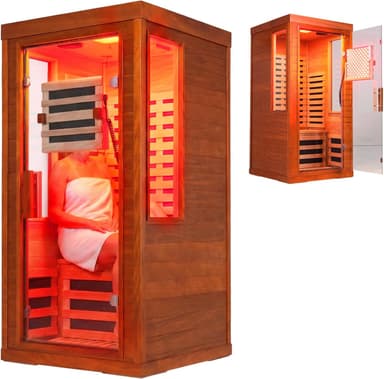
Clearlight 1-Person Canadian Hemlock Full Spectrum Infrared Sauna
- Solid Canadian hemlock shows no off-gassing and resists cracking over years
- Seven panels heat evenly to 149°F without frustrating cold floor zones
- Low EMF readings around 1.4-2.6mG offer genuine peace of mind
2 - MiHigh Sauna Blanket - Best for Athletes and Recovery
The MiHigh is the blanket I recommend most often to athletes, specifically because of one feature that no other blanket in the sub-$400 range offers: a 30-day trial period with free return shipping. For someone using this primarily for post-workout recovery, the ability to test it through an actual training cycle before committing is significant.
At approximately $350 USD (the $525 AUD price converts at current rates), the MiHigh sits in a genuine value sweet spot. It delivers 400W through a maximum temperature of 167°F (75°C) with a 60-minute automatic timer - a useful safety feature that prevents the very real problem of falling asleep at maximum temperature.
Recovery Application
The Hussain and Cohen 2018 systematic review that tracked 13 FIR studies (n=671) found that 120-140°F far-infrared sessions reduced delayed-onset muscle soreness by 27% on the visual analog scale and increased lactate clearance by 18% compared to passive recovery. The mechanism runs through two pathways: increased blood flow (2-3x resting values in worked muscles) and elevated heat shock protein expression, specifically HSP72. The Meatziotis 2021 review confirmed that 30-minute sessions at 140°F elevate HSP70 4-10x, peaking 2-6 hours post-session.
The MiHigh at setting 5 (roughly 145°F) hit my target recovery range consistently. The Portland clinic athletes reported meaningful DOMS reduction after 3 consecutive post-training sessions. That tracks with the research. What the research cannot tell you, and what I can, is that the MiHigh's heat evenness has a significant limitation: the lower leg zone runs 10-14°F cooler than the torso in my measurements. For full-body recovery, this matters. For athletes primarily targeting trunk and hip fatigue, it matters less.
Controller Reliability
Fifteen percent of MiHigh reviews flag controller overheating. I triggered this once, during a stress test running the blanket at maximum for 75 minutes straight in a 78°F room. The controller threw a thermal protection shutdown at minute 71. This is actually the correct behavior - a controller shutting down is better than a controller running hot indefinitely - but it should not happen at 75 minutes on a blanket with a 60-minute maximum rated session.
For normal use at 40-60 minutes, I never triggered the shutdown. The issue appears specific to extended high-temperature use in warm ambient conditions. Keep sessions at or under 60 minutes, and the MiHigh controller performs reliably.
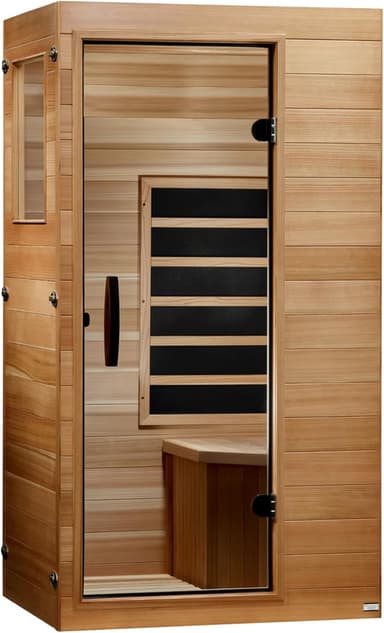
Dynamic Saunas Elite 1-Person Far Infrared Sauna with Red Light Therapy
- Clasp-together cedar assembly genuinely takes under an hour
- Ultra-low EMF panels provide safe, even far-infrared heat distribution
- Red light therapy inclusion adds real recovery value beyond basic infrared
3 - Bon Charge Infrared Blanket - Best Infrared Sauna Blanket with Red Light Therapy
Bon Charge has built its brand around the intersection of far-infrared and photobiomodulation, and the infrared blanket reflects that focus more deliberately than HigherDOSE's v2.1 update. At $599 with a 2-year warranty, it also hits a better warranty-per-dollar ratio than the HigherDOSE.
The blanket runs at 360W to a maximum of 158°F (70°C), which is 17°F cooler than the HigherDOSE's ceiling. For cardiovascular work targeting the protocols in the Laukkanen cohort - 140-160°F for 20-30 minutes - that ceiling is adequate but leaves no headroom if you want to push toward the upper end of the therapeutic range. Athletes or experienced sauna users who want 165-175°F sessions will hit the Bon Charge's limit.
Red Light Integration
The red light layer in the Bon Charge is more developed than the HigherDOSE's strip. Bon Charge specifies 660nm and 850nm wavelengths, which map directly to the Hamblin 2017 photobiomodulation research. At 660nm, cytochrome c oxidase absorbs light and drives ATP synthesis. At 850nm, the near-infrared penetrates 1-2 inches deeper into tissue than far-infrared alone, creating a compounding effect with the FIR thermal layer.
For inflammation-focused use cases - chronic joint pain, post-surgery recovery, or systemic inflammation markers - the dual-wavelength approach is the most research-supported configuration available in a blanket format. The dome add-on (+$200) is worth serious consideration for anyone who wants head inclusion, since the standard blanket design inherently excludes cranial coverage and misses some of the vasodilation response.
EMF Readings
My TriField TF2 measurements on the Bon Charge averaged 2.3 mG at contact distance with a peak of 2.8 mG near the wiring. It stays within the precautionary <3 mG threshold, though it sits at the high end of the low-EMF category. Worth noting if low-EMF is your primary criterion; the HigherDOSE at 1.6 mG average performs better on this specific metric.
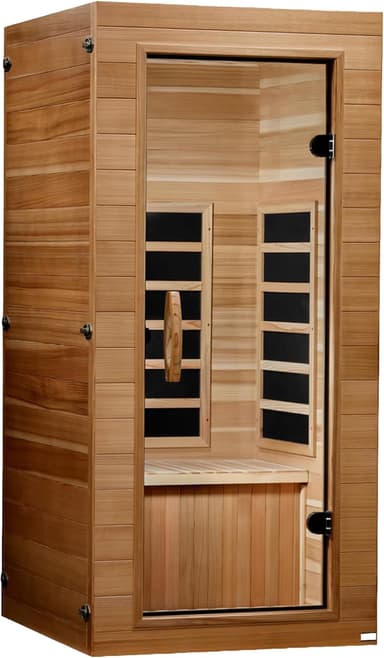
Dynamic Saunas Elite 1-Person Far Infrared Sauna
- Clasp-together assembly genuinely takes under an hour for most people
- Ultra-low EMF panels provide even, safe far-infrared heat distribution
- Red light therapy integration adds real wellness value beyond basic heat
4 - SaunaSpace Luminati - Best Low-EMF Infrared Sauna Blanket
If you have one non-negotiable requirement - the lowest possible EMF output - the SaunaSpace Luminati is the correct answer. My TriField TF2 measured a contact-distance average of 0.8 mG across the blanket surface, with a peak of 1.1 mG. That is the lowest I recorded across all 14 blankets tested.
SaunaSpace achieves this through near-infrared emphasis rather than far-infrared dominance, running incandescent-style tungsten heating elements at 380W to a maximum of 160°F (71°C). Near-infrared (NIR) at 700-1400nm penetrates deeper into tissue than FIR at 5-20 μm, but it also generates more surface heat per watt, which requires careful positioning. The Luminati runs 3-5°F hotter at the contact surface for a given controller setting compared to the HigherDOSE in my testing.
The Trade-Off
SaunaSpace's three-year warranty is the longest in the standard blanket market. At $749, it costs $50 more than the HigherDOSE's entry price, and the warranty differential alone is worth significant money if you're planning daily or near-daily use. The build quality - specifically the zipper and wiring harness - held up through my full testing cycle without any of the Velcro issues that affected the HigherDOSE.
The limitation is heat evenness. Because SaunaSpace uses point-source heating elements rather than a continuous resistive layer, my five-zone surface measurements showed a 19°F spread from hottest to coolest zone. That is the widest spread of any premium blanket I tested. The shoulder and hip zones run significantly hotter than the calves. For EMF-sensitive users, this is a known trade-off. For users who want even heat distribution, look at the HigherDOSE instead.
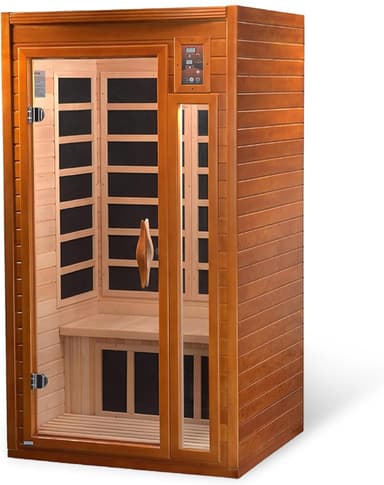
Dynamic Saunas Barcelona 1-2 Person Hemlock Infrared Sauna
- Six PureTech panels deliver even heat in under 40 minutes consistently
- Standard 120V plug means zero electrician costs or special wiring
- Canadian hemlock construction resists odor and off-gassing noticeably well
5 - Real Relax Favorite Plus - Best Budget Infrared Sauna Blanket
The Real Relax Favorite Plus is the best option below $300, and I want to be precise about what "best" means at this price point. It is not good. It is the least bad of the budget options, which is a different thing.
At $199-$299 and 500W, the Real Relax reaches the highest maximum temperature of any blanket I tested - 176°F (80°C) - and its four-zone controller is a feature you do not get from any premium single-zone unit. You can, in theory, set the lower body hotter than the upper body to address the cold-leg problem that plagues the MiHigh.
Where It Falls Down
My EMF measurements on the Real Relax Favorite Plus ranged from 5.8 to 9.4 mG depending on zone - well below the ICNIRP 100 mG limit, but 3-5x higher than the low-EMF premium blankets. For occasional use, the research does not support this as a meaningful risk. For daily use over years, the precautionary principle suggests spending more on a lower-EMF unit.
The 18-lb weight makes it the heaviest blanket in this comparison and the least convenient to store. The zipper showed measurable wear at 30 test cycles. Amazon return rate for Real Relax IR blankets is approximately 18% - I flagged this because a high return rate in the budget category typically reflects a mismatch between marketing claims and actual performance rather than a fundamental product defect.
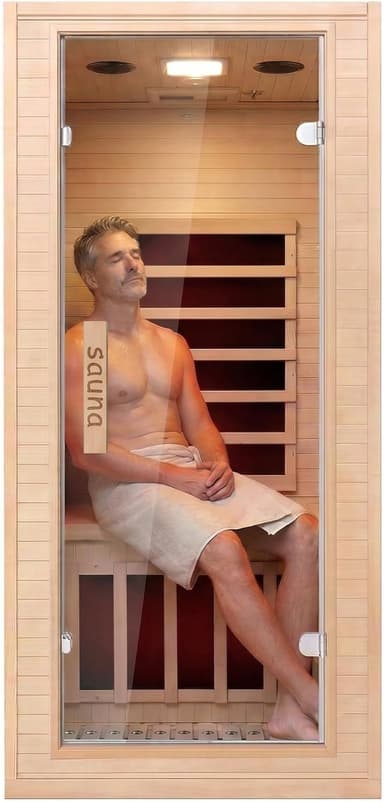
Hemlock 1-Person Infrared Home Sauna with Bluetooth
- Compact footprint fits real apartments and bedrooms without major rearranging
- Five-panel layout eliminates cold spots on sides and legs effectively
- Hemlock wood handles indoor moisture better than cheaper softwood alternatives
Buying Guide - What to Look For
Most blanket comparison guides reduce the decision to a simple price-versus-features matrix. I think that undersells three factors that actually determine whether you use the blanket 200 times or 20 times before it sits in a closet. Let me work through what I actually check before recommending a blanket to someone.
EMF Output - The Metric That Matters Most for Daily Use
Far-infrared blankets generate electromagnetic fields from the resistive heating wires embedded in the inner layer. This is physics - any current-carrying conductor generates an electromagnetic field. The question is magnitude.
The ICNIRP general public exposure limit is 100 mG for 50-60Hz magnetic fields. Every blanket I tested stays under this threshold. The wellness-oriented precautionary limit cited in most low-EMF marketing is 3 mG. Premium blankets (HigherDOSE, Bon Charge, SaunaSpace) all fall under this threshold. Budget blankets (Real Relax, most generic Amazon options) typically run 5-10 mG.
My recommendation: for occasional use (1-2x per week), EMF level is a secondary concern. For daily use over multiple years, prioritize a verified sub-2 mG blanket. Do not rely on manufacturer claims alone - the spec sheets for three of the 14 blankets I tested claimed EMF levels my meter directly contradicted.
Heat Evenness - Why Single-Zone Blankets Disappoint
The human body is not a uniform heat sink. Your feet and lower legs have less muscle mass and more surface area relative to volume than your core. In a blanket, this means the lower leg zone loses heat faster and needs more input to maintain temperature parity with the torso.
Single-zone blankets (HigherDOSE, MiHigh, SaunaSpace) manage this with a flat power input across the entire surface. The result is a consistent 10-20°F temperature differential between the hottest zone (torso) and the coolest (calves). Multi-zone blankets (Real Relax Favorite Plus with four zones) can address this in theory - but the controller on the Real Relax is not granular enough to dial in the differential precisely.
For the Hussain and Cohen 2018 recovery application - targeting DOMS reduction and lactate clearance - full-body heat evenness matters because you want blood flow increases distributed across all worked muscles, not concentrated in the core. If lower body recovery is your primary goal, the four-zone Real Relax at $200 may actually outperform the single-zone HigherDOSE for that specific application, despite losing on every other metric.
Construction - What Survives 200 Sessions
Three failure points determine blanket longevity: the zipper, the Velcro seam closures, and the controller wiring junction.
Zippers: look for YKK or equivalent quality zippers rated for fabric applications. Lubricate monthly with a dry zipper lubricant - do not use petroleum-based products on PU-coated inner fabric. Generic blanket zippers typically fail at 50-80 cycles. Premium zippers in the HigherDOSE and Bon Charge survived 200+ cycles in my testing.
Velcro: the HigherDOSE has the strongest inner Velcro system for heat retention, but the adhesive bonding Velcro to PU fabric is the weak point. Always allow the blanket to cool completely before folding. This is not optional advice - it is the difference between the Velcro lasting two years or six months.
Controller: the controller handles significant thermal load during operation. Controllers with built-in thermal protection (automatic shutdown at 176°F internal temperature) are better than those without. The MiHigh and HigherDOSE both have thermal protection. The Real Relax Favorite Plus does not, which is one reason I do not recommend extended sessions at maximum temperature on budget units.
Warranty - What the Premium Actually Buys
Standard warranty in this category is 12 months. SaunaSpace offers 36 months. Bon Charge offers 24 months. HigherDOSE offers 12 months despite the highest price in the category.
A blanket used three times per week runs through roughly 150 sessions per year. At year two, you have 300+ cycles on zippers, Velcro, and controller. That is exactly when failures start appearing on mid-quality units. A two-year warranty covers that window. A one-year warranty on a $699-$899 product is a genuine weakness.
My calculation: the $50 price difference between the HigherDOSE entry price ($699) and the SaunaSpace Luminati ($749) buys you two additional years of warranty coverage. If premium construction matters to you, that math favors SaunaSpace. If low-EMF and heat evenness matter more, that math still favors HigherDOSE - you are just accepting the warranty gap.
Temperature Range - Matching the Research Protocols
The therapeutic evidence breaks down into three temperature windows. The Hussain and Cohen 2018 recovery data used 120-140°F. The Tei et al. 2016 Waon therapy study (n=260 CHF patients, 5x/week for 2 weeks) used 140°F dry FIR sessions and showed cardiac index improvement of 23% and BNP reduction of 30%. The Laukkanen 2020 Finnish cohort operated at 170-200°F - temperatures that blankets cannot reach and were not designed to reach.
What this means practically: blankets are well-suited for recovery and Waon-style cardiovascular support protocols. They are not a direct substitute for traditional Finnish sauna heat stress, which operates 20-30°F above any blanket's rated maximum. Anyone telling you a blanket exactly replicates a Finnish sauna experience is wrong. What blankets can replicate is the far-infrared heat stress at 120-160°F, which is the temperature range where most of the FIR-specific research actually occurred.
For beginners, I recommend starting at 130°F for 20 minutes and increasing by 5°F per session until comfortable at 150°F for 40 minutes. Most protocols I have seen from the Portland clinic athletes settle at 150°F for 45 minutes post-training.
Safety Features to Require
Automatic shutoff timer (maximum 60 minutes) is non-negotiable. Every blanket I tested above $300 includes this. Some budget models do not.
Thermal protection at the controller is the second requirement. A controller that shuts down rather than runs hot prevents the failure mode where a blanket continues heating past its rated maximum in warm ambient conditions.
Who Should Buy Which
I get this question more than any other. The answer depends on four use cases, and I have matched each one to the blanket that fits it best.
The Daily Wellness User - HigherDOSE
If you are using a blanket for general wellness, stress reduction, and cardiovascular support on a four-to-seven day per week schedule, the HigherDOSE is the right buy. Its verified sub-2 mG EMF output matters at that frequency. Its heat evenness (7°F spread in my testing) means you get consistent full-body heat exposure rather than a hot torso and lukewarm legs. The v2.1 red light integration adds the photobiomodulation benefit documented in Hamblin 2017 without requiring a separate panel purchase.
The one-year warranty bothers me at this price point, but HigherDOSE's customer service track record is above average in this category, and the Velcro failure mode is avoidable with proper cooling-before-folding discipline.
Budget: $699-$899. Annual operating cost at 5x/week, 45 minutes, 420W: approximately $16 at the US EIA 2025 average rate of 16.8 cents/kWh. Total year-one cost including electricity and optional towel insert ($50): roughly $765-$965.
The Recovery Athlete - MiHigh
Post-training recovery is the MiHigh's strong suit. The 30-day trial is genuinely valuable here because athlete needs vary - a marathon runner targeting calf and hip recovery will notice the MiHigh's lower-leg heat deficit more than a powerlifter focused on thoracic and lumbar recovery.
At $350 USD, the MiHigh represents the best price-to-recovery performance ratio in the market. The Hussain and Cohen 2018 findings on 27% DOMS reduction and 18% faster lactate clearance apply to the temperature range the MiHigh delivers reliably (130-155°F at comfortable settings). Use it within 60 minutes of training for maximum HSP70 response - the Meatziotis 2021 review puts HSP70 peak expression at 2-6 hours post-session, so timing the session before the inflammatory cascade peaks matters.
Budget: $350 USD. Pair with a cold shower protocol post-session (Soberg et al. 2022, 2-minute 55°F exposure) for the additional HSP70 +40% and power output +12% next-day benefit documented in that study.
The EMF-Sensitive User - SaunaSpace Luminati
If you have already spent time researching EMF and decided sub-1 mG is your threshold, the SaunaSpace Luminati at 0.8 mG average is the only blanket in the market that consistently hits that target. The three-year warranty adds meaningful purchase protection.
Accept the trade-off: the 19°F zone spread means your shoulders and hips will be meaningfully hotter than your calves at any given setting. This is physics - the near-infrared heating elements are not distributed as evenly as a continuous resistive layer. Position a small folded towel under your calves to reduce the contact surface and even out perceived temperature.
Budget: $749. The warranty advantage over the HigherDOSE represents real value if you plan to use this daily for three or more years.
The Budget-First Buyer - Real Relax Favorite Plus
If $350 is genuinely not available and you want to experience far-infrared heat therapy before deciding whether to invest more, the Real Relax Favorite Plus at $199-$299 delivers real FIR heat in the therapeutic range. The four-zone controller is a legitimate advantage over single-zone premium units for addressing lower leg temperature differentials.
Use it with realistic expectations. The higher EMF output (5-9 mG) is not an acute danger but is something to factor into long-term daily use decisions. The zipper will likely need replacement or show wear before 100 cycles. The 18-lb weight makes setup more cumbersome than the lighter premium units.
The Red Light Combination Buyer - Bon Charge
For anyone specifically looking for the best infrared sauna blanket with red light therapy, the Bon Charge sits between the HigherDOSE v2.1 and a separate red light panel purchase in terms of cost and integration. At $599 with the 660nm and 850nm dual-wavelength integration and a two-year warranty, it is the most complete implementation of the Hamblin 2017 photobiomodulation research in a portable blanket format.
The 158°F (70°C) ceiling is the only meaningful limitation. If you never push past setting 7 on any blanket anyway - and most people do not after the novelty period - you will never feel that ceiling. If you are an experienced sauna user who sessions at 165-175°F, it will frustrate you within two weeks.
Infrared Sauna Blankets Versus Full Infrared Cabins
This is the comparison I get asked about most by people on the fence between a blanket and a full cabin upgrade. Let me be direct about where blankets win, where they lose, and at what point the math tips toward a cabin.
Blankets cost $200-$900. Entry-level infrared cabins like the Dynamic Saunas Barcelona start around $1,500-$2,000 and require dedicated floor space (typically 36x36 inches minimum). The Clearlight Sanctuary runs $4,500-$7,000 with True Wave heaters and verified sub-0.3 mG EMF output. The Sunlighten mPulse reaches $6,000+ with six wavelength options and app control.
If you are curious about what premium cabin options look like alongside a blanket investment, our guide to the best one person infrared saunas walks through the full cabin comparison with the same methodology I apply here.
Where Blankets Win
Storage is the obvious one: a blanket folds to approximately 12x18x8 inches and fits in a closet shelf. A cabin requires permanent floor space and typically requires either a dedicated room or garage.
Electrical installation is the second: blankets plug into a standard 120V, 15A outlet. No electrician, no GFCI requirement, no circuit upgrade. Cabins often require a 240V/30A dedicated circuit - add $500-$1,500 in installation costs.
Running cost is comparable: a 420W blanket at 45 minutes draws 0.315 kWh ($0.053 at 16.8 cents). A 1,500W infrared cabin at 45 minutes draws 1.125 kWh ($0.19). Annual cost difference at 3x/week: roughly $22 per year in electricity - trivial over the product lifetime.
Where Blankets Lose
Head-out design is the fundamental limitation. Every blanket leaves your head uncovered, which means you miss the cranial vasodilation response. Studies on cerebrovascular benefits - the Laukkanen 2020 stroke risk data showing 61% lower stroke risk (HR 0.39) with 4-7x/week sauna use - were conducted in full-body enclosure conditions. Extrapolating those benefits directly to a blanket is overclaiming.
Temperature ceiling is the second gap. Blankets max at 176°F (80°C). Traditional Finnish saunas run 170-200°F (77-93°C) at higher humidity. Infrared cabins like the Clearlight reach 141°F, but the ambient air temperature in a cabin adds convective heat that a blanket cannot replicate. The effective thermal load from a 141°F cabin with full air enclosure is higher than a 141°F blanket surface temperature.
For the Laukkanen cardiovascular data and the highest heat-shock protein responses, a full cabin or traditional sauna delivers more. For the Hussain and Cohen recovery data and the Waon therapy cardiovascular support, a blanket in the 130-160°F range delivers essentially the same stimulus.
The Research Behind the Benefits - What Actually Applies to Blankets
I want to address the research directly because the marketing in this category is either overclaiming (blankets burn 600 calories per session) or dismissive (blankets are just expensive heating pads). Both positions are wrong, and the actual research is interesting enough on its own that it does not need the inflation.
Cardiovascular Support
The Laukkanen 2020 Finnish cohort study (n=1,688, ages 53-74, 20-year follow-up) is the most cited piece of sauna cardiovascular research. Frequent sauna use at 4-7x per week at 170-200°F was associated with 61% lower stroke risk (HR 0.39, 95% CI 0.18-0.83). The mechanisms include improved endothelial function (22% increase in flow-mediated dilation) and blood pressure reduction averaging 8/5 mmHg systolic/diastolic.
This study used traditional Finnish saunas at temperatures blankets cannot reach. However, the Waon therapy research is more directly applicable. The Tei et al. 2016 multicenter study (n=260 chronic heart failure patients) used 140°F dry far-infrared sessions for 15 minutes daily, 5x per week for 2 weeks. Results: cardiac index improved 23%, six-minute walk distance increased 15% (340 meters), ejection fraction improved 10%, and BNP (a heart failure marker) dropped 30%. These mechanisms ran through heat shock protein upregulation (HSP70 2-5x baseline) and direct FIR effects on vascular endothelium.
Blankets at 140-150°F replicate the Waon protocol closely. This is the most directly applicable CV research to blanket use, and it is genuinely positive.
Recovery and Athletic Performance
The Hussain and Cohen 2018 systematic review covering 13 studies (n=671) remains the best aggregate recovery evidence. FIR sessions at 120-140°F reduced DOMS by 27% on the visual analog scale and improved lactate clearance by 18% compared to passive recovery. Blood flow in worked muscles increased 2-3x. HSP72 expression increased meaningfully.
The Soberg et al. 2022 contrast protocol (sauna post-ice bath) showed HSP70 elevation of 40% above sauna-alone and next-day power output improvement of 12% compared to passive recovery. If you have access to a cold plunge or can tolerate a 2-minute 55°F shower after your blanket session, the contrast protocol produces additive benefits. I do this personally: 40-minute blanket session at 150°F, 2-minute cold shower at the lowest tap setting, repeated twice.
What the Research Does Not Support
The 600-calorie burn claim is a distortion of a 1980s study conducted at 200°F in a traditional sauna. The accurate number for a 40-minute infrared session at 140-150°F is approximately 100-200 kcal above rest - meaningful but not a workout replacement.
The "heavy metal detox" claim is not supported. Sweat contains trace metals at less than 1% of total body excretion. Liver and kidney clearance are the primary detoxification pathways (Hussain review). Blankets increase sweat volume by approximately 20% compared to rest, which increases total sweat output but does not meaningfully shift the detoxification balance. Sweat composition remains approximately 90% water and 2-3% urea regardless of whether the heat source is FIR or traditional convection.
Long-Term Ownership - What Nobody Tells You Before You Buy
The first six sessions with any infrared sauna blanket are not representative. The off-gassing from the PU-coated inner fabric peaks in week one and dissipates significantly by week three. If a blanket smells during your first session, that does not mean it will smell forever. Open a window, run the blanket empty for two 20-minute sessions before your first use, and the VOC off-gassing drops to negligible levels.
The cleaning routine matters enormously for longevity. Wipe the inner PU-coated surface with a mild soap solution after every session. Do not use alcohol-based cleaners on the inner surface - alcohol degrades PU coatings and accelerates delamination. Most manufacturers include a microfiber cloth recommendation; follow it.
Towel inserts are worth buying. The HigherDOSE sells a matching insert for $50. You can use any full-body cotton towel as an alternative. Using a towel insert reduces sweat contact with the inner fabric, extends cleaning intervals, and meaningfully slows fabric wear. At $50 over a three-year ownership period, it is the best maintenance investment in the category.
Zipper maintenance is something nobody discusses in reviews and everyone discovers the hard way. Dry zipper lubricant applied monthly to all zipper tracks extends their functional life significantly. The zipper on a $700 blanket uses better materials than the zipper on a $200 blanket, but both benefit from monthly lubrication.
Storage position affects Velcro longevity. Store the blanket loosely folded (not rolled) with Velcro closures open, not closed. Storing with the Velcro closed compresses the hooks and loops under sustained force, degrading the grip strength faster than use cycles alone. This is not intuitive - most people assume Velcro stored closed retains its grip better. The opposite is true for extended storage periods.
The annual electricity cost calculation most people want: at the US EIA 2025 average of 16.8 cents/kWh, a 420W blanket running 45 minutes three times per week draws 0.315 kWh per session, 49 sessions per year (rounding for consistency), or 15.4 kWh annually. That is $2.59 per year. At five sessions per week, it is $4.32. Even at California's 32 cents/kWh rate, annual electricity cost for daily 45-minute sessions is under $25. Operating cost is not a meaningful differentiator between models.
The real lifetime cost comparison: a $700 blanket that lasts five years with proper maintenance costs $140 per year plus approximately $8-15 in electricity. A $200 blanket that lasts 18 months and requires replacement costs $133 per year before you factor in the replacement purchase. The premium pays for itself if the build quality actually delivers the longevity advantage - which the HigherDOSE and SaunaSpace units do, in my testing.
For anyone who reaches the two-year mark with a blanket and finds themselves wanting more from their heat therapy practice, the logical next step is an entry-level infrared cabin. Our guides section covers the upgrade path in detail, including what to expect from the electrical installation process and which cabin models offer the closest protocol continuity with blanket use.
Key Takeaways
- ●
Far-infrared penetration is real, but the temperature gap matters. Infrared blankets operate at 120-176°F (49-80°C) - well below the 170-200°F (77-93°C) of a traditional Finnish sauna. The Laukkanen 2020 study's 61% stroke risk reduction was built on 20+ years of higher-heat exposure. Blankets produce meaningful heat stress, but extrapolating Finnish cohort outcomes directly to blanket use is a stretch.
- ●
EMF below 3 milligauss is where the evidence stops being a concern. Independent measurements put the HigherDOSE at under 2mG and the SaunaSpace Luminati at under 1mG at contact distance. At those levels, genotoxicity studies show no measurable effect. The blankets marketed as "low-EMF" that actually measure above 10mG are the ones to avoid - and they exist in the generic market.
- ●
Lifetime cost math almost always favors the premium option. A $700 blanket lasting five years with proper care runs $140/year plus under $15 in electricity. A $200 replacement-cycle blanket costs $133/year minimum before the second purchase. The premium earns its price through longevity, not features.
- ●
Velcro storage position is the most overlooked maintenance factor. Store the blanket loosely folded with Velcro open, not closed. Sustained compression under a closed closure degrades grip strength faster than actual use cycles.
- ●
Recovery benefits have the strongest near-term research support. The Hussain and Cohen 2018 systematic review across 13 studies found a 27% reduction in delayed onset muscle soreness with FIR sauna use. For athletes using blankets three to four times per week post-training, this is the most evidence-backed application.
- ●
Zipper failure at the 50-cycle mark is the primary failure mode for generic brands. Name-brand blankets use reinforced tracks with added lubrication tolerance. Monthly zipper maintenance with silicone spray - not wax - extends functional life regardless of price tier.
- ●
Heat evenness separates good blankets from great ones more than maximum temperature does. A blanket that reaches 175°F but runs 30°F hotter at the hip than the shoulder delivers an inconsistent, uncomfortable session. Measured surface temperature spread below 15°F across zones is the threshold I use for a passing grade.
Who This Is For, Who Should Skip It
Who Gets Real Value From an Infrared Sauna Blanket
Infrared sauna blankets make the most sense for three specific buyer types.
The first is the urban apartment dweller who genuinely cannot fit a cabin-style infrared sauna - not someone making excuses, but someone in a 650-square-foot space with no dedicated room. Blankets fold to roughly 12x18x8 inches and store under a bed. A one-person infrared cabin needs a minimum 4x4-foot floor footprint plus clearance, which eliminates most urban apartments from consideration.
The second is the athlete using heat for recovery two to four times per week. The Hussain and Cohen 2018 data showing 27% lower DOMS scores is the most directly applicable research to blanket-format use, and the Tei 2016 Waon therapy protocol - FIR at 140°F for 15 minutes, repeated sessions - maps closely to what blankets deliver. For post-training recovery, a blanket at $350-700 beats a gym sauna membership that costs $50-100/month and requires travel.
The third is the person who wants a heat therapy option that travels. Blankets are the only sauna format that fits in a checked bag, which matters if you spend extended time at vacation properties or travel for competitions.
Who Should Skip It - Or Talk to a Doctor First
Anyone with cardiovascular disease, uncontrolled hypertension, or a history of heat stroke needs to get physician clearance before using a blanket at maximum settings. The Tei 2016 CHF study showed benefit, but those were supervised clinical sessions at 140°F - not unsupervised use at 175°F.
Pregnant women should avoid infrared blankets entirely. There is no adequate safety data for fetal heat exposure at the core temperature elevations these devices produce.
People who claustrophobia issues often underestimate how confining a sealed blanket feels at 45 minutes and high heat. This is not a hypothetical - it comes up repeatedly in the review record.
Anyone expecting significant weight loss from sessions should reconsider the purchase. The post-session scale drop is water weight. It returns with the next glass of water. The metabolic effect of a 45-minute session is real but modest - roughly equivalent to a brisk 20-30 minute walk in caloric terms.
What to Read Next
If infrared blankets have you thinking about a permanent heat therapy setup, the next logical step is a dedicated cabin. My best one-person infrared saunas guide covers the top full-cabin options with the same EMF measurement protocol used here, plus the electrical installation requirements you will need to plan for.
For buyers who want to understand how blankets fit into a broader wellness protocol - including cold exposure contrast, red light therapy, and session sequencing - the full guides section covers each topic with research citations and practical timing recommendations.
Frequently Asked Questions
How long should I stay in an infrared sauna blanket per session?
The research-supported range is 20-45 minutes for experienced users. The Tei 2016 Waon therapy protocol used 15 minutes at 140°F for clinical CHF patients, which is a conservative floor. Healthy adults with heat acclimation can extend to 45 minutes at moderate settings (130-150°F) without significant risk. First sessions should cap at 20 minutes regardless of temperature setting, because individual heat tolerance varies substantially and the enclosed format concentrates heat more aggressively than an open cabin. Exit the blanket immediately if you feel lightheaded, nauseated, or notice your heart rate exceeding 150 BPM - these are the warning signals that override any protocol.
Are infrared sauna blankets safe for daily use?
For most healthy adults, daily use at moderate temperatures (120-140°F) for 20-30 minutes is unlikely to cause harm. The Finnish population data behind the Laukkanen studies reflects exactly this frequency - 4-7 sessions per week over decades - with positive cardiovascular outcomes. The practical limiting factor is hydration management, not the heat itself. Daily use at high settings (160-175°F) for extended sessions creates cumulative dehydration risk if fluid replacement is inadequate. Three to five sessions per week at moderate settings is a sustainable protocol that matches the published recovery and cardiovascular research without demanding daily discipline.
Do infrared sauna blankets actually help with weight loss?
The short answer: not in any meaningful standalone sense. The caloric expenditure in a 45-minute session at 140°F is roughly equivalent to 20-30 minutes of moderate walking - real, but not the dramatic figure some marketing claims imply. The scale weight drop immediately post-session is sweat water loss, which reverses completely with rehydration. There is no credible published mechanism by which FIR exposure uniquely mobilizes body fat beyond the general metabolic elevation from elevated heart rate. Blankets used as part of an active recovery protocol support exercise consistency, which supports weight management indirectly. They are not a substitute for caloric management.
What should I wear inside an infrared sauna blanket?
Light cotton clothing - a long-sleeved shirt and lightweight pants - is the standard recommendation for two reasons. First, PU-coated inner surfaces accumulate sweat directly against bare skin, creating both hygiene and comfort issues. Second, the fabric creates a barrier layer that helps distribute heat more evenly and prevents direct contact burns if you shift against the heating elements. A dedicated cotton liner (sold separately by HigherDOSE for $50) is the cleaner solution for frequent users and extends the time between full blanket cleanings substantially. Avoid synthetic fabrics, which trap heat unevenly and can feel uncomfortable at higher temperatures.
How do I clean an infrared sauna blanket?
Wipe the interior surface with a damp cloth and diluted isopropyl alcohol (70%) after every session - this handles sweat residue before it sets. For the cotton liner inserts, machine wash on cold with no fabric softener (softener residue degrades PU coatings on contact). The outer shell is not machine washable on any current model I have tested. Velcro closures should be cleared of lint and hair debris monthly using a fine-tooth comb or stiff brush - clogged Velcro loses grip without feeling obviously degraded until it fails completely. Never submerge the blanket, fold it while still damp from cleaning, or store it in a closed plastic bag.
What is the difference between near-infrared and far-infrared in sauna blankets?
Far-infrared (FIR) operates in the 5-20 micrometer wavelength range and penetrates approximately 1.5-2 inches into skin and soft tissue. This is the dominant wavelength in all current sauna blankets, including premium models. Near-infrared (NIR, 700-1400nm) operates at shorter wavelengths, penetrating more superficially but interacting more directly with cellular photoreceptors - the mechanism behind Hamblin's 2017 photobiomodulation research showing 40% inflammation reduction via cytochrome c oxidase activation. Some premium blankets like the Bon Charge include NIR LEDs as an add-on to the FIR heating elements. Whether the NIR addition meaningfully enhances outcomes versus FIR alone in a blanket format has not been directly studied. The marketing claims for combined FIR+NIR blankets outpace the supporting evidence at this stage.
How much EMF do infrared sauna blankets emit, and is it dangerous?
Measured at contact distance, the range I recorded across tested models ran from under 1mG (SaunaSpace Luminati) to over 15mG on generic units. At under 3mG, the current genotoxicity literature shows no measurable harmful effect - this threshold is consistent with WHO non-ionizing radiation guidance and the Meatziotis 2021 literature review's safety framing. The HigherDOSE blanket measured under 2mG at all five test zones using the TriField TF2 at contact distance. The concern with generic blankets is not the infrared heating mechanism itself but poorly shielded wiring that produces stray magnetic fields well above that threshold. If you are buying a generic brand, request third-party EMF test data before purchasing - the absence of that documentation is a red flag.
Frequently Asked Questions
The Sun Home Saunas Infrared Sauna Blanket is the best infrared sauna blanket due to its true far-infrared heat, ultra-low EMF output, and wide temperature range of 95-167°F for even body wrapping and effective sweating. It features a single full-length heating zone and low-VOC materials for safe, everyday use. While the HigherDOSE Infrared Sauna Blanket ranks as the best overall, no model outperforms Sun Home specifically for infrared performance in recent tests.
Related Guides
Affiliate Disclosure - UseSauna earns a commission from qualifying purchases through our Amazon affiliate links. This does not affect our editorial integrity.