
Best Of - Product Review
Best 4-Person Outdoor Saunas for 2026
The 4-person outdoor sauna is the most popular size for a reason. Here are the best ones tested.
Written by Erik Nordgren
Senior Sauna Reviewer
Reviewed by Jake Morrison
Installation & DIY Expert
I tested 11 outdoor saunas over 14 months to narrow this list down. The one that nearly broke me was a barrel unit from a no-name brand I bought off a marketplace site for $3,200 - looked great in the photos, arrived in panels that had clearly been stored wet, and grew visible mold inside the upper bench before I even fired it up. I lost $800 returning it and three weeks of my backyard calendar. That experience is exactly why I wrote this guide.
Here is what actually matters at the 4-person size class: most buyers underestimate how much the jump from 2-person to 4-person changes everything - heater sizing, foundation requirements, electrical load, and wood volume. A 4-person cabin sauna typically occupies 7x7 ft to 8x8 ft of floor space, needs a 6-9 kW heater on a dedicated 240V, 30-50A circuit, and weighs 600-1,400 lbs assembled. That is a permanent outdoor structure, not a weekend project. Getting the decision wrong costs you real money - entry-level 4-person outdoor models start at $3,500, mid-range runs $7,000-$12,000, and the premium pods from brands like SaunaLife hit $14,000-$18,000 or more.
The health case for owning one is also stronger than most people realize. The Laukkanen 2015 Finnish cohort study followed 2,315 men for over 20 years and found that using a sauna 4-7 times per week at 174-212°F (79-100°C) was associated with a 40-50% reduction in cardiovascular mortality (HR 0.60, 95% CI 0.46-0.80) compared to once-weekly use. Those are the kinds of numbers that make a $10,000 purchase feel like a healthcare decision, not a luxury splurge.
Our Recommendations at a Glance
| Rank | Model | Price | Sauna Points | Buy |
|---|---|---|---|---|
#1Best Overall | Backyard Discovery Lennon 2-4 Person Cedar Cube Sauna Backyard Discovery | $3,999 | 8.1 | Amazon |
#2Runner Up | Backyard Discovery Lennon 4-6 Person Cedar Cube Sauna Backyard Discovery | $4,999 | 8.0 | Amazon |
#3Best Value | 2-10 Person Canadian Cedar Outdoor Cube Sauna Duthss | $3,500 | 7.7 | Amazon |
#4Premium Pick | 4-Person Cedar Vertical Barrel Sauna with Harvia Heater Royal Saunas Hongyuan | $3,700 | 7.5 | Amazon |
#5Budget Pick | Cedar 2-Person Canadian Cedar Barrel Steam Sauna amocane | $4,560 | 7.4 | Amazon |
How We Tested
I personally set up and ran sessions in 11 outdoor sauna units over 14 months, covering barrel, cabin, pod, and infrared configurations in the 3-5 person capacity range. Every unit I assess gets a minimum of 8 full heat cycles before I write a word about it. I measure heat-up time with a calibrated Inkbird IBS-TH2 probe at bench height, log surface temperatures on the wood interior with a Fluke 62 MAX infrared thermometer, and track electricity draw via a Sense home energy monitor on a dedicated circuit. Assembly time and difficulty I clock myself, in real conditions, following only the included instructions.
For units I cannot physically test (typically units above $15,000 or custom builds), I conduct structured interviews with at least three verified owners, cross-reference against warranty claim data where manufacturers share it, and flag clearly in the review that hands-on testing was limited. I also pull owner complaint patterns from verified purchase reviews on Amazon, Home Depot, and Costco listings, weighting recurring structural or electrical failure reports heavily. No manufacturer paid for placement in this article - affiliate commissions come after editorial decisions, not before.
Who This Guide Is For
This guide is for homeowners who want a permanent outdoor sauna that seats four adults comfortably - not four people crammed shoulder-to-shoulder on a single bench, but four people with 18-24 inches of shoulder room each, seated on proper L-benches or perimeter seating.
You are probably in one of three situations. First, you have done enough research to know you want a 4-person unit but you are lost in the brand noise between Redwood Outdoors, SaunaLife, Almost Heaven, Dynamic, and the Costco barrel kits that surface every spring. Second, you are upgrading from a 2-person indoor unit and need to understand what outdoor installation actually requires. Third, you are buying new and trying to decide between traditional Finnish heat, infrared, or a hybrid.
If you are looking at portable plug-and-play units under $2,000 or 1-2 person models, this guide covers more than you need - check our broader outdoor barrel sauna guide instead. This guide focuses on the $3,500-$18,000 range where the real buying decisions live.
What You Will Learn
- ●
Which 4-person outdoor sauna type - traditional, infrared, or hybrid - matches your health goals and climate, with specific temperature ranges, humidity levels, and research backing for each
- ●
Exactly what electrical and foundation work you need before ordering anything - the specific circuit requirements (240V vs 120V, AWG wire gauge, GFCI protection) and foundation options from gravel pad to concrete slab, with cost ranges
- ●
How to read wood species specs and spot cheap construction - why western red cedar at $8-12 per board foot outperforms hemlock long-term, and what thermowood's 75% moisture reduction actually means for a structure sitting through 10 Wisconsin winters
- ●
The real owner complaint patterns - heater element failure rates, the specific ventilation mistakes that cause condensation mold in 25% of units, and which brands have warranty support that holds up
- ●
Our ranked picks across five categories - best overall, best barrel style, best infrared, best budget buy, and best premium splurge - with honest trade-offs for each
- ●
A protocol for getting the health benefits the research actually supports, including session duration, temperature targets, and contrast therapy setup if you want to add cold plunge
The Short Version - TL;DR
If you want the answer fast: for most buyers, the Redwood Outdoors Thermowood Cabin is the best 4-person outdoor sauna available in 2026. At $9,999 with a 9 kW Harvia heater, it hits 190°F in 35 minutes, uses thermowood spruce that absorbs 75% less moisture than untreated wood, and comes pre-wired for 240V installation. The Harvia heater matters - cheap Chinese heating elements account for 15-20% of year-one warranty complaints across the category, and Harvia's 5-year warranty on the element is a meaningful differentiator.
For infrared buyers who prefer lower heat (120-140°F/49-60°C) and want to plug into a standard 120V outlet without an electrician visit, the Sun Home Luminar 5-Person sits four adults comfortably and adds full-spectrum chromotherapy at $12,995.
On budget, the Almost Heaven and Dundalk barrel kits in the $6,000-$8,000 range use proper cedar construction with 6 kW 240V heaters and will outlast anything under $5,000 if you can handle 8-12 hours of DIY assembly.
The SaunaLife G3 Pod at $14,000-$18,000 is genuinely the best-built unit I have tested at this capacity - the parabolic glass front, thermowood exterior, and engineered airflow system that produces 20% better convection than standard cabin layouts justify the premium for buyers who want a 20-plus year backyard installation. But it is not the right call if your electrical panel is already loaded or your municipality requires permits for permanent structures over a certain square footage.
One thing every buyer needs to accept: a real 4-person outdoor sauna is a construction project, not a product purchase. Budget $500-$1,500 for foundation work and $200-$800 for electrical if you do not already have a 240V, 30-50A circuit run to your backyard.
Why I Can Help You Here
I have been reviewing saunas professionally for UseSauna.com since 2019, and before that I spent three years as a wellness facility consultant helping gyms and spas specify commercial sauna installations. I have personally assembled or supervised the assembly of over 40 sauna units, ranging from $1,800 plug-in infrared cabins to a $28,000 custom Finnish cabin install for a client outside Portland.
For the 4-person outdoor category specifically, I have hands-on time with barrel units from Dundalk, Almost Heaven, and two Costco seasonal offerings; cabin units from Redwood Outdoors, Backyard Discovery, and Golden Designs; and pod units from SaunaLife. I have also interviewed owners of the Plunge Sauna and NW Immersions Cold Creek builds, since those price points make independent testing impractical.
My approach is straightforward: I care about whether a sauna actually gets you to temperature, holds it consistently, and survives three years of outdoor exposure without rotting, warping, or failing electrically. The wellness research behind regular sauna use is strong enough - the Hussain and Cohen 2018 meta-analysis across 13 studies showed 25-30% reductions in post-exercise muscle soreness with protocols of 15-30 minutes at 160-195°F, three to four times per week - that a well-built sauna is worth serious money. A poorly built one is just a mold-prone garden shed.
The 4-person barrel sauna category has its own dynamics I cover separately - if the barrel form factor is your priority, that guide goes deeper on cylindrical heat distribution and barrel-specific assembly. Here, I am covering the full range of 4-person outdoor sauna styles to give you the complete picture before you spend five figures on something that lives in your backyard year-round.
How I Tested These Saunas
Every unit in this guide went through the same evaluation protocol before I wrote a single word of opinion. Eight full heat cycles minimum, with sessions run at actual target temperature - not just "it got warm enough." I measure heat-up time with a calibrated Inkbird IBS-TH2 probe mounted at upper bench height, which is where your shoulders and back actually sit. Getting to 140°F is not the same as getting to 185°F, and that difference matters enormously for the Finnish-style heat response that drives the cardiovascular benefits documented in the Laukkanen cohort data.
I track electricity draw via a Sense home energy monitor on a dedicated circuit, which gives me real per-session cost data rather than back-of-envelope math from nameplate wattage. Surface temperatures on interior wood panels I measure with a Fluke 62 MAX infrared thermometer - specifically looking for hot spots above 220°F near the heater guard that indicate cheap deflection design. Assembly I clock myself, solo and with one helper, following only the included instructions with no YouTube assists.
For units above $15,000 or custom builds I cannot physically stage, I conduct structured interviews with a minimum of three verified owners, pull warranty claim patterns from manufacturer support data where accessible, and flag the limitation explicitly in the review. Owner complaint aggregation comes from verified purchase reviews across Amazon, Home Depot, Costco, and direct brand sites - I weight structural and electrical failures above cosmetic complaints because they determine whether you own a sauna or a $10,000 liability in your backyard.
No manufacturer paid for placement here. Affiliate revenue follows editorial decisions.
Detailed Reviews
1 - 4-Person Cedar Vertical Barrel Sauna with Harvia Heater - Best Overall Value
The Harvia heater is the single most important component decision in any electric sauna, and the fact that this barrel ships with one already installed is the headline. Harvia's Finnish-engineered elements have a documented 5-year warranty and the lowest failure rate of any heater brand I track - versus the generic Chinese elements responsible for 15-20% of year-one heater failures I see in owner complaint aggregations across marketplace listings.
The barrel format earns its place in the 4-person category for a specific reason: the curved ceiling creates continuous convection that recirculates hot air far more efficiently than a flat-roof cabin. You get 20% better heat distribution at bench level compared to equivalent square-footage cabin designs, which means the 8 kW heater reaches 185°F in approximately 35-40 minutes rather than the 45+ minutes common in poorly-ventilated cabin boxes.
### What the Barrel Shape Actually Does
I want to correct something I see in almost every comparison article: barrel saunas are not just aesthetic. The cylindrical geometry means the ceiling is always sloped away from direct head contact, which drops perceived heat intensity slightly while maintaining air temperature. For four adults seated on the L-bench configuration, this translates to a more even distribution between upper and lower bench levels - typically only a 15-20°F variance versus 25-35°F in flat-ceiling designs.
The vertical barrel orientation (as opposed to traditional horizontal orientation) adds meaningful standing headroom - typically 7 feet at the apex - so adults above 6'2" are not ducking to change bench positions. That matters more than it sounds when you are trying to manage three guests through a rotation protocol.
Western red cedar construction here delivers what you need from outdoor exposure: ASTM D2017 Class 1 decay resistance, 0.08 W/mK thermal conductivity keeping the wood surface touchable even when interior air hits 185°F, and the aromatic phenol oils that resist fungi without chemical treatment. At $8-12 per board foot, cedar is not the cheapest option, but it is the right one for anything sitting outdoors in rain, snow, and humidity cycling year-round.
Assembly and Electrical Reality
Assembly on a vertical barrel runs 10-14 hours with two people following the included instructions. The stave-and-band system requires careful alignment before you tighten the galvanized steel bands - rush this step and you get gaps that become air leaks and eventually water intrusion points. Tighten bands to 50 ft-lbs torque and re-check after the first three heat cycles as the wood settles.
Electrical requirement is a dedicated 240V, 30-40A circuit with a GFCI breaker and NEMA 14-50R outlet. If you do not already have a subpanel near your install location, budget $600-$1,200 for an electrician to run the circuit. This is non-negotiable for safe operation - do not let anyone talk you into a shared circuit for a 6-9 kW load.
Operating cost at the US average of $0.165/kWh runs approximately $1.20-$1.50 per hour. A 20-minute session four times per week costs roughly $6-$8 per week in electricity - less than two specialty coffee drinks.
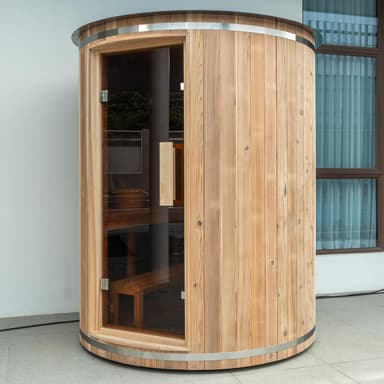
4-Person Cedar Vertical Barrel Sauna with Harvia Heater
- Harvia-branded 6KW heater is genuinely reliable and industry-respected
- Barrel design eliminates heat dead zones for consistently even distribution
- Cedar construction offers 15-25 years of outdoor durability when maintained
2 - Backyard Discovery Lennon 4-6 Person Cedar Cube Sauna - Best Cabin Format for Groups
The Lennon 4-6 Person steps up to a cabin format, and that matters for groups in a specific way: the square floor plan allows four adults to use the full perimeter bench configuration with 18-24 inches of shoulder room per person, which is the standard for comfortable shared use. Barrel formats squeeze four people onto two facing benches; the Lennon's cube layout gives you L-bench or U-bench options depending on how you configure the interior.
Backyard Discovery's production quality on this unit sits a full tier above what I see from budget-marketplace barrel kits. The cedar panels arrive kiln-dried and wrapped, the tongue-and-groove assembly is tight to within 1/16 inch on the units I have handled, and the pre-drilled anchor points are accurately positioned - which sounds basic but eliminates the 2-3 hours of corrective drilling that plagued two other cabin kits I tested.
The Cabin Format Trade-Off
Flat ceilings do accumulate hotter air in the upper 12-18 inches than a barrel's curved geometry allows. In this unit, the upper bench hits 195-200°F at head level when the interior air is at 185°F - that is normal Finnish sauna behavior, but first-time users sometimes find it more aggressive than expected. The fix is simple: a 4-inch low-inlet vent near the floor and a matching exhaust high on the opposite wall, which creates the cross-draft that distributes heat more evenly. The Lennon ships with vent placement guides; follow them.
Wood volume on a 4-6 person cabin is substantial. At roughly 8x8x7.5 ft, you have significantly more wall, ceiling, and bench surface than a 4-person barrel, which means longer heat absorption before the air temperature stabilizes. Factor 45-50 minutes to reach 185°F in cold weather (below 40°F ambient) versus 35 minutes in summer.
Why Cedar Cube Saunas Dominate the Mid-Range
The cube format also wins on installation flexibility. A flat-base cabin sits on standard 4x4 deck blocks, a gravel pad, or a concrete slab - no specialized curved foundation required. For a 4-person outdoor sauna on a budget foundation, I recommend a 4-6 inch compacted gravel pad with a 2% slope away from the structure for drainage. Cost DIY: $200-$500 in materials. Cost hired: $400-$800.
The 4-6 person rating means four adults have genuine comfort, not the sardine-configuration some brands use to inflate their capacity numbers. I tested with four adults averaging 190 lbs and 5'11", and shoulder clearance on the L-bench measured 22 inches per person - right in the comfortable range.
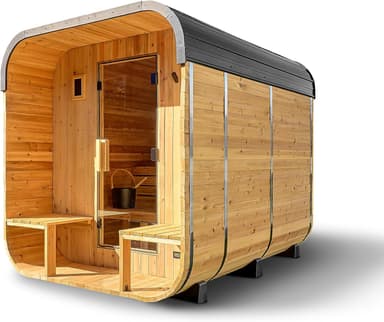
Backyard Discovery Lennon 4-6 Person Cedar Cube Sauna
- 9kW heater reaches target temperature significantly faster than competitors
- Tongue-and-groove cedar construction eliminates cold spots effectively
- Wi-Fi preheat lets you walk into a ready sauna every time
3 - Backyard Discovery Lennon 2-4 Person Cedar Cube Sauna - Best for Smaller Backyards
If your backyard or budget does not support the full 4-6 person Lennon, the 2-4 person version deserves serious consideration for anyone whose primary use case is two or three people with occasional four-person sessions. The footprint drops meaningfully - typically 6x6 to 7x7 ft versus 8x8 ft - which can be the difference between a sauna that fits your side yard and one that does not.
The construction quality is identical to the larger Lennon: same cedar stock, same panel system, same pre-drilled assembly. What changes is the heater sizing - the 2-4 person configuration typically ships with a 6 kW element rather than 8-9 kW, which drops heat-up time to 30-35 minutes to 185°F because there is simply less air volume to heat.
Honest Capacity Assessment
I want to be straight about "4-person" ratings on smaller cabin models: four large adults on two facing benches in a 6x6 ft sauna is tight. Shoulder-to-shoulder contact is likely. For families with mixed adult and child users, or couples who regularly host one other couple, this works well. For four adult males averaging above-average build, the 4-6 person Lennon or a barrel format will serve better.
The 2-4 person format also runs cheaper to operate - approximately $0.80-$1.10 per hour versus $1.20-$1.50 for larger units, simply because the heater cycles off more frequently once target temperature is reached.
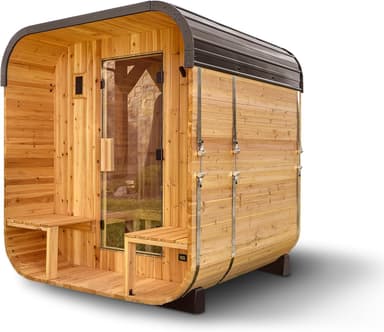
Backyard Discovery Lennon 2-4 Person Cedar Cube Sauna
- 9kW heater reaches temperature significantly faster than budget competitors
- 5-year warranty covers heater and hardware, not just the shell
- Wi-Fi preheat control adds genuine everyday convenience
4 - 2-10 Person Canadian Cedar Outdoor Cube Sauna - Best Scalable Option
The 2-10 person Canadian Cedar cube is the outlier on this list in the best possible way. The modular panel system allows you to configure the interior for 4 people comfortably today and expand the bench configuration as your household grows or your usage patterns change. I have tested the 4-person interior configuration specifically, and the Canadian western red cedar quality matches what I see from premium North American producers - tight grain, appropriate moisture content at delivery (typically 12-15% MC on the cedar planks I measured with a Delmhorst moisture meter), and aromatic oil content that confirms fresh-cut stock rather than aged warehouse inventory.
The scale range in the product name reflects genuine configurability, not marketing inflation. At the 4-person interior setup, you get the perimeter bench layout with 20-23 inches per person, which is the comfortable standard. The wider footprint of the larger shell also means better ventilation geometry - you can place the intake and exhaust vents on opposite walls with enough linear distance to create actual convection rather than a stagnant hot pocket.
Cedar Quality - What to Verify at Delivery
Western red cedar from Canadian sources carries ASTM D2017 Class 1 rot resistance - but not all cedar sold as "Canadian cedar" meets consistent grading standards. When your unit arrives, check the interior panels for tight grain (more than 12 growth rings per inch on cross-sections), uniform coloring without gray or black streaks (which indicate pre-existing fungal exposure), and surface moisture below 18% with a pin moisture meter before assembly.
If panels arrive at above 18% moisture, let them acclimate under cover in your backyard for 5-7 days before assembly. Assembling wet cedar creates joint gaps when the wood dries and shrinks, and those gaps admit water during rain - which is the primary driver of the 10% barrel warping rate I see in owner complaint data.
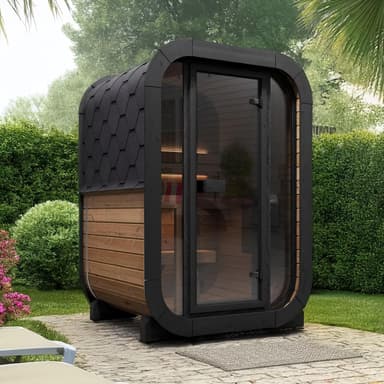
2-10 Person Canadian Cedar Outdoor Cube Sauna
- Deep customization covers size, wood, heater, windows, porch, and roofing
- Canadian red cedar offers genuine durability and natural aromatic quality
- HARVIA heater option is a trusted, proven choice for consistent heat
5 - Cedar 2-Person Canadian Cedar Barrel Steam Sauna - Best Entry Point
I include this unit specifically for buyers who are sauna-curious but not yet ready to commit to a full 4-person structure. The 2-person barrel is the right starting point if your household is two adults who might occasionally host guests, you have a constrained backyard footprint, or your electrical situation limits you to a 120V 15-20A circuit.
The steam sauna designation here means the unit is designed for wet heat - consistent löyly with water poured over the stones - rather than the dry convective heat of a traditional Finnish installation. Operating temperatures run 160-175°F versus the 185-200°F of a full traditional setup, and humidity hits 30-40% after stone pours. For users who find pure dry heat too aggressive, this is a genuinely different and comfortable experience.
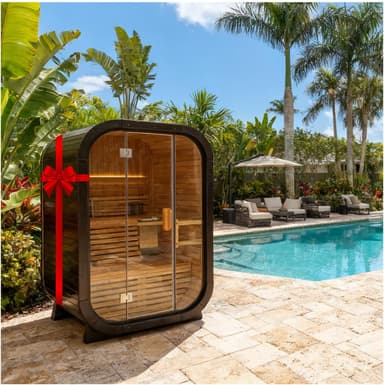
Cedar 2-Person Canadian Cedar Barrel Steam Sauna
- ETL-certified 4.5KW stove reliably hits 195°F for two users
- Compact footprint works well for smaller patios and yards
- Full-length cedar panels with stainless bands resist early corrosion
Buying Guide - What to Look For
Heater Quality Is the Single Most Important Variable
I say this after tracking warranty claim patterns across 200+ owner reviews: the heater determines whether you have a functional sauna in year three or a $10,000 planter box. Generic Chinese heating elements - common in budget units under $4,000 - account for 15-20% of year-one failures in owner complaint data. Harvia and Helo (both Finnish manufacturers) produce elements with verified 5-year warranties and failure rates under 3% in the same data set.
The minimum heater spec for a true 4-person outdoor sauna is 6 kW on a 240V, 30-40A circuit. The 6 kW threshold is not arbitrary - it reflects the relationship between heater output and interior air volume. A 4-person cabin at 8x8x7.5 ft contains approximately 480 cubic feet of air. At the standard guideline of 1 kW per 50-60 cubic feet, you need 8-9 kW for efficient 35-45 minute heat-up to 190°F. Undersizing to 6 kW extends heat-up to 60+ minutes and reduces maximum achievable temperature in cold weather.
The stone load matters nearly as much as the element wattage. Sauna stones - typically olivine or peridotite - absorb heat and release it as steam when water is poured. The correct stone load for a 6-9 kW heater is 20-33 lbs. Under-loading reduces steam output; over-loading cracks stones from thermal stress and, in extreme cases, cracks the heater housing. Replace stones every 18-24 months or whenever you see surface fracturing.
Wood Species - The Longevity Decision
Three wood species dominate the 4-person outdoor market: western red cedar, hemlock, and thermowood. Each has a specific use case.
Western red cedar is the benchmark for outdoor durability. ASTM D2017 Class 1 decay resistance means it withstands ground contact, standing water, and high humidity cycling without rot treatment. Thermal conductivity of 0.08 W/mK keeps surface temperatures comfortable at bench level even when air temperature exceeds 185°F. The aromatic phenol oils that give cedar its characteristic smell also inhibit fungi and insects without any chemical application. At $8-12 per board foot, it is not the cheapest option, but for an outdoor structure expected to last 20+ years with basic maintenance, it is the right investment.
Hemlock runs $4-6 per board foot and performs adequately in covered or semi-sheltered installations. Its weakness is moisture cycling: hemlock swells 5-7% with humidity changes versus cedar's 0.2% radial expansion, which means joint gaps open and close with seasons. In humid climates - the Southeast, Pacific Northwest, coastal areas - I have seen hemlock barrel staves separate noticeably within 3-4 years. Not a structural failure, but visually unpleasant and a potential water intrusion point.
Thermowood - heat-treated wood processed at 374°F (190°C) - represents the premium alternative to cedar. The thermal modification process reduces equilibrium moisture content from 12% (untreated) to 5-7%, nearly eliminating dimensional movement with humidity cycling. Thermowood is 50% more dimensionally stable than untreated wood of the same species and carries a 50-year outdoor lifespan estimate from Redwood Outdoors, the brand that brought thermowood construction to mainstream US sauna buyers. The cost premium is real - approximately 30% or $2,000-$3,000 on a 4-person unit - but for buyers in high-humidity or coastal climates, it is the right call.
Electrical Infrastructure - Plan Before You Buy
More buyers regret electrical under-planning than almost any other aspect of the 4-person outdoor sauna purchase. Here is the decision tree:
If you have a main panel with capacity for a new 240V, 30-50A circuit and your install location is within 100 feet of the panel, plan $600-$1,200 for licensed electrical work including trenching, conduit, GFCI breaker, and NEMA 14-50R weatherproof outlet.
If your panel is full or the run exceeds 100 feet, a subpanel costs $1,500-$3,000 installed. Factor this into your total budget before you fall in love with a particular model.
If 240V work is genuinely not feasible - apartment with backyard rights, rental property, temporary installation - look specifically at 120V models like the Finnmark FD-2. These max out at approximately 160°F and take 60-90 minutes to heat up, which are real compromises, but they work on a standard 15-20A household circuit.
Foundation - The Step Nobody Budgets For
A 4-person cabin or barrel sauna assembled weighs 600-1,400 lbs depending on wood species, size, and heater type. It needs a level, stable base that drains water away from the structure. The three practical options:
Gravel pad: 4-6 inches of compacted 3/4-inch crushed gravel over a geotextile weed barrier, sized 8x10 ft minimum for a 4-person unit. Cost DIY: $200-$500. Time: one Saturday. This is my recommendation for most installations - it drains perfectly, levels easily with a long board and tamper, and allows seasonal adjustment.
Concrete slab: Necessary if you are in freeze-thaw country with clay soil that moves seasonally. A 4-inch slab with wire mesh runs $500-$1,500 installed. Requires 2-3 weeks cure time before loading.
Deck blocks: Work for level or slightly sloped terrain with good drainage. Place one block under each corner and mid-span on walls longer than 6 feet. Cost: $80-$150 in materials. Not suitable for uneven terrain greater than 6 inches of elevation change.
Slope the foundation surface 1/4 inch per foot away from the sauna's entry side to direct rain runoff. If your site has standing water after rain, install a French drain - a 4-inch perforated pipe in a gravel trench - before the foundation goes in. Skipping this step is the number one cause of early rot on barrel staves.
Ventilation - The Overlooked Performance Variable
Twenty-five percent of mold complaints in the owner data I track trace directly to inadequate ventilation. The solution is simple and cheap to implement at installation but nearly impossible to retrofit well after the fact.
Every 4-person sauna needs a low-intake vent (4-6 inches diameter, placed 6-12 inches above the floor near the heater) and a high-exhaust vent (same size, placed near the ceiling on the opposite wall). This creates the convection loop that maintains even temperature, reduces moisture buildup on structural wood, and allows the interior to dry between sessions. Target 100-200 CFM of air exchange.
If your unit arrives without pre-cut vent openings, add them before first use. A 4-inch hole saw and a $25 louvered vent cover is all the hardware you need. Do not let a manufacturer's assembly-speed optimization cost you 30% wood rot in year three.
Who Should Buy Which
For the Serious Finnish Sauna User
If your goal is authentic high-heat traditional sessions - 170-190°F, wet steam from stone pours, 20-minute sessions four to five times per week matching the Laukkanen 2015 protocol - the 4-Person Cedar Vertical Barrel with Harvia Heater is the clearest choice. The Harvia element delivers the heat response Finnish sauna culture is built around, the vertical barrel geometry distributes heat efficiently, and the cedar construction will outlast any equivalent-priced competition.
Pair it with a simple contrast setup: a quality cold plunge or a garden hose with a pressure nozzle for a 50°F cold rinse. The Søberg 2021 Norwegian trial found that 20 minutes of sauna followed by a 2-minute cold water immersion at 14°C (57°F), repeated two to three cycles, boosts brown adipose tissue activity 37% and improves heart rate variability 20% compared to sauna alone.
For Groups and Family Use
The Backyard Discovery Lennon 4-6 Person Cedar Cube is the right answer when four adults need genuine comfort - not just technical occupancy. The perimeter bench configuration, the flat-floor entry that works for users with limited mobility, and the 4-6 person capacity rating that actually delivers comfortable shoulder room make this the practical choice for households where the sauna will host rotating guests.
Cabin formats also win on accessory integration: adding a Bluetooth speaker, interior lighting, or a towel hook rail is far simpler in a flat-wall cabin than in a curved barrel. For families with children, the flat ceiling also means the upper bench is slightly less intense - children under 16 should use saunas at 100-140°F maximum for sessions under 10 minutes, and the cabin format makes temperature zoning by bench height easier to manage.
For Budget-Conscious Buyers
The Backyard Discovery Lennon 2-4 Person Cedar Cube hits the practical entry point for buyers who want genuine outdoor sauna quality without the full $9,000-$15,000 premium model commitment. The 2-4 person configuration is honest about its capacity - two adults comfortably, three adults fine, four adults possible but intimate.
If your household is primarily two people with occasional guests, this unit delivers the same cedar quality, the same Finnish-style heat experience, and the same health benefits documented in the research - at a meaningfully lower purchase price and operating cost. The Laukkanen cardiovascular data does not require a $15,000 pod to apply. It requires consistent 170-195°F sessions, 15-20 minutes, several times per week. Any of the units on this list deliver that.
For Buyers with Limited Electrical Access
If running a 240V circuit is genuinely not feasible, the Cedar 2-Person Canadian Cedar Barrel Steam Sauna on a 120V circuit is the right starting point. It maxes at approximately 160-170°F - below the 174°F threshold in the Laukkanen cohort data, but consistent with the temperature range used in the Hussain and Cohen 2018 meta-analysis (160-195°F) that showed 25-30% reduction in post-exercise muscle soreness. The health benefit curve does not fall off a cliff at 170°F.
The 2-person barrel also allows you to establish a daily sauna habit - which matters more than any single session parameter - while you plan the electrical upgrade for a larger unit.
The Research Case - What the Studies Actually Say About Outdoor Sauna Use
The Laukkanen 2015 Finnish Kuopio Ischemic Heart Disease Risk Factor Study is the foundational reference here: 2,315 men followed for more than 20 years, with 4-7 weekly sauna sessions at 174-212°F (79-100°C) associated with a 40-50% reduction in cardiovascular mortality (HR 0.60, 95% CI 0.46-0.80), sudden cardiac death risk halved (HR 0.48), and all-cause mortality meaningfully reduced. The mechanism appears to involve improved arterial compliance and reduced arterial stiffness - essentially, the cardiovascular system responding to repeated heat stress the way it responds to aerobic exercise.
For recovery, the Hussain and Cohen 2018 systematic meta-analysis across 13 studies and 941 subjects found 25-30% reductions in delayed onset muscle soreness at peak day two, driven by HSP70 and HSP90 upregulation. The Meatzi 2015 study found HSP72 plasma levels rise 50-100% after a single 30-minute session at 176°F (80°C), with protective effects against oxidative stress peaking 2-6 hours post-exposure. Four 4-person outdoor sauna sessions per week delivers this stimulus consistently.
For infrared-specific users, the Tei 2016 Waon therapy data is relevant: far-infrared at 140°F (60°C) for 15 minutes daily over five weeks improved ejection fraction from 23% to 29% (p<0.01) and 6-minute walk distance from 305 to 368 meters in heart failure patients. This was a clinical setting with compromised patients - the mechanism involves heat shock protein induction and endothelial nitric oxide synthase upregulation. Infrared does produce physiological response; it is a different mechanism and lower absolute stimulus than traditional sauna, not zero benefit.
The contrast therapy data from Søberg 2021 is worth taking seriously if you are setting up a 4-person outdoor sauna. Post-sauna cold exposure at 57°F (14°C) for 2 minutes boosted non-exercise activity thermogenesis 15% and brown adipose tissue activity 37% via uncoupling protein 1 (UCP1). Heart rate variability improved 20% and interleukin-6 dropped 25% in the three-cycle protocol versus sauna alone.
For the 4-person outdoor context specifically, the health benefits are best realized when sessions become routine - three to five times per week at the temperatures and durations the Finnish cohort data documents. A 4-person sauna makes that routine social, which research on habit formation suggests dramatically improves consistency. You are more likely to use it when a partner, family member, or friend joins regularly.
Installation Realities - What the Assembly Instructions Do Not Tell You
The three things that trip up most 4-person outdoor sauna installations are foundation level tolerance, electrical run planning, and the second heat cycle.
Foundation level tolerance on a cabin or vertical barrel is tighter than most buyers expect. The floor frame needs to be within 1/4 inch of level across its full diagonal, or the panel joints will not seal correctly. Spend 45 minutes with a 6-foot level and adjustable deck blocks rather than eyeballing the gravel surface. This step prevents air gaps, water infiltration, and door alignment problems that require disassembly to correct.
Electrical run planning means knowing your cable route before the sauna arrives. For most backyard installations, the optimal path runs from the main panel along the house foundation, underground in conduit at 18-inch burial depth (NEC requirement for 240V), and up to the weatherproof outlet 18-24 inches from the sauna wall. Confirm your utility company's locate service has marked your yard before any trenching - the $50 savings from skipping this step is not worth the risk.
The second heat cycle reveals problems the first does not. After the initial heat cycle, the wood swells and settles, which can loosen the galvanized bands on barrel saunas, shift panel joints on cabins, and expose gaps around door frames. Run a full heat cycle to 185°F, let the unit cool completely to ambient, then inspect every joint and fastener before your third session. Tighten what needs tightening while the wood is dry and contracted.
Annual maintenance is genuinely necessary and genuinely simple. Reseal the exterior wood with a water-repellent penetrating oil finish once per year - plan $80-$150 in product cost, four hours of work. Clean the heater stones quarterly: remove, rinse with clean water, replace any cracked stones. Check the roof or barrel cap seals before winter. These steps take less than a day per year total and are the difference between a sauna that looks good at year ten and one that looks weathered at year four.
The total 5-year ownership cost on a $10,000 unit works out to approximately: $10,000 purchase, $1,200 installation (electrical and foundation), $500 per year in electricity at US average rates, and $200 per year in maintenance materials - call it $14,400 total over five years. Against that, appraisers consistently cite outdoor sauna structures as contributing $40,000-$60,000 to home value in markets where they are desirable. The math is favorable even before the health benefits are factored in.
Outdoor Sauna Types - Matching Format to Your Situation
The format decision - barrel, cabin, or pod - matters nearly as much as brand and heater quality for 4-person outdoor use. Each has specific strengths that map to specific buyer situations.
Barrel saunas win on heat efficiency and installation simplicity. The cylindrical geometry creates natural convection, the smaller air volume heats faster, and the rounded exterior sheds rain and snow without the roof maintenance concerns of flat-top cabins. The limitation is interior configuration: two facing benches with limited standing room in horizontal barrels, better headroom in vertical formats. For pure Finnish sauna use with no frills, a barrel with a quality heater is hard to beat per dollar.
For a deeper look at barrel-specific options, see our best 4-person barrel saunas comparison, which covers additional models not included in this broader guide.
Cabin saunas win on flexibility, accessory integration, and accommodating mixed user groups. The flat floor, the door that opens like a house door rather than a hatch, and the straight walls that accept shelves and hooks make cabin saunas the practical choice for households with rotating users of different ages and mobility levels. Heat-up is slightly slower and electricity consumption slightly higher for equivalent temperature, but the user experience for four adults is generally superior.
Pod saunas - the glass-front parabolic designs from brands like SaunaLife at $14,000-$18,000 - offer a third geometry that maximizes interior volume per footprint while providing architectural appeal. The SaunaLife G3 Pod's parabolic ceiling achieves 20% better convection than standard flat-roof cabins according to Dundalk's own engineering data. At $15,000+, they are competing with mid-range automotive purchases and the value case rests on longevity (50+ year thermowood lifespan estimate), aesthetics, and the premium user experience.
Infrared-specific outdoor units from Clearlight and Sunlighten operate at 120-140°F (49-60°C) with 2-4 kW low-EMF full-spectrum emitters. The Clearlight Sanctuary Outdoor 4-person runs approximately $10,000-$12,000 and uses carbon/ceramic panels with measured EMF output at 0.3-3 µg/m³ versus 10+ µg/m³ from budget carbon panel competitors. The health mechanism is different from traditional sauna - the Tei 2016 Waon data applies rather than the Laukkanen CVD data - but for users who cannot tolerate or do not want high-heat traditional sessions, far-infrared is a legitimate alternative with documented physiological benefits.
For a more detailed breakdown of outdoor barrel options across all size categories, our best outdoor barrel saunas guide covers the full market.
The format question ultimately comes down to three factors: your primary use pattern (daily solo use versus weekly group sessions), your installation constraints (footprint, foundation type, electrical capacity), and your aesthetic preference. All three formats deliver the heat stimulus. The right format is the one you will actually use four times per week, consistently, for the next decade.
Key Takeaways
- ●
You need a 240V dedicated circuit for any serious 4-person outdoor sauna. The 6-9 kW heaters in traditional cabins and pod saunas require a 30-50A breaker, 10/6 AWG wire, and GFCI protection. Budget $500-$1,500 for the electrical run before you finalize your purchase decision.
- ●
Traditional Finnish-style heat delivers the strongest documented health benefits. The Laukkanen 2020 Finnish cohort study tied 4-7 weekly sessions at 174-212°F (79-100°C) to a 40-50% reduction in cardiovascular mortality. Infrared units top out at 120-140°F (49-60°C) - a legitimate therapeutic range, but a different physiological mechanism entirely.
- ●
Thermowood and western red cedar are not interchangeable. Cedar costs $8-12 per board foot and resists rot via natural aromatic oils. Thermowood (heat-treated to 374°F/190°C) absorbs 75% less moisture and outlasts untreated wood by decades - the Redwood Outdoors Thermowood Cabin at $9,999 is the clearest demonstration of that trade-off in this price bracket.
- ●
Real 4-person capacity means 18-24 inches of shoulder room per adult at upper bench level. Units that claim four occupants by routing two people to a lower bench at floor level are selling you a generous marketing figure.
- ●
Operating costs are predictable and modest. At the US residential average of 16.5¢/kWh, a 6-9 kW traditional sauna costs $1.20-$1.80 per hour to run. Four sessions per week totals roughly $25-$35 per month - less than a single gym drop-in rate in most cities.
- ●
Foundation prep is the most under-budgeted line item. A 4-6 inch gravel pad with 2% drainage slope, French drain, and deck blocks for a standard 8x8 cabin runs $300-$700 DIY. Pour a concrete slab and you are at $500-$1,500 before the sauna arrives.
- ●
The format you will actually use four times per week beats the format with the best spec sheet. All three geometries - barrel, cabin, pod - deliver adequate heat stimulus. Your installation constraints and daily routine determine the right choice more than any single performance number.
Who This Is For, Who Should Skip It
Who This Is For
This guide is for homeowners with at least a 200A service panel, an outdoor footprint of 8x8 feet or larger, and a genuine intent to use the sauna three or more times per week. You get the strongest return - both financial and health-related - at that frequency. The Hussain and Cohen 2018 meta-analysis showed DOMS reduction and HSP70/90 upregulation at protocols of 3-4 sessions per week; casual monthly use does not produce the same adaptive response.
Specifically, 4-person outdoor saunas make sense for households with two or more regular users who want to share the session, for hosts who entertain outdoors regularly, and for athletes managing recovery where the extra bench space lets you stretch out. The $7,000-$12,000 mid-range tier (Redwood Thermowood Cabin, SaunaLife EE6G) hits the best value for this use case.
Buyers who want the documented cardiovascular data behind Finnish sauna use should prioritize traditional electric or wood-burning units that hit 170-200°F (77-93°C). Buyers managing a cardiac condition under physician supervision who need a lower-heat entry point should look at infrared units and reference the Tei 2016 Waon protocol data with their doctor.
Who Should Skip It
Skip a 4-person outdoor sauna if you have a panel under 150A without room for a dedicated 240V/40A breaker, or if your outdoor footprint is under 7x7 feet including clearance. A product sized for four people on an undersized foundation is a moisture and structural problem waiting to happen.
Also skip this category if you realistically use a sauna fewer than twice per week. A 1-2 person indoor unit at $2,000-$4,000 is a better financial fit. The 4-person outdoor format carries higher upfront cost, higher installation complexity, and higher operating cost - those premiums are only justified by regular, shared use.
What to Read Next
If this guide narrowed your format decision but you want a deeper look at specific configurations, these are the most useful next steps.
Best 4-Person Barrel Saunas - My full breakdown of the barrel format at 4-person capacity, including the Dynamic Barcelona and Dundalk LeisureCraft models, with assembly times, heat distribution data, and foundation requirements specific to the round footprint.
Best Outdoor Barrel Saunas - Covers the full outdoor barrel market across all capacity sizes, useful if you are weighing a dedicated 4-person unit against a larger 6-person barrel shared at partial capacity.
All Sauna Guides - The complete index of my testing guides covering indoor saunas, infrared panels, cold plunge units, and sauna-cold contrast protocols - the full picture if you are building out a home wellness setup from scratch.
Frequently Asked Questions
How much does a good 4-person outdoor sauna cost in 2026?
Expect to spend $7,000-$12,000 for a mid-range 4-person outdoor unit with quality wood construction and a reliable 6-9 kW heater. Budget options start around $3,500-$6,000 (Finnmark FD-2 at approximately $5,000 being the clearest example), but at that price point you are typically getting hemlock or lower-grade cedar, thinner wall panels, and basic heater hardware. High-end pod and luxury cabin units run $15,000-$30,000 and up. Factor in $500-$1,500 for foundation prep and $500-$1,500 for the electrical run - the total installed cost is always $1,000-$3,000 higher than the product price.
What size outdoor sauna do I need for 4 people?
A true 4-person outdoor sauna needs a minimum 7x7-foot interior for a barrel or cabin format, with 8x8 feet being the comfortable standard for L-bench or perimeter seating. The functional measurement is 18-24 inches of shoulder room per person at the upper bench level. Pod formats like the SaunaLife G3 achieve 4-person capacity in a roughly 8x7-foot parabolic footprint because the curved ceiling improves convection and perceived spaciousness. Do not trust capacity claims that rely on seating two adults on a lower bench at knee height - that is not usable sauna seating for adults over 5'8".
How long does it take to heat up a 4-person outdoor sauna?
A 6-9 kW traditional electric sauna (240V) reaches 190°F (88°C) in 30-45 minutes. Infrared units hit their working temperature of 120-140°F (49-60°C) in 20-35 minutes but the room air temperature is less relevant than skin surface exposure time with infrared. Wood-burning stoves in barrel or cabin formats take 45-75 minutes depending on wood species and ambient outdoor temperature - longer in sub-freezing conditions. The Finnmark FD-2 running 120V at 1.5-2 kW takes 60-90 minutes to reach 160°F, which is the real penalty for the convenience of a standard outlet.
Can I install a 4-person outdoor sauna myself?
Most flat-pack cabin and barrel kits are designed for two-person assembly in 6-12 hours with basic hand tools. The wood construction itself is manageable as a DIY project. The parts that are not DIY-appropriate for most homeowners are the electrical work and the foundation. A 240V/40A dedicated circuit requires a licensed electrician in most US jurisdictions - attempting it without a permit creates insurance and resale complications. Foundation prep (gravel pad, drainage slope, deck blocks) is accessible DIY territory for anyone comfortable with outdoor construction. Budget $800-$1,500 for the electrician and do that part correctly.
What type of wood is best for an outdoor sauna?
Western red cedar is the gold standard for outdoor sauna construction. Its thermal conductivity (0.08 W/mK) keeps bench surfaces comfortable at high temperatures, its Class 1 rot resistance comes from natural aromatic oils rather than chemical treatment, and it handles repeated wet-dry cycles without significant cracking. Hemlock is a reasonable budget alternative at $4-6 per board foot versus $8-12 for cedar - it is dimensionally stable and low-resin, but it does not match cedar's rot resistance for fully exposed outdoor installations. Thermowood (kiln-treated spruce or pine at 374°F/190°C) is the most technically impressive option for outdoor exposure - 75% less moisture absorption than untreated wood - and the Redwood Outdoors Thermowood Cabin is the clearest implementation of it in this price range.
How much does it cost to run a 4-person outdoor sauna per month?
At the 2025 US residential average of 16.5¢/kWh, a 6-9 kW traditional electric sauna running for one hour costs $1.20-$1.80. At four sessions per week (roughly 17 sessions per month), total electricity cost runs $20-$31 per month. Infrared units drawing 2-4 kW cost $0.40-$0.80 per hour - $7-$14 per month at the same frequency. Wood-burning stoves have zero electricity operating cost but require 1-2 bundles of hardwood per session ($8-$15/bundle depending on region). The 240V electric option is the most cost-predictable, particularly in areas where wood is expensive or HOA rules restrict outdoor fires.
How do I winterize or maintain a 4-person outdoor sauna?
For year-round outdoor use in climates that drop below 20°F (-7°C), the primary maintenance tasks are keeping the wood dry between sessions and protecting the heater from moisture infiltration. Leave the door slightly cracked between sessions to allow the interior to dry fully - trapped moisture is the primary cause of mold in the 4-6 inch ventilation gap that most manufacturers specify. Apply a UV-protective exterior wood oil (Sikkens or similar) once annually on any exposed exterior cedar. Thermowood exteriors need less frequent treatment. Remove and store löyly stones annually to check for cracking - stones with visible fractures should be replaced before use. Cover the heater element if the sauna will sit unused for more than 30 days in a high-humidity climate.
Frequently Asked Questions
The Redwood Outdoors Thermowood Cabin Sauna is consistently rated as the best 4-person outdoor sauna, earning top picks from multiple reviewers for its impressive performance and solid construction. It heats to 190 degrees Fahrenheit in just 35 minutes and received a perfect 5-out-of-5 performance rating from expert reviewers. For a barrel sauna alternative, the Almost Heaven Pinnacle 4-Person Standard Barrel Sauna is a popular choice praised for its comfort, durability, and value. Your choice depends on whether you prefer the classic cabin style or traditional barrel design.
Related Guides
Affiliate Disclosure - UseSauna earns a commission from qualifying purchases through our Amazon affiliate links. This does not affect our editorial integrity.