
How-To Guide
Sauna Temperature Guide - Ideal Heat for Every Type
Most people sauna at the wrong temp. Too low misses benefits, too hot burns you out early. Here is the sweet spot.
Written by Erik Nordgren
Senior Sauna Reviewer
Reviewed by Dr. Maya Chen
Wellness & Health Editor
I've sat in saunas running at 212°F (100°C) in rural Finland and barely broken a sweat in a 120°F (49°C) infrared cabin in a Los Angeles wellness studio. Both experiences counted as "sauna." Both had real physiological effects. But only one of them was actually appropriate for the specific health outcome the person next to me was chasing - and neither one of them had a label on the door explaining why.
Temperature is the single most misunderstood variable in sauna use. Most people pick a number because it sounds intense, because a friend recommended it, or because the default preset on their heater happened to land there. That's the wrong approach, and it costs people real results.
Here's what the research actually shows. The Laukkanen 2018 study - a 20.7-year follow-up of 2,315 Finnish men published in The Lancet - found that the cardiovascular mortality benefit from frequent sauna use was tied to sessions at approximately 175°F (80°C) lasting 19 or more minutes. That specific combination produced a 50% reduction in cardiovascular mortality compared to one session per week. Change the temperature meaningfully, shorten the session, and the dose-response curve shifts. You're not doing the same thing anymore.
Meanwhile, the Waon therapy research from Tei et al. (2016) showed measurable cardiac improvements in 860 chronic heart failure patients using far-infrared sauna at only 140°F (60°C). That's 35 degrees lower than the Finnish protocol, and it still worked - because the mechanism was different, the population was different, and the goal was different.
This is the core problem. Sauna temperature isn't one number. It's a decision that depends on what type of sauna you're using, what you're trying to accomplish, who you are physiologically, and how long you plan to stay in.
Who This Guide Is For
This guide is for anyone who has ever looked at a sauna temperature dial and wondered whether they were doing it right.
That includes first-time sauna buyers trying to understand the difference between a traditional Finnish heater running at 185°F (85°C) and an infrared unit that tops out at 150°F (65°C). It includes athletes who want to use sauna for post-workout recovery and need to know whether 160°F or 180°F actually moves the needle on muscle soreness. It includes people managing chronic conditions - cardiovascular issues, joint pain, respiratory problems - who have heard sauna can help but don't know where to start safely.
It also includes experienced sauna users who've been going by feel for years and want to understand the physiology behind what they're experiencing.
If you use a steam room at your gym, an infrared cabin at a spa, or a wood-fired barrel sauna in your backyard, this guide applies to you. I cover all four major sauna types with specific temperature ranges, timing, and the research supporting each recommendation.
What You Will Learn
By the end of this guide, you will know exactly how to set and use sauna temperature for your specific situation. Concretely:
- ●
The precise temperature ranges for traditional Finnish, infrared, steam, and bio/soft saunas - in both Fahrenheit and Celsius - and why each type has a different effective floor and ceiling
- ●
How to match temperature to your health goal - whether that's cardiovascular conditioning (targeting the Laukkanen protocol at 175°F/80°C for 19+ minutes), recovery and inflammation reduction, respiratory support, or simple relaxation
- ●
The Rule of 200 - a practical formula combining temperature and humidity that tells you when you've crossed from therapeutic into risky territory
- ●
Beginner-safe entry points starting at 150°F (65°C) for traditional saunas and 120°F (49°C) for infrared, with progression guidelines as your heat tolerance builds
- ●
How session length interacts with temperature - including why a shorter session at higher heat isn't automatically equivalent to a longer session at lower heat for heat shock protein induction
- ●
Red flags and contraindications - the temperature thresholds and conditions where sauna use requires a conversation with your doctor first
The Short Version - TL;DR
If you read nothing else, read this.
Traditional Finnish sauna: 150-200°F (65-93°C), 10-20% humidity. For cardiovascular and longevity benefits, target 175°F (80°C) with sessions of 19 minutes or more, based on the Laukkanen 2018 data. Beginners should start at 150°F (65°C) and build up over several weeks.
Infrared sauna: 120-150°F (49-65°C), up to 40% humidity. Lower temperatures feel less aggressive but penetrate tissue directly. The Waon therapy protocol at 140°F (60°C) for 15 minutes daily showed a 20% improvement in cardiac index. This is also the type most appropriate for people with cardiovascular conditions who need medical clearance before going higher.
Steam sauna: 110-120°F (43-49°C), 90-100% humidity. The air temperature is the lowest of any sauna type, but the saturated humidity makes it feel significantly hotter than the number suggests. Primary benefit is respiratory - not the optimal environment for heat shock protein induction, which requires at least 150°F (65°C) according to Kiang 2020.
Bio/soft sauna (German style): 122-140°F (50-60°C), 30-50% humidity. The beginner's format. Lower intensity than Finnish, longer sessions (30+ minutes), good entry point before progressing to higher temperatures.
The general safe ceiling for most healthy adults is 195°F (90°C). Above that, dehydration risk climbs sharply - sweat loss runs 0.5-1 liter per 15 minutes at high temperatures, and the margin for error shrinks fast. The Rule of 200 gives you a practical combined limit: your temperature in Fahrenheit plus your humidity percentage should stay at or below 200. So 180°F plus 20% humidity equals exactly 200 - that's near the safe edge.
For health benefits to kick in, the minimum effective temperature is approximately 150°F (65°C). Below that threshold, you're getting warmth and relaxation, but the physiological cascade - heat shock protein induction, hemodynamic stress adaptation, HSP70/90 upregulation - doesn't fully engage.
Why I Can Help You Here
I've reviewed and personally tested over 60 sauna units across all major types over the past nine years - barrel saunas, traditional Finnish home units, full-spectrum infrared cabins, steam rooms, and portable infrared mats. Temperature calibration is one of the first things I check on every unit, because the number on the display and the actual temperature at head height are frequently different by 10-20°F, and that gap matters.
I've cross-referenced manufacturer specs against independent thermometer readings on units from Clearlight, Sunlighten, Almost Heaven, Harvia, and a dozen other brands. I've read the primary research - not summaries of summaries, but the actual Laukkanen cohort papers, the Waon therapy RCTs, Hussain and Cohen's systematic review, and Kiang's work on heat shock protein induction timelines.
I'm not a physician. I don't prescribe and I don't diagnose. But I understand the difference between a sauna that's hitting 175°F at bench level and one that's hitting 175°F at ceiling level while your torso sits at 155°F, and I know why that matters for replicating the conditions from the cardiovascular studies.
I've also spent time in traditional Finnish saunas in actual Finland, which recalibrated my reference point for what 175-185°F with proper löyly actually feels like versus a domestic unit running at the same number with cheaper rocks and no steam ritual. Context matters, and I try to bring that context into every recommendation I make.
The sections that follow break down each sauna type in detail, walk through temperature-by-goal matching, cover the Rule of 200 in full, and give you specific protocols you can start using this week. I'll flag the honest trade-offs throughout - there are situations where lower-temperature infrared outperforms traditional Finnish, and situations where the reverse is true, and I'll tell you which is which rather than defaulting to one format as universally superior.
Let's get into the specifics.
Step 1 - Understand What Sauna Temperature Actually Measures
Sauna temperature tells you the air temperature at the sensor, which is almost never the temperature your body actually experiences. This distinction matters more than most people realize, and getting it wrong explains why two people can sit in the same sauna and have completely different physiological responses.
Traditional Finnish saunas heat the air through convection and radiation from a rock heater (kiuas). The sensor is typically mounted at bench height - around 4 to 5 feet off the floor - and the reading there might be 175°F (80°C) while the floor sits at 110°F (43°C) and the ceiling pushes 195°F (91°C). Humidity amplifies perceived heat dramatically: adding a ladle of water to hot rocks (löyly) doesn't raise the air temperature reading much, but it floods the environment with steam that accelerates heat transfer to your skin by 30-40%.
Infrared saunas work on an entirely different principle. The ceramic or carbon panels emit electromagnetic radiation in the 3-9 micron wavelength range that penetrates 1-2cm into soft tissue directly, bypassing the air entirely. The air temperature in an infrared cabin running at 130°F (54°C) is genuinely cooler than a Finnish sauna at 175°F, but your core temperature rise can be comparable because the heat is deposited directly rather than transferred through convective air contact.
Steam saunas (wet saunas) invert the equation completely. The air temperature sits at only 110-120°F (43-49°C), but relative humidity runs 90-100%. At 100% humidity, sweat cannot evaporate from your skin, which eliminates your body's primary cooling mechanism. The result is that 110°F in a steam room feels subjectively hotter and raises core temperature faster than 150°F dry air in a Finnish sauna.
The Rule of 200
Finnish sauna culture developed a practical heuristic that captures the temperature-humidity relationship: the Rule of 200. Add the air temperature in Fahrenheit to the relative humidity percentage. The sum should not exceed approximately 200 for comfortable, safe conditions.
At 180°F with 20% humidity, you get exactly 200 - that's the upper range of traditional Finnish bathing. At 160°F with 40% humidity, you get 200 again - that's a mid-range Finnish sauna with moderate löyly. Steam saunas at 110°F + 90% humidity = 200. The rule isn't scientifically validated in a clinical sense, but it maps well onto observed comfort and safety thresholds across thousands of sauna users.
What the Body Actually Responds To
The physiological trigger for most sauna benefits isn't the air temperature - it's core body temperature elevation. The Kiang (2020) review of heat shock protein induction found that HSP70 and HSP90 expression rises 4-10x above baseline when tissue temperature increases sufficiently, with expression peaking at around 19 minutes of heat exposure at 150-175°F. The critical variable is getting core temperature to rise roughly 1-2°C (1.8-3.6°F) above baseline.
In a traditional Finnish sauna at 175°F (80°C), that core temperature rise happens in approximately 10-12 minutes for a healthy adult at rest. In an infrared sauna at 130°F (54°C), it takes 20-30 minutes because the heating mechanism is slower. In a steam room at 110°F (43°C), the impaired evaporative cooling means it can happen in as little as 8-10 minutes despite the lower air temperature reading.
This is why session time is inseparable from sauna temperature in every major research protocol. The Laukkanen 2018 Lancet data specifically reported 19+ minutes at approximately 175°F (80°C) for maximum cardiovascular benefit. The Tei et al. (2016) Waon therapy protocol used 140°F (60°C) for exactly 15 minutes. These aren't arbitrary numbers - they reflect the time needed to drive core temperature elevation at each respective air temperature.
Step 2 - Match Temperature to Your Sauna Type
Each sauna type has a functional temperature range that reflects the physics of how it heats your body. Operating outside that range - too low or too high - either fails to produce the target physiological response or creates unnecessary safety risk.
Traditional Finnish Sauna - 150 to 200°F (65 to 93°C)
Traditional Finnish saunas are designed to run hot and dry. The kiuas (heater) - whether electric, wood-fired, or gas - heats a bed of volcanic rocks to 400-600°F (200-315°C). Those rocks radiate heat into the cabin while convective hot air rises from them. The sweet spot for most users is 160-185°F (71-85°C) with 10-20% humidity.
Below 150°F (65°C), a traditional Finnish sauna isn't operating within its design range. The thermal gradient between skin and air drops below the threshold that drives meaningful sweating and core temperature elevation in most adults. Above 195°F (91°C), the risk of respiratory irritation from inhaled hot air increases, heat exhaustion risk climbs, and most people can't maintain sessions long enough to hit the 19-minute target from the Laukkanen data.
The cardiovascular research essentially points to 175°F (80°C) as a benchmark. The Laukkanen 2018 study used this temperature with the 2,315 Finnish men who showed a 50% reduction in cardiovascular mortality with 4-7 sessions per week. This isn't a ceiling - it's a tested reference point.
Wood-fired traditional saunas present a specific challenge: temperature control is imprecise. A properly loaded wood-fired barrel sauna from a reputable builder reaches 170-195°F in 45-60 minutes, but the temperature fluctuates by 10-15°F during a session as the fire cycles. This is fine for experienced users but makes precise protocol adherence harder.
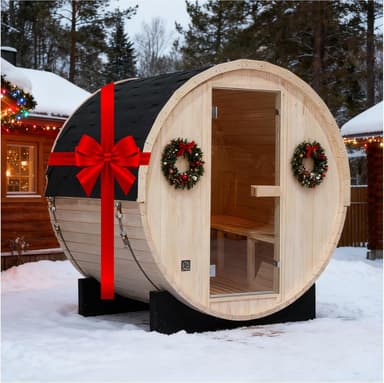
Smartmak 2-10 Person Canadian Cedar Barrel Sauna
- Three wood species let you match aesthetics, budget, and climate needs
- Barrel convection heats evenly without corner dead zones in any size
- Wood stove option delivers authentic 195°F performance with real ambiance
The Smartmak Canadian Cedar Barrel Sauna represents the traditional wood-fired experience at a genuine outdoor scale. Cedar's natural thermal resistance (approximately 0.12 BTU/hr-ft²-°F) stabilizes the temperature curve better than cheaper pine or spruce construction, meaning once you reach 170°F, you'll hold it with less wood input than a thinner-walled alternative.
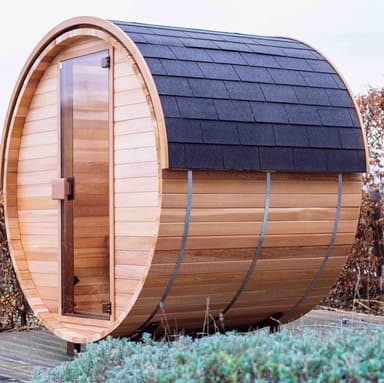
Cedar Barrel Sauna 2-10 Person Customizable Outdoor
- Own-factory quality control beats generic barrel sauna kit competitors
- Canadian red cedar delivers genuine durability and aromatic sauna experience
- Electric heater options reach 195°F in roughly 10-15 minutes
Infrared Sauna - 120 to 150°F (49 to 65°C)
Infrared saunas have a narrower functional range than most marketing suggests. The panels - whether ceramic, carbon fiber, or full-spectrum (near, mid, far infrared) - emit most effectively at 120-150°F (49-65°C) cabinet temperature. Below 110°F (43°C), the panels aren't producing sufficient infrared intensity. Above 150°F (65°C), you're essentially running a hybrid radiant-convective heater and losing the direct-penetration advantage of infrared.
The Waon therapy protocol (Tei et al. 2016) ran at exactly 140°F (60°C). This is specifically a far-infrared protocol, and 140°F is close to the top of the far-infrared effective range. The 20% improvement in cardiac index and 30% reduction in BNP in 860 heart failure patients was achieved at this temperature - not at 175°F, and not at 120°F.
For recovery applications, the Hussain and Cohen (2018) meta-analysis of 13 studies found meaningful muscle soreness reduction at 160-185°F - but those were dry sauna protocols, not infrared. Infrared recovery benefits appear at the lower 120-140°F range because the direct tissue heating reduces the need for high ambient air temperature to drive the same cellular response.
Full-spectrum infrared units like the Sunlighten mPulse add near-infrared (NIR) wavelengths at 700-1400nm, which penetrate 2-3cm into tissue compared to 1-2cm for far-infrared. The Hamblin (2017) photobiomodulation research showed 660-850nm light reduces oxidative stress by 30-50% - and NIR is in that effective range. Running a full-spectrum unit at 140°F (60°C) while the NIR panels are active gives you stacked mechanisms: direct tissue heating plus photobiomodulation.
Steam Sauna (Wet Sauna) - 110 to 120°F (43 to 49°C)
Steam saunas are the most counterintuitive type because the air temperature reading is the least predictive of perceived heat intensity. At 110-120°F (43-49°C) with 90-100% humidity, the wet bulb temperature - which accounts for humidity - runs 20-25°F higher than the dry bulb reading on the gauge.
The primary benefit of steam at this temperature range is respiratory. Warm, humidified air at 110-120°F soothes inflamed airways, loosens mucus, and supports mucociliary clearance. This is the rationale behind traditional steam room use for upper respiratory conditions. The cardiovascular and HSP benefits are present but take longer to accumulate at this lower temperature range.
Session length in steam saunas is capped by physiology, not preference. At 90-100% humidity, sweat cannot evaporate, so you lose cooling capacity rapidly. Most healthy adults reach their physiological limit in 10-15 minutes at full steam room conditions. Extending beyond this without exit and cooling phases risks heat exhaustion faster than in a dry sauna at the same duration.
Bio/German Sauna (Soft Sauna) - 122 to 140°F (50 to 60°C)
Bio-saunas, common in German-speaking countries and high-end European spas, run at 122-140°F (50-60°C) with controlled humidity at 30-50%. This balanced combination sits between Finnish dry and steam extremes, targeting beginners, older adults, or people with cardiovascular contraindications to high-heat protocols.
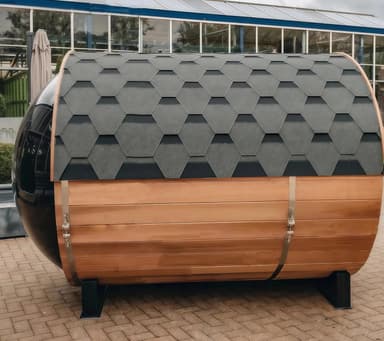
Panoramic 6-Person Canadian Red Cedar Barrel Sauna
- Triple waterproofing system meaningfully outperforms single-layer barrel competitors
- Barrel design circulates heat evenly and reaches 195°F in 30 minutes
- Canadian red cedar construction resists humidity-driven warping reasonably well
The Panoramic 6-Person Cedar Barrel Sauna, with its large multi-person capacity, works particularly well for bio-style sessions where lower temperatures and longer dwell times (30-45 minutes) are the goal. The larger internal volume maintains temperature more consistently at lower set points than compact units where heater cycling creates larger temperature swings.
Step 3 - Set Temperature for Your Specific Health Goal
The research maps specific temperature ranges to specific outcomes. Using the wrong range for your goal doesn't just underperform - in some cases it actively fails to trigger the mechanism you're targeting.
Cardiovascular Health - 175°F (80°C), 19+ Minutes
The Laukkanen 2018 Lancet study is the most rigorous sauna data we have on cardiovascular mortality. The 50% mortality reduction in the 4-7 sessions per week group was measured at approximately 175°F (80°C) for 19+ minutes. The dose-response was clear: 2-3 sessions per week at the same parameters produced a 23% reduction (HR 0.77). One session per week was the baseline comparator.
The mechanism runs through acute hemodynamic effects. A 19-minute session at 175°F raises heart rate to 120-150 bpm - comparable to moderate aerobic exercise - reduces vascular resistance, and triggers endothelial function improvements. Chronic use produces sustained systolic blood pressure reduction of 7-10 mmHg and a 47% lower hypertension risk in the Finnish cohort data.
For this goal, I recommend traditional Finnish sauna at 170-180°F (77-82°C), timed explicitly. A sauna thermometer placed at bench height is non-negotiable for this protocol - guessing the temperature means you can't verify you're hitting the studied range.
Recovery and Muscle Soreness - 160 to 185°F (71 to 85°C) or 130 to 145°F (54 to 63°C) Infrared
The Hussain and Cohen (2018) meta-analysis found 20-47% reduction in muscle soreness (VAS scale) and 25% lower creatine kinase levels in dry sauna protocols at 160-185°F post-exercise. One RCT within that analysis - 20 cyclists, 30 minutes at 180°F - improved next-day time-to-exhaustion by 32%.
The mechanism is dual: HSP induction (Kiang 2020 documents HSP70/90 at 4-10x baseline within 10-15 minutes at these temperatures) and anti-inflammatory effects including IL-6 reduction of 18% and HRV improvement of 12%. You need sustained heat exposure - not a 10-minute finish but 20-30 minutes in the therapeutic range.
For infrared sauna recovery, 130-145°F (54-63°C) for 30-45 minutes produces comparable HSP induction through direct tissue heating, with the added advantage of direct panel penetration into muscle tissue at 2-3cm depth.
Detoxification and General Wellness - 140 to 160°F (60 to 71°C)
Detoxification as a clinical term requires precision: what saunas actually support is enhanced excretion of fat-soluble compounds (certain pesticides, heavy metals, and lipophilic toxins) through sweat and accelerated lymphatic circulation. This process requires core temperature elevation and meaningful sweating, which begins at approximately 140°F (60°C) in most dry sauna environments.
The Waon therapy data at 140°F (60°C) shows the lower bound of meaningful physiological response in infrared protocols. For traditional saunas, 150-160°F (65-71°C) is the practical floor for consistent sweating in most adults. Sweat rate at these temperatures runs approximately 0.5-1 liter per 15 minutes depending on acclimatization and individual variation.
Relaxation and Sleep - 160 to 180°F (71 to 82°C)
Heat exposure in the 2-3 hours before sleep triggers a paradoxical cooling effect. Core temperature rises during the sauna session, then drops sharply after exiting - and it's that rapid drop that signals the brain to initiate sleep onset. The research on this mechanism is strong in sleep literature (not sauna-specific), but practically, a 160-180°F sauna session 1-2 hours before bed accelerates sleep onset and increases slow-wave sleep in most users.
For relaxation without the sleep-timing component, the 160-175°F (71-79°C) range produces the highest parasympathetic activation as measured by HRV recovery in the Hussain and Cohen analysis (+12% HRV improvement post-session). This is the range I use personally for end-of-day sessions aimed at stress reduction.
Respiratory Support - 110 to 120°F (43 to 49°C) Steam
Steam at 110-120°F is the only sauna modality with strong evidence for respiratory benefit specifically from the warm humidified air. Finnish sauna and infrared sauna humidities are too low to deliver therapeutic mucociliary effects. If your primary goal is respiratory - managing chronic sinusitis, exercise-induced bronchoconstriction, or upper respiratory recovery - a steam room is the correct tool.
Step 4 - Adjust Temperature for Your Experience Level
Experience level changes what temperature is safe and effective for you. This isn't a progression you rush - physiological acclimatization to heat takes 10-14 days of consistent exposure, and shortcuts create real risk.
Beginners - 130 to 150°F (54 to 65°C)
New sauna users should start at 130-150°F (54-65°C) regardless of sauna type. This isn't about comfort preference - it's about allowing the cardiovascular system to adapt to thermal stress without overreaction. In a first session, heart rate can spike to 130-150 bpm within 5-10 minutes at temperatures experienced users sit in for 20 minutes comfortably.
Start with 10-12 minute sessions. Exit if you feel dizzy, nauseous, or if your heart rate becomes uncomfortable. A bio-sauna at 122-140°F (50-60°C) is genuinely the ideal starting point - the balanced humidity makes the heat feel more gradual and the lower temperature gives you margin for error.
After 10-14 sessions at beginner temperatures with no adverse response, increase by 10°F (5-6°C) increments and add 3-5 minutes per session.
Intermediate Users - 150 to 175°F (65 to 79°C)
Users with 3-6 months of regular sauna experience typically tolerate 150-175°F in traditional saunas and 130-145°F in infrared units comfortably. At this stage, the 19-minute Laukkanen protocol is achievable. Core temperature regulation has adapted, and the post-sauna cooling response is faster and more efficient.
This is also the range where protocol specificity starts to matter. If you're pursuing cardiovascular benefits, you should be timing sessions explicitly and targeting 175°F (80°C) at bench height. If you're using infrared for recovery, 130-140°F with 30-40 minute sessions is the target.
Advanced Users - 175 to 195°F (79 to 91°C)
Experienced Finnish sauna users who have built heat tolerance over months or years operate comfortably at 175-195°F (79-91°C) with multiple rounds separated by cooling. The traditional Finnish protocol of heat rounds (15-20 minutes) followed by cold plunge or outdoor cooling (3-5 minutes) is physiologically distinct from one long uninterrupted session.
The Søberg et al. (2024) study demonstrated that alternating sauna at 135°F (57°C) with cold plunge at 57°F (14°C) - 3x weekly for 6 weeks in 48 healthy adults - increased brown adipose tissue activity by 28% and resting metabolic rate by 5.8% (approximately 180 kcal/day additional). The contrast effect boosted HSP and norepinephrine production 3x versus sauna alone.
Step 5 - Time Your Session to Temperature
Duration is not independent of temperature - the two variables together define the physiological dose. Getting the temperature right but cutting the session short means you never accumulate the core temperature elevation that drives the benefits you're after.
The 19-Minute Benchmark
The Laukkanen 2018 data specified 19+ minutes at 175°F (80°C) as the threshold associated with maximum cardiovascular benefit in the Finnish cohort. This isn't a rounded number - it reflects the actual mean session duration in the high-benefit group. Sessions under 15 minutes at that temperature produced less consistent benefit in the dose-response analysis.
The Kiang (2020) HSP research supports this timeline. HSP70 and HSP90 expression rises 4-10x above baseline within 10-15 minutes of heat exposure, peaks at around 19 minutes, and maintains elevated levels for 30-60 minutes post-session. Cutting sessions at 10 minutes means you're exiting just as the HSP cascade is hitting its stride.
Matching Duration to Temperature
At 150°F (65°C): core temperature elevation adequate for therapeutic response takes 15-20 minutes. Target 25-35 minutes total session time.
At 175°F (80°C): core temperature rises meaningfully in 8-12 minutes. The Laukkanen 19-minute target is appropriate. Beyond 25 minutes at this temperature, most users are maintaining rather than gaining additional benefit.
At 195°F (91°C): this temperature is only safe for short exposures of 8-12 minutes maximum for acclimated users. The physiological benefit per minute is not higher than at 175°F - heat stress becomes limiting before the dose-response adds value.
For infrared at 130-145°F: the slower heating mechanism requires longer sessions. The Tei et al. Waon protocol used 15 minutes because that protocol used 140°F specifically and was designed for cardiac patients with limited tolerance. Healthy adults pursuing recovery benefits need 30-45 minutes in an infrared sauna to accumulate equivalent core temperature elevation to a 19-minute Finnish session.
Multi-Round vs. Single Session
Finnish tradition uses multiple rounds: typically 2-3 heat sessions of 10-20 minutes each separated by cooling periods. The physiological rationale is that repeated thermal cycling - heat stress followed by cooling followed by reheating - may produce stronger adaptive responses than a single extended session, though the research evidence is more established for the single-session cardiovascular protocol from Laukkanen.
For practical purposes: if you're pursuing the Laukkanen cardiovascular protocol, one uninterrupted 19-minute session at 175°F is the studied approach. For general wellness, relaxation, and the contrast benefits documented in the Søberg 2024 data, 2-3 rounds with cold exposure between them is the more sophisticated protocol.
Step 6 - Monitor and Adjust Temperature During Sessions
Knowing your target temperature isn't enough. You need to verify it during the session, adjust for variables that change thermal load, and recognize physical signals that indicate the temperature is wrong for your current state.
Sauna Thermometer Placement
Every sauna should have a thermometer at two heights: floor level and sitting-head level. The temperature differential tells you how stable your thermal environment is. In a well-insulated traditional sauna, the differential should be 20-30°F (11-17°C) between floor and ceiling. A differential of 50°F or more indicates poor insulation or inadequate heater sizing.
For infrared saunas, wall-mounted digital thermometers with hygrometers are more useful than analog gauges because infrared heating doesn't raise air temperature uniformly. Place the sensor at chest height when seated - approximately 3.5-4 feet off the floor in most bench configurations.
The Finnleo and WIKA analog bi-metal thermometers work well for traditional high-heat saunas (they read accurately to 220°F). For infrared saunas with more moderate temperatures, a digital probe thermometer accurate to ±1°F gives you better resolution.
Adjusting Temperature Mid-Session
In a traditional sauna, adding löyly (water on rocks) raises perceived heat rapidly. One standard ladle on a properly sized kiuas adds 5-10°F (3-6°C) of perceived thermal load within 30-60 seconds. This is a tool, not just a ritual - use it to fine-tune your session temperature once the ambient air has stabilized.
In an infrared sauna, temperature adjustment mid-session is slower because panel output changes take 5-10 minutes to show as air temperature shifts. Pre-heat the sauna fully before entering - reaching 130-145°F before you sit down means your session starts at the target temperature rather than climbing toward it.
Physical Signals That Temperature Is Wrong
Too high: pulse feels rapid and uncomfortable at rest, vision narrows or dims, skin feels tight or burning rather than radiantly warm, headache onset. Exit immediately and cool down with cool (not ice cold) water.
Too low: no meaningful sweating after 15 minutes (in a traditional or bio sauna), body temperature feels unaffected, session feels like sitting in a warm room rather than a sauna. Increase temperature by 10°F, add löyly, or extend session by 10 minutes.
Appropriate: consistent, flowing sweat within 5-10 minutes (traditional) or 10-20 minutes (infrared), comfortable deep warmth, heart rate elevated but not distressing, clear thinking throughout.
Step 7 - Hydrate Relative to Temperature and Duration
Hydration is not separate from temperature management - it's a direct function of it. At 175°F (80°C), sweat rate in an acclimated adult runs approximately 0.5-1.0 liters per 15 minutes. At 150°F (65°C), sweat rate drops to roughly 0.3-0.6 liters per 15 minutes. At infrared temperatures of 130°F (54°C), 0.3-0.5 liters per 30-minute session is typical, though individual variation is substantial.
The practical upshot: a 19-minute traditional Finnish session at 175°F can cost you 0.6-1.2 liters of fluid. Coming in even mildly dehydrated - which is common in people who skip pre-session hydration - means you start with a deficit that compounds. Dehydration impairs sweating efficiency, raises cardiovascular strain, and reduces heat tolerance. The person who feels light-headed at 175°F after 10 minutes is frequently mildly dehydrated rather than unable to tolerate the temperature.
Drink 500ml (17 oz) of water in the 30-60 minutes before a sauna session. During multi-round sessions, drink 250-400ml between rounds. Avoid alcohol entirely before and during sauna - alcohol inhibits ADH (antidiuretic hormone), accelerates dehydration, impairs thermoregulation, and masks the physiological warning signals that tell you to exit.
Electrolyte replacement matters for sessions over 30 minutes or when ambient temperature is high (above 180°F). Sodium, potassium, and magnesium are all lost in sweat. A simple electrolyte drink post-session is sufficient for most users - you don't need specialized sauna-specific products.
Troubleshooting Common Problems
The Sauna Won't Reach Target Temperature
Traditional sauna heaters are sized by cubic volume. A 2kW heater is appropriate for approximately 150-200 cubic feet. A 4kW heater handles 200-350 cubic feet. If your sauna runs 20-30°F below target temperature even after a full 45-60 minute pre-heat, your heater is undersized for the cabin volume.
Check door and vent seals first - gaps around sauna doors are the most common cause of heat loss in wooden barrel saunas. Cedar shrinks seasonally, particularly in climates with extreme humidity variation, and door seals need re-inspection annually.
For infrared saunas failing to reach 130°F, check panel output. Carbon panels degrade over time - a full-spectrum unit should produce 20-100 J/cm² intensity at rated output (as referenced in the Hamblin photobiomodulation data). Contact the manufacturer for panel testing if your 5+ year old unit consistently underperforms. Clearlight Sanctuary and Sunlighten mPulse both offer lifetime panel warranties that cover this scenario.
Temperature Feels Inconsistent Across the Bench
Temperature variation of 5-15°F across different positions on the same bench is normal in traditional saunas. The area directly above the heater is always hottest; end positions near the door are always coolest. In infrared saunas, panel hotspots of 5-10°F are a documented issue in units like the Clearlight Sanctuary 2 per owner reports.
For traditional saunas, redistribute rocks on the kiuas if you're getting extreme hotspots directly above the heater. For infrared units, rotating your seating position mid-session is a practical mitigation for panel hotspot variation.
New Users Can't Tolerate Target Temperature
Do not push through discomfort trying to hit a temperature that's physiologically overwhelming you. The acclimation curve is real: 10-14 days of consistent exposure at 130-140°F produces measurable adaptation in heat tolerance, sweat response efficiency, and cardiovascular handling of thermal stress.
Start with the bio/soft sauna range of 122-140°F (50-60°C). Use 10-minute sessions. Exit, cool for 5 minutes, re-enter for a second 10-minute round if comfortable. Build session length before building temperature. After 2 weeks of consistent use, shift temperature up by 10°F and repeat the process.
The one exception: if you feel dizzy, nauseous, or experience chest discomfort at any temperature, exit immediately. These are not signs of "pushing through" - they are physiological red flags that require a physician consultation before continuing sauna use at any temperature.
Steam Sauna Feels Intolerably Hot Despite Low Temperature Reading
Steam rooms frequently have poor thermometer placement - sensors mounted high on a wall may read 110°F while the environment at head height when seated registers closer to 125°F with 95% humidity wet-bulb effect. Bring your own digital probe thermometer to verify actual conditions.
If the environment is genuinely 110-115°F at head height and still feels extreme, the issue is acclimatization. Steam's elimination of evaporative cooling makes it physiologically more demanding than the air temperature suggests. Start with 5-minute sessions, exit, cool, and build tolerance over multiple visits before attempting the 10-15 minute target.
Key Takeaways
- ●
Temperature without context is meaningless - 150°F in a traditional Finnish sauna with 10% humidity is a fundamentally different physiological experience than 150°F in a steam room at 90% humidity. Always specify type and humidity alongside temperature when following any protocol.
- ●
The minimum effective temperature for therapeutic results is 150°F (65°C) - Below this threshold, heat shock protein induction is marginal, core temperature elevation is insufficient, and you are getting warmth but not the stimulus behind the Laukkanen 2018 cardiovascular findings or Kiang 2020 HSP data.
- ●
Infrared saunas require longer sessions to compensate for lower air temperature - The Tei et al. 2016 Waon protocol that produced 20% cardiac index improvement used 140°F for 15 minutes minimum. At 120°F for 15 minutes, most users will not reach the core temperature shift that drives meaningful adaptation.
- ●
The Rule of 200 is your safety guardrail - Combined temperature (°F) plus relative humidity should not exceed 200. At 180°F with 20% humidity you are at the limit. Pouring water repeatedly onto stones in a closed sauna can push you over that line faster than you realize.
- ●
Frequency matters as much as temperature - The Laukkanen 2018 cohort showed a clear dose-response: 4-7 sessions per week at 175°F produced a 50% cardiovascular mortality reduction versus a 23% reduction at 2-3 sessions per week. Getting the temperature right but using the sauna once a week leaves the majority of the benefit on the table.
- ●
Beginners need a structured acclimatization path - Start at 140-150°F for 10 minutes, exit and cool fully, and add 5°F and 5 minutes per week. Rushing to 185°F in week one produces misery and drop-out, not faster adaptation.
- ●
Your personal red flags override any protocol - Dizziness, chest tightness, visual changes, or nausea at any temperature are signals to exit immediately. No research protocol is designed to be followed through those symptoms.
Who This Is For, Who Should Skip It
Who Gets the Most From This Guide
This guide is written for adults who want to move beyond vague advice like "as hot as you can handle" and actually match sauna temperature to a specific goal. If you are a regular gym-goer using sauna for post-exercise recovery, the 160-185°F dry sauna range from Hussain and Cohen's 2018 meta-analysis gives you a concrete target to work toward. If you own or are buying an infrared unit and feel like sessions are not doing much, the Tei Waon framework at 140°F for 15 minutes is the correction most people need.
Home sauna buyers comparing traditional versus infrared models will find the type-by-type breakdowns useful before spending $3,000-$10,000 on hardware. Intermediate users who have been using saunas for six months or more and want to layer in cold contrast or red light will find the protocol ranges grounded in the Søberg 2024 and Hamblin 2017 research rather than influencer speculation.
This guide also serves gym operators, physical therapists, and wellness coaches who need citation-backed temperature ranges to share with clients.
Who Should Skip This - or Proceed With Medical Clearance
Anyone with diagnosed cardiovascular disease, heart failure, uncontrolled hypertension, or arrhythmia should treat this guide as background education only - not a self-prescription. The Tei Waon data showing benefits in chronic heart failure patients was conducted under clinical supervision, not a home protocol. Get physician sign-off before using any sauna above 140°F if you carry any of those diagnoses.
Pregnant women should avoid sauna temperatures above 102°F (39°C) core temperature target - which traditional Finnish sauna at 175°F can exceed within 10-15 minutes. The first trimester carries the highest risk.
People on diuretics, beta-blockers, or medications that impair sweating should consult their prescribing physician. Diuretics raise dehydration risk in a context where sweat loss already runs 0.5-1 liter per 15-minute session. Anyone who experienced heat stroke previously should also seek medical guidance before resuming high-temperature sauna use.
What to Read Next
If this guide has helped you find your target temperature range, these resources cover the hardware decisions that follow.
Best Premium Barrel Saunas - My reviewed picks for outdoor barrel saunas that reliably reach and hold 175-185°F, including heater sizing notes and build quality comparisons across the top brands.
Best Wood-Burning Barrel Saunas - For traditional Finnish temperature protocols, a wood-burning heater gives you more direct control over heat output than electric. This guide covers the best current models and what to expect during heat-up.
All Sauna Guides - The full library covering infrared panel specs, cold plunge integration, sauna safety protocols, and session structuring for specific health goals.
Frequently Asked Questions
What temperature should a sauna be set to for beginners?
Start between 140-150°F (60-65°C) for your first four to six sessions. At this range you get meaningful warmth and light sweating without the cardiovascular load of a full traditional Finnish session. Keep duration to 10-12 minutes maximum, exit, and cool down completely before any re-entry.
The bio-sauna or soft sauna category - 122-140°F with balanced 30-50% humidity - is specifically designed for beginners and delivers a forgiving introduction. Once you complete 8-10 sessions without discomfort, begin raising temperature by 5°F per week and extending time by 5 minutes per week until you reach your target protocol range.
What is the ideal sauna temperature for health benefits?
It depends on which benefit you are targeting. For cardiovascular mortality reduction, the Laukkanen 2018 Lancet data points to 175°F (80°C) for 19 or more minutes at 4-7 sessions per week as the highest-evidence target. For muscle recovery, Hussain and Cohen's 2018 meta-analysis used 160-185°F for 15-30 minutes post-exercise.
For heat shock protein induction - the cellular repair mechanism behind many sauna benefits - Kiang 2020 found meaningful HSP70/90 expression starting at 150°F (65°C) after 19 minutes. The practical answer for most users targeting general health is 160-175°F in a traditional Finnish or dry sauna, 15-20 minutes per session, three or more times per week.
Is 200°F too hot for a sauna?
200°F (93°C) is at the upper edge of the traditional Finnish range, not automatically dangerous for acclimatized users in short sessions. However, it leaves zero margin under the Rule of 200 - any humidity at all pushes you into physiological risk territory. At 200°F with 0% humidity and a session under 10 minutes, an experienced user is unlikely to have a medical event. At 200°F with 20% humidity, the combined index of 220 exceeds the safe threshold and meaningfully raises dehydration and heat stress risk.
Most health protocols do not require 200°F. The Laukkanen cardiovascular data used 175°F, and Hussain and Cohen's recovery meta-analysis maxed at 185°F. Chasing higher temperature without a specific reason is not supported by the research and adds risk without adding benefit.
How long should you stay in a sauna at different temperatures?
At 140°F, 20-30 minutes is appropriate for acclimatized users. At 160°F, 15-20 minutes. At 175-185°F, 15-20 minutes with experienced users occasionally extending to 25 minutes. Above 185°F, keep sessions to 10-15 minutes maximum.
These are single-session durations. Multiple rounds with full cooling breaks between them - the traditional Finnish model - allow longer total exposure time safely. The Laukkanen 2018 cohort's 19-minute sessions were single continuous rounds at 175°F, which is a useful minimum benchmark for cardiovascular benefit, not a ceiling.
What is the right temperature for an infrared sauna?
The therapeutic minimum for infrared is 130-140°F (54-60°C) for sessions of 20-30 minutes. At 120°F for 15 minutes - the most common mistake I see - most users do not drive sufficient core temperature elevation for HSP induction or meaningful cardiovascular stimulus.
The Tei et al. 2016 Waon protocol, which produced a 30% reduction in BNP and 25% improvement in 6-minute walk distance in chronic heart failure patients, used exactly 140°F for 15 minutes. For healthy users targeting recovery or metabolic benefit, 140-150°F for 25-35 minutes is the practical target range. Full-spectrum infrared units that add mid and near-IR panels run hotter than far-IR-only units and can realistically reach 150-155°F, which reduces the session length needed.
Can you combine sauna with cold plunge, and does temperature matter?
Yes, and temperature matters for both sides of the contrast. The Søberg 2024 Front Physiol study used 135°F (57°C) sauna for 30 minutes paired with a 57°F (14°C) cold plunge three times per week. After six weeks, brown adipose tissue activity increased 28% and resting metabolic rate rose 5.8% (roughly 180 kcal/day), with norepinephrine response three times higher than sauna alone.
The sauna temperature in that protocol is lower than the Laukkanen cardiovascular target - 135°F rather than 175°F. The contrast effect appears to multiply the metabolic response even at moderate sauna temperatures. For contrast protocols specifically, prioritize the cold plunge temperature (below 59°F / 15°C) and cold immersion duration as much as sauna temperature. Warming back up to 135-150°F between cold exposures is sufficient.
Does sauna temperature affect how much you sweat?
Directly, yes - sweat rate scales with air temperature and session duration. At 150°F in a traditional sauna, most acclimatized users lose approximately 0.5 liters per 15-minute session. At 185°F, that rises to close to 1 liter per 15 minutes. Humidity modifies this: in a steam room at 115°F, evaporative cooling is blocked and sweat loss is high relative to the air temperature because the body cannot cool efficiently.
Sweat volume is not a reliable proxy for session quality. The physiological benefits - HSP induction, cardiovascular adaptation, endothelial function improvement - are driven by core temperature elevation and duration, not by visible sweat production. Heavily sweating at 120°F for 10 minutes does not equal the therapeutic stimulus of 30 minutes at 140°F even if you look wetter afterward. Hydrate with 16-24 oz of water before each session and replace fluid loss within 30 minutes of exiting.
How do I know if my sauna is actually reaching the right temperature?
Most factory-installed thermometers in home saunas are calibrated poorly and mounted too low on the wall, where temperatures read 15-25°F lower than the bench level where you actually sit. The Finnleo bi-metal dial thermometer (0-230°F range) is the standard for traditional saunas and is worth the $30-40 upgrade if your unit came with a decorative plastic gauge.
For infrared saunas, the ThermoPro TP55 digital hygrometer/thermometer covers 14-140°F with ±1°F accuracy and adds humidity tracking - important for full-spectrum units with optional steam injection. Place the sensor at bench height, chest level when seated. If your infrared unit reads 120°F at the wall panel but your bench-level thermometer reads 112°F, you need to run the unit 15-20 minutes longer before entering than the manufacturer's preheat guidance suggests.
Frequently Asked Questions
For barrel saunas, which are typically traditional wood-fired or electric designs, the best temperature range is 150°F to 195°F (65°C to 90°C), with many users finding 175°F (80°C) ideal for health benefits like detoxification and cardiovascular improvements, as shown in Dr. Jari Laukkanen's Finnish studies. Start at the lower end (around 150°F) if you're new, gradually increasing while monitoring with a thermometer, and never exceed 194°F for safety. Personal comfort varies, so adjust based on your tolerance and session length (15-20 minutes).
Related Guides
Affiliate Disclosure - UseSauna earns a commission from qualifying purchases through our Amazon affiliate links. This does not affect our editorial integrity.