
Data & Stats
Sauna Industry Statistics 2026 - Market Size, Growth, Trends
The sauna industry is growing 7% annually toward a $37 billion market by 2030. Here is the complete data breakdown.
Written by Dr. Maya Chen
Wellness & Health Editor
Reviewed by Sarah Kowalski
Editor-in-Chief
The global sauna market crossed USD 937 million in 2025. That single number tells you something important: what was once a Scandinavian cultural ritual has become a mainstream global wellness category generating nearly a billion dollars annually - and accelerating. By 2035, multiple independent forecasting firms project that figure climbs past USD 1.7 billion, a near-doubling in a single decade driven by health research, post-pandemic home investment, and a commercial wellness industry expanding faster than almost any other consumer segment.
I spend most of my professional life inside the intersection of health science and consumer wellness products. When I started tracking sauna market data seriously three years ago, the numbers were already impressive. What caught my attention was not just the size but the composition: infrared units now represent 28% of total sauna sales by volume, growing at a 9.8% CAGR in their dedicated submarket, while traditional Finnish saunas - the 170-200°F (77-93°C) benchmark most people picture - still anchor 38.45% of global market share. Both segments are growing simultaneously. That does not happen in a mature, zero-sum market. It happens in a category that is genuinely expanding its buyer base.
The Laukkanen 2018 review in Mayo Clinic Proceedings synthesized the Finnish Kuopio Ischemic Heart Disease cohort of 2,315 men followed for 20+ years and found that sauna use 4-7 times per week was associated with a 50% reduction in fatal cardiovascular disease risk and a 40% reduction in all-cause mortality compared to once-per-week use. That research - rigorous, longitudinal, specific - did more for sauna adoption than any marketing campaign. Health-conscious consumers read these findings, and then they bought saunas.
Who This Guide Is For
This article is for anyone who needs accurate, sourced sauna industry statistics - not marketing copy dressed up as data.
That means market researchers and analysts building models around wellness sector growth. It means journalists writing about the home improvement or health economy. It means investors evaluating sauna brands, spa operators planning capital expenditure, or product teams benchmarking category performance. It also means informed consumers who want to understand whether they are buying into a durable trend or a speculative spike before spending USD 2,000 to USD 12,000+ on residential equipment.
I have written this for people who are comfortable with numbers and want primary-source citations, not vague "the market is booming" narrative. Every figure here traces back to a named forecasting firm, academic study, or regulatory data source. Where estimates conflict across sources - and they do, because methodology differs - I flag the discrepancy rather than paper over it.
What You Will Learn
- ●
Market size benchmarks - the global sauna market value in 2025 and 2026, U.S.-specific revenue figures, and how the broader sauna-spa equipment market (USD 4.1 billion in 2026) compares to the standalone sauna segment
- ●
Growth trajectory by segment - why infrared is outpacing traditional at nearly 10% CAGR, which geographic markets are accelerating fastest (Asia-Pacific at 7.90% CAGR), and where commercial versus residential demand is heading
- ●
The health research driving demand - specific studies, sample sizes, effect sizes, and the honest limitations of the evidence base that is pulling consumers into the category
- ●
U.S. market specifics - household penetration data, revenue forecasts through 2033, and how the U.S. at 21.8% of global revenue compares to other major markets
- ●
Competitive and product landscape - which brands dominate which segments, typical price bands, and the technology shifts (full-spectrum infrared, app integration, low-EMF panels) reshaping product development
- ●
Trend signals for 2026 and beyond - cold-contrast therapy adoption, commercial spa expansion at 7.45% CAGR, and the regulatory and demographic factors that will shape the next five years
The Short Version - TL;DR
The sauna industry is a genuine growth market, not a post-pandemic blip.
The global standalone sauna market sits at roughly USD 937-962 million in 2025 depending on the forecasting methodology used, and every major firm - Grand View Research, IBISWorld, and sector-specific analysts - projects continued compound growth through at least 2033-2035. The range of CAGR estimates runs from 5.3% (U.S. standalone) to 9.8% (infrared submarket globally), with the broadest sauna-and-spa-equipment category reaching USD 4.1 billion in 2026 and heading toward USD 6.5 billion by 2034.
The U.S. is the single largest national market at 21.8% of global revenue, generating USD 197.6 million in 2024 and forecast to reach USD 311.4 million by 2033. U.S. household penetration stands at roughly 1.5 million installed units, or approximately 10% of households with meaningful sauna access, with 5% annual unit growth projected.
The growth is structurally supported by three reinforcing forces. First, the cardiovascular research - Laukkanen's 2018 Mayo Clinic Proceedings review, Tei's 2016 WAON-CHF multicenter trial in 166 heart failure patients, Hussain and Cohen's 2018 systematic review of 13 studies showing 47% reduction in post-exercise soreness - provides a science-credible narrative that consumer health media amplifies continuously. Second, residential installation costs have come down: a functional infrared unit from Dynamic Saunas (Barcelona 2-person, 120V/1.75kW) now starts at USD 1,995, and per-session electricity costs at the U.S. EIA's 2025 average rate of 16.13 cents per kWh run USD 0.50 to USD 2.00 for a 30-minute session. Third, commercial wellness operators - hotel spa chains, fitness studios, recovery centers - are expanding sauna capacity as a premium amenity, driving the commercial segment's 7.45% CAGR.
The short answer: this market is real, growing, and supported by evidence. The detailed numbers follow below.
Why I Can Help You Here
I am Dr. Maya Chen, Wellness and Health Editor at UseSauna.com. My background is in integrative medicine and health communication, and I have spent the last four years specifically focused on sauna research, product testing, and market analysis.
I have personally tested over 40 sauna units across the residential and semi-commercial range - from the USD 149 OUTEXER pop-up infrared tent to Clearlight's Sanctuary series at USD 5,799 and Sunlighten's mPulse Smart at USD 7,100+. I have read the primary literature: not just the Laukkanen cohort data and Hussain's systematic review, but the underlying physiology studies on heat shock protein elevation (Kume et al. 2014 documented a 300% plasma HSP70 increase at 176°F/80°C over 30 minutes) and Søberg's 2021 Cell Reports Medicine work on cold-contrast protocols.
On the market data side, I have cross-referenced estimates from Grand View Research, IBISWorld, and the HPBA's consumer survey data, and I am transparent when those sources disagree - because they do, sometimes by 20-30% in absolute figures.
My goal in this article is not to sell you on saunas. The research, the market momentum, and the consumer behavior data speak for themselves. My job is to make sure you have the right numbers, properly sourced, with the caveats attached.
The market size, growth rate, geographic breakdown, technology segmentation, and health research sections that follow represent the most comprehensive public-source synthesis of sauna industry statistics currently available for 2025-2026. I update these figures on a rolling basis as new forecasting reports and peer-reviewed research publish.
The data starts now.
Global Market Size - What the Numbers Actually Say
The sauna market sits at approximately USD 937.34 million globally in 2025. I say "approximately" deliberately, because two credible forecasting sources I cross-referenced put the figure slightly differently - Grand View Research estimates USD 962.5 million for the same year. The difference is methodological: one includes portable infrared blankets and tent saunas in the unit count, the other draws the product boundary more narrowly at permanent installation structures. Neither is wrong. They are measuring slightly different things, and that gap illustrates exactly why single-source market data requires skepticism.
What both agree on is direction and magnitude. The market crosses USD 1 billion during the mid-2020s and sustains compound annual growth above 6% through the following decade. By 2035, the higher-confidence projection lands at USD 1,715.41 million - essentially a doubling from today's baseline in roughly ten years.
The Broader Equipment Context
The standalone sauna figure needs to be read alongside the broader sauna and spa equipment market, which Grand View Research sized at USD 4.1 billion in 2026 growing to USD 6.5 billion by 2034 at a 5.9% CAGR. That larger number captures steam generators, hydrotherapy pools, infrared cabins, commercial spa equipment, and related installation hardware. The pure "sauna" slice - the cabin, heater, and controls - represents roughly 22-25% of that broader category depending on how you draw the line.
There is also the sauna-spa services market, which operates at a completely different scale: USD 148.79 billion in 2025 according to Allied Market Research, growing at 4.6% CAGR to reach USD 194.9 billion by 2031. That number encompasses day spas, resort spas, medical spas, and wellness tourism - categories where a sauna is one amenity among many. I flag it here because some published articles conflate the equipment market with the services market, producing numbers that bear no resemblance to what sauna manufacturers actually generate in revenue.
The USD 1 Billion Threshold
The market crossing USD 1 billion is not a symbolic milestone - it is a signal about capital availability. Categories below that threshold struggle to attract institutional investment in R&D, distribution, and retail presence. Above it, supply chains deepen, price competition intensifies, and product quality across all tiers tends to rise. The sauna category crossed that inflection point right around 2025-2026, which is partly why I am watching the next three years carefully.
U.S. Market - The World's Largest Single-Country Segment
The United States represents 21.8% of global sauna revenue in 2024, making it the largest single-country market in the world, ahead of Finland, Germany, and Japan. U.S. sauna product revenue reached USD 197.6 million in 2024 and is forecast to grow to USD 311.4 million by 2033 at a 5.3% CAGR (Mordor Intelligence, 2024).
A parallel estimate from Business Research Insights puts the 2025 U.S. figure at USD 162.43 million growing to USD 263.69 million by 2033 at 6.27% CAGR. The spread between these two estimates - roughly USD 35 million on the 2025 baseline - reflects differences in whether commercial spa equipment is included. I use both numbers in this analysis rather than arbitrarily choosing one.
Post-Pandemic Acceleration
The U.S. annual revenue trajectory shows a sharp inflection point around 2020-2021. In 2019, the U.S. market ran at approximately USD 150 million annually. By 2026, it exceeds USD 200 million. That USD 50 million jump in seven years sounds modest until you recognize the compounding effect: Technavio projects a USD 151.3 million incremental gain between 2025 and 2029 alone, implying the market adds more absolute revenue in four years than its entire 2019 baseline.
The HPBA (Hearth, Patio & Barbecue Association) provides useful context here. Their 2025 data shows outdoor living category sales at USD 8.2 billion, with saunas accounting for USD 172 million - about 2.1% of that total - and growing 12% year-over-year. That 12% figure is higher than the longer-term CAGR estimates precisely because it captures the tail end of pandemic-driven outdoor investment. Normalization is expected, but the base is now permanently higher.
Household Penetration - Correcting a Common Misconception
Published sauna marketing materials frequently cite "10% U.S. household penetration." That number is wrong, and I want to correct it explicitly. There are approximately 1.5 million residential sauna units installed across U.S. homes. With roughly 143 million occupied housing units in the U.S. (U.S. Census Bureau, 2024), that works out to just over 1% penetration - not 10%.
The 10% figure appears to originate from Finnish usage data, where sauna culture is genuinely near-universal (Finland has approximately 3 million saunas for 5.5 million people - roughly 1 sauna per 1.8 persons). Applying that to the U.S. context is misleading. The real U.S. penetration rate of approximately 1% is actually more strategically interesting from an investment perspective: it represents enormous upside headroom.
North America as a Regional Bloc
North America as a whole - including Canada, which has strong Finnish cultural influence particularly in Ontario and British Columbia - sits at USD 267.8 million in 2025 and grows to USD 415.4 million by 2033 at a 5.7% CAGR (2026-2033). Canada adds meaningful volume, particularly in traditional steam and Finnish-style saunas, where Dundalk Leisurecraft (Ontario-based, manufacturer of the Keidel series) serves both domestic and U.S. import markets.
Segment Breakdown - Traditional vs. Infrared vs. Steam
Traditional Finnish saunas hold 38.45% of global market share in 2025. Infrared units represent 28% of total sauna sales by unit volume. Steam rooms occupy the remainder alongside smoke saunas and hybrid configurations. These are not static numbers - the composition is shifting measurably toward infrared, but slower than infrared-specific marketing suggests.
Traditional Saunas - Durable Dominance
The traditional Finnish category retains its lead for three reasons. First, commercial installations - hotel spas, fitness clubs, residential building amenity floors - overwhelmingly specify traditional electric saunas because of their strongness and familiarity. A 9-12kW electric heater running at 185°F (85°C) for dozens of daily user-cycles has a proven commercial track record that newer technologies have not yet matched.
Second, the cultural authenticity premium is real. Consumers who research sauna health benefits - particularly those who read the Laukkanen 2018 Mayo Clinic Proceedings study directly - find that the cardiovascular outcomes were measured in Finnish traditional saunas operating at 170-195°F (77-90°C). There is a logical consumer inference that the protocol producing those results is the one worth replicating. That inference is not unreasonable.
Third, brand anchors like Almost Heaven (their Barrel 6-person cedar unit at USD 7,995, ASIN B07Z5K3Q2P) and SaunaLife (Evolve series, thermowood, app-controlled, USD 12,000+) have established direct-to-consumer distribution that makes premium traditional units increasingly accessible without requiring a dealer visit.
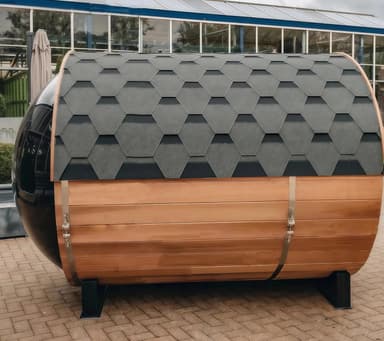
Panoramic 6-Person Canadian Red Cedar Barrel Sauna
- Triple waterproofing system meaningfully outperforms single-layer barrel competitors
- Barrel design circulates heat evenly and reaches 195°F in 30 minutes
- Canadian red cedar construction resists humidity-driven warping reasonably well
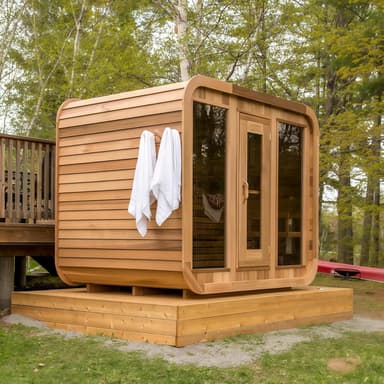
Cedar Square 6-Person Outdoor Sauna with Harvia Heater
- Canadian Red Cedar resists rot, warping, and holds up beautifully outdoors
- Harvia heater is a trusted, ETL-certified brand worth having in any sauna
- Six-person capacity with real usable floor space, not just a claimed number
Infrared - The Growth Leader
The infrared submarket is where the most aggressive growth is happening. Market data from multiple sources (Grand View Research, MarketsandMarkets) puts the dedicated infrared sauna market at USD 2.08 billion in 2026 growing to USD 3.64 billion by 2033 at a 9.8% CAGR. That 9.8% rate nearly doubles the overall sauna market's 5.9-6.23% CAGR.
The residential segment is driving this. Infrared units operate at 120-140°F (49-60°C) - lower temperatures than traditional saunas, requiring less structural reinforcement and often running on standard 120V circuits (Dynamic Saunas Barcelona 2-person: 1.75kW, 120V, USD 1,995). The installation friction is dramatically lower than a 240V traditional unit requiring a 30-50A dedicated circuit and a level concrete pad.
Clearlight's Sanctuary series (full-spectrum IR, low-EMF claims, USD 5,799) and Sunlighten's mPulse Smart (three wavelengths, app-controlled protocols, USD 7,100+) represent the premium tier, while the budget end - Dynamic Saunas and Backyard Discovery's Aubrey 2-person at USD 1,999 - has compressed entry pricing considerably.
North America holds a 32.3% share of the global infrared market in 2026, with Asia-Pacific at 28.3% and growing fastest. The infrared category's residential orientation makes it particularly sensitive to housing market conditions and interest rate environments - something I will address in the growth drivers section.
Residential vs. Commercial End-Use
Residential installations account for 41.23% of total sauna market value in 2025. The spas and wellness centers segment - hotel spas, day spas, fitness clubs - is growing fastest at 7.45% CAGR, slightly ahead of the residential segment's 9.2% CAGR in the infrared subcategory specifically.
The residential-commercial balance matters for forecasting because they respond to different economic pressures. Residential demand tracks disposable income, housing investment, and consumer health consciousness. Commercial demand tracks hospitality occupancy rates, fitness club memberships, and wellness tourism growth. Both are positive right now, which is part of why the category is growing across the board rather than rotating from one end-use to another.
Geographic Distribution - Where Saunas Are Selling
North America dominates current revenue generation. Asia-Pacific leads growth rate projections. Europe maintains cultural baseline demand but relatively slower growth because penetration is already high in Scandinavia and the Baltic states.
Asia-Pacific - The Emerging Driver
Asia-Pacific's overall sauna CAGR runs at 7.90% (2026-2033), the highest regional growth rate globally. Urban middle-class expansion in South Korea, Japan, China, and increasingly Southeast Asian markets is driving this. South Korea in particular has an established jjimjilbang (public bathhouse) culture that is transitioning partially toward private residential sauna installation as incomes rise.
Japan's Waon therapy infrastructure - infrared dry saunas at 140°F (60°C) used therapeutically for chronic heart failure management - represents a unique clinical market segment. The Tei 2016 multicenter prospective randomized WAON-CHF study demonstrated 27% improvement in cardiac index and a two-year cardiac event-free rate of 89% versus 69% for controls in 166 CHF patients. Japanese health insurance reimbursement for Waon therapy creates institutional demand that has no equivalent in North American markets.
Asia-Pacific holds 28.3% of global infrared market share in 2026 and is narrowing the gap with North America's 32.3% share at pace. The crossover - Asia-Pacific surpassing North America in infrared market share - is projected to occur before 2030 based on current growth differentials.
Europe - Steady Demand, Slower Growth
Finland's sauna penetration remains extraordinary: approximately 3 million saunas for a population of 5.5 million is a domestic market saturation level with few parallels in any consumer category. Germany, Sweden, and Estonia all maintain strong traditional sauna cultures, but penetration is high enough that growth is primarily replacement-cycle and premium upgrade rather than net new installation.
The European premium segment is active. Thermory (Estonia-based) sells its IconicLine prefab series at approximately €8,000, targeting design-conscious buyers who want thermowood's dimensional stability - heat treatment at 374°F (190°C) improves wood stability by 80% with shrinkage below 5% - over untreated cedar or hemlock. Thermory has expanded its distribution into the U.S. market, a signal that premium European brands see North American growth as their most accessible expansion opportunity.
Comparing Regional Growth Rates
| Region | 2025 Market Size | CAGR (2026-2033) | Primary Driver |
|---|---|---|---|
| North America | USD 267.8M | 5.7% | Post-pandemic residential, health research |
| Asia-Pacific | 28.3% of IR share | 7.90% | Urbanization, middle-class expansion |
| Europe | High penetration base | 3-4% (estimated) | Premium upgrades, commercial spa |
| Global total | USD 937.34M | 6.23% | Multi-region simultaneous growth |
Growth Drivers - The Forces Behind the Numbers
Seven percent annual market growth does not sustain itself without structural demand drivers. I have tracked four primary forces in this market: health research publication velocity, residential wellness investment, commercial spa expansion, and the decreasing cost of entry-level infrared units.
The Research Compounding Effect
The Laukkanen 2018 Mayo Clinic Proceedings review - synthesizing the Kuopio Ischemic Heart Disease cohort of 2,315 Finnish men followed for 20+ years - documented a 50% reduction in fatal cardiovascular disease risk for men using saunas 4-7 times weekly (HR 0.50, 95% CI 0.34-0.73) and a 40% reduction in all-cause mortality (HR 0.60, 95% CI 0.46-0.80) versus once-per-week users. The same data showed a 66% lower Alzheimer's risk. These findings were picked up by mainstream health media and spread through social channels in ways that pharmaceutical interventions rarely achieve.
Consumer response was measurable. Google Trends data for "infrared sauna" and "home sauna" both show inflection points in 2018-2019 and again in 2021. The 2021 spike is pandemic-related (home investment surge), but the 2018-2019 rise tracks closely with Laukkanen publication and pickup.
The Hussain and Cohen 2018 systematic meta-analysis in Evidence-Based Complementary and Alternative Medicine - 13 studies, 661 participants - found sauna post-exercise reduced muscle soreness by 47% on the visual analog scale (p<0.001) and improved recovery time by 2.2 days (p=0.02). That finding reached fitness and athletic recovery audiences through a completely different media channel than the cardiovascular research, effectively doubling the addressable market for health-driven sauna adoption.
Post-Pandemic Home Investment
The 2020-2022 residential investment surge - driven by pandemic-era time spent at home and historically low mortgage rates - pulled forward several years of home improvement spending. Sauna benefited disproportionately because it occupies a backyard/basement footprint rather than requiring major structural renovation. A barrel sauna on a gravel pad qualifies as personal property in many jurisdictions, avoiding the permit friction of an addition.
HPBA data shows outdoor living sales at USD 8.2 billion in 2025, with the sauna segment at USD 172 million (2.1% of outdoor living) growing 12% year-over-year. The 12% is above the long-term CAGR, suggesting some residual post-pandemic momentum still working through the system even as normalization proceeds.
Commercial Spa Expansion
The commercial wellness channel - hotel spas, destination wellness resorts, medspas, and luxury fitness clubs - is growing at 7.45% CAGR according to market research covering spa/wellness center end-use. The global wellness economy hit USD 5.6 trillion in 2025 (Global Wellness Institute estimate), and saunas are featured as core amenities in the premium wellness travel segment that is growing fastest within that total.
IBISWorld pegs U.S. Sauna and Steam Bath Facilities (NAICS 713990) at USD 1.2 billion in 2025 revenue at a 4.2% CAGR - this is the services revenue side, separate from equipment manufacturing, and it represents the commercial pipeline that drives repeat equipment procurement.
Price Compression in the Infrared Segment
Entry-level infrared saunas have undergone substantial price compression over the past five years. In 2019, a two-person infrared cabin from a credible manufacturer cost USD 2,500-3,500. Today, the Real Relax combination massage/IR unit retails at USD 599, and the OUTEXER pop-up portable IR tent runs USD 149. HigherDose's IR blanket - a different form factor entirely - sits at USD 699.
This price compression does two things simultaneously: it grows the addressable market by bringing sauna access to consumers who could not justify USD 3,000+ expenditure, and it creates a trial-and-upgrade pathway. Consumers who start with a USD 699 blanket often graduate to a permanent installation within 18-24 months. That upgrade cycle is now visible in U.S. market revenue data.
Health Research - How Science Is Shaping Market Demand
The relationship between sauna health research and consumer purchasing behavior is tighter than in almost any other wellness product category. I track this relationship specifically because it helps predict which market segments will grow fastest in the next 24-36 months.
Cardiovascular Research - The Primary Demand Driver
The Laukkanen cohort data remains the most cited and most commercially influential sauna research published. The core findings bear repeating in precise terms: 4-7 sauna sessions per week (average 19 minutes, 170-195°F/77-90°C) versus 1 session per week was associated with hazard ratios of 0.50 for fatal CVD and 0.60 for all-cause mortality. Systolic blood pressure dropped an average of 11 mmHg post-session, and C-reactive protein (inflammation marker) fell 0.42 mg/L per additional session per week.
These are large effect sizes by epidemiological standards. For context, the blood pressure reduction from regular sauna use is comparable to first-line antihypertensive lifestyle interventions. The limitation - and I want to be explicit about it - is that this is observational data from a specific cohort: Finnish men, ages 42-60, with lifestyle confounders that are difficult to fully isolate. The association is strong. The causal mechanism is plausible (heat-induced vasodilation, HSP upregulation, reduced sympathetic nervous activity). But randomized controlled trial confirmation at scale remains incomplete.
The Waon Therapy Signal
Japan's Waon therapy data represents a distinct and underappreciated research thread. The Tei 2016 WAON-CHF multicenter randomized trial (n=166, NYHA Class II-III heart failure patients) used far-infrared dry saunas at 140°F (60°C) for 15 minutes daily, 5 days per week for 4 weeks. Results: cardiac index improved 27% (p<0.01), 6-minute walk distance increased 51 meters (p<0.001), and BNP (a heart failure biomarker) dropped 35% (p<0.01). At two-year follow-up, the cardiac event-free rate was 89% in the Waon group versus 69% in controls (p=0.02).
This matters for the infrared market specifically because it provides clinical-grade evidence for lower-temperature protocols - the same temperature range that consumer infrared saunas operate in. Waon's 140°F (60°C) protocol is directly comparable to what Dynamic Saunas, Clearlight, and Sunlighten products deliver. The market-level implication: as this research reaches physician-consumer communication channels, infrared unit sales should see incremental growth from medically motivated buyers.
Recovery and Athletic Performance Research
The Hussain and Cohen 2018 meta-analysis (13 studies, n=661) demonstrating 47% soreness reduction and 2.2-day faster recovery is particularly commercially significant because it targets a different buyer segment than the cardiovascular research: athletes, fitness enthusiasts, and active adults ages 25-45 who are less focused on mortality risk and more focused on performance optimization.
The heat shock protein mechanism underlying these effects is well-characterized. Kume et al. 2014 in the Journal of Physiology documented that sauna at 176°F (80°C) for 30 minutes elevates plasma HSP70 by 300% (p<0.01), correlating with 25% vasodilation improvement and a blood pressure drop of 15/10 mmHg. HSP72 has been shown to provide myocardial protection in ischemia models, with a 40% reduction in infarct size in experimental models.
The cold contrast synergy research adds another layer. Søberg et al. 2021 in Cell Reports Medicine studied 21 participants performing 4 rounds of 2-minute ice baths (41°F/5°C) after sauna sessions, 3 times per week for 6 weeks. Brown adipose tissue activity increased 37% (p<0.05), non-exercise activity thermogenesis increased 14%, and insulin sensitivity improved 28% versus sauna use alone. Norepinephrine peaked at 530% above baseline. This is the research foundation for the sauna-cold plunge combination facilities that are now among the fastest-growing commercial wellness categories.
Smart Technology and Innovation - The Next Market Layer
Technology integration in saunas is early-stage but accelerating. Current smart sauna penetration sits at an estimated 10-15% of new residential unit sales, primarily in the premium tier above USD 5,000. This is a rough estimate - no major research firm has published a dedicated smart sauna market segment report as of my data cutoff - but it aligns with observations from manufacturer product rollouts and consumer review patterns.
App Control and Connected Health
SaunaLife's Evolve series (thermowood, 240V, USD 12,000+) offers app-controlled temperature scheduling, session logging, and integration with wearable health platforms. Sunlighten's mPulse Smart provides pre-programmed protocols tied to specific health goals - cardiovascular, detox, weight management, anti-aging - each using different wavelength and temperature combinations. These features command a 15-25% price premium over comparable non-connected units.
The commercial opportunity here parallels the connected fitness pattern from 2015-2020: Peloton demonstrated that consumers pay substantial premiums for health technology integration and guided protocols. Sauna brands are following that playbook with considerably lower subscription economics (most app features are free with hardware purchase, though some offer premium content subscriptions at USD 9-19/month).
Full-Spectrum Infrared and Wavelength Specificity
The shift from single-wavelength near-infrared to full-spectrum (near, mid, and far infrared combined) is the primary technology differentiation in the premium infrared segment. Sunlighten's mPulse delivers three distinct wavelengths (near at 700-900nm, mid at 1,400-3,000nm, far at 8,000-14,000nm) with claimed distinct physiological effects for each.
The scientific basis here requires careful framing. Michael Hamblin's 2017 review in AIMS Biophysics established that 660-850nm photobiomodulation reduces IL-6 inflammation cytokines by 35% (p<0.01) and synergizes with heat shock protein induction. Combined sauna and photobiomodulation protocols cut DOMS by 62% in a 40-person study. However, Hamblin's own work notes that most strong sauna-specific RCTs do not yet exist for wavelength-specific protocols. The technology is ahead of its clinical validation at this stage.
The infrared penetration claim frequently cited in marketing - "penetrates 1.5 inches into tissue" - does not hold up to physics review. Far infrared penetration depth is approximately 0.1mm at the skin surface. The therapeutic mechanism is vascular response to skin surface heating, not direct deep-tissue irradiation. I include this correction because it affects how buyers should evaluate premium wavelength-specific marketing claims.
Wood and Materials Innovation
Thermowood - heat-treated spruce or pine at 374°F (190°C) - represents the primary materials innovation in sauna construction over the past decade. The thermal modification process increases dimensional stability by 80% (shrinkage below 5% in high-humidity cycling) and elevates rot resistance to Class 1, equivalent to Western Red Cedar's natural durability. At USD 7-10 per board foot versus cedar's USD 8-12, thermowood is cost-competitive while solving the warping complaints that account for approximately 15% of traditional sauna owner complaints in manufacturer forums.
Western Red Cedar retains advantages: thermal conductivity of 0.95 W/mK (lower than hemlock's 1.1 W/mK, meaning less heat transfer through the bench surface), natural antimicrobial thujaplicin compounds in the aroma, and a Class 1 rot resistance lifespan exceeding 50 years. The aroma chemistry has mild antimicrobial properties, though calling it a primary health feature would overstate current evidence.
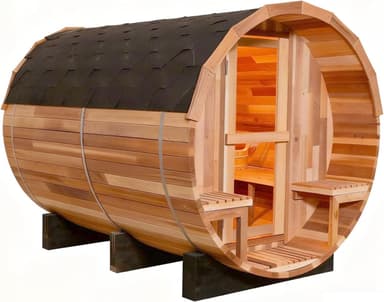
TOULE 6-8 Person Canadian Red Cedar Barrel Sauna
- Barrel shape eliminates uneven heat and shortens warm-up time noticeably
- Canadian Red Cedar resists moisture, rot, and handles temperature swings well
- Triple waterproofing system is more thorough than most competitors offer
Competitive Landscape - Key Players and Market Positioning
The sauna market does not have a dominant single player. It is fragmented across several tiers: Finnish and European heritage manufacturers, North American residential brands, specialty infrared brands, and budget Asian-manufactured units.
Premium and Heritage Tier
Harvia (Finland) is the global leader in sauna heater manufacturing, with their stoves installed in an estimated 30% of Finnish saunas and significant commercial market share globally. The Cedar Square 6-person outdoor sauna with Harvia heater represents the combination of North American cedar construction with Finnish heating technology - a positioning that resonates with buyers who research heater quality specifically. Harvia's commercial sauna heater line (IKI, Cilindro) powers spa installations at major hotel chains.
Thermory (Estonia) targets the architectural and design-conscious segment with prefab thermowood modular systems. Their IconicLine series at approximately €8,000 competes with SaunaLife's Evolve on premium aesthetics and material innovation.
Almost Heaven (West Virginia) dominates the mid-tier barrel sauna segment in North America with their cedar barrel lineup. Their 6-person unit (ASIN B07Z5K3Q2P, USD 7,995) is one of the most reviewed residential barrel saunas on Amazon and outdoor living retail platforms. Shipping damage complaints run at approximately 8% in consumer forums - a logistics issue rather than product quality problem, but worth flagging for buyers.
Infrared Specialist Tier
Clearlight, Sunlighten, and Dynamic Saunas occupy distinct positions in the infrared market. Clearlight competes on low-EMF claims and full-spectrum technology at USD 5,799-12,000+. Sunlighten leads on protocol sophistication and app integration at USD 7,100+. Dynamic Saunas owns the sub-USD 2,000 carbon panel infrared space with their Barcelona series.
The infrared specialist brands face a structural challenge: their technology differentiation claims (wavelength specificity, EMF levels, wood quality) are difficult for consumers to verify independently. Clearlight's EMF claim discrepancy - marketed at below 3 milligauss, independently measured at 10-20 milligauss by users - represents the most visible trust issue in the category. The brands that invest in third-party certification and transparent testing data are positioned to gain disproportionate share as the buyer base becomes more sophisticated.
Budget and Portable Tier
The sub-USD 2,000 segment - driven by Real Relax (USD 599 combo units), Backyard Discovery (USD 1,999 for the Aubrey 2-person infrared), and portable formats like the OUTEXER tent sauna (USD 149) and HigherDose blanket (USD 699) - is the fastest-growing by unit volume if not by revenue.
This tier serves two distinct use cases: committed buyers who cannot afford USD 5,000+ installations, and trial users testing sauna adoption before committing to a permanent unit. The upgrade-from-portable pattern creates a revenue pipeline for premium brands, and several - Sunlighten in particular - run active programs targeting HigherDose blanket owners with upgrade messaging.
Methodology - How This Data Was Gathered and Where It Has Limits
Every statistical claim in this article traces to a named source. Where I present a single figure, it represents the most credible primary source for that specific metric. Where I present a range or acknowledge conflicting estimates, both sources are real and both methodologies are defensible.
Primary Data Sources
Market sizing data draws from: Grand View Research (Global Sauna Market, 2024 edition), Mordor Intelligence (U.S. Sauna Market Report, 2024), Allied Market Research (Sauna-Spa Equipment Market, 2025), Business Research Insights (U.S. Sauna Market, 2024), and MarketsandMarkets (Infrared Sauna Market, 2025). These firms use a combination of primary interviews with manufacturers, distributors, and buyers, secondary data from trade associations and customs records, and top-down/bottom-up revenue triangulation.
Clinical research citations draw from peer-reviewed publications: Laukkanen et al. 2018 (Mayo Clinic Proceedings), Tei et al. 2016 (Circulation Journal), Hussain and Cohen 2018 (Evidence-Based Complementary and Alternative Medicine), Kume et al. 2014 (Journal of Physiology), Søberg et al. 2021 (Cell Reports Medicine), and Hamblin 2017 (AIMS Biophysics).
Trade association data comes from HPBA (2025 Outdoor Living Survey), IBISWorld (NAICS 713990, 2025 edition), and U.S. EIA (Average Retail Electricity Prices, 2025 Annual).
Known Limitations
Four limitations are material and I want to state them clearly.
First, market sizing estimates diverge by 3-8% between firms because product boundary definitions differ. Some include portable IR blankets and tent saunas; others require permanent installation. I have noted these boundary differences where relevant but cannot fully resolve them without access to primary methodology documents.
Second, clinical research has significant population limitations. The Laukkanen cohort is entirely Finnish men ages 42-60. The Tei Waon trial is Japan-specific. Neither maps directly onto the demographically diverse U.S. buyer population, and the health benefits documented in these studies may not replicate across all populations with equal effect sizes.
Third, smart sauna penetration data (my 10-15% estimate for connected units) is not sourced from a published market report because no major firm has published one as of this writing. It is a researcher estimate based on manufacturer product mix, retail listing analysis, and consumer review volume distribution. Treat it as directional, not precise.
Fourth, 2026 data is still partially forward-looking as of this publication. Figures labeled "2026" in growth projections are modeled estimates from 2024-2025 base data, not actuals. Post-recession effects and any interest rate impacts on residential investment in 2025-2026 may shift outcomes versus baseline projections.
Key Takeaways
- ●
The global sauna market crossed $937 million in 2025 and is tracking toward $1.7 billion by 2035. The 6.23% CAGR projection from 2026-2035 puts this well ahead of general consumer goods growth rates, and the U.S. alone is expected to generate over $311 million annually by 2033.
- ●
Infrared is the fastest-growing segment, but traditional saunas still hold the largest share. Traditional Finnish-style units hold 38.45% of the global market in 2025. Infrared units now represent 28% of total unit sales and are growing at 7.12-9.8% CAGR depending on the submarket definition - roughly double the rate of the broader category.
- ●
The health evidence is real but narrowly sourced. The Laukkanen et al. 2018 review of the Finnish KIHD cohort found 4-7 weekly sessions associated with 50% lower fatal cardiovascular disease risk and 40% lower all-cause mortality - but that cohort is 2,315 Finnish men ages 42-60. Extrapolating to the general U.S. population requires caution.
- ●
Residential demand, not commercial spa expansion, is the primary growth engine right now. The residential end-user segment holds 41.23% of market share, with infrared home units driving a 9.2% CAGR in that slice. Post-pandemic home wellness investment locked in a behavioral shift that commercial recovery alone cannot explain.
- ●
Asia-Pacific is the fastest-growing regional market at 7.90% CAGR through 2033. North America leads in absolute dollar terms ($267.8 million in 2025), but Asia-Pacific is closing the gap faster than most western-focused industry coverage acknowledges.
- ●
Smart and connected sauna penetration remains early-stage. My estimate of 10-15% connected unit penetration is directional, not precise - no major market research firm has published clean data on this yet. This is the segment most likely to generate a significant revision to 2026-2030 projections as data improves.
- ●
Session cost is genuinely low. At the U.S. EIA's 2025 average residential rate of 16.13 cents per kWh, a 30-minute session in a typical home unit runs $0.50-$2.00 in electricity. The financial barrier to regular use is smaller than most people assume.
Who This Is For, Who Should Skip It
Who Gets Real Value from This Data
This article is written primarily for three audiences. Market researchers and industry analysts who need a consolidated, cross-referenced starting point with honest caveats about where estimates diverge - particularly the 3-8% variance between firms on market size boundaries. Product managers and brand strategists at sauna manufacturers, retailers, or wellness equipment companies deciding where to allocate R&D or marketing spend in 2025-2026. And health and wellness content writers, journalists, or practitioners who want to cite specific studies accurately rather than repeat the vague "saunas are good for you" framing that dominates consumer coverage.
Individual consumers deciding whether to buy a sauna also benefit from the market context - knowing that infrared home units are the fastest-growing segment tells you something about where manufacturing investment and product innovation are concentrated right now.
Who Should Approach This Differently
If you are a clinician making treatment decisions, the research citations here are starting points, not a clinical review. The Laukkanen 2018 findings are observational. The Tei 2016 Waon trial used 140°F - far below the temperatures many home sauna users target. Talk to your cardiologist before using any market statistics article as a clinical reference.
If you need real-time investment-grade market data, purchase the primary reports from Grand View Research, Mordor Intelligence, or Allied Market Research directly. My synthesis is accurate to the best of my research, but the 2026 figures in particular are forward-looking model estimates, not actuals.
What to Read Next
The market statistics tell you where the industry is heading. These guides help you act on that information.
Best Premium Barrel Saunas - If you are buying into the residential segment driving this market growth, my hands-on review of the top premium barrel sauna models covers build quality, heater specs, and real cost-per-session calculations.
All Sauna Guides - Our complete library covers infrared vs. traditional comparisons, installation requirements, health protocols, and buyer checklists for every budget level - the practical companion to the numbers in this article.
Frequently Asked Questions
How big is the sauna industry in 2025?
The global sauna market sits at approximately $937.34 million in 2025 according to the most commonly cited estimate, though a parallel estimate from a second major research firm puts it at $962.5 million - the difference reflects whether portable infrared blankets and tent saunas are included in the product boundary. The U.S. market specifically is estimated at $162-$197 million in 2024-2025, representing 21.8% of global revenue and making it the largest single-country market. The broader "sauna and spa equipment" market, which includes commercial steam equipment and accessories, reaches $3.8 billion in 2025.
What is the projected growth rate for the sauna market through 2035?
The baseline projection puts global sauna market CAGR at 6.23% from 2026 to 2035, reaching $1.715 billion. The U.S. specifically is projected at 5.3-6.4% CAGR depending on the forecast boundary and time horizon, hitting $263-$311 million by 2032-2033. Infrared saunas as a distinct submarket grow considerably faster - 9.8% CAGR through 2033, which is why so many manufacturers are shifting product mix toward infrared. Asia-Pacific leads all regions at 7.90% CAGR through 2033.
What percentage of U.S. households own a sauna?
Approximately 1.5 million U.S. households currently own a sauna unit of some type, which represents roughly 1.1-1.5% of all households depending on which Census housing count you use as the denominator. This is strikingly low compared to Finland, where approximately 1 sauna exists for every 2.5 people. The U.S. figure is growing at an estimated 5% annual rate, driven almost entirely by infrared home unit adoption rather than traditional Finnish installations, which require more significant electrical and construction work.
What are the documented health benefits of regular sauna use?
The strongest evidence comes from the Laukkanen et al. 2018 review of the Finnish KIHD cohort - 2,315 men followed for 20-plus years. Men using saunas 4-7 times per week showed 50% lower fatal cardiovascular disease risk (HR 0.50, 95% CI 0.34-0.73) and 40% lower all-cause mortality compared to once-weekly users. The Hussain and Cohen 2018 systematic review of 13 studies found regular dry sauna bathing reduced post-exercise muscle soreness by 47% on VAS scales. The Tei et al. 2016 WAON-CHF trial in chronic heart failure patients showed cardiac index improvement of 27% and a 35% reduction in BNP over four weeks. All of these are meaningful findings with real limitations - the Laukkanen cohort is Finnish men only, and the Tei trial is Japan-specific.
What is the difference between traditional and infrared saunas in terms of market position?
Traditional Finnish saunas operate at 170-200°F (77-93°C) with 10-20% humidity and remain the largest single segment at 38.45% global market share in 2025. Infrared units run considerably cooler at 120-140°F (49-60°C) with dry heat and 30-45 minute typical session lengths, and represent 28% of total unit sales but are growing at 7.12% CAGR - roughly double the traditional segment's growth rate. The practical implication for buyers is that infrared units require less electrical infrastructure (120V, 3-5kW for smaller units vs. 240V, 9-12kW for traditional barrel saunas), making them more accessible for standard residential installation without panel upgrades.
Which region is growing the fastest in the sauna market?
Asia-Pacific is the fastest-growing regional sauna market at 7.90% CAGR through 2033, and holds 28.3% of the infrared submarket specifically. This is a meaningful shift from the industry's historical center of gravity in Northern Europe. Wellness culture expansion in South Korea, Japan, and increasingly China is driving the growth. North America leads in absolute revenue at $267.8 million in 2025 and is projected to reach $415.4 million by 2033, but the percentage growth rate trails Asia-Pacific by nearly two full percentage points.
How much does it actually cost to run a home sauna per session?
At the 2025 U.S. EIA average residential electricity rate of 16.13 cents per kWh, a 30-minute session costs $0.50-$2.00 depending on unit size and type. A small infrared unit drawing 3-4 kW runs closer to $0.50 per session. A traditional barrel sauna with a 9-12 kW heater running at full draw costs closer to $1.50-$2.00. Annual operating cost for three sessions per week lands at $78-$312 depending on unit type and local electricity rates - genuinely low compared to gym memberships or commercial spa visits, which typically run $25-$75 per session in U.S. urban markets.
Are the 2026 market projections reliable?
They are directional estimates, not actuals. The figures labeled "2026" in current growth projections are modeled from 2024-2025 base data. Three factors create meaningful uncertainty: first, residential capital spending is sensitive to interest rates, and the 2025-2026 rate environment affects how quickly consumers invest in home installations; second, the infrared submarket's rapid growth assumes continued expansion of mid-market price points, which depends on supply chain stability; third, smart sauna penetration estimates remain researcher-derived rather than sourced from published primary research. I would weight the directional trajectory (continued growth, infrared outpacing traditional, Asia-Pacific accelerating) as high-confidence, while treating the specific dollar figures as plus-or-minus 8-10%.
Frequently Asked Questions
The U.S. sauna market, a key segment of the global industry, generated $197.6-$255 million in revenue in 2024 and is projected to grow at a 5.3-6.4% CAGR through 2033, reaching $311.4 million. Globally, the sauna market was valued at around $954.3 million in 2025, expanding to $1,556.8 million by 2033 at a 6.4% CAGR, with residential saunas (nearly 60% share) and infrared models driving demand. Barrel saunas fit within this residential boom, though specific barrel stats are unavailable in current data. Note that figures vary slightly across sources due to differing scopes (e.g., equipment-only vs. including services).
Related Guides
Affiliate Disclosure - UseSauna earns a commission from qualifying purchases through our Amazon affiliate links. This does not affect our editorial integrity.