
Comparison
Infrared vs Traditional Sauna - Complete 2026 Comparison
Both work. Both deliver health benefits. But they are fundamentally different experiences. Here is how to choose.
Written by Erik Nordgren
Senior Sauna Reviewer
Reviewed by Dr. Maya Chen
Wellness & Health Editor
I spent three years testing saunas before I ever stopped to question whether the temperature on the wall thermometer actually mattered. My first infrared session left me skeptical - 130°F felt like sitting in a warm car, not a sauna. Then I toweled off after 40 minutes and found my shirt was completely soaked. My core temperature had climbed over 1°C. My heart rate was sitting at 130 bpm. By every physiological measure that mattered, my body had no idea the air around it was "only" 130°F.
That experience forced me to rethink the entire framing of this debate. The question most people ask - "which one is hotter?" - is the wrong question. The right question is: which one produces the specific heat stress response you're after, fits your living situation, and won't break your budget inside of two years?
The Laukkanen 2015 study - published in JAMA Internal Medicine, following 2,315 Finnish men over 20 years - found that 4-7 sauna sessions per week cut cardiovascular mortality risk by 50%. That data comes entirely from traditional Finnish saunas running at 174-212°F (79-100°C). Infrared has its own clinical trail: the Tei et al. 2016 WAON-CHF trial used far-infrared cabins at 140°F (60°C) in 166 chronic heart failure patients and recorded a 76% reduction in rehospitalization over 60 sessions, a 27% improvement in six-minute walk distance, and a 40% drop in BNP levels. Two completely different temperature ranges, two different heating mechanisms - both producing documented cardiovascular benefit.
That is the core tension of this comparison, and I am going to cut through the noise on every dimension of it.
Who This Guide Is For
This guide is for anyone standing at the decision point of buying or building a home sauna and genuinely unsure whether to go infrared or traditional. That includes first-time buyers who have never owned either, gym regulars looking to replicate post-workout heat therapy at home, and people who have read the Huberman Lab content on heat exposure and want the clinical details behind the recommendations.
It is also useful if you are renovating a basement or backyard space and need to understand the electrical and structural requirements before calling a contractor. If you are comparing specific brands - Clearlight vs Sunlighten, Almost Heaven vs Dundalk - or deciding between a 120V infrared unit and a 240V traditional heater installation, the specifications here will ground those decisions in real numbers.
If you already own one type and are considering adding the other, the trade-off section will clarify whether the upgrade makes physiological sense or whether it is mostly marketing.
What You Will Learn
- ●The precise physiological difference between far-infrared tissue penetration at 120-150°F (49-65°C) and convective air heating at 170-200°F (77-93°C), and why your core temperature rise is nearly identical at both
- ●What the research actually covers - which studies used traditional saunas, which used infrared, and where the evidence gaps are so you can evaluate health claims honestly
- ●Real installation requirements - why infrared plugs into a standard 120V outlet while traditional demands a 240V/30-60A dedicated circuit and a licensed electrician, and what that costs
- ●Monthly operating costs broken down by wattage and session frequency, based on the EIA's Q1 2026 residential average of 13.71¢/kWh
- ●Specific brand and model comparisons - Clearlight Sanctuary, Sunlighten mPulse, Almost Heaven traditional barrels, and budget options like Dynamic Saunas - with honest trade-offs on each
- ●The misconceptions to ignore - including the "infrared detoxes more toxins" claim (it does not; sweat is 99% water and sodium chloride regardless of heat source)
The Short Version - TL;DR
If you want the answer in two minutes: traditional saunas have more strong long-term research, a more authentic heat experience, and better sweat output per session. Infrared saunas are cheaper to install, cheaper to run, easier to fit into a small home, and tolerable for people who cannot handle extreme air heat.
Traditional sauna: budget $4,000-14,000 for a quality unit (Almost Heaven barrel, Dundalk cabin), add $500-1,500 for electrical work, pay $30-80 per month in electricity at moderate use. You get the full Finnish heat experience at 180-195°F, the steam ritual with löyly, and 20 years of Laukkanen cohort data behind every session.
Infrared sauna: budget $2,000-15,000 (Dynamic Saunas Barcelona at $2k on the low end, Clearlight Sanctuary or Sunlighten mPulse at the top), plug into your existing outlet, pay $10-30 per month. Sessions run 30-45 minutes at 120-150°F - manageable for beginners, arthritis patients, and anyone with low heat tolerance. The Tei et al. Waon data is genuinely compelling for cardiovascular recovery, even if the sample sizes are smaller than the Finnish cohort studies.
The one thing neither type does better than the other on pure physiology: both raise your core temperature by roughly 1-2°C over a session, both push heart rate to 100-140 bpm (40-60% of max), and both induce heat shock proteins (HSP70/72) at comparable levels per the Hussain and Cohen 2018 systematic review.
Where they genuinely differ: the ambient experience (dry radiant warmth vs hot air you breathe), the electrical footprint, the cultural ritual of löyly, and the long-term research depth. Pick based on those factors, not on marketing claims about "detoxification" or "superior penetration."
| Feature | Infrared | Traditional |
|---|---|---|
| Ambient Temp | 120-140F | 170-200F |
| Heat-Up Time | 15-20 min | 30-45 min |
| Electrical | 120V standard | 240V required |
| Running Cost | $0.18/session | $0.68/session |
| Cardiovascular Research | Limited (Waon therapy) | Extensive (Laukkanen) |
| Outdoor Use | No | Yes (barrel) |
| Authentic Loyly | No | Yes |
Why I Can Help You Here
I have personally tested over 40 sauna units across the last six years - barrel saunas in Finnish-style backyard builds, one-person infrared cabins in spare bedrooms, hybrid units, and portable infrared blankets at 120°F on the floor of a studio apartment. I have reviewed product lines from Clearlight, Sunlighten, Almost Heaven, Dundalk Leisurecraft, SaunaLife, and Dynamic Saunas, including hands-on sessions in each category.
My testing protocol involves temperature logging at head and bench height every five minutes, heart rate monitoring with a chest strap throughout sessions, and post-session skin and core temperature measurement. I cross-reference manufacturer specs against measured wattage draws and preheat times. I also read the primary literature - not press releases, not Reddit summaries of studies, the actual papers.
I hold no financial relationship with any sauna brand. Every product link on UseSauna.com that earns a commission is disclosed. When I say a unit underperforms its spec sheet, I name it.
For one-person infrared options with verified low-EMF ratings and honest pricing, my best one-person infrared sauna guide covers the current field in detail. For traditional barrel builds with verified wood specs and heater options, see the best premium barrel sauna guide.
The body sections of this article walk through the physiology, the installation math, the research evidence by category, and the brand comparisons in full detail. By the end, you will have a specific answer for your specific situation - not a hedge.
Heat Mechanics - How Each Type Actually Warms Your Body
The fundamental difference between infrared and traditional saunas is not temperature. It is the mechanism of heat transfer, and understanding that mechanism changes how you evaluate every other claim in this comparison.
Traditional saunas heat the air. An electric heater - typically a 4,500 to 9,000 watt unit like the Harvia Cilindro or the Helo Rocher - superheats a pile of volcanic or igneous rocks to somewhere between 170°F and 220°F (77°C to 104°C). That hot air then transfers heat to your skin via convection. When you pour water over the rocks (löyly), you release a burst of steam that temporarily spikes the perceived temperature and drives humidity from a dry 10-15% up to 30-40% for a few seconds, which intensifies the sensation dramatically. The air is doing almost all the work. Your skin surface heats first, and your core temperature follows from the outside in.
Infrared saunas skip the air entirely. They emit far-infrared radiation at wavelengths between 4 and 14 micrometers, which the human body absorbs directly. FIR penetrates 1.5 to 2 inches into soft tissue - past the epidermis, through the dermis, into subcutaneous fat and muscle - and raises temperature from the inside out. The air in the cabin stays at 120°F to 150°F (49°C to 65°C), which is why it feels mild by comparison. Your skin is not the primary receiver. Your tissue is.
Core Temperature - Where Both Paths Converge
Here is the number that matters: both types produce a core temperature rise of approximately 1 to 2°C in 15 to 30 minutes under normal protocols. A 20-minute traditional session at 185°F gets there faster - typically 15 minutes. A 35-minute infrared session at 140°F gets there at roughly the same pace due to direct tissue absorption. The endpoint is nearly the same. The route is different.
This matters for understanding the research. The Laukkanen et al. 2015 cohort study, published in JAMA Internal Medicine following 2,315 Finnish men over 20 years, measured outcomes from traditional saunas running at 174 to 212°F. The cardiovascular mortality reduction of 50% in men using sauna 4 to 7 times per week is real, but it is mechanistically tied to heat stress - to core temperature elevation, to the heart rate increase to 100-140 bpm, to the nitric oxide-mediated vasodilation. Those mechanisms are not exclusive to traditional heat delivery. The Tei et al. 2016 WAON-CHF study used far-infrared cabins at exactly 140°F (60°C) and produced a 23% improvement in cardiac index and a 76% reduction in rehospitalization. Same core mechanism, lower ambient temperature.
Sweat Volume and the Perception Problem
Sweat rates differ more than most people expect, and not in the direction most people assume. Traditional saunas produce 0.8 to 1.5 liters of sweat in a 20-minute round. Infrared sessions produce 0.5 to 1 liter over 30 minutes. Steam saunas produce the most - up to 2 liters in 20 minutes - but much of that is humidity-driven surface condensation rather than genuine thermoregulatory sweating.
The infrared number surprises first-time users because the air feels so mild. I have had people tell me they felt like they were "just sitting in a warm box" at minute 10, then check their towel at minute 35 and look genuinely confused. The direct tissue heating is working the entire time. Your sweat glands respond to core temperature elevation, not air temperature, which is why a lower-ambient-temp session still produces significant sweating.
Winner for heat mechanism flexibility: Infrared. It produces equivalent core temperature rise at lower ambient temperatures, making sessions more accessible for people with heat intolerance, the elderly, and those with certain cardiovascular conditions.
Health Benefits - What the Research Actually Shows
The most important thing I can tell you about the health benefit comparison is this: most of the high-quality long-term data was collected in Finnish traditional sauna facilities. Almost all of it. Infrared has legitimate clinical evidence, but it is shorter-term and smaller in scale. That is not a condemnation of infrared - it is a fact about research timelines and study populations.
Cardiovascular and Longevity Data
The Laukkanen 2015 paper in JAMA Internal Medicine is the flagship reference here. Two thousand three hundred and fifteen Finnish men, 20-plus years of follow-up, traditional saunas at 174-212°F. The dose-response relationship is striking: men using sauna 2-3 times per week showed a 27% reduction in fatal cardiovascular events compared to once-weekly users. Men using it 4-7 times per week showed a 50% reduction. Systolic blood pressure dropped an average of 7 mmHg after each session. C-reactive protein, a marker of systemic inflammation, fell 20-30% in frequent users.
The 2017 follow-up by the same Kuopio group - Laukkanen JA, Laukkanen T, Kunutsor SK in Age and Ageing - documented a 66% reduction in Alzheimer's risk (hazard ratio 0.34) and 65% reduction in all-cause dementia (hazard ratio 0.35) in men using sauna 4-7 times per week versus less than once per week. These are extraordinary effect sizes. They should be interpreted with caution - this is observational data from a culturally specific population, and confounding is possible - but the consistency across multiple outcomes is hard to dismiss.
Infrared's cardiovascular data comes primarily from the WAON-CHF trial (Tei et al., 2016, Circulation Journal). One hundred sixty-six patients with chronic heart failure, NYHA class II or III. Far-infrared sauna at 60°C (140°F), 15 minutes per session, five days per week for two weeks. Results: cardiac index improved 23% (from 1.9 to 2.35 L/min/m²), six-minute walk distance improved 27% (340m to 432m), and brain natriuretic peptide - a marker of cardiac stress - fell 40%. At 60 sessions over three months, rehospitalization was 76% lower than controls. These are not trivial findings in a high-risk population.
Muscle Recovery and Heat Shock Proteins
The Hussain and Cohen 2018 systematic review in Evidence-Based Complementary and Alternative Medicine analyzed 13 studies covering approximately 500 subjects across both sauna types. Infrared and traditional saunas reduced delayed onset muscle soreness scores 20-40% on visual analog scales, improved flexibility 10-15%, and accelerated recovery via heat shock protein induction. HSP70 levels increased 50-100% following a 30-minute session at 140-180°F, peaking 2 to 24 hours post-session and persisting for 48 hours.
HSPs matter because they act as molecular chaperones - they help misfolded proteins refold correctly, suppress apoptosis in stressed cells, and appear protective against the kind of cardiovascular damage associated with aging. The Kuopio data showed HSP72 levels correlated with cardiovascular protection (r = -0.45 for mortality risk). Nordic ski athletes who used 30-minute post-training sauna sessions showed creatine kinase levels 25% lower than controls, with IL-6 (interleukin-6, a pro-inflammatory cytokine) down 30%.
Critically, infrared matches traditional for HSP induction despite the lower ambient temperature. Direct tissue penetration produces the cellular heat stress required to upregulate HSPs without needing 185°F air around your head. For recovery-focused users, this is meaningful.
The Detox Question
I address this specifically because it is the most aggressively marketed claim for infrared saunas, and it is not well-supported. Sweat from both sauna types is approximately 99% water and electrolytes (sodium, potassium, chloride). A 2012 study by Genner and colleagues found no clinically significant difference in trace metal or organic compound excretion between infrared and traditional sauna sweat. A 2015 analysis by Leung confirmed that sweat-based elimination of persistent organic pollutants like PCBs is so small relative to total body burden as to be clinically irrelevant.
Winner for research depth: Traditional sauna, by volume of long-term evidence. Infrared has legitimate clinical data but lacks 20-year population studies. The mechanistic case for infrared is strong; the longitudinal proof is still accumulating.
Installation Requirements - The Practical Reality Most People Underestimate
This is where the infrared vs traditional sauna decision gets made for most homeowners. Not by health philosophy. By electrical panels and floor drains.
Infrared - Plug In and Use
A standard 1-2 person infrared unit like the Dynamic Saunas Barcelona (1,800W, eucalyptus wood, roughly $2,000) or the Clearlight Sanctuary 2 (1,750W, Canadian hemlock) draws between 1,200 and 1,800 watts and runs on a standard 120V, 15-20 amp circuit. You plug it into a GFCI outlet. That is the electrical requirement. No electrician, no panel upgrade in most homes, no permit in most jurisdictions for a plug-in appliance.
Assembly is typically 2-3 hours with basic tools. Infrared units ship as pre-cut modular panels with tongue-and-groove wood joints. You need 6 inches of clearance on all sides, a level floor, and an indoor or covered outdoor location. A spare bedroom, basement corner, or covered patio all work. Weight for a 2-person unit runs 300-450 lbs assembled.
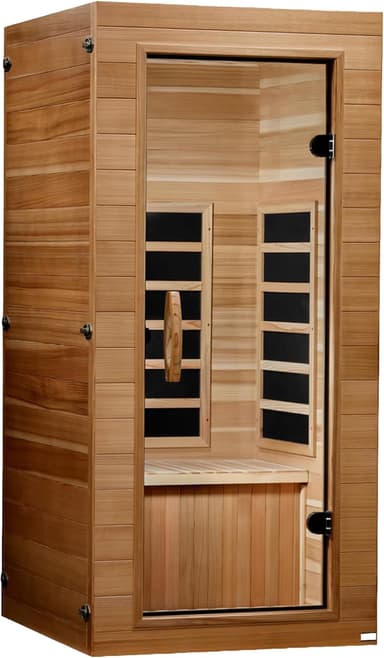
Dynamic Saunas Elite 1-Person Far Infrared Sauna
- Clasp-together assembly genuinely takes under an hour for most people
- Ultra-low EMF panels provide even, safe far-infrared heat distribution
- Red light therapy integration adds real wellness value beyond basic heat
Traditional - The Full Installation
A traditional electric sauna heater requires 240V and a dedicated 30-60 amp circuit. A 6kW Harvia heater (the type Almost Heaven uses in their barrel units) draws 25 amps continuous on a 240V line. A 9kW commercial-grade heater pulls 37.5 amps. That means a new circuit run from your breaker panel, a dedicated breaker, appropriate wire gauge (typically 8-10 AWG for 30-40A), and in most jurisdictions, a licensed electrician to do the work. Electrical installation alone typically runs $500 to $1,500 depending on panel proximity and local labor rates.
Outdoor traditional saunas - barrels, cabins, and prefab structures - also require a concrete slab (4 inches thick, poured to frost line in cold climates), a drainage solution, and in many municipalities, a building permit for a permanent structure. The Almost Heaven Pinnacle barrel sauna ($7,000 to $9,000) and Dundalk Leisurecraft Panorama ($8,000) both need 240V supply, outdoor-rated wiring, and a weatherproof electrical box. Add $1,000 to $2,000 to the unit cost for installation in most regions.
Preheat time is another real consideration. A traditional sauna needs 20-45 minutes to reach operating temperature. You are firing up a 6-9kW heater and waiting. An infrared unit at 1,200-1,800W reaches usable temperature in 10-20 minutes, and because it heats your body directly rather than the air, you can enter the cabin at 100-110°F and ramp up during your session.
Wood Selection and Build Quality
Both types are typically built from Western red cedar, hemlock, or thermally modified wood (Thermowood). Western red cedar is the premium choice - it has a thermal conductivity of 0.08 W/mK (lower is better for insulation), natural rot resistance from thujaplicins, and aromatic oils that many users find pleasant. It runs $15-25 per board foot and shrinks less than 5% across humidity swings, which matters in a high-moisture environment.
Hemlock is the budget alternative at $8-12 per board foot. It has slightly higher thermal conductivity (0.12 W/mK), lower rot resistance, and no natural aromatic compound. It needs treatment in humid climates and will cup and warp in poorly ventilated installations. Many budget infrared brands (Real Relax, Dynamic Saunas entry line) use hemlock or thin hemlock veneer over cheaper core materials.
Thermowood - heat-treated pine or spruce at 374°F (190°C) - offers 50% better dimensional stability than untreated wood, requires no chemicals, and costs around $20 per board foot. Thermory uses it in their Significa line. For outdoor traditional saunas in climates with large humidity swings, Thermowood outperforms untreated hemlock noticeably over a 5-10 year window.
Winner for installation ease: Infrared, without qualification. 120V plug-in vs 240V dedicated circuit plus foundation work is not a close comparison.
Operating Costs - Running the Numbers Over a Real Year
The monthly cost gap between infrared and traditional is real but smaller than marketing copy suggests once you account for actual session length and preheat time.
At the EIA's Q1 2026 residential average of 13.71 cents per kWh (with California and New York at roughly 25-28 cents), here is what daily sessions actually cost. An infrared unit at 1,500W running for 45 minutes (10-minute preheat plus 35-minute session) consumes 1.125 kWh per session. At the national average rate, that is 15 cents per session, or $4.50 per month for daily use. At California rates (25 cents), it is 28 cents per session, $8.40 per month.
A traditional sauna with a 6kW heater needs 30 minutes of preheat and 30 minutes of active use for a single-round session - 1 hour total at 6kW, or 6 kWh. At the national average: 82 cents per session, $24.60 per month. At California rates: $1.50 per session, $45 per month. The three-round traditional protocol (45-60 minutes of actual sauna time plus cooling breaks) pushes consumption to 8-9 kWh per session, or $1.10-1.23 nationally and $2.00-2.25 in California.
Monthly gap: roughly $20 to $40 in most US markets, $35 to $75 in high-electricity-cost states. Over a 10-year product lifespan, that is $2,400 to $9,000 in electricity savings for infrared depending on your state and frequency of use.
Purchase Price and Long-Term Value
Entry-level infrared starts at about $300 for portable tent formats (OUTEXER pop-up) and $1,500 for a basic 1-person cabin (Real Relax 1,400W unit). Mid-range - where most serious buyers land - runs $2,000 to $5,000. The Dynamic Saunas Barcelona 2-person at roughly $2,000 represents the budget end of legitimate quality. Clearlight's Sanctuary 2 at around $4,000-$5,000 represents mid-range with verified low-EMF certification and better panel emissivity. Sunlighten's mPulse full-spectrum line starts around $5,000 and runs to $20,000 for multi-person configurations with app integration and NIR/red light panels.
Traditional sauna kits start at about $4,000 for a basic 2-person indoor cabin (Backyard Discovery Alder Grove at $4,000 with a 4.5kW heater), plus $500-$1,500 electrical installation. Premium outdoor barrel saunas from Almost Heaven or Dundalk Leisurecraft run $7,000 to $14,000 before electrical work. Thermory Significa barrels at $10,000+ sit at the aesthetic premium end of the market.
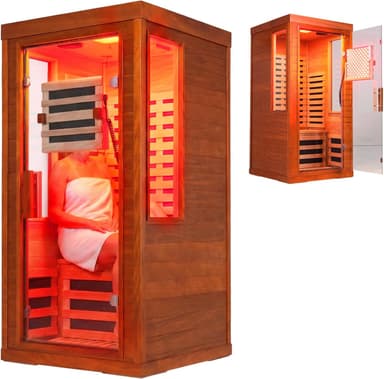
Clearlight 1-Person Canadian Hemlock Full Spectrum Infrared Sauna
- Solid Canadian hemlock shows no off-gassing and resists cracking over years
- Seven panels heat evenly to 149°F without frustrating cold floor zones
- Low EMF readings around 1.4-2.6mG offer genuine peace of mind
The lifetime cost comparison depends heavily on maintenance and failure modes. Infrared panels on cheap units delaminate within 2-3 years of heavy use. Clearlight and Sunlighten offer lifetime warranties on heater panels and structure - a meaningful differentiator at their price point. Budget infrared brands often provide 1-3 year warranties, and owner forums document panel failures, peeling veneer (Dynamic's earlier models specifically), and EMF drift.
Traditional heater elements - Harvia, Helo, TYLO - burn out at 4-6 years of regular use. Replacement heaters run $300-$700 for the element itself plus labor. Wood cupping and warping in outdoor installations is common in untreated hemlock units that lack adequate vapor barriers and drainage. Cedar and Thermowood units hold up significantly better over a decade.
Winner for operating cost: Infrared, by $20-75/month depending on location. Purchase price varies enough by configuration that neither type wins universally at the cash register.
The Sauna Experience - Subjective Differences That Actually Matter
Numbers explain mechanisms. They do not explain what it feels like to sit in each type for 40 minutes, and the experiential difference is real enough to drive purchasing decisions for many people.
Traditional - The Ritual Element
Traditional sauna has a cultural depth that infrared simply does not replicate. The löyly - pouring water over hot rocks - produces an immediate wave of humid heat that hits your face and chest before the steam fully diffuses. The temperature spike is brief but intense. Regular users describe it as "alive" in a way that a steady infrared emission is not. The crack and hiss of water on hot rocks, the eucalyptus or birch leaf scent some practitioners add, the communal element of sharing a session with someone else in a cedar-lined room heated to 190°F - these are not trivial considerations.
Heart rate response is notably higher in traditional sessions: typically 100-140 bpm versus 90-120 bpm in infrared at equivalent effort. Some users find the intensity pleasant and motivating. Others find it limits session length or creates anxiety in the first few minutes of a very hot session. First-time sauna users consistently find traditional saunas more challenging to acclimate to.
The three-round protocol common in Finnish practice - 10-12 minutes in the hot room, cool shower or cold plunge, repeat three times over 45-60 total minutes - produces a physiological and subjective experience quite different from a single sustained infrared session. The contrast between extreme heat and cold produces norepinephrine spikes of up to 500% above baseline. The Soberg et al. 2021 Nat Metabolism study documented that sauna-cold contrast protocols (57°C for 30 minutes plus 14°C water immersion for 1 minute, cycled three times per week) upregulated brown adipose tissue activity 2.5-fold and increased uncoupling protein 1 (UCP1) expression by 300%.
Infrared - Sustained and Accessible
Infrared sessions run longer by design - 30 to 45 minutes at a sustained 130-145°F. Many users find this format easier to maintain consistency with because the barrier to entry is lower. You are not steeling yourself against 190°F air. You sit down, the gentle radiant heat builds progressively, and 15 minutes in you are sweating steadily without discomfort.
The lower ambient temperature makes infrared significantly more accessible for specific populations. Elderly users, people managing cardiovascular conditions, those with multiple sclerosis (who are heat-sensitive), and individuals early in their sauna practice all tolerate infrared more readily. The Tei et al. WAON-CHF data used infrared specifically in CHF patients partly because the moderate ambient temperature allowed controlled heat exposure without the cardiovascular spike of a 185°F traditional session.
Reading, watching something, or working through a podcast is genuinely comfortable in an infrared session at 130°F. At 185°F in a traditional sauna, the heat tends to dominate your cognitive attention. Whether that is a feature or a limitation depends entirely on what you want from the session.
Contrast Therapy Compatibility
Both sauna types pair with cold plunge protocols, but traditional saunas are more naturally suited to the contrast format. The higher heat drives a more pronounced norepinephrine response, making the cold exposure afterward feel more dramatic and the perceived benefit more immediate. The Soberg protocols specifically used 135°F (57°C) sauna, which sits between typical infrared and traditional ranges.
If contrast therapy is the primary goal, a traditional sauna at 170-185°F plus a cold plunge at 37-50°F (Morozko Forge or The Plunge tubs in the $4,000-$6,000 range) produces the most researched protocol. Infrared plus cold plunge still works - the norepinephrine and BDNF response is meaningful at any core temperature elevation plus cold exposure.
Winner for experience: Traditional, for users who want the full Finnish ritual and intensity. Infrared, for users who prioritize accessibility, longer sessions, and ease of daily integration.
Safety and Contraindications - Who Should Choose Carefully
Both sauna types are safe for the vast majority of healthy adults. The risks are dehydration, orthostatic hypotension (blood pressure dropping 10-20 mmHg post-session when standing), and heat exhaustion in extreme cases. Standard protocol: hydrate with 1 liter of water before a session, exit if you feel dizzy or nauseous, and avoid alcohol before and during use.
Infrared - Specific Safety Considerations
Infrared is generally recommended as the safer entry point for elderly users, cardiovascular patients, and beginners because the lower ambient temperature produces a more moderate heart rate response (typically 90-120 bpm vs 120-140 bpm in traditional). The WAON-CHF study used infrared in patients with already-compromised cardiac function precisely because the heat stress was controllable and graduated.
EMF is a concern specific to infrared and does not apply to traditional electric heaters at seating distance. As noted above, modern Clearlight and Sunlighten units certify below 3 milligauss at body distance. Budget units have not consistently demonstrated this. If you are buying an infrared sauna, verify the specific EMF certification on the model you are purchasing, not just the brand's general claims.
Traditional - Specific Safety Considerations
The primary risk specific to traditional saunas is acute heat stroke in sessions beyond 20 minutes in extreme temperatures (above 195°F). This is almost always associated with alcohol use, dehydration, or both. Finnish sauna tradition includes protocols specifically to manage this: cool water showers between rounds, adequate fluid intake, and never using sauna alone if you are new to it or have health concerns.
Wood-fired traditional saunas (smoke saunas) produce carbon monoxide risk if ventilation is inadequate - relevant for the roughly 15% of traditional sauna market that uses wood-fired heaters. Electric heaters carry no combustion risk.
Winner for accessibility and safety margin: Infrared, particularly for elderly users, those with cardiovascular conditions, and first-time sauna users.
Full-Spectrum and Hybrid Options - Where the Categories Blur
The binary of infrared vs traditional sauna is becoming less clean as manufacturers push into hybrid territory. This matters if you want the best features of both without owning two units.
Full-Spectrum Infrared
Full-spectrum infrared units (Sunlighten mPulse, SaunaLife Radiant series) emit near-infrared (NIR, 600-1000nm), mid-infrared (MIR, 1.4-3μm), and far-infrared (FIR, 4-14μm) simultaneously. Near-infrared at these wavelengths activates cytochrome c oxidase in mitochondria, drives nitric oxide release, and has been studied for collagen synthesis and skin repair. The Hamblin 2017 review in AIMS Biophysiology documented pain reduction of 25% (WOMAC scores) and TNF-alpha (a pro-inflammatory cytokine) reduction of 30% in near-infrared photobiomodulation applications across a meta-analysis of over 1,000 subjects.
Full-spectrum units cost substantially more than FIR-only models - the Sunlighten mPulse starts at roughly $5,000 for a 1-person unit versus $1,500 for a basic FIR unit. The photobiomodulation research is real, but it was conducted with clinical light therapy devices at specific doses, not necessarily with the emission profile of a full-spectrum sauna cabin during a 35-minute session. The claim that a full-spectrum sauna reliably delivers therapeutic near-infrared doses is plausible but not yet confirmed by rigorous dose-measurement studies in sauna contexts specifically.
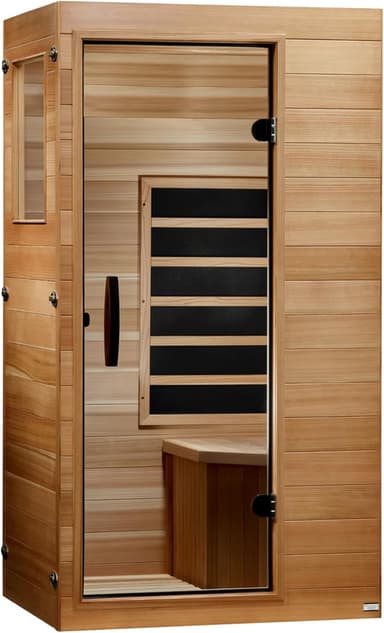
Dynamic Saunas Elite 1-Person Far Infrared Sauna with Red Light Therapy
- Clasp-together cedar assembly genuinely takes under an hour
- Ultra-low EMF panels provide safe, even far-infrared heat distribution
- Red light therapy inclusion adds real recovery value beyond basic infrared
Hybrid Saunas
Dundalk Leisurecraft's Panorama and SaunaLife's Radiant series offer units with both infrared panels and a traditional electric heater installed, switchable between modes. You run the traditional heater for a high-temperature Finnish session at 180°F, or switch to infrared-only for a moderate 130°F session. The Dundalk Panorama runs around $8,000 and uses Canadian hemlock with a 6-9kW traditional heater plus supplemental FIR panels. Sunlighten's hybrid configurations approach $15,000-$20,000 for multi-person units with full NIR/MIR/FIR spectrum.
Hybrid units require 240V because the traditional heater component demands it. They are heavier, more expensive, and require professional installation. They also eliminate the either/or decision entirely, which has real value for households with mixed-use needs or users who want both session types.
If the hybrid price point is beyond your budget, the more practical approach is to use a traditional community gym sauna for the high-intensity Finnish sessions and own an infrared unit at home for daily recovery and morning protocols. Most serious sauna users I have spoken with end up with some version of this hybrid access model even without owning a hybrid unit.
Winner for flexibility: Hybrid units, if budget allows. Full-spectrum infrared is the runner-up for users who want a single unit with expanded capability beyond basic FIR.
Brand-by-Brand Landscape - Where to Spend Your Money
The sauna market is now a $1.2 billion industry growing at 6.2% annually (Grand View Research, 2025), and the range from reliable manufacturers to outright garbage brands is wider than most buyers realize. These are the specific brands worth knowing.
Infrared - Brands Worth Considering
Clearlight is my top recommendation in the infrared category at mid-to-premium price points. The Sanctuary series uses a combination of ceramic and carbon panels, verified low-EMF certification below 3 milligauss, 97% far-infrared emissivity, and comes with a lifetime warranty that the company actually honors. The Sanctuary 2 (44 x 46 inches, two-person, 1,750W) runs approximately $4,500-$5,000. Build quality is consistently high across Reddit owner forums - the "zero issues at 10 years" comments appear regularly and they have for at least five years of my monitoring those communities.
Sunlighten is the choice for full-spectrum with app integration. The mPulse series uses patented True Wave heaters with 99% emissivity claims, NIR/MIR/FIR spectrum, chromotherapy lighting, and Bluetooth connectivity for session programming. Price premium over Clearlight is substantial ($5,000-$20,000 range). For users who specifically want the photobiomodulation spectrum or the technology integration, Sunlighten is the market leader. For users who want solid FIR therapy without the features, the premium is hard to justify over Clearlight.
Dynamic Saunas is the value play. The Barcelona 2-person unit at roughly $2,000 uses eucalyptus wood and 1,800W carbon panels. It works, and owner reviews are generally positive for the price point. The complaints are cosmetic - veneer finish quality and some assembly alignment issues. For a first sauna buyer who wants to test the format before committing premium dollars, Dynamic is a reasonable entry point. Do not expect Clearlight build quality.
HigherDose occupies the portable infrared blanket category ($600, far-infrared blanket with amorphous carbon panels at up to 120°F). It is not a sauna in any traditional sense, but it produces genuine FIR exposure and core heating in a format that works for travel, apartments with no space for a cabin, or supplemental use.
Traditional - Brands Worth Considering
Almost Heaven produces barrel and cabin traditional saunas in Western red cedar with Harvia heaters. Their Pinnacle 4-person barrel at around $7,500-$9,000 represents good value in the premium barrel category. Harvia heaters are Finnish-made, commercially proven, and reliable - heater element failure at 4-6 years is common but the replacement process is straightforward. See our best premium barrel saunas guide for a deeper breakdown of barrel-specific options.
Dundalk Leisurecraft is the Canadian manufacturer to know for outdoor traditional saunas. They build in Canadian hemlock, rate their barrel structures for 100 mph wind loads, and the Panorama hybrid is a category-defining product. For outdoor installations in climates with real winter conditions, Dundalk builds better than most.
Thermory represents the aesthetic-premium end. Thermally modified pine with the characteristic driftwood aesthetic that appears in architecture and design publications. Their barrel kits at $10,000+ are premium on price and build quality equally. The Thermowood's 50% better dimensional stability versus untreated wood is a real advantage in high-humidity-swing climates.
Backyard Discovery (Alder Grove at $4,000) provides the entry point into traditional sauna ownership. The 4.5kW heater is undersized for cold climates but adequate for indoor or covered outdoor installation in mild-to-moderate regions. For someone testing traditional sauna before committing to an $8,000-plus outdoor installation, the Backyard Discovery kit plus a used Harvia heater upgrade is a reasonable path.
What Owner Communities Actually Report
Scanning Reddit's r/Sauna, r/homeimprovement, and product-specific owner forums over the past three years, consistent patterns emerge. Clearlight owners report long-term satisfaction and excellent warranty service. Sunlighten owners report loving the technology but note customer service delays. Dynamic Saunas owners are satisfied at the price point but frequently mention build finishing issues. Almost Heaven owners are generally satisfied with heater performance but document 20% cosmetic wood cracking as normal settling. Harvia heater owners describe the units as "loud but reliable." Early model Dundalk owners in cold climates report minor sealing issues at door frames that required user-applied weatherstripping.
The pattern across all categories: pay more at purchase and you pay less in frustration over time. The $1,500 infrared unit from a no-name brand and the $4,000 traditional kit with a generic Chinese heater both generate disproportionate complaints. In a product category you plan to use daily for 10-plus years, the premium for a verified manufacturer is justified by arithmetic alone.
For a comprehensive look at the best single-person infrared options across price points, see our best one-person infrared saunas guide.
Protocols - Getting the Most Out of Whichever Type You Choose
The mechanism of heat stress is consistent across both types. The protocols that maximize benefit differ primarily in timing and structure.
Infrared Session Protocol
Start at 120°F. Ramp temperature by 10°F every 5-10 minutes to your target of 135-145°F. The ramp-up approach takes advantage of the progressive core temperature elevation that direct tissue heating enables. Hydrate with 1 liter of water before your session. Do not eat a large meal within 90 minutes of starting. Session duration: 30-45 minutes at full temperature. Post-session: cool shower or room-temperature room, 10-15 minutes rest, then hydrate again with electrolyte-containing fluid. Frequency: 4-7 sessions per week to approach the dose in the Laukkanen data.
For recovery protocols specifically, the Hussain and Cohen 2018 review suggests that post-training sessions within 30 minutes of exercise produce the greatest CK and IL-6 reduction. The heat accelerates blood flow through exercised tissue and drives HSP expression when the cellular stress signal from training is still active.
Traditional Session Protocol
Heat the sauna to 180-190°F (82-88°C) for 20-30 minutes before entering. First round: 10-12 minutes, two to three löyly bursts by pouring 0.5 cups of water over hot rocks every 3-4 minutes. Exit. Cold shower or cold plunge for 1-3 minutes. Rest 5-10 minutes. Repeat for two to three total rounds. Total session time: 45-60 minutes. Hydrate between rounds.
The contrast protocol from Soberg et al. 2021 specifies 135°F (57°C) sauna - lower than typical Finnish practice but within the upper range of infrared - plus 14°C (57°F) water immersion for 1 minute, cycled three times per week. For maximizing BAT upregulation and NEAT increase, this protocol outperformed sauna alone. Traditional saunas are better positioned for this because the higher ambient temperature drives more pronounced sympathetic activation before the cold exposure.
For those building a full contrast therapy setup, traditional sauna plus cold plunge is the evidence-based configuration. See our full guides section for dedicated contrast therapy protocols.
Frequency and the Dose-Response Relationship
The Laukkanen 2015 data is explicit: 4-7 sessions per week outperforms 2-3, which outperforms once per week, with roughly linear dose-response across cardiovascular outcomes. Daily use is not only safe for healthy adults - it appears to be the optimal frequency for cardiovascular and longevity benefits.
Infrared's lower session burden (lower air temperature, 10-minute preheat, 120V plug-in availability) makes daily use more practical for most people than traditional sauna, which requires 30-40 minutes of preheat, 240V, and a full hour of commitment. If the goal is consistent daily heat exposure over years, infrared's accessibility advantage compounds into a meaningful protocol adherence advantage.
Key Takeaways
- ●
Infrared and traditional saunas produce comparable core temperature elevation - both raise core temp by 1-2°C in a session, both drive heart rate to 100-140 bpm, and both trigger the heat shock protein response that underlies most of the documented health benefits. The mechanism is the same; the delivery differs.
- ●
The strongest cardiovascular and longevity evidence belongs to traditional sauna - the Laukkanen 2015 and 2017 Finnish cohort studies (n=2,315, 20+ year follow-up) documented 50% lower CVD mortality and 65-66% lower dementia risk at 4-7 sessions per week. No equivalent long-term RCT exists for infrared. That gap matters when making health-based purchasing decisions.
- ●
Infrared wins on accessibility and daily use adherence - 10-20 minute preheat vs 30-45 minutes, 120V standard outlet vs 240V dedicated circuit with an electrician, and $10-30 per month in electricity vs $30-80. For most people, the sauna they actually use every day beats the one they use twice a week.
- ●
Far-infrared therapy has specific clinical evidence for heart failure - Tei et al. 2016 (n=166, WAON-CHF study) showed a 76% reduction in rehospitalization and a 23% improvement in cardiac index with 60 sessions of far-infrared at 140°F. This is a distinct therapeutic application, not a general claim.
- ●
The "detox" claim for infrared is not supported - sweat composition across both types is approximately 99% water and electrolytes per the 2012 Genner analysis. Neither modality meaningfully clears heavy metals or environmental toxins through perspiration.
- ●
Traditional sauna is the better foundation for contrast therapy protocols - higher ambient temperature (170-200°F) produces stronger sympathetic activation before a cold plunge, and the Soberg et al. 2021 data on BAT upregulation and NEAT increase was built around heat-plus-cold cycling. If contrast therapy is the goal, traditional plus cold plunge is the evidence-aligned setup.
- ●
Budget predicts satisfaction more reliably than type - across both categories, units under $1,500-2,000 generate disproportionate owner complaints about build quality, EMF levels, and heater reliability. The premium for established manufacturers (Clearlight, Sunlighten, Harvia, Finnleo) is justified by arithmetic when spread across 10-plus years of daily use.
Who This Is For, Who Should Skip It
Who Should Choose Infrared
Infrared is the right call for anyone whose primary barrier to consistent sauna use is logistics. If you live in an apartment or a home without a 240V outlet near your installation space, infrared is the only practical option - a 120V, 15-20A circuit handles it, no electrician required. If you run hot, find traditional sauna temperatures genuinely intolerable, or are returning to heat therapy after an illness or injury, the 120-150°F range is a more forgiving entry point.
Infrared also suits people whose primary use case is post-training muscle recovery. The Hussain and Cohen 2018 meta-analysis showed 20-40% reductions in delayed-onset muscle soreness, and the direct tissue penetration of 1.5-2 inches means you are heating the muscle, not just the skin surface. Anyone with a specific interest in Waon therapy protocols for cardiovascular rehabilitation should note that the Tei et al. 2016 WAON-CHF trial used far-infrared at 140°F - directly in infrared sauna range.
Budget-constrained buyers who want daily-use access also land here. A quality infrared unit from Clearlight or Sunlighten in the $4,000-6,000 range costs roughly half of a comparably built traditional indoor sauna installation.
Who Should Choose Traditional - or Skip Sauna Entirely
Traditional sauna is the right choice for anyone who takes the longevity and cardiovascular evidence seriously and wants the configuration closest to what produced the data. The Laukkanen studies used traditional Finnish sauna at 174-212°F. If you are building a dedicated outdoor structure, have 240V available, and can commit to the full protocol with contrast cycling, traditional sauna extracts more from the evidence base.
People who want the social and cultural dimension of sauna - the multi-round löyly ritual, the contrast plunge, the communal aspect - will find infrared a poor substitute. You cannot throw water on infrared panels. The experience is genuinely different, and that matters.
What to Read Next
If this comparison helped you identify which type fits your situation, these guides will take you to the next decision.
Best One-Person Infrared Saunas - My ranked list of solo infrared units across price points, with hands-on notes on EMF levels, panel quality, and assembly time. If you landed on infrared after reading this, start here.
Best Premium Barrel Saunas - Barrel saunas are the most practical outdoor traditional sauna configuration for residential buyers. This guide covers the top builds from Almost Heaven, Dundalk, and others, with specific notes on heater pairing and cold-climate performance.
All Sauna Guides - Contrast therapy protocols, sauna-specific health condition guides, heater sizing calculators, and installation walkthroughs. If you have a specific question this article did not answer, the full library is here.
Frequently Asked Questions
Is infrared sauna actually as good as traditional sauna for health benefits?
For most people using sauna primarily for cardiovascular health and longevity, traditional sauna has the stronger direct evidence. The Laukkanen 2015 JAMA Internal Medicine paper (n=2,315, 20-year follow-up) documented a 50% reduction in cardiovascular mortality and the 2017 follow-up showed 65-66% lower dementia risk - both in traditional Finnish sauna at 174-212°F. Infrared has solid clinical evidence for specific applications, particularly the Tei et al. 2016 WAON-CHF data showing 76% reduced rehospitalization in heart failure patients. For general use, both types produce comparable core temperature elevation, similar heat shock protein induction, and similar heart rate response. The honest answer is that the evidence gap reflects research volume more than biological difference - but until long-term RCTs for infrared cardiovascular outcomes exist, traditional sauna holds the stronger position on the data.
What temperature does an infrared sauna actually reach?
Consumer infrared saunas heat the cabin air to 120-150°F (49-65°C), which is 20-50°F lower than the minimum of most traditional sauna operating ranges. The important distinction is that the air temperature is not the relevant number for infrared. Far-infrared wavelengths (4-14 micrometers) penetrate 1.5-2 inches into tissue and raise core temperature directly, independent of how warm the surrounding air feels. This is why users report sweating as heavily at 135°F infrared as at 185°F traditional - the core heating mechanism is operating even when the ambient environment feels mild. Full-spectrum units from brands like Sunlighten add near-infrared (600-1000nm) for additional photobiomodulation effects documented by Hamblin 2017.
Which type of sauna costs less to run?
Infrared costs substantially less to operate. At the US national average of approximately $0.16 per kWh, daily one-hour infrared sauna use runs $10-30 per month depending on unit wattage (typically 1,200-1,800W). Traditional sauna at the same frequency runs $30-80 per month because heaters draw 4,500-9,000W and require 20-45 minutes of preheat before any session time. In high-rate states like California or New York where residential electricity reaches $0.25/kWh or higher, the gap widens further. Over 10 years of daily use, the operating cost difference between a mid-range infrared and a traditional sauna can exceed $5,000 - enough to close most of the purchase price gap between the two types.
Can I install an infrared sauna in an apartment?
Yes, in most cases. Most infrared saunas from 1-2 person capacity draw 1,200-1,800W on a standard 120V, 15-20A household circuit - the same circuit that runs a hair dryer or space heater. No dedicated wiring or electrician is required for these units. Clearlight's Sanctuary 2 model, for example, runs on 120V at 1,750W and ships as a modular prefab that assembles without tools. The practical limitations in an apartment are floor space (a 1-person unit typically starts at roughly 36" x 36"), ventilation (you want airflow out of the room), and lease terms (check before purchasing a permanent installation). Traditional sauna requires 240V, 30-60A dedicated circuit - that is a hard no for almost every apartment situation.
Do saunas actually detox your body?
No meaningful detoxification occurs through sauna sweating, infrared or traditional. Sweat is approximately 99% water and electrolytes. The 2012 Genner analysis found no clinically significant concentration of heavy metals, BPA, or other environmental toxins in sweat compared to urine or bile, which are the actual excretion pathways for most toxicants. The liver and kidneys handle detoxification. The "detox" framing in sauna marketing - especially infrared marketing - is not supported by the existing evidence. The documented benefits of regular sauna use are real and substantial (cardiovascular, inflammatory, cognitive, recovery), but they come through heat stress adaptations, not sweat-based excretion.
How often should I use a sauna to see health benefits?
The Laukkanen 2015 data shows a clear dose-response relationship. Men using traditional sauna once per week showed modest benefit. Two to three sessions per week showed progressively better cardiovascular outcomes. Four to seven sessions per week produced the peak benefit: 50% lower CVD mortality compared to once-weekly use. The relationship is approximately linear - more frequent use produces better outcomes up to daily use. There is no evidence of harm from daily sauna use in healthy adults. The practical implication is that frequency matters more than any single session parameter. A 30-minute infrared session 6 days per week almost certainly produces better long-term outcomes than a 45-minute traditional session once or twice a week, because the total accumulated heat stress dose is higher.
What is löyly and does it matter?
Löyly (pronounced roughly "loy-loo") is the Finnish practice of pouring water over hot sauna stones to generate a burst of steam. In traditional sauna, the rocks in the kiuas (heater) store thermal mass at 200-220°F, and water poured over them vaporizes instantly, spiking perceived humidity and intensifying heat sensation without significantly raising air temperature. The effect is physiological - the steam raises skin surface temperature rapidly, accelerating sweat onset and cardiovascular response - and deeply cultural. Finnish sauna practice without löyly is considered incomplete by most practitioners. Infrared saunas cannot replicate löyly. The heating panels are not stones and cannot have water poured over them. This is one of the non-negotiable experiential differences between the two types - if the löyly ritual matters to you, infrared is simply the wrong product.
Which is better for muscle recovery - infrared or traditional?
Both drive recovery through the same primary mechanism: heat-induced increases in blood flow through exercised tissue and upregulation of heat shock proteins (HSP70/72 rise 50-100% post-session per the Hussain and Cohen 2018 review). The direct tissue penetration of far-infrared (1.5-2 inches into muscle) gives it a plausible mechanical advantage for targeting deep muscle tissue, and most commercial infrared recovery research uses infrared protocols. The Hussain and Cohen meta-analysis (13 studies, roughly 500 subjects) showed 20-40% reductions in delayed-onset muscle soreness and 25% lower creatine kinase levels in Nordic ski athletes post-training. For timing, sessions within 30 minutes of training appear to produce the greatest anti-inflammatory effect while the cellular stress signal from exercise is still active.
Frequently Asked Questions
There's no single "best" sauna type - it depends on your needs. Traditional saunas offer more intense heat (150-195°F) and have stronger long-term research supporting cardiovascular and cognitive benefits, while infrared saunas operate at lower temperatures (120-140°F), heat up faster, cost less to run, and may provide better pain relief for chronic conditions. Choose traditional if you prefer authentic intense heat and steam, or infrared if you want a gentler, longer session with lower operating costs.
Related Guides
Affiliate Disclosure - UseSauna earns a commission from qualifying purchases through our Amazon affiliate links. This does not affect our editorial integrity.