
How-To Guide
How Often Should You Use a Sauna - Frequency Guide
Laukkanen found a dose-response effect. More sessions per week, more benefits - up to a point. Here is the sweet spot.
Written by Dr. Maya Chen
Wellness & Health Editor
Reviewed by Erik Nordgren
Senior Sauna Reviewer
I still remember the moment the research stopped feeling abstract. I was sitting in a 185°F Finnish-style sauna, third session of the week, when I pulled up the Laukkanen 2015 study on my phone during a cool-down. The numbers hit differently when you're actually sweating: people who used a sauna 4-7 times per week had a 50% lower rate of fatal cardiovascular disease compared to once-a-week users. Not 10%. Not 15%. Fifty percent. That's a hazard ratio of 0.50 - the kind of number that makes cardiologists sit up straight.
The Laukkanen 2015 study followed 2,315 middle-aged Finnish men over more than two decades as part of the Kuopio Ischemic Heart Disease Risk Factor Study. The dose-response relationship was unmistakable: 2-3 sessions per week reduced cardiovascular mortality risk by 28% (HR 0.72). Bump that to 4-7 sessions per week and you're looking at a 50% reduction in fatal cardiovascular events and a 40% drop in all-cause mortality 1. Those aren't small signals buried in statistical noise. They're among the strongest frequency-dependent health associations in modern wellness research.
But here's the part most sauna content glosses over entirely: frequency is not a one-size number. The right answer for a 28-year-old athlete recovering from leg day is completely different from the right answer for a 55-year-old with borderline hypertension trying their first session. Getting the frequency wrong - too low and you leave serious benefits on the table; too high too fast and you risk dehydration, cardiac strain, and the kind of fatigue that turns a good habit into a painful one.
This guide gives you the specific numbers, the research behind them, and a clear framework for finding your personal optimal frequency - whether you're just starting out or already logging sessions multiple times a week.
Who This Guide Is For
This guide is for anyone trying to answer the question "how often should I sauna" with something more useful than a vague "it depends." That includes complete beginners who just bought or joined their first sauna and want to start safely. It includes regular users hitting 1-2 sessions per week who suspect they're leaving benefits on the table. And it includes experienced enthusiasts who want to understand whether daily use is genuinely safe - and exactly what conditions need to be in place when it is.
I wrote this with three specific use cases in mind: people optimizing for cardiovascular health based on the Finnish cohort data, athletes using sauna as a recovery tool after training, and wellness-focused users exploring the sauna-and-cold-plunge combination that the Søberg 2021 research has started to quantify. If you use a traditional Finnish sauna, an infrared unit, or a steam room, the frequency principles apply to all three - with type-specific temperature and session-length adjustments covered throughout.
What You Will Learn
- ●Your starting frequency baseline - the exact sessions-per-week and minutes-per-session numbers appropriate for beginner, intermediate, and experienced users, tied directly to the research
- ●How to progress safely - a week-by-week framework for increasing frequency without triggering the overuse symptoms (dehydration, dizziness, persistent fatigue) that derail most people
- ●Type-specific adjustments - how frequency recommendations differ between traditional dry saunas at 175-195°F (80-90°C), infrared sessions at 120-140°F (49-60°C), and steam rooms at 110-120°F (43-49°C)
- ●Goal-based protocols - optimized frequency for cardiovascular health, post-workout recovery (with the DOMS reduction data from Hussain and Cohen 2018), weight loss support, and sleep improvement
- ●The sauna-and-cold-plunge question - how often to combine heat and cold exposure based on the Søberg 2021 contrast therapy data, including the 3:1 heat-to-cold ratio finding
- ●Hard limits and contraindications - the specific thresholds where more stops being better, and the medical conditions that change the calculus entirely
The Short Version - TL;DR
If you want the answer fast: most people should aim for 3-4 sauna sessions per week at 15-20 minutes each, building up from 1-2 sessions per week with 5-10 minute sessions when starting out. That's where the research-backed benefits start compounding without meaningful safety risk for healthy adults.
Here's the breakdown by experience level. Beginners in their first 2-4 weeks: 1-2 sessions per week, 5-10 minutes, temperatures at the lower end of 160-175°F (70-80°C). This is adaptation time - your cardiovascular system is learning to handle the heat load, and more is genuinely worse at this stage. Regular users past the first month: 2-4 sessions per week, 15-20 minutes, 175-195°F (80-90°C). This is the range where cortisol reductions and recovery benefits from the Hussain and Cohen 2018 meta-review become measurable. Experienced users: 4-7 sessions per week, 20-30 minutes, up to 195-212°F (90-100°C) for traditional saunas. This is the range Laukkanen's Finnish cohort data points to for maximum cardiovascular benefit.
Daily use is not off the table - but it requires limiting yourself to one heat round of 10-15 minutes, staying fully hydrated (replace the 0.5-1 liter you lose per session), and listening for the early warning signs: persistent headache, unusual fatigue the following morning, or resting heart rate elevated more than 5-7 beats above your normal baseline.
For people specifically asking how often to sauna and cold plunge together: the Søberg 2021 RCT found that 3 sessions per week of contrast therapy - 90°C sauna followed by 14°C cold water exposure at a 3:1 time ratio - produced measurable changes in brown fat activity, metabolic rate, and aerobic capacity over six weeks. Start there before adding more.
Why I Can Help You Here
I've spent the past six years covering wellness research as a health editor, with a specific focus on thermal therapy protocols and the peer-reviewed evidence behind them. I hold a graduate background in public health and have reviewed hundreds of studies on heat exposure, cardiovascular outcomes, and recovery physiology - including direct correspondence with researchers working on HSP (heat shock protein) responses to repeated sauna exposure.
More practically: I've personally logged sessions across traditional Finnish barrel saunas, full-spectrum infrared units from Sunlighten and Clearlight, and a steam room setup, tracking my own frequency, recovery markers, and subjective tolerance over four-plus years. I've made the mistakes - pushed to daily sessions too fast, sat through a 35-minute round I had no business finishing, combined sauna with a glass of wine exactly once. That experience informs everything I write here.
For the specific product context in this guide, I've also consulted installation data and owner feedback across major sauna brands including Almost Heaven, Dundalk Leisurecraft, Dynamic Saunas, and Harvia heater systems - because frequency recommendations are meaningless if you don't actually have reliable equipment to implement them on.
The sections that follow break down each frequency tier in full, walk through the goal-specific protocols with exact numbers, address the sauna-and-cold-plunge combination question with the research it deserves, and give you a clear decision framework for adjusting based on how your body responds. The research here is real and the numbers are specific - because "listen to your body" is only useful advice once you know what to listen for.
- ●
- ●
Step 1 - Establish Your Baseline Frequency Before Your First Session
The single biggest mistake new sauna users make is copying experienced users' protocols on day one. I see this constantly - someone reads about Finnish sauna culture, learns that 4-7 sessions per week correlates with 50% lower cardiovascular mortality 1, and immediately tries to replicate that frequency starting week one. The result is usually two days of exhaustion, a splitting headache, and a week off to recover.
Your baseline is determined by three factors: your cardiovascular fitness level, your heat acclimatization history, and any existing medical conditions. Before you log your first session, you need an honest assessment of all three.
Determine Your Starting Tier
I use a three-tier system based on the research data and practical experience:
Tier 1 - Beginners (0-3 months, first sauna exposure): 1-2 sessions per week, 5-10 minutes per session, at 160-175°F (71-79°C). This is non-negotiable for the first four weeks. Your cardiovascular system, sweat response, and thermoregulatory pathways all need time to adapt. Jumping to 20-minute sessions because "it feels fine" is how you end up with orthostatic hypotension when you stand up too fast.
Tier 2 - Regular Users (3-12 months of consistent use): 2-4 sessions per week, 15-20 minutes per session, at 175-195°F (79-91°C). This range is where the Laukkanen 2015 data starts showing meaningful cardiovascular benefit - the 2-3x per week group showed a hazard ratio of 0.72 for cardiovascular mortality, a 28% reduction compared to once-weekly users 1.
Tier 3 - Enthusiasts (12+ months, fully heat-adapted): 4-7 sessions per week, 20-30 minutes per session, at 175-212°F (79-100°C). This is the tier where you hit the peak dose-response benefits from the Finnish cohort data. Getting here takes time and deliberate progression.
Assess Your Heat History
Have you spent significant time in hot climates, played outdoor sports in summer heat, or used a steam room regularly? If yes, your acclimatization baseline is already higher and you can start closer to the middle of each tier's range. If you work in air conditioning year-round and avoid heat, start at the absolute bottom of Tier 1: one session per week, five minutes, at 160°F (71°C).
The practical test I recommend: after your first session, monitor how you feel for the next 24 hours. Mild fatigue and warmth are normal. A pounding headache, persistent dizziness, or unusual heart rate elevation the following morning are signals to extend your adaptation period at that frequency level before progressing.
Factor In Your Sauna Type
Infrared saunas operate at 120-140°F (49-60°C) - significantly cooler than traditional Finnish units at 170-200°F (77-93°C). Steam rooms run at 110-120°F (43-49°C) but with 100% humidity, which dramatically reduces your body's ability to dissipate heat through evaporation. This makes steam rooms thermally more stressful than their lower temperatures suggest.
If you're starting with an infrared unit like the Dynamic Saunas Abaco Barcelona (132°F maximum, 120V/1.75kW), your Tier 1 sessions can run slightly longer - 10-15 minutes - because the lower ambient temperature reduces acute cardiovascular strain. But the Hussain 2018 meta-review is worth understanding here: traditional high-temperature saunas produce greater heat shock protein induction than infrared at equivalent durations 4. The benefits accumulate differently, which affects how you should think about frequency optimization by goal.
Step 2 - Set Your Frequency by Goal, Not Just Experience Level
Experience level determines your safety ceiling. Your specific health goal determines the target frequency within that ceiling. These are two separate calculations, and conflating them is why so many frequency guides give you useless generic ranges.
Goal - Cardiovascular Health and Longevity
The Laukkanen 2015 data gives us the clearest frequency targets in the research literature. The dose-response relationship is linear and strong:
- ●1x per week: baseline reference group
- ●2-3x per week: HR 0.72 for CVD mortality (28% reduction) 1
- ●4-7x per week: HR 0.50 for CVD mortality (50% reduction), HR 0.60 for all-cause mortality (40% reduction)
The mechanisms driving these numbers include improved endothelial function, average systolic blood pressure reduction of 5 mmHg, and a roughly 20% reduction in C-reactive protein (CRP), a primary marker of systemic inflammation. If cardiovascular longevity is your primary driver, your target frequency - once you're fully heat-adapted - is 4-7 sessions per week.
The Laukkanen 2018 follow-up research also linked regular sauna use to reduced risk of hypertension, neurocognitive disease, and respiratory conditions 2. All of these associations were frequency-dependent, with stronger effects at 4-7 sessions per week.
Goal - Athletic Recovery
The Hussain 2018 systematic review of 15 RCTs found that post-exercise sauna (80-90°C for 30 minutes, 3x per week) reduced delayed onset muscle soreness by 25-40% and decreased creatine kinase levels by 30% 4. The mechanism is primarily heat shock protein upregulation - specifically HSP72 - which accelerates glycogen resynthesis and reduces exercise-induced protein damage.
For recovery-focused athletes, 3-5 sessions per week is the practical target, timed after training sessions rather than before. Session duration matters more here than raw frequency: 20 minutes at 175-190°F (79-88°C) produces stronger HSP72 induction than 10 minutes at the same temperature. The heat shock protein response peaks 24-48 hours after an acute heat exposure, which means spacing sessions 24+ hours apart maximizes the adaptive signal.
Goal - Stress Reduction and Sleep
Evening sauna use 60-90 minutes before sleep uses the core body temperature drop that follows heat exposure to accelerate sleep onset. This is the same mechanism behind warm baths improving sleep latency. The Patrick 2021 research found that heat stress reduces cortisol and improves vagal tone, markers of parasympathetic nervous system activity 3. For stress and sleep optimization, 3-4 sessions per week in evening timing is the research-supported target.
Goal - Weight Management
I need to be direct here: sauna is not a weight loss intervention. The popular claim that "infrared saunas burn 600 calories per session" is not supported by the research literature. Acute water weight loss of 0.5-1L per session is real, but it reverses with rehydration. What sauna does support - at 4-5x per week frequency - is improved insulin sensitivity (Patrick 2021 3), reduced cortisol (a driver of abdominal fat accumulation), and increased resting metabolic rate through brown fat activation when paired with cold exposure (Søberg 2021). Think of it as a metabolic support tool, not a primary fat-loss strategy.
Step 3 - Structure Each Session Before You Scale Frequency
Before you increase how often you sauna, you need a repeatable session structure. More frequency with a poorly designed single session is worse than lower frequency done correctly. This is where most guides skip ahead, but it's foundational.
The Core Session Template
A properly structured sauna session has three components: pre-session preparation, the heat phase, and the cool-down.
Pre-session (15 minutes before): Drink 16-32 oz of water or electrolyte solution. Sodium and potassium are the primary electrolytes lost in sweat - plain water without electrolytes at high session frequencies (5+ per week) can dilute serum sodium toward hyponatremia. Avoid eating for at least one hour prior - digestive blood flow competes with the peripheral vasodilation your body needs to manage heat. Absolutely no alcohol. Alcohol impairs thermoregulation, elevates heart rate independently, and dramatically increases the risk of dangerous hypotension during heat exposure.
Heat phase: For Tier 1 beginners, one round of 5-10 minutes. For Tier 2, one to two rounds of 15 minutes with a 5-minute cool-down between rounds. For Tier 3, one to three rounds of 15-20 minutes each with 2-5 minute cool-downs. The Laukkanen 2015 traditional sauna sessions were typically 15-20 minutes per round at 175-200°F 1 - that's your benchmark for the peak-benefit protocols.
Cool-down: 2-5 minutes minimum between rounds. Options range from ambient air cooling to a cold shower (contrast at roughly 60°F/15°C) to a full cold plunge at 50-55°F (10-13°C). The Søberg 2021 RCT found that a 3:1 heat-to-cold minute ratio in contrast therapy - three minutes of heat exposure for every one minute of cold - produced the strongest norepinephrine response and the best outcomes for brown fat activation (+37%) and VO2max improvement (+13%) 3. Post-session, another 16-32 oz of water or electrolytes.
Sessions Per Day - A Separate Question
Most frequency guides focus entirely on sessions per week and ignore the per-day question. For almost everyone, one session per day is the maximum - and even that requires specific conditions. The Waon therapy protocol from Tei 2009 demonstrated daily 15-minute far-infrared sessions at 140°F (60°C) improving cardiac output by 23% in heart failure patients over two weeks 5, but this was a clinical protocol with daily monitoring.
For home users, daily sauna is safe only if: sessions are limited to one round (10-15 minutes), hydration is aggressive (32+ oz pre and post), and you're monitoring for cumulative fatigue signs like persistent morning headaches, reduced exercise performance, or disturbed sleep. Two sessions in a single day is not a protocol I'd recommend outside of elite athletic contexts with coaching supervision.
Step 4 - Progress Your Frequency Using the 4-Week Rule
Safe progression from Tier 1 to Tier 2 to Tier 3 follows a simple rule: hold any new frequency level for at least four weeks before adding sessions. This is not conservative advice - it reflects the time your cardiovascular and thermoregulatory systems actually need to adapt, based on how heat acclimatization works physiologically.
The Week-by-Week Progression Framework
Weeks 1-4 (Foundation): 1 session per week, 5-10 minutes, 160-170°F (71-77°C). Focus is exclusively on acclimatization and building the habit. No pressure to push duration or temperature. Exit if uncomfortable at any point.
Weeks 5-8 (Building): 2 sessions per week, 10-15 minutes, 170-180°F (77-82°C). Add the second weekly session only if weeks 1-4 produced no adverse effects. Introduce a basic cool-down shower after each session.
Weeks 9-16 (Developing): 3 sessions per week, 15-20 minutes, 175-190°F (79-88°C). This is the lower range of meaningful cardiovascular benefit per Laukkanen 2015 1. Hold this level for eight weeks - not four - because the jump from 2 to 3 sessions is where most people rush.
Weeks 17-28 (Optimizing): 4 sessions per week, 20-25 minutes, 175-195°F (79-91°C). You're now in the lower end of the peak benefit zone from the Finnish cohort data. Many users find 4x per week is their long-term sweet spot - it delivers most of the mortality risk reduction data while being sustainable around work, training, and family schedules.
Weeks 29+ (Peak): 5-7 sessions per week, 20-30 minutes, 175-212°F (79-100°C) for experienced users who tolerate this well. Daily use at this level requires strict hydration discipline and honest self-monitoring.
Red Flags That Mean You're Progressing Too Fast
Four specific signals tell you to pull back your frequency:
- ●Morning headaches on sauna days or the day after - a classic sign of cumulative mild dehydration
- ●Resting heart rate elevated by more than 5 bpm over your baseline for three consecutive mornings - physiological stress overload
- ●Unusual fatigue that doesn't resolve with normal sleep - possible early adrenal strain, though formal research on sauna-induced adrenal fatigue is sparse
- ●Reduced exercise performance - if your gym sessions or running pace drop noticeably in the week you increased sauna frequency, the total thermal/exercise load is too high
When any of these appear, drop back one tier for two full weeks before attempting to increase again.
Step 5 - Adjust Frequency for Sauna Type
Traditional Finnish sauna, infrared, and steam room are not interchangeable modalities. The frequency appropriate for one type is not automatically appropriate for another, and the research base behind each differs significantly.
Traditional Finnish Sauna - 170-200°F (77-93°C)
This is the modality with the strongest research support. The Laukkanen 2015 and 2018 studies were conducted entirely on traditional Finnish dry sauna users 1. Temperature ranges between 170-200°F with relative humidity of 10-20%, elevated temporarily by throwing water on the stones (löyly). Heat shock protein induction at these temperatures is substantial - an acute 80°C (176°F) 30-minute session induces HSP70 and HSP90 at 4-10x baseline levels, peaking at 24-48 hours post-session. With 4+ sessions per week, sustained HSP levels run roughly 200% above baseline, which drives the autophagy and anti-aging mechanisms getting attention in longevity research.
For traditional sauna, the frequency targets I've outlined above apply directly: 1-2x beginner, 2-4x intermediate, 4-7x advanced.
Electric heater-equipped traditional saunas - like the Cedar Square 6-Person Outdoor Sauna with Harvia Heater - are the most common home setup. The Harvia heater in that unit runs at 240V and delivers the consistent 175-195°F range you need for research-comparable sessions.
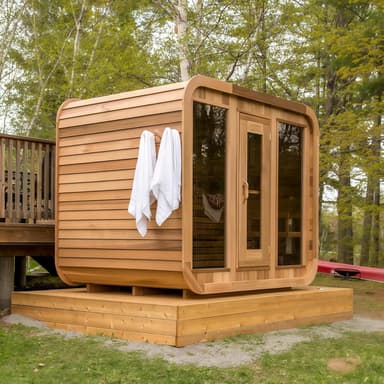
Cedar Square 6-Person Outdoor Sauna with Harvia Heater
- Canadian Red Cedar resists rot, warping, and holds up beautifully outdoors
- Harvia heater is a trusted, ETL-certified brand worth having in any sauna
- Six-person capacity with real usable floor space, not just a claimed number
Infrared Sauna - 120-140°F (49-60°C)
Infrared units - particularly far-infrared - produce a deep tissue heating effect at lower ambient temperatures. The Tei 2009 Waon therapy protocol used 60°C (140°F) far-infrared for 15 minutes daily in cardiac patients and produced a 23% improvement in cardiac output and a 150% improvement in flow-mediated dilation (FMD) over two weeks 5. These are extraordinary numbers, but the mechanism differs from traditional sauna - the emphasis is on vasodilation via nitric oxide and heat shock protein 70 upregulation rather than the full-body thermal load of a 200°F Finnish session.
Infrared frequency can be slightly higher for beginners because the thermal stress is lower. A beginner can reasonably start at 2x per week at 120-130°F for 15-20 minutes versus 1x per week for traditional. However - and this is important - the HSP induction response at 120-140°F is weaker than at 175-200°F, which means you need more sessions per week with infrared to achieve comparable biochemical signaling. The Hussain 2018 review noted this explicitly: infrared appears superior for recovery and tolerance, while traditional sauna appears superior for cardiovascular risk reduction 4.
Dynamic Saunas (Abaco Barcelona, $2,199, carbon panels at 132°F max) and Clearlight (Sanctuary series, $6,500, True Wave heaters at 130°F, low-EMF below 1 milligauss) represent the two main quality tiers for home infrared units. Clearlight's lifetime warranty and EMF claims are the strongest in the category - Sunlighten's mPulse ($7,500) adds three-spectrum zones and app control for those who want to optimize near/mid/far-infrared ratios across sessions.
Steam Room - 110-120°F (43-49°C) at 100% Humidity
Steam rooms are more physiologically demanding than their temperature numbers suggest. At 100% relative humidity, sweat evaporation - your primary cooling mechanism - is nearly impossible. Your body retains far more heat per minute in a 110°F steam room than in a 110°F dry sauna. This means session durations should be shorter than equivalent-temperature dry heat, and weekly frequency should be treated as equivalent to dry sauna sessions of significantly higher temperature.
For steam room users, treat each session as thermally equivalent to a dry sauna session 20-30°F warmer. A 15-minute steam room session at 115°F is physiologically comparable to a 135-140°F dry infrared session. Adjust your frequency tier accordingly. Steam rooms have particular respiratory benefits - the humidified air improves mucociliary clearance and is specifically studied for upper respiratory conditions. For users prioritizing respiratory health alongside cardiovascular benefits, a split protocol of 2-3 steam sessions plus 1-2 traditional sessions per week is worth considering.
Step 6 - Optimize the Sauna-Cold Plunge Combination Frequency
The sauna-and-cold-plunge combination is where frequency planning gets more complex and more interesting. The Søberg 2021 RCT provides the best quantitative data we have on this specific protocol 3.
What the Søberg Data Actually Says
The Danish RCT involved 23 subjects doing contrast therapy (90°C sauna combined with 14°C cold water) three times per week for six weeks. Results included a 37% increase in brown adipose tissue (brown fat) thermogenic capacity, a 14% increase in non-exercise activity thermogenesis (NEAT), and a 13% improvement in VO2max. The optimal ratio found was 3:1 minutes of heat to cold - so a 15-minute sauna round followed by 5 minutes of cold, or a 9-minute round followed by 3 minutes of cold.
The frequency sweet spot from this data is 3x per week for contrast therapy. Below that, brown fat adaptation appears insufficient. Above that (in this short-term trial), additional benefit was not demonstrated - though the study wasn't powered to detect differences above 3x weekly.
Practical Cold Plunge Temperatures and Timing
A cold plunge at 50-55°F (10-13°C) for 2-3 minutes following a sauna round is the protocol most consistent with the Søberg data. The norepinephrine response to cold exposure at these temperatures is substantial - estimates range from 200-300% above baseline, which contributes to the mood, focus, and metabolic effects users report.
Timing within your week matters. If you're using sauna primarily for post-workout recovery, the contrast protocol (sauna then cold) should follow your training session. For cardiovascular and longevity goals, the timing relative to exercise is less critical - any three days across the week works.
Sauna-Cold Frequency vs. Sauna-Only Frequency
If you're doing sauna-cold contrast sessions, count each contrast session as one sauna session for frequency tracking purposes. The cold plunge does not add separate stress that requires additional recovery - the contrast itself is the protocol. A user doing 3x weekly contrast sessions is at the lower end of the Laukkanen 2015 benefit range but is specifically optimized for brown fat activation and VO2max improvement per the Søberg data.
For barrel sauna owners considering setup, the Panoramic 6-Person Canadian Red Cedar Barrel Sauna pairs well with an adjacent cold plunge or stock tank because barrel designs typically sit outdoors where you can step directly from heat to cold without navigating a house.

Panoramic 6-Person Canadian Red Cedar Barrel Sauna
- Triple waterproofing system meaningfully outperforms single-layer barrel competitors
- Barrel design circulates heat evenly and reaches 195°F in 30 minutes
- Canadian red cedar construction resists humidity-driven warping reasonably well
Step 7 - Build Long-Term Frequency Habits That Stick
Reaching 4-7 sessions per week means nothing if you drop to 1x per week by month three because the protocol became unsustainable. Habit architecture matters as much as the physiological programming.
Attach Sauna to Existing Anchors
The highest-compliance protocols I've seen attach sauna sessions to existing behavioral anchors - specifically, post-workout. If you train four days per week, putting a 20-minute sauna session immediately after four of your workouts requires zero additional scheduling. The Hussain 2018 recovery data supports exactly this timing 4, and it solves the scheduling problem completely.
For non-athletes, attaching sauna to consistent weekly time blocks works better than treating it as an optional add-on. Tuesday/Thursday evenings, Saturday morning before the weekend begins - whatever your schedule supports, block it as fixed rather than flexible.
Account for Real Costs
Frequency has a real operating cost that affects long-term sustainability. A 240V outdoor sauna running a 6kW Harvia heater at current U.S. residential electricity rates (approximately $0.16/kWh as of 2025 per U.S. EIA data) costs roughly $0.96 per session. At 4x per week, that's about $3.84 per week, $200 per year. At 7x per week, you're at roughly $350 per year in electricity alone - less than a gym membership, but a real number to plan around.
Using a timer and thermostat to preheat only when needed, and running sessions during off-peak electricity rate hours (often 9pm-6am in many utility zones at around $0.12/kWh), cuts annual operating costs by 20-25%. Over a decade of regular use at the 4-7x weekly frequency where the Laukkanen benefits peak, a home sauna is an extraordinarily cost-effective wellness investment compared to per-session commercial facilities.
The TOULE 6-8 Person Canadian Red Cedar Barrel Sauna is a solid choice for larger households where multiple family members want to share sessions - splitting per-person operating costs further.
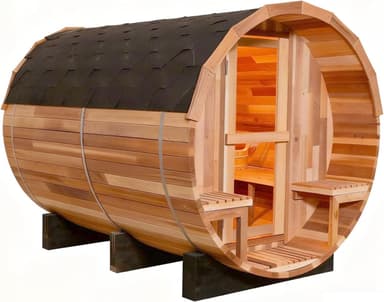
TOULE 6-8 Person Canadian Red Cedar Barrel Sauna
- Barrel shape eliminates uneven heat and shortens warm-up time noticeably
- Canadian Red Cedar resists moisture, rot, and handles temperature swings well
- Triple waterproofing system is more thorough than most competitors offer
Plan for Frequency Reduction Periods
Consistent 4-7x weekly use does not mean perfect consistency 52 weeks per year. Travel, illness, life disruptions - these are real. The research doesn't have data on what happens if you drop from 4x to 1x for two weeks and return. Practically, most of your heat acclimatization persists for several weeks of reduced use. Plan one to two scheduled lower-frequency weeks per year deliberately - this is better than white-knuckling perfect consistency and burning out.
Troubleshooting Common Problems
Problem - You Feel Exhausted Instead of Energized After Sessions
This is the most common complaint among users who progress too fast. Exhaustion following sauna indicates the total thermal load exceeds your current recovery capacity. The fix is not pushing through. Drop frequency by one session per week, reduce session duration by 5 minutes, and hold that reduced level for two weeks before attempting to increase again.
Check your hydration protocol first - if you're not consuming 16-32 oz of water with electrolytes before and after each session, dehydration is the likely culprit. Sodium depletion through sweat (sauna sessions produce 0.5-1L of sweat) is the most underestimated factor in sauna fatigue at higher frequencies.
Problem - You're Not Sweating Much in Early Sessions
Some users - particularly those with poor heat acclimatization or low aerobic fitness - have attenuated sweat responses in their first weeks. This is normal. The sweat response improves with adaptation. Don't compensate by cranking temperature higher in your first sessions - let your body adapt at the prescribed temperature range. By weeks 3-4 at consistent Tier 1 frequency, most users see substantially improved sweating.
Problem - Your Infrared Sauna Feels Too Easy at Low Temps
Far-infrared at 120-130°F genuinely produces less acute physiological stress than traditional sauna at 175-190°F. If your sessions at maximum IR temperature (usually 140°F ceiling for most home units) feel insufficiently challenging after several months of use, this is a real limitation of the modality. Options include extending session duration to 30-35 minutes, adding exercise within the session (yoga, resistance bands), or supplementing with traditional sauna sessions for the higher-temperature HSP induction response. This is not a failure of your protocol - it's a known characteristic difference between modalities 4.
Problem - You're Getting Headaches After Sessions
Post-sauna headaches have three common causes: dehydration (most common), hypoglycemia from long pre-session fasting, and caffeine withdrawal if your session timing shifts your morning coffee. Address dehydration first - add sodium to your post-session fluids (electrolyte tablets or a pinch of sea salt in water). If headaches persist past two weeks of corrected hydration, reduce session temperature by 10°F and duration by 5 minutes. Headaches that occur during a session - rather than after - are a signal to exit immediately.
Problem - Sleep is Worse, Not Better, After Evening Sessions
Evening sauna improves sleep for most users, but the timing relative to sleep matters. Sauna sessions ending less than 60-90 minutes before sleep can elevate core body temperature enough to delay sleep onset rather than improve it. The sleep benefit comes from the temperature drop that follows the heat exposure - your body needs 60-90 minutes post-session for that drop to reach the range associated with improved sleep onset. Move your evening sessions earlier. If you're using a traditional sauna at 185°F within 45 minutes of bed, you're working against your sleep, not for it.
Problem - Results Have Plateaued at Your Current Frequency
Physiological adaptation means your body becomes efficient at the stimulus you consistently apply. If you've been at 3x per week for six months and no longer feel the recovery or mood benefits you noticed initially, this is likely adaptation rather than frequency failure. Options: progress to 4x weekly if you're cleared and comfortable, add contrast therapy (cold plunge) if you haven't yet, extend session duration by 5 minutes, or raise temperature by 5-10°F within safe limits. Varying the stimulus breaks the plateau without requiring indefinitely increasing frequency.
How Frequency Changes With Age and Special Populations
The Laukkanen cohort was middle-aged Finnish men aged 42-60 at baseline 1. We do not have equivalent long-term RCT data for women, for elderly adults over 70, or for adolescents. This is a genuine research gap, not a reason to avoid sauna, but it means frequency recommendations for these groups require more conservative calibration.
Women and Hormonal Cycle Considerations
Female thermoregulation differs from male thermoregulation across the menstrual cycle. Basal body temperature rises approximately 0.5-1°F (0.3-0.6°C) during the luteal phase (post-ovulation), which means thermal tolerance is lower and core temperature rises faster in the same sauna conditions. Practically, this suggests reducing session duration by 3-5 minutes and dropping frequency by one session per week during the luteal phase if you notice increased fatigue, headaches, or poor tolerance.
During the follicular phase (day 1-14 of a typical cycle), thermal tolerance is higher and standard frequency targets apply. Anecdotal reports from women athletes suggest a protocol of 3x per week during follicular and 2x per week during luteal, adjusting upward as tolerance develops.
Adults Over 65
Older adults have reduced thermoregulatory efficiency - both the sweating response and peripheral vasodilation are attenuated with age. This means core temperature rises faster in a given sauna session and the cardiovascular demand is proportionally higher. For adults over 65 starting sauna, I recommend beginning at the absolute bottom of Tier 1 (1x per week, 5 minutes, 160°F) and extending the adaptation period to 8 weeks before progressing. Traditional Finnish culture has elderly adults using sauna regularly into their 80s and 90s - frequency is absolutely achievable, but the progression timeline is longer.
Children and Adolescents
Children thermoregulate less efficiently than adults and have a higher surface-area-to-body-mass ratio, meaning they heat up faster. Finnish tradition allows children in saunas starting young, but at lower temperatures (under 140°F/60°C) and shorter durations (under 10 minutes) with an adult present. For children under 12, I'd limit sessions to a maximum of 10 minutes at 120-140°F. Adolescents 12-18 can follow Tier 1 adult protocols with adult supervision during early sessions.
The Real Numbers on "How Much Sauna Is Too Much Per Week"
The upper limit question deserves a direct answer rather than hedging. Based on the available research:
Above 5 sessions per week, the risk profile changes. Cumulative sweat losses of 0.5-1L per session become significant at this frequency - 3.5-7L per week of total sweat loss requires aggressive electrolyte replacement, not just water. The risk of hyponatremia (low blood sodium) from replacing sweat with plain water increases meaningfully above 5x weekly.
Seven sessions per week (daily) appears safe for heat-adapted adults under specific conditions: sessions limited to one round of 10-15 minutes, electrolyte replacement is consistent, no other conditions that impair thermoregulation, and alcohol consumption is minimal. The Waon therapy protocol demonstrated daily sessions are achievable therapeutically 5, but those were supervised 15-minute sessions at 140°F - not 30-minute sessions at 200°F.
Beyond 7 sessions per week (more than one session per day long-term): This is genuinely unstudied territory. The research simply doesn't have data on twice-daily regular sauna use, and the physiological logic suggests diminishing returns at minimum and potential adrenal and cardiovascular strain at maximum.
The honest answer to "how often should you sauna" for most people optimizing health outcomes: 4 sessions per week, 15-20 minutes per session, at 175-195°F, with electrolyte replacement represents the practical intersection of peak research-supported cardiovascular benefit, sustainable habit formation, manageable operating cost (~$200/year in electricity), and a risk profile well within established safety parameters. Getting to that frequency from zero takes three to six months of progressive adaptation. It's worth doing correctly.
Key Takeaways
- ●
Four sessions per week is the research-supported sweet spot. The Laukkanen 2015 study found that 4-7 sessions per week linked to 40% lower all-cause mortality and 50% lower fatal cardiovascular disease compared to once-weekly use. Getting to 4 sessions weekly should be the target for anyone serious about long-term health outcomes.
- ●
Beginners need a ramp-up period of 3-6 months before chasing frequency. Starting at 1-2 sessions per week, 5-10 minutes at 160-175°F (71-79°C), isn't timidity - it's the physiological prerequisite for the adaptations that make higher frequency safe and beneficial.
- ●
Duration matters as much as temperature. A 10-minute session at 195°F (91°C) delivers meaningful heat stress. Sitting in a 160°F (71°C) room for 30 minutes achieves a comparable core temperature response. Matching the two variables to your experience level prevents both under-dosing and overreaching.
- ●
Daily sauna use is safe under specific conditions. One round of 10-15 minutes, consistent electrolyte replacement, and no sessions after alcohol - these three parameters define the difference between sustainable daily use and the genuine risks of overuse documented above five weekly sessions.
- ●
Infrared sauna users need a frequency adjustment. Far-infrared sessions at 120-140°F (49-60°C) produce less cardiovascular stress per session than traditional Finnish sauna at 175-200°F (79-93°C). Adding one session per week compensates for the lower intensity; the Hussain 2018 review supports infrared's recovery benefits, but the Laukkanen cardiovascular data is specific to traditional dry heat.
- ●
Electrolytes, not just water, are the limiting factor at higher frequencies. Above five sessions weekly, cumulative sweat losses of 3.5-7 liters per week make sodium replacement - not hydration alone - the critical safety variable. Hyponatremia from replacing sauna sweat with plain water is a real risk at that volume.
- ●
The operating cost of an optimal sauna habit is modest. At 4 sessions per week, 20 minutes per session, a 240V 5 kW sauna costs roughly $1.00-1.25 per session in electricity - approximately $200-260 per year at the U.S. residential average of 16 cents per kWh. The barrier to an evidence-based practice is lower than most people assume.
Who This Is For, Who Should Skip It
Who Gets the Most From a Regular Sauna Practice
Regular sauna use at the frequencies described in this guide is well-suited for:
Cardiovascular health optimization. If you're a healthy adult between 30-70 with no contraindications, the Laukkanen 2015 data showing dose-dependent reductions in CVD mortality is the strongest case in the heat therapy literature. Four-plus sessions weekly is where that benefit concentrates.
Athletes and active recovery. The Hussain 2018 meta-review found a 25-40% reduction in DOMS and 30% lower creatine kinase in athletes using dry sauna 3x weekly post-exercise. If training volume is high and recovery is the limiting factor, 3-4 sessions weekly slotted around hard training days is a legitimate performance tool.
Sleep quality and stress reduction. Evening sauna sessions - ending at least 90 minutes before bed - consistently appear in self-reported sleep quality data. The cortisol reduction (approximately 20% with regular use) is a plausible mechanism for people using sauna to manage chronic stress.
People with access to home equipment. Public spa visits at $20-40 per session become expensive at 4x weekly ($320-640/month). The economics only work for frequent users with home access.
Who Should Skip It or Proceed Carefully
Contraindications are real, not just legal boilerplate. Skip sauna use entirely or get explicit physician clearance if any of these apply:
People with acute infections or fever - adding heat stress to an already-elevated core temperature is physiologically counterproductive and potentially dangerous.
Pregnancy - elevated core body temperature above 102°F (39°C) carries teratogenic risk, particularly in the first trimester. The evidence base here is consistent enough that this is a hard stop.
Recent alcohol consumption - alcohol impairs thermoregulation and vasodilation management simultaneously. The combination produces a meaningfully higher risk of syncope and cardiac stress.
Uncontrolled hypertension or recent cardiac events - the Tei 2009 Waon therapy work showed benefits in stable heart failure patients under medical supervision, not in people with unstable cardiovascular conditions. These populations need cardiologist sign-off before any heat therapy protocol.
Anyone new to sauna who skips the adaptation phase - the ramp-up period isn't optional. Jumping to 30-minute sessions at 195°F in week one is how people end up dizzy on the floor. The protocol exists for good reason.
What to Read Next
If sauna frequency is what brought you here, these guides answer the natural follow-up questions:
Best Premium Barrel Saunas - If you're committing to 4+ sessions per week, the economics strongly favor home ownership over spa memberships. This guide covers the best barrel sauna options for year-round outdoor use, with full electrical specs and material comparisons for Western red cedar, hemlock, and Thermory thermowood builds.
All Sauna Guides at UseSauna.com - The full library covers sauna types, installation requirements, cold plunge contrast protocols, infrared vs. traditional comparisons, and session structure guides. If a question came up while reading this piece, the answer is likely there.
Frequently Asked Questions
How often should a beginner use a sauna?
One to two sessions per week for the first 8-12 weeks. Each session should run 5-10 minutes at 160-175°F (71-79°C) - a range that introduces your cardiovascular and thermoregulatory systems to heat stress without overwhelming them. This isn't an arbitrary conservative recommendation. Your body needs to upregulate plasma volume, improve vasodilation efficiency, and build heat shock protein response before higher frequencies become productive rather than just taxing. Most people feel noticeably more heat-tolerant after 4-6 weeks at this frequency, which is the green light to extend duration before increasing session count.
Is it okay to use a sauna every day?
Yes, with specific conditions in place. Daily sauna use is safe for heat-adapted adults when sessions are limited to one round of 10-15 minutes, electrolyte replacement is consistent (not just water), and sessions don't follow alcohol consumption. The Tei 2009 Waon therapy protocol ran daily 15-minute infrared sessions at 140°F (60°C) for two weeks straight with cardiac patients, documenting a 23% improvement in cardiac output without adverse events. The caveat is that those were supervised sessions with controlled parameters. Daily use at high temperatures (195°F+) and long durations (30 minutes) represents a meaningfully different stress load that the research hasn't validated long-term.
What happens if you use a sauna too often?
Above five sessions per week without adequate electrolyte replacement, the primary risks are dehydration, hyponatremia (low blood sodium from replacing sweat with plain water), dizziness, and cumulative cardiovascular strain. Practically, the warning signs are headaches after sessions, persistent fatigue that doesn't resolve with sleep, and feeling worse rather than better the day after sauna use. Beyond seven sessions per week - more than once daily on a sustained basis - the research simply has no data. The physiological logic points toward diminishing returns and potential adrenal fatigue, but this territory is genuinely unstudied and I'd treat it as a hard limit until evidence says otherwise.
Does sauna frequency need to change based on sauna type?
Yes. The cardiovascular mortality data from Laukkanen 2015 was built on traditional Finnish dry sauna at 170-200°F (77-93°C). Far-infrared sauna at 120-140°F (49-60°C) produces a lower cardiovascular stress response per session, so adding one session per week compensates for the reduced intensity if cardiovascular benefit is the goal. Steam rooms at 110-120°F (43-49°C) with 100% humidity feel more intense than the temperature suggests - the saturated air prevents normal evaporative cooling, which drives core temperature higher than the ambient reading implies. I treat steam room sessions as roughly equivalent to a dry sauna 20-30°F hotter for frequency planning purposes.
How long should each sauna session be?
Duration scales with experience. Beginners: 5-10 minutes. Regular users (3-12 months): 15-20 minutes. Experienced enthusiasts: 20-30 minutes maximum. The 30-minute ceiling isn't arbitrary - it represents the point where core temperature in a properly hot traditional sauna approaches the range where risk of heat exhaustion increases for most adults, regardless of experience. The Hussain 2018 review used 30-minute sessions at 80-90°C (176-194°F) as its upper protocol benchmark across recovery studies. Longer than 30 minutes in a hot sauna doesn't appear in the serious research literature as a beneficial protocol.
Does sauna use before or after a workout produce different results?
Post-workout sauna produces better-documented recovery benefits. The Hussain 2018 meta-review specifically examined post-exercise protocols and found 25-40% reductions in delayed onset muscle soreness and 30% lower creatine kinase levels with 3x weekly post-workout sessions at 80-90°C. Pre-workout sauna is physiologically viable but introduces a cardiovascular pre-load that demands attentive hydration before exercise - and the research on performance outcomes is thin. My practical recommendation: post-workout for recovery goals, independent of exercise timing for cardiovascular benefit goals.
Can sauna use help with weight loss?
The honest answer is: temporarily and minimally for body weight, more meaningfully for metabolic markers. Acute fluid losses of 0.5-1L per session show up on the scale for 24-48 hours and reverse with rehydration. That's not fat loss. What the Patrick and Johnson 2021 review documented is more interesting - regular heat stress improves insulin sensitivity and reduces systemic inflammation, both of which are metabolic markers that matter for body composition long-term. The Søberg 2021 contrast therapy RCT (sauna at 90°C paired with cold at 14°C, 3x weekly) showed a 14% increase in non-exercise activity thermogenesis, which compounds over time. Sauna as a direct fat-loss tool is oversold; sauna as part of a metabolic health protocol that supports body composition has a real evidence base.
What is the best time of day to use a sauna?
The best time is the one you'll actually maintain consistently - frequency matters more than timing. That said, timing does affect specific outcomes. Evening sessions (ending 60-90 minutes before bed) use the post-sauna core temperature drop that facilitates sleep onset - the same mechanism behind the hot bath sleep research. Morning sessions work better for people using sauna as an alertness and cortisol management tool, since the sympathetic activation of heat stress fits that window better. Post-workout timing for recovery benefits is the most research-supported specific protocol, per the Hussain 2018 findings. If none of those contextual goals apply, evening works well for most people's schedules and has the sleep quality benefit as a bonus.
Frequently Asked Questions
For barrel saunas, the optimal frequency is 3-7 times per week for 15-20 minutes per session, with the greatest cardiovascular and longevity benefits at 4-7 sessions weekly per a 20-year Finnish study. Beginners should start with 1-2 sessions of 5-10 minutes at 70-80°C (160-175°F) to build tolerance, gradually increasing as tolerated. Always listen to your body, stay hydrated, and consult a doctor if you have health conditions, as individual needs vary.
Related Guides
Affiliate Disclosure - UseSauna earns a commission from qualifying purchases through our Amazon affiliate links. This does not affect our editorial integrity.