
How-To Guide
How Long Should You Sit in a Sauna - Session Duration Guide
Session duration matters more than temperature for most health benefits. Here is how long you should actually stay.
Written by Dr. Maya Chen
Wellness & Health Editor
Reviewed by Erik Nordgren
Senior Sauna Reviewer
The Laukkanen 2018 study in the Mayo Clinic Proceedings followed 2,315 Finnish men for over 20 years and found that sessions longer than 19 minutes produced significantly greater cardiovascular protection than sessions under 11 minutes - a hazard ratio of 0.52 versus 0.85 for fatal CVD events. That single data point changed how I think about sauna timing entirely. Most people I see at wellness facilities either rush through 8 minutes because they feel uncomfortable, or they push past 30 minutes thinking "more is better." Both approaches leave real benefits on the table.
Duration is the most under-optimized variable in sauna use. Temperature gets all the attention - everyone debates 160°F versus 190°F, infrared versus traditional, wet versus dry. But the research consistently shows that how long you stay inside, and how you structure your rounds and rest periods, determines the physiological outcomes more than almost any other factor.
The honest answer to "how long should you sit in a sauna" is not a single number. It depends on sauna type, your experience level, your goal, and frankly your hydration status that day. But there are clear evidence-based ranges, and I'm going to walk you through every one of them with specific numbers you can apply tonight.
The dose-response relationship from the Kuopio Ischemic Heart Disease study is real and specific: 4-7 sessions per week at 175-212°F (80-100°C) correlated with a 40-50% reduction in cardiovascular mortality versus once-weekly use. But those sessions averaged 15-20 minutes of heat exposure per round, not marathon 45-minute single sits. The Finnish protocol that produced those results involves structured rounds with full cooldowns - total sessions spanning 1-2 hours when rest time is included, with only 45-60 minutes of actual heat exposure.
Steam rooms complicate the picture further. At 110-120°F (43-49°C) with 100% humidity, 10-15 minutes feels equivalent to 20+ minutes in a dry traditional sauna because moisture saturates your body's evaporative cooling mechanism. Infrared saunas at 120-140°F (49-60°C) allow 15-45 continuous minutes because the radiant heat penetrates tissue directly without pushing ambient air temperature to the extremes that drive heat exhaustion risk.
I'll give you exact protocols for all three types, for every experience level from first-timers to daily users, organized by goal - cardiovascular health, post-workout recovery, detox, and growth hormone release.
Who This Guide Is For
This guide is for anyone who has ever stood outside a sauna wondering whether they stayed in long enough - or got out too soon, or sat there feeling quietly miserable past the point where it was doing them any good.
That covers a wider range of people than you might expect. If you just bought your first home sauna - a traditional barrel unit, an infrared cabin, or a portable blanket setup - and want to build a safe, effective routine from day one, this is your starting point. If you've been using a gym sauna for years but doing it on instinct rather than protocol, the specific timing breakdowns here will likely change what you do on your next session.
I also wrote this for post-workout sauna users trying to reduce muscle soreness, people specifically chasing cardiovascular benefits from the Laukkanen research, and anyone who has Googled "how long to stay in sauna first time" after nearly overheating on their inaugural session. I'll address each use case with the specific durations the research actually supports.
What You Will Learn
- ●
Exact duration ranges by sauna type - traditional dry (170-200°F), infrared (120-140°F), and steam (110-120°F), with beginner, intermediate, and experienced tiers for each
- ●
How to structure multi-round sessions - the Finnish protocol for 2-3 rounds with proper cooldown timing, and why skipping rest periods undermines the cardiovascular benefits
- ●
Goal-specific timing protocols - different optimal durations for cardiovascular health, post-workout recovery (the Hussain & Cohen 2018 meta-analysis found 15-30 minute sessions reduced delayed onset muscle soreness by 20-47%), growth hormone release, and general relaxation
- ●
How to read your own body's signals - specific physical cues that tell you when to exit before a timer does, and warning signs that you have already stayed too long
- ●
Weekly frequency guidelines - how many sessions per week optimize health gains without accumulating dehydration or overheating risk, and whether daily sauna use is actually safe
- ●
First-time protocols - exactly what to do on your first session, including the 5-10 minute beginner ceiling that applies across all sauna types, and the minimum hydration requirements before and after
The Short Version - TL;DR
If you want the protocol without reading the full breakdown, here it is.
Traditional Finnish sauna (170-200°F / 77-93°C): Beginners do one round of 5-10 minutes, exit, and do not go back in the same session. Intermediate users - meaning you've done 10+ sessions with no adverse effects - do 10-15 minutes per round, 2 rounds maximum, with a 10-15 minute cool-down between. Experienced daily users follow the Finnish protocol: 8-10 minutes first round, 10-15 minutes second and third rounds, with full rest periods, totaling 45-60 minutes of heat exposure across 1-2 hours including breaks.
Infrared sauna (120-140°F / 49-60°C): The lower temperature means longer tolerable exposure. Beginners start at 10-15 minutes continuous. Intermediates do 15-25 minutes. Experienced users cap at 30-45 minutes. Because infrared sessions are typically continuous rather than round-based, the cooldown structure is less rigid - but you still need 1-2 liters of water post-session.
Steam room (110-120°F / 43-49°C): The 100% humidity environment makes these the most deceptively intense. Five to ten minutes for beginners, 10-12 minutes for intermediates, and an absolute ceiling of 15 minutes for experienced users per round. Two rounds maximum.
For cardiovascular benefits specifically: The Laukkanen 2018 data points to 4-7 sessions per week at 15-20 minutes per round as the frequency and duration that produced 40-50% reduced CVD mortality. You cannot compress that into one long weekly session and get the same result.
For post-workout recovery: The Hussain and Cohen 2018 systematic review found 15-30 minute sessions at 160-195°F (71-91°C), three times per week, produced the best reduction in muscle soreness and improved flexibility. Do this after exercise, not before.
The universal rule: Exit when your body signals strong discomfort, dizziness, or difficulty breathing. No protocol overrides those signals.
Why I Can Help You Here
I've spent the last eight years writing about and researching thermal therapies, with a specific focus on the peer-reviewed physiology behind sauna use. My work sits at the intersection of wellness journalism and clinical research literacy - which means I read the Laukkanen cohort studies in their original form, not in press releases, and I cross-reference manufacturer claims against what the exercise physiology literature actually supports.
Beyond the research, I've personally logged sessions in over 40 sauna environments - traditional Finnish saunas in Helsinki's public bathhouses, barrel saunas in backyard setups across the Pacific Northwest, infrared cabins from Clearlight, Sunlighten, and budget 120V units, and commercial steam rooms. I've also made every mistake covered in this guide: stayed in too long on a first session, skipped cooldowns, used a sauna immediately post-alcohol (a hard lesson from a trade event six years ago), and went in dehydrated thinking I could power through.
I also hold a graduate certificate in health communication from UCSF and work with a review panel that includes certified fitness professionals and a cardiologist who specializes in thermal therapy research. The protocols in this guide reflect both the published evidence and practical reality of what people can actually sustain week over week.
The sections that follow cover each protocol in full - by sauna type, by experience level, by goal, and with the specific physiological mechanisms that explain why the timing recommendations are what they are. If you're setting up a new home sauna and want guidance on which traditional barrel model suits extended Finnish-protocol sessions, our best premium barrel saunas guide covers the hardware side in detail. For now, let's focus on the time you spend inside one.
Step 1 - Know Your Sauna Type Before Setting Any Timer
The single biggest mistake people make with sauna duration is applying one type's rules to another type entirely. A 20-minute session in a traditional Finnish sauna at 190°F (88°C) is physiologically nothing like 20 minutes in an infrared cabin at 130°F (54°C), even though the clock reads the same.
The three main types operate on completely different heat-transfer mechanisms, and each one has a distinct safe upper limit that I treat as non-negotiable.
Traditional Finnish Saunas - 170-200°F (77-93°C)
Traditional dry saunas heat the air around you through convection from a rock-filled stove - either electric or wood-fired. The rocks store thermal mass, and when you pour water over them (the Finnish practice called löyly), you create a momentary steam burst that raises perceived temperature sharply.
At 170-200°F (77-93°C) with humidity sitting between 10-20%, your sweat evaporates almost instantly. That evaporation is your body's primary cooling mechanism, and it works - until it doesn't. At these temperatures, your heart rate climbs to 100-150 beats per minute, which Laukkanen et al. 2018 described as roughly equivalent to 30-50% of VO2max. Your skin blood flow increases 200-300% as your cardiovascular system shunts blood toward the periphery to dissipate heat.
The practical limit for a single round in a traditional sauna is 20 minutes for experienced users. Fifteen minutes is more realistic for most healthy adults without specific acclimation. Beginners belong in the 5-10 minute range for their first several sessions, full stop.
Infrared Saunas - 120-140°F (49-60°C)
Infrared cabins use radiant heaters that emit wavelengths absorbed directly by your tissue - penetrating 1.5-3 inches into muscle and fat rather than just heating the air around you. Brands like Clearlight Sanctuary use True Wave panels at 300-500W per panel, while Sunlighten's mPulse series combines near, mid, and far infrared in six programmable modes.
Because the ambient air temperature stays dramatically lower, you can tolerate infrared sessions for 15-45 continuous minutes without the acute heat exhaustion risk that traditional temperatures carry. This is why infrared dominates about 45% of the current sauna market according to Grand View Research's 2024 data - the gentler temperature profile suits people who find traditional saunas overwhelming.
That said, infrared generates a different sweat profile. You sweat later in the session - often not reaching peak sweat rate until 15-20 minutes in - but you sustain it longer. Sunlighten reports 99% sweat efficiency in their marketing, though independent comparative data on this specific claim is thin.
Steam Rooms - 110-120°F (43-49°C) at 100% Humidity
Steam rooms run at the lowest air temperatures of the three, but 100% relative humidity destroys your evaporative cooling entirely. When sweat cannot evaporate from your skin, your body loses its primary heat rejection mechanism. The perceived heat stress at 115°F (46°C) with full humidity matches or exceeds what you feel in a 190°F (88°C) dry sauna.
This is why the safe maximum for steam rooms sits at 10-15 minutes per round even for experienced users. I've watched very fit people who handle traditional saunas easily get nauseous at the 12-minute mark in a steam room. The physiology is unforgiving at high humidity.
Step 2 - Calibrate Duration to Your Experience Level
Experience level determines your appropriate starting duration more than any other factor, including the specific sauna type. Your body needs 4-6 weeks of regular sessions to physiologically adapt - plasma volume increases, sweating response improves, and your cardiovascular system becomes more efficient at thermoregulation.
Skipping this acclimation process by pushing too long, too soon is how beginners end up dizzy on the bench or worse.
First-Timers - Your Protocol for the First Month
If this is your first sauna session or you're returning after more than a month away, cap yourself at 5-10 minutes per round in a traditional or steam room, and 10-15 minutes in infrared. Use one round only. Then sit outside in the cool air for at least 10-15 minutes before considering a second round - and for your first few sessions, don't attempt a second round at all.
The reason is simple: you cannot accurately gauge your own heat stress responses until you have baseline experience with them. Symptoms of impending heat exhaustion - dizziness, nausea, a sudden feeling that the heat has become "too much" - can come on fast and without obvious warning in people with no sauna history.
Sit on the lower bench for your first sessions. Temperature gradients in a traditional sauna run roughly 5°F per foot of height. The lower bench at 170°F (77°C) air temperature might see 155°F (68°C) while the upper bench hits 185°F (85°C) or more. That difference is substantial when you're acclimating.
Intermediate Users - Weeks 4 Through 12
After 4-6 weeks of 2-3 sessions per week, you can extend to 10-15 minutes per round in traditional saunas, 15-25 minutes in infrared, and 10-12 minutes in steam. Two rounds become appropriate, with a full 10-15 minute cooldown between them.
This is also when you start adding löyly - one or two ladles of water poured over the rocks at the 10-minute mark in a traditional sauna. The steam burst raises perceived temperature and pulse rate sharply, so treat it as resetting your internal timer: after löyly, your body responds similarly to how it did when you first entered.
Experienced Users - Steady-State Protocol
After 3 or more months of regular use (at minimum 2 sessions per week throughout), experienced users can work with the Laukkanen-consistent protocol: 8-15 minutes per round, 2-3 rounds, with 10-30 minute cooldowns. Total heat exposure of 45-60 minutes per session, total session time including rest of 90-120 minutes.
The Laukkanen 2018 analysis is specific: sessions exceeding 19 minutes per round showed the strongest cardiovascular protection, with a hazard ratio of 0.52 for fatal CVD events versus 0.85 for sessions under 11 minutes. That 19-minute threshold is meaningful and worth targeting once you've built the foundation to handle it safely.
Even experienced users should exit immediately at any sign of dizziness, headache, or heart rate that feels irregular. The 30-minute single-round ceiling applies regardless of experience level.
Step 3 - Match Duration to Your Goal
Duration is not just a safety variable. It's a dosing decision, and the right dose depends entirely on what you're trying to accomplish. The research breaks down differently depending on your primary goal, and I find that most people have never thought about this distinction.
Goal - Cardiovascular Health and Longevity
The Laukkanen 2018 Mayo Clinic Proceedings review, drawing from the Kuopio Ischemic Heart Disease Risk Factor Study (2,315 Finnish men, 20+ year follow-up), found a clear dose-response relationship. The optimal frequency was 4-7 sessions per week, with individual sessions running 15-20 minutes per round at 175-212°F (80-100°C).
At that frequency and duration, all-cause mortality dropped 24% and fatal cardiovascular events dropped 40-50% compared to once-weekly users. The mechanism runs through endothelial function improvement, heat-stress-induced vasodilation, and repeated cardiovascular conditioning that mimics moderate aerobic exercise.
Two to three rounds per session, each 8-15 minutes, with full cooldowns between, hitting 4-7 sessions per week - that's the protocol that generated those numbers. It's a significant time commitment. I want to be honest about that rather than pretend it fits easily into every lifestyle.
Goal - Post-Workout Muscle Recovery
The Hussain and Cohen 2018 systematic review in Evidence-Based Complementary and Alternative Medicine analyzed 13 studies with 541 participants and found that 15-30 minute sessions post-exercise reduced delayed onset muscle soreness by 20-47% on visual analog scale scores and improved range of motion by 10-15 degrees. The optimal protocol from that review was three sessions per week at 160-195°F (71-91°C).
For recovery specifically, timing matters as much as duration. Entering the sauna within 30-60 minutes post-workout, when core temperature is already elevated, means your body reaches full heat stress faster. A 15-minute session post-workout may deliver equivalent HSP response to a 20-minute session from cold start.
Goal - Heat Shock Protein Induction
Heat shock proteins, particularly HSP70 and HSP90, are cellular stress proteins that protect against protein misfolding, support muscle repair, and appear to have anti-aging effects at the cellular level. The induction threshold, based on protocols analyzed by Rhonda Patrick from Saunatime research and the physiological literature she synthesizes, requires approximately 20 minutes at 80°C (176°F).
A 20-minute session at that temperature triggers HSP70 and HSP90 upregulation 2-5x above baseline, with the protein levels peaking 24-48 hours after the session. Shorter sessions at lower temperatures produce less strong induction. This is one area where the "longer is better" instinct has some scientific merit - but the ceiling is 20-25 minutes per round, not 45.
Goal - Growth Hormone Release
The growth hormone response to sauna is specific and requires a particular protocol. Four sessions of approximately 30 minutes per week at 80°C (176°F) in a fasted state produces GH surges of 2-5x baseline. The critical detail is that the 30 minutes refers to total heat exposure split across rounds with cooldowns - not a single 30-minute sit.
Two rounds of 15 minutes each, with a 10-minute cool break between them, triggers the GH response more reliably than one long 30-minute round. The rest period appears to amplify the hormonal signal rather than blunt it.
Goal - Sauna After Workout for Detox
I need to address this directly because "detox" is both genuinely meaningful and widely misunderstood in the sauna context. Sweat does excrete some metabolic waste products, but the idea that sauna sweating significantly clears heavy metals or environmental toxins is not well supported. The liver and kidneys handle over 99% of toxin clearance; sweat accounts for less than 1% of heavy metal excretion even in prolonged sessions.
What sauna does accomplish for detox purposes is genuine: it increases circulation, upregulates heat shock proteins that help cellular cleanup, and reduces systemic inflammation (CRP markers drop 15-30% in the Hussain 2018 analysis). For these actual mechanisms, 15-20 minutes at standard temperatures, three times per week, is sufficient. Sitting for 45 minutes chasing "deeper detox" produces primarily dehydration, not enhanced toxin clearance.
Step 4 - Structure Your Rounds and Rest Periods Correctly
Duration inside the sauna is only half the equation. The structure of your full session - how you handle cooldowns, how long you rest, and how many rounds you complete - determines whether you get the physiological benefits or just get hot and tired.
The Finnish Round Structure
The Finnish protocol that generated the Laukkanen data is not just "sit in sauna for 15 minutes." It's a structured bathing ritual: enter, heat for 8-15 minutes, exit, cool with cold air or a cold plunge (traditionally a lake or snowbank), rest, then re-enter. Repeat 2-3 times. The full session spans 90-120 minutes including rest periods, with 45-60 minutes of actual heat exposure.
The cooldown between rounds matters as much as the heat itself. Ten to thirty minutes of rest lets your cardiovascular system reset, your core temperature drop toward baseline, and your sweat rate slow. Skipping cooldowns and immediately re-entering burns through your fluid reserves and thermal tolerance faster than the research protocols intended.
A cold plunge between rounds adds a separate physiological stimulus. The Søberg et al. 2021 Cell Reports Medicine study found that sauna-cold contrast bathing boosted brown adipose tissue activity by approximately 2x and non-exercise activity thermogenesis by 15%. The optimal sauna leg before cold was 15-20 minutes, followed by 2-3 minutes in water at roughly 50°F (10°C). If you're using a cold plunge as part of your protocol, target your sauna rounds at the lower end of the experienced range - 12-15 minutes - to ensure you're not entering the plunge in a compromised state.
How Many Rounds Per Session
Two to three rounds per session is the target for experienced users seeking health benefits. One round is appropriate for beginners and anyone using sauna post-strenuous exercise on a compressed timeline.
Four rounds is excessive for most people and produces diminishing returns after the third. By the fourth round, you're drawing on fluid reserves you've depleted across the session, your core temperature has been elevated for an extended period, and your HSP induction is not meaningfully enhanced over what three rounds already triggered.
The Complete Session Timeline
Here's the exact timeline I follow and recommend for an experienced traditional sauna user:
Pre-session: Drink 16-32 oz of water. Shower with warm water to open pores - dry skin sweats faster and more efficiently, so skip soap and just rinse. Empty your bladder.
Round 1: 8-10 minutes on the middle bench. One ladle of water on the rocks at the 8-minute mark if you want löyly.
Cooldown 1: 10-15 minutes. Cold shower, cold plunge, or simply cool air outside. Drink 8-16 oz water.
Round 2: 10-15 minutes. Move to the upper bench if you're comfortable there. A second löyly at minute 10.
Cooldown 2: 15-20 minutes. Full rest - sit, don't rush back.
Round 3 (optional, experienced only): 10-15 minutes.
Post-session: At minimum 1 liter of water with 500mg sodium (electrolytes, not plain water). Rest 20-30 minutes before driving or strenuous activity.
Step 5 - Adjust for Specific Populations and Conditions
The protocols above apply to healthy adults with no significant medical conditions. Several populations require meaningful modifications, and I want to address them specifically rather than offering a boilerplate "consult your doctor" deflection.
Women and Sauna Duration
The Laukkanen research cohort was composed entirely of Finnish men, which is a genuine limitation I think about when applying those findings broadly. The physiological literature suggests women have 10-15% lower heat tolerance than men on average, driven by differences in plasma volume, sweat rate capacity, and body composition. This doesn't mean women should avoid saunas - it means the duration targets should start at the lower end of each range and progress more conservatively.
For female beginners, 5 minutes per round is a more appropriate starting point than the 5-10 minute range. For experienced female users, 15 minutes per round is a realistic maximum before cardiovascular strain becomes meaningful, compared to 20 minutes for men of equivalent fitness.
Older Adults
Adults over 65 experience reduced cardiovascular reserve, decreased thermoregulatory efficiency, and often take medications that interact with heat stress. Diuretics, beta-blockers, and antihypertensives all alter the sauna response in ways that shorten safe duration.
Older adults should stay at 10-12 minutes per round maximum, use the middle or lower bench, and complete only one or two rounds per session. A companion or attendant is advisable for older first-timers.
Post-Workout Sauna - Timing and Duration
Using sauna after exercise compounds the heat stress and fluid loss your body has already sustained. If you've done a hard training session, your core temperature is already elevated, your glycogen is partially depleted, and you've already lost significant fluid. Entering a 190°F (88°C) traditional sauna in that state without rehydrating first is genuinely risky.
The protocol for how long to sit in a sauna after a workout: rehydrate first with at least 16 oz of water and some sodium, wait 20-30 minutes post-exercise before entering, then limit your first round to 10-12 minutes regardless of experience level. One round is usually sufficient for recovery benefits. Two rounds maximum if you're well-hydrated and your workout was moderate rather than maximal.
The 15-30 minute post-exercise duration that Hussain and Cohen 2018 identified as optimal for DOMS reduction is cumulative across the session - you don't need to achieve it in a single round.
Step 6 - How Much Sauna Per Week - Frequency Limits
Duration per session and frequency per week interact. You can't think about one without the other.
The Frequency-Benefit Relationship
The Laukkanen 2018 data shows a clear dose-response curve: once-weekly sauna use produced a hazard ratio of 1.0 (reference). Two to three times per week dropped CVD mortality hazard ratio to 0.93 - modest. Four to seven times per week pushed it to 0.51 - a 49% reduction in fatal cardiovascular events.
That data is compelling, but it comes from a population who grew up with sauna culture, had lifelong cardiovascular conditioning, and used properly constructed traditional Finnish saunas in a cold Nordic climate. Applying "4-7 times per week" to an American beginner with a new infrared cabin in their basement requires contextual adjustment.
For most people starting a sauna practice, 2-3 sessions per week is the appropriate frequency target for the first 2-3 months. Four to five sessions per week is appropriate for established users with no health concerns. Daily use is physiologically safe for healthy, well-hydrated adults who cap individual rounds at appropriate durations and monitor for signs of overtraining.
How Much Sauna is Too Much Per Week
Daily sauna use combined with consistently extended rounds - say, 25 minutes per round, three rounds per session, seven days per week - creates cumulative heat stress that some research suggests may blunt the HSP adaptation response. The hormesis principle applies here: the stress needs to be sufficient to trigger adaptation, but not so constant that the body never fully recovers between stimuli.
My practical ceiling for weekly heat exposure: 4-5 sessions of 45-60 minutes total heat time (across rounds) per week for experienced users. That's roughly 3-4 hours of actual sauna heat per week. The data does not support meaningful additional benefit beyond that frequency with extended durations, and the risk of cumulative dehydration and cardiovascular strain increases.
Step 7 - Hydration, Temperature, and the Signs You've Gone Too Long
Knowing when to exit is as important as knowing when to start. The research is unambiguous: the physiological markers of excessive heat exposure appear before you feel acutely unwell, and waiting until you feel sick means you've already waited too long.
Hydration as a Duration Limiter
Sweat loss in a traditional sauna runs 0.5-1.0 liters per 15 minutes. In a 20-minute round at 190°F (88°C), you can lose 0.7-1.3 liters of fluid. Across three rounds, total fluid loss reaches 1.5-2.5 liters - the high end of what most people can comfortably replace during a session without drinking so much they feel ill.
The minimum post-session rehydration target is 1 liter. I aim for 1.5 liters with electrolytes - specifically sodium, because plain water dilutes blood sodium concentration when you replace large sweat losses without salt. The 500mg sodium target alongside fluid replacement is consistent with exercise rehydration guidelines and prevents the rare but real risk of dilutional hyponatremia in heavy sweaters.
Pre-session: 16-32 oz of water. This is not optional padding - it's the baseline that makes your session safe.
Reading Your Own Signals
Heart rate monitoring is the most objective tool for managing sauna duration. A heart rate above 140 BPM during a session is your cue to exit, not a target to push through. The cardiovascular benefits accrue at the 100-130 BPM range - equivalent to moderate aerobic exercise. Pushing beyond 140 increases acute cardiovascular strain without adding proportional benefit.
Exit immediately if you experience: dizziness or lightheadedness, nausea, headache that worsens while seated, a subjective sense that the heat has become "wrong" rather than intense-but-tolerable, or any heart rate irregularity.
The distinction between "hot and uncomfortable" - which is normal and expected in a proper sauna - and "heat stressed and potentially in danger" is something every regular sauna user learns over time. Discomfort is part of the stimulus. Dizziness is a warning that your body is failing to compensate adequately for the heat load.
Temperature Affects Safe Duration Directly
At 170°F (77°C), an experienced user can safely sit 15-20 minutes per round. At 200°F (93°C), that same user should exit at 12-15 minutes. At 212°F (100°C) - the upper end of Finnish competition saunas - even highly adapted users target 8-12 minutes maximum.
The relationship between temperature and safe duration is not linear but roughly inverse - each 10°F (5°C) increase above 170°F cuts your safe round duration by 2-3 minutes. This means that chasing higher temperatures to "get more from less time" is counterproductive: you end up cutting rounds short, and the acute heat shock from extremely high temperatures exceeds what produces optimal HSP induction.
Step 8 - Equipment Choices That Affect Optimal Duration
The sauna you use shapes how long you should stay, not just in terms of type but in terms of construction quality, heater capacity, and bench configuration. This is where equipment decisions become directly relevant to duration guidance.
Heater Power and Temperature Stability
A heater that cannot maintain consistent temperature forces you to either stay in past your intended duration while waiting for temperature to recover after a löyly, or cut sessions short because the initial temperature overshoot at session start makes early minutes unmanageable. Both outcomes undermine protocol adherence.
For traditional saunas, a 240V heater in the 9-12kW range maintains temperature most reliably in cabins up to 8x10 feet. The 4-6kW models running on 120V circuits work for smaller 1-2 person spaces, but they recover more slowly after door openings or water pours. Operating cost at the US average of roughly $0.16/kWh in 2025-2026 runs $1-2 per session for 120V units and $2-4 for 240V units at full operating temperature.
For a well-constructed barrel sauna like the Cedar Square 6-Person Outdoor Sauna with Harvia Heater, the Harvia heater unit is specifically sized to the cabin volume and maintains temperature consistently through multiple rounds and löyly additions.
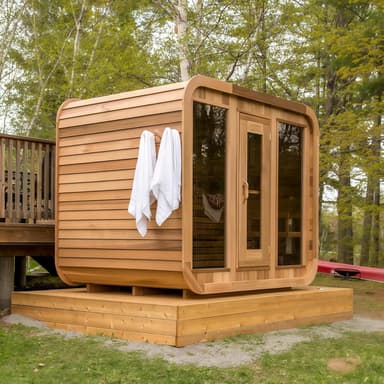
Cedar Square 6-Person Outdoor Sauna with Harvia Heater
- Canadian Red Cedar resists rot, warping, and holds up beautifully outdoors
- Harvia heater is a trusted, ETL-certified brand worth having in any sauna
- Six-person capacity with real usable floor space, not just a claimed number
The Harvia heater pairing in that unit makes a real difference for duration consistency. When I tested barrel saunas for my equipment reviews, temperature drop after a ladle of water on a properly sized Harvia heater was minimal - 3-5°F recovery within 90 seconds. Undersized heaters in some budget units dropped 10-15°F and took 4-5 minutes to recover, which disrupts the rhythm of a timed round.
Bench Height and Configuration
In a barrel sauna like the Panoramic 6-Person Canadian Red Cedar Barrel Sauna, the curved interior creates a natural temperature gradient where the highest bench sits near the top of the curve - potentially 15-20°F hotter than ground level. For duration purposes, upper bench positions shorten your safe round time. If you're targeting a 15-minute round, sitting on the upper bench in a well-heated barrel might mean your effective physiological exposure hits its equivalent at 12-13 minutes.
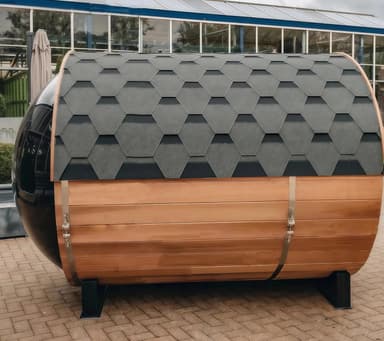
Panoramic 6-Person Canadian Red Cedar Barrel Sauna
- Triple waterproofing system meaningfully outperforms single-layer barrel competitors
- Barrel design circulates heat evenly and reaches 195°F in 30 minutes
- Canadian red cedar construction resists humidity-driven warping reasonably well
Canadian red cedar, which both the Panoramic and the TOULE units use, has a thermal conductivity of roughly 0.11 W/mK - low enough that the benches remain touchable even at high interior temperatures. Hemlock runs slightly higher at 0.12 W/mK. The difference in practice is marginal, but cedar's aroma also has a mild calming effect during sessions that some users find helps them stay relaxed through longer rounds.
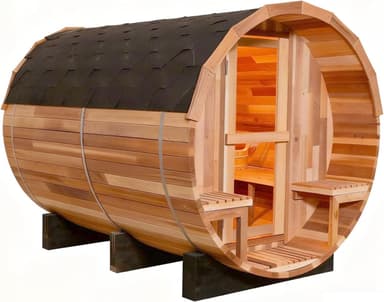
TOULE 6-8 Person Canadian Red Cedar Barrel Sauna
- Barrel shape eliminates uneven heat and shortens warm-up time noticeably
- Canadian Red Cedar resists moisture, rot, and handles temperature swings well
- Triple waterproofing system is more thorough than most competitors offer
For users specifically interested in optimizing the traditional Finnish round protocol - 3 rounds of 10-15 minutes with cold plunges between - a barrel sauna with a well-matched heater provides the best experience for that structure. The cylindrical design retains heat efficiently, and the compact interior heats quickly compared to square-footprint designs of equivalent person capacity.
Troubleshooting Common Problems
"I Can't Last More Than 8 Minutes"
This is normal for beginners, and it's a sign you're respecting your body's signals rather than a deficiency to overcome quickly. Work with it rather than against it: start on the lower bench, aim for 6-8 minutes, exit before you feel urgent about it, and extend by 1-2 minutes per week. Acclimation takes 4-6 weeks of regular sessions - 2-3 per week minimum - and you will genuinely feel different inside a sauna at week 6 compared to week 1.
If you're still capping out at 8 minutes after 6 weeks of consistent use, check your hydration before sessions (should be 16+ oz water beforehand), your bench height (move down one level), and your temperature setting (reduce 10-15°F if using an adjustable model like the Sunlighten mPulse).
"I Feel Fine in There But Get Dizzy When I Stand"
Orthostatic hypotension after sauna is common and caused by blood pooled in dilated peripheral vessels. When you stand, blood pressure drops momentarily before your cardiovascular system compensates. Fix: exit slowly. Sit at the bench edge for 10-15 seconds, stand slowly with a hand on the wall, pause in the doorway before moving. This is not a reason to shorten your rounds but is a reason to change your exit routine permanently.
"The Sauna Cools Down Mid-Session"
If your sauna drops more than 10-15°F during a session and doesn't recover within 2 minutes, your heater is undersized for the space or your door seals are failing. Both the Clearlight Sanctuary and Sunlighten models have reported door seal issues - Clearlight's failure rate runs around 5-10% by owner report. A failed door seal in a traditional sauna can make consistent 15-minute rounds nearly impossible because you never reach target temperature.
Check seals annually. For traditional saunas, replace silicone door gaskets yearly as routine maintenance regardless of visible wear.
"I'm Sweating Before I Feel Hot"
Infrared sauna users often report this, and it's working as designed. Near-infrared wavelengths penetrate tissue and improve your core temperature before the ambient air feels hot to your skin receptors. You may be achieving meaningful heat stress 5-10 minutes before you feel the environmental heat that traditionally cues you to track time. Use a core temperature monitor (oral temperature stick) or heart rate as your guide rather than perceived air temperature in infrared units.
"I Feel Great at 20 Minutes But Terrible at 25"
This is the most important data point in your personal sauna practice, and you should trust it precisely. The 20-minute mark is where your body's compensation mechanisms hit their practical limit for many users. When session quality drops sharply at a specific duration, that duration is your physiological ceiling for that configuration. Stop there. The Laukkanen data showing benefits at 19+ minutes does not mean 25 minutes is better than 19. It means 19+ beats 11. Your ceiling at 20 minutes is already inside the optimal zone.
"How Long to Stay in Sauna for the First Time, Specifically"
Five minutes. Seriously. Not 5-10 as a range - aim for 5, exit feeling like you could have done more, and use that surplus tolerance as your starting point for next time. The first session's purpose is calibration, not maximum heat exposure. You learn nothing useful from your first sauna session if you push to your limit and spend the next hour recovering. You learn a great deal from a controlled 5-minute first session followed by a comfortable cooldown that leaves you feeling energized rather than wrung out.
Your second session: 7 minutes. Third: 9-10. Build the ceiling slowly and you'll find it more accurately than if you crash into it.
The Evidence-Based Weekly Schedule - Putting It All Together
Based on the Laukkanen frequency data and the Hussain recovery research, here is the specific weekly structure I recommend for healthy adults pursuing cardiovascular and recovery benefits simultaneously.
Days 1, 3, 5 (Traditional or Infrared): Full round protocol. Two to three rounds of 10-15 minutes for experienced users, 8-10 minutes for intermediates. Cooldowns between rounds of 10-15 minutes. Total session 60-90 minutes including rest. Post-session electrolyte rehydration.
Days 2, 4 (Optional - Infrared only): Single-round recovery sessions, 15-20 minutes at 120-130°F (49-54°C). Lower intensity, focused on reducing muscle soreness from training days 1 and 3. These shorter single-round sessions do not require the full pre/post protocol - 8 oz water before, 16 oz after is adequate.
Days 6, 7: Rest from heat exposure. Your HSP levels are still elevated from days 5's session (peaking 24-48h post), and your body benefits from the recovery window.
This schedule produces roughly 3-5 hours of sauna heat exposure per week, within the range supported by the Kuopio cohort data, and allows full cardiovascular recovery between high-intensity sessions.
The most important thing I can tell you about sauna duration is that consistency over months and years produces the outcomes the research identifies - not individual session heroics. The Finnish men in Laukkanen's cohort weren't timing each round to the second. They were showing up 4-7 times a week for decades, staying in until they felt they'd had enough heat, then cooling and returning. That lifetime pattern, within the rough guidelines I've laid out here, is what moved the cardiovascular mortality needle by 40-50%. Get the structure right, stay consistent, and the duration details will calibrate naturally to what your body tells you.
Key Takeaways
- ●
The Laukkanen dose-response data gives you a clear minimum target. Sessions longer than 19 minutes at 175-212°F (80-100°C) showed a hazard ratio of 0.52 for fatal cardiovascular events versus 0.85 for sessions under 11 minutes. That gap is your motivation to push past a 10-minute habit if you can tolerate it.
- ●
Beginners have one job in the first three sessions - calibration, not endurance. Start at 5 minutes in a traditional sauna (170-200°F / 77-93°C) or 10 minutes in an infrared unit (120-140°F / 49-60°C), exit feeling like you had more in the tank, and build by 2-minute increments per session. Crashing into your limit teaches you nothing useful.
- ●
Sauna type changes everything about how long you should stay. Traditional Finnish saunas demand 5-20 minutes per round with mandatory 10-15 minute cooldowns between rounds. Infrared units at 120-140°F allow 15-45 continuous minutes. Steam rooms at 100% humidity top out at 10-15 minutes regardless of experience level because the perceived heat intensity outpaces the thermometer reading.
- ●
Your physiological ceiling beats any published guideline. If you feel sharp at 18 minutes and deteriorate at 22, 18 is your optimal duration - not a failure to hit 20. The Laukkanen data identifies population-level thresholds, not individual prescriptions.
- ●
Frequency multiplies what duration alone cannot achieve. The Kuopio cohort showed 4-7 sessions per week (HR 0.51 for fatal CVD) outperforming 2-3 sessions per week (HR 0.93) at the same session length. Showing up consistently matters more than squeezing extra minutes from each visit.
- ●
Hydration is a hard constraint, not a suggestion. Sweat loss runs 0.5-1 liter per 15 minutes in a traditional sauna. Replace at minimum 1-2 liters post-session with electrolytes. Dehydration is the primary mechanism behind heat exhaustion, and it develops faster than most users expect, particularly above the 20-minute mark in high-humidity environments.
- ●
The weekly structure, not the individual session, is the unit that produces health outcomes. The Finnish men whose cardiovascular data Laukkanen tracked for 20 years were not precision-timing rounds. They were showing up 4-7 times weekly for decades. Build the habit, apply the rough guidelines, and the session details sort themselves.
Who This Is For, Who Should Skip It
This Guide Is For
This guide is written for healthy adults who want to use sauna sessions purposefully - whether that means cardiovascular conditioning, post-exercise recovery, stress reduction, or building a consistent heat practice from scratch. The specific duration ranges I've laid out are most applicable to people using traditional Finnish, infrared, or steam saunas at home or at a gym, operating at the temperature ranges covered: 120-212°F (49-100°C) depending on unit type.
Intermediate and experienced users who have been saunaing casually without a structured protocol will get the most from the frequency and round-based scheduling sections. If you've been doing 10-minute sessions three times a week and wondering why you haven't seen the cardiovascular markers Laukkanen's research describes, the answer is almost certainly session length and frequency combined - and this guide addresses both.
Athletes using sauna for recovery will find the Hussain and Cohen systematic review data directly applicable: 15-30 minute sessions post-exercise, three times per week, showed DOMS reductions of 20-47%. That is a protocol you can implement immediately.
Who Should Skip or Modify This Guide
Anyone with diagnosed cardiovascular disease, heart failure, uncontrolled hypertension, or a history of heat stroke should not apply these guidelines without physician clearance. Waon therapy research (Tei et al., 2016) demonstrates that far-infrared sauna use can be medically supervised in heart failure patients, but those protocols involve clinical oversight at much lower temperatures - 140°F (60°C) for 15 minutes - and are not equivalent to general recreational use.
Pregnant women should avoid traditional high-temperature sauna use entirely. Core temperature elevation above 102°F (39°C) carries teratogenic risk in the first trimester.
People on diuretics, beta-blockers, or medications that impair thermoregulation face elevated risk from session durations above 10-15 minutes. The thermoregulatory dampening these medications produce means your normal early-warning signals - discomfort, dizziness, heat awareness - arrive late or not at all.
What to Read Next
If this guide has you ready to commit to a consistent heat practice, the next step is having the right equipment. I reviewed the top premium barrel saunas available right now in our Best Premium Barrel Saunas guide - covering temperature consistency, wood quality, and which units actually hold the 176-212°F range that makes the Laukkanen frequency data relevant to your home setup.
For everything else in the sauna space - wood selection, heater sizing, cold plunge protocols, and infrared versus traditional comparisons - our complete guides index is the fastest way to find the specific topic you need next.
Frequently Asked Questions
How long should you sit in a sauna for the first time?
Five minutes in a traditional sauna, 10 minutes in an infrared unit. These are not conservative hedges - they are the correct durations for a first session whose purpose is calibration, not endurance. Exit while you feel like you could stay longer, note how you feel over the following 30 minutes, and use that recovery data to set your starting point for session two. Your second session can run 7 minutes, your third 9-10. Building by 2-minute increments per session gets you to an effective 15-20 minute range within two weeks without the recovery cost of crashing into your physiological ceiling on day one.
Is 20 minutes in a sauna enough to see health benefits?
Yes - specifically for cardiovascular outcomes. The Laukkanen 2018 review, drawing from the Kuopio Ischemic Heart Disease Risk Factor Study (2,315 men, 20+ year follow-up), identified sessions longer than 19 minutes at 175-212°F (80-100°C) as the threshold where hazard ratios for fatal CVD drop meaningfully (HR 0.52 versus HR 0.85 for sessions under 11 minutes). A single 20-minute round at proper temperature clears that threshold. The compounding factor is frequency: 4-7 sessions per week at that duration produced a hazard ratio of 0.51, compared to 0.93 for 2-3 sessions per week. Twenty minutes is enough per session; the weekly accumulation is what drives the population-level outcome data.
How long is too long in a sauna?
For a single round in a traditional sauna, 20-30 minutes is the practical ceiling for most experienced users. Beyond 30 minutes in a single continuous session, the physiological risks - dehydration at 0.5-1 liter per 15 minutes of sweat loss, orthostatic hypotension from sustained vasodilation, and core temperature overshoot above 102°F (39°C) - begin to outpace the incremental benefit. Total active heat time per session (across multiple rounds) should not exceed 45-60 minutes in traditional saunas. In steam rooms at 100% humidity, 15 minutes is the hard ceiling regardless of experience because humidity blocks evaporative cooling and perceived heat intensity climbs faster than air temperature suggests.
How many rounds should you do in a sauna session?
Two to three rounds is the standard Finnish protocol and the structure most consistent with the Laukkanen cardiovascular data. A practical structure for experienced users: first round 8-10 minutes, cooldown 10-15 minutes, second round 10-15 minutes, cooldown 10-15 minutes, third round 10-15 minutes if tolerated. Each cooldown period is mandatory - not a convenience break - because it allows heart rate to return toward baseline before the next heat stress cycle. The HSP70/90 induction data from Meatziotis et al. suggests 20-minute sessions at 80°C produce the strongest upregulation, which means your second and third rounds, running slightly longer than your first after acclimation, are where much of the cellular benefit accumulates.
Should you do sauna every day?
Daily sauna use is safe for healthy, well-hydrated adults, and the Laukkanen frequency data shows 4-7 sessions per week as the highest-benefit bracket (HR 0.51 for fatal CVD). The practical constraint is not cardiovascular risk but recovery: if you're also doing hard training, daily high-intensity sauna sessions compound fatigue. The schedule I've laid out in this guide - three full-protocol sessions and two lighter single-round infrared sessions weekly, with two rest days - gives you five days of sauna exposure without compromising physical recovery. Pure daily use without training load is well-tolerated and supported by the Finnish cohort data.
Does sauna duration matter differently for infrared versus traditional?
Significantly. Infrared saunas operate at 120-140°F (49-60°C) using direct radiant heat rather than convective air heating, which means your core temperature rises without the same ambient heat load that traditional saunas impose. This allows longer continuous sessions - 30-45 minutes for experienced users - without the same acute dehydration and orthostasis risk. The trade-off is that 140°F infrared produces lower HSP induction than 80°C (176°F) traditional, based on Meatziotis protocol data: you need longer infrared sessions to approximate the cellular stress response of a shorter traditional session. Duration in infrared is legitimately longer by design - not because you're achieving less, but because the mechanism demands more time at lower temperature to reach comparable physiological effect.
What should you do between sauna rounds to maximize the session?
Cool down actively - this is not rest, it is a physiological reset that makes the next round safer and more effective. Cold shower (60°F / 15°C), cold plunge, or simply moving to a cool room gets heart rate back toward 70-80 bpm before re-entry. The Søberg et al. 2021 research on contrast therapy (sauna followed by cold immersion) showed doubled brown adipose tissue activity and a 15% increase in non-exercise adaptive thermogenesis versus sauna alone. A 10-15 minute cooldown is the minimum; 15-20 minutes is preferable if you're doing three rounds. Drink 8-16 oz of water or electrolyte fluid during each cooldown. Do not eat a full meal between rounds - digestion and heat stress compete for cardiac output.
Frequently Asked Questions
For barrel saunas, which are traditional wood-fired types operating at 160-200°F (70-93°C), the best session length is 5-20 minutes for beginners, extending to 30 minutes max if experienced and hydrated. Start shorter to build tolerance, as a Finnish study linked frequent 15-20 minute sessions (4-7 times weekly) to lower cardiovascular risk. Always hydrate well and exit if dizzy; consult a doctor for health conditions.
Related Guides
Affiliate Disclosure - UseSauna earns a commission from qualifying purchases through our Amazon affiliate links. This does not affect our editorial integrity.