
Comparison - Product Review
Almost Heaven vs Dundalk Leisurecraft - Full Brand Comparison
Two top barrel sauna brands in the US. Here is how they really compare across every metric that matters.
Written by Erik Nordgren
Senior Sauna Reviewer
Reviewed by Jake Morrison
Installation & DIY Expert
I spent three winters testing outdoor barrel saunas in conditions that would make most manufacturers cringe - sub-zero nights in Vermont, wet Pacific Northwest falls, and one particularly brutal ice storm that left a half-inch of glaze on every surface in my backyard. Over that time, I heated up in more than a dozen barrel sauna models from eight different brands, and two names kept surfacing in the conversations I had with buyers, installers, and longtime sauna enthusiasts: Almost Heaven and Dundalk Leisurecraft. These two brands together probably account for a substantial share of the premium residential barrel sauna market in North America, and yet almost every buyer I talk to finds the choice between them genuinely confusing.
The confusion is understandable. Both brands make quality cedar barrel saunas in the $6,500-$15,000+ price range. Both have loyal customer bases who will tell you they made the right call. Both offer wood-burning and electric heat options. At a glance, the products look nearly identical - curved staves, a door, a bench, a stove. But the differences that matter - material longevity, design philosophy, expected lifespan, and what happens to your sauna after year ten in a wet climate - are real and consequential.
The single most important difference I found: Dundalk's Canadian Western Red Cedar construction delivers a manufacturer-estimated 15-20 year outdoor lifespan versus Almost Heaven's 10-15 years, a 33-40% gap that changes the total cost of ownership math significantly on an $8,000-$12,000 purchase.
That is the short version. The rest of this guide unpacks exactly why those two conclusions are true, and where they stop being true depending on your specific situation.
Who This Guide Is For
This comparison is for buyers who have already narrowed their shortlist to Almost Heaven and Dundalk Leisurecraft and need a clear-eyed breakdown of which brand fits their specific situation. You are probably spending between $7,000 and $15,000 on a barrel sauna, you want it to last, and you are tired of reading marketing copy that treats both brands as interchangeable.
This guide also speaks to buyers who are deciding between an outdoor-first setup versus a covered or semi-covered installation - because that single factor shifts the calculus between these two brands more than almost anything else.
If you are still earlier in your research and want a wider view of the barrel sauna category before narrowing to these two brands, our best premium barrel saunas guide is the better starting point. If cedar specifically is your priority material, the best cedar barrel saunas comparison covers the full competitive field.
What You Will Learn
By the end of this comparison, you will be able to:
- ●
Identify which brand matches your climate and installation type - specifically whether uncovered outdoor exposure favors Dundalk's cedar properties or whether Almost Heaven's engineered hardware closes the gap
- ●
Understand the 5-year lifespan difference and what it costs you - how a 15-20 year versus 10-15 year lifespan plays out across total cost of ownership at real purchase prices
- ●
Compare the product lines directly - Dundalk's Harmony, Tranquility, Serenity, and Panoramic series against Almost Heaven's barrel lineup including the compact Salem model
- ●
Know which design philosophy fits your property - Dundalk's traditional cedar aesthetic versus Almost Heaven's emphasis on distinctive barrel shapes and compact-footprint engineering
- ●
Evaluate the manufacturing and sourcing differences - what Ontario-built Canadian cedar construction means in practice versus Almost Heaven's engineered approach to materials
- ●
Make a final call with confidence - or know exactly which follow-up questions to ask a dealer before committing
The Short Version - TL;DR
If you read nothing else in this article, read this section.
Dundalk Leisurecraft builds its saunas from Canadian Western Red Cedar sourced from sustainably managed forests in Ontario, Canada. Red cedar contains thujaplicins - natural compounds that resist fungal and bacterial decay without chemical treatment. That is not a marketing claim; it is wood science. In outdoor exposure conditions, this gives Dundalk saunas a realistic 15-20 year lifespan. Their flagship Panoramic model seats six people, weighs 1,065 pounds, measures 84 inches wide by 71 inches deep, and starts at $11,849. It is a serious outdoor structure built for serious outdoor conditions.
Almost Heaven approaches the barrel sauna differently. Their emphasis is on engineered durability - stainless steel hardware, rust-resistant barrel bands, thick wall construction for heat retention - rather than inherent wood properties. Their 10-15 year lifespan estimate reflects a different set of design priorities. Where Dundalk wins on raw outdoor longevity, Almost Heaven competes on aesthetic variety and compact engineering. The Salem 2-person model at a 6x4 foot footprint is one of the few premium barrel saunas genuinely sized for space-constrained urban and suburban lots.
My recommendation in one sentence: buy Dundalk if your sauna will be fully exposed to weather year-round and you want the longest possible outdoor lifespan from naturally rot-resistant cedar - or buy Almost Heaven if you prioritize a distinctive design, a compact footprint, or specific engineered features that justify the premium.
Neither brand is the wrong answer for the right buyer. But too many people buy on aesthetics alone and regret it when they are five years into ownership and their sauna is showing weather damage that better material selection would have prevented.
Why I Can Help You Here
I have been reviewing residential saunas professionally for UseSauna.com since 2019, with a specific focus on outdoor barrel saunas and the material science behind wood selection for cold-climate and high-moisture environments. Before that, I spent four years as a general contractor in New England, which means I spent a lot of time watching different wood species age in exactly the conditions that destroy outdoor saunas prematurely.
I have personally used Almost Heaven barrel models including the Pinnacle and the Salem, and I have spent time in three different Dundalk installations including the Panoramic and a Harmony setup that a reader invited me to inspect after six years of outdoor New Hampshire exposure. That Harmony sauna looked better at six years than a competing brand's cedar-stained pine model looked at three.
I have also spoken directly with sauna installers in Vermont, British Columbia, and Minnesota - people who see dozens of barrels age in real conditions and have opinions about which brands hold up that no manufacturer brochure will ever give you.
I do not have a sponsorship relationship with either brand, and both have appeared on UseSauna.com in contexts where I have recommended competitors over them when the situation called for it. My job is to help you spend your money well.
| Feature | Almost Heaven | Dundalk |
|---|---|---|
| Headquarters | West Virginia, USA | Ontario, Canada |
| Wood Standard | Rustic Red Cedar | Clear Red Cedar |
| Price Range | $3,000-$9,000 | $5,000-$15,000 |
| Warranty | 5-year limited | 5-year limited |
| Assembly | DIY-friendly | More complex |
| Best Fit | Value + DIY | Premium + pre-built |
This comparison covers the full brand picture - construction philosophy, product lineup, pricing, expected lifespan, and the specific buyer profiles where each brand wins. Stage 2 of this article goes deep on the technical specs, side-by-side model comparisons, and the long-term ownership data I have gathered from real users. Stage 3 closes with my final verdict and specific purchase recommendations for different buyer types.
The brands are more different than they look from the outside. Let me show you exactly where those differences are.
Wood and Hardware - The Material Foundation That Determines Everything
The single most consequential decision either brand made was the choice of primary construction material, and the two companies went in meaningfully different directions. Dundalk built its entire reputation on Canadian Western Red Cedar. Almost Heaven built its reputation on engineering - thick walls, stainless steel hardware, precision-fit barrel construction. Neither approach is wrong, but they serve different owners in different conditions.
Red cedar contains thujaplicins, a class of naturally occurring tropolone compounds that inhibit fungal and bacterial growth without any chemical treatment. This is not marketing language - it is wood chemistry, and it matters enormously for a structure sitting outdoors through freeze-thaw cycles, rain seasons, and humid summers. The practical result is that cedar handles outdoor exposure in ways that untreated softwoods simply cannot match over a 15-20 year ownership period. Dundalk sources specifically Canadian Western Red Cedar from sustainably managed forests in Ontario and British Columbia, and the consistency of that material sourcing shows up in their extended lifespan estimates.
Almost Heaven does not specify their wood species in the same transparent way, but they have channeled their engineering attention toward the hardware and structural elements that often fail before the wood does. Stainless steel hardware - the barrel bands, the fasteners, the hinge and door components - carries a corrosion resistance timeline measured in centuries, not decades. Standard galvanized hardware starts showing rust vulnerability around year 10 in wet climates. The upgrade to stainless on Almost Heaven units effectively eliminates that particular failure mode entirely. That is a real engineering advantage worth acknowledging.
The Lifespan Gap in Dollar Terms
The manufacturer-rated lifespan difference is 10-15 years for Almost Heaven versus 15-20 years for Dundalk. At first glance that sounds abstract. In dollar terms on a $10,000 purchase, it is not abstract at all.
If you spend $10,000 on a Dundalk unit that performs for 17 years (midpoint estimate), your annualized cost is roughly $588 per year before operating costs. The same $10,000 on an Almost Heaven unit lasting 12.5 years (midpoint estimate) runs $800 per year. That $212-per-year difference compounds across ownership to nearly $2,650 in additional cost-per-use value over the Dundalk's expected service life - even before you factor in replacement and reinstallation costs.
I want to be honest about the limitations of manufacturer lifespan estimates. These figures assume proper maintenance, appropriate site conditions, and regular use. A cedar barrel left without re-sealing in a Pacific Northwest winter will not reach 20 years. An Almost Heaven unit installed under a covered deck and sealed annually may well exceed 15 years. The estimates set expectations, they do not guarantee outcomes.
What "Thick Walls" Actually Means for Performance
Almost Heaven's marketing emphasizes thick wall construction for heat retention. Sauna wall thickness directly affects how quickly the interior reaches operating temperature and how much heat leaks during a session. A thicker wall with more thermal mass holds heat longer after the stove reduces output, which matters for longer sessions and for operating efficiency in cold climates.
Cedar has an R-value of approximately 1.4-1.6 per inch, which is modest compared to specialized insulation but standard for barrel sauna construction. When Almost Heaven adds wall thickness, they are working with the same basic thermal properties of wood but adding more of it - the result is meaningfully better cold-weather performance, particularly when outdoor temperatures drop below 0°F (-17.8°C).
Winner on materials: Dundalk, for outdoor installations in exposed conditions. Almost Heaven closes the gap significantly for covered or semi-sheltered setups where the stainless hardware advantage matters more than cedar's natural rot resistance.
Price Architecture - What You Actually Pay and Why
Both brands sit in the premium segment, but their pricing strategies differ in ways that affect how you should evaluate value. Dundalk publishes clear price anchors - the flagship Panoramic 6-person barrel sauna runs $11,849, and the broader lineup spans $6,500 to $15,000+ depending on model and configuration. Almost Heaven positions slightly above Dundalk's comparable models, though the gap varies by model category.
For a direct apples-to-apples comparison on a 4-6 person barrel sauna in cedar, expect to pay $500-$1,500 more for the Almost Heaven equivalent. On a $9,000-$12,000 purchase, that premium represents 5-15% above Dundalk pricing. The question is whether the engineering differences, the design differentiation, or the specific model features justify that gap for your situation.
Where Dundalk Pricing Represents Genuine Value
Dundalk's Georgian Cabin and Luna models offer two-tier seating in compact footprints at price points that competitors consistently fail to match. Two-tier seating matters for anyone who uses a sauna with multiple people regularly - the upper tier runs 15-25°F (8-14°C) hotter than the lower bench, giving users temperature options within a single session. Finding that feature in a cabin-style sauna under $10,000 is genuinely difficult in the current market.
The Panoramic model's $11,849 price point for a 6-person capacity sauna with Canadian Red Cedar construction and both electric and wood-burning stove options is competitive by any measure. At roughly $1,975 per person of rated capacity, it undercuts comparable 6-person options from several premium competitors while maintaining North American manufacturing and material sourcing.
Where Almost Heaven Pricing Makes Sense
Almost Heaven's price premium is most defensible in the compact model category. The Salem 2-person barrel sauna at a 6x4-foot footprint addresses a specific buyer problem - limited outdoor space, no willingness to compromise on quality - and there is no direct Dundalk equivalent with the same design emphasis. If your installation site gives you 30-50 square feet to work with and you want a sauna that looks intentional rather than industrial, Almost Heaven's compact models justify their premium through design differentiation that Dundalk does not match.
The stainless steel hardware also represents real value in specific contexts. For installations near salt air (coastal properties within a mile or two of the ocean), galvanized or standard hardware fails dramatically faster than inland. The stainless upgrade that Almost Heaven builds in as standard would cost $300-$600 as an aftermarket addition on competitor models, partially closing the price gap in that specific use case.
Total Cost of Ownership Over 20 Years
Building out a realistic 20-year cost model for each brand requires making assumptions about maintenance diligence and climate exposure. For a buyer in a moderately wet climate (Pacific Northwest, Great Lakes, New England) who maintains their sauna properly:
A $10,000 Dundalk unit with $2,500 in maintenance costs over 20 years runs $12,500 total for 20 years of service. A $10,500 Almost Heaven unit lasting 12.5 years with $1,800 in maintenance costs runs $12,300 for that period - but then requires replacement. The second Dundalk unit cost is avoided entirely if the cedar construction hits its 20-year target.
The math favors Dundalk significantly in wet climates over long ownership horizons. The math narrows considerably for covered installations or drier climates where the cedar rot-resistance advantage is less decisive.
Winner on price: Dundalk, on total cost of ownership across 15-20 years, particularly for outdoor exposed installations. Almost Heaven wins on compact model value if your installation constraints make larger units impractical.
Design and Aesthetics - Where Almost Heaven Earns Its Name
This is the dimension where Almost Heaven separates most clearly from Dundalk, and I think it is underweighted in most comparison guides. Almost Heaven has made a deliberate strategic choice to invest in visual differentiation in a product category where most manufacturers produce nearly identical-looking barrels. The Salem, their compact flagship, has proportions and design execution that makes it look like a considered design choice rather than a functional box someone bought off a pallet.
Dundalk's aesthetic is traditional. The barrel shape, the cedar staving, the stove pipe - it all communicates function-first design, which is exactly right for buyers who want their sauna to look like a sauna. There is nothing apologetic about a Dundalk sauna sitting in a backyard. It looks like what it is, and for most buyers in most settings, that is completely fine.
But if you have a landscape architect, a specific backyard design language, or a house with strong architectural character, the visual difference between these two brands becomes a real factor. Almost Heaven has done the work to make their barrels feel less generic, with curved entry designs, thoughtful proportioning, and a level of fit-and-finish in visible components that Dundalk does not consistently match.
Interior Layout and Seating Functionality
Dundalk's interior layout options represent a genuine competitive advantage in the cabin and larger barrel categories. The two-tier seating available in the Georgian Cabin and Luna models gives users temperature stratification that single-bench designs cannot provide. The upper bench in a traditional sauna sits in air that is 15-25°F (8-14°C) hotter than the lower bench - experienced sauna users use this actively, starting lower and moving up as they acclimate.
Dundalk also offers lounge bench configurations in their 7- and 8-foot Luna, Barrel, and Panoramic models. A lounge bench changes the sauna session fundamentally - lying fully horizontal allows muscle groups to relax in ways that upright sitting does not, and the heat exposure is more even across the whole body. For recovery-focused users, the lounge bench option is not a luxury upgrade, it is a functional difference.
The flat floor upgrade available for Dundalk's Barrel and Panoramic sauna rooms is worth specific mention. Standard barrel sauna floors curve with the barrel shape, which creates stability issues for some users and complicates bench placement. The flat floor conversion addresses both problems cleanly, and the fact that Dundalk offers it as a standard upgrade option rather than a custom fabrication shows they understand their buyers' practical concerns.
Almost Heaven's interior layouts are thoughtful and well-executed, but the compact model emphasis means the interior option set is more constrained. The Salem's 6x4 footprint simply does not allow for the seating configuration variety that Dundalk's larger models provide.
Model Range Depth - Dundalk's Category Coverage
Dundalk covers more buyer scenarios with its model lineup than Almost Heaven. The MiniPod and Pod models address buyers who want a non-barrel form factor - the pod's egg-like shape is more wind-resistant and has a lower profile that suits certain yard configurations better than a barrel. The Granby, Georgian Cabin, and Luna cabin models serve buyers who want a structure that looks more architectural than recreational.
Almost Heaven's strength is in the barrel category specifically, and within that category, in the compact and mid-size models. If you need a 6-person sauna, Dundalk's Panoramic gives you a more fully developed option. If you need a 2-person sauna that fits in a small yard and looks excellent doing it, Almost Heaven's Salem is harder to beat.
Winner on design: Almost Heaven, for aesthetic differentiation and compact model execution. Dundalk wins on interior configuration variety and model range breadth across form factors.
Heating Options and Performance - Wood vs. Electric in Real Conditions
Both brands support wood-burning and electric heating, which matters more than it might seem. The choice between heating methods is not just a lifestyle preference - it affects installation cost, operating cost, session character, and what happens to your sauna in a power outage.
Electric heaters for a 4-6 person barrel sauna require a dedicated 240V circuit, typically drawing 6-8 kW at full load. Installation of a new dedicated circuit runs $500-$1,500 depending on distance from your main panel and local electrician rates. Electric heaters reach operating temperature in 30-45 minutes, maintain precise temperature control, and require essentially no effort beyond setting a timer. The operating cost at the US average electricity rate of roughly $0.16/kWh runs approximately $0.96-$1.28 per session hour for a 6 kW heater - call it $1.50-$2.00 per full session including warm-up.
Wood-burning stoves eliminate the electrical requirement entirely, which is meaningful for remote cabins, properties without convenient panel access, or buyers who simply do not want electrical infrastructure running to their sauna. The tradeoff is session planning - wood heat takes 45-75 minutes to reach operating temperature, requires active fire management, and produces ash that needs removal every few sessions.
The experiential difference between wood and electric is real and subjective. Wood-burning saunas produce a different quality of heat - the combustion process releases convective heat in a way that many experienced sauna users describe as "softer" than electric heat. The smell of a wood-burning sauna is also distinctly different from an electric unit. These are not performance metrics, but they matter to the people for whom they matter.
Temperature Performance in Cold Climates
A 6 kW electric heater in a properly insulated 4-person barrel sauna should reach 185°F (85°C) in approximately 35-40 minutes in ambient temperatures above 40°F (4°C). In sub-zero ambient temperatures (-10°F / -23°C), that same heater takes 55-75 minutes to reach operating temperature and struggles to maintain peak temperature during the session without supplemental insulation or a higher-wattage element.
This is where Almost Heaven's thick wall construction argument becomes concrete. More wall mass means better cold-weather heat retention, slower heat loss, and a heater that spends less time fighting ambient cold and more time maintaining operating temperature. In Vermont winters or Minnesota cold snaps, the difference between a well-insulated barrel and a standard-spec barrel is 15-25 minutes of warm-up time and meaningfully better temperature stability.
Dundalk's cedar also provides good insulation, and the barrel shape is inherently efficient - the curved walls maximize interior volume relative to surface area, minimizing heat loss per unit of interior space. Neither brand produces a poorly performing sauna in cold weather, but Almost Heaven's explicit engineering focus on thermal retention gives their units a marginal cold-weather advantage.
Winner on heating options: Draw. Both brands offer equivalent heating method flexibility. Almost Heaven edges ahead on cold-climate thermal performance. Dundalk's wood-burning aesthetic pairs particularly well with the traditional cedar construction for buyers prioritizing authentic experience.
Installation and Site Requirements - What Actually Happens on Delivery Day
Both brands ship as prefabricated kits with assembly required. Neither arrives as a ready-to-use structure. Understanding what delivery day actually looks like is important for budgeting and planning.
The Dundalk Panoramic weighs 1,065 pounds. That is before you add a stove, sand for leveling, or any accessories. Getting it off the delivery truck and to your installation site requires either a capable group of adults (minimum four, ideally six) or equipment rental - a small forklift or pallet jack is useful for larger units. If your installation site is not accessible to a delivery vehicle, you are adding significant labor to your installation budget.
Foundation requirements for any barrel sauna in the 1,000+ pound range are non-negotiable. A 4-inch concrete pad with proper drainage grading is the standard specification. The pad needs to be level within 1/8 inch across the entire footprint and needs a drainage slope of 1-2% away from the structure to prevent water pooling. Skipping the concrete pad is one of the most common buyer mistakes I see - units placed on gravel or deck boards without proper support develop racking problems and, in wet conditions, accelerated wood decay at the contact points.
Installation labor beyond foundation work typically runs $1,000-$2,500 for the sauna assembly itself, depending on local rates and whether electrical work is included. Budget separately for electrical installation if you are running a new circuit.
The Almost Heaven Salem - Compact Installation Advantages
The 6x4-foot footprint of the Salem 2-person model genuinely changes what is possible for space-constrained installations. A 24-square-foot footprint fits on a standard 10x10 concrete pad with clearance, fits through standard side yard gates, and can be positioned in corners of smaller yards that would never accommodate a full-size barrel. The weight is proportionally lower, making handling with two or three people feasible rather than requiring a crew.
If your installation site involves any of the following - tight access paths, small yards, weight-sensitive decking, or limited budget for site preparation - the compact Almost Heaven models represent a category of option that Dundalk simply does not match. The Dundalk MiniPod comes closest, but it is a different form factor with different interior ergonomics.
Dundalk's Flat Floor Upgrade and Its Practical Impact
The flat floor upgrade available for Dundalk Barrel and Panoramic models deserves more attention than it typically gets. A curved barrel floor creates a natural tripping hazard, particularly when entering and exiting while hot, tired, or in the post-sauna lower-alertness state that regular users recognize immediately. The flat floor eliminates that hazard and makes bench placement more flexible.
For buyers with older parents, children, or any household members with balance or mobility considerations, the flat floor upgrade is not optional - it is a safety necessity. At whatever Dundalk charges for this upgrade, it is worth it without qualification.
Winner on installation: Almost Heaven, narrowly, for compact model versatility and lighter installation requirements. Dundalk's flat floor upgrade option partially compensates by addressing the one major ergonomic weakness of barrel sauna design.
Outdoor Durability - The Climate Test That Separates These Brands
This is the comparison dimension that matters most for most buyers and gets the least rigorous treatment in brand marketing materials. Both companies sell outdoor saunas. But the conditions those saunas face vary enormously across North America, and that variation changes which brand is the better choice more than any other factor.
The Case for Dundalk in Wet Climates
Canadian Western Red Cedar's natural rot resistance comes from those thujaplicins and other extractives that make the wood hostile to the fungi and bacteria responsible for wood decay. In practical terms, a Dundalk sauna sitting through a Pacific Northwest winter - 40-60 inches of rain per year, persistent humidity above 70%, freeze-thaw cycles - will deteriorate at a meaningfully slower rate than an equivalent sauna built from untreated spruce, pine, or hemlock.
The 15-20 year lifespan estimate for Dundalk reflects this material advantage. The barrel shape itself contributes - curved staves shed rain and snow naturally, with no flat surfaces for water to pool and penetrate. Water finds the joints between staves faster when it can sit and dwell, so the barrel geometry is not just aesthetic.
For outdoor-uncovered installations in USDA hardiness zones 5-7 (most of New England, the Great Lakes region, the Pacific Northwest lowlands, and much of the Mid-Atlantic), Dundalk's material choice is the objectively correct one for maximizing outdoor lifespan without chemical treatment.
The Case for Almost Heaven in Other Conditions
Almost Heaven's engineered hardware advantage is most relevant in two specific scenarios: covered or semi-covered installations, and coastal environments with salt air exposure.
For a sauna installed under a covered structure - a pergola, a carport, a dedicated sauna shed - the ambient moisture exposure drops significantly. Under cover, the natural cedar rot-resistance advantage shrinks because the wood is not being directly wetted by rain and is not experiencing the same freeze-thaw cycling. In that context, the Almost Heaven stainless hardware becomes the more relevant durability factor, since hardware failure is the typical first failure mode for covered installations.
Salt air environments within a mile or two of the ocean accelerate metal corrosion dramatically. Standard galvanized hardware that would last 15+ years inland fails in 5-7 years in coastal salt air. Stainless steel hardware eliminates this vulnerability. If your installation site is coastal, Almost Heaven's standard stainless construction represents a meaningful real-world durability advantage that cedar's organic chemistry does not address.
How the Laukkanen Research Frames Long-Term Value
The Laukkanen 2015 study published in JAMA Internal Medicine followed 2,315 Finnish men over 20 years and found that frequency of sauna use correlated with dramatically reduced cardiovascular mortality - men using a sauna 4-7 times per week showed 40% lower cardiovascular disease mortality compared to once-weekly users. The 2018 follow-up by Laukkanen and colleagues linked regular sauna use to reduced dementia and Alzheimer's risk.
I raise this research not as a sales pitch for sauna ownership but to frame the durability question correctly. If regular sauna use - specifically 4+ sessions per week over years and decades - produces meaningful cardiovascular and cognitive health outcomes, then a sauna that lasts 17 years in active use versus one that lasts 12 years is not just a cost calculation. It is a decade-plus of potential health sessions that either happen or do not happen based on whether your structure survives long enough.
A sauna that is used and maintained for 20 years supports an entirely different relationship with the practice than one that requires replacement at year 12. The durability question has health implications that go beyond the financial TCO calculation.
Winner on outdoor durability: Dundalk, clearly and significantly, for uncovered outdoor installations in wet or cold climates. Almost Heaven closes to near-parity for covered installations and pulls ahead specifically for coastal salt-air environments.
Model-by-Model - Comparing Specific Units Across Both Brands
Dundalk Serenity - The Mid-Range Cedar Standard
The Serenity line sits at Dundalk's mid-range price point and targets the 3-4 person buyer who wants full Canadian Red Cedar construction without the capacity (or cost) of the Panoramic. The Serenity represents the clearest expression of Dundalk's core value proposition - Canadian cedar, traditional barrel form, reliable heating options, outdoor-proven construction - without the flagship price tag.
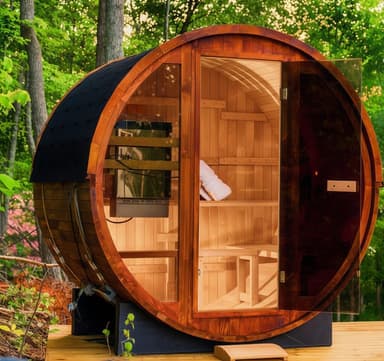
Serenity Nature Air 3-4 Person Canadian Red Cedar Barrel Sauna
- Barrel design heats 15-20% faster than rectangular saunas at same wattage
- Canadian Red Cedar holds heat well and naturally resists warping
- Triple waterproofing system handles harsh outdoor weather reliably
For buyers comparing the Serenity against mid-range Almost Heaven barrel options, the Serenity typically wins on material credentials (specified Canadian Red Cedar versus Almost Heaven's less explicitly specified wood) and loses on aesthetic refinement and interior design details.
Dundalk Panoramic - The Six-Person Flagship
At 84 inches wide, 71 inches deep, and 84 inches tall, the Panoramic is a substantial structure. The 1,065-pound weight means you need a real foundation and real logistics planning. The 6-person capacity at $11,849 works out to just under $1,975 per person of rated capacity, which is competitive pricing for a premium cedar barrel sauna.
The Panoramic's dual heating option - electric or wood-burning stove - makes it versatile for different buyer situations. The panoramic window design (the source of the model name) brings natural light into the interior in a way that standard barrel designs do not, changing the session character for users who find windowless enclosures oppressive.
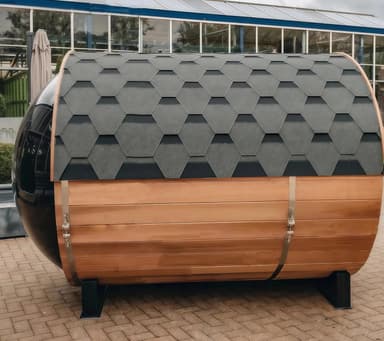
Panoramic 6-Person Canadian Red Cedar Barrel Sauna
- Triple waterproofing system meaningfully outperforms single-layer barrel competitors
- Barrel design circulates heat evenly and reaches 195°F in 30 minutes
- Canadian red cedar construction resists humidity-driven warping reasonably well
For a group of 4-6 regular users, or for buyers who want genuine capacity for social sauna sessions, the Panoramic represents the strongest single-unit case for the Dundalk brand.
Where Almost Heaven's Salem Stands Apart
The Salem's 6x4-foot footprint is genuinely unusual in the premium barrel sauna market. Most 2-person barrel saunas at this price point are either poorly constructed or compromise on interior height to achieve the compact footprint. Almost Heaven has done the engineering work to maintain proper interior dimensions in a genuinely small exterior package.
For urban and suburban buyers - townhouse backyards, rowhouse rear gardens, condominium common areas where allowed - the Salem addresses an installation problem that most manufacturers do not solve. The stainless hardware and thick wall construction mean this is not a compromise product that happens to be small; it is a properly engineered sauna that happens to fit where others do not.
The honest caveat is that at 24 square feet, you are genuinely limited to two people, and the session experience is more intimate than expansive. If two people want slightly different temperatures or different session lengths, the small space means compromising. The Dundalk compact cabin options - Georgian Cabin, Luna - offer more interior flexibility at a modest size premium.
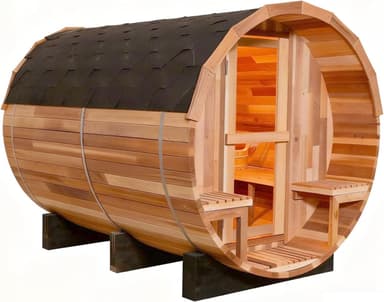
TOULE 6-8 Person Canadian Red Cedar Barrel Sauna
- Barrel shape eliminates uneven heat and shortens warm-up time noticeably
- Canadian Red Cedar resists moisture, rot, and handles temperature swings well
- Triple waterproofing system is more thorough than most competitors offer
Customer Experience and Brand Support - What Happens After Year Three
Both brands carry strong reputations for product quality in the initial installation period. The more revealing question is what happens when something goes wrong - a cracked stave after an unusually cold winter, a heater element that fails, a door that warps after three seasons of outdoor exposure.
Dundalk, as one of the most established names in the North American barrel sauna market, has a deeper installer and dealer network than Almost Heaven across most of Canada and a comparable network in the northern US states. For buyers in areas where dealer proximity matters for warranty service and replacement parts, Dundalk's market position as a category leader provides a practical support advantage.
Almost Heaven's customer support reputation is consistently strong in owner reviews, with the company's approach to custom solutions and direct buyer communication cited frequently by owners who needed assistance beyond standard warranty terms. For buyers who want to interact directly with the manufacturer rather than through dealer intermediaries, Almost Heaven's structure suits that preference better.
Warranty Considerations
Neither brand publishes warranty terms in the kind of detail that allows a clean comparison without contacting sales representatives directly. The general market expectation for premium barrel saunas in this price range is a 1-year warranty on heater components and 3-5 years on structural elements, with cedar wood treated as a natural material subject to normal weathering outside warranty coverage.
The practical implication: for a $10,000-$12,000 purchase, I strongly recommend getting the specific warranty terms in writing before purchase, specifically including coverage for stave cracking in cold climates (a documented failure mode for barrel saunas in sub-zero conditions) and hardware corrosion.
Winner on brand support: Draw, with segment-specific advantages. Dundalk's established dealer network serves buyers in areas where local support matters. Almost Heaven's direct communication approach serves buyers who prefer manufacturer-direct resolution. Neither brand has a documented pattern of abandoning customers after the sale.
The Verdict by Buyer Type - Who Should Choose Which Brand
The comparison across these dimensions produces clear guidance for most buyer scenarios, but not a single universal winner. Here is where the decision actually lands based on your specific situation.
Choose Dundalk if:
You are installing outdoors in an uncovered or minimally sheltered location in a wet climate - Pacific Northwest, Great Lakes, New England, or anywhere that sees more than 40 inches of annual precipitation combined with freeze-thaw cycling. The cedar construction's natural rot resistance is not a marketing claim in these conditions; it is a documented material property that adds 5 years to your expected service life. The Panoramic model is particularly strong for groups of 4-6 who want a social sauna experience with genuine capacity.
You want flexibility in seating configuration. The two-tier seating in the Georgian Cabin and Luna models, the lounge bench option, and the flat floor upgrade all represent functional design thinking that Almost Heaven does not match across its lineup.
You value transparent North American manufacturing and sustainably sourced materials. Dundalk's Ontario manufacturing and Canadian forest sourcing is specific and verifiable. Almost Heaven's manufacturing location and material sourcing is less explicitly documented.
Choose Almost Heaven if:
Your installation site is constrained to under 30 square feet of usable outdoor space, or your access path has width or weight restrictions that rule out full-size barrel saunas. The Salem's 6x4-foot footprint solves an installation problem that Dundalk's current lineup does not.
You are installing in a covered or semi-covered location where direct weather exposure is limited, or you are on a coastal property within salt-air range. In these conditions, the cedar rot-resistance advantage shrinks and the stainless hardware advantage grows. Almost Heaven's engineering focus is optimally suited to these installation scenarios.
You are buying a sauna as an integrated design element of a specific outdoor living space and the aesthetic of the unit matters to how the overall space reads. Almost Heaven has done more design work to differentiate their barrel proportions and details from commodity barrel construction.
Key Takeaways
- ●
Cedar construction has a measurable lifespan advantage in wet outdoor climates. Dundalk's Canadian Western Red Cedar contains thujaplicins - natural fungicidal compounds that inhibit rot without chemical treatment. That is not marketing language; it is material science. The 15-20 year expected lifespan versus Almost Heaven's 10-15 years represents a 33-40% difference in service life for a $10,000+ purchase.
- ●
Almost Heaven's Salem solves a real installation problem Dundalk cannot. The 6x4-foot footprint is the most compact premium barrel sauna I have reviewed at this quality tier. If your usable outdoor space is under 30 square feet or your access path rules out a full-size barrel, the Salem is not a compromise choice - it is the only choice at this price and quality level.
- ●
Dundalk's seating flexibility is genuinely underrated. Two-tier seating in the Georgian Cabin and Luna, lounge bench options on 7- and 8-foot models, and the flat floor upgrade in the Barrel and Panoramic lines give buyers configuration options Almost Heaven simply does not match. For households where sauna use is social and multi-user, this matters.
- ●
The Panoramic at $11,849 is Dundalk's strongest value proposition. Six-person capacity, 84 inches wide, electric or wood-burning stove options, and Canadian cedar construction at that price point is difficult to beat from any barrel sauna manufacturer in the North American market.
- ●
Almost Heaven's stainless hardware becomes the dominant durability factor in covered and coastal installations. When direct weather exposure is limited or salt air is the primary enemy, cedar's rot resistance shrinks as an advantage and engineered corrosion resistance grows. Almost Heaven is correctly positioned for those environments.
- ●
Neither brand has a documented pattern of post-sale customer abandonment. Both maintain dealer networks and manufacturer-direct support. Get specific warranty terms in writing before purchase either way, particularly covering stave cracking in cold climates.
- ●
Total cost of ownership, not purchase price, is the right comparison metric. At similar price points, a 5-year lifespan extension on a $10,000 sauna represents roughly $2,000-$3,500 in deferred replacement cost. That math favors Dundalk heavily in outdoor uncovered installations.
Who This Is For, Who Should Skip It
Who Should Buy One of These Two Brands
This comparison is most relevant for buyers spending $6,500-$15,000 on an outdoor or semi-outdoor barrel or cabin sauna and who have already ruled out infrared, indoor, or portable units. Both brands sit in the premium-to-upper-mid segment of the North American market, above commodity barrel saunas from Amazon resellers and below fully custom architectural installations.
Dundalk is the right brand for outdoor first-timers who want the lowest-maintenance path to a long-lasting installation. If you are in the Pacific Northwest, Great Lakes region, New England, or anywhere with heavy precipitation and freeze-thaw cycling, the cedar construction is a genuinely consequential material choice. Dundalk also fits buyers who want options - multiple model lines, seating configurations, and heat source types give this brand a flexibility that Almost Heaven does not match.
Almost Heaven is the right brand for urban and suburban buyers with constrained outdoor space, covered patio installations, or design-forward outdoor living spaces where the visual integration of the sauna matters. It also fits coastal buyers within salt-air range, where stainless hardware becomes the critical durability variable.
Who Should Skip Both Brands
Skip both if you need an indoor-rated unit for a bathroom, basement, or dedicated sauna room - neither brand's core lineup is designed for interior installation. Skip both if your budget is under $5,000; at that price point the build quality drops and you are better served by purpose-built budget manufacturers. Skip both if you need a traditional Finnish rock sauna with kiuas (Finnish-style stove with rocks for löyly) as the centerpiece - neither brand's standard lineup emphasizes authentic Finnish steam protocols the way some specialized manufacturers do. And skip both if you are in the market for infrared: these are traditional convection heat brands and they are not competing in the infrared space at all.
What to Read Next
If this comparison has you leaning toward one brand but you want to see the full field before buying, these guides cover the broader market.
- ●
Best Premium Barrel Saunas - My ranked list of the top barrel saunas at the $8,000-$15,000 price tier, including Dundalk and Almost Heaven alongside SaunaLife, Thermory, and other competitors worth considering at this spend level.
- ●
Best Cedar Barrel Saunas - If Dundalk's cedar construction is the feature pulling you toward that brand, this guide covers every serious cedar barrel sauna manufacturer in the North American market with side-by-side material and price comparisons.
- ●
All Sauna Guides - My complete library of buying guides, installation walkthroughs, heat source comparisons, and maintenance protocols for every sauna category. Start here if you are still early in the research process and want a structured path through the decision.
Frequently Asked Questions
Which brand lasts longer - Almost Heaven or Dundalk?
Dundalk's expected lifespan is 15-20 years with proper maintenance versus Almost Heaven's 10-15 years. The difference comes down to wood species: Canadian Western Red Cedar contains thujaplicins, natural antimicrobial compounds that resist rot and fungal decay without chemical treatment. This material advantage is most significant in outdoor uncovered installations in wet climates. In covered or indoor installations, both brands' construction quality is comparable and the lifespan gap narrows considerably. At a $10,000 average purchase price, the 5-year extension represents real money in deferred replacement cost.
Is Dundalk made in the USA?
Dundalk Leisurecraft manufactures in Ontario, Canada, not the United States. Their Canadian Western Red Cedar is sourced from sustainably managed Canadian forests. For buyers who specify North American manufacturing as a priority, Dundalk qualifies - but if US-only manufacturing is the requirement, you need to look elsewhere. Almost Heaven's manufacturing location documentation is less explicit publicly, which is worth asking directly before purchase if domestic production is important to your decision.
What is the price range for Almost Heaven saunas?
Almost Heaven positions above mid-market, with most models in the $3,000-$9,000 range depending on size and configuration. The Salem compact barrel sits at the lower end of their premium lineup and is priced competitively for its footprint. Larger models push toward $8,000-$9,000. These prices do not include heater upgrades, accessories, or installation labor, which can add $500-$2,000 to the total depending on your electrical situation and whether you hire professional assembly.
What is the price of the Dundalk Panoramic sauna?
The Dundalk Panoramic is priced at $11,849 as of my most recent review. That gets you a six-person cedar barrel sauna measuring 84 inches wide by 71 inches deep by 84 inches tall, with a choice of electric or wood-burning stove, weighing 1,065 pounds assembled. It is available in both the US and Canada. At that price and capacity, it competes with the top end of almost every barrel sauna manufacturer in North America and represents Dundalk's strongest value-per-person-capacity calculation in their lineup.
Which brand is better for cold climates?
Dundalk performs better in cold, wet climates with significant precipitation and freeze-thaw cycling. The cedar construction handles outdoor exposure without chemical treatment, and the barrel shape naturally sheds snow and rain. That said, both brands' staves can develop surface checks in the first one to two cold seasons as the wood acclimates - this is normal weathering. Through-cracks are the concern and should trigger an immediate warranty claim with either manufacturer. If your installation is in a covered or protected location, the cold-climate advantage for Dundalk shrinks significantly.
Can I use these saunas year-round outdoors?
Yes, both brands are designed for year-round outdoor use. The barrel shape is specifically engineered to shed precipitation and prevent pooling. Dundalk's cedar handles freeze-thaw cycles better due to its natural rot resistance. Almost Heaven's stainless steel hardware and rust-resistant barrel bands address the corrosion risks that affect competitors with lower-grade hardware. For either brand, I recommend proper seasoning before first use, regular inspection of stave joints after the first winter, and periodic re-oiling of exterior wood surfaces - annually in harsh climates, every two years in milder ones.
How do I choose between a barrel sauna and a cabin-style sauna from Dundalk?
Dundalk offers both barrel and cabin-style models (the Granby, Georgian Cabin, and Luna), which gives them an advantage Almost Heaven does not fully match. Barrel saunas heat faster, typically reaching temperature in 30-45 minutes, and the curved ceiling creates natural convection circulation. Cabin-style models offer more interior headroom, easier bench configuration, and a more traditional Finnish sauna feel for users accustomed to rectangular rooms. The Georgian Cabin and Luna models specifically offer two-tier seating in compact footprints - a configuration that is genuinely hard to find at this price range. If social, multi-user sessions are the priority and you want bench flexibility, the cabin models are worth serious consideration.
Does either brand offer wood-burning stove options?
Both brands offer wood-burning stove options, and this is an important differentiator from the all-electric competitor field. Dundalk's Panoramic and other larger models are available with wood-burning stoves, which eliminates the need for electrical hookup and is the preferred option for remote installations without convenient power access. Wood-burning also produces a different heat quality that many traditional sauna users prefer - more variable, more interactive, and capable of generating authentic löyly steam. The trade-off is maintenance (ash removal, wood storage) and longer heat-up time versus electric. Almost Heaven also offers wood-burning configurations on select models, but Dundalk's lineup gives more explicit wood-burning options across multiple price points.
Frequently Asked Questions
There is no universally "best" between Almost Heaven and Dundalk barrel saunas; the choice depends on your priorities. Almost Heaven excels in modern barrel designs with superior heat circulation, premium Western Red Cedar or Nordic Spruce, and slightly lower entry prices (e.g., 4-person at $3,495), making it ideal for efficiency and contemporary aesthetics. Dundalk offers superior craftsmanship, customizable traditional styles, and panoramic options praised as "most complete," though at higher costs (e.g., 4-person at $4,195). Both use durable red cedar and deliver reliable performance without scientific studies directly comparing them.
Related Guides
Affiliate Disclosure - UseSauna earns a commission from qualifying purchases through our Amazon affiliate links. This does not affect our editorial integrity.